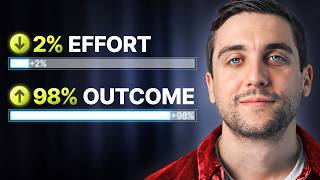
This is a YouTube video titled "The Cost Of Inaction: Why Doing Nothing Is Expensive!" containing a monologue or talk discussing the philosophical and practical implications of the decreasing cost of action in the information age. The speaker explores how technological advances, especially AI, lower barriers to creating and building, while also making it easier for people to rationalize inaction. The content encourages writers and creators to leverage these tools rather than fear automation. There is only one speaker, and the talk is reflective and motivational in nature.
In the information age, the cost of inaction is going up because the cost of action is going down. So let me explain what that means. So, first of all, it has never been easier to rationalize not doing anything, because so many of the things that we have in life today we could only dream of having 10 years ago, 20 years ago, 30 years ago. So it doesn't really matter if you make 40 grand a year or 400 grand a year. Either way, you want to watch Netflix. Either way, you can have sushi delivered to your door with Postmates, right? Either way, if you need help hanging a TV or something, you can find someone to come over and help you do the task for not very much money, right? 50 bucks, 100 bucks. So many of the things that we value in society now aren't that expensive. And also so many of the things that we all value. Not only can you have making a ton of money, but you can actually afford many of them by not making that much money. And so what that does, and as that trend continues, what that does is it makes it easier and easier to rationalize not doing anything, right? Because imagine if Netflix cost you a thousand dollars a month. Well, if that's how much it costs to have that level of entertainment, for example, you would find the energy or motivate yourself to go earn or increase your earning potential so that you could afford the thing that you really want, right? Simple example, replace Netflix with anything. The problem is that Netflix and Postmates, and so many of the things that are incredible value adds to our society and, and provide an obscene amount of value in and of themselves are so cheap, right? So do you really need to inspire yourself to take action when you already have access to pretty much every show or movie that you could possibly watch for 10, 15, $20 a month? No, it's hard. It becomes harder and harder to not take action. And so this is one of the big pro cons that I see in our technological information age right now, is that as things get easier and as the barrier to entry for so many things comes down, and as scale allows so many of these things to become cheaper and cheaper, it actually makes it easier to rationalize not working or not deploying effort, because, well, you already have Netflix and you already have Postmates, right? The second point is, is that, which is almost the opposite of the same thing, but it is the opportunity is that the cost of action is also going down. So think about the cost of effort, the cost of time, the cost of action that went into building software 30 years ago, then Think about the cost of effort and time and action for software 10 years ago, and then think about the cost of time and effort and attention and action building software today. And if AI is doing what we think it's going to do, which it probably will, that cost of action is only going to go down. It is going to become easier and easier, or said more specifically, it will require less and less effort to actually instigate some sort of action, right? So 30 years ago, it took you five years to build a piece of software. Today it takes you five hours. So the cost, what it costs you to build and do something in society continues to go down. And what's amazing about this sort of situation is that it creates a ton of problems and a ton of opportunity at the same time. And so that's why, you know, why I wanted to talk about this topic today, is especially for writers, writers who think AI is going to replace me, technology is going to replace me, there's not going to be any use for me in the world. Well, there's two big things you need to keep in mind here. One, as technology improves and as the cost of action goes down, more and more people are going to rationalize not doing anything. So in a sense, your competition goes down because more and more people go, eh, you know what? Whether I make 40 grand a year or 80 grand a year or 120 grand a year or 250 grand a year, it doesn't really matter because all I really want to do is play video games and watch Netflix and order Postmates twice a week. Not that there's anything wrong with that. If that's what you want, that's fine, but that's going to get easier and easier, right? And at the same time, because the cost of action is going down, your competition also simultaneously goes up because there are more and more opportunities to build things and it requires less and less effort to build something, right? A little bit of action goes a long way today. And I guarantee you, 10 years from now, that fraction, you know, that little bit of action is going to lead to an even bigger outcome, right? So it is both the problem and the opportunity. And so if you're sitting there going, well, as a writer, I'm really afraid of xyz, you need to really internalize both the problem and the opportunity. And how do you solve this problem? Well, it's actually really simple. You solve the problem by not being the person who goes, I'm satisfied with Netflix and Postmates. That's all you have to do. The whole solution is going, you know what, I can actually build and create things today that I was unable to build 10 years ago. And actually it cost me one tenth the amount of time, effort and action. Well, then you should probably go do that. So let me give you a couple examples. So one, writing and publishing a book. How difficult was it to write and publish a book 50 years ago? Well, extremely difficult. And the amount of action that it required was very, very high. Right. Today you could theoretically write and publish an entire book in 30 days or less. Does not take that much action relative to what it took 50 years ago. Right. And now today, let's add in a little bit of AI into that. And let's also add in the rapid fire feedback loops that come with writing on social platforms. You add in some of these technological advances and you realize, wow, not only today is it so much easier to do the thing that used to be very difficult, but every single day it gets easier from here. It requires less and less action means just a little bit of action goes a long way. And so whenever I hear writers really complaining about how AI is going to take everything away and we're all going to be automated away, that is only true if you go, I'm going to stay stagnant. But if you continue to deploy effort and find new ways to deploy effort and pay attention to how is the world changing and how can I use these new tools? Well, guess what? The return that you're going to get on your little bit of action is higher today than it has ever been in human history. And I guarantee you, a year from now, the return on your action, the little bit of action that you take will be double, triple, quadruple, whatever it is today, because that is the rate at which things are accelerating. And so I just wanted to do a quick little, you know, this is one of those topics that I find myself thinking about. It's a little bit more philosophical, but I just wanted to share some of the thinking here, which is, if you sit there and think I will be automated away, you will be. But if you sit there and ask the question, well, what can't be automated? Or how can I use automation to my advantage? Well, then guess what? You won't be. And I think one of the coolest reframes is recognizing that one of the biggest benefits of all of this innovation that we're surrounded by is that your cost of action is only going to go down. It is not that hard to do a lot of the things that you see people doing today. And it's only going to get easier. So why don't you build the skill and capitalize on it? So. Just wanted to share that. I hope this reframe helps you. And don't worry about AI. It is a tool. It is not an enemy.