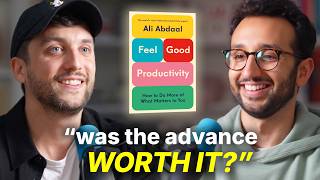
Ali Abdaal discusses the trade-offs between traditional and self-publishing: advances and distribution against royalties and control. He covers book deals, translation rights, and how each path works in practice.
How much do you care about like building to sell?
I don't want to sell. I'm. I much prefer the idea of building cash generating machines, you know, rather than.
A big sort of like 5x revenue exit or something.
Yeah, I mean if you think about okay, I sell my company for 20 million bucks, okay, you know, 50% goes to Uncle Sam, so I got 10 million, you know, and then I put that in what like a 5% account and then I, and then I make like, you know, what is that, 400k a year or something? Like that's actually a lot less than I make. So Yeah, I have 10 million bucks, but my lifestyle is actually less than what I have now. So why would I want to sell? Same argument by the way I make for book deals. Like why, why take the advance when you know the publisher is going to make or they're going to try to make 10 times that on your book? Maybe a different path is just, just self publishing the book and you, you don't get a lump sum up front, but you might generate more in royalties over a longer time horizon.
What do you think I should do for my next book?
I'm so glad you asked this. So I, I've been wanting to talk to you about this. So first of all, I'm like halfway through your book, I want to pay you compliment and I feel like this is going to come off as a backhanded compliment, but I don't mean it that way. It is way better written than I thought it was going to be. And not that I like thought you were a bad writer or anything, but very often I will read self help books and it's just like really, it's like very mindless. You know, I am not finding your book to be mindless at all. It's really cool and I like the combination of research and personal story. And I also think the categorical difference of grinding productivity versus feel good productivity, like how you set that up in the beginning. Very smart.
Thank you.
Very smart. So one of my questions was actually what was your book deal and was it a one book deal? Was it a multiple book deal?
Yeah, it was one big deal with Penguin having the right of first refusal on future deals for life.
Do you know for how long?
But it just means that if I do go tradition I have to give them the option to but I it first.
How long is that clause in effect for? Do you know? Like if you do that once and they take it, do you have to give them first right of refusal for all the books?
After that, I'm not sure I should look at the contract.
That's an important piece to know, but.
I. I think I. I can choose to self publish the next one if I wanted to.
You can?
Yeah.
Okay.
I just have to give them the option of buying it, but I don't have to accept their offer.
Oh, okay. Well, then that's fine.
It just means that if Penguin versus, I don't know, Simon and Schuster were bidding.
Oh.
Then they have the right to dibs on it.
Oh, got it. Okay, so before I give you my perspective, what do you think you should do? And like, how are you thinking about this?
Yeah. So this is, this is going to be very inside baseball. So if anyone feels like leaving the podcast at this point, by all means, please do. I am not sure. So, thinking out loud, by the way.
I feel like this, this is what I wanted to talk to you about for mine. So let's just, we'll just keep it going. Great.
Perfect. Yeah, that's fine. Um, I'm not sure. So obviously there's value in traditional publishing. Um, in my, in my case, the goal was to have an asset that was to be seen as like a legit guy rather than quit, just a YouTuber and all that, you know, all of that stuff.
I think you accomplished that big time.
Yeah. So the prestige, the New York Times list, the Sunday Times list, the fact that it's traditionally published with Penguin, blah, blah, blah.
Congrats on New York Times, by the way. I haven't, I haven't said that here, but, but congrats.
Thank you very much. So all of that stuff is done and now for future books. I know I want to write future books and I also quite like the fact, quite like to the fact that I had an editor who was nice. They had like the in house Penguin designer made the front cover. I hired an external designer to make 50 variations and we couldn't find anything better than the COVID And the COVID turns out to be really nice.
It's a great cover.
Thanks. They Penguin landed us like 36 different language translation deals. It's in bookstores. People are sending me pictures from like freaking Taiwan, from like Random Bookstore in Austin. You know, all over the world people are sending pictures of this book in different translations. And I hear that that sort of stuff doesn't really happen if you're self published unless you become like a David Goggins or something like that, which just seems unlikely. So there's part of me that's like, I like the freedom that Paul Millard has making like 400 grand already from his book sales of the Pathless Path. I like the idea of doing, like, smaller books. Like, I really want to do a book around, like, I don't want to say the title because, like, normally I'm not protective of ideas, but when it comes to book titles, I'm pretty protective of ideas. But I want to do a series of books and have. Feel like I have more freedom and that the stakes are lower. But also I like the idea that, you know, there's a big publisher behind it who then is doing the publisher machinery to get it into different languages and into different bookstores around the world, which is kind of cool.
So just to summarize, what. What do you feel like the publisher did that you wouldn't be able to do specifically?
Good point.
The translation deal.
Translation.
I would say. I would say the bulk translation deal. Because fun, fun fact, by the way, right now I am negotiating the. The Korean rights for art and business of online writing, which is self published, so you can do translation deals. It's just. They're emailing you. They're not emailing the publishing house.
A handful of people have emailed us being like, hey, do you have a Slovakian deal? And I'm like, do we have a slot? Yep, turns out we do. Sorry. That kind of thing.
So it's possible and that you can do that. But you know, doing a bulk deal, like, they go out and sell it in 36 languages. That's something that a publisher does that an individual typically cannot. Okay, so that's one. Yeah, but like, what else. What else do you feel like they.
Translation thing and the bookstores.
Okay, so do you know the data of how many copies were bought online versus in store?
That's a good point. No, but just looking at what we already have, it's like 9010Amazon versus everything else.
Okay, so.
And everything else also, like Barnes and Noble, it's unclear as to whether it was bricks and mortar or online sale. Yeah, a big chunk of those are probably online as well.
The Megatrend in books is that. It's funny because everyone, whenever they talk about book deals is like, I want to get into bookstores. But the trend line is that book spot in stores is going down and book spot online is going up. Something else that I have found a lot of people don't know is you talked about, you know.