Why Do You Get Cramps (Tetany) During Breathwork Exercise? - SOMA Breath
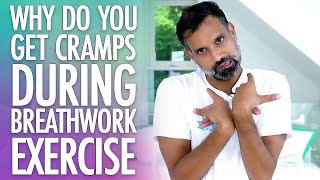
Niraj Naik explains why intense breathwork causes painful cramping: hyperventilation raises blood pH, triggering calcium loss that disrupts nerve signals. He frames it as a psycho-spiritual tool for emotional release, not a daily practice, and warns to do it under supervision with gradual progression.
Chapters
So what's the real reason why you get all this cramping in your hands? When you do an intense breathwork session, you may have done like a long rebirthing session, holotropic, or even one of our soma breath sessions. And towards the end of it, you may get all this kind of cramping feeling where your face goes all like that and can actually be quite painful. And you're told, especially in a holotropic or rebirthing where it's very, very intense, you're told to breathe through it, everything's going to be fine. And you sometimes get massaged to release that feeling. And you may be wondering, is this actually a good thing? Is this causing damage? What actually causes it in the first place? And you may also be wondering why after several sessions, it gets less and less of a problem to the point where you need to do really intense sessions for it to really kick in. Like, for me, I really rarely get it anymore because I've experienced breath work so much. So let's explain to you what actually causes it. Okay? So from a biological perspective, I'm a pharmacist, by the way, so I study biology and understand a few things about the breath and its relationship to the body. And actually, breathing is the one thing that directly influences your bloodstream in a profound way, faster than anything apart from drugs. Okay? So actually, it has the power to act like a drug itself. That's why we need to be mindful about how we're using it. Because with intense breathing, where you're hyperventilating, you're breathing very fast in and out. And I know people who do holotropic and rebirth are going to argue with me and say, oh, it's not hyperventilating. It is hyperventilating. Hyperventilating basically means breathing faster than your normal rhythm. And do you or do you not in holotropic breathwork, breathe in and out at faster rhythm than you normally do? So that is, hyperventilating means hyperventilating, breathing at a faster rate. So those of you who argue against it being hyperventilation, it is hyperventilation. And what hyperventilation does is what you're doing through the process of breathing itself is you're breathing oxygen, breathing out carbon dioxide, right? So if you're breathing in oxygen and breathing out carbon dioxide at a faster rate than you normally do, it means you're breathing out a lot of carbon dioxide a much faster rate than normal. What that does is it changes the ph of your bloodstream. You become Slightly alkaline, okay, More alkaline than you normally are. And you are already slightly alkaline, but it goes a bit more alkaline. And there is where the issue comes from. Because this triggers a state after a period of time of hyperventilating called respiratory alkalosis. People who breathe faster rates than normal, who have very fast breathing patterns, maybe they're under stress, emotional stress, panic, they trigger the same phenomenon, respiratory alkalosis, okay? And you get panicky, you get tightness of chest. You feel like intense kind of traumatic feelings like you feel sometimes. Some people feel like this moment of terror building up. Some people, it can be quite a nice sensation mixed in with pain. And it can be a very weird feeling. It can be very light headed and stuff like that. And really what's going on here is because your body is trying to maintain a perfect pH, it needs around 7.4.
Throughout the day. Because every function of your body depends on this ph. So if you go slightly alkaline, even for a few minutes, you get all freaked out, you panic, your body goes into panic, it thinks it's going to die. It's like you're invoking a near death experience. Your body thinks it's going to die because you've changed the pH, you forced the change in physical. And Stanislaw Grof, who invented holotropic breathwork, he himself states in his book, I've read his book, that it seems that the way holotropic breathing works is because you're invoking like a near death experience temporarily. And through that kind of shock to the body, to the nervous system and the psyche, profound healing can come out. Like in, like you can resolve a lot of stored emotions. You can release emotions that have been stored inside, trapped inside the body. And it should be done with an instructor. And you should have somebody minding you during this because you know it can release a lot of trauma. It can actually make you traumatize itself. So you gotta do it with caution. So any of these kind of very high intense breathing practices where you're doing a lot of fast rhythmic breathing is going to trigger respiratory alkalosis. And therefore these are not therapeutic tools for your physical health. These are more for your psycho spiritual health, okay? Your physical health is not going to be improved by these intense breathing practices if you do it every single day, okay? They should be used with caution as well when you're doing an intense breathing practice like this, okay? What you may get is a side effect that is a positive stress response. If you're Doing it with a good intention in a good space, you could create a positive stress response in the body for that time. Okay. It's like going into sauna for like 20 minutes in intense heat, getting that heat shock. This shock of respiratory alkalosis can make the body adapt and become stronger. To prevent the respiratory alkalosis kicking in again and affecting you so hard, you become better adapted at actually.
Maintaining that ph. Now this obviously needs more study and science done and research on this. However, it could explain why people who do it several times in a row don't get that tetany feeling anymore. So the tetany feeling comes from actually your body using calcium, leaching calcium in order to bring the ph back into balance. Okay. And that's, that's your body fighting against. And so you're all this cramping is actually because you're actually affecting the whole electrical nervous system of your entire body. And your body is going into these weird kind of seamless seizure cramps. And it's actually your body trying to compensate against the excess alkaline that's been built up. Now it could be that the more you do it, the more you get adapted to it. And your bay, your body, body becomes dealing with the stress of respiratory alkalosis, which itself could be a good thing to help you become more adapted at using oxygen the more efficient way and being able to mitigate the risks associated with over oxidation from hyperventilation. Because a lot of people breathe over breathe during the day when they're stressed out and that triggers all these problems. Perhaps holotropic rebirthing actually and our SOMA techniques, the longer, more intense sessions are actually helping with this. However, this is not proven. But what I do know is that this shouldn't be your normal day to day breathing because then it becomes instead of acute respiratory alkalosis, which is triggered by this fast intense breathing, it becomes chronic, chronic hyperventilation where you're always breathing a much faster rate than you should, than you need to, leads to chronic stress, oxidative stress, and a lot of other health problems. And that's why pranayama is a system designed to bring down the breath rate to calm your nervous system down so you breathe less, have less risk associated oxygen stress. So if you're doing rebirthing where it's just a one off, you're doing it part of a treatment, part of a protocol, doing it with an instructor who knows what they're doing, you're doing a safe way, it could lead to some health benefits and profound psycho spiritual benefits. It's definitely not the normal way to breathe. Hyperventilating isn't how you should breathe if you want to be healthy. But it is.
Something that we should do with caution and understand that this tetany is just your body trying to get against, go against the respiratory alkalosis. It's like a reaction to the respiratory alkalosis and it goes away. So don't worry, you're not going to kill yourself by doing this. Because you'll stop breathing before. As in, you'll stop doing the fast breathing. You'll go back to normal breathing way before any harm can be caused.
And the tetany is just a common thing that almost everyone gets when they do these intense breathings. It's actually a sign your nervous system is functioning well. Okay. However, it does seem to go away after several sessions, as it has done for me and other people. It gets. It does still there. It's still there, but it's definitely not as intense as when you first do it. So I hope this cleared up any misunderstandings or confusion or any curiosity about what actually happens when you do these intense breathing practices to your hands. Why do you get all this cramping and giving you some of the science, some of the reasons behind it, and why it's not such a big issue. However, it's definitely an indication that hyperventilation isn't what we want to do on a day to day basis for healthy habits. And in Soma Breath, we actually teach you the correct way to breathe, real healthy habits, how to form them, and we give you a whole protocol to follow you which leads you safely to the more intense breathing practices. Because according to Pranayama Yoga, there should be a progression. It shouldn't be just something you are thrown into right from the start. You need to train the nervous system. We teach you how to do that in the right precise protocol. And also we have a masterclass. You can sign up for that. You can learn how to be an instructor, follow the links and in the description and you can subscribe to our YouTube channel for more videos just like this and obviously leave some comments, interact with me, ask me questions so that I know the kind of new videos to create for you. Much love, many blessings, peace.
More from Niraj

Guided SOMA Breath Practice with David and Chantal | Breathe Together Sunday | 2026-10-11

Guided SOMA Breath Practice with Piotr Ciepiel | Breathe Together Sunday | 2026-10-04


We’ve all been told we need to lift weights, run, or do HIIT to stay fit and healthy.




Guided SOMA Breath Practice with Kiera Young | Breathe Together Sunday | 2026-09-27