World Breathing Day - Breathe For Peace
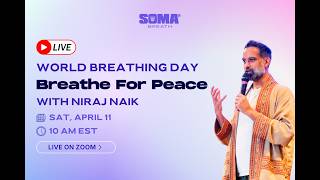
Niraj Naik leads a live session on breathwork for calm and peace, explaining how controlled breathing increases CO₂ tolerance to settle the nervous system and reduce anxiety. Participants share stories of less medication and better focus. He announces a 21-day Awakening Journey, instructor certification, and a new app feature for synchronized global breathing.
Chapters
You're fire blazing. Your energy's divine. You are amazing. I have to tell you, it's wild. What a creation. Your spirit gets me high. Gets me high. Gets me high. Gets me high. Gets me high. Gets me high, Gets me high, Gets me high, Gets me high, Gets me high, Gets me high, Gets me high, Gets me high, Gets me high, Gets me high. Gets me high, gets me high. You should know, you're a masterpiece. A living tribute to mastery. You're beautiful, it's not hard to see. I'm part of you and you're part of me. Anyone can see that you're priceless. Your flavors put the sweetest of spices. You're so powerful, so righteous. The light you shine is the brightest.
You are amazing.
A miracle of life. You're fire blazing. Your energy's divine. You are amazing. I have to tell you twice, what a creation. Your spirit gets me high, gets me high, gets me high, gets me gets me high, Gets me high, Gets me high, Gets me high, Gets me high, Gets me high, Gets me high, Gets me high, Gets me high, Gets me high, Gets me high, Gets me high, Gets me high. Oh, you get me high. I can touch the sky. You know you get me so high. You're made from the stars and you've come so far. I wanna be where you are. Such a work of art. When I'm with you, it's a celebration. You always have my appreciation. Your body, mind, and your conversation. Your spirit flies and it's so amazing. Kiss me high, kiss me high, kiss me high, kiss me high, kiss me high, kiss me high, kiss Is divine. You are amazing. I have to tell you twice, what a creation. Your spirit gets me high. You are amazing.
Welcome all Somis and soon-to-be Somies for International Breath Day. World Breath Day is today, and we are all going to get a chance to celebrate together. So a big welcome to everyone on the call. My name is Jason Mark Campbell. I'll be the host for today, and I'll get a chance to welcome the one and only, the founder, the creator behind Soma Breath for an incredible journey where we're going to get to breathe together, move a little, and truly do a celebration with the hundreds of people who are tuning in on Zoom. And if you're watching this on one of our live streaming services, know that we have live sessions that happen regularly, including our Breathe Together Sunday. And we're currently in the middle of our Be the Change campaign. So we are having some additional stuff just to bring the community together, bring a lot more breathing so we can unlock our inner pharmacy and create a positive ripple in the world. Of positivity and people that are tapping into all their energy. Now I'd love to take a moment to say, where is everyone tuning in from? If we're going to be having a World Breathing Day, we definitely want to see where are people coming in from around the world. So if you just type into chat your city, your country, where you're tuning in from, and we're going to see if our little map gets populated with all the wonderful locations. I'm seeing some people out in Australia, Indonesia, Philippines. Europe's getting a little populated all the way up to Norway. We have some France being the lowest. Oh, Spain just popped in. Maybe Portugal. I see, yeah, Portugal just arrived. We got South Africa tuning in, and I believe we have Brazil or Uruguay down there, maybe Argentina. I'm seeing some South Americas tuning in. We have some Central America. Very good. Mexico coming in. U.S., we have East Coast, West Coast, Texas, I believe. We have California, Oregon, New York. We have Illinois, Canada. I believe we got somebody tuning in from Calgary, or at least from Alberta, and I'm assuming we're going to have a few people from Toronto. Iceland just appeared, so good to see Iceland. I'm seeing Thailand is popping in, and our first Danielle coming in from India as well. And looks like we are covering a few different regions around the world. London being reinforced here. We got Someone here, Helen, coming in from the UK. We have Bahrain, first Middle East. We have Bahrain coming in. We have Michigan coming in from Betsy. Guys, this is really cool. And of course, I have my graffiti artists that have started making streaks on the screen. But don't you all worry, I know how to clear drawings as well. So we're going to not put graffiti on the beautiful map. Instead, we get to see this lovely collection of somis. Who are tuning in from around the world. Now, for those of you who are confused about the term SOMIs, type in confused in the chat just because I'm going to get you guys to work a little. We're going to host you, we're going to have an amazing session, but I'll make you work just a little bit. So if you don't know what a SOMI is, type in confused. And if you are a SOMI, well, hold on because I'm going to ask you that question once again, which is, where are my SOMIs at? Which is type in 2. If you're a somie or an instructor, type 3. That means you're a somie already. And if you are confused, don't worry, that's probably because you're new to Soma Breath. You can go ahead and type in 1 in the chat now. So if you were confused by the term somies, just type in 1, and that lets us know that you're brand new to coming on these Breathe Together sessions. Today, a very special one for International World Breathing Day. And by the end of this session, you will not be confused. Matter of fact, you might be feeling really incredible You will never answer this question the same. The 43% of you who are brand new to Soma Breath, you are then going to become a regular after you go through the session today. Now let me answer some of the questions that I know are going to come up, which is, will there be a replay? This is being live streamed, so on YouTube you can access this already. But if you are on YouTube now and you're watching this live, we encourage you to use that link to join us on the Zoom because this is where we're going to be interacting. This is where we're gonna have some incredible session. And as you're registered for the Be the Change campaign, we made sure that you all get access to this World Breathing Day as well. And so we're gonna have a replay, absolutely. The livestream is already gonna be available. If you don't follow Soma Breath on YouTube already, you should definitely check it out 'cause there's tons of live sessions that get posted there regularly. Now, the other question I might get is how long are we going for? Well, I'll tell you what the maximum length is gonna be, and it is 2 hours. So we'll be done in 2 hours for sure, but I have a feeling we're going to have a more condensed session. Niraj himself is looking to make the session be around an hour long. So for one solid hour, you'll be doing a little bit of moving, a little bit of shaking, a little bit of breathing. We don't know what's fully in store for today, and that's part of the surprise. But by being here, you're going to get a chance to experience something really magical. So now, this whole event is part of World Breathing Day. Niraj, which I'll welcome in a moment, is going to share a bit more about that. But since we're going to be very focused on getting you to experience your very own breathing with Soma Breath breathing technology. There's a few of you who might be by the end of this wondering, how do I go deeper? What is a pathway? If I'm getting these incredible results, how do I get a journey that truly goes deeper? And we'll speak about that towards the end through our 21-day awakening journey. So stay tuned towards the end, we'll make some mentions about that. And even some of you might be considering becoming an instructor. And if that's the case, again, we usually hold a little space at the end to answer any questions for those who might want to become an instructor, because as you've noticed, there's a few of them who are on the call today, and we want to get to focus on giving you an incredible experience, incredible journey. And if you have questions about the instructor program, we'll make sure to answer that all towards the end. Does that sound good? If so, use the react button right here on Zoom. There's a little heart, and if you slap on that heart, you can go and choose the kind of reactions you want to make. And while we're hosting sessions, our instructors love it when you get to send these hearts, send these thumbs up. It keeps us encouraged and very well supported. So always fun for you to use that. And I think I'm done blabbing. I think we should take a moment to introduce very powerfully the host, or the instructor, the one and only Niraj Naik, who is the founder of Soma Breath. Went through an incredible journey of healing himself through the breath and now is on a mission to bring healing to the world, peace to world by realizing that when we start regulating our own nervous system, when we start using tools like the breath, when we get to all breathe together, we get to connect together. And given that we have such a worldly group that is joining today, we're bringing the world together. And when you have the right energy, you get to tap into the states you need to go into to be able to do the things that are going to incredibly shift the world. Well, we're going to teach you how to do that, and you're going to do it with Soma Breath. So without further ado, let's give a warm welcome for Niraj Naik, who's going to be guiding the session today. Niraj, the floor is yours.
World Breathing Day is now a national holiday. It must be celebrated by everyone, because when we breathe together, we unite and can make peace on Earth. There we go, it's the State of the World address coming from my presidential studio right now in Ibiza. I've just been playing around with some things, you can see, and You know, it's good to start with a bit of a laugh. Nice. If only all of our presidents were like that, right? You want to see my American impression? I'm just going to give you the American rendition just for a laugh. It's pretty good as well. Watch this. You know, if only, if only All our presidents were like this guy.
I am pleased to announce that World Breathing Day will now be a national holiday. When we breathe together, we unite, and together we can make peace on Earth.
Yeah, let's do it! Yes, yes. Who, who Who wishes that more of us, more of us in the world breathe together at the same time? Hey, who's, um, come on these events before and felt like a different person after doing a session and wishes that everybody did this together? Rhetorical question, just like a politician. Exactly right. Like, so what we're going to be doing, we actually have got some really cool features that are going to be coming out soon on the brand new updated Soma Breath app where we have these coherence rooms where it's on all the time. You can join anytime and it's a perfect 5-second in, 5-second exhale rhythmic breath to cool music that you can choose. You can choose which music you want, and it will tell you how many people are breathing at the same time as you around the world on the app. So that's coming very soon, a, um, a Global Coherence Room. It's going to be amazing. I'm going to love it. You're going to all love it. So, um A lot of cool exciting features coming, Summer Breath, a lot of updates. Oh, someone says I like the new one that was added with the music Limitless. Yeah, it's very cool. It's the one that's produced with Thimba and it's a real, real good track. The production is amazing. So go and check out all the new content on the Summer Breath app if you haven't already. There's a whole library of different breathing tracks and loads of amazing classes from our top instructors who are so cool and do such powerful sessions on there. And I'm so glad to see how it's turned into like a Soma, um, like kind of dojo, because we have weekly classes and it's so good to see that these classes are getting quite busy, right? The numbers are growing where there's a lot of people around the world tuning in and having their lives completely changed by our instructors, which is like, for me, like the best, the best feeling ever. All right, so there's going to be some of you on this call who, um, because there's usually two, two or three different types of people on this call. The ones who are just here because they want to just get involved and really connect, breathe, and, and really go deep. And then there's the others who also have a calling to share this work with the world, and maybe you're looking to become solar breath instructors, right? And then there's a third type, which is both. Like, you, you're here because you really want to go deep for yourself, but you also want to share. So stay back at the end of this. We're going to be going for about an hour from now, um, for those of you who want to have a discussion about our various paths you can go down, uh, to take this work into the world, because we need to make this world a better place. So we need more people like yourselves to jump on. Okay, so let's move into the, um, the session for today. So, so today is World Breathing Day. Yes, um, there's another one of those holidays, um, well, it's not actually a holiday, it's a Saturday, so technically is. They chose the 11th, which is my magic number, which is cool. I don't know who came up with this date. World Breathing Day, but fair play to them. I think every day should be a World Breathing Day, you know, really. But, um, the point of this is really about unity, right? And, and one thing we do all have in common, let's be real here, the one thing we all have in common is we all breathe, right? I'm yet to meet a human being who doesn't breathe. Breath, okay, and is still conscious. Have you ever met anyone like that? I've never met anyone who's quite like that yet. I mean, there are some people I know who can hold their breath for remarkably long periods of time, and sometimes when I'm doing these breath holds, I also wonder, like, do I ever need to breathe again? And you get into such a profound bliss state, it's just incredible, just with holding your breath, which is you're about to do in a minute. And yeah, sometimes you wonder, like, do we, do we even need to breathe, right? And here's the thing. So yogis figured out actually that our age, believe it or not, is connected to your breath. So you are born with a certain number of breaths in a lifetime. The reason why is because we have internal engines, car engines, called mitochondria. And this mitochondria turns oxygen and glucose into water, CO2, and life force energy, ATP, prana, chi. So this is what drives all of the functions of life. Now, just like your car engine, which can break down with wear and tear from stress of oxygen burning right, fuel to make combustion. Okay. Eventually that engine wears out and breaks down. Okay. Unless you service it often, you can make it last a bit longer. Or if you're some kind of alien Japanese technology, you can go significantly longer than you'd ever expect, but it still will break down eventually. Now, human beings are the same way. We have wear and tear because of oxidative stress. Okay, have you seen an apple? If you leave out for too long, it goes brown, it rusts. That's also oxidative stress. So we are prone to oxidation of our skin. That's why we get a bit wrinkly and age, um, from oxidation from our skin appearance. But also internally, we internally rust just like metal, and we break down just like our engines. and this is because the process of making energy is slightly inefficient and it causes wear and tear. So what the yogis figured out was that if we can hack our mitochondria to be more efficient using oxygen, and if we can have more healthy mitochondria, we can extend our lives. And the net result of that will mean we need to breathe less, not more. Because a lot of breathing causes more stress, more wear and tear. The less we need to push the gas down to go the same distance, the more efficient we are, the longer we're going to live. So actually, you know, this World Breathing Day, you could also discuss it in context of how do we breathe less? As a planet. Okay, because here's another thing: the less we need to breathe, the more calm we are inside, the more blood flow we have going to our brain. Okay, because if we overbreathe, if we hyperventilate, which is what we do when we're all stressed out, okay, when we're nervous, we're anxious, or we've eaten too much food, or we're not exercising, we're unfit, right? There's many different causes of this chronic hyperventilation. We actually let go of CO2. CO2 is the gas that calms us down. It's not oxygen, it's CO2, the toxic supposed waste gas that we need to get rid of at all costs. No, this is the gas that actually makes us more relaxed, more calm, and actually is what allows us to get more oxygen to our brain. Where it's needed. So people who huff and puff a lot all day long, they have less oxygen going to the brain, they have less blood supply going to the rational side of the mind, and they become irrational. Okay, own up. Who's become irrational in a panic when they're nervous? When are the worst times you've ever made decisions? The times we made the worst decisions? It's probably when you're stressed out, nervous, anxious, right? Because our breath is hyperventilating and we're letting go of oxygen— oh, sorry, of CO2— and we're getting less oxygen to our brain. That's called chronic mild hyperventilation, and this is the problem that the world has on scale, the problem of chronic overbreathing. Stress breathing, hyperventilation. So with Soma Breath, you can train your breathing to be more calm, more relaxed, more in the flow, more aligned with your metabolic needs, so you produce energy efficiently. All right, and then you're— you become naturally more calm, you become more relaxed, Because calm breath, calm mind. Busy, erratic mind, erratic breath. The breath is a mirror of the mind. So in Soma Breath, we teach you all of these things. We teach you how to control the breath, how to regulate it, how to slow it down, how to make yourself more calm and more at peace. And when we're at peace, we make better decisions. We're better people to be around with. We're more kind and compassionate. We generally are better people to hang out with. With, right? Am I right? Am I right here? That when we are more calm and we're feeling good, we're in a happy state, we are much better people to hang out with, right? So, so you see what I'm doing here? I'm reverse engineering what we need to create peace on Earth. What it really begins with is ourselves, the inside. And the cool thing is, is that we might not be able to control everything going on the outside, but we can control is how we react to it on the inside. And that's the breath, right? That's the remote control for your mind, body, and spirit. So that's what I'm going to show you how to take control over. All right. So what we're going to start with, okay, is what we're going to literally do is do like a typical morning routine. I believe if you do this every morning, right, you're going to crush it in your life and you're going to have an amazing day because you're vibing high, right? How high you vibe will affect all your decisions and interactions in the day. So if you want great results in your life, you want to feel great. So the morning routine is super important to do that. So if you could just go away today with a morning routine Right? Would that be useful? If you go away with a little morning routine you can take away with you and start practicing from even today, it might be your morning today, from tomorrow, every day. Would that be cool? Would that be useful? Let me know in the comments. Yes, of course. Yes, yes. Okay, so let's begin. With the beginning. What we, um, start the day with, okay, is most of us probably lying in bed under our covers, right? So let's look at that, that first, the position that you sleep in. So let's start right from like actually before you go to even bed, which is the night before, the position you go to sleep in. Who here, own up, sleeps on their back? Okay, tell you a funny story. So the other night I was coming home and I came in, it was like late, my wife had already gone to bed. And I was going into our room and I heard this, like, this horrible noise, like, scary. And I was like, oh my God, what's going on? Like, I've never heard this voice before, this sound before. So I go towards the bed and there's this light still shining from mobile phone into my wife's face, who had a face mask on because she was doing something with her face. And she had fallen asleep like this and making the most scary sound ever. And I completely freaked out. I thought this was some possessed woman who was my— before that, my wife. And I thought this was like that movie Poltergeist or something, or Exorcist. It was, it was really scary, and I freaked out. And then she completely freaked out, and then she went a bit crazy because I woke her up. But what that showed to me was what I've been telling everybody, right? That is, if you sleep on your back, you are really prone to snoring, right? And making horrible gargling sounds with your throat. Okay, just like my wife was. So who here has a problem with snoring? Anyone? Okay, you don't need to own up to that. You don't need to own up to that. Not everyone wants to own up to, to, to being loud snorers, right? My wife doesn't snore. She never does that. She never sleeps like that. It's so unusual for us to do that, but she just fell asleep doing this face mask thing. So one of the easiest ways to cure snoring and to have a much better night's sleep is to go to sleep on your side, right? And there's a right side and a wrong side. And the right side is the right side. Okay, so if you sleep on your right side, you turn on the right side of the brain. Okay, you'll notice that the left nostril becomes easier to breathe out of because you activate the right hemisphere. And when you sleep on that side, ping, your parasympathetic nervous system switches on, and you're going to drift off into a much deeper sleep. If you sleep on your left side, you go into more of a sympathetic state, and you don't want to do that before you go to bed. It's also not great for digestion. So sleep on your right brain from now on. So that's sleeping. Don't sleep on your back. There's only some people who need to sleep on their back because of some injury or some other condition, but generally it's better to sleep on your side, right? So try that, and it really helps to especially stop snoring. And if you're a snorer, try it for sure, okay? It really helps. And like, often, like, if you know somebody snores, look at position they're in. They're usually up, like, on their back because the throat goes back like this, and you can just push them to one side and the snoring usually stops. All right, so there you go. That's how you want to go to sleep. Now, in the morning when you wake up, here's a trick you can use. When you wake up, turn to your left side, okay? Just sleep on your left side, right? And what you want to do is wait till your right nostril becomes more active. So just lie there for a bit and just meditate on the sound the sensation of the air. It's called the svara moving up and down through your nostrils. And when it feels clear on your right side, get out of bed on your right foot. Boom, you'll be more alert than if you drank a cup of coffee, guaranteed, because you've turned on your sympathetic nervous system. So that's how you're going to get out of bed. But then what you want to do, okay, is actually sit down again. And you can stay in your bed if you want, you can sit down on a chair, and you want to just spend a few moments just to do some breath awareness. Just breathing in and out, observing your breath. No control, don't control your breath, just observe the breathing. So you breathe in and out. Do this for like a minute, that's all you need. Then what we're going to do is the morning breath hold time test. So to do the morning breath-hold time test, it's very easy and we can all do it right now. And I'm gonna— well, Jason, maybe you want to get a stopwatch ready. What we're going to all do together is to measure our morning breath-hold time. You normally do this in the morning, first 10 minutes you wake up. Okay, so rest well, Jason. It sure was a blast. Okay, so after 3, 2, 1, we're going to do— actually, let me just tell you how to do it first. Breathe in through your nose, breathe out through your nose, pinch your nose, and hold your breath until your maximum effort. Okay, do it to your maximum effort. I found an easier way to work out your morning breath hold time, so just hold it to your maximum effort. Okay, and then tell me what that score is, or just note that score down. On here. So let's start. 3, 2, 1. Normal inhale, normal exhale, hold. Great. Doing great. Nice, got some people over a minute. Fantastic. Now you've noted that score. Okay, I'm going to hurry up a little bit because we've got a lot to go through. What you're going to do is minus 25% off it. So if you were 60 seconds, 25%, which is a quarter, take off a quarter. So that'll be like 45 seconds. Okay, so minus 25%. That's your actual morning breath hold time. Okay, so take note of that score. Okay, now these are the ranges. Okay, so if you're between 20 and 40 seconds, you are average. But we don't want to be average, right? We want to be above average. Okay. So above average is 40 seconds and above. 40 seconds and above is the aim. That's the goal, and that's what we are trying to get you to do. So, breath. But let me just talk to you about what bad score is. So 0 to 10 seconds is usually people who are physically unfit, okay, or they have a serious illness. Like, between 0 and 5 seconds is people on their deathbed. They can hardly breathe, hold their breath at all. Right? Often it's like 0 seconds, like they simply can't hold their breath. And 10 to 20 seconds is usually a sign of low fitness. Could be anxious, could be very worried, frantic mind. But also it can often come with symptoms like chronic congestion, sinus problems, high blood pressure. And you may also have some kind of disease you're trying to fight. Now, when we get to like 20 seconds to 30 seconds, usually the symptoms go away, like congestion, brain fogginess, fatigue, headaches, migraines. All of that starts to fade when you get 20 to 30 seconds, or they don't come as often, right? Even your resilience to stress is improved. You won't get ill as often, right? When you start getting over 40 seconds, All of those symptoms tend to go away, right? So if you've had like problems with getting sleep at night, that's usually gone. If you have lots of nasal congestion, sinus problems, usually gone. If you suffer from headaches, migraines, chronic pain, tension, usually fades away. And if you have like sleep problems, usually you'll be able to sleep much easier. So blood pressure problems usually go away as well, and anxiety and worry and tension All that stuff fades away. 40 seconds, especially 60 seconds and above. But you can get to that. You can get to that. So tell me, who here has done Soma Breath regularly and has followed our morning breath hold time guidance and has noticed a difference between going from low score to over 40 seconds? Who here can like vouch for what I'm talking about? Anyone? Yep, Darren. Yep, Ro says lots of you. There we go. See, Brittany says when I started back in August, I was 10 seconds. So how are you now, Brittany? What's the difference in your symptoms? Where's Brittany? Is she online? Maybe she can pull her up. That's a great example of—
Good morning, Niraj.
Hey.
So when I started and I found you guys back in— um, hold on, let me turn my camera back on. Sorry, you guys.
Yeah.
Good morning. I'm still in my robe. Uh, great.
Yeah.
So I found Soma back in August and then I actually became a Soma instructor and went to Ibiza October and November. And when I was in Ibiza, I found I was only at like maybe still 12 seconds and I have been practicing religiously and I this morning got to 28 seconds. So keep practicing. I mean, I still feel like I probably could have done longer. But I didn't want to push myself past that threshold.
So, okay. And how have— what have you noticed in yourself? Has that changed?
So I am someone who typically has— let me close my window so you guys don't hear my chickens. Um, I am someone who typically lives with high anxiety and depression. I also have a traumatic brain injury, and so there's a lot of things that I can become overstimulated. Breathwork has completely changed the way that my body responds to stress the way that, um, when things happen, I kind of almost just sit back for a moment and I find myself doing a full round of breath before I respond. It has allowed me to— sorry, it's all right.
Hey, okay, Brittany, that's great. Brittany, I think, I think, I think we, um, all got your message there. It's great. So that's just proof right there, right? Somebody who's at 12 seconds but now has seen the difference, right? And there's a lot of people making comments here, um, saying that they also have felt a change, right? So I'm not making stuff up here. I know it sounds too simple. How do— let's— by improving our breath hold time, we get better and healthier and happier? Like, what? What? Why? Okay, so we teach all of this stuff, the science, the why, all in great depth, okay? But in a nutshell, it's all about your ability to get oxygen to your body tissue cells, improving your mitochondrial health, and protecting against oxidative stress. This is all measured by your ability to hold your breath. The longer you can hold your breath, the better you are at using oxygen in a healthy way, right? So that's the goal of some of that. That's ultimately what we're doing. So So that's your check-in, right? It's better than any fitness tracker or a Ring or whatever those gadgets you are that you got that you spend hundreds on. This is free of charge, doesn't cost anything, and gives you way accurate, more accurate readings. Okay, so use that. Now next, what we do is we need to move a bit. Okay, we've been in bed for a while. Okay, so we need to get the body moving, circulating. Before we do any other kind of exercise. So what we're going to do now is the best form of exercise there is, okay, which is a breathwave. Okay, this is the best one. So I'm going to put on some music and we're just going to shake and move and dance for one track just to get really in the state. Okay. So I played this track, um, and it went down pretty well. I'm gonna play again. Oops, it's the wrong thing. Okay, so get into a comfortable position, put your feet hip-width apart, and I'm just going to get the music queued up. Let's do it. Okay. Hip width apart. Now let's just shake. So when you're breathing out, you let go of the, just releasing any of the old energy that doesn't serve you. Just shake it out. Just shake, shake, shake first. Just to release any of that stagnant energy. It's an amazing way to release any tension, especially old energy from the day before that might be holding you back. So just shake it off. That's right, don't be shy to release with some sound.
Oh, it's bouncing. Close. So inside the— now we can start just moving. Woo! We start dancing. Yeah. Woo! Really stretch it out. Move it.
All right, okay, so coming back down, taking all that beautiful life force energy down with you. Great. So that's how we start before we prepare to get into the breathwork experience. So how's everyone feeling? Who's feeling a bit more loose, a bit more up, a bit more happy? Epic, brilliant, fantastic, so cool. All right, so now what we move into is doing some soma breath. So here is where you can use to also bring in other exercises that you might be doing. So let's say you do yoga, you can bring your yoga routine. If you do, um, any kind of weights or physical fitness, you can be bringing that in. Maybe you do this whole routine down the gym. All right, that's what I, I was doing every day in Bali. So, you know, you can find like ways to enhance this routine, but if you just did what I'm about to do with you today, which is just a couple of rounds of the breath, okay, so on breath, delivering a dose of intermittent hypoxia, okay, you're going to dramatically improve your breath hold time. And your inner world is going to improve because we're delivering a dose of this active ingredient which creates magic inside. So when you take oxygen away from the body for a bit and give it back, take it away from a bit, give it back, right, the body adapts to having less oxygen. So it thinks it's running out of oxygen, and so it becomes stronger, more adapted to using the oxygen it's already got. Okay? And what it will then do is it will increase the amount of blood cells you have. It will increase your blood vessels in your heart, into your brain. You get a better blood flow, blood circulation around your body because your body is trying to help you when you've got a deficiency of oxygen. All right, it's an adaptive change. You're tricking the body by holding your breath in this specific way into thinking it's running out of oxygen. It's crazy, but it's simple and it works, all right, because it's so simple. So people don't believe it sometimes that this can be possible, but we've seen so much incredible change in people who do this regularly, who, who get 2 rounds is all you need, like, to start with. There's 2 rounds of soma breath with the breath holds is often enough. That's all you need to get the active ingredient, the active dose you need to get the benefits you're looking for, right? So it's not a lot, okay? It's literally— we're going to do this now together. In 10 minutes. You're going to get 2 doses of it, okay? And we have loads of different Soothe Breath sessions on the app, okay? The app is filled with phenomenal classes and sessions from our instructors and myself. So there's something really there for all of you, right, to get, to get really engaged with. And we also teach a lot of other techniques, um, as well. So if you want to go deeper on, um, different breathing techniques, we also have lots of different other breathing techniques on the app for you to choose from as well. All right, which is, which is awesome. So you can enhance this routine in so many different ways, but what we're going to do right now is just give you a dose of of, uh, Sauer breath. Okay, I'm going to give you 2 doses of intermittent hypoxia for you to start getting some amazing benefits. Okay, for World Breathing Day. Okay, and I'll show you how quickly you can get there with just this one session. And what we also have is a course which I'm going to talk to you about after this called the 21-Day Awakening Journey. That gives you a whole protocol prescription that takes you to, um, doing 6 rounds a day for a week, and it prepares you to get there, right? And then over 21 days, what they found in these clinics and labs, when you do these, um, reduced breathing techniques where you're creating intermittent hypoxia, right, over 21 days, we We wake up stem cells, we heal trauma wounds in the brain, we enhance healing in the body, we reduce inflammation, we increase your cardiovascular health, we create coronal collaterals. So if you have a weak heart, if you've got heart blockages, increases the blood flow in your heart. So prevents like problems like atherosclerosis and blocks, which a lot of people suffer from these days, right? Is plaques and blocks. In the heart, causing heart attacks. But it also enhances the function of your brain. You get better blood flow to your brain, which means you can think better. You can talk more with more conviction. You articulate better. Your mind is more clear. You function at a better rate. All right. So it enhances the overall health of the entire being. And this was a secret technique from India that's been preserved for many years. That I've been very blessed to be taught by a Himalayan yogi who's a medical doctor. And in his ashram up in India, Dr. Prakash Marsh, I've seen him transform people with these techniques where he's documented it, evidence-based. And I learned this, and that's what I brought to the world through Soma Breath to, um, to help people with this incredible medicine we have right underneath our nose. We've had it all this time. Nobody showed you how to use it. And that's why Sarah Beth has grown and gone. We've gone, gone for 8 years, right? We must be doing something right. We've seen so many transformations. We've had Cambridge University study us, which is amazing. Okay, so we're just onwards and upwards with the whole community. So let me teach you how you do this technique. It's super easy. Okay, you're just going to sit down. And have a back straight. So you breathe in through your nose first and you let go, and this straightens your posture. So now you've got a nice straight back, straight posture, okay? And then what you're going to do is follow along these simple instructions. When I say in, you breathe in through your nose. When I say out, you breathe out through your mouth. And you hear me say in 2, out 2, 3, 4. So you basically breathe in that rhythm. In 2, out 2, 3, 4. No pause between inhale and exhale. Keep a continuous rhythm until you get told to breathe in. Breathe out. Hold your breath after 4 exhales and completely relax. This is the bit that's important. You're going to do this sitting up. You're going to let your chin drop to your chest. This creates a neck lock, an energy lock. You hold your breath now until your first big urge to breathe, then you override that first urge. Now you might get some sensations of you're feeling like you're suffocating, so if you just do like this, if you move your windpipe a bit Okay, that goes away. And if you just— every time you get like a contraction of your diaphragm, which will happen when you're holding your breath that long, if you just go with the twitch, if you just move with the twitch, it allows you to hold your breath another 10, even 20 seconds longer. Okay, swallow if you need to. Then when you cannot hold any longer, breathe in, hold your breath in. And then you're going to hold your breath until instructed, or until the first urge to breathe, and you release with a hum.
Hum.
And then that completes the circuit. So we're going to do 2 rounds of that, and you're going to be encouraged to hold your breath for 90 seconds on the exhale and almost a minute on the inhale. It's all guided, don't worry. And if you find it's too uncomfortable, just go back to normal breathing. Don't do this if you've just had a heart attack. If you have serious lung complications, that means you can't breathe. If you are pregnant or menstruating, be, be careful with doing this. Otherwise, you can all do this, okay? There's no intense breathing with this at all. All right, are we ready? Do this sitting up. You want to do this sitting up, okay? It's only 10 minutes, then you can use the energy locks, okay? Let's go. So get comfortable. After 3, 2, 1, let's begin. Welcome to Soma Breath Intermittent Hypoxic Training Sequence, where you're going to be breathing in a 2-in, 4-out rhythm with a breath retention phase. Breathing in through your nose, out through your mouth. That's right. So now sit comfortably with an upright posture, relaxed. When you hear me say in, breathe in, and when you hear me say out, breathe out. The smooth and consistent rhythm to the rhythm and groove of the music. That's right. Let's begin. 3, 2, 1, exhale. And in, breathing in, breathing out. The smooth, consistent inhale and exhale. Breathing in through your diaphragm. Into your chest and letting go on every exhale. This rhythm should be effortless, relaxed, with no force. Deepen your breath slightly, taking Taking longer, deeper breaths, staying in that rhythm. Deepen your breath even more. Begin to breathe deep, full breaths in that same consistent rhythm. Just 3 breaths left before the breath retention phase. 2 breaths left. One last breath. Now take a deep breath in. In and breathe all the air out, holding your breath after a full exhalation, relaxing the shoulders, your chest. Let your chin drop towards your chest and relax every muscle in your body. That's right. You have 60 seconds remaining on this breath hold. If you need to take a breath at any time, take a little sip in through your nose and breathe out and hold your breath. And you can repeat this as many times as you need to until you get the command to inhale. That's right, stay calm, stay relaxed. You are perfectly safe. Allow your muscles of your body body to be relaxed and at ease. Let your shoulders drop, soften your jaw, your face becoming very relaxed. You have 20 seconds remaining. You're doing great. See if you can hold your breath slightly beyond the comfort zone, going beyond what you thought was possible. Overriding the fear of holding your breath rubs off on other areas of your life where you may be having fear that holds you back. 5, 4, 3, 2, 1. Now take a deep breath all the way in and hold your breath after full inhalation, pulling up the muscles around your pelvic floor, your sphincter up, contracting up. You send this energy up like a spiral of light in into your midbrain, illuminating you to the light of this blissful awakening. And focus now on maintaining the state of stillness by holding your breath for as long as you comfortably can. Now you have 15 seconds remaining of this breath retention phase. Your neck, muscles in your chest, your diaphragm, your face. Just stay calm and at ease and enjoy that stillness. 5, 4, 3, 2, 1. Now let go with a hum. Hum. Now coming back to normal breathing, observing how you feel, noticing any changes. 3, 2, 1, exhale. And in 2 Out.
2, 3, 4.
Breathing in. Breathing out.
3.
The smooth, consistent inhale and exhale.
2, out. 2, 3, 4. In. 2, out. 2, 3, 4. In. 2, out. 2, 3, 4. In, 2. Out, 2, 3, 4.
In, 2.
Out, 2, 3, 4. In, 2. Out, 2, 3, 4. In, 2. Out, 2, 3, 4. 2, out, 2, 3, 4.
In, 2, out, 2, 3, 4. Deepen your breath out even more. Begin to breathe deep, full breaths in that same consistent rhythm.
2, out, 2, 3, 4. In, 2, out, 2, 3, 4. In, 2, out, 2, 3, 4. In, 2, out, 2, 3.
Just 3 breaths left before the breath retention phase. 2 breaths left. One last breath. Now take a deep breath in and breathe all the air out, holding your breath after a full exhalation, relaxing your shoulders, your chest. Let your chin drop towards your chest. And relax every muscle in your body. That's right, you have 60 seconds remaining on this breath hold. If you need to take a breath at any time, take a little sip in through your nose and breathe out and hold your breath. And you can repeat this as many times as you need to until you get the command to inhale. That's right, stay calm, stay relaxed. You are perfectly safe. Allow your muscles of your body to be relaxed and at ease. Let your shoulders drop, soften your jaw, your face becoming very relaxed. You have 20 seconds remaining. You're doing great. See if you can hold your breath slightly beyond the comfort zone, going beyond what you thought was possible. Overriding the fear of holding your breath rubs off on other areas of your life where you may be having fear that holds you back. 5, 4, 3, 2, 1. Now take a deep breath all the way in and hold your breath after full inhalation. Pulling up the muscles around your pelvic floor, your sphincter, up, contracting up. You send this energy up like a spiral of light into your midbrain, illuminating you to the light of this blissful awakening. And focus now on maintaining the state of stillness by holding your breath for as long as you comfortably can. Now you have 15 seconds remaining of this breath retention phase. Relax muscles in your chest, your diaphragm, your face. Just stay calm and at ease and enjoy that stillness. 5, 4, 3, 2, 1. Now let go with a hum. Now coming back to normal breathing, becoming aware of the sensations in your body. Noticing any changes, reflecting on this journey and any insights, inspiration, or ideas you've received in this moment. Become aware of them. As they come from a higher place. And as we come to the end of this experience today, know that you're now connected to the light of a higher power. You can tune into this light at any moment, become a channel, and breathe in that light to every cell of your being. That's right. Much love and positive energy for your day ahead. Peace. Okay, so slowly coming back round, just checking in with how you all feel. Who was able to hold their breath the for 90 seconds on the exhale. Relaxed, peaceful. Second time, yes. Okay, there you go. So you can get used to this, okay? At first you might find it difficult, but then you get used to it, and the guidance really helps to encourage you to stay there, right? Beautiful. So I'm sure most of you now feel a bit of a shift inside, right? So this is your morning routine now. You've just done that little sequence. Now you can, again, you can add whatever exercise you want to that, but I will have at least an hour of doing some kind of exercise like this before I have any food, like, like, or smoothies or anything like that. And one thing you can also do if you want to be a proper yogi is before you do any of your practices, try and clear your bowels, like evacuate bowels. There's a few tricks and techniques for that as well, but that's beyond this call. But this will help you stay, um, much more, um, prepared to be able to go deep in breath sessions. So if you're like all feeling fatigued and full up, um, it's a bit hard to, to do these breath holds. So that's why yogis would generally in the mornings do a cleanse, right? They'll clear their bowels first, then they'll go into their morning practice, right? You can still do your breath hold time, but then when you do your morning practice, you can have a little bit of a break, do your routine, clear your bowels and then go into it. You can drink, you know, you can have a coffee, you can do your thing, you know, to, to do your, um, to go to the toilet if you need to, and then, um, you're more prepared. Okay, but that's it. That's your— that's a little morning routine for you. And you can repeat the breath work that we just did, um, another time in that day. But you can also use our app. So the Soothe Breath app has tons of these tracks. It has loads of amazing tracks and journeys that deliver a dose of intermittent hypoxia, but also layer on neurosomatic programming, helping you to set an intention for the start of the day, helping you manifest, how to create magic. Okay, so the app is amazing. Now that track, what we just did, is the first week of the 21-day awakening journey. So if you want to go really deep and do a whole protocol based on what we just did this morning, then do the 21 Day Awakened Journey. It's, it's what we use to, to really form a solar breath lifestyle and in 21 days to be completely transformed. Okay, so check that out as well. There's information of that Jason just posted in the comments. Maybe we— I don't know if we can use the QR code, if it's easier for people to just use the QR code to get these links Um, but yeah, so anyone got any questions about anything? I'm gonna take a few questions, but we're gonna try and finish a little bit early today, um, because I know you're all busy and I'm busy and we've got, um, things to be getting on with. So I'm actually busy finishing our app right now, revamping the Solar Breath app. Um, so if anyone has any questions, I'm going to take a few questions. And obviously I'm going to stay back as well for 10 minutes for anyone at the end who wants to learn about being a certain breath instructor. Fantastic. Okay, let's see, there's some questions here. I really can't hold my breath that long and feel panicky during and disappointed now. So look, that's why it helps to have a coach, okay? I recommend hire one of the instructors or the coaches Maybe one of the instructors can reach out to you right now. You need a coach, that's all you need. They will, they will encourage you and make sure you do the technique correctly and you progressively improve. Okay, um, so there you go, a bunch of good feedback there for you.
Um, taking a moment here just to share that if you go to find.somabreath.com, you can actually look at all of our instructors, and there's a lot of classes being listed there. I'll also put a link in to the chat.
Great. So D. Harmon says, that was great. I just completed the 21-Day Awakening with Nigel, was so knowledgeable, like a doctor. Yeah, he is. He's one of our best, uh, instructors, or transformational coaches. And I want to become an instructor as I feel I could answer a lot more questions for clients. Yes, it'll really help you. Yes, um, that's what we train you. We train you to be super super comprehensively, um, versed in, in all of these transformational modalities. You're learning it from a scientific, biological, and physiological perspective. As I'm a pharmacist, I made sure the training is proper. It's not some kind of wishy-washy thing that some AI made in like 5 minutes. No, this is serious stuff, right? I've been doing this for many years, and so I, I've produced it like a degree. That's what it's like, but in a, in a broken-down way, so it's not like overwhelming. Anyone can do this. You don't have to be, uh, you know, some kind of A-grade biology student to understand how to do this. Anyone can do this, okay? It's designed for everybody. So I work with people with trauma and want to train as a facilitator. Is this method suitable? Yes, it's very suitable. Um, in fact, we're a trauma-informed training, okay? Christine, who's on the call today, she added the training for trauma-informed, uh, work in Soul Breath. So it's perfectly suitable. In fact, it's very powerful and healing for you, um, if you have any kind of trauma. Our methodology is, is just incredible for that, for transforming. You see, trauma leaves a physical wound in the brain. It's a scar in the brain tissue that they've shown on the microscopes. And what they found is intermittent hypoxia, if you've done it over 21 days like we show you, it heals that scar in the brain, which is phenomenal. That's why people who may have trauma, who have never been able to heal it from other types of practices, finally make the shift with 21 Days, especially people with PTSD. It makes a huge impact, people with PTSD. I'm new to this, but it's been great so far. I was wondering, in one of your last sessions, instructor mentioned that you shouldn't do it if you have tinnitus. Tinnitus can be exacerbated by the more more fast breathing techniques. So that's our more intense summer breath practices. They're— you're fine. They're usually longer, and we don't do them so often online. Um, but what we just did today is fine. Just is when you do very heavy breathing and then hold your breath, like, or mouth breathing and then holding your breath, it usually triggers it. We don't do mouth breathing really in summer breath. Only in the more advanced practices. Okay, amazing. So just trying to get some more of your questions. If anyone wants to speak live— okay, Julia. Julia Menard, go for it. There we go.
Pleased to meet you. Um, yeah, I, I know that you've always been passionate about peace. You sign off your meditations with peace, and I saw you in Dubai And I saw how affected that was for you in every which way, somatically and everything. And I'm just wondering, just your connection with peace, because I know you have a deep one. And for me, I'm a bit of a subversive. I want to see more peacemakers in the world. So I'd love to hear you speak to how Soma helps us become more peace-promoting.
I love it. That's a great question. So Um, so I, I'm very practical, right? I, I'm very pragmatic. I like to make things actionable because I think when people take action and do things, that's when we make an impact, a change. And so, so peace is something people need to understand the word, what it means first, all right, before we can take action to acquire it. So I I learned this one very profound thing from when I was in India. I spoke to this amazing yogi who was there, very simple person, and he said like that you, in yogic practice, this aspiration is to bring peace to mind, tranquility to mind. It's chiti vritti nirodha. Right? That's actually the goal of yoga, is to bring peace to mind. So why, why do we want to do that? Well, yoga was actually used in the olden days by Ayurvedic doctors for a form of psychotherapy for people who are going crazy, to bring them back into calmness, right, and to more into their human self. So it was used in that way, and it is a method for acquiring that, but on a more spiritual level. So a lot of people talk about falling in love and following your love and going after things you love. The problem with the word love— love, if you think of all the things we fall in love with, they often are things that if they get taken away from us, it can be quite Devastating. Um, you know, you can fall in love with things and then, um, you know, an accident happens, you can't do that thing anymore, for example. And then people just go into clinical depression, right? Or you're madly in love with someone and then they run off with somebody else, or even worse, they die, right? And people completely can't handle it, right? So, so another reason for the aspiration of peace is that if you if you can strive towards peace of mind and what that actually means and what that entails— that's actually what the process of Tantra is actually about, is breaking all your attachments to things, because that's the only way to true peace, right? Then you can call love in, and it's okay if it goes, right? So you're okay, you don't fall apart, right? So if you look at a lot of the most troubled people on the planet, it's usually because they were in love with something, obsessed with something, because love creates addiction, obsession. And then that thing was taken away from them at some point, or that thing traumatized them or stabbed them in the back or something. And that's left the person completely traumatized and they can't deal with it. And that's what it's trying to prevent, is because you're always going to fall in love with things, things are always going to get taken away from you. That's just the nature of life. It's the ability to have to deal with that. So there is a psychological way of dealing with it, psychospiritual way, right, which is just awareness, okay. But then there's the physiological way, which is what yoga tries to do, because it's foolish to control the mind through the mind, right. If someone's having a panic attack, you tell them to calm down, it doesn't work. Like, calm down, calm down, it doesn't work. But if you tell them to breathe in and out through a paper bag, right, which is what most people do, they calm down, they become tranquil. It's like, wow, miracle. So why does that happen? Because CO2 is a tranquilizer for the mind. It calms you down. So the whole process of yoga, if you look at it, is designed to increase your CO2 tolerance. You you naturally have more CO2 in your system. People who are stressed out and angry and pissed off and anxious, they overbreathe and they have less CO2. But very slow breathers, people who are very calm, relaxed, and healthy have more CO2 tolerance. So they have more CO2 in the bloodstream. So you can create that, but you have to do exercise. You have to do asana. You have to do these hypoxia techniques. You have to increase your mitochondria in your cells. You need to become more efficient using oxygen to be able to be so calm because you have such a perfect balance of the oxygen, CO2 in your body. So physiologically, when you're at your best and you're energetically at your most optimum state, breath and asana is all you need to get to that point. The rest of it is just inner work. If you look at the yogic method, it's 8 limbs, but the first ones are fully focused on asana and breath, pranayama and yoga asana. And that whole point of that is to prepare the body in the right state, as I just told you about, to then do all the inner work. And the rest of it is, you know, Dharma, karma, karma yoga, bhakti yoga, devotion. You know, there's karma, taking the right action. But you have to understand, all of this is inner game stuff. This is like learning what's the right action, what's wrong, what's your right path, what's the wrong path. You know, finding all— it's all about know thyself. So the rest of the 8 limbs is all about know thyself, and then the end, you'll be able to get into such state of meditation that's called samadhi. Okay, you go into the ultimate bliss, where you don't have any attachment to anything anymore, even your own body. So that's the ultimate quest, right? And you have overcome the fear of death and all that. So that's where you become truly immortal, because you're not attached to this body anymore. So it's not like some kind of Brian Johnson in a lab immortality quest. No, it's it's a psycho-spiritual one, right? Which is what the yogis get. They know that the soul is eternal, we live forever, but most people are unaware of this, and so they get very attached to the physical body, and it makes them very, very, like, anxious because they're so attached to things and other people and stuff. So really, Tantra yoga is about finding your truth, your true self, and from that you attain peace of mind, tranquility of mind. But it starts with what we're teaching. So that's why I'm very practical. I'm like, people are like, oh, this is going to be World Breathing Day. Well, at the beginning I said that this is, um, the only way to world peace is through inner peace. If everyone goes away with a morning routine that achieves that— yes, we can all do synchronized breathing together right now, great, we just did actually— the Soma Breath Method itself You all just breathe together, all of you on the call right now, exactly the same time. That has its own spiritual, um, effect. So yes, we just did that. But the more important thing is that you go away, all of you, with a morning routine, something you can do every day that's actionable, that starts bringing you towards inner peace. Because what we know with the 21-Day Awakening Journey, that's why I call it the Awakening, so when people go through that course It's like a condensed version of the 8 limbs of yoga in 21 days. It's like a crash course. It's all of the— because I've gone really deep into this. I've spent many years studying this and practiced it, and I was like, how do we make this practical? Because it's too mystified. Yoga is too mystical, and tantric yoga is even more too convoluted in mysticism. So I wanted to bring it down to science. That's why I found amazing yogi doctor who's the co-creator of Soma Breath, Prakash Marsh. And we joined forces and we demystified yoga for, for everyone. And that's, that's Soma Breath. And actually, if you read his book, if you're into this, if you're curious, it's called The Medical Understanding of Yoga by Prakash Marsh. Okay, read that book. There's also an interview on yoga. Um, interview with him about the medical understanding of yoga on our YouTube channel. So I'm going to write his name down. It's really worth watching this interview because he really explains the most profound science, okay, that's thousands of years old, and it will tell you everything you need to know to be healthy, happy, and, and naturally high.
Brilliant.
Yep. So check all that out. Hope that answered your question.
It was so good.
It was a great download.
Thank you.
Great.
Loved it.
Great, great, great, great. Okay, so thank you so much, Julia. And, um, let's take a couple more people. I'm in the flow now, so let's take a couple more questions. Thank you, Helga. Your 21-day program is amazing. Samantha? Hello?
I was muted. Sorry. I was curious about the tinnitus. Is that what it's called when you like clench up?
Yeah.
So I've— that happens to me every time I've done big breathwork sessions. And I've done like 4 or 5 maybe. Is it bad? Should I not be doing that? Because they tell me it's normal.
It does happen to a lot of people. It's whether you don't like tinnitus or not. Like, I, I don't like the ringing in my ears. Like, I remember I used to get tinnitus when I used to run the nightclubs with the horrible sound systems, like too loud. I'd be going to raves all the time and my ears were bleeding with this for days. Yeah, I thought it would never stop. And I know some people have that like as their norm, and some people have got that from breathwork, especially the intense holotropic stuff. Yeah, like rebirthing and all that, and especially mouth breathing, heavy mouth breathing.
Yeah.
And I personally wouldn't want to feel like that, so that's why with Soar Breath it doesn't really happen. Like, we do more milder rhythmic breathing, so rhythmic breathing sessions There are some advanced stuff as well, but not that often. Like, you'll see that to a point. Like, what, like holotropic, for example, is— I don't know what kind of session— well, actually, what kind of session did he do that triggered it?
Holotropic.
Yeah.
Yeah. So you're like, yeah, for like an hour, right? Yeah, that, that does trigger it. That does. It changes the air pressure. And, um, I don't do the breathwork like that because I don't believe it's necessary. To get the results that we're looking for.
Yeah. Is it the same as when your body's tensing up? Like, yeah, that's— I don't really hear it in my ears, it's my body that—
oh, you mean tetany? You mean tetany?
Oh, okay, okay.
Yeah, tinnitus is where you get ringing in your ears. Tetany is when your body cramps up.
Okay.
Yeah, that's completely normal, and usually 5 or 6 times in a row of doing it, it goes away. I don't really get it anymore because I did very intense, um, I did very intense breathwork back in the day, and, and after about 5 or 6 of them in a row, it goes away. I, I rarely get tetany now. Okay, the body adapts to the stress.
Okay, thank you for clearing that up. I got those two mixed up.
No worries. Okay.
Thank you.
I know somebody else asked about tinnitus before. Okay, one more question. Lisa? Hello? Hi. Hello.
Am I unmuted? Hello?
Yeah.
Hi. Okay. Hi, how are you? Can you hear me?
Right? Yeah, great. How are you?
I'm good. I had a question. I have a 17-year-old daughter who has a genetic disorder. And she's neurodiverse. So she thinks different, her brain is wired differently. And because of this, she has recently started suffering from severe anxiety, which has led me on this journey It's helped me tremendously, and I was hoping she would join with me today, but trying to get her to focus for this long is kind of hard right now. So I was just thinking if something like this would be beneficial for her and help. I mean, can it rewire her brain?
I don't know if we can completely guarantee any rewiring can happen because it's very different and everyone's different. Um, but for sure you can get a lot of benefits, especially the slow rhythmic breathing. I mean, Ro just says it really helped me with my anxiety, neurodivergence. So why don't you come on, Ro, if you want, and just share? Fantastic. Go for it.
Hi, sorry about my light. I wasn't planning on being here this morning, but I was really excited to find out that you were doing another big live. I've been with you guys since quarantine when we were doing, you know, thousands of people all over the world raising energy and sending it out. So I was very excited to be here this morning. I am ADHD. I was diagnosed autistic and ADHD at 34 years old, the Brigham and Women's Hospital of Austin, and I have intractable migraine as well. When I found your first masterclass that I found in 2020, I went to my neurologist and said, is this something I can do? And they said, absolutely. I'm just coming off of 3 days of major migraine confusion because I had a car accident and a concussion. And knowing that I can get back into a morning routine and do this, and I do this to my own music every morning myself, the first thing when I get up. Stephen Whitney was my first, my first instructor many, many years ago. And it really has truly helped me calm my anxiety. My boyfriend yesterday, I got really upset over something I couldn't control. He said, what do you do when you get that upset? I said, I breathe. I breathe. I bring it back to my Soma training from so many years ago and from my everyday. And I do my deep breathing and I do my exhales. And I know that it's helping my parasympathetic nervous system to do the longer exhales and the breath holds. I do it because I have no patience. I have a morning routine music playlist that I put on every morning, and I have one song that this— that the in, out, and it works perfectly to the song. And I have a hard time sitting still, so I, I dance with it. And when I have a hard time with the exhale, I, I dance with the exhale. And it has improved my, um, it is my everything. It has improved my state of mind. It has improved my concentration immensely. My anxiety— I'm prescribed 3 milligrams of lorazepam every day for anxiety. And I do not have to take it when I religiously do my morning routine. And when I'm aware that I'm getting anxious, my choice is do I want to take a med that is going to knock me out or do I want to sit down and breathe for a little while and hopefully feel better? And if the breathing doesn't— the breathing is my first line of defense for everything since I have learned about Soma. And, you know, she doesn't need to take it in these large— like my son, same way. I've got a 26-year-old fully disabled son who I wanted in on this session today, but I'm taking bite-sized learning from what I— from this and saying, hey, come sit on the couch with me and listen to this song. And Niraj says, if you breathe like this, and we have such respect for you, Niraj, because you've done so much for the world and for us, that he's like, if Niraj says that this is going to work, then I'm going to do it. And he can only do it for a little bit at a time, but it helps. So yes, I've been babbling on, but yes, yes, yes. 6 years. It definitely helps.
Wow.
I love it. That's amazing feedback. She's been doing it for 6 years. So good. Thank you so much, bro. I really appreciate it. You've been very engaged in the comments as well, so appreciate that. I love your enthusiasm. So thank you, Niraj.
You've changed my life.
Oh, wow. It's an honor. So, Lisa, did that answer your question?
You did. And the way I view it is it can only benefit her. It would never hurt her. So I'm just— my job now is to try to get her to try and come join me.
Yes, for sure.
Thank you for everything you do. It's amazing. It was my first time and I'm now going to be part of your group and get the app and everything. Thank you.
Do it. Do it. Nice one. Cheers, Lisa. Okay, let's take one more. We got a couple of hands up, so let's just get through it. So, Alfrooz, Thank you so much.
I'm sorry if you've already answered this. Um, any, uh, sequence that you would recommend for panic attacks on flight takeoff? Thank you.
Um, go to the Soothe Breath app, go to the Breath Farmer section and check out the, um, techniques that are there for anxiety in the moment, because they're all for in-the-moment techniques. But it's all about slowing your breath. It's all about slowing your breath, holding your breath, mimicking what you do when you're breathing in and out through a paper bag, which is breathing in your CO2. That's, that's what works the best. But there's, there's a few tricks in that app you can check out. Okay, amazing. So Mary, do you want to mute? I mute. Oh, there we go. Sorry, I muted you. Just need to mute yourself. Unmute.
Thank you so much for taking this last one. Um, so I do Soma breathing every morning, but I do find myself, um, wanting to do the advanced, uh, Soma breathing, like on the Awaken with Yula, like the hour one, and then also yours for Higher Power, the hour one.
So they, you know, do go into faster breathing with the 1-1, or I guess 2-2, but sometimes I make it 1-1.
And I don't know, it makes me feel really good, but I wasn't sure, like, can you do that every day? And I usually follow it up with a 20 to 30 minute cool down in one nostril, out the other, for— and then bring myself down to regular breathing about 20 to 30 minutes.
Is that okay to do for your nervous system? Everything that's on the app you can do every day. We don't have any very advanced holotropic sessions on the app. The higher power, which is probably the peak of what we have on the app, um, it's completely fine. You can do every day. It's just, um, it's just a bit more intense at the end. The rest of it is, is, um, the normal protocol. So does that answer your question? Thank you.
Oh yes, that's what I needed to hear.
Thank you so much.
I appreciate that.
I love it. I love the people doing this. Thank you. Thank you. All right. So I think that brings us to the end of this year's national holiday, World Breathing Day. So it's been an absolute honor. I think this was something I was just wondering, what do I do? Like, do I make it into a group meditation? I thought, no, what's more useful is if you go away with something actionable, where you can use these tools now, every day. Right? And as I said, soon on the app that's coming out, we will have a global coherence room, which is where you had to plug in with everyone at the same time, any time in the day, and you'll see how many people are breathing together. And that's how we're going to spread this coherence around the world. So I built this epic feature. Um, so yeah, and also I think I gave you a bit of a background here. That Julia's question especially on what peace really means and how do we acquire it physiologically and then also for real, right, as a real tangible thing in our life. So I hope we covered a lot. Um, I think we covered a lot, um, and answered a few questions. And for those of you who are interested in being Soma Breath instructors, just out of interest, maybe I don't know, Jason, can you use that poll just to see, um, who's really very interested and wants to stay back? And maybe we do a, um, scale or something. Jason, we'll do it.
Yes, no, here, and I'll make it really pretty. By the way, I'm the tech guy here. I love doing things fancy, so Bear with me, I'd like to showcase something real nice. And here we go. So if you are interested in the instructor program, you can type in 1 to signal yes, type in 2 for no, and that way we'll be able to have everyone who is interested to stay back towards the end. And what I'll also suggest, since there was also a mention of the 21-day awakening journey, one thing that's very interesting to know is for those of you who are going on a journey to become an instructor the 21 Day Awakening journey is a step you take inside of your journey of becoming an instructor. So all the instructors here have went through that protocol. So if you're looking to go through a transformation for yourself, the 21 Day Awakening, I'm going to take a moment and just bring that up on the screen right now. And this is a powerful 21 day. You can do it by yourself or you can do it with a mentor. But currently for the World Breathing Day, we have it offered at 60% off. Off. So if you've ever wanted to go through the 21 Day Awakening journey, this is the perfect time to do so. If you scan that QR code or use the link that I've typed in the chat, which I'll pin right now so everybody can see, it is being offered at 60% off. So you definitely don't want to miss that. And for those of you who are looking to learn more about the instructor program, of course this is an included program within the instructor certification since you are going to be having your personal transformation as you go on this journey to transform the lives of others. And so Niraj, there we go. That is your survey.
Wow.
Such a huge amount of people here are interested. That's phenomenal. So, um, this, I suppose we need to talk about what that means then. So I think being a Soothe Breath instructor is, is, um, something that is could be one of the most, like, useful things that you could certify in. The reason why I'm saying this is not, not to brag about how good the course is or anything like that. It's more the fact that, like, I think this is the missing piece in our educational system, right, that we've been suppressed from having because we have not been educated on the power of the breath, right? At school, at universities, or anything. Like, even doctors and medical professionals, they get very little training on the breath. So when you have this knowledge, which is actually the essence of yoga, of meditation, of all these spiritual practices— when you have this knowledge in a scientific format that is easy to bring into your life in a prescription and a dose-like format, because I'm a pharmacist, right? It makes everything so much easier from all these yogis have been trying to tell us for thousands of years to do and to bring in actually into our lives. So I think it's the missing piece to lifestyle education, to most kind of health professional practices, coaching, all of these things. I really think it's, it's so important that everyone should learn this from a young age at school. It should be part of the curriculum. That's actually my bigger mission. That's where I want to get to. But in the process of getting there, right, what we've done is create a certification. So what that means is that just by learning this for yourself, you're going to be really equipped with knowledge that's going to help you with your own health and many aspects of your life, all in one complete system. But the cool thing with our certification is that it's, it's actually in a market, all right, that's actually in demand right now. In fact, the trend for breathwork has gone through the roof. It's just going— it's the highest point it's ever been, all right? So there's a big demand for this, and now more and more people are waking up to things like nervous system regulation and the autonomic nervous system and how we can control it. So much more awareness about the breath than has ever been. So now it's easier to convince people to do this. When I started out 20 years ago, people thought I was an alien, like a weirdo, when I started to talk about this stuff. You know, and then just even 10 years ago, still, this was all kind of very niche. And nobody really discussed this sort of stuff, especially breathwork, on the mainstream. Now it's all over the place, right? Got celebrities doing it, you know, newspapers, magazines talking about it. It's completely a different world now. So that means there's a lot more demand and a lot more people wanting to learn about this, and they need people to teach them how to do these techniques. Plus, with Soma Breath, what we've done is we've created experiences So if you take somebody on an experience that not only heals them from inside out but makes them feel like they've had a conversation with God, I'm telling you, you will— you will not struggle with getting clients. If you're already a coach, if you're a therapist, if you're a healer of any form and you want to get more clients, you want to make more clients stick to you, if you even are a medical professional, right? I know dentists now are using our method. When you share this experience with them, your clients, they're just gonna be like, whoa, what just happened? And they want to keep coming back for more. And then you can bring people up into more advanced stuff. So this is really good for people who are already certified in something else, and even people in the medical world or the health world who want to bring in a methodology into what they're already doing. But what we also have, and the most biggest segment of people who join Soho Breath are people who are like me back in the day when I was a pharmacist and I hated my career. I wanted to do something meaningful with purpose and passion. So I created my own certification because I needed something because there wasn't out there before. Like if, if Soho Breath existed at that time when I was going through that stress burnout, I would have, I would have done that certification because it just ticks all the boxes, right? It's, it's fun, it's cool, it's edgy, it's got music that I really love, it actually works, it's not some woo-woo bullshit, it actually works, it's real, it's got science behind it, it's got Cambridge University supporting it, and the top like transformational leaders in the world use it, right? From Marissa Peer to Ben Greenfield to Vishen Lakhiani, Mindvalley, and, you know, Rituals Cosmetics, the biggest cosmetics brand, built an entire department in their main department store dedicated to my method, Summer Breath. So it really does work. It really works, and people love it, and people fall in love with it. So we have all this, um, different options you can go down, but most people start with our breathwork certification, right, the somabreath certification. And, um, maybe Jason, you want to go through the ins and outs of next steps for anyone who's interested in doing that. But we also have a transformational coaching certification, which is the top tier, uh, where I'm more involved with this, with the training side and it's a holistic transformational modality that brings in other techniques from somatic therapy to holistic health coaching to breathwork. So we have just a strictly breathwork certification. We also have transformational coaching, which is more holistic, all right, which is a bit more of a higher price because there's a lot more that goes into it. But remember, everything is powered by the breathwork music, the Soma Breath breath templates. You don't have to go out there and find playlists or produce your own music. We give you hours and hours of incredible templates that you can plug in and play straight away. All right, there we go. Awesome. Any questions?
A lot more details related to this, um, but honestly, the next steps for anybody who's interested, I've put up the QR code. We also put the link into the chat, and I'll remain here towards the end once Niraj steps out to just answer any other specific questions. I know there's people that are asking about some of the pricing, and it really depends on what you're looking to achieve and where you stand financially. So the next step is very clear. All you need to do is when you click on that link, you can start the application because we want to know your why. When we know your why, we'll get to craft what is the best path forward if there is a fit for you to become an instructor. Will match whatever it is that we can make possible for you to get started. And you have about 5 questions to answer on that application, and you'll get a chance to schedule a call with one of our team members, and that will be your next step. I encourage for everybody who's been feeling what you felt through the session today, and this was the absolute first time, get a chance to get on a conversation. You've had an experience of what Soma Breath can do for you, and when you get on that chat, our team's just going to be able to to support you, guide you. We call them vision and flow calls because we want to hear what your vision is, and if we see there's alignment, then we'll make a recommendation for you. There's no obligation, and our entire team is very friendly and are here to support you. So if you're feeling inspired, that's a great action to take. And I'll remain a little more— Niraj, I'll answer any specific question when it comes to what's included. I've mentioned already, for those who want to go through that 21-day awakening journey that Niraj has mentioned And if you go through the instructor path, you will graduate from that program through it. And so we'll walk you through all these details for what is the specific case for all individuals. So there you go.
So yeah, like the Vision and Flow call, the reason we call it that is a lot of people kind of know they want to do something, but they're not quite sure what yet, what that is. And maybe just because there's a lot of options and so many, it can be overwhelming. With all the certifications that are out there in the world, all these different career paths you can go down, it's like, what do I do that's aligned with who I truly am? Well, that's what this call is all about. What our coaches do, they use our methodology, the Average Peaceful Day method, to craft out what a peaceful day in your future would look like, right? Where you're, you're doing all the things you really want to do from the bottom of your heart, right? And they'll map out whether any of our certifications make sense or if some other certification makes sense, more sense, right? They'll find alignment, and if there's no alignment with Soul Breath, then that's fine, okay? But at least you go away with clarity because then you know that our path might not be the right one for you, but some other path may be, right? Which they'll help you find. So that's the purpose of the Vision and Flow Call. It really helps you create alignment, okay, with where you want to be. So I just wanted to add that little bit there for you. So that's the next step, is schedule a call if you're interested. It only takes one call to totally change your life. Seriously, um, as quite a lot of our instructors will say. And boom, then we'll see you in the community. And we've got so much cool stuff happening. Um, I'm constantly working on upgrading and improving everything and and I'm right now polishing the app, which is gonna be the ultimate platform for all of our instructors to lead sessions and get discovered. And it's just so cool. I'm so excited about it. So yeah, there we go.
Actually, that's a very funny, funny thing that's happening. So Niraj actually has been in the lab creating such an amazing set of tools for instructors. And, uh, for all of you who are already instructors, know that on the 20th of April, We have a very surprise session that we're going to do with all our instructors to announce some cool upgrades that is coming to everyone, as well as a little more details on this exciting technology support tool that's going to be out there to make you even more successful as Songbreath instructors. So be excited. And if you want to be a part of the tribe, you want to join the community, well, we'd love to welcome you in. And that next step is to book a call. So with that, Niraj, everyone, happy World Breathing Day. Thank you so much for guiding us through a session, getting us moving and dancing. And for anybody else who wants to just have a chat around the instructor program, I'll stick back, and Niraj, I'll leave it to you for some closing words.
Yeah, so it's been an honor. I'm loving it. Um, I love all the people showing up. We've got so many cool regulars, and, um, just keep this growing. Spread the word, tell everyone about this, share the links, the Zoom links, like spread it, post it on your Facebooks, your Instagrams, like let more people know about what we're doing. Because seriously, if you felt an impact today, then you are doing a disservice to humanity by keeping it to yourself, right? You, you need to get this out to them. It's your duty if you find that this is impacting you to share it with others, right? Because that ripple effect is what makes this world a better place for everyone. It's like we're not here to sell some kind of get-rich-quick scams or anything like that. No, this is like real stuff that changes people's lives. And I'm not just saying that just figure of speech. No, it's actually changing people inside out, right? So as you know this, you felt it, please spread the word. That really helps us. You know, we have a battle of our own, which is that it's so expensive now to reach people. People. Facebook and Google just own, own the internet, right? And they charge extortion amounts to reach people. So we need the grassroots help so that we're not completely dictated to by these big institutions that run things at the moment. So that's why we need the grassroots. We need to build that, um, like, following, um, through the community. Community is the real cure. And we need to do this on a grassroots level. So any help you can give, much appreciated. Thank you.
Thank you, Niraj Naik Naik. And thank you everyone for participating in our Breath Day. With that being said, I see a lot of cameras are still on, so I'm going to remove the spotlight, switch it to gallery view, and just see if I can see a couple people that I can wave with. Stacy, Afroz, we got Deborah, Julie, everybody else who wants to turn on their camera. This is a good time for us to be able to wave and say hi as we close off the session for today. I saw in the chat somebody had jumped in late, and don't worry, if you go to YouTube right now, go to Soma Breath, look at the lives, it's already available. If you want to redo that session, experience any part once again, hear that song that Niraj Naik Naik played, you can see it on YouTube and check it out. And now that we have a ton of your faces here, I will say have a good morning, afternoon, or good night depending on your world place. I get to see you wave. Matina, Stefan, Laureen. We got Sharon, we got Sylvia, we got Rachel, Agata, Kaihoi. We got Inga Marie, Mary Grace. Who else? Diamon, Julian throwing up the arms. I like that. And perhaps with enough encouragement, we can play a little bit of music as we call it And again, for anybody who has questions about the instructor program, you can drop it in the chat. I'll drop the link and I'll stay back after this song that I'm going to play directly from the Soma Breath app. And so for those who don't yet have the app, there's tons of music there as well. So I'm going to grab my dance music, and since we talked about tribe, we're going to drop the tribe song. Take care, everyone. Did my music stop? How dare I? Hold on.
Try, wait, try, wait.
More from Niraj

Guided SOMA Breath Practice with David and Chantal | Breathe Together Sunday | 2026-10-11

Guided SOMA Breath Practice with Piotr Ciepiel | Breathe Together Sunday | 2026-10-04


We’ve all been told we need to lift weights, run, or do HIIT to stay fit and healthy.




Guided SOMA Breath Practice with Kiera Young | Breathe Together Sunday | 2026-09-27