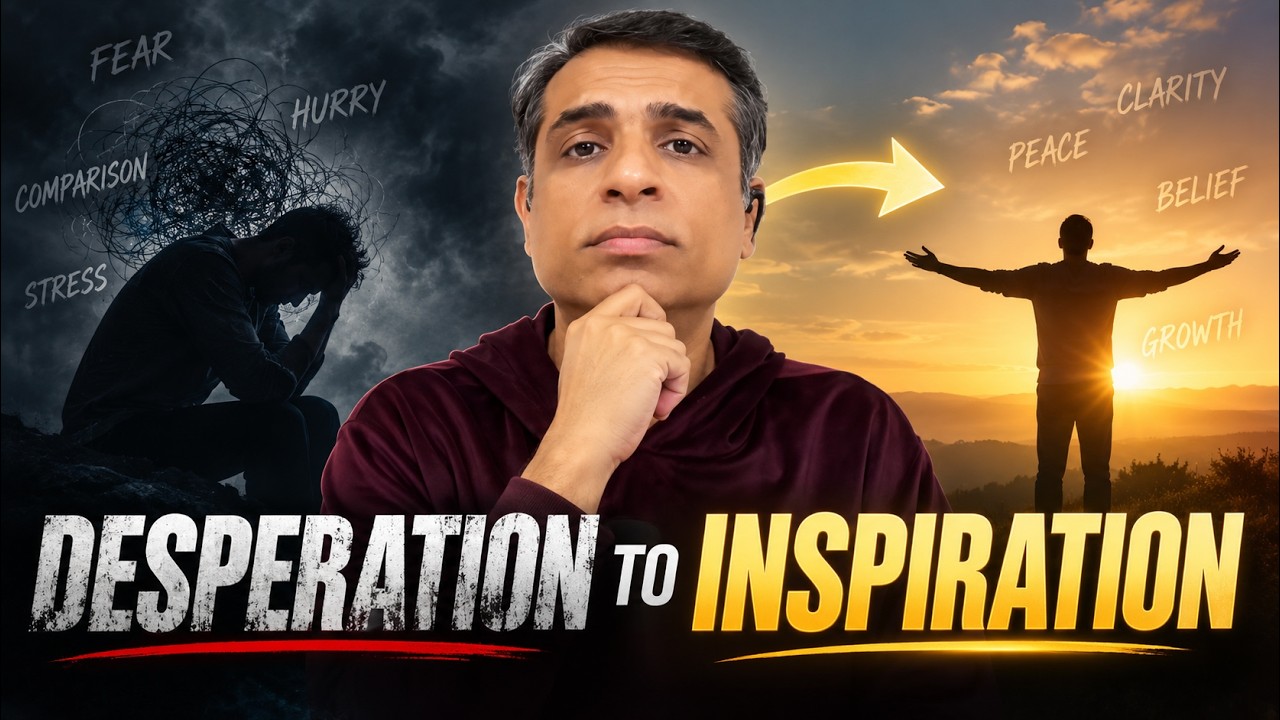
In this bilingual (English/Hindi) self‑help video, Paridhi Dhingra explains that recurring emotions are not failures but messages from an internal "emotional guiding system". She likens emotions to a persistent knock on a door, urging us to listen rather than ignore, suppress, or over‑express them. Using a personal story about a friendship that deteriorated due to unaddressed anger, she illustrates three common ways people mishandle emotions – snoozing (ignoring), suppressing, and eruptive expression – and why each leads to being stuck. She then breaks down four core emotions (guilt, anger, sadness, fear) and the specific action signals each conveys: guilt signals responsibility and the need to apologize; anger signals broken expectations and the need to communicate them; sadness signals loss and the need for acceptance; fear signals a warning and the need for caution. Practical advice includes recognizing the signal, writing down the question "What is the emotion trying to tell me?", and taking the indicated action (apologize, set expectations, accept loss, etc.). The video concludes with a call to share the content, a plug for a masterclass on the "Hope Noop No Healer Certification Course", and an invitation to apply the emotional‑guidance framework to break emotional loops.
Chapters
Are you realizing that there are many emotions you're experiencing again and again? It's like you're stuck in a loop. The same emotion is coming to you again and again and again. And what are you doing with those emotions? Snoozing them, ignoring them. Sometimes you're expressing those emotions, and many people tell you, express it out. निकाल दो। Has expression of anger has ever resolved anger completely? Just by expressing sadness, does sadness completely go away? Not really, because we don't understand the language of what emotions are telling us. We remain stuck in that emotion. Let me give you a good example here. If you are inside the house and somebody is knocking on the door and they know you are inside and you don't open the door, what are they going to do? They're going to knock harder, correct? And if you still don't open the door, they're going to knock even harder. Eventually, if they know you are inside, they love you, they care for you, well, what are they going to do? They're going to break the door down to find out what's happening with you inside. You know who's that person who's knocking on your door all the time? Your emotions. Your emotions are not bad. They care for you. Your emotions are trying to tell you something. Your emotions are communicating to you what action you need to take to manifest your goals, to attract your goals. But you're not listening to your emotions. But it's not your mistake. You're not listening to your emotions because you don't know their language. This is what I call emotional guiding system. Our emotions are actually an internal guiding system that we have, that the universe has given to us like a gift. Every time we go wrong in life, our emotions are guiding us to go in the right directions. Let me tell you one step at a time what your emotions are telling you, with my story to start with. Once there was a friend of mine, and I was really angry with this friend. But that anger did not suddenly start very high on one day. Slowly that anger was building. You must have also gone through this in your life, right? So in my case, with my friend, anger was slowly building. And at one point, the anger got so much that I said, I don't want to talk to this guy. You know, for many, many days when this anger was going on, there were 3 things I was doing with this anger. Either I was snoozing it, which means what? We ignore our emotions. नहीं है इमोशन। सेकंड, we suppress that emotion that no no I'm not I'm not actually angry with my friend ऐसे ही मूड खराब होगा। Or eventually when we ignore when we suppress and it doesn't work it gets built up for too long a day comes when your emotion erupts this is called expression again doesn't help what did it do it actually destroyed my friendship with him just like that your sadness is giving you signals Your frustration is giving you signals. Your anger is giving you signals. Your helplessness feeling, your fear is also not a bad emotion. Many people think fear is bad. It's not bad. It's giving you a signal. Let's take one example at a time. What is the emotion of guilt telling you? It is a guidance system inside you. The first time you feel guilty, ask yourself, why am I feeling guilty? Like, what is the emotion trying to tell me? Write this sentence down. What is the emotion trying to tell me? And here is what guilt is always trying to tell you: I made a mistake. I should take responsibility for it. I need to go and say I'm sorry to somebody. The more you avoid saying sorry, the more you avoid opening up. And if you ignore it, saying it's okay, यार उसको बुरा नहीं लगाओगा, doesn't matter. And you keep extending that guilt. A time will come when it will become too strong. You might even suppress it one day by making a joke. Some people say, अरे हँस के निकाल दो। कोई बात नहीं, ओके? Suppress it. One day it will erupt and that guilt will eat you up. So listen to the emotions. What is the guilt trying to tell you? Take responsibility. Second emotion: anger. What is anger telling you? I remember once, like I told you, between me and my friend, the anger was going on. So what was that anger trying to tell me about between me and my relationship with my friend? Anger is always trying to tell you. Some expectation was broken by your friend for you. Whenever there is an expectation broken and you feel that they did something that they were not supposed to do, you'll get angry. So when that happens next time, what do you need to do? What is the action signal here? What is the emotion trying to tell you to do? The emotion is saying, go talk to him and tell him you're not liking what he is doing or she's doing. Communicate and clear out the expectations. But if you don't clear out the expectations, what's going to happen? You're going to have more mismatch of expectations, and this emotion is going to remind you again with anger something is wrong, expectations are not matching. Again you suppress, again it will keep going on, and one day it will become so powerful that the expression will happen and a volcano eruption will happen. Instead of that, listen to the anger, go clear out the expectations once and for all. Sadness. What is sadness trying to tell you? It is an action signal that is telling you there is a sense of loss. If you— like, if somebody dies, we feel sad. If you lose a job, you feel sad. Why sadness happens with a sense of loss? So what is the action signal here? The action signal is acceptance. Because when you lose something, you can't always change that. You can't always bring it back. Sadness is trying to tell you, accept what you cannot change. The moment you accept it, you will be surprised— sadness disappears. Do you see how if you could listen to the emotional guidance system, you could evolve from that emotion instead of remaining stuck in that pattern? And how do you remain stuck in that pattern? By not listening to the emotion. By not understanding what the emotion is saying. By snoozing it, by suppressing it, by expressing it too much unnecessary. Instead of that, communicate. Understand what the emotion is trying to tell you. And if you want to go in detail with it, here is what I would like you to do. In the description below this video, I've given you a link to an amazing masterclass called Hope Noop No Healer Certification Course, where we teach you how you can listen to your emotions and heal them, evolve through them, rather than just remaining stuck in your emotions. Makes sense. Do you know somebody who's a friend of yours who's right now stuck in an emotion and doesn't know how to understand his emotional guiding system? Share this video with one of your friends so you can help them understand and listen to their emotions. I'll see you soon in another video. Listen to your emotions. Bye.