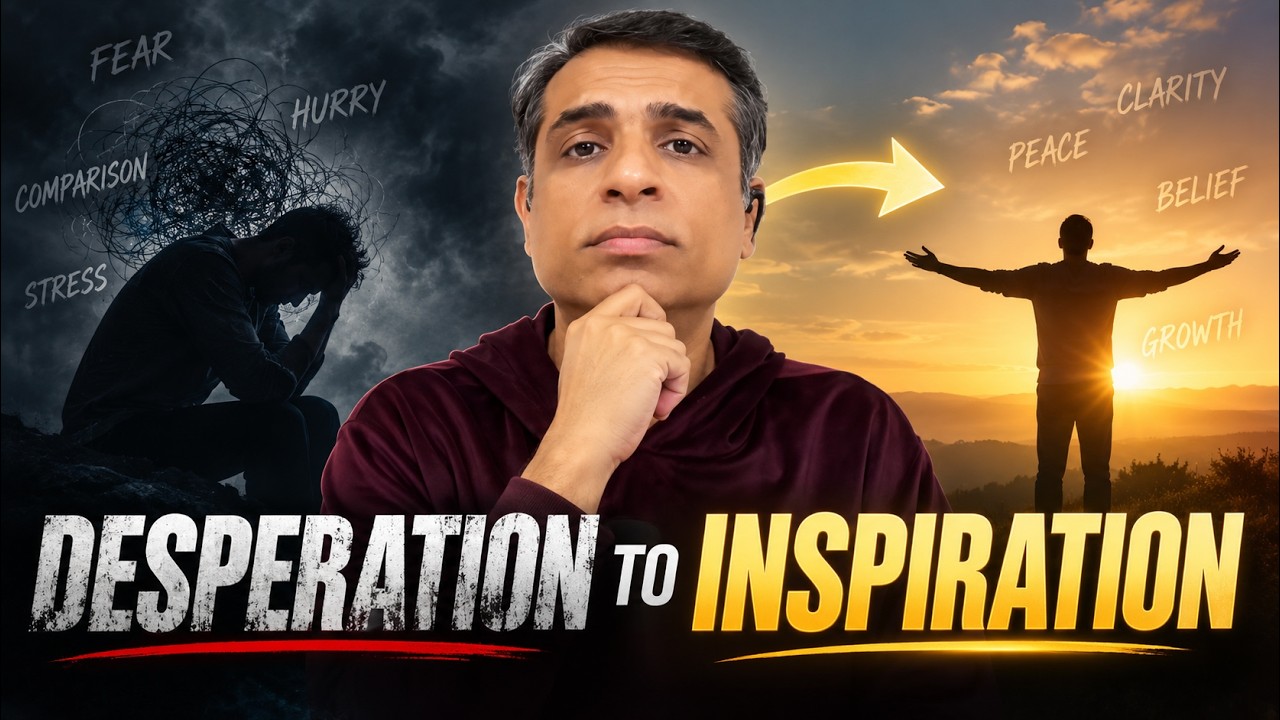
Mukesh Ambani's Secret to Success REVEALED | Law of Attraction Case Study | Mitesh Khatri

The video presents a Law of Attraction case study of Mukesh Ambani, delivered by Paridhi Dhingra and Law of Attraction coach Mitesh Khatri. It argues that Ambani’s external success stems from three core emotional frequencies—calm in crisis, hunger for growth, and generosity—combined with two foundational beliefs: a customer‑first mindset and a commitment to impact the entire Indian economy. The narrative illustrates each frequency and belief with real‑world examples from Ambani’s life (e.g., taking over after Dhirubhai’s death, navigating the 2008 financial crisis, handling family disputes, launching Jio, and the lavish generosity displayed at his son Anant’s wedding). Throughout, the presenters encourage viewers to adopt these frequencies and beliefs, providing affirmations and urging enrollment in an Advanced Law of Attraction course.
Chapters
साहस एक ऐसी ताकत है, जिससे डर को भी डर लगता है।
India's richest businessman Mukesh Ambani. Today we are learning a law of attraction case study about not only the most successful man in India, but one of the most respected entrepreneurs in the world.
To me, what is most important is do we really move the country forward? And does the consumer gain?
Let's learn about the Ambani family today, specifically Mukesh Ambani, to understand why is he so successful. As you know, we understand not by what people have, by what people have inside them, not just outside them, because it is their frequency inside that gives them what they have outside. Because the bigger the person inside you, the bigger the person outside.
I have been very fortunate To lead Reliance, everything I am today is because of Reliance.
Try and think about it. Do you think Mukesh Ambani would be as successful he is outside if he was not not that big on the inside?
It is always good to be together as one Reliance family, and it makes occasions like this truly truly special.
No chance, right? Let's learn. What is his frequency so you can adopt that frequency and have similar success? Do you want to be a billionaire? Maybe, maybe not. But you definitely want to be rich. Do you definitely want to be successful? Then let's learn from his frequency starting now. My name is Mitesh Khatri. I and my wife, Indu Khatri, we are Law of Attraction coaches and national bestselling authors of this book, The Law of Attraction. Let's learn 3 specific emotional frequencies That makes Mukesh Ambani the way he is. Remember, I keep saying that our life is always based on our energy, our frequency. But what is our frequency made of? Our frequency is made specifically of 3 things: our feelings, our beliefs, and our actions. Whatever you feel is what you attract in your life. Now, we all want to be rich. We all want to be successful. We want to be abundantly successful, which means some of us even have dreams of being a billionaire. But we are struggling. Why do we struggle? Because I am here and who I want to become here, that frequency is different. I need to adapt the frequency of who I want to become. The best way to do that is think about people who've already reached there and adapt their frequency. Starting today, let's think about Mukesh Ambani. What is his emotional frequency that you can learn from? Take a notepad and pen and quickly write down these 3 emotional frequencies. The first one is called as calm in crisis. Yes, his emotional pattern is he's very calm in crisis. Listen, emotions that you feel once in a week don't matter, but emotions that you feel every day as a habit makes you who you are. Mukesh Ambani's frequency emotionally is he's always very calm in crisis. Have you seen any of his videos where he's panicking, where he's shouting, throwing a tantrum? No, he's never even excited too much because his pattern is being calm not only during opportunities but also during crisis. Write this down: crisis and opportunities don't make us feel anything. It only multiplies our existing emotional pattern by 10 times. Mukesh Ambani's pattern is calm in crisis because— I'll give you 3 examples. Example number 1: I remember when, uh, Dhirubhai Ambani had passed away. He had to take over the business in a very unexpected way. Of course, he was prepared for it. But during that time, he was calm during that crisis. Not just that, when there was a financial crisis, global financial crisis in 2008, the way he led his company at that time as a, as an organization, the way he took it up from there and the way he made his company grow was amazing. Why? Because he has this habit of being calm during crisis. Remember the time when there was a separation going on between Mukesh Ambani and Anil Ambani and there was a lot of family dispute going on? At that entire time, we always saw Mukesh Ambani with a lot of grace in the way he communicates to the reporters or the way he spoke to his family. Whatever we saw— listen, a lot of people would say, but that is all fake. What happens behind the camera, who knows? You can hide fake things certain period of time, but when you see somebody behaving a certain way consistently, 5 years, 10 years, 15 years, 20 years, 30 years, It's difficult to hide authenticity for too long. So he's authentically calm in crisis. Now the question you have to ask yourself is, forget about Mukesh Ambani for a minute. Let's learn from Mukesh Ambani and ask yourself, are you calm in crisis? Do you have that pattern, or do you normally panic when there's a pattern going on? Do you feel worried when a— when you know something is about to go wrong, a crisis is about to come? Do you panic? Do you get worried a lot? If you do, then we cannot have the kind of success that we want from people like Mukesh Ambani. Listen, we idealize these people. We idealize because we want to become like them. But then becoming like them is not first about the results they have, it's about the kind of person they are inside. Remember I said bigger the results outside you depends on bigger the person inside you. If you're— if I am a small person inside, my results are going to be small outside. If I'm a big person inside, the results are going to be outside also very, very big. Now let's say I expect big results, but with big results come big problems. Do you have that emotional pattern of being calm in crisis? Write this affirmation: I'm always calm in crisis. Write this affirmation and say it with me right now: I'm always calm in crisis. Isn't it an amazing affirmation and a very powerful emotional pattern that you agree makes Mukesh Ambani who he is, right? Let's go towards the second Emotional frequency of Mukesh Ambani. The second emotional frequency of Mukesh Ambani is hunger for growth. They are truly, truly hungry. Like as a family, you will observe the hunger for growth is what I can say is infinite, infinite level of hunger for growth. A lot of people I have met who say, "यार अभी जितना कर लिया ना life में उतना काफी है।" Now see, one moment they will say, "जितना कर लिया उतना काफी है," but in the second moment I have seen the same person saying, "यार I wish मेरे पास भी ये होता।" That's because there's an internal conflict going on about, do I really want or I don't want? Am I really willing to work for it or I'm not? See, people like Desh Ambani are not conflicted. Their hunger for growth has nothing to do with limits. Like, they don't even think limitations. Probably their mind says, limits? What limits? But that's because in their mind, they're constantly thinking about not just growing in one part of the business, but in every part of the business. Think about it. Oil and gas business, right? Textile business, telecommunication business, FMCG business, fashion business. Think about any industry and you'll find Reliance working in that area. They're constantly working towards business because their need for growth, their hunger for growth is infinite. They don't want to be only the richest company in India. They want to be the richest company in the world. They want to be a global phenomenon. But only wanting something is not enough. Question is, do you have that emotional frequency which is so clear that you never have a conflict that that's who I am? Once again, let's keep Mukesh Ambani on the side and ask yourself, do you have that hunger? Do you have that affirmation that yes, I want to be a billionaire? Yes, I want to have this kind of success. If you are a person working in an organization and one day you want to be a CEO of a company, Only desiring is not enough. Do you have that hunger where you say, "Yes, I want to be the CEO of a company"? Only saying it in a desirable way—that doesn't mean the hunger is there. There are two ways of looking at it: should and must. Should is मिला तो अच्छा है. I should get this. नहीं मिला तो भी okay. Must is I must get this in my life. See, people like Mukesh Ambani—they don't live in the should world; they live in the must world. From today, get into the must world if you want to be people like them. And write this affirmation down. Yes, I am hungry for growth. Just saying that one affirmation, I am hungry for growth, in every area of your life, your subconscious will start giving you growth, right? The 3rd frequency which I have observed about people like Mukesh Ambani, and not just him, people like him, is the emotional pattern of generosity. What is generosity? Generosity is the ability to give. It's the— not only the ability to receive, it's also the ability to give. And it's very, very clear and visible in the way they've started this organization called Reliance Foundation, where the amount of money they spend on rural development, on education of poor people— they spend a lot of money for philanthropy. Now you would say, but Mitesh, it's easy to do that when you have the money. No, it requires the heart first. You may have even ₹10,000 a month, but I know people who spend out of those ₹10,000 ₹500 every month to help people. Question is, do I really have that heart? Am I really generous in giving? And I'm not just talking about charity. I'm talking about the way you treat people, the way you deal with people. When guests come home, how do you deal with them? When you give a gift, how do you give a gift? I remember a very rich person whom I was learning from once told me, never give the gift as per the other person's capacity. Give the gift as per your capacity. The other person may not deserve it, but if you feel you are a bigger person, then you need to give the gift accordingly. And that is why I believe Mukesh Ambani is very generous. A very good example is a recent example of his son Anant Ambani's marriage. The amount of money that Mukesh Ambani spent in that marriage, I think we are all aware of that. It was a story of the year and everybody was talking about it, not just Bollywood people. Hollywood people came for his marriage, not just politicians. Entrepreneurs from all over the world were invited. He actually made sure that there were private jets available for some of these VIPs. It was told that the amount of private jets that were flying during that time for his son's marriage at that time was the largest amount of private jets ever flew on a private airport at that time. But that happens because of the kind of generosity he has. Once again, you will say, but Mitesh, when you have that kind of money, it's easy to spend. No, I know millionaires who have a lot of money. They're not generous with their employees the way they give salaries. They're not generous with their family the way they give gifts sometimes. Ask yourself, are you generous or are you stingy? Now, if you're generous, that's great. But if you're not, write this affirmation: I am generous with myself and I'm generous with others. Now the first part of this affirmation is very important because if you're not generous with yourself, how will you be generous with others? When you spend on yourself, are you stingy or are you generous? I've seen a lot of people when they're spending on others, they spend nicely. Spending on self, when buying clothes for themselves, when traveling, they not give themselves the best. Why? Because they're not generous with themselves, right? So start saying this affirmation: I'm generous with myself and I'm generous with Today I want to give you a gift before you leave. In the description below, you'll find a link of an amazing course called Advanced Law of Attraction Course, where I teach you in depth how to take your frequency to the next level so you can attract this kind of success in your life. That is called the Advanced Law of Attraction Workshop, and the first lesson is my gift for you. Quickly click on it now, register right away, and take this gift, and I'll see you in the Advanced Law of Attraction Course. Thank you. First lesson completely free. This is me practicing generosity just like Mukesh Ambani. These are the three emotional frequencies. If you adapt them, you will get closer to frequency and success of Mukesh Ambani. Now let's look at some of his beliefs that makes him who he is. Let's go. The first belief of Mukesh Ambani that makes him who he is is I strongly believe he got this belief from his father, and that belief is. Customer approach first. Customer first. They always say customer first.
To me, what is most important is, uh, do we really move the country forward and does the consumer gain?
The benefit should always go to the customer, not to the, not to the retailer, not to the distributor, not even to themselves as the wholesaler or the creator or the founder of the company. They said make the customer first, give the benefit to the customer first. So they are never aspiring to be a company like Apple. They're never thinking of being the most luxurious company in the world. They're trying to be the most customer-friendly company in the world. They want to give customers the most user-friendly, the most pocket-friendly, the most reasonable products and services that they can provide. That is why when Jio came in at that time, they blew the market. Why? Because their approach is always customer first. They got, I think, more than 300-400 million subscribers, and they kind of shook up the entire telecom industry at that time. Invested more than $30 billion to start this business of Jio Telecom. But that's because when they think customer approach first, they were not only thinking about, about the rich people in the country, they were also thinking about the rural people because they are always thinking global. And that brings me to the second belief of Mukesh Ambani. The second belief is tied to the first belief very, very strongly. The second belief is— write this down— they believe in creating an impact on the entire economy of the country. Yes, write it down. Believe in creating an impact on the entire economy of the country. Now, what does that mean? They don't want to help 10,000 people or 1 lakh people or 10 lakh people or 1 crore people. They are always thinking global economy, country economy. They're constantly thinking How can we help the entire country? And while doing that, how can we make money? So coming back to that example of Jio and how they started this business, they were not only targeting people like you and me who are already having phones, they were targeting people who did not afford phones, who could not afford internet. They went to villages and thought, how can this person who today as a farmer makes probably only ₹4,000, ₹5,000 a month, how can this farmer also afford a phone and afford Wi-Fi and afford internet at home?
What we did with Jio is really we put in like And not many in the world had backed us. But as I just explained, we are strong believers that if India and 1.3 billion Indians have to participate in this new world, right, for us, we cannot always have the data infrastructure 20 years after the world. We would have no chance. Today, we have, along with Rajan and Kumar, like along with like with all of us as one industry. I think that India in terms of data infrastructure will be ahead of the US by 2019.
And because of that thinking of theirs, customer first, because of their thinking of customer in every household of this country. I remember Dhirubhai Ambani had this belief, which I believe he passed it on to Mukesh Ambani as a business also, is we want ₹1 from every family of this country. Every family. We don't want to necessarily make ₹1 lakh from 10% of the country. We want to help every member of every family of this country. And even if one member of the family gives us ₹1 in the entire country, we'll automatically become the most richest company in the world, if not definitely in the country. But that's because they are constantly thinking about every person in the country. They're thinking, what services can we, can we give them? Think about it. They started Reliance Stores. Why do they have to start Reliance Stores? It's grocery stores. They didn't have to get into that business. But they knew what is sold in a grocery store— rice, food, food articles, electronics, small stuff. But they want all these things to be part of their business because they want to be in every household of the country. They want to make an impact on the entire economy, and they can do that by only going to the grassroots. And being part of the grassroots means always thinking customer first. Ask yourself this question: Do you have this thinking as an entrepreneur? Are you always thinking customer first? Are you thinking whatever business I am doing, I want my business to be in every household of this country? Like in my case, I took this belief from Mukesh Ambani and Dhirubhai Ambani many years ago, where I said the services which I give, which is law of attraction coaching in my case, I want every household of this country to practice law of attraction. The way people wake up in the morning and brush their teeth, I want every person in the family of every family of this country to wake up while brushing their teeth. They will do affirmation every single morning and practice affirmation with me. Isn't that an amazing vision? Now, maybe it'll come true, maybe it'll not. That's not the question here. The question is, do you have the audacity? Do you have that guts? Do you have that belief? And do you— are you working towards that action frequency every single day that I want this to be my reality? The more you're working towards it, the more it will work towards you. Did you write this down today? Are you ready to cultivate these kind of emotions, beliefs, and actions so that you can also be a billionaire? Listen, you may not want to be a billionaire. It doesn't matter. I'm sure you would agree that these emotional frequencies, these beliefs, and these actions are definitely positive. In fact, they're ultra positive because they are beliefs of the most successful person on this earth. Amazing, right? So if you're going to learn from this and you're going to implement this, in the comments section right now before you go away, because later you'll forget, tell me in the comments what did you love in today's video, what did you learn, and what will you adapt in your life. And if you want me to make more such amazing case studies of Law of Attraction, tell me who should I select next— which country, which entrepreneur, which actor. Let me know. So if you loved today's video, make sure that you also watch our other Law of Attraction case studies that we've created earlier. We made a case study on Law of Attraction with
More from Paridhi

The secret to making manifestation actually work #manifestationtips #mindset #shorts


ou Create Goals but Can't Stay Consistent? Here's Why 👀 | Mitesh Khatri | Law Of Attraction

The Money Mistake That Keeps You From Becoming Wealthy | Mitesh Khatri | Law Of Attraction

The ONE Emotion Blocking Your Wealth | Why Impatience Keeps You in Lack | Mitesh Khatri


The Hidden Reason You Feel Responsible for Everyone | Mitesh Khatri | Law Of Attraction