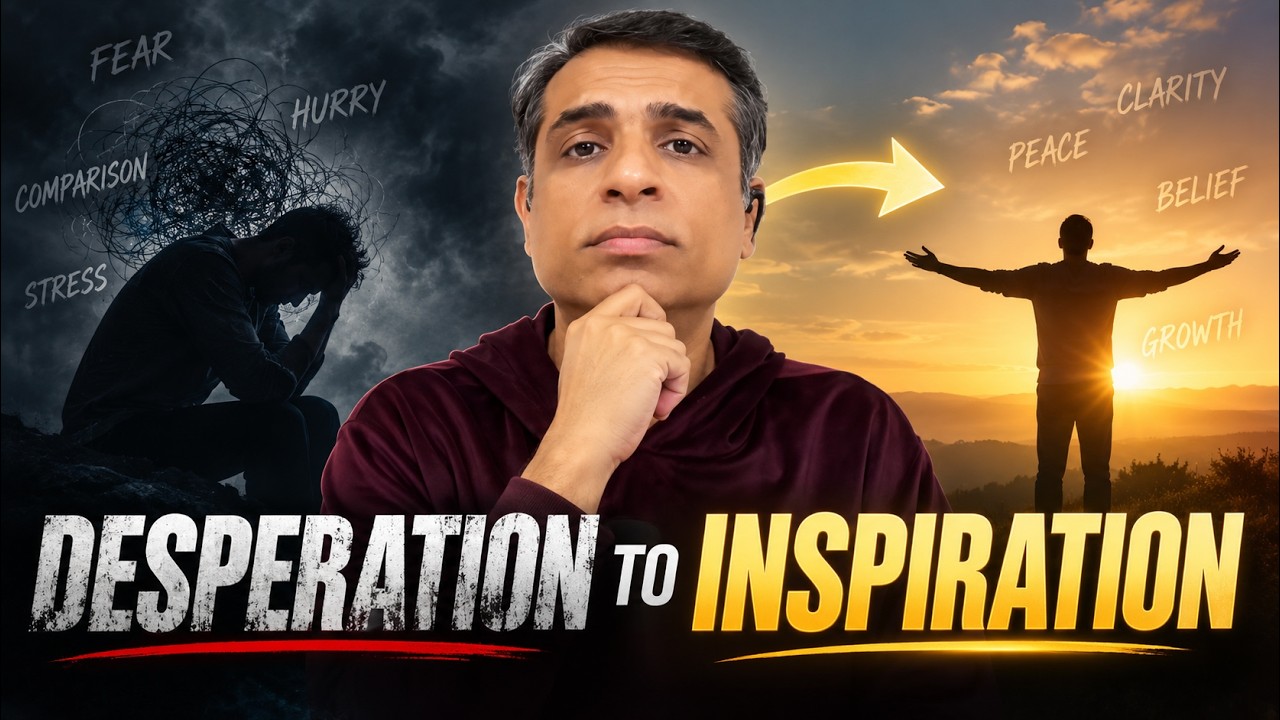
In this self‑help video, Paridhi Dhingra (presented under Mitesh Khatri’s channel) reframes anxiety not as a flaw but as the brain’s built‑in safety system that signals perceived danger. She explains the evolutionary roots of this response, noting that modern triggers often produce false alarms. Through the story of a client named Rajesh, she illustrates how anxiety can mask underlying relational conflicts—in his case, a hostile relationship with his boss. Dhingra then outlines a three‑step process to "switch off" the safety mode: (1) welcome the anxiety instead of suppressing it, (2) interrogate the symptom to uncover what it is trying to tell you, and (3) take concrete action on the identified root cause rather than merely treating the symptom. The video concludes with a promotional pitch for a Neuro‑Linguistic Programming (NLP) program, offering a free introductory lesson, and a call to share the video and subscribe for future content.
Chapters
Anxiety. Do you experience having sleepless nights sometimes? You're lying in the bed and turning and twisting and not able to sleep. And sometimes you go through physical symptoms where your entire body moves and you have heart palpitations and you're not able to breathe. And like, what should I do right now? And then when you go through this anxiety, one of the things that people always tell you is breathe, breathe, breathe, breathe. Like, let go of this anxiety. Let go. Calm down. Calm down. And most people have made anxiety like a taboo, like there is something wrong with a person if that person has anxiety. Today I want to tell you something very important. Anxiety is not bad. Actually, anxiety is a signal to your system that something is wrong, please take care of it. Anxiety is communicating something to you. But instead of asking anxiety, what is really going on? What do I need to pay attention to? Instead of that, we avoid anxiety, and we— because we feel anxiety is bad. So then we start searching on what are the solutions for anxiety. What are some of the solutions that people tell you? Take deep breaths, avoid it. 2, go for yoga. 3, start distracting your mind towards something else. And the more you go through these techniques, you'll realize that for some time you're able to avoid anxiety, but then some reason at particular time it gets triggered again. A particular situation a particular person, a particular conversation, a particular memory comes back and the whole thing gets triggered again. Why? First, let's understand why does that anxiety come back again and again. But first, I want you to know anxiety is not bad. Here is why anxiety comes back. Your anxiety is your mind's way of protecting you and telling you that there is some danger around you and you need to take care of it right now. Our brain is having one task which the brain does perfect, which is protecting you. And in order to protect you, sometimes when you don't listen to the brain, the brain has to give you signals, very powerful signals that, listen, something is wrong, take care of it. And we are hardwired like this, like we are born like this. Thousands of years ago when we were living in caves, at that time when animals were around us and we were hunting animals to survive, and animals were hunting us. Our brain was wired into being very intuitively strong that, is there danger? And your body would start like breathing strong, and you would start getting signals to protect you that something's wrong, there's some animal around you, be careful. Now, that signals are still here with you. We are not listening to those signals. That is one. Second problem is many of these signals right now are false alarms. Because you don't know how to listen to those signals. Example, I'll tell you the story of one of my students. His name is Rajesh. Rajesh was going through a lot of anxiety every morning before he was going to work. So one day I was doing this workshop for my Platinum members. We call it NLP, Neuro-Linguistic Programming, where we specifically deal with this topic of anxiety a little more in depth in terms of how does your mind work and how can we give control to you to take care of not just anxiety but any emotion in life. So Rajesh was on the video at that time with us on a live Zoom call, and he said he gets anxiety every morning before he goes to work. Now think about this— going to work, sweating, palpitation is increasing, breathing is increasing. Now he's thinking it's happening because of what's in the house. This is a false alarm. Or he's thinking it's because I'm going to office. False alarm. I kept asking him a very important question: what will happen if you go to the office? What will happen in the next 1 hour? What normally happens every day at office? The more I questioned him, I realized he was going through a huge conflict with his boss, and he was going through an experience where he was constantly being dominated and to some extent even verbal abuse. And that experience is what his mind was trying to avoid, and his mind was giving him signals that don't go there, danger is there. But instead of listening to his mind, he He was trying to do all the kind of techniques earlier to avoid this anxiety and to get rid of it. Anxiety is not bad. It is trying to communicate to you, something is wrong, take care of it. So what is the first step of taking care of anxiety? Step 1, every time anxiety comes, welcome it. Sounds crazy, right? Yeah. Welcome it. Because if you don't let anxiety properly be in your body, how will you let it complete the communication that it wants to give you? First, welcome it. Let it be there. Don't worry. Don't try to avoid it. Don't try to distract it. But now the second step is important. Once you allow the anxiety to be there, second step, ask this question: What is this? What is the symptom trying to tell me? Because this is just a symptom. What is the symptom trying to tell me? What's wrong? Am I avoiding a bad relationship? Am I avoiding a particular activity which I don't want to do but I have to do now in some time? Am I trying to defend myself with somebody? What am I trying to avoid, or what am I threatened by right now? The more you ask this question, write it down, and you'll really get clear about why are you feeling these symptoms. Particularly in case of Rajesh, when I kept asking him, he realized that instead of dealing with his relationship with his boss, he was just trying to deal with this emotion called anxiety because he thought it was a bad thing to have. Once we got to the root cause, which is step 2, after asking him again and again, why are you having these symptoms? When we realized it was his relationship with his boss, then we did step 3, which is now take action to handle the root cause problem, not the symptom. So I taught him a couple of techniques on how he can perceive his boss in order to deal with his boss. 2, I also taught him that now when you go to the office, take action. Instead of avoiding your boss, have an open, transparent communication with your boss, that boss, I'm having these emotional anxiety issues because every time I come to the office, I'm scared of having a conversation with you. Be open about it, be transparent about it, and communicate and say, I would like to have a better relationship with you. Can you please help me? Believe it or not, he went, he spoke to his boss, they resolved the communication problem between them, and his anxiety attacks went away. Think. If he would have not taken care of that relationship, unfortunately, he would have gone into this loop of anxiety, techniques to avoid, anxiety, techniques to avoid, anxiety, techniques to avoid. Now, this is a loop. Don't remain stuck with this loop. Get out of it. It's very simple. Step 1, welcome the anxiety. Step 2, ask the question, what is my anxiety trying to tell me? Step 3, take action to resolve the root cause problem instead of simply dealing with symptoms. Now, I hear you. I know what you're thinking. Maybe you're saying, Mitesh, all this is great. My anxiety is a little more complicated. Like, I've been going through it for so many years and I don't know how to deal with it. I understand. In that case, you need to learn a little more about your mind, about your subconscious, about your symptoms, about the root cause. And we do an amazing, powerful program, not only this topic of anxiety, but much more about your mind called Neuro-Linguistic Programming. Where we teach our Platinum members, where we teach our NLP students not only how to take care of your emotions but how to take care of your beliefs, right? You have a limiting belief for 20 years, people say it takes 5 years to change that. We can change it in 10 minutes. You have some kind of phobia that you've got for 10, 10 years, like phobia of heights, fear of things that you want to do, we'll be able to take care of that in just a few minutes in this program called NLP. You don't have to take my word for it. I'll give you an amazing gift that will give you an entry into a whole new world of neuroscience. It's called neuro-linguistic programming. Below this video, in the description right now, there's a link. Click on it, register it, and the moment you register, you'll get an invitation as a gift to my first lesson free of neuro-linguistic programming course. Go through the first lesson, it's completely free from my side, and you will enter a world of neuroscience and you will enter a world of Techniques which are so powerful that you must have never thought that, oh, manifestation techniques are here in the form of scientific techniques like NLP also. Wow! Go through the lesson, and in the meantime, don't wait. Welcome the anxiety. Ask what it wants to say to you. Step 3, take action to deal with the root cause. And share this video with some friends of yours who you know need deal with anxiety. I'll see you soon. Keep manifesting, and remember to subscribe to the channel so that the next time I'm creating awesome content like this, you definitely get a notification. See you soon in the next video. Bye.