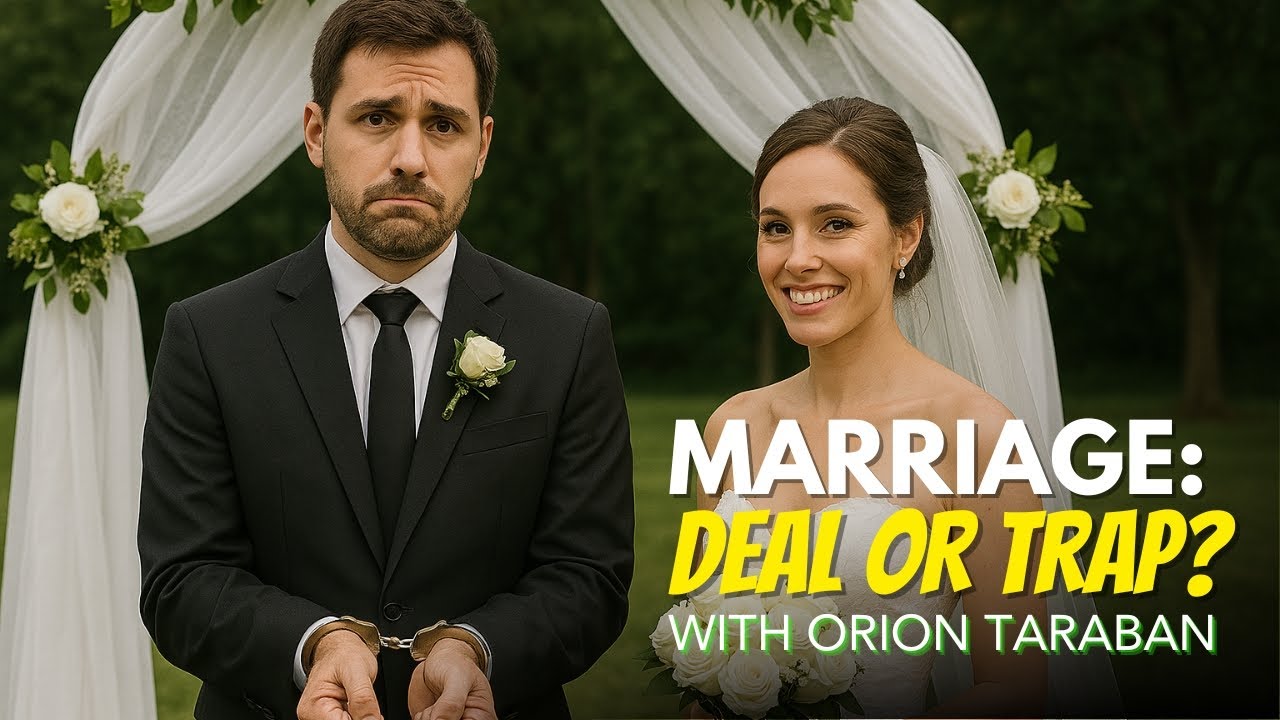
In this interview, Dr. Orion Taraban discusses his view of marriage as an existing legal institution that he does not personally need. He frames marriage for high‑earning men as a high‑risk, low‑reward contract, questioning what tangible benefits it provides beyond what an unmarried partnership already offers. Taraban argues that the marriage market is asymmetrical: women typically gain more material and security from marriage, while men gain little unless they are socioeconomic equals or stand to receive a substantial financial subsidy (e.g., from a billionaire heiress). He cites hypergamy, the tendency for women to seek higher‑earning partners, and points to statistics such as women initiating 70‑80% of divorces and higher rates of erectile‑dysfunction medication use among men when women out‑earn them. He reflects on historical social pressure, noting that a bachelor in his 40s would have faced far greater stigma 50 years ago, and that societal expectations continue to push individuals toward marriage despite personal disagreement. Taraban expands the conversation to the broader human need for external structures—military service, religion, or a spouse—to provide discipline, purpose, and a framework for living. He argues that while such external anchors can be helpful for most people lacking self‑regulation tools, the ideal is for individuals to internalize structure rather than conform to ill‑fitting external prescriptions. The interview touches on optimism bias, the psychological benefits of slight delusion, and the difficulty of navigating life without prescribed guidance.
Chapters
All right, we got a question for you. Do you believe in marriage, the concept of marriage?
I believe that it exists. It is a— it is an institution that exists in the world. It's not like Santa Claus. It's not like— I believe in it. It exists.
It does exist. Next question. Okay, so, but he says, how would you justify the concept of marriage against the modern world red pill truths? So this is from Fight for a Better Now on YouTube. So he is saying that he's— he thinks he has seen the Matrix metaphor. He's taking the red pill and he's seeing behind the curtain, and he's coming to you saying, from what I know and from listening to you and myself, do you believe in marriage as a, let's say, a positive thing? And if so, why?
Well, I certainly don't feel like I need to defend marriage. I mean, if it's truly a good thing, it should be able to stand on its own merits. I am not married. I am not interested in getting married in a legal and formal sense. And I've said before, I'll say it here, is primarily because I'm not sure how I benefit from entering into that legal contract. It just seems like a lot of risk and not a lot of reward. I also am unclear as to what opportunities being married open that weren't already available to me as an unmarried man who's in a relationship. So maybe it's the libertarian in me, but it's also like, why does the government need to be involved in my romantic relationships? It's like, Why can't we just be two consenting adults who enjoy spending time with each other? So to my end, there's a lot of risk, not a lot of reward, especially as a high-earning man. I think it's like if I were a woman, I would definitely want to get married under most circumstances. And I'm not saying that I would never get married, but I kind of would get married for the same reason that most women would want to get married, namely it would significantly improve their quality of life. So if there's any, like, beautiful billionaire heiresses out there who are looking for a husband and want to, you know, subsidize my vocations, like, we can talk. Like, I have a lot to gain from that arrangement. And under most circumstances, women have more to gain from the marriage arrangement than men. So I can understand why at a certain point their ultimatum generally comes down the pipeline where the woman's basically saying, like, you know, I'm going to need this in order to continue the relationship. But it's a level of security that on that level, at that point, the hypothetical woman is demanding that she couldn't provide to me. It's an asymmetrical arrangement. The only way it would be symmetrical is if, you know, we're more or less socioeconomic equals, and that's happening more and more. But in general, women don't want to marry socioeconomic equals and certainly not men who earn less than them. They are more enthusiastic about marrying hypergamously. Men who are higher status and higher earning. So we also know that in situations where the woman out-earns the man, that there's a host of poor marital outcomes. Men are like 3 times more likely to be on erectile dysfunction medication, for instance. And we already know that women initiate 70 to 80% of divorces. But when the woman out-earns the man, it's, it's significantly more common for them to initiate divorce than it already is. So while modern women have careers and are often very high earning and are socially accomplished. And they might say that because of this, material conditions aren't really that important to me. The behavior on a population level belies that claim, as that it does seem to be important, maybe more as a psychological or an emotional cue than as a material resource. But it does seem to be important. Otherwise, Why would there be so much more unhappiness and conflict and dissolution under those arrangements? So that's kind of the long and short of it, is that I have no problem with commitment. I think commitment is good and necessary where it's appropriate. I just don't see how marriage serves my goals.
Now, if we were to jump into a time machine and take Orion back, I don't know, 50 years, would, would your tune be different then? Because the social framework is a little bit different and more advantageous for men in marriage, or no?
I think it'd be more difficult for me to speak out so bald-facedly about the issue. I certainly, I mean, I have experienced all kinds of direct and indirect social pressure to get married. I think that would have, if we go in the time machine, it would be even greater at the time. I doubt I would have gotten this far without being partnered up. Also, it's like 40s at this point. To be a bachelor in your 40s 50 years ago would be, you know, this guy is— he's never going to change. He's, he's an inveterate playboy or bachelor or what have you. So yeah, things change. It's just also how disagreeable you're willing to be. It's like the social pressure is going to change, but it's never going to go away entirely. Alan Watts said if people can talk you out of something, you deserve it on some level. So the ability to withstand social pressure, to understand who you are and how you want to live your life despite the consequences, that's not a path that everyone can take. It's much more difficult than people think. I think that movies and video games and have trained a whole generation to think that they have main character energy and that's That's just not true. I think most people in their private consciousness think they're the ones who are going to stand up to the Nazis and they're the ones that are going to go fight the band of brigands at high noon when no one else will. They'll do the right thing even if it costs them their lives. It's like, have you talked to people recently? It's like, I don't think that that's true. So the pressures to conform are incredible and very, very powerful. More so than a lot of people would like to acknowledge, because it's not very socially— it's not very socially desirable to say that you're compliant, nor is it very positive from an ego-based perspective. No one thinks, "I did exactly as I was told today, I feel really good about myself." And yet so many people respond to arguments of authority and direct and indirect social pressure that I think it would be extremely difficult for most people under most circumstances to live the lives that might be in their best interest to live, for better or for worse.
I did an interview with a lady by the name of Michelle Langley who wrote two books, Women's Infidelity 1 and Women's Infidelity Part 2. And she said a common thing that she says to women that she consults with is, you're not as good as you think you are, to the women. It's probably—
you could say that to men too. I mean, I think, yeah, we know that most people think they're above average in most things, which we know is statistically impossible. So We all have a, most of us have a positive bias, and that might be healthy actually. Like if it gets too delusional and we, we lose touch with reality, that can harm our interpersonal relationships. But on the whole, it's probably better to think you're a little better than you are than a little worse than you are. To be fair, I think some research suggests that slightly delusional people are the happiest people. And like the more clearly you see reality, the more likely you're prone to depression.
That's right.
Because there's a lot of, you know, there's a lot of difficult and unfulfilling and just awful aspects to being alive and being a human being. Sometimes it's difficult to maintain optimism and hope in the face of what we see and logic and reason and statistics and experience. But it still might be called for.
This is where things like religion and other things step up to give people a sense of purpose and direction and a framework to live in to deal with with the plethora of not so nice things that hit you day to day. That's a deep conversation here, O'Reilly.
Well, sure, people need that. And, you know, just like the Army could be really good for some young men, they don't have discipline, they, they're kind of just weak and flailing, and they get inducted or they join and they enlist, and it's almost like they're given a container in which they can become somebody. They can learn skills, they can learn to self-regulate. But the Army is not for everyone. But if you don't get in the Army, you have to get it. Most people are going to get it from somewhere. If it's not the Army, it's religion. If it's not religion, it's your spouse. I think that's oftentimes— I think that men, at least historically, would talk about their wives as if, you know, they're their better half, kind of keeping them on the straight and narrow. And without her, I would just go off the rails. And it's like you're talking like a young guy who needs the Army. You know what I'm saying? It's like we definitely need structure, but I believe to the extent that it's possible, that it's in the individual's best interest to extrapolate that structure internally as opposed to finding an external structure to conform to. Because no matter what that external structure is, it's like buying clothes off the rack. It's not going to fit you perfectly. And you're going to amputate or stretch yourself to conform to that externally imposed vision of who you're supposed to be. As opposed to doing the hard work and self-regulating according to an auto-extrapolated structure. But that's difficult to do because you have to on some level reject the army and the spouse and the religion and all those things to create the space to think, well, what do I truly value? What do I really want? How do I truly want to live? In the beginning, you're in like a featureless environment where you can walk in any kind of direction. There's no right and wrong and you can pretty much do whatever you want. But how do you go from that to, no, this is, this is how I want to live? It's extremely difficult. It's so much easier to just be told how to live, whether that's by your priest or by your doctor or by your spouse. But that said, I don't think that's best for the individual.
But is it safe to say it is best for the majority of individuals because they don't have the tools in their toolbox to navigate things independently like what you talk about?
Yeah, I think you can make that argument. I would think that these things these externally imposed structures were, I mean, necessary evils for quite some time.