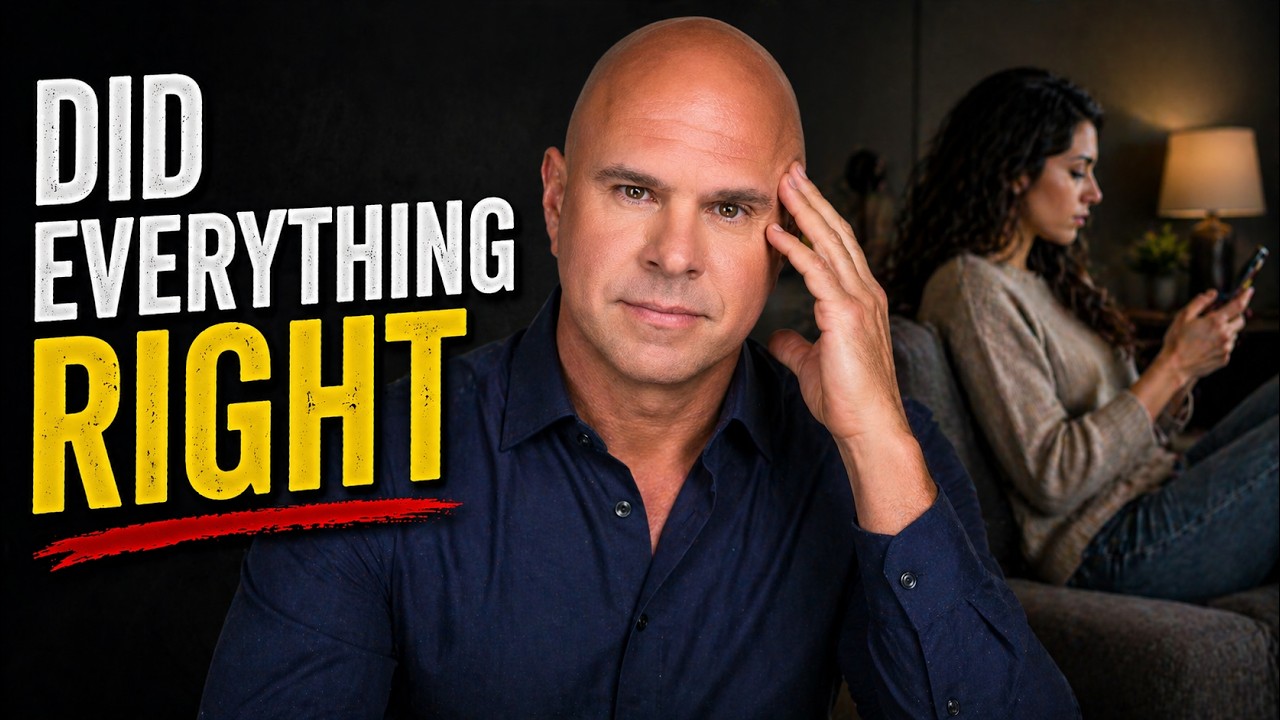
In this video, men's relationship coach Ralph Brewer explains why traditional advice—more communication, vulnerability, and emotional openness—often worsens intimacy for men who are anxiously attached to dismissive‑avoidant wives. He outlines how avoidant partners experience emotional closeness as pressure and why the anxious man's attempts to “fix” the relationship increase anxiety for the avoidant partner, leading to further withdrawal and a dead bedroom. Brewer then shifts to a solution: men must stop trying to rescue the relationship with the wrong strategy and instead develop a secure sense of self. He advises building boundaries, self‑regulation, external support (men’s groups, therapy), and reclaiming personal interests, which can reveal the relationship’s true state. When men become secure, they either see the relationship improve or recognize it as a one‑sided dumpster fire and choose to leave. Brewer emphasizes that the goal is not to become avoidant but to become a secure, purpose‑driven individual who can thrive with or without the marriage. He promotes his resources—Help4Men community, his books Rebuild and The Dead Bedroom Fix—and ends with a call to action for likes, subscriptions, and comments.
Chapters
A lot of men reaching out to me for help will say, Ralph Brewer Brewer Brewer, I did everything that she said and what everyone around me said I was supposed to do to save this marriage. I opened up more to her emotionally. I talked about my feelings. I listened more. I took it upon myself to go to therapy. And somehow the intimacy between us, yes, our sex life, did not improve. If anything, it got exponentially worse. This really, really messes with guys because at our core, we are problem solvers. We are fixers. We see the machine break down. We figure out what mechanism, what part of the machine requires repair. Where do we put in the oil? What lug nut do we tighten down? So we add more and more effort. We try and get the right tools. And as far as what effort and what tools to use, we just listen to everyone around us. Everyone seems to say the same thing. Communication, communication, communication. Vulnerability. Feelings, feelings, feelings. Emotions. You'll hear this advice in the form of little snippets like connection creates desire. Women need emotional safety. Be more vulnerable, communicate more. So you take all of this advice that you hear very seriously. You don't half-ass it. You do the work. You read the books, you listen to the podcast episodes, you watch the YouTube videos, you sign up for the coaching and the courses, and you do all that emotional communication stuff that they talk about. And all that does is create more distance between the two of you instead of that closeness and that reassurance that you, Mr. Anxious, so badly need. And now you are confused and you're frustrated and you're starting to wonder, What in the hell is wrong with me? And here is the uncomfortable truth that applies to many of you out there. The strategy didn't fail because you didn't try hard enough. The strategy failed because it was the wrong strategy to begin with. As far as general relationship advice that a lot of men hear out there from their loved ones, from their family and friends, or maybe online, one thing that those guys rarely hear about, but it's something that I talk about quite a bit, is something called attachment styles. And if you're not familiar, this helps tie a lot of this stuff together. So pay attention. A huge percentage of men that are in dead to bedroom relationships, those men are married to what we call dismissive avoidant women. And if you do not understand how your dismissive avoidant partner's nervous system works, you're just going to end up doing what you're doing, which is pushing them further and further away. The dismissive avoidant person experiences emotional closeness a little differently than the secure or anxiously attached person. To them, emotional intensity feels like pressure. Vulnerability feels like obligation. You saying, hey, can we talk? That feels like a setup. Someone needing constant reassurance feels very, very draining, and emotional dependence feels very unsafe. That doesn't make those people bad people. It doesn't make them villains. It makes them wired to protect themselves by being very self-contained. Distance feels regulating. Independence feels calming to them. And this is important. Needing someone else feels downright dangerous to them. Now, here is where anxious men unknowingly fall into a trap. When the sex starts to drop off in a relationship, there is a portion of men who do get very angry and withdrawn. But then there are those good men, the anxious men, who just try even harder to connect. They initiate more talks. They ask the wife how they're feeling. They try to be emotionally present. They learn all the therapy language. They try to be safer. And this to them feels very mature and respectful and loving because it is. But to her, to the avoidant and her nervous system, you just got a lot louder and closer. You you just got more emotionally demanding. You just got way more focused on the relationship. You just turned the heat up a few hundred degrees. And the avoidant person doesn't respond to that heat with more desire. They respond by shutting down. She just pulls back from you. Not because she's cruel or because she's evil. Simply because your closeness and your reaching out for reassurance and all that good stuff, all it does is just give her a whole bunch of anxiety. But in a lot of guys' defense, what they hear verbally from their wife, who they have now determined is very avoidant, is It's sometimes the polar opposite. Sometimes the woman will explain away some of her behavior, like, I just don't feel emotionally connected to you, I don't feel safe with you. Or you may take the hint and start to pull back away from her, and she goes, why are you being so distant? Where did Mr. Anxious go? She got kind of used to the validation and behavior on your part, and now she like legitimately misses it, but strangely she doesn't like it. I know, doesn't make any freaking sense. You're responding to what she says, and she is responding to how she feels. So you can see how the two worlds collide. She flat out feels too much pressure from you. Pressure to reassure, pressure process, pressure to engage, pressure to manage feelings, and pressure to keep the relationship emotionally stable. And you slowly but very surely go from being a grounded partner to being a lot of very anxious background noise. You are predictable and you're always available and you're always trying very, very hard. That can be comforting to some people, but to her, Ms. Avoidant, that does not create any kind of desire on her part. So you can see, if you're trying to build a connection and grow that intimacy between the two of you, and let's just be blunt, try to get into her pants. You can see how this is not the way to go about doing it. But here's the thing, some of these guys, after joining a men's group like ours— and you can learn more at help4men.com/join to learn more about the brotherhood— what happens is these guys become more secure. Because again, with these attachment styles, what we're talking about, this anxious person over here on this end and the avoidant person on the other end, they are both very insecure in their own way. So when you get help— and who's more likely to get help? The anxious person. When you get help, you become more secure. You start to learn boundaries. You stop overexplaining everything. You learn how to regulate your own emotions and stop relying on her and others to do so. You stop looking for constant reassurance and you build friendships outside of the marriage. You start to reclaim some of your old interests and you start acting from choice instead of fear. And for a lot of those guys, instead of the relationship suddenly improving like what they originally wanted, suddenly everything becomes a lot more clear to them. This relationship is a complete dumpster fire. It's very, very one-sided. The guy suddenly realizes, wait a minute, I'm the only one doing any work here. I'm the only one going to therapy and reading the books. I'm the one that seems to be tolerating all the discomfort here. I'm the only one who recognizes that I need to make some real changes, some adjustments to the way I approach this relationship. She, on the other hand, refuses to do anything. This is the big rub when it comes to being in a relationship with what they call a dismissive avoidant person. In order for them to get better and to become a more secure individual, what do they have to to do? They have to get help. They have to be vulnerable, which is quite frankly the antithesis of everything that they are. It's not impossible, but it's highly, highly unlikely. And frankly, if you got a guy who's been in a dead bedroom for months, if not years, and he suddenly grows a backbone, grows, you know, a set of balls— sorry to be crass— and he looks over at his wife and goes, you know what, what am I doing with this person? From what I've seen, these guys put themselves back on the market, so to speak, pretty quickly. They drop the insecure avoidant wife and they go back out with their new secure suit on, and they find a new woman real quick., and the avoidant woman is left behind saying, what the hell just happened? Sometimes that is the catalyst for that woman. Or let's be fair, sometimes the avoidant man— in fact, most avoidants are in fact men— that's the catalyst for them to have very real change in their life. Their rock bottom moment, their face down in the gutter moment. They just lost their husband and their family because they refused to put in any work. It sounds a lot like addiction, doesn't it? Like if you have somebody who has an alcohol or a substance abuse problem. Yes, it's very, very similar. Just like with the addicts, what spouses and partners of these addicts determine is we want them to get better. We're their biggest cheerleader. We hope they turn their lives around, but I don't have to be around for it. I don't have to be there for the inevitable ups and downs. I am too secure to put myself in that position. You can still love them, but you don't have to intertwine your life with them, especially if they refuse any and all kinds of help. By all means, be there for them, be their biggest cheerleader, but realize when they are holding you back and possibly destroying your mental health and your life in the process. So to summarize all of this, The goal in a relationship like this is not to pull back in order to manipulate some form of desire out of your partner. The goal is not to play some stupid games. The goal is not you yourself to become some kind of cold and detached avoidant person. The goal is to build something that a lot of men quietly give up on. The goal is to build a self, a secure self that exists with or without the relationship. You want to build a man with direction, with a mission in life or multiple missions. With a purpose. You want to build a man with emotional steadiness that doesn't require constant reassurance in order to function properly. For some of them, when you rebuild that sense of self and that security, what a lot of women say is, "That's my husband. I got my husband back. I don't know who that other guy was, that Mr. Insecure, but now I got the guy back that I met when we were dating. Now I feel safer to come back more to center and more secure. I feel safe to be vulnerable with you because you are a secure man." That's ideally what we want to see. But the key is whether that happens or not, you will be okay. You just have to believe it. Ironically, the more you believe that, the higher chance you have of saving your relationship. Funny how that works. By the way, if you want to talk about rebuilding your life from the ground up and rediscovering this more secure version of yourself, check out my book Rebuild, and you can learn more at readrebuild.com. And guys, also, if you could give me a like and subscribe, I would really appreciate it. Share this, leave a comment down below. Does this hit home for a lot of you? A lot of you guys in dead bedroom situations? If so, guys, you are not alone. I wrote a book on this years ago. A third edition of the book just came out last year called The Dead Bedroom Fix. Yes, I've written a lot of books, 5 of them actually. So check it out. And by the way, you can learn more about all my books and everything I've ever done, our men's organization, the team that we have at Help for Men at helpformen.com. Guys, thank you so very much for watching. I do appreciate it, and we'll catch you on the next one.