The Truth About the Honeymoon Stage (and Why It Always Fades)
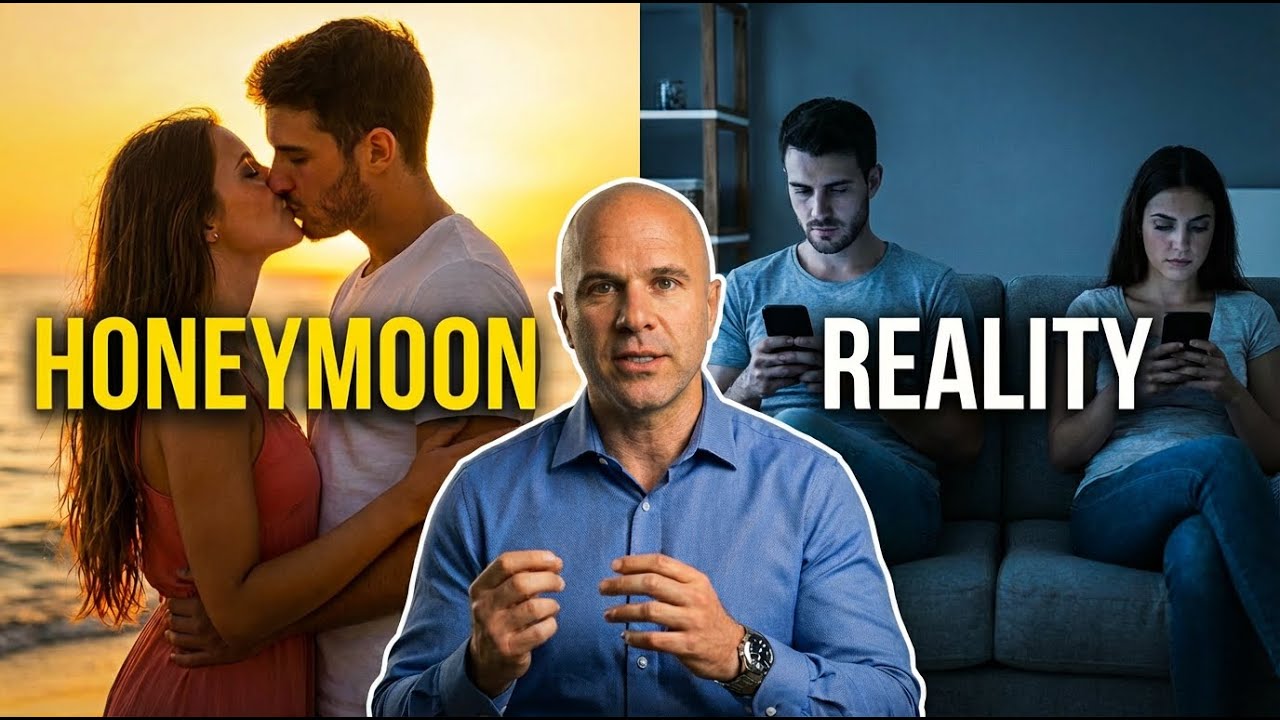
Ralph Brewer explains why the honeymoon phase fades: dopamine, oxytocin, and other neurochemicals surge for six months to three years, then decline. Many men mistake this natural shift for failure. Novelty and unpredictability are essential to sustain desire, especially as routine and stress erode it over time.
Chapters
There is an aspect of the relationship game, the mating game, the dating game, the marriage game, whatever you want to call it, for men in particular, that doesn't get enough appreciation. I've talked about it ad nauseam in all of my material for years and years. And still, when I talk to men one-on-one or men in the comments on my videos and so forth, I can say definitively, the message hasn't really got across to a lot of you. And that thing is the phenomena that we call the honeymoon stage, the early relationship, new relationship energy, or the Limerence phase of a relationship. Exactly what it is, how it works, and what it means for you in long-term relationships. Let's talk about it. The honeymoon phase. We've all felt it, that rush of excitement, that lustfulness, that super amount of energy at the very early stage of your relationship. You cannot stop thinking about her. When your phone buzzes, you get that little bit of adrenaline, that little bit of excitement that says, "Oh, she's reaching out to me again." You have long drawn-out conversations. You have sex like crazy teenagers. You're more patient with her. You're more present. You're more giving. You're more generous with her. And it feels like you you are in love, because you are. But what is this in-love feeling that you're experiencing? It is quite literally chemistry. The honeymoon stage, as we call it, is not just a poetic metaphor. It is a very real and measurable biological phenomenon in the human body. And here's the kicker, guys. For the vast majority of human beings all across the Earth, This feeling, this honeymoon phase that you're experiencing is unfortunately very, very temporary. So, let's talk about what is going on in your body and in hers and what happens when it inevitably dwindles down. What does that mean for you and your relationship? When you fall for somebody, when you really click with them at a romantic level, your brain is dumping a cocktail of chemicals designed to hook you two together. Mother Nature, as I often refer to it, human biology, whatever you want to call it, it is trying to accomplish one thing: get you two to bond together and make more human beings. The body and brain does so via a cocktail of chemicals that I mentioned earlier, and those chemicals are— let's start with the big one— dopamine. This is the pleasure chemical, as it's known. What you're feeling when you fall in love with a woman is the exact same chemical response that you get in your brain when you do something like cocaine or if you win the lottery. Seriously, it's the same process at play. It creates feelings of euphoria, energy, motivation, and obsession. And science can see this change taking place in the brain using fMRI scans. We can see the brain in the centers where dopamine is involved. It lights up like a Christmas tree. Another chemical that we don't talk about often is norepinephrine. This is the chemical that boosts alertness and focus. This is the chemical that gives you those butterfly feelings, the racing heart, the feeling that this is the only thing that you could think about— this person and being in love with them. It also helps you to stay up all night talking to them, or maybe jump in your car at 2 AM to drive across the country to go see them. Now let's talk about oxytocin. This is the bonding chemical. This is the chemical that spikes in your brain during physical touch, eye contact, and yes, orgasm. Oxytocin promotes trust and connection between people. Women experience an extreme spike in oxytocin during sex, and this creates a very strong emotional connection to their partner. Now, let's talk about vasopressin. This is the chemical that is responsible for, in part, pair bonding and very protective behaviors. It is especially linked to monogamy in men. And not coincidentally, this chemical in men raises during orgasm. So, once you have an orgasm with a woman, lay down with her, you're going to be more apt to want to protect her and bond with her. And now let's talk about the chemical that we all know and love. Testosterone. Yes, men have more testosterone in their body than women do, but it does seem to spike in men and women at the early stages of the relationship. With testosterone, you are more energized, you're more aggressive, often in a very good way, and you are eager and ready to pursue the other person. And as I mentioned, yes, testosterone does seem to spike in women at the early stages of the relationship, which in turn makes them more, drum roll, horny. So that's a pretty potent cocktail of chemicals in the human brain that causes you, as you can see, to bond, to have a lot of sex, to feel really great, to want to protect the other person, all that good stuff that says, "I think I'm in love with this person." When exactly does this subside? In most people, we can see it goes anywhere from like 6 months after meeting them. It can last up to like 3 years in some people. And what we see is the brain chemical cocktail changes to accommodate more of a stable, comfortable, secure relationship type of dynamic between people, or that dynamic or the connection between the two people just fades completely. This is precisely where a lot of men say, "Because she's not jumping my bones 24/7, because we're not having sex 3 times a day like we used to, this means that there's something really wrong here." This process of coming down from the honeymoon stage is something that is basically rocket fuel for the anxious man. He sees his woman as not as sexual as she used to be, not as connected, not as lovey-dovey, and he starts thinking all kinds of thoughts like, "She's cheating. She doesn't like me anymore. I'm gross. I'm a terrible man. What can I do?" And on and on and on. And this is where I say a lot of you aren't appreciating where you are on the timetable of a relationship. And yes, this is inevitable, for the vast, vast majority of human beings in long-term monogamous relationships. You are going to see a dip in that romantic lustful connection between the two of you. Now, are we saying, for instance, that oxytocin just completely goes away in our women, you know, once we get safe and secure and get married and have kids and everything? No, but we're missing a crucial component. And this is the part that makes people go, "Oh, that Ralph Brewer, that's not good." And that is oxytocin alone is not enough. Oxytocin plus novelty, newness, seems to be the one-two punch, the one-two combo that really takes a woman from meh to holy shit horny. For many women, too much predictability, routine, yes, safety, security, comfort equals a lowering of that novelty, which equals a lowering of her libido and sexual desire for her mate. It would seem that in the human female, the human female brain to be more specific, it requires some semblance of unpredictability and some semblance of distance in order to keep the flame going. The two big sex hormones that everybody talks about, estrogen and testosterone, After the honeymoon phase, the testosterone starts to level in women and men too, by the way. When men— when we have children and we cohabitate, we see that the testosterone levels in men go down, but we also see in women, especially as they age, the old estrogen ebbs and flows. With perimenopause, estrogen naturally comes down in most women, and this lowering of estrogen can have a major impact on her overall feeling of well-being, natural lubrication and sexual desire. Here is something that is a little disturbing for a lot of people to hear, and that is in some people, dare I say a lot of people, a prolonged emotional closeness to an individual can also lead to a loss of libido, a loss of sexual activity between the two of them. Sounds counterintuitive, but again, when you're emotionally very close to somebody, you know, picture somebody that's super, super close, like they're with somebody 24/7, 365, best friends in the whole world, shoulder to shoulder. There's no mystery. There's no novelty there anymore. There's no individuality. On top of all of this, with the waning honeymoon phase, with the disappearance of the honeymoon phase, let's say, and moving into a more secure long-term relationship and marriage, what often comes with that is stress. And yes, women tend to be— not always, but they tend to be— more sensitive to stress. Women tend to be more anxious than men, have higher levels of anxiety. To be more exact, if we were to measure the human population and say, of all of you, who has the highest levels of anxiety? The people on the extreme, extreme anxiety end of the spectrum are mostly women. Stress is a very potent libido killer. So what do we learn from all this? The honeymoon stage for the vast, vast majority of us is inevitable. It's going to happen, guys. You cannot force your wife to feel sexual desire. You cannot guilt your wife into feeling sexual desire. And unfortunately, you cannot go back and rewind the hands of time and experience the honeymoon stage exactly the way it was before. As I have often said, what you can experience is kind of like little blips on the radar, little spikes on the EKG of lustfulness. You will just see it a little bit here and a little bit there, but it won't be the consistent level that you had in the first months or couple, 3 years of your relationship. How do we achieve those little spikes, those little moments of novelty and polarity and positive emotional tension, as it's known? Well, if I may be so bold, I did write a book on the subject, and it's called The Dead Bedroom Fix, and you can learn more at deadbedroomfix.com. Or check out the absolutely free course that I have online. You can go to deadbedroomfixcourse.com, and there you'll watch 10 videos of myself talking all about this and all about the things that you, Mr. Man, can do to bring about some semblance of the old honeymoon stage again and reinvigorate your sex life.
More from Ralph


Why Women Emasculate Men — and Why You Must NEVER Cave | Alison Armstrong Interview








Sexless Marriage… She Said She'd Rather Get a Divorce Than Have Sex With Me Again