Essential Insights to Improve Your Conversion Rate
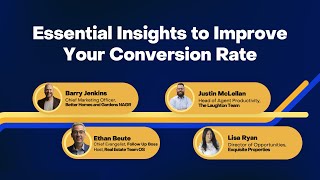
In this Real Estate Team OS YouTube panel, host [SPEAKER A] brings together three regional real‑estate leaders—Barry Jenkins (CMO, MyTeam Ridge, ~80 agents, 350‑400 leads/month), Lisa Ryan (Director of Opportunities, Exquisite Properties, ~40 agents, 600‑800 leads/month) and Justin McClellan (Head of Agent Productivity, The Lawton Team, ~200 agents, ~1,000 opportunities/month)—to discuss how to boost lead‑to‑client conversion. The conversation moves from high‑level mindset (meeting leads where they are, turning “dreamers” into “planners”) to concrete operational tactics: the structure and hand‑off role of Inside Sales Agents (ISAs), systematic KPI tracking, AI‑driven conversation analysis, appointment‑setting scripts, buyer‑agent agreement timing, early lender involvement, and ongoing coaching through call reviews, role‑playing and AI‑generated practice calls. Panelists share anecdotes (e.g., a single‑mom’s 12‑year rental story) to illustrate empathy‑driven selling, and they stress the importance of data‑driven monitoring (appointment ask rates, show rates, offer rates) and a leadership mindset that prioritises serving the client over being liked. The session ends with practical take‑aways: increase talk‑time, use AI and dashboards for coaching, maintain rigorous follow‑up to avoid neglect, and empower agents to own face‑to‑face meetings as the primary win.
Chapters
So we've got a great session here. Just by way of framing it up. Obviously, the goal is to run a profitable business. Obviously, you're going to run a profitable business. You're going to be getting returns on the investments that you're making. Obviously you're investing in leads. Whether you're doing it with your time or money or both, this is an investment. And of course, the best return multiples of returns come when we can turn one person into multiple transactions through repeat referral business and building a great relationship. That's how a great business is built. But it all starts with that initial lead conversion. So that's what we're going to be focusing here. We have three great guests, and I would love for you each to introduce yourselves, share your name, your role or your title, what market you're in, approximate agent count, because I know it fluctuates, and approximate number of leads that your team is working every month. And we'll go this way.
My name is Barry Jenkins. I'm the chief marketing officer of MyTeam Ridge in Virginia Beach, Virginia. Got about 80 agents, depending on the day of the week, and we get between 350, 400 leads a month.
My name is Lisa Ryan. I'm the director of Opportunities Exquisite Properties in San Antonio, Texas, and we are a team of about 40 agents with 30 in production, and we get anywhere from six to 800 leads in a month.
My name is Justin McClellan. I am head of agent productivity with the Lawton team. We're based in Phoenix, Arizona, and we have about 200 agents and we get roughly 1,000 opportunities a month.
Awesome.
I am not in a real estate business. I don't have any agent count to share with you. I've been with Follow Up Boss since last summer, and one of my first charges was to develop and launch a show called Real Estate Team Os. Are you familiar with this show?
It's amazing. Good.
And all three of these folks, if you love what they're sharing with you, they've all done episodes with me. In fact, Barry's done two.
Yes, I've done two.
So that's what I do. I host conversations about building real estate businesses. So to get this thing going, I would love to hear from you, Justin, on. You know, obviously there are a lot of mechanics around generating leads, bringing them into the system, getting them distributed properly. But all of that we can set aside for at least a few minutes because it's so much about the mindset of the agent as head of agent development or what's the property Head of agent productivity. Productivity. Even better. Talk about the mindset of the lead from the lead's perspective.
Yeah, I think it's a, a fundamental piece of the entire process of lead productivity or agent productivity is really getting in the spot of not necessarily where you got connected with the, with the person, but where they are in their journey and maybe what happened prior to that exact spot. Sometimes people, we get connected when they're six days in their journey, six weeks, six months, six years before they actually end up buying a home. But that's, that's a massive piece of that puzzle, I think within our team to help drive productivity. We really dive into that first moment and really dive into trying to get that next step. Because if you're truly going to be somebody's advocate in this journey, you gotta be invested. I think understanding the client's why is big. And one of the things in Agent Ombre's. We've got some of our agents here, every single one of our agent onboardings, I go through a story to personalize this experience for them. And I tell a story about my mom. Right. I'll give the high notes. So quickly.
Hey, most of these people haven't heard this one. Just go at it, okay?
Single mom, she's got two kids, she works two jobs, has two pennies to rub together. She rented the exact same home for 12 years. So I think everybody in this room, as you're trying to advocate for your clients, can say, is there really any financial benef benefit to renting the exact same home for 12 years? There's none. So then I start to think about and unpack why. And I think there's a lot of fear. Fear of the unknown, fear of the process. And I also think that there's nobody that in their circle or in their tribe that is a person that they trust or respect to help them through that process. So my mom, on a Friday night, she puts her kids to bed, all of a sudden clicks that button. Contact agent. Takes a tremendous amount of courage to be vulnerable with a perfect stranger. And that's the position that an agent is in, is to receive that individual that's being vulnerable, that wants to take something bigger for their life. So I think that's a must have with an agent that wants to be part of our company, generated opportunities.
So it's deep in the culture, it's deep in the training.
100% cool.
So part of what I heard there is obviously meeting people where they are. Barry, I know you have a systematic approach to the different stages of the Journey and different mechanisms for helping people through those. Can you break that down a little bit?
Yeah, sure. I love what was just shared about that story. Twelve years in the same home. And really what that story does is it evokes compassion for most of us. We really like a lead that knows what they want. When do you want to move? What do you want? Right. That we love. We crave clarity with our leads. The good lead is the one that can place an order like you're a waiter or a waitress, right. When in fact, the majority of consumers keep in mind this is the largest financial transaction of their life. Most of them are dreaming. And the real conversion, where the real revenue is for most of you is when the consumer answers the question, when are you hoping to move? Or what kind of home do you want? And they say, I don't know. There is an incredible opportunity with the dreams, dreamers. But instead of the dreamer, you saying we should go meet at a house or let's go get pre approved tomorrow. Really what you want to do, the sale you want to make is transitioning from a dreamer to a planner. That's the conversion. That's the moment you can get them as a client. And so then as you transition from a dreamer, they don't know what they want. You help articulate what they want. We use questions like not what home do you want? Which is future. We ask what do you want to change about where you live right now? We ask them to reflect currently and in the past about that. We want them to complain about where they live and that gives them insight into what they want. So then they become a planner. And I don't know about you guys, but I don't have a long list of people in my life that when I get done talking to them, I've learned more about myself. People pay therapists a lot of money for that. You get the ability to be that person. Transitioning from a dreamer to a planner to then a shopper, which is what we all want. But there's a lot of revenue there as a business. If you can master that art.
Cool. Lisa. I know. I mean, I'll just use my language for it. What you all are doing. Exquisite. Is really cool. Around the ISA function in particular, I call it like an empowered ISA approach. And with that, you're helping the scenario where instead of agents meeting dreamers, necessarily some of that is being done through the ISA function. So speak a little bit into first, your title, Director of opportunities, and second to your approach of how you're supporting agents in this yeah, definitely.
So we have a team of six licensed realtors who work as inside sales agents. So these conversations that Barry and Justin are talking about, all of these happen initially with the isa. They're the first point of contact, they're the first impression, they're keeping the lead's excitement level really high. And then we go on to hand off the opportunity to the agent to work from there. So an I have the not so easy task of managing the database and I act as that buffer between the agents and the ISA to make sure that once that handoff happens that there's no neglect happening from there. So I want the ISAs to keep doing all of the lead generating and focusing more on setting up more opportunities. And then I will keep a close eye as sort of a client relations manager. I will call after we set up an appointment. I reach out to the consumer two days after the appointment to see how did everything go. Because we know sometimes some people aren't a really good personality fit and we'd like to intercept any sort of maybe not so happy experience that they had and connect them with another agent. And if I'm not able to connect with them, I'm going in again in 10 days and peeking in again, trying to see how that interaction went. And then we have the 40 day mark. That's where typically the neglect may start. And it's not a bad thing. Agents are busy, we want them out in the field working with their clients face to face. And so sometimes things slip through the cracks and that's what I'm here for. And if we see something, we'll send it back to the ISA to do the follow up. Because agents do not love the follow up and ISAs are really great at it.
How do you all, either of you, how do you all, Are you training agents to manage that? Do you have, I mean it's part of your role, for example, Justin, to monitor that activity and like who is managing that process so that these neglect, which feels like kind of a strong word but I know exactly what you mean by it, so it's effective. How are you all managing that? Because the agents are doing this.
Yeah, agents, our ISA team, we have a small ISA team, we do have a database manager and we have a really robust operational that builds out a ton of stuff within fub as far as the action plans and a lot of the automations that help support it, as opposed to the ISA being a huge piece. I think at the end of the day, in my role specifically, it's more of the KPI management piece where you can see where an agent is falling down, whether it's appointment rate, met rate, show rate, offer. Those are the KPIs that we hyper focus on. And then once we see one of those indicators start to have a trend, all right, let's dive in. And ultimately our agents are intensely motivated to serve those individuals. Nobody wants to drop the ball on somebody's mom because they didn't keep following up on it or they didn't provide that value that they're looking for. So at the end of the day, our agents perform at a very high level for it. So it's just some nudges every now and again.
And to talk about stages, I always love to say that nurturers are the cheaters. That's the stage that I keep a very close eye on. You know, you meet somebody one day and they're waiting until after the election and then you call them and here they are in their new home and we're congratulating them. And so that's sort of the tricky stage. And where I see agents have a difficult time reaching out to that person who said, I'm going to hold off or I want to wait. And they say, Lisa, what do you want me to do? Say I just called them two weeks ago. I'm like, they need to hear your voice. They need to know that you care. Because as much as you think that the agent thinks that they're bothering them, they're not. We're hustling and they'll let you know if you're bothering them.
Yeah, you know, and I, I wasn't doing a good job of, of monitoring the conversations. And, and so I leveraged, you know, I have AI bolted on to follow up boss. And it's listening and analyzing every conversation in my organ. Lots of insights, lots of grading. But one of the ones that was very fascinating was five months ago. It gives me a percentage of conversations where my agents were asking to meet with the lead. And it was 35%. So three and a half out of 10 times they had a longer than two minute conversation. They said, would you like to meet? And so I quickly said, standard operating procedure going forward, if they have a pulse and a desire to buy or sell a home one day and you are offering an appointment and within 30 days. Now I'm up to seven because I'm watching on a weekly basis, seven out of 10 conversations, my agents are asking for the appointment. And 52% of the times we ask an appointment is created in follow up boss. But this Is where with lead conversion, AI is not going to basically solve the lead conversion problem, but teams that integrate AI deeply into their business. In this way, you move at a faster clip than other organizations. And so this is where you're going to watch in a year or two, teams that are moving at that faster clip, they're just going to convert more because their sales team is better trained and better equipped.
Yeah. And it's simple stuff. I mean, I'm sure each of you has something to share on asking for the appointment.
A little part of me died when you said like 30% are asking for it. That was killing me. I think some of our standard metrics is within the first 30 seconds we're offering an appointment. Right. And after all, that's what people want.
Give a little color to that. Like, how does it, like in the first people, like, oh, first three seconds. Yeah, it sounds. What does that sound like?
Hi, my name is Justin. I'm with Lawton team. I specialize in the Peoria area. How you doing today? Awesome. Great. I see you're looking at 123 Main Street. What's a good time to go check it out?
Done.
Done. Yeah, right. I think. I think. And then at that point, they're going to have. They're going to say yes, which is awesome. And then that's where you can do your fact finding. You know what inspired you to kind of look at this property or what caught your eye about this property? Or they're going to say no. All right, tell me why not to. Your point is like the celebration aspect, and then a good agent's gonna ask three to five questions. A great agent's gonna ask nine to ten and go deeper on it. Like, I think one of the things that we coach to a ton is identifying rapport doors. So if a client's saying, I want a five bedroom or I'm looking for a big backyard or I need a casita, like, all those things are rapport doors. And it opens up a question. The only reason why they're talking about a school or five bedrooms is because they have kids or they work from home or there' something unique about it. Don't be afraid to ask that question because then that's when you're going to start to see their why, what's the pain point. To Barry's point, you're talking about, like, what didn't they like about their house? Well, obviously it wasn't meeting their needs, so that's why they need their growing family. And then you can relate. And now you're like to my mom, like the reason why she goes online is because she didn't have anybody in her tribe.
Right.
Well, our job is to find a way where we can connect and be in her tribe. And you got to be invested in the relationship.
Yeah. And it's not easy, especially on that initial phone call. You're asking very personal information. You're pushing really hard to get this person to put their guard down and not have sales breath. And that's why we've had so much success with ISAs because they're not so attached to the outcome being the closing. For an agent who is struggling and needs to pay the bills and get something in the pipeline, the ISA's salary is dependent on that commission. But it's easier for them to push for the appointment if it's a piece of land on a Friday at 5 o', clock, they'll say, well, let's go check it out instead. They're always constantly pushing for that and it is, it's difficult to get that appointment set right up sometimes.
And so your ISAs are asking for the appointment and then that's the setup for the handoff.
Yeah. So we identify who we are as inside sales agents and we let them know. It's not gonna be myself out there meeting you, but it will be someone from my office, someone that I work very closely with so that they know we're not some third vendor party. And then we introduce them with the agent in a group text and say, this is who you'll be meeting with. We keep them very excited and if they have any questions, let them know. And we reassign everything and hand it off. And from that point it's in the agent's hands to that to the closing table. Whether it's a year or two years from now.
I think redefining the win is the win initially. When is the face to face, it's not the close. And making sure you make the celebration of those wins like those, those toll gates are big.
Yeah, that's where I wanted to go next anyway. I mean that is the. Probably the most powerful moment in the whole scenario is that face to face meeting where some of these impressions that they're developing through good conversation, good discovery, you know, some movement into diagnosis prior to prescription, of course, but like getting that face to face meeting. Any thoughts, tips, insights about getting face to face and. Or leveraging that first in person experience to turn into a long term relationship.
Yeah. So for us, the buyer agent agreement process, you know, we've been having buyer Agent agreements for over a decade, but talking about our respective rate of pay at the beginning of the transaction before they found the house was a new venture for us. And for most buyer's agents that are newer or just never broached into listings, for many of you, you've never had to discuss your respective rate of pay with the buyer. The seller handled it. He didn't have to talk about it. Suddenly, you have to actually make a more difficult sale than the listing agent, because the listing agent has to say, oh, you want to sell your home? Here's why I'm worth it. And we show the photos and all this other stuff. As a buyer's agent, it's all conceptual. If you buy a home in the next X amount of months, this is my respective, you know, percentage of commission that I'm going to want. And it's difficult. And so for us, we've been preparing for nine months for this. And what we do is because most of the leads that we talk to are dreamers, they don't know what they want yet, or the home that they picked out, to your point, is no longer available. And instead of the agent saying, I'll call you, I'll send you some more properties, I'll see what's available, we take every conversation as an opportunity to say, hey, this is the largest financial transaction of your life. It deserves careful consideration and wise planning. It sounds like you're still figuring it out. I am so thrilled that you're not ready. I actually specialize with dealing with people that aren't ready to buy their home. I like to meet Wednesday afternoons or Saturday mornings. What we're going to do is an end to end review of the entire process so that you can be empowered, which is a buzzword in our culture. Empowered to know what you want. And so whenever you do decide to buy, you're going to be ready. And so what we found is that for us, this has shrunk our incubation time from lead to closed by 65%. People are buying faster because we're giving them clarity. We're giving them a roadmap. So we sell the fact that they're not ready. We celebrate it. It's not bad news. It's okay that you're not ready. That's what most of us do because we're trying to be nice. This is a celebration of the fact that they're aware that they're not ready and we capitalize on it. And I'll just tell you, this has become a cash cow for my organization. The ROI on talking to people that don't nice what they want, getting them to meet face to face, Having the lender either call or stop by during that meeting has been transformative for my organization.
Okay, I didn't know that piece was in there. So tell us a little bit more about the lender participating in it directly.
Well, look, I mean, this is a lot of money. Yeah, yeah. And so, you know, you can talk about round these round numbers of a half a million or a million dollars. And for many people, it's scary. Right. The lender has the unique opportunity to bring clarity to the part that they're most afraid of. Most of the people that tell you they're wa waiting a year. Like, I don't even know what I'm going to have for dinner tomorrow. Right. I don't know what I had for lunch yesterday. How are they planning 12 months out? They aren't. They're just overwhelmed. So to have the lender do a quick overview of what it would cost them to put down the closing costs associated with the loan, what their monthly payment will be. Right. And when people say, I checked on a mortgage calculator, that's not factoring in property taxes, insurance rates, it's not factoring in HOAs or condo fees, the lender is able to give a degree of certainty that's going to accelerate the funnel without you being pushy. To your point, I'm caring enough about the consumer that does not think they want to talk to me right now. They literally are trying to get off the phone. I'm not ready for you. They think we're door dash guys. They think when it's time to have the door opened, they press a button and we go run off and open the door. Our greatest value is on the front end. And so I'm gonna sit in an uncomfortable conversation for three to four minutes with a stranger. We call them leads and actually talk to them long enough enough to open up an opportunity for them to become aware that they have no idea what they're doing. And I'm the answer in that moment. And so it's become a really big deal. And actually, percentage wise, my agents are making more money per deal as a result of this change, because now they know their worth and they can articulate their worth. And as people try to chip away at their commission. Oh, we need to do dishwasher. No, no, no. I'm worth every penny. And so it's really worked to our benefit.
It's really good. If I was taking notes right now, I'D write something down like, I know there are dreamers in my database and we need to figure out how to have the right conversations.
As usual. Nailed it.
Appreciate that. Lisa, Face to face appointment. You know that, that your, your ISA team is investing a lot in this relationship. They're maintaining excitement, they're driving the opportunity to create a face to face moment for the agent. What is that about from an organizational perspective? What are, what's that experience designed around?
Yeah. So like Barry said, we'll set up buyer's consultations if we really can't. A lot of it comes down to the language that you use when talking to them. You know, they're scared, there's objections that we have to push through and we all, at the end of the day we really should just be acknowledging them and offering some sort of solution. You know, we're going to work at your pace. We're here to take you by the hand. We just want to keep them excited and let them know that we're here for you. We're a one stop shop and we want to be able to provide any service that you may need. And in order to make that happen, we need to connect you with either the lender or an agent. And so trust us, you know, we're happy we got connected to every opportunity that we can and it allows them to put their guard down. But it's super important right now in everyone's database. Like we've recently made some adjustments in our to take a look at agents and see who's calling. We can't figure out the why and the hows and the what's through a text or an email and phone calls are scary. I get it. But it just takes a little bit of practice. And now with AI, it has the capability to sort of coach the staff on what they're doing. Right. Are you confident? Were you able to offer them some sort of knowledge or educate them? Were you able to keep the sales moment momentum rolling? What was the close? Was it clear and concise? So it's. Yeah, it's very important.
Cool. Justin, anything on the face to face appointment, how you all are empowering agents to maximize that opportunity?
I think kind of going back to the beginning a few years back when we were kind of starting in a lot of these company generated opportunities. We had experienced agents that had built a big business as far as their SOI was concerned. And then transitioning from SOI to maybe some company generated opportunities and telling them just go 100%, just go. It was like trust fall like Just fall back. I gotcha. And we had a lot of skepticism from some of our agents starting that out. I said, just take, take 20 and you don't put any barrier. Your win is to get a face to face. I guarantee you'll get at least a 10% conversion on that. And they, no qualifying questions, like no timing, none of that. I was like, if you can be honest with me and say you just go and do whatever you got to do to get a face to face, I guarantee you they got two months, they took 20 opportunities and at the end of that two months they had three conversions and they're like, I think I got two more in there. It's just going to take a little bit longer. And I'm like, when you start to compile that kind of data, then next thing you know you're, it's empirical and it's a proven fact. In the last five years, we've taken 35,000 opportunities and we've had 3,500 closings with that theory. So just go meet a face to face. I think any of our high performing agents that truly embody that are anywhere from a 17 to 25% converter.
Yeah. And I think that's why. And I don't remember the number off the top of my head, but it's like 2/3 or 3/4 of, of buyers and sellers work with the first agent they talk to in person. Yeah, yeah. So with only a few minutes left, I would love for you, Barry, each of you actually, but we'll kind of go down the line. Any other high level, like do's don'ts or anything that you've raised or that anyone else has raised that you kind of want to plus up or double down on.
I think, you know, look, if you want to improve your conversion rate, you have to talk to more people. And if you have a team, I'll just tell you that your agents are scared to talk to strangers about real estate. And you notice the word. I'm choosing my words really carefully. I'm not calling them leads. These are people that have dreams. Right. We're scared. And so what I tell my agents is instead of being so, what happens is they keep that quiet and then they go off in the corner and they're ashamed of themselves and it's this downward spiral. So what we do is we're very, we try to be very mindful, Very demure. Right, okay, sorry. But we do, we try to be very mindful.
See how well that ages.
Yeah, I know, years. But the whole idea is it's okay that you're scared. And I used to think that you needed that. People that had courage had an absence of fear. And that's not the case. You can do something while you're afraid and obtain courage as a result. And so we acknowledge being afraid. We accept it, it's okay. We teach them to do it anyway way and then from there we just let the results speak for themselves. And so my advice is to have courage, have those conversations. And the last thing is just don't be selfish. For most of you, you're so consumed with pleasing the stranger on the other end of the phone that you've become useless. And what I want you to do is instead of making them your best friend, I want you to lead them the same way that your doctor, when you go to the doctor's office and you share symptoms and the doctor doesn't try to get you to like them, the doctor is clinical, the doctor has direction. We have an opportunity to really have strong leadership with these strangers. And so when you're sitting in that conversation, have that leadership role and don't be consumed with getting them to like you, be consumed with serving them with their interests first.
Cool. I'm sure both of you would say yes, but both of you also have some responsibility and opportunity to influence other people to live that out. Any tips or insights on that? Like adopting this mindset and this approach? Because you all use very similar language, which is why I love this panel so much.
Yeah, I think personally it just comes down to your greatest lead source is your own database. Too many times we see opportunities coming through that are actually existing in our own database. And so for anyone out there who's really looking to get their business rolling or you know, scrape up some of the old dust, it's, it's, it's there for the agents. And it starts by picking up the phone. And there's no such thing as too much follow up. And that's going to be my biggest advice. Pick up the phone, do it again and again and again.
Yeah, for sure. I think if I had to give like a nugget that I think has been most impactful and how we've grown, I would say call reviews. So if, if you're a leader listening to the calls, whether it's the initial call coming in or whether it's a follow up call, learning, and even if you're just a practicing agent doing that self scout, to say, if I listen back to it, did I miss an opportunity and how could I go about it? Do that A B testing. It might be painful in moments, but if we're all here to serve, to help people get to that next spot, whether it's a client or whether it's an agent that's on our team, make that investment of time. It'll pay off tenfold. You'll see exactly where that agent is and how you can unstick the them to get them to the spot that they want to be.
Awesome. So I heard call listening. I heard probably dashboards in follow up, boss. Pay attention to what's happening on whole at all the various stages of conversion. But then also work it down to the individual, so that drives overall coaching. But then also work it down to the individual agent level so you can work with them one on one.
Yeah, and role playing too. You know, we've been having our agents practice with AI Just calling AI and just trying to get appointments and. And you know, there's a part of your brain that grows harder.
Make it harder.
You can. There's four levels, I'm sure, and you know, they get grades and all that, but there's a part of your brain that actually grows when you do hard things. And I can just tell you the fastest thing I've ever seen is having an agent Call AI 20 times a day. You know, they're scared, but they're doing it and they're just growing with each call. With each call. It's hard to get roleplay partners at scale and so to be able to leverage these tools that are available to us today, it's a, you know, it's a game changer.
Awesome. Well, that is the time we have. I appreciate all of you spending all of this time with all of us. I hope you enjoyed the session, found some useful information in it, and thank you all for making this happen.
Pleasure.
Girl, you got me.
I'm singing.
It's like.
More from Real










Zillow, PPC, Referrals… what’s actually working in today’s market? #realestateteam
