How Our Teams Keep Agents Productive At Scale [SUMMIT]
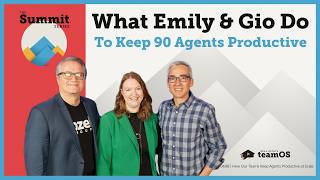
Emily Smith and Giovanni San Genesi explain how Weimert Group and Posit Group keep agents productive through pod structures, single-brand alignment, and tech stacks like Follow Up Boss and dotloop. Both teams promote transaction coordinators from within and roll out new tools carefully to avoid disrupting agents.
Questions this video answers
June 3, 2025
~60 agents
~30 agents
Just over 10 years
Approximately 5–7 agents per pod
Chapters
How do you keep real estate agents productive at scale? Who's powering and what's powering high performing organizations? For answers, you've got this second episode in our first ever summit series here on real estate team OS, featuring Emily Smith, COO of Wiemer Group Realty, a 60 agent team, and Gio Sanginesi, agent partner, who's also served as VP of Growth for Posit Group, a 30 agent team. Both teams have pod structures, but they run them very differently. Their tools and tech are different and we get details on what they're using. Transaction management and transaction coordination has some similarities, but also some differences. The summit series continues right now with Emily and Geo on real estate team os.
No matter where your business is today or where you want to take it, you'll get there faster and more profitably with an operating system. Welcome to teamos, your guide to starting, growing and optimizing real estate team. Here's your host, Ethan Butte.
Geo.
Emily, thank you so much for taking the time to make this happen. I'm really glad we could do this in person. Welcome.
Thank you.
It's great to be here. Thanks, Ethan.
Yeah. For our audience, I would love for you to each introduce yourself and just share a little bit about the organization you work with and your role inside that organization.
Certainly. Ladies first.
Oh, thank you. Well, I'm Emily Smith, COO of weimart Group Realty, and I've been with weimart Group Realty now just a little over 10 years. My title is COO, but I always sort of joke that I just wear whatever hat is necessary to keep the organization moving forward, growing, and keep us kind of headed towards the future.
Nice. Was that a fun anniversary?
It was actually. This is the first job I've ever had in my whole life that I've made it to a 10 year anniversary. So I like change. I like when things are new and exciting. And real estate is that it's new every day. The market shifts. We have to pivot and grow and be able to expand our tool belt. And so for me, real estate has sort of captivated my attention in a way that I never would have imagined when I started in this field.
Cool.
That's awesome. So 10 years, you get a Cartier watch with that?
Oh, I wish I did get a Tiffany like key necklace.
Beautiful.
Yeah, it was very sweet. It was a very sweet gift.
Nice to be recognized. Ten years, that's awesome.
What about you?
So I'm Giovanni San Genesi. Yes, Giovanni Sanjanesi. But everyone knows me as Gio, right? Keep it simple. I am with the Poser group at Kelder Williams and I am the vice president of growth along with being a senior lead agent, which means I'm still in the trenches, happily and passionately involved in helping people buy and sell homes. On the VP of growth side, help with the recruitment and oversee our pod leaders who basically work with our aging partners on a day to day basis.
Cool. Well, we'll definitely be talking plenty of recruiting, onboarding, training, kind of coaching, mentorship. Is that formal or informal? We'll definitely be talking about agent retention in our time together. We'll definitely be talking about pods in our time together. Because I think you all do it. You both do pods, but a little bit differently, but just, you know, for a little bit of fun context. What was the pre real estate version of Geo?
Who were you before real estate on. On a career, from a career standpoint, corporate world. So basically I've been in, in sales in a consultative role since graduating. So I've been in the finance industry, been in the, in the manufacturing industry, holding leadership positions throughout. I was in that role or in the corporate world quite a long time, two thirds of my career to date. And then decided to get into residential real estate in 2016.
Cool. Small business owner. Entrepreneur.
Yeah, entrepreneurial heart built to just be creative and pivot and do the things. And so right out of college I took a job at a very large church as their creative arts director. And what that meant was holding a lot of pieces and pulling them together and that had to do with their technical teams and also their creative teams. And so trying to make sure all of those pieces really fit together. Did that for a number of years. And then I started my own wedding photography business. So I flew around the country photographing weddings for families and got a little tired of it over time, the travel. And also there came a point where I just knew it wasn't the right path for me. I needed to seek out something else. But like Gio said, the skill sets that you build upon in those earlier pieces of your career, it's really interesting how those have all come back to really serve me in real estate. Trying to, you know, pull from all the pieces and bring everything together into one nice package, we do that all day, every day with our buyers and sellers or for our teams.
Absolutely. Real estate brings a lot of disciplines together. And I find agents that know how to manage those different disciplines or at least are open to learning those disciplines are the ones that tend to succeed. You know, everyone's got their background and it's really. To me, it's. It's interesting to see everyone's background on our team and how they've come from a variety of different areas, and yet they all succeed as agents because they're their authentic self, bringing what they have learned and carrying it forward in the best interest of our clients.
That's when one of the most fun things about my seat in this role on hosting real estate at Team OS for well over a hundred episodes is that you certainly see patterns.
Right.
But at the same time, there's just no right way to do this business, and there's no right way to build a team. There's so many different ways to do it, and it's been a pleasure to see all of that for a little bit more context. Gio, like VP Growth, who are you connecting with every day in the organization? Who are you kind of checking in with weekly? Who do you maybe just connect with? Maybe ad hoc or on a monthly basis? Like, where are you plugged into the organization specifically in that role? Yeah.
So if you were to ask me that question five years ago, I'd be connecting with Ken on a daily basis. Right. As we were growing our business, as our content gets more and more expansive, that's become a weekly. So Ken Posak's got a very busy schedule on a daily basis. I'm connecting with other POD leaders and agents in my podcast, in addition, of course, to clients, and then on the operations side as well. We feel very strongly that we are one team. And so our operations and our agent partner team work really, really well as best as possible, understanding each other's roles, understanding each other's sides. And so we take great pride in the fact that we are one team working towards one initiative, and that is serving our clients to the highest level and being there for them every step of the way.
Cool. How about you, Emily?
Awesome. So my day. I think I'm just gonna maybe preface this a little bit.
Okay.
So my day is different every day of the week depending on what we're building towards. Like, in the beginning, when I started with Jenny, I started actually in a marketing role. And so in the beginning, it was just taking those pieces and doing what we could do. And then over time, it built more into, like, our systems and building out those systems. And that allowed me to step fully into this role that we call COO on our team. So my day still functions like that, where I'm. What project are we working on? Who do I need to be talking about that? I have touch points built into My day for the staff itself, so making sure they have what they need and what they're doing. But really our goal is to hire really capable, amazing people who want to do the work with us and not just for us, but with us and build those partnerships so that I don't have to talk to them every day so that if they need something, I'm there. Or for problem solving, we can do that together. But so that they are operating on their own as like absolutely true independent partners of the team and they're just keeping all the pieces moving. So my day literally looks different based on if something is breaking or if it's all running smoothly. I joke. I spend three quarters of my time playing therapist to our, our team. It's just a lot of encouraging. It's. This isn't going to be both, right? Yeah. And some of that may just be personality based for who I am, but it's helping people reach those goals no matter what they are. So it's. I'm struggling today I talked to this lead. I don't know what to do about this situation. And we're just problem solving on. What could you say? How could you go back and re. I'm sure your day is like that too.
Absolutely.
And really, you know that that extends to the role of a realtor. I mean, the old realtor has many hats and one of those hats is that of a therapist. Right. Understanding your clients and what they're going through as part of the process of selling or buying a home. So we do carry that hat quite a bit. And then internally, of course, just being there as a sounding board, as, you know, an individual that, that will listen and help and guide as much as possible. But to your point, you know, our agent partners are all, all independent, you know, business people, 1099, if you will, working towards an effort, but really working towards that effort as one when it comes to branding and when it comes to, you know, our core values.
Yeah, I definitely want to talk about branding with JIO at some point during this session to see how they approach that. But the other hat I feel like I wear during the day that feels role specific is being a learner. I, I take it on my shoulders to be a learner for the organization. So it's what tech is out there that we haven't seen yet. What are other teams like ours or not like ours doing?
Is it, are you committed to that in a way that you are time blocking it or is it just kind of your default where you're, you know, when you're reading on a Thursday evening, or you're scrolling a feed, or you're. Those are the things you orient yourself toward. Or are you, like, time blocking?
I wish I could say I was time. I want to say I'm time blocking.
Say, yes, Emily, that's the answer.
I want to say I'm time blocking.
I'm not a tie. Right. I'm not a die. I can't do it. Like I told you, I'm creative, so I'm more of an organized hot mess. Like, I can tell you where it's all at. I know. And ironically, I'm the one building our systems. I realized a long time ago that my greatest gift is to really see a holistic picture and build a really great system, but to not have to live in it and so I can move on and build the next thing.
Yeah. Just to take off on that a little bit or to extend on that, we've got this phrase that I try to encourage all of our agent partners to consider at all times, and that phrase is be the best SOB you can possibly be. Anytime I present that for the first time, their eyebrows raised like, oh, what are you saying? Jail? And really what it is is being the best student of the business. Right. Always being curious, always wanting to learn, always wanting to understand where we are currently and where we need to be, you know, in terms of our business overall. And so that's what it's all about, I think, you know, anytime we get to a static position is when our business will flatten out and not be what it could be. So be the best version. Be curious. Be the best SOB you can be.
Absolutely. In this business. I think you mentioning I'm in the trenches, I love being in the trenches. I'm not in the trenches in the same way that you are not in the field as a licensed agent. But I spend a lot of time listening on my calls so that I can approach problem solving like I am in the trenches. Absolutely on purpose. So that for us, they think it's that, how do you help problem solve for your agents if you aren't listening to them? So making sure you're hearing them on. Okay, we're missing a tool here. Like I've heard. I've had the same conversation three times this week about a gap that's happening for maybe a specific problem in a contract. I'm like, we need to solve that gap. So it's being an active listener in this seat. It's really thinking through what's next and then being willing to pick up the phone to other great teams and ask the question, how are you solving this gap? Or do you know this is a gap? Can we solve this together? Like, is there a way that we could figure out this gap? I'm grateful for the industry relationships. We have to be able to do that problem solving.
That's one of the things I really enjoy about my seat as well, is that everyone's very open and available in general in a way that I haven't seen in any of the other industries I've worked in or been closely associated with. So in the spirit of what you just shared, I would love for you to ask Gio a branding question however you want to. We'll go to branding next.
I'm just curious. So in our world, when agents come to our team, one of the questions we always have to talk about at the table is what is your vision for what you want your brand to look like when they are sort of launching themselves to the world? And at wimurt, we all fly the same flag. We are all weimert everyone brands to wemer, they don't use outside colors, outside logos, because in our minds, we're building our reputation together, our kind of that track together. So I'm just curious, that Posac Group, what does that look like for you guys?
We're very similar. We follow one brand, and that's the. The poser group brand. So a lot of our agents come to us with a certain level of activity of their own and having created their own brand. And so one of the discussions we have is, are you willing to reset that into what our brand is? Because our brand is what drives us. Our brand and content that supports it is what drives us. So very much intentional that way with every agent partner that joins, and if they're very active on social media, they pivot to understanding what our brand is, what the sort of parameters to our brand are, and then work with their pod leaders and our marketing production team. So very similar. I mean, obviously your organization as well as ours has done a good job of not cluttering up the identity of who we are.
Yeah. And I think that's what separates a solo agent from a team agent. Where do I belong as a person? One of these is like, what level of control versus what level of freedom? You know, some people talk about it in terms of ego and humility. I think those. Those are a little bit loaded for the conversation. So it's like, what level of control do you really need or want for yourself? And people that are like, I Need to do things. I want bright red. Well, that's not what we're doing here. And so, you know.
Well, and that's alignment. Right. So it becomes easier at the table when you're hiring if you're clear on who you are, which I. I love the way you just explained all of that, because it's very clear that you have that piece figured out.
Yeah.
And so when you're talking to another agent and you're saying, I really love what this could be, this could be a great partnership, but this isn't in alignment with who we are as a business. So this isn't maybe going to be the best fit for you or for us. And that's okay. We'll wish you the best.
They could have the great skill set. They could have, you know, part of the core values, if you will, or all the core values. But if they can't, you know, assimilate themselves to what our brand is or don't want to, we do the same. You know, we part as friends and we wish them the very best because our brand is everything to us. It's. It's what gives us the opportunities that we have today and in the future.
Cool. You mentioned pods a couple of times already. Let's go there next. What is your pod structure? It sounds like you are actively a pod leader.
I am.
What does it mean to be a pod leader? What's the pod structure? And what is the benefit to the agent and to the business overall of.
So I think. I think as I answer that question, we speak to the evolution of pods within our group. Anyway, when I started with Ken in 2017, it was him and I, an ISA and another agent that had just joined us. So we were all working towards, you know, an effort to build the business within our business, if you will. As we started to scale and expand, we started to realize that having me oversee all these agent partners would be very, very challenging. So we started to create pods. And in the Keller Williams world, that's not the way it's normally done. Right. So we created something that we felt was going to be a lot more int. Intentional and a lot more productive in the eyes of agent partners who generally want a couple of things from a team. Right. One is accountability. Who's going to hold them accountable? Well, If I'm managing 16, 17, 18, 20 agents, I can hold them accountable, but to a certain degree. Whereas we had someone, another pod leader, if you will, with a smaller group, 5 to 7 is the average within our pods. And so we've evolved because of that, we've evolved because of our growth, our scaling and the need to maintain our value proposition is in that if you want accountability, we're going to offer that to you in every other aspect of the business. So even in those sessions we become therapists sometimes where it's not just production based discussions, it's more of this is where my life is today and it's impacting my business. I need to figure this out before I can figure my business out. And so we act as support mechanisms for that as well. So for us, we've built our pod leadership team to five now. All right, we're just over 30 agents. So if you do the math, it's going to be five to seven.
Right.
For each. And that's how we'll continue to grow. Our team is, as we grow by another five or six, we will bring in another pod. We bring pods in in advance as well. So our pods start 60, 90, 120 days in advance of them receiving their first agent to oversee. And we do it very intentionally, very purposefully, all with a value proposition to ensure that our agents are receiving what they're anticipating and getting the support that's needed. Because this is not an easy business.
You know, and so, so it's about, I mean, not just some of the accountability, psychological support, being heard, feeling comfortable and confident with the people around you, having a little cohort in this larger organization, scripting role play. Yeah.
And getting into the, the nuts and bolts of, of the business. And so we, we have agents that come from different walks of life. We don't necessarily look to hire anyone within a specific background. Part of our value proposition is curiosity. Right. So bringing anyone that has a level of motivation, a willingness and really the goal of succeeding in the business. And that hopefully comes with some inherent qualities that you look for and the ability to learn all the other things that are necessary. So that's really the purpose behind all of this.
Is there an organizing principle to that 5 to 7? Like is it geographic? Are you intentionally like, you know, mixing up experience levels? Like is your organizing principle or is.
It like it's optimizing? Optimizing again, the value of what a POD leader will bring. Our POD leaders are all in production, all very productive, successful experience, and they're all as passionate as I am and that is they want to continue to help serve buyers and sellers. So optimizing their time in being productive agents as well as their time in being leaders within their group of five to seven. We felt five to seven would be a Good number to work with. I work with whatever they're comfortable with. And five to seven seems to be that number.
Cool.
How about you, Emily? I know you have pods, at least in name. How similar or how different is it and how do you do it?
Sure. So for us, we're not using agent partners as our pod leaders. We've tried a lot of different versions of that over the years. And what I found was they would cap out on their own ability to be helpful. Helpful when they themselves were busy. So even with the best of intentions, they were not able to check in with their teammates because they all of a sudden had a deal going sideways or something was going on. And I totally understand that all of that can be incentivized, and it can be done in a way that might work extremely well for us. It just didn't. And so a few years ago, we organized ourselves by transaction manager. We have three, and each agent is assigned one. And it's not evenly split. It's not like you could take our roster of agents and divide out amongst the three because it's somewhat based on the agent goals and their production. So we have one transaction manager that has like 30 agents and another that only has 15.
But again, those 15 are more productive on average.
Correct. But the transaction managers in our world have been with us, all of them, more than seven years. So they have seen hundreds of contracts. They have an expertise level. They're all licensed, actually. And so they have an expertise level that creates more of a partnership with the agent. So instead of putting an agent over a pot of agents, we had this idea of why not put the transaction managers over a pod of agents? So they now coach, they now are going, whew, this agent keeps missing the same spot on this contract. Or this agent has got a hole here in their business. Or I'm seeing that we're missing the pieces and they're able to come behind them and a pick up the pieces with them or for them. But then they can bring that up the chain and say, hey, I think we need some coaching on this area of the business. Now, I want to acknowledge that's really only from like, contract to close. And that's where that piece matters for us. On the front side of the business, when we talk about leads, we have a leads manager, and our leads manager is doing something similar where she's watching databases and watching. Does this agent understand how to talk to this particular type of lead? Do they have the tools that they need? Do they have the scripts that they need? Do they have what they need in order to connect with the lead up front. So it is a little bit of like a split model. Our pod section falls into the backside. We also have smaller versions of what you've described on our team. So right now we have about 10 showing partners on our roster who are really just buyer specialists who aren't quite ready to do all of the things that real estate entails. They're people that are newer to the business or they're just kind of getting their feet wet. But they're partnered with a lead agent on the team, and they're essentially bringing them up in real estate and teaching them about part at a time. And so starts with learning how to do open houses. It starts with learning, you know, what do you say to someone when they're standing right here with you versus on the phone? And it's working them through all of the beginning parts and then teaching the mastery around those parts. And as they graduate through, they could step out on their own onto the team. Or I have a showing partner that's been with an agent for, like, I don't know, six or seven years. And it's just.
And that's the role that they want.
Yeah, they love it. It's the. It's the piece of the business she loves the most, and she loves the agent that she works with. And part of what makes that work is he's very fair to her and he's good to her. And so because of that, it works for them and it will work, I think, for a long time. And I think there's a beauty in recognizing that when you've got good people around you, no matter the seat, if you take care of them and you are good to them, they could live in that seat longer than maybe the path or the book that we're all reading tells us that they could. Like, yeah, there's no one right way.
Especially if we're open in the conversation. I'm sure you're having these conversations all the time, and all the other pod leaders are too, is like, what do you really need and want for yourself? And if this person wants something different or air quote more, then you help them get there. But if they're. If they're satisfied, they're challenged, they're in. It's working for both parties, then there's no reason to know to change that up too much for sure.
I don't know if you see this, Gio, but oftentimes we sit down with agents that I feel like when they come to us from other Places are being talked into wanting more than they want for themselves. So they're like, I should hire an assistant, I should hire a showing partner, I should go to this next level. And if you stop and slow down and ask them, well, what do you need out of this? I love that. What do you need versus maybe what do you want? Because there's a gap there. And that could be monetary need or that could even just be ambition.
Let's unpack that. Let's understand, you know. And so we don't have showing assistance, although we're starting it off with one of our agent partners, one of our more productive agent partners, and we're going to see how that works. And the reason we haven't brought in showing assistance is because, you know, our agent partners basically take it from step one to close and develop the relationship along the way. And once they're under contract with a client, our transaction coordinator will then step in and parallel the efforts to close. So we often have a very successful, high rate of closing. There's four steps to the business, as we like to say, right? It's the contacts that creates the leads, the leads that creates the contracts, and the contracts that get to closing. And each step is very, very important to understand. So we make sure that the support is there. Now, with that said, the sort of intentionality when it comes to the people that represent us. Core values, personality fit, culture fit, wide ranging. It's never within a narrow scope. If you hire good people, as you said, Emily, then you're going to get the sort of culture that you're looking for. If you hire with what it is you're looking for, you're going to get the ability to scale and not, not deviate or compromise who you want to be. And so Ken and I were very clear in 2017 when he said, you know, I think we're onto something and I think we want to start growing. We both saw that vision for growth in a very similar way. And that is we wanted to make sure that as we grew, our culture never changed and that whoever we brought onto the team would want to stay. And so we're very proud to say that our turnover is also very, very low.
I'm curious, Gio, when you talk about culture and you're describing that to someone, if someone were to say to you, like what? How do you describe the culture at Posack Group? How do you do that?
It's a selfless culture. That's how I describe it. So we're all independent, we're all working for ourselves. Within the brand of the Poser Group. And yet when we have, you know, a lot of our communication is done through Slack. For those of you that use Slack, big fan. Me too. Yeah, we find it just a great way of just keeping the team together and so. And yet when someone, you know, shares that they've got a contract, we all celebrate with them, we all applaud them. When someone joins the team, we make them welcome. When someone is struggling with a challenge, you know, even though their pot leaders are there, sometimes they want a different perspective they'll get on our Slack channel, we've got 30 plus agents that will be more than happy to provide their version of a solution. And so that's who we are. We're a selfless group who care for each other that are working towards the growth of our individual businesses in the scope of the overall business known as the Poser Group. And as a result, many people on our team refer to us as a family. And families stick together, families support each other, families, you know, are there for each other. That's evolved because there was again, intention behind who we are. And, and Ken, I have to give him a lot of credit. He's, he's very successful, but he's very humble, modest and, and open minded.
Sounds like a good Michigander. You know what I'm talking about?
He does, right? Yes. Are you from Michigan originally? Part of the story.
I was like, he's from Toronto, Ken's from Kennis.
I'm from Michigan originally, so I know exactly. I'm the outlier here. But there's a certain, there's a certain level of character, if you will, that comes from Michiganders. I can say so respectfully and I love that. I spent a lot of time in Michigan in the corporate side before I got into the residential side.
But can you show us where Ken lives on your hand?
Absolutely, absolutely. He lives right there.
Absolutely, absolutely. Absolutely.
The mix, right? Yeah, sure.
So where I'd like to go next is, you know, just in the spirit of the name of the show, which is real estate team OS OS's operating system. I think of the operating system as the combination of people, process and tech that we put in place to allow our agents to do their thing in accordance with the business model that we've designed. So with that, is there a key role or is there a key process or is there a key piece of tool or technology that's been critical to the Posit group or to Weimart Realty that you'd like to highlight and maybe get into a Little bit.
So our tech stack to us is everything. I have a work smarter, not harder mentality. I also try to keep in mind that our agents are in the field, but so often our operations team is in house, so they're on a computer at a desk. So what might work for them in a process may not work for the agents in the field. So we try to keep that mind when we design a new system, practically speaking, before we get into the nitty gritty of what the systems are. I'm very determined to not train agents on something in the middle of busy season. So I really strongly believe when you implement a new system matters, when you onboard new technology matters so that you don't disrupt agent life or their ability to serve their clients. Like you've mentioned so many times at a high level because you're just trying to introduce a new piece of shiny technology. So we try not to change technology too often in our worlds if at all humanly possible. Every agent in our brokerage uses the same technology. 100% adoption that is unique, I think, to the real estate world for the most part, unless you run a team like ours. So I want to acknowledge that I always feel bad for team leaders when they're like, I've got people on five different versions of CRMs. We don't have that problem in our world. But Follow Up Boss for to us was the biggest domino to changing our business. We've been with Follow up boss almost 10 years and it's the place to get agents out of their phone, out of their Facebooks, out of all those other places that they keep contacts to put them into one organized spot and.
Maybe lose a little bit of time in the process.
100%. 100%. And so it's how do you teach agents that you know these tools you're putting in front of them matter? How is this going to save them time? How is it this going to do those parts? But Followup boss is the first domino. If you can teach an agent how to stay organized about who to be speaking to when, whether that be a lead or that be someone that they served three years ago that they need to keep track of in order to build that repeat referral cycle type of relationship that's really important to us. So Follow Up Boss is big. The team all uses dotloop as our signing platform. And then beyond that and for contract to close anything signing has to do, it's dotloop. Our entire backend is built on Monday dot com. We built out ourselves because we couldn't Find the thing. We didn't want to hobble together six versions of technology and keep duct taping. I felt like that's what we were doing. So we built our own through Monday.com and between those three pieces we kind of live a little seamless life and we will pull tech in where we need it. Like we have pieces and parts that integrate with Follow Up Boss that allow us to nurture our database or allow us to do that follow up. We've just integrated with Rooster, which my team is really loving. Little plug for the Rooster team because they don't have to leave Follow Up Boss to set up an MLS search. Like, we are constantly looking for ways to save the agents time so that we can prove to them like you can do this. Technology's helping you. It's not hurting you in this business, it's helping you move faster.
For us, very similar. We're very consistent in the. In our tech stack, there is no multiple CRMs. It's one system that we integrate each of our agent partners and our whole team around. For us, it's rew as a CRM. We use DocuSign basically. And the other big part of this is we're super, super proud of our transaction coordination team. Our TCs are amazing. You probably feel the same about yours, but we feel without them we would not be able to do what we do as agents. And so that's a big, big part of our value proposition, is keeping it consistent, teaching to it as necessary, and again, being one team. Operations and sales, working towards the effort of serving the client best. Because at the end of the day, without them, we have no business.
Great tc, where do you find these people? I know that you're not responsible, Gio, for finding these folks, but where do they come from? How do we find them? Do they exist in our organization already and they're waiting to be plugged in there?
Ours did. The last two TCs we've hired came from inside the organization. They were actually agents in the field that wanted a different life. They had small children. They were tired of running around town opening doors. They understood real estate at a high level. Traditionally speaking, they need to be a little more organized than what I see a traditional agent in the field be. So they've maybe a different gift set out of the gate on that. But for us, the last two that we've hired have come from Internal. On a hiring note, I think finding people that are passionate about not just administrative task, but also in. Do you thrive in chaos? Do you like putting all the pieces together, does it make you happy to get to talk to the title company and the lender and the clients on the other side, if you're filling in gaps for an agent and could you see yourself as a real partner? So when you're hiring, it's looking for someone that, yes, can do administrative check off the boxes, but it's somebody that also really just enjoys solving those problems and loves people enough or cares enough about that client experience piece to marry the two parts and to say, yes, I'm going to take really good care of the checkboxes, but I'm also going to take really good care of the people.
Yeah, it makes more sense now that your TCs are leading ages.
Like that helps.
I mean, it's not critical, but it does help.
It does. We've recruited, but again, we recruit in the same way of ensuring that they meet the culture, the core values, and again, they can live in chaos because, let's face it, we all live in chaos when it comes to real estate. There's so many moving parts at times that you just need to know how to work with it. So we're very, very happy. We just hired a third recently as well, going through the same process. And for us, it's almost like looking for that needle in the haystack. It's not as evidently available as you would like to think. And so. So we've gone through a ton of interviews to find that one person that. Because again, for us, it's all about ensuring that we hire someone that's going to want to stay with the group, grow with the group and be part of the group. We don't like turnover, quite frankly, because stability is disruptive. It's very disruptive. Stability is our intention always.
I'm sorry, I was just going to say I heard you had 400 applicants.
We did.
For a TC position. So the ability to comb through and really find the right person, like, what a great pool. Yeah.
And we don't compromise. We don't compromise. Like, even when we were close and I was not involved directly, just hearing through ken and our TCs, who were a big part of the process, even when we were close, we did not move forward until we were at a point where we said it was the right person. And, you know, having met her recently. Absolutely. She can be a great fit.
That's awesome.
I love including the tcs and the TC hire. I think just in a variety of different organizations, I've worked in not including the peer group in any way. I mean, it's not A group decision. Not everyone gets to say who they prefer, but like having them weigh in on it and making sure that they're going to plug in correctly and making sure that you as a. I speak to either of you personally, but like to you as the decision maker or the hiring manager or whatever the. You know, we want to call that opportunity, letting those other voices in because you don't. You're not in those seats every day. So anyway, I just really respect that your TCs were involved in bringing on the next TC.
Absolutely. You think about it, it makes sense. It's relevant, you know, they know what it takes. Now, a TC role with us is probably different than a TC role with your company and different with another brokerage. Our TCs work to who we are, work to our systems, work towards our objectives. And so hiring to that needs to involve them. And again, this is where Ken is very open minded on the process of hiring talent. He had several people involved in this case. There was also an office manager and others involved as well. So it's been great.
Yeah, I really feel strongly like hiring the right people does lead to that loyalty piece. Not just from that person, but from the team that they're trusting that the organization is going to make a good hire on their behalf. Trust. And for them to be willing to say, I'm going to continue to stay here. We call it leadership team, but call it the whole team is looking out for my best interest as a whole. They're trying to make those decisions. And I think that goes with hiring. I think that goes back to technology. Having leaders that are looking around the corner and saying, we've tried out 700 versions of this, not within the team, but ourselves behind the scenes. We've tried it and then we tested it with a few of you before we launch. Anything breeds trust.
Yeah.
So you're not just quickly pivoting. Jenny, for a million years has said we are driving a cruise boat. We are not jet skiing. We have to keep that thing strong and steady. There are too many people on board and too many families. If you go out a layer that this affects their real lives, what they bring home, it affects their quality of life, their sanity, like all of the pieces. So whether it be the person we're hiring for a role or it's the technology pieces we're onboarding, that all builds or tears down trust extremely fast.
Yeah, the, the speedboat or, sorry, the jet ski versus the cruise ship. It reminds me of my conversation with Billy Hobbs, the COO with the Lawton team in Phoenix, he referred to it as jerking the wheel. He's like, you know, we certainly have, you know, in theory, plenty of reasons to jerk the wheel and make quick decisions, but, you know, ultimately it's bad for everybody.
Yeah, 100%.
Yeah.
I mean, I probably had 10 emails this week from technology companies that would maybe even be a great idea or would be something that we could do. But you have to stop and ask, is this the best thing for the organization or if it is a great thing, what's the timing that this will be best for the organization? In.
And I think you're both at, I mean, even though you're at different sizes, I think you're both of an appropriate size to test something out. So you take the meeting, you vet it out, you weigh it out, you look at the cost, you look at, you know, is this going to duplicate with any of the systems that we have or is this whole unique. We move forward. But before rolling it out, maybe even choosing the timeline, you're testing it with some agents to figure out what is this 100?
Because on that call with the salesperson.
It sounded like a five day onboarding, but it turns out, you know, is.
It a five day operating?
Yeah, anytime. I'm sorry, go ahead.
No, I was just gonna say anything. Are you doing the things you're promising? That's the biggest thing. That's the key.
The value proposition that you convey at the very start has to be maintained or else that trust is not there, the confidence is not there. And for us, when we made the change from one CRM to another, we actually brought the new CRM that we're now currently using and just basically allowed our team to work with it in parallel and determine that it was something they were going to be comfortable with in making the transition. We went through that process and the transition was, was very well received, you know, and if it wasn't for that CRM, quite frankly, it'd be really tough to, to manage one's business, you know, because we allow up to 100 team leads, if you will, for them to manage. That's a lot of people. And so how do you manage 100 team leads without technology?
Yeah, I mean, that's another benefit of that trust and stability that I've heard from both of you. And your organizations is like they're half bought in on it anyway. They know that you're not jerking the wheel or driving a jet ski, you know, that they're acting with best interest in mind, you know, that they're including agent voice, even if it's not mine, I know that it's her or him that's also being included in the decision or the process.
I hope you enjoyed the first part of our conversation here with Emily and Gio. We'll join them again in just a few episodes when they walk us through end to end exactly how their teams recruit onboard and train high performing agents. Next in the series is our panel of four real estate agents and they started with our four team leaders but today two are solo and two are still with those teams. In fact, one says she'll never leave that team. They welcome us into how they structure their day, the role of their CRM, how they found their team, and so much more. If you haven't yet signed up, go to realestateteamos.com subscribe right there. You can get updates on this series. You get email exclusive insights every single week. You get instant access to eight Subscriber Only episodes. That's at realestateteamos.com subscribe. Thanks for checking this episode out.
Thanks for checking out this episode of Team os. Get quick insights all the time by checking out real estate Team OS on Instagram and on TikTok.
Tik tok.
More from Real










Zillow, PPC, Referrals… what’s actually working in today’s market? #realestateteam
