Operations Leadership from Assistant to COO with Christy Belt Grossman | Ep 023
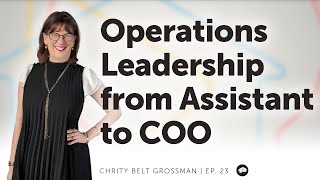
A recorded interview (Real Estate Team OS, Ep.023) with Christy Belt Grossman on operations leadership in real estate. Christy defines the hallmark of high-performing teams as "life-giving leadership" and traces her career from mortgage operations to COO of a billion-dollar Keller Williams team and now founder of Ops Boss Coaching. The conversation covers an ops-role taxonomy (assistant/task-oriented → director of operations/result-oriented → COO/growth-and-vision partner), hiring and comp practices (salary surveys, pay at/above market), KPI and weekly meeting structures (20-minute Monday goals + weekly business planning), delegation flow ("I do / we do / you do / you own"), and how ops must shift from efficiency to measurable results—especially in shifting markets. The episode closes with personal anecdotes, contact links (opsbosscoaching.com, Instagram), and practical encouragement to co-create ops roles and document systems for scale.
Chapters
For insights into optimizing your real estate team, we're talking with Christy Belt Grossman.
But if I hire someone who's building along with me, together we're going a lot higher.
She started her career running operations in banking and mortgage. She spent more than two decades as COO of the Belk team, a high performing Keller Williams team in Northern Virginia, and one of the first teams to hit a billion in sales. Today she's the owner of Ops Boss Coaching, providing education, community and coaching to real estate operations professionals. Thanks so much for talking team Os today, Christy.
Thanks for having me, Ethan. Super excited.
Yeah, I'm really pleased to have you on the show. I think as many operations people as I've heard from in the four months since the show's been live, they're of course dramatically outnumbered by agents and team leaders and brokerage owners. So I really want to bring that sensitivity to this conversation and you're the perfect person to do it. Uh, but before we dive into your specialty, your expertise, your background, and what you're experiencing in coaching all kinds of folks across the country, I'd love for you to share a must have characteristic of a high performing team.
This is such a great question. And I struggled with it. And I actually went back and listened to all the legends that you've had on your show and I'm like, yeah, I agree with that. Yeah, I agree with that. I kind of narrowed it down to a couple things and then ultimately I'll give you my final thoughts, I'll give you my final answer. I almost had to find a friend. I started thinking about it and I started thinking about the mistakes that I made in my career and then how I've come back from those mistakes. And so one of the things that I'm super passionate about for high performing teams is that we're united in mission, vision, values. And I know you've had a couple of other people talk about that, but that those mission, vision and values are actually living in, in the hearts and the minds of every single person on the team versus just hanging on the wall or it's just in my leader head as a leader. And then I'm like, but that's not enough. And I think one thing that really jumps out at me as I observe real estate teams around the country and transaction coordination companies and all the different businesses that we coach is there has to be an evolution of superstar salesperson. I'm a great realtor. I'm great with customer service, great with my numbers to being a great business person. Business Boss. And that's where most people stop and they don't evolve into life giving leader. I call it life giving leader. So it's not just being a leader, it's being a life giving leader. And everything else flows, I think, from that, whether it's trust, confidence, hope, creativity, action, all of those things kind of come from leadership. So I think that's where I kind of settled in. My answer was life giving leadership.
Really well done. And thanks for diving back into some of those other episodes.
That was great. They're awesome.
How. Thank you. It's a joy and privilege. Life giving leader. Give us a few more words on that. I mean, partly, I imagine that it's some level of intentionality. It's like conscious awareness of my opportunity and response, responsibility. In this position. I think a lot of people are leading kind of by default rather than by intent. Is it, is it really about intention or are there other nuances there?
It's about intention. It's about what's important. It's about how you move through your day, through your week. It's about, am I working from multiple priorities at any given time so that my team is in chaos, or am I working from a singular priority and casting that vision down? Is it about I'm inspiring people because I have big numbers. Am I just talking to inspire people or am I actually walking the talk and being purposeful and intentional in what I'm doing? Am I treating people as leverage or treating people as people to some offload tasks? Or I have so many leads I should just bring more agents on my team because I can make more money if they do more business? Or is it truly about partnering with people to build something bigger and better and changing the world? Right. We have a huge. I'm super passionate about real estate as a vehicle. We have a, an ability. How many people get to go to work every day and love what they do and help people change their lives and be passionate about that. Like most people go to a 9 to 5 and are miserable and we have this ability to do something completely different. And as a team leader, we have that ability to do that with each person on our team too. And so I see a life giving leader as someone who is partnering to do bigger things with each person for their benefit as well as for the benefit of the whole and the world.
It's an opportunity all of us have really in the various different roles that we play in our lives. I think, I mean, part of what I'm taking out of the way you describe that is being Present, you know, like not being with someone and, you know, having your mind and thoughts on a variety of other things and wondering when this is over and I can get on to the next thing. We're not doing what seems right, which is to be present with other people, to be of service and value, to actually be curious, to actively listen and some of these other things. And I now understand life giving in a much more literal sense from, you know, the impression you left when you first said it. Now I feel it very, very literally of it is giving life to other people.
Giving life to other people and to their dreams and aspirations through uniting your dreams and aspirations together for something bigger, I think is where I'm going. So it's not about grow. It is about growing sales and it is about growing profit. And yet if we grow our people, our business grows and our profit grows from that. And I think oftentimes we go about it backwards. And I know on my real estate team, we kind of went about it backwards. We built our business plan first and we focused on all the numbers and then we added in a mission, vision, values later, and it didn't work. Work very well.
Yeah. How are we going to fire these people up to do this thing?
You know, kind of came crashing down while we had people leave us and. And they should have.
Okay, you just set me up for where I wanted to go next anyway, which is summarize in whatever way you think would be useful to the types of folks that are going to be engaging in this episode. Your career arc leading up to and into the Belt team.
So I went to the College of William and Mary, which is considered to be a public Ivy. It's the second oldest college in the United States and we have a lot of really awesome people that came out of that. And yet I came out of it looking for a job and not a career. I didn't think that I wanted to have a career. I just wanted to get married and have a job and live happily ever after. We built our first house. I made a mortgage application. I got recruited by my loan officer to come into the mortgage business. I ended up loving real estate operations on the mortgage side, ran seven offices of a national mortgage company in three states, and then realized that I was out of alignment with my personal values. And while I loved passionately my career and I really enjoyed doing it, I also adopted two children and was not spending any time at home. And my husband would bring them in at night to have ice cream with me at the conference table so. So that I could See them before they went to bed. And one day I woke up and said, this is not what I am meant to do. And that's how I got into real estate. So joined the real estate team. We were one of the very first teams before teams existed way back in the day and we built a real estate team that became the number five team in the world for Keller Williams at one point. And then over time, again, I was out of alignment with my values. And that's when I decided to replace myself on the team and build my coaching company.
Really good. Let's double back a little bit to early stage of career. Like, what were some of your natural strengths at that point that someone else identified in you to put you in some of these roles? And kind of what did you acknowledge within yourself that allowed you to continue investing in the operations function? Like, what was it about you or your experience or your natural skill set or your passions that you know? Because you didn't start a sales coaching company.
No. And I was a loan officer at one point in mortgage banking and made a lot more money doing that and realized sales is just not for me. You know, I, I think I started out thinking that I was just the typical. I'm detail oriented, I get things done, I like to learn and grow, I like to have lots of things on my plate and just, you know, be really productive. And I can see chaos. I can take the chaos and kind of organize it. And I thought that's what my niche was. And I did that for a while. But what I realized is I kind of am one of those unicorns. And I know you interviewed Emily Smith and I think Emily Smith, I collect unicorns. Where it's a combination of your typical, what you think of an admin. Right. Detail oriented and organized and all that along with being a driver and building. And she used the word, which I've used for a long time, which is being entrepreneurial. So I loved in the mortgage business, I was a loan processor, a loan closer, a loan underwriter, an operations manager. I did all of the things and at a certain point I get tired of checking the things off the list and I'm ready to build the next thing. So it's like, build the thing, go on to the next, let somebody else run it. And that's kind of what I brought into real estate too. Where we started with just two agents and me build the things and keep bringing more people in until eventually we had a large team. Love it.
I would love for you to kind of dive into that a little Bit from you and two agents to, you know, a billion dollars in sales production. You also referenced maybe a dramatic turn or two, as you characterized it earlier. Give us that arc a little bit for context, especially too, like, set the scene. What year was this and how, like, where did you look to even recognize we're doing a team model here? Like, it doesn't sound like there were too many of them at the time.
So there were not a lot of teams at the time. But the one thing. So I was part of a family team, by the way, which makes things even more complicated. But I think that's a pretty fairly common thing in the real estate world. And I worked with my mom and my brother. One of the awesome things that my mom did and this was in the 90s was going to Howard Britton seminars, which I'm sure you've heard him. He's no longer here. But it was back in the day where people would collaborate across company lines and learn new things and do all the things. So we started, and that was kind of my first exposure to teams. But there weren't in my board of realtors, just to give you context, at the time, I think there were 20,000 realtors, something like that. Don't quote me on the exact number. And there were three assistants. That's it. So I knew who the other two people were, and there was no one here. So if I wanted to collaborate and build, I had to go outside of my region, outside of my metropolitan area. I'm in the D.C. area, and that's kind of where a lot of what I do now came from, was just looking for those other unicorns across the globe and collaborating with them to build. I thought I knew a lot about real estate. I'd been in mortgage business for 10 years. I underwrote. You know, I had the highest sign off authority for underwriting for million dollar loans and all of the things. And yet I came into real estate and realized there was a whole lot I didn't know. So I had to build things from scratch. And. And I was coming into a very successful agent's business. My mom. And yet there were no systems. There was no. It was. It was all up here in her head. And so I had to take what was in the head out and then add my spin to it to build it into the next thing. And then my brother bought the team. And. And my brother and I collaborated to kind of next level it. He really was that person that went from superstar salesperson to business boss. And focusing on what does that look like, and then the mistake that we made was we really did not do a great job at leveling up to life giving later. And so we had a large team of, I don't remember, maybe 15 people at the time. And we had six people on our team agents walk out the door together on the same day and go to another office of our brokerage and open their own team. And our DNA was in that it wasn't all, oh, they were terrible people or anything like that. It was us not being, making that transition from business boss to life giving leader and making it about others. And we learned that lesson the hard way. So then we rebuilt.
Very good. Thank you for sharing that. I want to, I'm going to try to do something that I think is going to be difficult, which is to kind of characterize for folks that aren't super familiar. They're either interested in going in this direction or they're early stage or they are that leader who doesn't have the kind of the operations personality or skill set that are trying to continue operating like a rapidly growing team or they're operating it all out of their heads and they haven't documented it. I want to get into kind of what ops roles can look like and how they should be structured or could be structured over different, maybe iterations of team growth and team size. But before we do, I'm not, I want to kind of like set the scene a little bit and just give you two fun questions I haven't asked anyone on the show before. And the first one is, what do you wish more founders and owners or CEOs or whatever we want to call that kind of, you know, high performing salesperson who's now leading the construction of an organization. What do you wish more of those folks knew or understood about operations and ops leaders?
You actually just hit exactly on it. And that is that all operations leaders and roles are not the same that an admin or an EA or an assistant or a director of operations or a coo. Those are all completely different things. And before you know what you need or if you need multiple of those, you have to know where you're going. And I think many people start out and I'm going to build a team. Okay, well why are you building a team? Where are you going? Are you building a team doing 100 units? Are you building a team doing a thousand units? What's your purpose in building a team? And I think in our industry we have a habit of talking about operations people as if they're all one role. And they're really not. And so when you were asking me kind of my path before I really started as assistant or executive assistant or administrative, whatever you want to call it, and worked and earned my way by my contribution to the team into director of Operations and into Chief Operating Officer and the power that there is in those higher roles. Doo and COO is incredible. And until you are the leader that that person wants to partner with, you won't get that right person. You have to work on your leadership first. And I think Jenny Wiemer is a beautiful example of that. I've had on the podcast that I used to host with Lindsay Soprani. We had a podcast. Jenny and Emily were on that podcast. And if you want to attract someone amazing, which everyone does, you have to be pretty amazing, too.
Very good for folks who. Because we may not get there in this conversation. In the kind of back third of episode 16 with Emily Smith, she talks a lot about her relationship with Jenny Wiemer and the way that they work together. And she generalizes it a little bit, too, so it could be applicable to your own business, which, of course, is always our goal here. So that's episode 16 with Emily Smith and episode four with Jenny Weimert as well. Although we don't talk so much about the partnership with an operations leader and the growth and development of that person inside the company. One more question in that same vein. What do you wish more real estate agents knew or understood about operations or about ops leaders?
I. I think people miss the power of what that role can be. That, that role will be whatever you envision it. So if you envision it as a task checker, offer a task delegator, then that role will be a task checker offer task delegator. If you envision it as I would like to hire somebody that will actually be a multiplier versus a subtractor and take things off my plate and I could actually multiply my business, work less time, be more purposeful and a better leader, and have a bigger business for both of us because of that person's contribution.
So at some level, it's. It's trust, it's investment, it's imagining the most and the best out of the people around you.
It's interesting. I still talk to people and they're like, oh, you're the assistant. Can I talk to. Can I talk to your boss? And I think like, gosh, I have my ops boss. We call her our systems boss. Brooke. She's powerful. She's powerful in and of her own, right? And OPS Boss Coaching and Christy Belt Grossman are nothing without that partnership. Together, we go so much higher. We push each other to be better. She leads. One of the biggest lessons I've learned recently is in being not just intentional, but in purposeful, in setting up my dominoes and making sure that I'm always working from a sense of priority versus a task list. Now, I knew that all my life, but to watch somebody do it at a higher level, it pulls me up and it pushes me up. That's the difference than just handing off pieces. Think about being a general contractor. Like, I don't really want to be a general contractor as an agent because that means I have hand off my social media, hand off my marketing, hand off my transactions, but I'm still managing all of that. I'm not going to. I can take my business a little higher, but if I hire someone who's building along with me, together we're going a lot higher. I'm using my hands. I just realized we're people listening and they're not going to see my hands. But that's okay, that's all right for.
Folks who are listening. Just so you know, the vast majority of you are on Apple podcasts and Spotify, but we also do put these up at YouTube if you ever want to see and spend time with our guests in a. I don't know. There's something super. Yeah, there's something super intimate about just being in earbuds as well. So it's, it's consumer's choice. The goal here is to, to teach through story, personality and hard learned lessons. So you just set me up for again, another direction. The, the next kind of big phase I want to go to of breaking this down for people. I mean, you mentioned it already, which is ops isn't the same. Admin isn't the same. There are stages of progression for an individual or different types of roles that you will need to add or switch at different times in the growth of your business. You just introduced the first one, which is my team is me and my admin and I'm going to invest in my admin as a partner in the business and I'm going to entrust them with this stuff. You also, by the way, made a, indirectly a compelling argument for why more agents should be joining teams, which is do you want to be the general contractor and oh by the way, try to save a little bit of time to service clients and generate new conversations or do you want to plug into a system that has a lot of this stuff Operating for you. Another path to go, of course, is you can make it yourself by bringing a really strong admin alongside you. But when we talk about operations in real estate at a very high level, break down kind of those, those main buckets. I mean, the roles are varied. I know that they vary by stage of growth probably. I don't know if stage of growth is actual sales production or if it's headcount.
It's, it's a little bit all over the place. I had a conversation with the team owner yesterday that his team will close about 400 units this year. And he does he. All he has is a handful of virtual assistants. And he's like, I have hit such a ceiling. Like I need that person to actually walk alongside and be that partner with me. So I think the first bucket is kind of, I call it the assistant bucket. And it could be virtual assistant, it could be an outsourced tc, it could be an administrative assistant. It's people that are task oriented. This is a job for them. They're part of a team. They're not leaders on the team. You're paying them for their time, basically. You're not paying them really for results, you're paying them for their time. And then I think the intermediary bucket is kind of director of operations or kitten wrangler I call them. You know, so you've got operations to direct. You're not the solo admin. You are doing some sort of administrative work, but you're also leading other people and you own the operations side of the business. Someone is not tasking you task by task. I own that whole part of the business. That's my thing. I'm paid for results. I'm not paid for my time. Right. We, we set goals. I'm, I'm working towards those goals. And I have a deeper understanding of the business of real estate versus somebody showing up and doing a piece of it. But they don't really, they have blinders on and they don't really know what the rest of the business is. And then I think the third level is kind of chief operating officer. So that is all of the things of director of operations. So I own the operations side, but I'm paid for results and growth. So I'm paid for results. My systems produce results and my systems add to the business. So we teach, for example, the 3x rule that you're operations team should generate results with their systems that are three times the total of their salaries. So for example, I don't just build a database and a Touch plan. I actually build a touch plan that's going to generate X amount of leads or X amount of commission income from the business that comes from that. And then the COO will often across teams will encompass other roles too. They may be doing recruiting, they may be doing retention of agents, accountability with agents, working with, setting standards, things like that. And I call them co casters of vision. So while the own team owner is casting the vision, you are co creating that vision and co casting the vision with them. Those are kind of the three different buckets that the way I see it for ops.
Awesome. Thank you. Now I want to talk about the organizations that they are essentially building within your organization. So in my imagination, the admin is brought in. If they're brought in nicely and well and you find a great person, you're entrusting them and they could grow into the do COO type roles going forward as the business grows and they're, they understand it intimately, they know the ins and outs of everything and whatever. And so maybe the next, maybe the next admin or something is you know, as the, as the leader or agent or sales leader, let's say decides. Okay, now I need to take a couple more of these hats off. Is it going to go with the admin or do we need another admin alongside our current admin? And that admin might also at some point outgrow, you know, in this, in this like phase between admin and doo. Like that's like, like it's not on and off. It's like, it's like it's happening day by day slowly. So they may need to take some hats off and hire into it. But when we get to like the, the a director of operations role we need, this is a role that we need. And now it's characterized and you did a nice job of, of all three of those before it's characterized in that way. What kind of organization does that person have? Are they, are they just an. An elevated solo operator? Are they typically, do they have a couple of roles reporting to them?
So to me you're not a director of operations unless you have someone else reporting to you. If you, if you don't, you're still, you're an executive assistant or an administrative assistant. What we see is as the team grows and we start, maybe you're a solo agent or you have three agents and now your business is growing, we need more administrative support. Typically that director of operations keeps a piece of what they were doing, but delegates off part of it. So for example, for me When I grew into doo, the first thing that I delegated was transaction coordination. Because I love helping people, but I hate talking to people. So I was like, I'm going to take off what I'm not great at and find someone else who loves this piece, delegate it off. But I still kept certain pieces that I had before. We often see it'll be some DOOs, keep transaction coordination and it may be listing coordination, it may be marketing or social media. And then they delegate off. And then as the team grows more, they delegate more out of that day to day tasking and focus more on the systems and the systems building and the income generation and the growth side of it. So those typically and ideally what you said happens is you bring in that first person and then they grow into it. But if the person, the agent has not thought about where am I going and what do I really want this person to be? They're not hiring the right person in the beginning that will be capable of growing into that. And the flip side is true also. I see a lot of agents make the mistake. I want the bill, I want the empire builder. I'm going to hire that awesome person that can be my coo. If you hire that person, you have to remember they're also a driver and they drive fast. And so if you are not helping build an organization big enough for them to become the COO fast enough, they will leave and find a place where they can use their gifts and talents faster. So it's kind of a conundrum where your speed has to be in sync.
Yeah. And you may also wind up with a person in one of these roles who actually either doesn't want to or may not be fully capable of taking that ride with you. That's another really, really difficult part of it.
Yes. We see that a lot. People can be great at transactions. I love, you know, I love checking the things off the list and making sure everything's done. But. But I don't want the responsibility of being a doo.
Yeah. And this, this takes us back a little bit to life. Giving leadership and helping people figure out what do they want, what are they excited by, what are they capable of? And it's so. It's interesting because this industry is not filled with a lot of people who are really easily satisfied. I feel like it's very aspirational and I always want to like more, more, more. Next, next, next. But not everyone wants that. And that's great for a number of positions. I don't think it's great for a coo. Role, but like, it's great for a lot of these positions and mutual understanding and mutual respect around strengths and weaknesses is probably a key. This is totally unfair because of the variety in. I mean, you also, the way you describe some of these roles, like they're often bespoke to the individual at some level too. It's not like it comes straight off of a job description that everyone could use for a director of operations. You mentioned this person has a passion and a strength for marketing, so they're going to retain some of that and kind of assign out and hire into some of these other areas. So. So there's variety there, but there's also variety in market size and, you know, cost of living and things. But just for a leader who's imagining the future of their business, salary ranges on admin, salary ranges on director of operations and maybe comp plans, I imagine is probably more accurate for coo, but I could be wrong about that. Can you generalize that in whatever way you're comfortable generalizing and qualify it however you want?
I will generalize that in how you should determine that for yourself without giving you numbers, because I will tell you it's completely different from market to market and role to role. I can. I have a team of 12 around the country who are all active operations people in addition to being coaches, et cetera. And their comp is all completely different because they live in Kansas and Rhode island and, you know, different places. So I will tell you the process that I've used since I was in the mortgage business, including for my coaching business. Every time I hire a salaried employee, I do a salary survey of the other top competitors. And immediately agents will say, oh, my competitors aren't going to tell me, you know, what they pay their people. But everybody wants to know what everyone else pays. So all you have to do is you call and you do a salary survey. Hi, I'm doing a salary survey. Would you tell me. I'll share the results back with you without any names on them so that you will have the same information that I have. And then you just ask basic questions. Are they paid a salary? Did they get overtime? Is there a bonus? Are there any other benefits? What's their vacation? Whatever the basic things are, put it in a spreadsheet, share it back. My philosophy is to pay at or above, preferably above that salary range that I find. And you have to do two sets of salary surveys. One is your industry. So if I'm real estate team, I'm going to call the other teams in my office and my competitors. And I'm going to also look on Indeed and see what other administrative assistants or directors of operations are getting. So I know what I'm competing because that's a role you can hire across industries. Right. So that's, that's my philosophy. Don't go in a Facebook group and post what are you paying your assistant. You're going to get a million different answers and you don't know what people actually do, what their responsibilities are. So I could pay somebody 35,000. Well that's awesome. They're an admin assistant and they work from 9 to 5 and don't add anything to the bottom line or. My last year on my real estate team I generated 515,000 in gross commission income from my system. So I was paid a lot more than 35,000 to do that.
Yeah. And I think if you do go to a Facebook group, obviously a recipe for failure. I think what you're ultimately going to do is validate whatever your instinct was anyway, this is what I want to pay you.
Yes, yes, people said it.
So here we are. Yeah. Stages of growth or like, like when do you know that you. Does the person. Does your admin know when director of ops is kind of the right title and opportunity or like, like again, just staying with your three buckets concept. Is this a production level? Is it intuitive? Is it. You know, we're also sometimes some of the struggle of like the mid sized team where it's not like a super small, by super small I mean like 10 or 10 people or fewer. Highly profitable, like super engaged, really connected. Of course we know the mega team that's getting by on thinner margins but much more volume and like in the middle. Of course sometimes you're hiring ahead of plan and so like it's just a little bit messier overall. So are we you know, promoting ahead of plan aspirationally? Talk a little bit about that. Like it like at 6 to 12 sales agents, where are we at, you know, 15 to 25.
I typically gauge it more by the number of units of a team because six to 12 agents could be doing six to 12 deals a month or five less than that or 10 times more. You just don't know. There's teams with high productivity and teams with low productivity. Again I typically benchmark that. I can tell you when I was on my real estate team in my particular area, which was the Washington D.C. area, which is a higher price point, lower unit, but high demanding clients type, a lot of high D clients. I typically gauged by number of units. So 50 units, great for one person to handle. Handle. When I hit 100 units, I need two people. When I go over that, I need three people. And that's just kind of a super generalized. That's not like how many files they should be carrying. It's just general for the business. But I would benchmark that around by your team's different states have you know, Maryland's got a 35 page contract versus another state that might have an eight page contract. So it's hard to benchmark those numbers. But the DOO one. Here's an example of mindset of a DOO versus an assistant. If I am the assistant and I'm thinking, gosh, I'm starting to feel pain, I can't get all the things done. I could be contributing at a higher level if I had some leverage. The way my mind would go is, let's look at the P and L. What does our P and L tell us we have available? Are we. Am I generating three times my salary in gross commission income? If I hired somebody, how much would we have to generate? How much more would we generate? And then build KPIs for that and be very intentional about that versus an assistant mindset might be, oh, I'm so stressed. I'm overwhelmed. We really need to hire help. Someone who thinks in the first manner that's a director of operations.
Really good example. It seems like in these roles it would be easy for incredible performance to leave the person a little bit under the radar or unnoticed because things aren't as broken. Where we had one system covering too many bases, we now have like a couple of variations within that system so that those are handled. Handled like unique situations are handled more appropriately. How does an operations person, and I'm guessing the personality type is not really a back patter or a horn tutor or whatever. Like they're not gonna, you know, draw a lot of attention to themselves. How do they. How does a. How does a growing ops leader know and communicate their own value and. Or how does the person that they're partnering with understand what success really looks like with them?
Love that we're very intentional about goal setting and KPIs. I think it's really important for every person on the team to know whether they're winning or losing. Because if you don't know you're winning, you automatically feel like you're losing. Right. And that is not a great situation. I think the biggest challenge most operations people have is getting their leader to sit down with them once a week. And so we teach a two meeting a week system. 20 minutes on Monday to do goals. And that's big rocks, not task list to do list. And it's not handoff from team leader to ops person. It's ops person telling team leader, this is what I'm doing this week. And then circling around with, you know, do I have any challenges I need your help with? And then one week, one meeting a week on business planning. Here's what I need from you, team leader. I need your feedback. I got this to an 8. What would make it a 10 for you? Like those kind of conversations are brainstorming things like that. I think if you're doing that, your team leader knows your value because you're talking every single week about it. But if you're not sitting down once a week. And I also think a mistake that I see team leaders make is they don't realize what you said just now is so important, which is we are not the type of people that ask for the pat on the back. But if you asked people what their love language was across operations people, and this is not a black and white, but the majority of them will say words of affirmation. And so the mistake I see agents make is I can just throw money at it and that will fix the problem. And it doesn't fix the problem because many operations people, while they like to make good money and they want to make good money, money is a sign of reward, of I've done a good job. Not like I'm all about the money. They're not like a salesperson that I just want to make a X amount of money. It's just a sign that they're appreciated, a sign that they've done a good job. And so the words of affirmation become important. And when you meet weekly, you can do that weekly.
Yeah, especially when the conversation is structured around things that you both need and want to happen for yourselves and for the business.
Yes.
For people that are thinking about like, okay, I've just been kind of assigning things to an admin. I might not be fully respectful of their capabilities and their value. To me, this organization, I want to start investing in this person because I know that there's a lot of, like solid foundation there and we've already invested a lot of time or energy or whatever together more. I just see the promise. I'm going to be more intentional about this. How would you approach KPI development between an early stage potential operations leader who's an assistant today, you know, alongside a highly productive Salesperson.
I think first of all is invite them into that conversation. I think when I talk about this, a lot of agents think they have to figure it out on their own. And they're like, I don't know where to go with that. Like I don't even know how to do this stuff. How am I supposed to figure out what the KPIs are like they don't even know what, what the term means. So invite your, your person who is sitting next to you into that conversation. If they are not part of a larger operations community, introduce them, open the door to that. If you are part of a mastermind group, ask the other people in your group who their admin are, who their operations people are. Introduce them to each other, bring them, introduce them to the ops boss community. Other ops bosses can help them come up with what those KPIs are. They're not super hard, but they're. If you haven't done it before, if you're new to the industry as an EA or an, or an admin, you'll need that help. But once you've been in the business for a while, I'm betting that your person that may be your director of operations actually has some great ideas for KPIs.
I appreciate that very much. Reminds me some of my own experiences. I was a young manager of people, we were doing creative work but still the same idea applies like this idea of co creating goals and outcomes and like co creating the goals like and it starts with like a, this is where we want to go. This is what I think would be, you know, a great thing to have happen by mid year or whatever. And then you just break it down into what needs to happen for that. What needs to happen for that? What needs to happen for that. Here we are, we have our KPIs key performance indicators. By the way for anyone that has heard us say, say that several times and, and we haven't explained it, this idea of co creating and just break things down like it really can be that practical. I would also add that A, I felt kind of lazy doing it but allowing depending on the personality type of the person I was managing, I would allow them to structure our one on one time together in the way that they really preferred like what do you need and want to get out of this time? And so I felt a little bit in the early stages like I was just being kind of lazy like pushing my work off on someone else. But this defining success, breaking it down to specific measurable goals, figuring out what the indicators are that we're on pace to that goal and figuring out how we're going to talk about it every week can absolutely be co created. In fact, a natural leader who is ripe to elevate into a doo or coo role very likely would love that opportunity.
And we want to offer them places to lead from whatever seat you're in. It doesn't matter what seat you're in. Everybody doesn't necessarily want to be a leader. But if your EA wants to become a doo, are you offering them opportunities to be creative, to be a leader? And the synergy that comes from that is really awesome. Between an agent, team owner and an operations person, you're going to come at things really different. And that's where creativity and innovation and efficiency and all of those things can exist that may not exist when you're trying to do it on your own.
When someone decides they're going to invest in operations, draw them a beautiful, pretty picture of some of the things that they can set down and entrust to someone else that they're probably emotionally, intellectually and just from a time perspective, burdened with. Today, if you bring the right person alongside you, you invest in them well, you co create an operations role. Very generally speaking, what can an agent or a team leader look forward to being able to set down and entrust someone else with?
Everything except their core 20%. So if you talk about Pareto's Law, 20% of your activities give you 80% of your results. If you're an agent or you're a team owner or whatever business owner, what is your 20%? Is it, you know, making it rain? Is it going on appointments, Whatever it is, everything except that can be leveraged to your person and they'll probably do it better than you did it and like doing it more.
Right. That's this huge advantage of the team model in general is more specialization at more positions and allowing people to be in their positions of strength.
And I think the challenge people have is they think when they hire that that immediately happens and they don't plan for the interim, which is the I do it, we do it, you do it, you own it, you have to plan for that. And that period is having done it myself and I'm super high D. I'm 99% D on disc. It's so painful. And yet when I actually have slowed down to do it that way, my results have been completely different than when I just kind of threw people in.
Yeah. And something else that you just reminded me of that we did touch on earlier Especially for like that high, high, high producing agent. This I do it, we do it, you do it, you own it. This is the process by which we start to create procedures for the operations that have been in my head all along, that we can now build some recruiting to build some onboarding for, provide some ongoing training for like all this. Like, you need that at some point anyway. And you, I would guess that most people don't have the discipline or patience to document that stuff themselves. And so the, the patience for the I do, we do, you do, you own is where you need to go if you're going to truly scale your organization. You need to build that foundational layer of things for other people to operate from and ways to provide like standards, procedures, whatever we want to call them.
I think some of us stand in our own way as well. Some of us have limiting beliefs about letting go of certain things. Like maybe it's like your social media because it feels so personal to you, or your marketing feels so personal and you've done it for all these years, or the way you email your clients and how you talk when you write and things like that. But if you have the right operations person who is really open to feedback and who asks good questions, they can get in your head. I will tell you, Brooke is amazing. She. She writes like me, she creates like me. And we. It was hard in the beginning because I didn't know as the person doing it, the questions to ask, but the way she asked me questions, well, was it the font? Was it the color? Was it like. Once we got nitty gritty into it, she was able to replicate and take it from there. And then you throw on top of that AI and we have ChatGPT and other ways that we can simulate talking like or whatever the other people. We have a lot of tools that can make that possible in an easier way now.
Yeah. Gosh, I have so many questions I want to ask. But with just a limited time remaining, I want to break another kind of myth that I might have, or I might have just a great insight about all of this. I don't know. But obviously the real estate industry is cyclical. There's ebb and flow. Sometimes the ebb or the flow is prolonged longer than prognosticators would expect. In shifting markets, does the operations function change a lot?
In shifting markets, operations becomes even more important because it has to. Whether you. When I characterize those buckets of paid for time, paid for results, we're now in a market where everyone has to be paid for results. Everyone has to be results focused. I have to be growth focused. I have to be lead generating. If I'm in an operation seat, I have to be adding business to the team. It's not just about saving people time or getting things done. And it has to be working from priority, getting the right things done. I can be busy in an admin seat 247 and never finish my to do list. But that does not mean that I am effective. I have to move from efficient to effective. Efficient was okay in a market where business was flowing in. We have to now be effective always, no matter what seat you're in.
Really good call. And frankly, it's a sensitivity that should carry in all markets. It's just that the slower market is the reminder that that should be the status quo. Whereas, you know, money somehow seems to conceal sins and flaws. Yeah, the business structure and business operations. I guess the other way we talk about that is when the tide goes out. Okay, this has been an absolute pleasure. Christie. I. There's so much more you could share with me and the folks that that watch and listen to a show like this one. Really appreciate that the work that you do and spending this time with me before I let you go. So I have three pairs of questions and they are these. What is your favorite team to root for besides the apps boss team? Or what is the best team you've ever been a member of besides the apps boss team?
I am not the athletic person, but I like to do lots of things and I thought about this and I think that my answer is My husband's banned from college so we have a band. I'm not part of the band. I'm one of the dancers. And navigating. It's a brilliant experiment in bringing together people with. We've got Trump supporters and Biden supporters and pro life and atheist and like all of this in this melting pot of an amazing rock band. And everyone gets along great because we have the same values, we have the same intents and it's just been a joy to be a part of that for 40 years.
That's really cool. Like how often do you physically get together with one another?
Just maybe three or four times a year. Multiple of the band members play in professional bands outside of this band. So this is kind of their fun place because we all went to college together. So they'll play it back at the college for homecoming or different gigs for events, weddings and things like that. Yeah. So it's just fun. Pure fun.
That's really awesome. What is one of your most Frivolous purchases or what is a cheapskate habit you hold on to even though you probably don't need to.
That would be my 2001 VW bug that I drive. I love it. It has personality. She has a name. Her name's Betsy. And. And everyone's like, why don't you get a new car? And I can obviously afford a new car, but she's too fun. I just love her.
Is that one of the original? Kind of like I forget when they re released the Beetle, but like the one with the flower holder and things in it.
Yes. I have a flower and a flag in mind. A daisy and an American flag.
Okay. And what color is Betsy?
Betsy is. So Betsy was branded for my old team, and now she's sort of unbranded, but. But still partially branded. So Betsy is red, white, and blue. She has blue stars on the front. She has red and white stars on the hood. And the rest of her is white with a license plate that says Ops Boss.
I love it. That's so good. Obviously, a Betsy Ross references my imagination here. I was a little slow to put that together. Okay, last one, Christy. When you're investing your time and attention into learning, growing, and developing, what is that look like? Or when you're taking the time to rest, relax, and recharge, what does that look like?
So for me, those two go together. Rest, relax, and growth. I grow when I can be creative and when I can be outside my normal environment. Now, I obviously go to conferences and all that stuff, but for that, for me, that means I go to Paris somewhere between three to five weeks. Weeks per year. This year, we're going for the month of May, and I just come completely not working, but I'm doing things that I would not normally do when I'm home and learning there. You know, I'm going to the art museum and learning that, oh, Picasso used to hang out with this writer and that painter and all these different people. Oh, that's just like the masterminding we do here. Like, that kind of thing. Just. Just getting completely outside of my environment.
Awesome. I love a new setting to either reflect on things that we thought were true or to be exposed to completely new things. If someone has gotten to this point, Christy, they may want to learn more about you or about Ops Boss coaching. For anyone who is with us at this moment in this conversation, where would you send people to follow up on this?
Opsbosscoaching.com or they can follow me on Instagram, Christybelt Grossman or Ops Boss coaching. And My email is Christy C H R I S T Y Ops Boss Coaching. Com.
Very good. Christie did not offer that email address because she does not want to hear from you. I can't tell you how many times I've offered email addresses from your seat. And like, you're like, how come only two people emailed me? Like, they spent an hour with me? Obviously I shared something useful. People are much more approachable than you might think and people are more willing to help than you might fear. So reach out to Christie. I'll round up all those links. I will save the email address for people who listened to this point in the conversation as, like, the actual reward. But all this stuff is linked up. If you are listening in a podcast app, we have these on YouTube. If you're watching on YouTube, you can walk around and listen to these conversations as well. But no matter where you're watching or listening, including on the website, at real estate team OS.com down below, there is a description. There's a description of all the high points of the conversation and links to the things that we talk about, including those links that Christy just shared. Christy, thank you so much for your time. I appreciate you and I hope you have a great afternoon having me and.
Thanks for the work you're doing for the industry. I love it.
Thanks for checking out this episode of Team os.
Get quick insights all the time by checking out real estate team os on.
Instagram and on TikTok.
More from Real










Zillow, PPC, Referrals… what’s actually working in today’s market? #realestateteam
