Successful Team Agent vs Successful Solo Agent [SUMMIT]
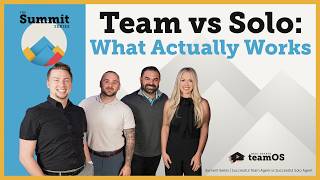
Tony Galarza, Bri Tucker, Matt Anderson and Nick Nelson compare team and solo real estate careers. They walk through their daily schedules, CRM tools like Follow Up Boss, and how they set family boundaries. The panel covers team growth, culture, and avoiding burnout.
Chapters
What are the growth pillars, opportunities and cultural elements that retain high performing agents? How do successful agents structure their day and protect their personal time? Why do some agents say things like I will never leave this team while others go solo? After starting on a team on these topics and more, our summit series continues with Tony Galarza of Wiemer Group Realty, Bri Tucker of Posit Group, and Matt Anderson and Nick Nelson, who started their real estate careers in the local EXP ecosystem. With Renee Funk and Ben Lob. We're talking successful team agents and successful solo agents right now on Real Estate Team os.
No matter where your business is today or where you want to take it.
You'Ll get there faster and more profitably.
With an operating system. Welcome to Team os, your guide to starting, growing and optimizing real estate team.
Here's your host, Ethan Butte. Thank you all so much for taking time to make this happen. I'm really excited to get into a wide variety of topics, but just for the context, for folks watching and listening, I would love. And I guess we'll kind of go this way since I'm looking at you. Give us a quick intro. You know who you are, nature of your business, and just for fun, maybe throw in something you make sure to always include in every buyer consult or listing presentation about yourself.
Ooh, about myself. Okay. Yeah, my name's Nick Nelson. I've been in the business for about four years now. Something that I always throw in. I usually like to tie in my, like, previous career because some people find it interesting. I was a dancer at Beauty and the Beast at Hollywood Studios for eight years of my life.
That's awesome.
And you say you have to include that.
Yeah, you've gotta include that.
A little tab.
You say Disney and they're like, wait, what? Yeah, I was a twirling spoon for eight years of my life prior to getting into real estate. So I usually include that. And that usually kind of helps, you know, break the ice a little bit.
Cool.
Yeah.
So my name is Matt Anderson with Matthew Anderson Properties. I always include that. I grew up in New Jersey because some people are like, oh, you're very just abrupt and you just say what you want to say and I'm like, that's me from being from New Jersey. I'm like, that's how it is. I don't have twirling spoon background. But yeah, that's what I always make sure I include. And I guess some people think I have an accent, so that's why I include.
I can hear it. Yeah, I can Hear it?
I don't.
I mean, I don't, but yeah, a little bit.
We never do.
Yeah, right.
Of course we don't.
So. I'm Tony Galarza with Weimer Group Realty. Been practicing real estate for about 18 years now. I include a lot of stuff in my packages, but to be honest with you, recently one of our teammates on our team came up with a grand idea, was creating a resume for both buy side and list side. And that's something that has been almost a game changer, to be honest with you.
But so it's like a traditional resume, but it's oriented toward. This is why I'm super well qualified to help you buy home.
And so it's even, it's even broken down into. And by the way, I use AI a lot for this, but it's even broken down into investor driven, you know, buyer driven, seller driven, you know, first time home buyer driven, a lot of that stuff. And myself and also my teammates on my team, we all have one created for ourselves.
That's a good idea.
That's a great idea.
Yeah. Never leave home without it.
That's good. I like that. My name is Bri Tucker. I've been in the business for six years. Been a part of the Posit Group for six years as well. So really have grown my business with our team. I always include something similar. But I like the resume idea better. Always send a video that I've recorded about myself to buyer or seller before we meet just so they can feel like they can get to know me a little bit better. And then it always comes up that I'm a mom of three, so I love to share that with people and it usually gives us something to connect.
About, truly personal video or like a background or video that you record once and use.
It's a sit down interview with, that I did with Ken. And so we're sharing like more about our team, more about myself. And then hopefully that gives them something to resonate with. And then usually it comes up that we can talk about it and be like, oh yeah, UCF or Texas. I grew up in Texas, so they pull little things out of that.
Yeah.
Can I ask if you do a lot of video stuff like that or like, you know, driving in the car, taking a quick video.
We do a lot of content driven media, but also just quick media like that too.
Yeah.
And it's. I love doing that. That's like my favorite part. That's where I get my recording voice from.
Yeah.
Is that just like regular leads too or is that someone that you already have an established relationship with, it's gonna be for everyone.
But for someone that's just coming in that maybe we don't have a relationship with, try to build the rapport first on the first call or consult and then send over the video so they can watch it at their leisure before we actually get to meet in person.
Yeah, I love that.
Yeah, it's super powerful. They feel like, especially if you're going to their home and they don't know you. Yeah, yeah. A little bit. Or it's also especially, like, functionally helpful when you're gonna meet them out somewhere. Like, we're gonna meet at the local coffee shop or something. You're not like, I'm the blonde person with, you know, with the black bag. How to do that? Like, it's like, oh, you know, if you make this a habit, you're greeted in just like a super.
Well, I'm sure it happens to you guys. Even with Instagram, they're like, oh, I already follow you. I saw what you did yesterday. You were out grabbing a coffee at Foxtail. I was like, oh, yeah, I was there.
Yeah, that was me. That was me.
When do you feel like social really caught on in that way? In particular, that people were greeting you in a way that was different because they see how you present yourself specifically, let's say, on Instagram.
Well, so I'm going to start. Because I'm not a big social guy.
Right.
In regards to social media, don't get me wrong, I'm on it, but a lot of the stuff that I'm on it. You have kids as well, I'm assuming.
Yeah.
Are all my kids. I mean, it's literally all it is. But I'm also very rooted into where I live, so I'm in Novito.
Okay.
So if you. It's very rare. I don't run into people that I already know. So that is kind of my social media to a point. I'm just always out and about. Right. So in the community. But the social media piece, I've always been fascinated by, I really have, like, the videos and posting all that stuff, but never in that type of way. It's just never been my thing.
Yeah. And I think it's. It's different, too. And correct me if you think differently, but especially being newer in the industry to only four years, I feel like I. I didn't have. As an established base where social media might not have been as prevalent, whereas you have 18 years of experience. So even before social media might have Taken off that base was already kind of your referral group type of thing. But I grew my business when I relocated from Jers off of leads, so it was literally all Internet generated. So I had no choice but to get my face out there, because who wants another Realtor calling them, asking if they want to sell or buy? Like, how do you diversify yourself? So I think that was, like, a necessity.
Yeah, I feel like social media has been very big for me. A lot of my business is sphere, but, like, I always tell this story because I think it's a fascinating story. I ended up getting connected to a seller, and we sold their house. They ended up buying, and then I sold that property as well. It was like a three deal over the course of a few years. But I remembered before closing, there was this, like, woman that was with the sellers, and she was like, oh, this is our realtor, Nick. She goes, oh, I know you. And I was like, oh, how do you know me? She goes, I saw your Ashton woods reel on Instagram, and that's how I started following you. And I referred you to the sellers because they're my friends. So, like. And I literally just hashtagged Ashton woods. And she had been looking at Ashton woods homes, found my reel by searching a hashtag, and that hashtag ended up closing multiple deals. It's just, like. It's wild. So I feel like Ken is massive on the social media. She's on. Like, y' all are on a whole nother planet.
He's on another level. Yeah, not y'. All. He's.
But, yeah, I feel like social media has been a big part of my career as well.
That's a cool story. And that's a lot of what we do as a team. It's funny because whenever I actually met my team leader, my partner Ken, he just had the idea to start doing YouTube. He's like, I've got this idea. I think it's gonna work. I don't really know, but it's gonna work. And I was like, yeah, okay, I trust you. Let's do it.
Let's do it.
So I was one of the very first people to join the team. So it was me, Ken, and a gentleman named Gio. So the three of us, and we were working in this backroom, closet, office. He makes a video about top golf and one about, like, a walkthrough in Golden Oak. And the first lead comes in that year. And so for the first two years, it was. It was very new. I wasn't doing a lot of social media. Because we were working inbound, referrals, sphere stuff, things like that. But I'd say about four years ago is when we really said, okay, we're going to transition from being a real estate company to a media company that sells real estate. And it was my responsibility to start showing up as a strategic partner that did content. And so now that's really my presence online as well, is trying to deliver that through video and make connections that way. And it's been a really powerful tool for us.
What does a good day or a good week look like? Like, what are you doing? What's going on? Like, when is it a good day or a good week? Like, what's happening? How do you structure that?
This week's been crazy for me. I mean, this is probably a good example of a good week. Just a busy week. Right? Right now I'm like, super listing heavy. And so yesterday I had photography and videography at a listing and then I went straight to a staging at a listing. I'm getting photographed tomorrow, I'm going to another listing shoot right after this. I mean, it's just like I have three listings being photographed in the next three days. It's go, go, go. And you just show up to be there for.
Is there anything on that? Like, are you, Is there anything you definitely do every single day? Or like, I do this every single Wednesday.
No time blocking is like I have attempted to do and it has not worked.
You know what's so funny is I, I can't comprehend people like you. Like, I'm like, I'm not. Like, if I. Not in a negative way, I almost like almost envy you to a point. Like how you just kind of freely go and do that. Like to me, if I'm not structured, I'm not doing anything.
So what is, what is your structure for a day or a week?
I mean, to be honest, I'm very consistent, right? So I'm an early riser. So I'm up every morning by 4:30, 5:00', clock, I'm in the office by 6 and I'm doing all that stuff that I need to get done from the day prior, checking my emails, you know, setting myself up for the day and making sure that my team is. Because I also run a team within our pod, within our brokerage at Wemer Group. So knowing what's going on with my agents, what, you know, with my assistant, you know, where everything is at, that's like my quiet time before, you know, everything blows up. Nine o', clock, I mean, everybody wants, right? So it's just how it goes. So by between that time it's really just focusing on what I need to make sure I'm structured for that day, what's I missed from the day before. And then as soon as 9 o' clock hits, it's really on the phone a lot. Right. So I really try to leave my afternoon open for. I'm a traditional KW guy from back in the day. Right. So it was, you know, you do your 9 to 11, you know, lead generation, all that stuff. So 11 and on is usually my time for appointments, photography and such. But I'm also leveraged. Right. So I also do have people that go on photography appointments or you know, things like that and buyer's agents. But with that being said, if my calendar is literally my best friend, if I don't live with my calendar and use it every single day, color code and all. Yeah, yeah, absolutely. Now I will you asked weekly as well.
So yeah, just in general. Yeah.
So I'm very data driven type of guy. I like to be educated. So every Tuesdays and Thursdays I'm looking at Monday morning quarterback reports. I'm digging into, you know, certain communities and things like that, you know, so really knowing what the market's doing.
So time blocked, market research.
Absolutely. Inman, all that great stuff, you know, so I'm really involved in that.
But yeah, and I do something kind of similar just because again doing so much Internet leads and everything to start. So even to this day like I'll typically either shift, it's either the gym or my follow up is first because I run everything through fub. It'll be like 7 to 9 is gym or 7 to 9 is follow up. And then 9 to 11 is going to be follow up or gym. So that's like consistent six days a week. I love the idea of having set time blocking for just data research too. Cause I kind of just do that when I could fit it in. But that's something that like weekly I try to do all the time. But I also think defining a good week is having a little bit of balance. Because my first like two years in real estate there was no balance, none. Like 10 o' clock at night I could be with like Nick and a couple other agents we're friends with and I'd be like sorry, leads coming in, gotta go. And now I'm like now that I'm transitioning more to referrals, it's having that balance of okay, this is me time now. I don't need to answer the 8:30 phone call last night or things like that. So I think being busy is great to define a good week, but also balance at the same time to have that kind of stability.
So it's funny. Sorry. It's all good things.
Absorbing.
So going back to KW days, Gary Keller, you say, obviously if you, you remove it, you gotta replace it. Right. That was a big thing in my life. He also said there's no such thing as balance. It's counterbalance. It's, you know, making sure if you're going one way, you gotta counter right back. Right. So I've kind of lived on that mantra. But if you ask one of my partners in my office, Joe, he'll tell you you can't reach Tony between four and seven o'clock every day.
It's very tough.
And luckily, again, I'm leveraged so somebody will be there to answer the phone so that service doesn't drop. However, that is my time for my children, that's my time for my wife, that's my time for my sanity. And I've learned that about six, seven years ago when I was like, what am I doing? We're making great money, we're doing all these great things. We're obviously growing a great business. But I'm tired as can be and my kids are burnout. Absolutely. So I'm also a baseball coach and things like that. So I literally have to. That time block of my day is. And it's part of my calendar. It literally says not going to be available.
I love that you said that because I'll review my whole day, but I also put my phone on do not disturb every day from 3 to 7. So I have three kids, but they're 2, 4 and 5, so they're very young. My boys also play baseball and we live like out on the field. So that's been a really important pivot for me as well. I'm an early riser with the kids naturally. So the days do start at 5:30. The mornings are really dedicated to the kids making sure they're fed and dressed and off to school. My working hours are 8 to 3. And it's like my expectation is that I'm going to get everything that I need to get done between eight to three. That's always going to be prospecting first. That's like my kind of my first domino that I know that if I get that done, that's the most important part of my day. We meet as a team every single Tuesday. So that's also dedicated on the calendar. That's when we go into market research, like the Monday morning quarterback. And then for the afternoons, I'm leveraged as well. So that allows me to be with the kids and exercise and do the other things that keep me sane. But I feel really good. If I can get everything in between.
8Am to 3pm what does leverage look like for you?
Transaction coordinator, media team, and then a showing partner.
Yeah, I was actually to say if you. If you don't block that time off, and when you actually, when you do block that time off, you feel like that 8 to 3, you actually get so much more done.
Well, you get a lot done.
So much more.
When I start. Well, I was. So I was doing the same thing. I, like, I have these three little kids and I would be like, working through the evenings, right? And they're like, mommy, mommy, you know, I need your attention. I'm like, you know, one more call. This is really important. This client really needs me. And then I wasn't showing up as the best agent or business owner. And I also wasn't showing up, showing up as the best moms. It's like, how do I split those two and be really good and own both of these spaces? And I looked at it and I'm like, that's seven hours. Like, eight to three is seven hours. Like, there's no reason that I can't get all of this done. And then I also like to, like, be very busy and kind of spontaneous. So I kind of had to make myself type A. And my husband's very type A, so he appreciated that. And when I started.
Yeah, when I started, I finally fully get you now.
When I started, like, really focusing on the calendar, setting better expectations with my clients, I got more done and I felt like I was performing better.
Yeah, I forget the name of the psychological phenomenon, but it's like, essentially, we'll take as much time as we allow ourselves. So when you can, when you compress it like that, and it's like, like super focused time, as you said, like seven.
Well, I have a great example for that because my kids pick up time. Actually used to be 4 o'. Clock. So I would have, like an extra hour to work out in the morning. And I wouldn't pick them up till four. It moved back till three. Well, I have to get them at three o', clock, right. So it's four. Like, I'm not gonna leave them there. So right then and there, you got.
This buddy, texting the teacher again, sorry.
Use Google Maps, you'll get yes.
So right then and there it Was like, okay, well that's my time. And so before my day was an hour longer. Cause I knew I had till four o' clock mentally. Now I know I have till three and I'm actually more productive. And you're right. I think it's the same thing with like deadlines and procrastination, all that. It's just the time that you give yourself.
Yeah, I also give myself permission to. I call it productive procrastination where I know I'm not really on the task because I'm like still measuring up against the deadline, but I'm still doing like productive things. So I can always justify it to myself, you know, I'm not like killing time.
Yeah.
And Maria, I actually had a question on with how you reset those expectations with your clients from 8 to 3. Like how did you go about doing that and how did your clients take that react?
Yeah, well, I had to kind of make it through the clients I didn't set the expectations with first because that was like for me to own and show up. But I've just been doing it upfront, you know, hey, these are the hour, like I'm excited to partner with you. We're going to take great care of you. These are the hours that you can reach me. I'm not available between 3 to 7 if anything's urgent. Sarah, my TC is in the office until 5 and I'll be back to my phone at 7 o'.
Clock.
I'm fortunate my kids go to bed early. Right. I'm sure that'll change as they get.
A little bit older.
But I, you know, I do still leave myself space to do consultations or calls anywhere between basically 7:30 to 9. It's not my favorite thing, you know, that will change, but at least leaves it open so that no one's waiting till the next day. Right. And I've never had anyone give me pushback. I think it's just saying it up front. And I was nervous too because you know, a lot of agents tout you can, you can contact me 24 7. Right. And that used to be me.
Text me at 8am I've got you.
Yeah. But then I realized I think they actually respect you more and it makes you seem like a busy professional and they understand that this is a professional role, not something where they should be contacting you maybe all through the night. And if they do, my phone's on do not disturb. I'll catch you in the morning. Yeah.
And that used to be me because I had the thought process of okay, this is a Internet lead. They're going to come in and if I don't answer, someone else will. So that was always like. And the speed and the speed delete. Because that was always my thing. I was like, I will be on the phone before anybody else. And that led like not having that type of balance where I was just at the mercy of everybody else.
Well, that makes sense.
Instead of having, you know, those expectations like you had. So that's why I was interested.
And I think initial confidence, you know, speed delete is still so important. Don't get me wrong, not every day is perfect like that. I try to manage it when I can, but there's times when you have to jump in, right. So that you don't lose the relationship. But once you get them on the phone and I feel like you've given your value proposition, you build rapport. Then it's like, and this is when I'm available.
Right, right.
And I think also especially like, you know, on the listing side, it's like, hey, every single Wednesday I'm going to be in your inbox. This is the kind of information you can expect. Of course we have conversations about it whenever you want. Like, I think that expectation setting, like definitely the. I respect that she's clear and professional in the way she's communicating and when she's available and that she has her family as her priority and these types of things. At the same time, I assume that you're all including some proactive communication to head off. It's multi layered, you know, 80%, maybe 80% of the common stuff where someone might like randomly call or text. You're like, oh, I've already delivered that. Which kind of tees up where I wanted to go next. Which is what role does your CRM play kind of day to day or throughout the week, you know, your prospecting window. Is that where you're there and then you're like kind of out of it or is it a, you know, are you mobile more and you're like in and out of it all the time? Like, what is your relationship to your CRM throughout the week?
Well, if this is a follow up boss plug, it's great.
It's not, it's, it's not. That's why I said CRM. But like.
Yeah, well, yeah, I mean, I'll start real quick, but I also want to kind of bounce back. But I'll come right back to it. But CRM is everything, right? So just like your calendars, everything. So is our follow up boss. It is something you're in all the time in my opinion. So I mean, our team is very structured in regards to it's expected to call through follow up boss, expected to email, expected to text message and we, and we do that for a purpose and it's actually worked out in our favor. So again, I run a team, so I want to make sure that I'm in the know of what my team's doing and they're in the know of what I'm doing. Right. They can see the communication when I'm on vacation. They know what's going on. They see everything. So utilizing that is key. And yes, it does lead our prospecting. I mean, it's 100% leading our prospecting, to be honest with you. We know exactly who to call that next day. We use, utilize our tasks and all that great stuff.
Smart list behavior based.
Oh, absolutely. Yeah. And you got to remember, so we met, group is very structured. They helped us become very structured as well. So you know, you talked about setting expectations, what I want to lead back to. So I have a 17 year old, a 12 year old and a 7 year old.
Okay.
So the dynamics are like all over the place.
Yeah, yeah.
It's, it's, it's nuts. And they're all boys too.
Oh.
So it's just one of those lives. But I feel bad for my wife. But every single day I have to literally make sure that I'm structured with all that.
That.
And if I'm not, I'm always going off the beaten path. Always. Right. So it is a very important thing to make sure it stays structured. The CRM though, is literally our best friend. We use it every day.
Yeah, I mean, I know I've learned a lot about follow up boss from you because you're, I feel like you're the, you're the club king when it comes to things. And so we're still relatively new into the single agent life. And so I'm still, I'm still integrating fub. I know I'm not integrating it as much as you are because I know you've got your smart lists and your tasks.
I'm on him every single day.
Nick, you were like that on the team though as well. So I love fub. It's the only CRM I've ever used. I know that I'm not utilizing it to its full capacity the way that.
You are, but what ways do you utilize it?
Again, a lot of my business is just sphere and so I feel like for you, a lot of your business has Been leads and people that you don't necessarily have a relationship from the get go. And so it's a lot more important to have those people in the database for just communication and making sure that you're able to close the deal with that lead. A lot of my business has just been, I mean, these people are in my regular cell phone.
You know, it's so funny. I actually think it's more important for your sphere and for your people like that to use, honestly. I mean, so we have, I mean, birthdays, anniversaries, home anniversaries, you know, literally being your, you know, to do list to know, oh, I gotta send that out. Yeah, I mean you put everything, everything in there, even the dog's, you know, birthday or whatever.
We put it all because there's a.
Point at which you, there's a 0% chance you could even remember that stuff.
Or have it on recall hands down. And like number one, one of the most recent updates. So now the tasks show up in my calendar and that is like the best thing. And they were like, I forget. So one of my mentees was like, why are you excited over this? I said, because it is life changing. Because I used to have to put it as appointments and it wasn't a real appointment. But for me, like, I think the most important thing with FUB is not only how user friendly it is, but also the plugins that we can use. Like, so I leverage different companies as well. Like texting Betty is my best friend. No, not sponsored, but it's my best friend with FUB because that in coordination with my action plans and also like you mentioned anniversaries and all those things, like, I've been starting to be able to convert leads because just for my personal business, what I see is that phone calls are still important 1000%. But what I'm noticing is when you set, when you ask the right questions and you pose the right questions via text and you don't sound like a used car salesman, no offense, that you're going to get those responses you need. So I've been getting more conversions just from like putting my text messages and typing them out and putting them into play versus having to make that call in the first 30 seconds. So being able to go and just plug that into FUB and have everything just play out even with like warm and my watch list, like people that are saying, okay, you know, check back in with me in March, et cetera, I can have my action plan go off. They get an automated text from texting Betty that talks about that prior conversation. So it's not just like, hey, are you ready to sell or buy now? It's like, hey, I know we talked about, you know, Jeremy a couple weeks ago, you know, how did he finish out the basketball season, et cetera. And by the way, this. So we're establishing a little bit more of a connection and that's been like huge.
Cool. Love that quick plug, by the way. I can't believe this turned into such a product segment that sincerely was not my goal. But like, if you're not using call, if you're not using the FUB number, like that's powering so much of the AI going forward as it records the calls and pulls out tasks, asks and summarizes all that for you. So I don't think you all use fub, do you?
No, I've never even seen fub.
So back to the original question.
Yeah.
Where does CRM fit into your. In your day or your week?
We definitely live in our CRM. We use real estate webmasters. It does exactly very similar things. Very. Yeah, it's very high level, does a lot of great things in terms of action plans, calendar. And we live in the CRM. I mean, we pretty much the rule is like, if it's not in your CRM, it doesn't exist. And so we really try to abide by that with every text conversation, phone conversation and note. So that way we're not trying to remember it all and we can really establish a good, well rounded business.
Something that I love about the diversity in this group is you all started on a team, but you're doing your own thing now. Brokered by exp. Yep. You have built a team inside a team and you have been with your team for, yeah, your whole real estate career.
I tried like a few months. Solo agent before that.
By the way. That's the conversation I want to have. Like, how are you thinking about where you are and why?
Yeah, well, and then actually my husband saw a Instagram story that Ken posted that he was looking for agents and he pushed me to do the interview. I didn't even follow Ken at this time, but I had seen him speak before in a market center. And Ken told me he thought I lived too far away. And I like to joke with him that I harassed him so that I could, so that I could join. And mind you, I was 19 whenever he took me onto the team. So it was a really big, like, leap of faith and opportunity that he gave me at that time.
So your husband knew that he was Doing something interesting.
Well, so my husband and I were both licensed. This is important story.
Sorry.
We were both licensed. We were thinking, okay, like we were leaving a different career field. We coached competitive cheerleading. That's actually how we met. And we're like, okay, the hours there are not super healthy.
Right.
You're working till like 11 o' clock at night, you have no balance. The income is pretty capped on like what opportunities you have. And we knew we were getting married and we wanted to start a family. So I'd always been interested in real estate. I'm like, well, let's take the test, right? What's, you know, all great things happen once you become licensed in real estate. Which wasn't exactly little did you know. Yeah, exactly. So my husband is. My husband's 10 years older than I am. So you know, we were balancing like he's already kind of been through like a career wave at that point. He's trying to figure out what he wants to do and re establish himself. I'm just leaving college, right. And trying to figure out what I want to do. And we both joined the KW Market center that Ken was at as single agents. And so we heard Ken speak one time and then we were kind of trying to figure it out ourselves. We probably did five or six sphere deals. My husband and I decided we really shouldn't work together. You know, that was probably the healthiest thing we could have done for each other. And so he went off into the insurance field. And then that's when I interviewed with Ken and said we were really going to make it work. And it was still a slow ramp up. I mean I'm so fortunate to be on my team. It's taught me everything. Ken has really poured into me. But there was really tough conversations those first two years, like am I going to pivot to basically a corporate full time job? Do we need to look for benefits or something that's more consistent? And I always look back now and that if I wouldn't have continued on that path, my life would be very, very different than it is today. So it's been an awesome journey.
Yeah, I don't know that I did the math right, but you started obviously pre pandemic.
Right.
So that was like a slightly leaner time than say 2021.
Right, right. Yes. Well, and that's what's interesting is like when I first started in the industry, like you guys can all attest, I'm sure I know you just started about four years ago, but 2019, it was a normal market. Right. And So I at least got to build some skills then. But then we were thrown into pandemic years where everything was just kind of throwing it at the wall to see what would stick and skills were out the window. And now we're back to a skills driven industry, or at least a skills driven climate, I would think, for where the market's at. So that definitely benefited me. I mentor agents on our team now and so we have some age that started with us actually in the pandemic and it's really hard to shift back to like the conversation based. So even though we're very media driven now, when I started it was cold calling and door knocking and open houses, like the old school KW stuff where we really built the foundation.
Yeah. And you're at home like this works for you. You have the opportunity to mentor other folks. You've got the system behind you. Yeah.
I mean, I'm. I'm still very much. Yeah. Oh, I see what you're saying. Yeah. Very much out in the field, but I'm at home with the Posit group and I will be here till I die. Absolutely.
Yeah.
Okay, cool.
How about you, Tony? I mean, I don't know how many iterations of solo agent or another team or brokerage or if you went straight into WIEMERT from the same Keller Williams office when they were there. Like, give that arc a little bit. And when did you decide to start a team inside the team and how did that go within wiemert? Like, how many teams are inside wiemert? I asked you like four questions in one.
There's a lot to uncover that.
How are you? How did you join the team?
When I. When did starting a team go? Was that something you all figured out together or was that something that was kind of established and ready to be done inside Wimmer?
Yeah.
So my story is kind of fun. So it's a little similar to yours. I was in a different industry. I was actually in the restaurant industry as a manager for a Chili's years and years ago. My wife was doing leasing in an apartment complex and one day she goes to my brother in law's house because he wants to sell it and he's interviewing Jennifer Wieman and I'm in the kitchen. I was cooking something and while they're doing the interview and she fell in love with Jenny and so she got her license and she was all excited, joined Jenny's team. She was agent number two with Jenny.
Oh, wow.
Yeah. And then I would say about three months later, Jenny decides she wants to hire somebody. On her team. And my wife says, you got to hire interview my husband. And Jenny's like, she didn't know me at the time, things like that.
Right.
So, long story short, I didn't also didn't want to do it. I was very happy where I was at, but I said, you know what? Let me give it a shot. And I literally met Jenny. We actually met in an Ikea because she was at a meeting, and it was a lot of fun to sit there and eat Swedish meatballs. And they'd be interviewed by Jenny Weimer. And we hit it off. It was like, okay, you know what? I'm going to jump out of this stable, consistent job that I felt very comfortable in and jumped into the industry. So I worked for Jenny, and I've been in real estate with Jenny my entire life. So I was Agent 3 shortly after, probably about a year or two after us, Joe and Jenny, my wife and I, again, we're in the industry, and it actually worked out pretty well. I won't lie. She's still doing it. We started our own little pod within, but ran very parallel with Jenny. Now, Jenny blew up. I mean, obviously, Jenny became a monster, but we ran very parallel. And then just one day, we were out having a drink and decided we need to put the band back together. So we did. And so now, remember, we started back 06, right. 0706. Somewhere around that timeframe where the market was. Okay. It's actually pretty decent. And then it just took a dive. So talking about being in the industry, when you're like, is this really a thing? Thing just really a career? Like, is this something I can really do? But it. It really built that foundation of what. Why I do real estate the way I do it today. Right. So you were saying that, you know, we're getting, you know, we went from a normal market to like a crazy market to now more of a. Like a. You really got to work and work really hard on this. Well, it's. That's even coming, in my opinion, to be even harder.
To be harder.
Yeah. So you really need to be Grassroot foundation built type of real estate. But so ever since 2016, we joined the band back together, and we just kind of kept on growing it the way it is.
So. And how big is your team now?
So my team right now, we have four agents on our team, all buyer's agents. So I'm a listing agent, and then the other three, two are buyer's agents, and I have an executive assistant.
Okay.
But again, we're also with WER Group. So we're very leveraged through them as well. We have a transaction coordinator that's dedicated to us. We have a marketing department as well that does of our listings and all that great stuff. We have a coo, Emily Smith, who basically does everything. I mean, you can call her and. But the true dynamic, I think that's even more important than all that leverage is the team, the way it's structured itself. Right. It's really neat. It's not just a brokerage. Right. We're a real estate team that's kind of made up of a bunch of great agents that truly want to work together. There's really no competition within each other. It's very weird when you kind of really implant yourself in it. My leverage actually comes from when knocking on somebody's door saying, hey, I need your help on this. You know, yeah, I'm running the cma. I can't figure out the numbers. Right. Or, you know, the frog meeting. You joined us the other day. Right. The listing team meeting. We did like having all those collective, you know, brains in that room together, working on one person's listing because we can't get it sold and trying to figure out what it's going to take. Like that, to me is what really collaboration.
35 or 40 of the agents in the room just learning. Either learning or brainstorming together, you know, dealing with what's going on in the market. I'm sure it was a different conversation two years ago, and I'm sure it was a different conversation four years before that. But that like Jenny told me probably two years ago when I first met her, we compete in the market, but we don't compete internally. There's no leaderboard or that kind of a thing. And like, I definitely got that feeling. Spending leaving KW inside your office.
Yeah, leaving kw. And when we started Weimer Group Realty, I always saw top down sheets when I was at Keller Williams. I always wanted to see where I ranked. It's not even a thing anymore. Like, we don't applaud that. Like, everybody does what they want to do. It's their goal. So the collaboration just completely turns so much different. Right?
Yeah.
So I think when you can separate ego too, and you can just come together collectively, it's gonna benefit you so much more than worrying about what your number is.
Right, Agreed.
Yeah, I hear that in a team context a lot. Like when people are talking about, should I be a solo agent or a team agent? It's this, you know, can I release control? Can I Follow someone else's plan. So you, you guys both started inside a team but have, have gone solo, but you're still kind of connected with other people.
Yeah. Right.
Talk a little bit about how that went from for you, Matt.
Yeah, so I actually a little bit of background, I got licensed in, I was getting my PhD at Florida State.
What were you studying?
Criminology and sociology. So yeah, I got a scholarship to go to Florida State. That was great. But after I got my master's, it's when kind of like when the pandemic started to hit and I said, I do not want to be doing high level statistics remote from New Jersey. And I was like, absolutely not. And I'm like, I'm done, I'm out. So I ended up leaving, I went back to New Jersey and I lived in Philly for a little bit during the pandemic. Cause I did not want to go back to my parents house. And I was like, this is not healthy for us. So I did that and I got licensed. And of course like three months after I got licensed in New Jersey, my friend Sam was like, we have no ties here. Like, let's just move to Orlando. I was like, screw it. So we did that. Then I had to get licensed in Florida and I got connected to my old team leader Ben through another connection. And I joined his team from day one. And 100%, like I wouldn't be able to have the ties that I have now or the base that I have now without the base of my team. I think that was extremely helpful for me. But for me, like after a year and a half, almost two years I think of being on the team, I felt like I needed to kind of branch out and do my own thing. But for me, it's all about being a resource. I think the most common thing that I hear all the time is with new agents especially is they're like, oh, you know, I didn't expect to make this little on my first deal or my second deal or my third deal. And I'm like, number one, sit down. And I'm like, you would not have. And you wouldn't even have this deal or know what to do if people weren't answering your calls and all those things. So that is null and void to me.
And probably if someone hadn't generated that opportunity for you.
Correct. And it's like, who's answering? Because for me, like it wasn't as much my team leader, but it was the resources that he had had for me, where I had two people. Kelly Blackwell, And Lee Davis, they were answering my calls at 10 o' clock at night. I don't know why they were, they shouldn't have. But they were answering those calls for me. And that's what got me through like my first five to eight deals. I needed that hand holding. But after that, when agents continue to do more business, like after your 10th deal and you start seeing those splits and things like that and you start learning more, I wanted to transition more to like just being a resource group. So my focus now, having Matthew Anderson properties. I don't have a team, I don't plan on having a team, but I have a Slack community. I don't know if anyone else is familiar with Slack, but live and die by that too.
Big fan.
Yeah. So I have a resource community that is basically just anyone, even if you're on a team, but anyone who's even an independent agent, you can come onto the Slack community and it's like, okay, you need lender options, these are available for you. You need potentially Y Lopo or other plugins or follow up bots, you can add that in as you want. And these are the costs associated. But it's basically the ability to have that collaboration without having to be on a team and have those splits. That was kind of a pain point for a lot of agents because that's what I missed with my team. Like with my team it was nice to have those huddles and those sessions to be able to collaborate. So being able to kind of recreate that in a solo agent setting was something that was super valuable.
How about you, like how did you think about solo versus team? What role did the team play in getting you going and how do you think about that for yourself?
Yeah, I mean the team was like integral when I started because, yeah, when you first get into real estate, you have no idea what you're doing. And so to have a team leader, like you said, holding your hand through the first few transactions to like learn the ropes, it was, I feel like I got so much value out of the it, especially in the beginning. And then again I feel like because a lot of my business is sphere, I felt like I was bringing the business to the team. And so I was just looking at certain things and I was like, I'm not sure I'm seeing the value in what the team was providing. And so I decided that I felt like it was the right time to branch off and go as a single agent. And then, yeah, everything that Matt has set up has kind of helped put the resources that the team had provided for me without being under the team umbrella.
But I also think, like, it's depending on situation too. Like, we have a really close friend, Marar Spignoni, who's with the Figueroa team. And she was originally going to go independent too, but she has three kids, she has a staging company. There's so many other things that were like moving parts for her that she's like, I need a team because they provide that additional support. And every team, like Ken and Wiemer, like, they're gonna provide different things. Right. Like, not every team is made equal. It really is dependent upon that individual what their lifestyle looks like and what they really need. And if those teams can address those pain points.
Yeah, like, I don't have kids, we've got two dogs and that's it.
Same.
You know, I feel like if I had a family that I had to tend to every day, I feel like.
So hats off to you too.
Being a mother, being a father is a full time job in and of itself. So I feel like I have additional time that I could be doing things myself that I didn't necessarily need the support of the team resources for. But yeah, going back to Mararis, it's a perfect fit for her. And she did not become a single agent because she still needs those resources because she's running kids around and she's got school and she's got all these things.
So, yeah, I mean, from my seat, having done this for 100 and, I don't know, 110 or 115 episodes, primarily with team leaders and operators, but also a handful of agents. And again, thank you all for doing these with me too. I've had a handful of agents on the show as well. I mean, the one thing that's obvious and I think you would all like nod your head in agreement too. I'm not asking you to do so coming. What you said, is it a. There's no one right way to do this business. You can find success however you want. There's no like perfect team or perfect team model or perfect team structure. These relationships that you all have to your teams and to other agents in the market and all these things are about, you know, just finding the right partnership and what works for me and what I want to do and what success looks like for me. And that changes over time.
So, you know, I have to jump in. And not necessarily challenging because I do agree with you, Jenny. Back when I stepped off the team and I joined, I started my own little pod or my own team. Within Keller Williams at that same mindset, I was like, you know, I know what I'm doing now. I really figured it out. I, you know, I can make this work for ourselves. And I've learned from one of the best. I mean, Jenny is hands down one of the best. And then you fast forward to when I joined the team back again. One of the comments that she made to me when we were sitting down having that drink when we decided to put the band back together was she said, it's my fault for not thinking big enough that I can keep you with me and still it makes sense for you to stay. Right. And so it kind of was like a shift for her mindset. Right. And that's also when she kind of stepped back away from doing all the listings and she, you know, started leveraging all those things. So it was a paradigm shift in her life to make that decision. And then there was another big, big shift in her in our business with our splits and because her mindset and Mike Wiemer as well, I have to give him a lot of credit to. But when they decided to not look at splits the way they used to look in the traditional way they look at it, and to look at it more as I want our agents to be able to actually build businesses within our team, that was massive. Right. So I was kind of pigeonholed in being a listing agent or, you know, running my own stuff and maybe having an assistant, but, you know, lower level type of assistant before the splits. After the splits, I was able to grow a team within. And remember, my. My expenses are very low because the team absorbs a lot of that. Right, Right. So it was, it was a mindset shift for me to be able to realize, like, wow, I can actually do what I wanted to do when I stepped off of Jenny's team years ago. Build a brand within the team, build also a pod as well. And that's been massive. So. But where you're coming from as well, if you don't have that structure, you know, if you don't have that, it makes sense.
And I think for you too, because, Nick, I know you're about to say something, so sorry, but I think, correct me if I'm wrong, that you going back to the team actually allowed you to just blow up your business even more because you had the background of. Because you had the backing of Jenny.
Oh, sure, absolutely.
Instead of like, like you said, you knew exactly what you were doing, going independent, but then you knew if you went back, you could get even bigger, develop the team on your own and have those resources. And I think that was a little bit different. Different for me with my teams, I felt like I was capped, Like I didn't see what was going to be happening after that. And again, that's fine, every team is different. But I didn't see where we could level up from there. And because of that, that's why I made that choice. Whereas you guys probably have a different, you know, perspective because your teams might be, you know, operating at a higher level.
I think my biggest perspective shift when I went back to Jenny was, oh my God, I'm spending so much money, money non stop. I'm non stop going, trying to do the same thing. I'm also a big believer that what you're doing right now is a very profitable position. And then what Jenny has built and Ken has built over the years is very, you know, good position to be in the middle section. Right?
Yeah.
That smaller team out there trying to do it on their own with, trying to compete with these big brokerages to try to even outspend, which you can't, you can't. I mean, these big teams have nudged other, you know, people out. So that middle pocket is very, very, very tough. And that's what I was running with.
The most common term for that obviously is the messy middle. But Jenny calls it the black hole, which I think is. Which I think I like that language. Yeah, it's super interesting. I'll just share. So I did an eight episode series going inside the Lawton team, like a 200 agent, two dozen staff, five office operation in Phoenix where I talked with a bunch of different team members. And one of the themes that emerged in talking with multiple people in multiple seats there is that they had developed essentially four levels, like they call them level 1, 2, 3, 4. And as you move through the levels, which is production based, it unlocks different types of leads. You get access to more luxury leads or you get access to more listing leads. And the splits kind of slide as you go. And you remind me a little bit of Tiffany Gobster on his team. First agent on the team, she said, I will literally never leave George. I might be paraphrasing and giving you that quote with Ken and she is like you, but built a team inside the team. And so it's like to get. Not everyone aspires to build a team that large necessarily. By the way, Whissel Realty Group in San Diego does the same thing. They call it bronze, silver, gold, platinum. But the whole idea is how do we through cultural and financial. Not incentives, but alignment. Find ways to continue learning and growing together as business partners. And some organizations are designed that way and others aren't. But I think, you know, for anyone watching and listening, if you want to, like, truly grow and scale a team, those two are not the same thing. It requires finding ways to keep different people engaged, no matter what they want to do. If they feel like they are at home, I am culturally aligned. And we can find financial ways to continue growing our business together. To the spirit of your question to Tony. So there's no question in that, but set, trigger anything for anyone.
We have growth pillars on our team as well, so.
And I hear both growth pillars describe briefly.
Yeah, so there's different opportunities to. You know, Ken has been so pivotal in laying groundwork for us. We have a blue sky meeting every year where we see where the growth is going and what opportunities are going to be next. And it's not just for him. It's for the whole team. And Ken made the decision to pull out of production as well so that he could focus more on growing the team. And that's been such an incredible opportunity for all of us. So, like, an example is that when you come on the team as an agent, part partner, you can work both buyers and sellers, but there is an opportunity to become a listing agent partner, where you're specifically getting listing leads. And of course, there's a big opportunity for business that way. We have an opportunity for leadership. So a pod leader. I'm a pod leader as well. So you mentor agents on the team, you're partnering with them on deals. So there's an income opportunity there. We have other opportunities. When you hit a certain level of production, you can go a team with. In a team, myself and one other agent are kind of testing the new groundwork for that. Now. You also get ISA leverage to follow up with your past clients.
So there's a lot of way into ISA leverage, correct? Okay.
Yeah. So there's. There's a. A lot that we've brought to the table with pillars to show our agents, like, hey, if this is your goal and you're happy doing what you're doing, that's amazing. And if you want more, we have more for you. The other one would be media partnerships. So we have our company, the Orlando Real. If you want to go in on content and you want to go out and do food reviews or go to the parks for free and do all that stuff, like, that's an opportunity, you just have to earn it. And so it's Gotten a lot of our people excited to work even harder and be more incentivized, along with the other value that we're getting from our transaction coordinators, our ISA team and our media department. And so Ken has really showed us on a small scale, like if someone were to recreate this, this is how much it would cost, not even including the time. And it's almost impossible to offer that anymore else.
Yeah, I just think culture is the biggest thing. Well, that's what we hire too, irrespective of production. It's because a lot of the people that I mentor are people that came from the service industry because literally moving down here, it was doing nothing but calls and follow up through FUB from 8 to 3 and then 3:30, I was in my little universal uniform, walking to Iowa, sweating my butt off and, and then serving all night and it was long freaking hours. But people that come from like the service industry background, especially restaurants I jive with so well and being able to mentor them and already have that, you know, common sense of culture makes everything else so much easier because those hard conversations that you need to have become that much easier and the expectations kind of already there.
So.
And just seeing how both of you guys love your, your teams, brokerages, et cetera, that just shows that the culture is one of probably the most important things.
It literally is our mantra.
That's the number one.
Yeah.
So we go by this thing called Ubuntu. It's a mantra. It's I am because we are.
Right.
Yeah.
And we put it on our shirts, we put it on our stuff, it's on our walls. Like it's in my office. And it true, it's true. It's actually funny. I've heard multiple times people interviewing for our team and to join the brokerage and it was a, you know, we think you're great, we think you're awesome. However, this is very important to us. It may not work. And I mean, and that's a big, bold statement to make, you know, to have to really own that that culture is going to be the biggest thing, not just production.
Right.
Well, and I know other agents on the POSAC Group and they've said the same thing. They're like, we will be with him till the day we die. Like, they just. And it was right as I was transitioning into single agent. So we had a really long conversation about that, that. Because, you know, I just feel like I admire what Ken's built because.
Well, especially to keep agents like you for that long.
Right. It Is it is really cool because you know what Ken has built, everyone that has joined that is a culture fit stays. You know, like that's what we've seen.
It's been self selects at some level.
It does. It self selects at some level. And it's like everyone is really bought in. And you know, we, we had a lot of hard, long conversations in the beginning. It's like, okay, we don't want to be turn and burn style. Like, how do we bring people in? This is when I was emerging into a leadership role and we're really trying to grow and GEO does a lot of that now. When we came back to, if we just keep hiring to culture, these people are never going to want to leave. And so culture is a big thing and it is hard. You know, sometimes you have these amazing agents, but if they're not the right fit, culture wise, like, that's really what we try to protect. And I think that's why people love it. And even, you know, even further with culture though, like, we've had conversations where yes, we're a family, but really what we are is actually a dream team. And what that means is we have standards for each other. So we don't let things pass just because we're family. Right. We love each other, but we also want to thrive and succeed. And I think that's helped us make that shift.
And family needs to have hard conversations.
Well, sometimes like what we came to was like, sometimes family won't, but the team will. A dream team will because you have standards and you have expectations and you're all after the same common goal. Which is interesting because we do get the opportunity to all build our own individual brand within the team. Yeah, we can do content. Right. We can grow our personal brand, but when it comes back to it, we're all the posit group. And it sounds like that's kind of similar.
It is, it is, it is. It is very. It's. It's. You know, it's funny, the culture piece of it. It's a. We, we don't. We celebrate a lot of things, but we don't celebrate numbers as much. But we do celebrate. We have. And don't fact check me on this, but we're 80 to 90 people on the team. Something like that.
That.
And the one number that stood out to me the most is when we went out to, we went to Detroit and we were just kind of celebrating and you know, all the success we had last year, all this. And Mike said our average tenure on the team is like four to five years now with average. With 90 people. The average years.
That's a lot.
That's not just because you're making a lot of money. No, no, it's not at all. Right. It isn't.
I feel like they're hard to see. When I spent some time with you all, I got to see one of multiple 10 year anniversaries.
Yes, you did. Yes, you did. Actually.
That's amazing. You know, we have a single agent that joined us almost two, three years ago. She was selling about 30 to 40 homes on her own as a single agent. And she loved what we were doing for content. She wanted to recreate the YouTube channel. Ken actually sat down and met with her and said, hey, this is what you need to do. This is the path. I'll give you all my secrets. She comes back, she's like, that sounds like a lot of work. I would rather, rather just join the team. And you, you know, that's a big shift basically to, you know, when you're selling 40 on your own, you need to sell 80 on a team, give or take. And she made it through that, that transition period and she loves it here. And she's also one that would say that she would die here. And, you know, she like the leverage on the team and even selling more and working harder gave her that place like in our culture. And she's, I think, gotten to grow more and become more leveraged because of the content, the media and the support.
Yeah, it's just a different experience and the choice is up to the agent. But this idea of like, you couldn't sell 80 on your own without putting your health and your family and your friends at risk.
Right.
You know, I mean, you could. I mean, some, some people have done it, but they're like that. It's pretty. It's pretty like maniacal commitment, you know, like, you gotta. So, like, what matters is A, what you want to achieve and B, what you take home at the end day of the year.
No, I was just going to say, and like, let's not forget the mental health side of things and like, keeping staying sane. Because I have those days all the time where I'm like, why am I doing this? I don't know about y', all, but it happens all the time.
What helps you the most get through that? The burnout.
I could say the gym. But realistically, I feel like that's a chore.
That's a chore.
So let's not act like it's not.
I have other chores that are equally Cumbersome.
I would just say reminding myself a. Having my dogs is great, but even just sitting outside in my backyard and reminding myself how far I've come so quickly and my house I wouldn't have if it wasn't for real estate. And even, like Nick and some other agents that I'm close with, that I grew up, kind of came up with on the team, they kind of reset me in a sense of being like, can you calm the F down? Like, you're fine. You're doing great. Yeah. So it's having, you know, people that I can turn to and stuff, I think is huge. But, yeah, for people that will say that they have no, like, mental, not. I hate to say it, like mental health. I have no, like, ups and downs when it comes to that. They're lying because I just don't.
They're lying.
Yeah. There has to be, like. It doesn't have to be as often as me, but it has to happen at least once. Like this one. It happens at least once a month. So I'm like, I know that that's other people, too.
Absolutely.
Yeah.
It's a reality. It takes time to really figure that balance out, you know, that counterbalance out reality. It doesn't happen as often anymore for me, but I think my biggest shift for that purpose was I realized what I. Why I was doing what I was doing. It wasn't. I'm not just here to be a machine and to just celebrate.
Right.
I mean, you were at our lunch the other day, and partner of mine, Corey Welsh, at one point in time, when he was a strictly listing agent on the team, he was closing 130 to 140. On his own.
Yeah, it's insane.
On his own. Right. And obviously you make great money. All these things are great. He's putting himself on the map. He's doing all these great things. But then a couple years down the road, he just hit a wall, and he just could not conceptualize like this.
Going for years, let alone one.
So it's just, you know, you get to a point where you're, you know, my outlet is coaching baseball. It's not a chore for me. It's one of my favorite things to do on the planet. It just truly, truly is. But I literally had the time blocking piece and being able to say, I'm done. I'm disconnected, and then I'll reconnect back in, give it to my own.
Has been like a. Oh, and fantasy football season. Don't talk to me. Oh, forget I'm going to I am like. So I have like seven teams. That is like my outlet. It's just not a year long outlet which is maybe for the best.
But that's my burnout because I lose every time I try.
Season. I'm like, I am in there.
Yeah.
So yeah.
Yeah. Somehow it can feel like more high stakes than what you're doing the rest of the year. Oh yeah.
Mind you, there's like $20 on the line.
I need to win. I get more angry about that than.
Losing a listing same and I don't even know why, but it's. Yeah, that's so funny.
Well, there's an ego attachment and there's a leaderboard.
Oh yeah, there is. See, take it away. It'll be fine.
Just a few episodes from now, we'll pick back up on this conversation with Nick, Bri, Matt and Tony and we'll be talking about listing communication strategies and social media strategies that are working for them them in today's market. Next up in the Summit series are four team leaders break down lead sources and lead distribution, the state of their agent avatars and recruiting funnels, threats and opportunities ahead for the real estate team, business model and more. Get updates on this series. Get email exclusive insights every single week. Get instant access to eight subscriber only episodes. It's totally free. Free, it's easy to do and it's all@realestateteamos.com Subscribe. Thanks again for watching or listening.
Thanks for checking out this episode of Team os. Get quick insights all the time by checking out real estate team os on Instagram and on TikTok.
More from Real










Zillow, PPC, Referrals… what’s actually working in today’s market? #realestateteam
