Clearing Clutter - Healing the 3 Key Emotional Reasons You’re STILL Holding onto Your Clutter
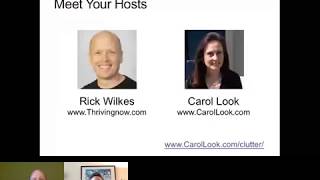
This is a YouTube video titled "Clearing Clutter - Healing the 3 Key Emotional Reasons You’re STILL Holding onto Your Clutter" recorded in November 2018. It features a conversational webinar hosted by Rick Wilkes and Carol Look, where they discuss emotional reasons behind clutter, including grief, feelings of not being enough, and fear of missing out (FOMO). The session includes guided tapping exercises aimed at emotional healing to help participants overcome their attachment to clutter. The content is designed to support emotional resilience and clarity in decluttering processes.
Welcome, everyone to Healing the three key emotional reasons you're still holding onto your clutter. I'm rick Wilkes from thrivingnow.com and I'm here with Carol look, and we're delighted that you're joining us from all around the world.
Hi, everyone. I'm Carol look www.carollook.com I love being here with you, Rick, my clutter partner, my partner in crime. And we are hearing from people, states and in the United States. So welcome. We're happy that you're joining us because we have a lot to discuss today on the topic of clutter. So welcome.
Carol and I have been engaging around clearing clutter for a long time. This is so dear to me. Anytime we're doing emotional work and helping people get clarity, I think we're addressing clutter. And, and as you've already read in our emails, we know that clutter isn't just about the stuff, but the stuff is a perfect symptom, so to speak, of what's going on inside. I'd like to share. We're coming together from around the world, literally. I wanted to share just a couple of things that people have already offered in our chat so that we know that we're in this together. Victoria writes, I am challenged with the task of downsizing. And Philip offered. He's really struggling to make simple decisions and act on them. Yeah, LZ said, I've been trying to shed 50 years of keeping too much stuff and want to clear my garage and my life to be free. You know, Deanna said that what holds her back is how much I paid for the stuff. And we're going to be talking about that today. And Lydia says it's funny how clutter doesn't just apply to objects we have tied it away, but also to the sentiments and feelings that are out of place.
Absolutely.
Yeah. And Alan offered, this is perfect timing. My mind and my house are both cluttered. Welcome, Alan. Welcome, everyone. It's great to have you here. We're going to hold. Hold on just a second. I will. Carol, do you want to cover what we're going to be covering today?
Yes. So I just wanted to make sure you're seeing some people are having some trouble hearing us. All right. All right, everyone. So just I want to say a couple of words. You all touched my heart with those quotes that you were saying because we've had all of that. I certainly have all of that. What I paid for something makes it difficult for me to give it away. Clutter is about our stuff, but it's Much more importantly about our emotions. So what we're going to cover today is helping you identify what we have found in years and years of work, the three key reasons that you hold on to clutter and that you're still holding onto it. We're going to also discuss the upside of staying stuck. And I know that'll sound funny to some of you and you'll think, no, I don't want to stay stuck. But clutter is very convenient and it does allow us to stay protected. So it's a really important aspect of this topic that Rick and I found. We're going to tap and show you how to tap in the most effective ways that we found to help you clear your emotional conflicts. Remember, it's the conflicts that hold the clutter in place, that one of you was saying that it's the emotions as well as the stuff. And that's what we know. Then we're going to announce our new Clearing Clutter program, which I am thrilled by and thrilled about. And what you all don't know is that once we record it, Rick has to edit it and then I, we both listen to it. And I'm telling you it was life changing, not just to record it, but also to listen to it again. It really is profound. And then most, most, most importantly, we're going to answer your questions, get to as many of your questions as possible because we've done so much work on this ourselves. I would certainly say, Rick, I had a much worse clutter problem than you ever did. But we've worked on it ourselves and worked with other people. And we have just about seen every iteration of what clutter looks like emotionally vibrationally, with the stuff, with the paperwork. And we have just about seen every iteration of what clutter looks like emotionally vibrationally with the stuff, with the paperwork and how to heal it. And that's what we're so excited about, is how to heal it. So again, welcome to all of you. We keep seeing people on the side just saying hello. Hello. We're here from all sorts of countries. We've got Germany and Switzerland and Newfoundland and all over the world. So we're delighted to have you here. And those are our topics, our key topics.
Yeah. And we are definitely seeing in the chat you all are, that there may be some people that are having audio problems. There's a little. If you can't hear us, you wouldn't know this, but if you're having trouble with the audio or video, look at the get video and audio help. It's down in the lower left on most screens, there will also be a replay. So we're doing the best we can with this. It's a bit like using some magic to bring 2,700 of us together on Fiji for a little clearing, clutter on the beach. And sometimes the connecting flights don't all make it. So for. For those of you that are here and listening, we appreciate your energy so much and thank you. We recognize that you're spending your part of your time in your life with us. So let's get going with the three key reasons you hold onto your clutter. Carol, would you take us through reason number one, this is so core, so.
Core for everyone that we have found loss versus gain. So basically what happens, the main reason you hold onto clutter is you're afraid of that grief, afraid of the loss, and you can't get in touch with the gain or what could be positive about releasing the stuff, the paperwork, the clothing, the books, whatever it is. So we have found that that is a glue that holds you to your stuff. Loss versus gain. Absolute. I would have to say, Rick, after all the clients we've worked with and ourselves and the recordings, we've done that really, that might be number one. I mean, truly number one, the most important. What do you think?
Yeah. The key for me is that if I have something and then I don't have it, I've lost it. My primitive brain says, oh, you had this and now you lost it. And if you do that once in your past, if you've lost something then was important to you, or you've given away something and regretted it, then what happens is that you start building up an association between things and a heightened sense of loss. And that's that the reason we put this number one, is that it's core. You cannot escape the primitive reaction. Why we did this program is that tapping has an impact on that primitive part of us. It gets into the primitive brain and says, yes, it's a loss and it's okay. We're right sizing this is okay. It was my grandmother's and I'm choosing to let it go. And it's okay. Oh, it has value and it's okay. I'm going to let it go. And in that, you know, that's where tapping can really help. Carol, did you want to talk about tapping and maybe lead us in some tapping on this?
Sure. I just wanted to mention again, of course, the acknowledgement with tapping is so profound as a technique and as a tool. And what we have found that people not Ignore, but they dismiss the level of grief they have. They think it's silly or they think they shouldn't have it. And that's part of the block. They can't let go because they won't even admit the grief that they have letting go of this tiny little vase that was their great grandmother's or whatever they want to get rid of. And that's something that we have found. So healing is being able to say, it is sad. It feels terrible. I don't want to let it go. And that frees up the space to say, hey, what if I let it go? So, sure, everybody.
I wanted to also just mention sometimes it isn't logical. That's the sign that it's really primitive. It's like, I want to get rid of this thing, but I can't. So if you're new to tapping, there are free tapping guides on both carolook.com and thrivingnow.com tapping.
So great. And I know some of you are saying you can't get the audio. The audio is on. Thousands of you are hearing it. So some of you, if you're not getting the audio or the video either. Rick, what are the two issues? Their computer, they're not on the. They don't have enough bandwidth or they need to click down below.
Yeah, it's hard to say. We're using a bit of technology magic for this. Again, there's a get audio video help. And some people are reporting that that's helping them. Turning down the volume, you might have less echo and there'll be a replay. So the replay. Carol and I are hearing each other pretty well, so the replay should capture that.
And a lot of. A lot of people are hearing us and commenting. Okay, so what we thought we would do for this first one, everyone is just acknowledge the grief. You can think about an item that you're struggling with to let go of, but we're going to acknowledge the grief and the loss and just say, that's true. Welcome to being human. Okay. If we don't validate and acknowledge this, you're not going to let go of anything. All right? So, Rick, you be my echo. Even though I'm afraid to let go.
Even though I'm afraid to let go.
Because it triggers that old grief I have.
Because it triggers that old grief I had.
I deeply and profoundly love and accept all of me Anyway.
I deeply and profoundly love and accept all of me.
Even though I'm afraid to trigger that grief. So I don't want to let this go.
Even though I'm Afraid to trigger this grief. So I'm afraid to let it go.
I accept who I am and how I feel.
I accept who I am and how I feel.
Even though I evidently have a conflict about releasing this item, Even though, evidently.
I do have a conflict about releasing this item.
And it's connected to loss and grief.
And it's connected to loss and grief.
I honor my emotions and choose to do the right thing for me.
I honor my emotions and choose to do the right thing for me.
Everyone. Two fingers, dominant hand, eyebrow point. I'm afraid of triggering the grief again.
I am afraid of triggering the grief again.
Side of the eye. No wonder I can't let go.
No wonder I can't let go.
Under the eye. My. Oh. Because they won't even admit the grief that they have letting go of this tiny little vase that was their great grandmother's or whatever they want to get rid of. And that's something that we have found. So my grief is like the glue.
My grief is like the glue under the nose.
I feel sad, and I haven't even let it go yet.
I feel sad, and I haven't even let it go yet.
Shin. At least I'm honoring this conflict.
At least I'm honoring this conflict.
Collarbone point. I appreciate that I have a lot.
Of emotional conflict I appreciate that I have a lot of emotional conflict under.
The arm, around all of my stuff.
Under the arm. I browned all of my stuff.
Top of the head. All this emotional conflict about grief and loss.
All this emotional conflict about grief and loss.
No wonder I can't make a decision.
No wonder I can't make a decision.
Good. Deep breath.
Good.
We. I like it when people say, oh, that's why I haven't been able to make a decision. You're not nuts. You're just doing something that's so normal because of your brain grief screaming at you to hold on. You get people who are tight and scarce and holding on. It's totally normal. That's how the brain works. But until you acknowledge and validate, you can't go to the next step. And it's still up to you, by the way. We still want to absolutely give you the freedom. If it's right for you, you'll hold on. If it's right for you, you'll let this particular item go.
So a couple of the core things about our approach to clutter here. Notice we're looking at the emotions we receive. Questions and comments. People that get started and then they stop, and then they. They run out of steam. And things like that, we can handle only so much grief unless you're addressing it. And if during the tapping you started thinking a little broader again, you can come back and think about one thing, that if you lost it or let it go, it might be upsetting to you. That was given to me by a dear friend. I don't know if I want to keep it or not. But as I think about it, like, what do I do? Do I really want it on my desk? I get confused. Props are good in this work. If you take nothing else from this, take one thing that you have a mix energy about and tap on that feeling of I want to let it go, I don't want to let it go. I don't want to lose things. I don't want to, you know, I feel this grief. When you do that, suddenly you find that your energy gets moving. And that's really key for Carol and I is how do you keep your energy moving? Not in a manic, I got to get it done, whip yourself sort of way, but in a very natural, sustainable.
Way, that energy moving. So just to respond, papers, information overload. Nancy Absolutely. It's the same. You get stuck because you have some glue of an emotional conflict that's keeping you holding on. And then Monique I buy books but never read them. We're going to address that in a couple of in the next couple of slides. So, Rick, let's move on to reason number two. Thank you all for contributing. You're adding so much already. We're reading your comments and that's going into it. Reason number two, Rick, you want to take us through that one? That's a big one.
Yeah. There are things that we're sold that are tied to increasing our sense of ourselves. If you have this car, if you have a boat, if you have a second house, if you have a particular jacket, if you have ugg boots, you know, there's all kinds of weird ways that we are sold things and they get tied to. You'll be enough if you get this. If you know this, you'll be enough if you learn this, if you have this in your home, if you have a microwave, you'll be enough. You'll be up with the modern folks, right? And so almost everything that we've ever been purchased or that has some kind of status to it has a confusing energy. And again, our primitive brain, the part of us that is maybe not logical about it, but but thinks in terms of I need this in order to be enough. This goes to digital stuff too, right? Carol I mean, you know, you have to be. You have to be the type of person that's well informed. Dear heavens, today, you know, how many newsletters and news feeds do you have to have in order to be that. Be enough informed? So shall we do some tapping on that?
I think that not enough is so key as far as a reason or the come from that. People hold on to stuff that they don't need, don't need to buy, shouldn't have, whatever if we felt enough. That's why so much of our program, you know, so much of our work is on that sense of self. When we're enough, we don't need as much stuff. So, Rick, why don't you lead us through the I'm not enough.
I'd be happy to, Nancy. Thank you. Rejection from people we love, that can definitely trigger it. We get a sense from them that there's something about our stuff or too much stuff that triggers that. That sense of rejection. Another thing that's about clutter in this not enough feeling is that we'll tend to be bouncing and distracted. Are you feeling distracted? There's a lot going on on the side. There's maybe Facebook. There's your phone dinging. I'm going to encourage you for a moment to ground yourself, to feel your feet on the floor, to feel yourself present. Close your eyes if that helps you. And you're in a place where you can do that and take a deep breath and think about something, whether you plan to get rid of it or not. That if it wasn't in your life, you would feel like you were less than. You're not enough. Notice what happens in your body. This is also a key part of Carol and my approach is that the reactions that you have about your clutter are probably also from the neck down. When I think about it, my throat starts getting a little, you know, and let's tap together. Even though it's so weird, even though it's so weird to think about not having this.
To think about not having this.
Making me feel not enough.
Making me feel not enough.
It makes me want to hold on to everything.
It makes me want to hold on to everything.
And not just that thing.
And not just that thing.
I have to hold on to everything.
I have to hold on to everything.
And I accept where I am and how I feel about it.
And I accept where I am and how I feel about it.
Even though it's so strange that this thing makes me feel like I'm not enough.
Even though it's so strange that this thing makes me feel like I'm not enough.
I don't want to be so tied to my stuff.
I don't want to be so tied to my stuff.
I accept who I am and how I feel about this.
I accept who I am and how I feel about this.
Even though I'm starting to realize Even.
Though I'm starting to realize I have.
Some weird emotional connections to my stuff.
I have some weird emotional connections to my stuff.
I have enough stuff.
I have enough stuff.
In fact, I could right size in fact, I could right size and still have enough stuff.
And still have enough stuff.
Eyebrow. I'm not enough without my stuff.
I don't feel I'm enough without my stuff.
I don't feel I'm enough without my stuff.
I don't feel like I'm enough without my stuff.
Am I enough without my stuff.
Am I enough without my stuff?
I really want my stuff.
I really want my stuff.
I have such a hard time getting rid of my stuff.
I have such a hard time getting rid of my stuff.
Hold on. I am so human.
I am so human.
Under the arm. I want enough stuff.
I want enough stuff.
Top of the head. But I am enough even without my stuff.
But I am enough even without my stuff.
Take a deep breath. Just notice what you're feeling in your body. Carol, where does that lead you to add?
For this, I would say that I could feel the anxiety when you were saying the statements, I'm not enough without my stuff. Am I enough? I could feel that kind of like a little panicky, like I don't know that I am as I go through other things that I need to clean out and clear out. You know, I've made such tremendous progress and I'm a different human being than I was a few years ago with stuff. But I can feel the emotional connection to meaning. Am I enough? Is that meaningful for me? Does it make me different? Better? Big or small? What does it do for me? So it was just stirred things up. And everyone, thank you all for again, your comments are wonderful. We are listening to them. It should stir you up. We want that because you can't heal something that hasn't been stirred up. And these are the key issues. We have worked, Rick, for years, both with EFT and then worked for years with people's clutter issues, our own included. And these are the issues that time and time again recur. And stirring it up is not a bad thing. Stirring it up means it's that we have opened the file and now we can heal It. Clear it and. And then make a decision. We're not trying to tell you to do anything. Someone says here, I feel sad. Yep, yep. It can trigger the feelings. What we want to do is validate your emotions and say, yes, you do. Yes, we do.
Absolutely.
Right. Where do we go from there?
Yeah. And I think part of where we go from there is realizing that most approaches to clutter focus on the things that, you know, there's. So one person said, there's just so many things and there's. There's. It feels overwhelming and helpless. That's the reason you're here today. The reason we're all here today is that it can be overwhelming and can feel like too much. Whether it's your inbox or your Netflix queue or the number of books you have on that you haven't read or. Or the closets that are full to overflowing. There are a lot of garages out there we've read that has an awful lot of stuff. The good news, and I think this is a good place for it, the good news is that by tapping, you're building resilience. You can take one thing and tap on the emotions that come up around that one thing. The grief, the sadness, the frustration, the overwhelm, the sense of stuckness, the. All of that, and then set it aside and come back the next day and pick another thing. We know from having done this for. For a long time, seeing the fruits of it in our own lives, seeing the fruits of it in the lives of thousands of people at this point is that that's enough. When people go and they attack their clutter, they're attacking their grief, their feelings, their. Their limit. When you. When you approach it as something that you want to be sustainable, it all shifts in a way over a period of weeks. You can be in a very resilient place. And that's what we want for people. It's not about having a clean table, honestly. We want you to be emotionally resilient, capable of making easy decisions in the moment, getting clarity about things that are even sacred to you.
I want to address two things. One, Rena, I think was her name, said that she feels like she's not enough unless she has her clutter. And if she doesn't have her clutter, she feels like a loser. So she said in quotes, she said, I'm screwed. No, you're not, Rena. You have two distinct emotional conflicts to tap on. I promise that'll take you so far to tap on each side. And then someone else said, I Can't work on each thing individually. We're not asking you to work on each thing individually. The emotional release from working on each emotional conflict individually will make many of your things seem less important, less urgent, and you'll be able to release them, let them go, pass them on, throw them out. So you. We're not suggesting work on each time. What she said is, I have a million tiny little items. I can't. Right, so we're not saying that. We're saying the tiny little items are just the symptom of the grief, the loss, the not enoughness. Work on. This is why those programs where they, you know, tell you an hour a day or whatever to work with your stuff, you have to work with the emotions or the stuff's gonna come back. I've done it, I've cleaned off a desk and two weeks later it's come back. So we know that pattern. So anybody who has emotional issues tied to clutter, the typical time management, clutter management programs, they don't work. And we know what we've done. We've tried.
Yeah. And the net result is that as you build up momentum, you'll find that the momentum increases the amount of time it takes you to tap on the grief. Might be, yeah, I'll miss this. Yeah, I'll miss this, but I don't want it anymore. Poof. And the next one you'll look at and go, that's the approach. That's the emotional approach. It isn't the forced approach. And that is different. And it's not right for everybody. But boy, for people that have tried other techniques of organizing and separating and sorting, you don't lose those, but this allows you to do them right.
I would say it's not right for everybody, but the people who do it find it successful and find this aha. Of like, oh, why didn't someone tell me that grief was involved in letting go of a shirt I bought five years ago that doesn't even fit? Like, what? So that's what we have found. So productive. I really want to say productive, because I do know that people with clutter tend to feel overwhelmed and non productive and then they feel ashamed and then they blame themselves. Then they look at the clutter and blame themselves some more and talk about a trap.
Yes, absolutely.
We want movement. But remember, movement in your energy before movement in your clutter.
Very good point. Worth amplifying movement in your energy before you start moving the clutter. Okay, so reason number three, Carol.
My favorite. Okay, everyone. Fomo, fear of missing out. So Literally the fear of missing something. So that's why the person, now I can't remember your name, who said, I buy so many books and I never read them. It's because you're afraid of missing out. Those of you who are on 400 newsletters, you never read them. I knew it was bad when I got a newsletter that said it was for homesteading and gardening. I live in New York City. How did I sign up for a newsletter like that? So fear of missing out is a panicky feeling that if you don't have what person is offered and it could be free. I had a client who said she was at a hotel and they were offering free cookies and she took them. I said, were you hungry? She said, no, and I don't even like cookies and I don't like peanut butter. She said they were free. I don't want to miss out. So it can be in the huge things and it can be in teeny tiny things. The point is that that panicky fear, if I don't have it, I'm missing. That's what's important. So we have found FOMO wasn't identified as a term until a couple of years ago. That FOMO is such a pronounced and profound come from that I'm so afraid I'm going to miss out that I'm going to listen to this, I'm going to watch this, I'm going to see this. Someone said I should do this. And we're not following our internal yes, we're following a fear. And when anything comes from fear less than or scarcity, then we're, as the expression goes, we're barking up the wrong tree. So fear of missing out, we all have it to different degrees. I certainly have it. This is a tappable issue. And when you tap on this as your fear, a lot of behavior starts to change. See, our world, our society goes for the behavior first. Clean it up, throw it out, right? We're starting with the emotions, and then the behavior naturally changes afterwards. And that's what we're going for with our program and with talking to you today on the webinar and in our lives. We know that from being practitioners of EFT for 20 years that if you don't work on the emotional movement, the behavior doesn't change on the other end. It can last for about a week. Same thing as weight loss, right? If you don't do the emotional work, anybody can go on a diet for two weeks. It does not last. So fomo, fear of missing out, karate chop, even Though I'm so afraid I'm.
Going to miss out Even though I'm so afraid I'm gonna miss out that.
I'm holding stuff I don't need and.
I'm holding on to stuff I don't need.
And I'm buying stuff I don't even want.
And I'm buying stuff that I don't even want.
I accept that this comes from a place of scarcity.
I accept that this comes from a place of scarcity.
And I accept my feelings.
And I accept my feelings.
Even though I have fomo.
Even though.
I have fomo, I am afraid of missing out.
I am afraid of missing out.
And I'm sure it's an old, old pattern.
And I'm sure it's an old, old pattern.
I accept who I am and how I feel.
I accept who I am and how I feel.
Eyebrow point. I have fomo.
I have fomo.
Side of the eye, I feel a.
Little panicky I feel a little panicky.
Under the eye when I think I'm.
Gonna miss out when I think I'm going to miss out under the nose.
So I have to get it whatever it is.
I have to get it whatever it is.
Because I need what everybody else has.
Because I need what everyone else has.
What if I miss something?
Oh, what if I miss something?
What if I don't have something?
What if I don't have something anymore?
What if I need it someday?
What if I need it someday?
I'm so afraid of missing out.
I am so afraid of missing out.
Good. Deep breath. Now that, of course, we could do a three day workshop. We could do a three day workshop on fomo. So everyone continue to work with that one. But these are our three top issues. We have found top conflicts that keep us glued to our stuff.
Yeah, right. I want to use an example that someone offered that they, if they had a jacket that would look so good on them now that they lost weight, but they gave it away. It's not with them anymore. You can, can't you feel the emotional, oh, I missed out. Right? I missed out. If I had that jacket, I would. I would look so good in it. Folks, that acts as energy constipation, okay? From that point on, that is a trauma inside of our primitive brain. I should have held onto it. And we get constipated and then it affects everything. And sometimes we gave things away because we just like did a cleanse rather than approaching it emotionally. We just did a cleanse. We packed up a whole bunch of stuff because we Just needed to get rid of it. But then we have that fear of missing out that gets activated by something we really do miss. You can tap on the thing that you missed and choose another way to feel about it, or just accept the grief of letting it go and needing to buy something else that's going to be nice looking on you. And if you have a clutter problem, this is part of the constipation. I don't know a better term for it. It gets your energy stuck and it's uncomfortable and it's like, ah, what am I going to do?
Just another takeaway along those lines, Rick, for everyone. Think of if I didn't have stuck energy, I wouldn't have stuck places on my desk, my car, my briefcase, my home that was full of stuff that's disorganized and I don't need it and I'm not going to use it, but I might use it one day. So always think of that. That idea of my energy must be stuck. And that's what we want to help you with, is revitalize that energy, get it moving. Understand there's always another thing people get off the newsletter list. You'll find another newsletter list. There are 10 more just like it. So just remember, we are all about stuck energy because that's what we have studied for years and years. And once you get unstuck, things start to move in beautiful ways, really stunning ways. We talk a lot about the abundance issue with this as well, because stuck energy is not good for the flow that in and out flow, financially and otherwise. So those are our three reasons, right? The grief, I'm not enough, and fomo fear of missing out. If all you did was walk away and said, I'm going to tap on one of those for a few minutes a day, I'm telling you, everything would change. And we really believe that and know that personally, certainly and clinically. Good. What's next?
Let's go a little deeper. Is there ever, Carol, an upside of staying stuck? I mean, what does your clutter protect? What do you mean by that?
So when I did a workshop in New York about clutter and use the upside question, what would be the upside of staying stuck? Even though people were saying, don't be silly, I don't want to stay stuck. I didn't say you wanted to. What I said was, there's probably an upside. It's serving you in some way. And a very brave woman in the audience said, yes. It means I don't invite people to my home because I use the Excuse that my clutter is too overwhelming and I'm too ashamed. And it kept her isolated. People would say, why would you want to be isolated? She wanted to be isolated. She did not want to show herself. So that would be an example of a quote upside to staying stuck. Many people use it. Someone mentioned disloyalty. Very important. You feel loyal to your family by holding on to all their stuff. Many people feel like it's just. They're afraid to be clear and to be out there and to be moving. So the clutter issue becomes this thing. They go around and around in circles, and they feel it's giving them something, so it's protecting something. So maybe it protects your desire to be intimate with friendships or romantic relationships. Maybe it protects your feeling that you might be exposed. Maybe it protects your feeling that you're a good daughter or son because you've held on to generations, generations of things. Maybe it protects your idea that, hey, stuff is valuable. And If I spent $20, $19 on that book from Barnes and Noble, that I have to hold on to it. So maybe you feel like a good person. There are so many ways that are upsides. Each of you, 2,000, almost 800 of you on this webinar would come up with a different answer. If you asked yourself the question, what is the upside of staying stuck with my clutter? What does it protect? You will come up with a vulnerable answer. And we just recommend that you honor it, you validate it, you hold onto it, and you say, hey, that's what I've been trying to protect with my stuff. Didn't even know it. How interesting. It's a little bit like someone used the example of a friend of theirs who was the funny guy at every party. He's holding on to the funny guy at every party because if he doesn't have funny guy, he has to show who he is. So this role became a shtick. So it does protect us. Everybody think of that. Keep asking yourself that. How. How am I trying to protect myself? What is it doing for me? So in other words, we know every problem we have is doing something for us. Don't shame yourself for it. Just say, oh, fascinating. I need to ask some more questions.
Yeah, my mom is downsizing. A lot of people seem to be moving downsizing. That kind of forces the question. And I remember I was there over the holiday, and she has a dog ramp for a dog that's no longer with her, and she's had it for three years. And even just getting permission for us to take it Someplace where someone else could make use of it. She had to face the emotional grief of its connection. And I know that my mom is not unique in that we share emotional connections, and by honoring those, rather than avoiding them, I think that for a lot of times, what the clutter protects us from are emotional things. And if. I mean, for me, I said, oh, okay. So you need to hold on to it because it's an emotional connection to your dog. Yeah. Oh, okay. It stopped being clutter. I want to just briefly say our definition of clutter is not whether you have a dog ramp or not, that you don't need. It is whether you are emotionally distressed by the things in your life. And you can keep things. You can find a place for them. But one of the things is if you find a place for things that have emotional pain related to them that you haven't tapped on, you won't want to go in that cabinet. You won't want to even look at it. When you walk in your living room, the emotional reminders will contract you. You'll feel a cluttered energy inside. And that's where we want people to have relief. It's not about whether your house is clean or not and ready for photography. You know that I don't care. You may care, great. This will help. But for us, we want you to have the emotional freedom to be able to live in your nest and feel good about the things that are there. Even if some of them make you cry sometimes when you see them. That's okay. We just don't want you to be protecting yourself from those things and backing yourself into a corner.
We're going for peace. So that was a great example. We want you to have peace, and you can't have peace if you've walled off feelings about stuff that's connected to a family member or a dog who's passed away. You don't have freedom and peace if you stay in the stuck place of shaming yourself for having too much stuff. That is not the freedom and peace we're going for. So that's how we're trying to encourage you all to really validate and respect. Respect what the stuff does represent. That's what's been missing in a lot of, I would say, management programs out there.
So, Carol, could you just take us through. How do you heal these emotional conflicts around clutter?
So our tapping is so profound. Learning how to do tapping with the. I deeply and completely love and accept myself and honors that there's a conflict. What's the real problem? The real Problem is we say either I don't have a conflict, we say our conflict is bad, or we say we're a terrible person to have a conflict. That's the problem. Right. So where does the healing come from? I deeply and profoundly love and accept myself, even though I refuse to throw out this terrible, you know, old ratty piece of clothing that doesn't even fit anymore. You're not a terrible person. You're human. You have attachment. Think of it in terms of attachment to something that you've put. You've projected more meaning into the thing that belongs there. It's all it is very, very simple. So our tapping and helping you through all this, that's the healing. And when the healing happens with the tapping and the I deeply and completely accept myself, even though I refuse to let go of one thing, do that, that's where the healing comes from. And that's what we want to help you with and have been helping you with and just feel, we just feel so loving of people who have this issue and so compassionate and so understanding, so absolutely, oh, pretty. It's. It's kind of linear in a way. And once we figured that out, it became simpler and easier to really create the space for everybody to heal. So the healing comes in owning, validating, respecting, and then tapping on it to clear and move that energy. That's where the healing comes. Then if you'd like to throw it out, fabulous. If you don't want to, that's fine with us too. But we've got to get to that place of I'm okay no matter what, and you're not feeling that way. Those of you who signed up for this, some of you have been saying you're panicky, you're grief stricken, you're freaked out. Right. That means you're not okay with your feelings. You're not owning and just saying, wow, I have this feeling and you're not okay with the conflict. And we want to help you say and agree with you. You are okay with the conflict. You're okay if you don't do anything different, there's healing for you.
Yeah. And I think that one of the things, and I see that people are being helpful and practical and being supportive of one another in the chat. That's great. I want to point out that the emotional healing, a lot of times people can be offered help and they block it or they have an excuse, oh, I've got this situation, so of course I can't solve it. And on the surface, that can be absolutely, positively an issue. It's not going to be as easy or straightforward if you're disabled. For example, if you have a disability, excuse me, and you, you can't use your arms and you're in a wheelchair, it's going to be different for you. And in working and tapping with those that have something that's right in their face about why they have their clutter, often this issue of, hey, what is the upside of keeping the clutter? Well, then I don't have to do this. So the emotional approach is not. It's so much easier. The reason there's so many books about the organizational approach to clutter is that that's the easy part. We're interested in making it emotionally peaceful where you get to resolve the inner conflict. And then, you know, and I, Carol and I, as we talked about this, we do a lot of emotional work. The fact of the matter is that things show up in our lives that we like or we don't. And they have an emotional conflict about moving them on. And for as long as that conflict exists in your energy system, you won't. And they'll build up. If I. If we deal with the emotional conflict now, you have your own clarity, and that's a beautiful thing.
A couple people said they feel a little overwhelmed again at the thought of completely cleaning out their house. We would say, again, chunk it down and just deal with the overwhelm. Chunk it down and deal with the first step first. We're not talking about cleaning out the entire house and moving. And someone else said they finally feel some. Some hope. And that's what we felt doing this. So it's awesome.
Yeah, you can just. You can tap your eyebrow. I'm not going to clean the whole house. I refuse to clean the whole house. What if this isn't about the whole house? Whole house is too much. It's okay. I don't have to do that. Notice how you're giving yourself some self permission. That's one of the beautiful things about tapping. Shall we move on?
Absolutely.
So this is an invitation. Just briefly remember that with tapping, we address the conflict and the energy and the overwhelm, the sense of trappedness, constipation, whatever. The other part of the setup statement is like, where do we want to feel? How do we want to feel? Like, even though I have this thing and a part of me doesn't want to get rid of it, I would love to have more tap, tap, tap. Space, freedom, energy from not having to care for it all the time. That could be a plant that was given to you, it takes too much of your time and energy for the reward. You want to move it on to somebody else who will care for it. Connection. You want more room in your life for connection. More space on your sofa for connection. Carol, you want to add to that?
I just want to encourage people to think about this for a long time. This is not a quickie answer necessarily. So think about that. What do you want space for? What do you want freedom for in your life? What do you want energy for? These four things we've listed here, Connection. And look at how your clutter is blocking that because we get so obsessed with the clutter we forget to look at and what would you like instead? So we find that a profound approach to add to the end of the clutter work is to really say, so what? What am I doing? What's the point? What am I doing this for? I got to a space where I said, I don't want to live this way anymore. I don't want to pretend and try to ignore that I have a million books that I've not read. And instituting a new rule that I can't buy any new books. It's not really doing it for me.
Yeah, exactly.
So we love this part of the. This question is really important and we hope you can get to that answer. What do you want instead?
Awesome. So in a few minutes we're going to start answering questions. We have so many questions. We're not going to get to all of them, but we are going to spend some time and answer questions and do some tapping. We wanted to introduce a new coaching and tapping program that Carol and I just completed. It's called Clearing Clutter from the Inside Out. Carol, do you want to talk a little bit about it?
Well, what I can tell you is my personal experience is what I started talking about in the beginning, which is that this program had a profound positive effect on me from lots of different angles. So we have seven modules here. You know, it's not about your stuff, how to clear out the stuff, how to work on the conflicts like we did before fomo, what's going on around your clutter. And it is just, it's manageable. We decided not to do a 10 hour program. This is each of the seven modules is 29 minutes or less. Some of them are 15 minutes. And we really talk about important nuggets and learning information. And we were having aha's with each other, Rick, back and forth. And then we listened to the recordings that you were editing for us and it was really I had a profound experience doing this program with you and then listening to it. And it's had quite an experience. So that's my rah rah because I loved it so much. But we wanted to do something that was manageable for all of you and to tap, feel led by us, by the hand, feel encouraged, because there is so much acceptance in this. There is just so many places where you can say, aha, there's a conflict that I could tap on and really move myself forward instead of feeling stuck. I hate feeling stuck. All my work is about how to help people get unstuck. So I love this program.
A couple of questions. Well, you know when someone just wrote, I have cabinets, drawers, dressers, closets in my bedroom all packed full of stuff and I can't even walk around in my bedroom. I don't consider that. We don't consider that abundance or right sizing or sustainable. And yet we understand and compassionately and kindly recognize that we're human. And these are things that happen for all of us. Things build up. And the energy, especially if there's an emotional component, it takes energy to shift things. For me, someone asked, we did a clearing clutter with EFT program that was back in 2009, and that was before you had huge Netflix queues and Facebook and Instagram and Pinterest and just a thousand million different distractions. So we wanted to revisit this from a deeper, energetic place. And we're delighted in what came out. We're including with this program, the previous one because we have written out tapping scripts and other things that are with it. And if you purchase the Clearing Clutter with eft, check your email. You should have an email link for the upgrade price for you. We've also tried to keep this very affordable and like Carol said, consumable, where you take a little bit and you do a little emotional work and you move forward. For a lot of people, this time of year is a time when they want to clear clutter. But that's true also during spring cleaning and getting ready for harvest and winter and fall and, you know, for all of us, clearing clutter, getting good at it in a sustainable way.
Thank you.
Makes such a difference. And I want to share, just briefly, a weird story. I emptied my car about five days ago and I dumped everything in the living room. And it's been interesting to me, having done the clutter work and then revisited it just now. I mean, I edited these, I tapped along. I've been in this program. I noticed something interesting. I gave myself Permission to allow that stuff to be there. As I was engaging with other people, it didn't cause me distress. Constantly gnawing at me like it would have. I was actually able to be with people and be in my home, even meditate in that same room without it feeling distress. Am I going to clear it up? Well, yeah, it won't even be a problem. But my energy has been invested in things that are honestly more important to me over the last five days. And I think that is where it goes back to. Clutter is a distress. And by reducing the distress, investing some time and energy in learning how to reduce your distress at your inbox, reduce your distress at all of these things, you know, it becomes different. And we do so much tapping in this program, but we also give you frames of reference that allow you to be effective in the energy that you put in.
I want to add those great topics, Rick. I wanted to add that we had promised in an email that we would talk about why FOMO is so expensive. And I think it's expensive to our energy. We don't sleep very well when we're afraid and think we have to have the next thing. We're not peaceful in our energy system and our countenance, how we are when we're so worried about stuff and we think we're a bad person. It's expensive to keep buying things we don't need. It's expensive. So on every level, energetically, emotionally and physically, having FOMO and having too much clutter does clog the drain. And that's why we want the sense of movement. And one of the things we've done with this program, Rick and I, we talked about all the stuff about the money and how much to price it. And you know, programs like this could be $197 or $97. And what we did is we put it to a price that we thought was most reasonable at this time of year. And we're opening it for a week. Now we are going to send you a couple of emails that say, hey, everybody, three more days, two more days, one more day. But we've opened it for an entire week and it's $67. And for the $67, you get the program from 2009. And for those of you who know us, you know that Rick and I have changed and grown and just had so much more happen to our lives in positive ways since 2009. So the original program, you get the brand new program with the seven modules and you get two live coaching calls with us and what we're doing is we're having those in January. I don't want to put one on Hanukkah week or Christmas week. Our schedules are cluttered. So those three things, the original program, which is fantastic and really dives so deep into the emotions and guilt and all sorts of things, and then the brand new program and two live calls. So we thought we'd give you a week to buy it now and you can check it out and maybe listen to one one of the modules and then be prepared to listen in. Or if you're not available, then you can just get the recordings in January and really start the year off on a very positive foot and mostly understanding that if you don't accept yourself, you're not going to make movement. And that's what we're. Someone said thank you. They felt so much love from us. Well, that's how we feel.
Yeah.
How we feel about this topic, about each other, about all of you making time. Oh, my gosh, on a Monday afternoon to be here and joining us. We just. That's how we feel. So that's part of the healing as well.
So it's carolook.com clutter. We'll take you there. You can read a little bit more about it. Make your own decision. As you can tell, we want to give you the foundational structure here during this free webinar coaching session so that you have something that you can go on if going a little deeper isn't the right thing for you right now. So how about if we look at some questions now? We started with 20 questions and now we're up to 49. We are going to go a little bit past the go a little bit past the top of the hour. We'll see. And then we'll be looking at these questions and addressing them in emails. Carol?
Yes, Hi. You just froze there for the first time for me.
Okay. Am I moving now?
Yes.
Okay. So the question is I seem to.
Trigger that grief, so I don't want to let this go, even though I'm.
Afraid to trigger this grief. So I'm afraid to let it go.
I accept who I am and how I feel.
I accept who I am and how.
I feel, even though I evidently have a conflict about releasing this item.
Even though evidently I do have a conflict about releasing this item and it's connected to loss and finish clutter tasks halfway and then I move on to something else.
Why? I just lost your video, Rick. Just.
Okay. Did you.
Yes.
Okay. Would you like to address that one? Seem to finish Clutter tasks halfway and then move on to something else. Why is that?
Hmm. So I hear the distraction in that. I hear boredom, grief.
And it's connected to loss and grief.
I honor my emotions and choose to do the right thing for me.
I honor my emotions and choose to do the right thing for me.
Everyone, two fingers, dominant hand, eyebrow point. I'm afraid of triggering the grief again in that. And I hear some upside of not completing it. Now that's just me. That's how I listen. That's how I hear. So I think that's something you could also tap on.
I am afraid of triggering the grief again.
Side of the eye. No wonder. You could also forgive yourself and say, so I'm doing three things halfway, and then I'll go do three things. Three quarters, and then I'll complete three things. There are ways to multitask that are different. There's not a perfect way to do clutter. Don't get too rigid. I can't let go.
No wonder I can't let go.
Under the eye. My grief is like the glue.
My grief is like the glue under the nose.
I feel sad, and I haven't even let it go yet.
I feel sad and too linear.
I'm someone who cleans this spot on the desk, this spot on the couch, and then this spot in the closet. I do that. So it's not. There's no right way.
I haven't even let it go yet.
Shin. At least I'm honoring this conflict. I think that's, again, to be more forgiving with all of you. There's no right way, so it's okay.
But at least I'm honoring this conflict.
Collarbone point. I appreciate. And if you don't want to go back to it, take a look at it and tap. Look at your messy desk. And tap, tap, tap, tap, tap. Until it doesn't scare you. It doesn't represent some weird thing for you anymore. It's just a desk with papers on it.
Yeah. And just one of the things you'll notice if you'd like, try to clean your inbox or something like that. And you always get down to the same four messages. That's a clue. If you clean your closet.
But you appreciate that I have a lot of emotional conflict.
I appreciate that. I take it only halfway. You can either have exhausted your ability to use willpower because you're not tapping on the things, the emotions that are coming up, but it also can be, oh, oh, now I got to that have a lot of emotional conflict under.
The arm around all of my stuff.
Under the arm around. All of my stuff, top of the head.
All this emotional conflict about grief and loss.
All this emotional conflict about grief and loss.
No wonder I can't make a decision.
No wonder thing. And I see it and I'm out of here. So. Yeah. Thank you, Carol.
I just want to say, Jim is saying I'm feeling lots of energy. That's what happens when you start to move the real conflicts that are the foundation underneath the stuff problem. So thank you, Jim.
Great. So this question is. As a crafter, I tend to see I can't make a decision.
Good. Deep breath. Good. We. I like it when people say, oh, that's why I haven't been able.
Almost everything is something I'll use someday.
To make a decision. You're not nuts. You're just doing something that's so normal because of your brain grief screaming at you to hold on. You get people who are, so what's.
Clutter and what isn't? Yeah, I totally get that. I grew up with someone who had that approach. And crafters are capable of using things in crafty ways, interesting ways. I think that clutter again, One, is it causing you distress? Is there a right size?
2, scarce and holding on, it's totally normal. That's how the brain works. But until you acknowledge and validate, you can't go to the next step. And it's still up to you, by the way. We still want to absolutely give you the freedom. If it's right for you, you'll hold on. If it's right for you.
Are you a part of a community, for example, of people who share, do.
You let this particular item go?
So a couple of the core things, share things. For some people, they won't be a part of a community because they feel like if I give this away, then I'll never get it back. But if you're part of a community, emotionally healthy group of people, you can share amongst each other. It's about our approach to clutter here. Notice we're looking at the emotions, all the sharing economy. I am so excited about that. And it's a way that we say, look, there's an. I've got so many things. You do clothing swaps, you do craft. We receive questions and comments. People that get started and then they stop and then they see item swaps, things that you're, you know, you don't know. But there isn't again, a right or wrong. But if you look at it and it's distressing you, they run out of Steam and things like that. We can handle only so much grief. Unless then it's clutter until it stops distressing you. And I love your addressing it. And if during the tapping you started thinking a little broader again, you can come back and, you know, think about one thing that you know, if you love this idea of. Right. Sizing. It's one of the things we tap on a lot in the program. Lost it or let it go. It might be upsetting to you. That was given is it's. It's not about how much. It's about your right size. And each of us have a different level. And so that's kind of my take on that.
Good answer, Rick. Because I think it's like, what's success to each of us? Success is different as an answer for each of us. Well, so is clutter.
To me by a dear friend. I don't know if I want to keep it or not. But as I think about.
And if you're distressed by it, it's not working for you.
Yeah. Carol, this about it. Like, what do I do? Do I really want it on my desk? I get confused. Props are good in this work. If you take nothing else from this, take one thing that you have a mixed energy about and tap on that person. Patty wrote, I have clutter in my paperwork section in my wealth prosperity area of my house. What does this mean? The paperwork has been going on for years.
Nice, Patti. What I would say ask a couple of questions. What else has been going on for years?
Feeling of I want to let it go. I don't want to let it go. I don't want to lose things. I don't.
What does the paperwork mean to you.
And what you know, I feel this grief. When you do that suddenly, if would.
Be a downside of letting go of the paperwork, how would that make you anxious or uncomfortable or feel incomplete? Let's go back to the tapping that Rick did for us about this idea of I'm not enough. If you feel incomplete without stacks and stacks of books and paperwork and what have you on your desk or wherever.
In your home, find that your energy gets moving. And that's really key for Carol and I is how do you keep your energy moving? Not in a manic, I gotta get it done, whip yourself sort of way, but in a very natural, sustainable way.
That energy moving. So just to respond papers, information overload. Nancy. Absolutely. It's the same thing. You get stuck because what get to that. Get to the place of emptiness. Emptiness isn't bad. It's just A feeling. Get to the place of I don't feel like I'm enough. So just a few questions first, Patti, then you'll know the direction where to tap. I think that's excellent. There is a reason if something sticks around. It's like if you still resent someone from something they did 10 years ago. It's not healed, it's not cleared up. It's telling you. It's talking to have some glue of an emotional conflict that's keeping you holding on. And then Monique, I buy books but never read them. We're going to address that in a couple of in the next couple of slides. So, Rick, let's move on to reason number two. Thank you all for contributing to you. It's feedback, it's information. Go for it. Ask a lot of questions and figure it out. You're adding so much already. We're reading your comments and that's going into it. Reason number two, Rick, you want to take us through that? Then tappity tap, tap.
Someone asked how long is today's presentation? We've reached the top of the hour. You're welcome to leave. You're not going to miss out on anything because there's a replay and you can come back in and start right at this question. You can click on the ask a question thing down at the bottom of the replay or you can just fast forward to the one hour point and pick up from there if you'd like to. So for those of you that have to leave right now.
Well, not. That's a big one.
Yeah. There are things that we're sold that are tied to increasing our sense of ourselves. If you have this car, if you have a boat, if you have a second house, if you have a particular jacket, if you. Thank you for being with us. Remember carolook.com clutter and let's go.
The answer is we don't know. We're trying to answer as many questions as possible while respecting your time and our time. So we'll see how many we can get in in the next 10 or 15 minutes. See how we do.
Rick, we're going to touch on the ones that have a lot of votes to have. Ugg boots. You know, there's all kinds of weird ways that we are sold. So this, this person asks. I can picture what needs to be done, but I can't seem to take the first step. Old things and they get tied to. You'll be enough if you get this in freeze mode all the time. Carol.
Even though I'm in freeze mode all the time.
Even though I'm in freeze mode all the time.
And I can't seem to take that first step.
If you know this, you'll be enough. If you learn this, if you have this in your home, if you have a microwave, you'll be enough. You'll be up with the modern folks, right? And so almost everything that we've ever been purchased and I just can't seem to take that first step. I appreciate or that has some kind of status to it has a confusing everything about me. I appreciate everything about me.
Eyebrow. For some reason, taking the first step makes me freeze.
For some reason, taking the first step makes me freeze.
I'm not sure why it scares me so much.
I am not sure why it scares me so much.
Apparently taking the first step.
Energy. And again, our primitive brain, the part of us that is maybe not logical about it, but thinks in terms of. Feels threatening under the eye. Apparently taking the first step feels threatened. I need this in order to be enough. This goes to digital stuff too, right, Carol? I mean, you know, you have to be. You have to be the type of person that's welling under the nose.
I appreciate who I am anyway.
Unformed. Dear heavens. Today you know how many newsletters. I appreciate who I am anyway.
Chin. And I'm gonna get to the bottom of this first step issue.
And I'm gonna get to the bottom of this first step issue.
Collarbone. I know what I want.
I know what I want.
Under the arm. And I'm so close.
And I'm so close.
Top of that. I choose.
And news feeds do you have to have in order to be that be enough informed. So.
To get ready to take that first step.
I choose to get ready. Shall we do some tapping on that?
I think the not enough is so key as far as a reason or the come from that people hold on to stuff that they don't need to.
Take that first step. Oh yeah.
Don't need to buy. Shouldn't have. Whatever. If we felt enough. That's why That's a lot of people. Thank you. Yeah, a lot of people have.
If you start with that simple tapping for a few minutes and then do something for three minutes, you get your energy moving. Even if it's just to hold that thing and tap on it. A freeze is a real thing. It comes from trauma. We all so much of our program.
You know, so much of our work is on that sense of self when we're enough.
All have it within our primitive brain. There's nothing wrong with you. This is.
We don't need as much stuff. So Rick, why don't you lead us through the I'm not enough.
I'd be happy to Nancy. Thank you. Rejection from people we love that can definitely trigger it. We get a skill that you can cultivate. I am absolutely confident that people can cultivate the skill of getting unstuck using this tool.
Totally. I want to respond to one comment from Hannah. It's so time consuming to clear the paperwork. And then Ania says yes and so boring. I tell you what I have a paperwork issue.
We get a sense from them that there's something about our stuff.
But when I tap on the emotions it is fast. It is not the time consuming thing you think it is. But being stuck emotionally makes it time.
Or too much stuff that triggers that that sense of rejection consuming.
You have to read every word, read every page. I have all these journals but when you tap on it I'm telling you something happens. Energy speeds up your decisions.
So another thing that's about clutter in this not enough feeling is that we'll tend to be bouncing and distracted. Are you feeling distracted? There's a lot going on in the side and there's maybe Facebook. There's your phone dinging. I'm going to encourage come clear and.
You start doing throw out archive. Save throw out archive. It starts to move. So I know it can still feel daunting to some of you.
Start you for a moment to ground yourself to feel your feet on the floor. Okay. Okay. This one was upvoted a lot. I'd like help in getting started to clear. I've just good intentions the day before. I can make fine plans as to what I need to do. Yet I'm not able to follow through and spend any time clearing to feel yourself present. Close your eyes if that helps you and you're in a place where you can do that and take a deep breath and think about something. Always we've touched on that in the last question something whether you plan to get rid of it or not that if it wasn't do you want to add a little quick round of tapping on something else more important or another aspect of that Carol.
What I would say is there's an upside downside question to be answered. If you got started what's the challenge?
Why don't in your life you would feel like you were less than you're.
Not enough to get started. Why do you always delay choose something else. Right. I also find we did a we have a little special thing in the.
Program where we make notice what happens in your body. This is also a key part of Carolyn. My approach is that the reactions that.
You have about your recommendation about five minutes, a five minute option. It changed my life.
Clutter are probably also from the neck down. When I think about it, my throat starts getting a little, heh, you know, unless.
Because I think I have to have a five day week off of vacation to be able to start my clutter. That's not reasonable. It's not rational. It's not how I run my life. If you did five minutes, that might scratch an itch and not make you feel so overwhelmed. You need to find the feeling that is making you behave this way. The behavior is tap together.
Even though it's so weird, I always put it off.
Find something more important. So go for the feeling. Keep tapping. Do the tapping in the program. Do the tapping from this call. And you're going to find movement and you're going to say, that's weird. It was Thursday, I don't know why. And suddenly I did the thing. Even though it's so weird to think.
About not having this.
To think of something that I had planned on doing for the first time.
Exactly.
These are great about not having this.
Making me feel not enough.
Making me feel not enough.
It makes me want to hold on to everything.
It makes me want to hold on to everything.
And not just that thing.
And not just that thing. Great questions you all.
Thank you so much. Okay, what if I don't see my. Oh, wait a second. What if I don't see my clutter as clutter? If I could see. Have to hold on to everything?
I have to hold on to everything.
All that I could need it. That I could need it later. We've addressed that a bit already. The idea that, you know, if you. There are people that are really tense. Let me get my video on here. Hopefully people can see me. What if I need it later? If that feels distressing to you. I accept where I am and how I feel about it.
And I accept where I am and how I feel about it.
Even though it's so strange that this thing makes me feel like I'm not enough.
Even though it's so strange that this thing makes me feel like I'm not enough.
I don't want to be so tied to my stuff as you look at that thing. Well, what if I need it later? Your energy is way up and that's clutter. If it's like, do I want to keep this around in case I need it later? Or is it okay for it to move on and know that I can replace it with.
I don't want to be so tied to my stuff.
I accept who I am and how I feel about something similar or something even better in the future, if that's what I need or borrow it back or whatever that what if I need it someday? Often acts as that anchor. And the emotional work that you can do just very quickly can get you to this.
I accept who I am and how I feel about this.
Even though I'm starting to realize Even.
Though I'm starting to realize I have.
Some weird emotional connections to my stuff.
I have some weird emotional connections to my stuff.
I have enough stuff.
I have enough stuff.
Peaceful place about the stuff that's in your life. A lot of stuff you will need later. There are things that I have in my cabinets that I may need later but that in fact, I could right.
Size in in fact, I could right.
Size and still have a fondue thing. Not quite sure it has more of an emotional attachment because it's something that.
My enough stuff and still have enough stuff.
Eyebrow. I'm not a mom and my brother and I used to do. So that's one of the things that I'm going to be looking at, if that makes sense.
How did you know I had a.
Fondue pot enough without my stuff?
I don't feel I'm enough without my stuff.
I don't feel I'm enough without my stuff.
I don't feel like I'm enough without my stuff.
Am I enough without my stuff.
Am I enough with pot in the kitchen? How did you know?
Who doesn't have a ponding pot in the kitchen?
Exactly. Exactly. Oh, so 80s. So everybody. Your stuff is your stuff. My stuff is my stuff. How does it distress you? These are great questions and I hope you respect the complexity of we're not my stuff.
I really want my stuff.
Really. I'm not saying it's simple, but we're saying if you don't get to the emotions, it's gonna be really complicated. So I hope you're seeing that and feeling that and seeing yourself and all of these questions. We're all in these questions. We are really. We are all one with these challenges and issues around holding on to our stuff. So my stuff.
I have such a hard time getting rid of my stuff.
I have such a hard time getting rid of my stuff.
Hold on. I am so human.
I am so human under the arm.
I want enough stuff.
I want enough stuff.
Top of the head. But I am enough even without my Stuff.
Keep tapping. Keep tapping. For sure.
Hold on just a second here. Put you on focus.
I lost your video just so you know. But I am enough even without my stuff.
Yeah. Some other people have reported that I'm still seeing it here. It may be because I'm looking at the questions at the same time. So yeah it's magic. But you know how magic is.
We love technology when it works.
Yeah. This person and Casey says take a deep breath. Just notice what you're feeling in your body. Carol, where does that lead you to.
Add for this I would say that I could feel the anxiety when you were saying the statements I'm not enough without my stuff. Am I enough? I could feel that kind of like.
A little panicky that and a lot of votes say something similar. I'm ready to release so much. The challenge for me is to find new homes for the good stuff. I guess my emotional attachment is not to keeping versus releasing but not wanting things to go to waste. Some of these things are expensive.
Like I don't know that I am as I go through other things that I need to clean out and clear.
Out and the like. How do you use the. How do you take the emotional approach to that which is practical too. We're not going to take something that has value and dump it in the.
Garbage unless it's such tremendous progress. And I'm a different human being than I was a few years ago with stuff.
We're really just fed up with it.
So I would say every But I can feel the emotional connection to meaning am I enough? Is that meaningful for me? Does it make me different? Better? Big or small? What community has a store, you know a place where you go do something do for me. So it was just stirred things up. And everyone thank you all for second hands or they have a church or synagogue that needs things for their. Again, your comments are wonderful. We are. We are listening. Listening to them practitioners. Like right now I have a client whose apartment burned down and all of her synagogue is helping them with bringing them stuff and clothes. They need everything. They need absolutely everything. So there's always a place in each community that it should stir you up. We want that. Because you can't heal something that hasn't needs things to be moved along and somebody else would find it very valuable. We do not recommend throwing expensive things down the garbage chute. We're not into that stir it up and these are the key issues. We have worked Rick for years both with EFT and then worked for years with people's clutter. Issues our own included. And these are the issues that time and time again recur. And stirring it but passing along feels really, really good. Rick, you helped me with that just briefly. We were giving away a bureau and a couch that up is not a bad thing. Stirring it up means that we have opened the file and now we can. We had had for a long time and it was quite costly back when we got it for us. And I couldn't let go. Couldn't let go. And you said someone else will value it. And sure enough the Salvation army people came and it was a guy who had been in the Gulf War. Clear it and then make a decision. We're not trying to tell you to do anything. Someone had no furniture. And to see his face when he said you're giving this away. Can I take someone says here I feel sad. Yep, yep. It can. It can trigger the feelings. What we want to do is validate your emotions and say yes you do. Yes, we do. Absolutely right. Where do we go from there? That only changed. But you had to convince me that someone else would find value.
Yeah. And I think part of where we go from there is realizing that most of in it.
So this person writing in you know someone else will find value. You found it valuable. Bless it and say I hope I find a home for it and research everybody within a couple of miles of your home or 10 miles. There's going to be a place that delivers stuff furniture, books, clothing to people who have less than you do. So it will not go to waste. But give it to a reputation.
Approaches to clutter Focus on the things you know. There's so one person said there's just so many things and there's. There's. It feels overwhelming and helpless. That's the reason you're here today.
The reasonable place we have a reputable place on 23rd street that I go to with clothing and all sorts of things.
We're all here today. Is that it can be overwhelming and.
It can feel that they will find a new beautiful home for for your.
Valuable like too much. Whether it's your inbox or your Netflix queue or the number item. Thank you, Carol. I'm feeling like it's time for us to bring this part to a close. For now the answering of the questions. There is one more question I saw come by there Carol and I feel like it's important the URL Carol books you have that you haven't read or the closets that are.com clutter is where you can learn more about the program. Someone asked Bolt overflowing. There are a lot of garages out there. We've read that has an awful lot of stuff. The good news, and I think this is a good place for it, the good news is that by tapping, you're building resilience. You can take about clutter and abundance and money flow. Would you like to lead us in a little tapping or address that in some quick way?
Yes. So first, when you're stuck, you can't.
Flow money one thing and tap on the emotions that come up around that one thing. The grief, the sadness, the frustration, the overwhelm, the sense of stuckness, the in.
Goods, in and out. Right? You don't just want money to have a big pile in your bank account. You have to have flow in and out, because that's how the world works and that's how energy works. Stuck energy is stuck energy. So we want movement both in our finances. We pay the bills, and we want money coming in. We pay the bills and we want money coming in, and we want energetic movement around our stuff. So just go right to the eyebrow, we'll skip the hand, go right to.
All of that, and then set it aside and come back the next day and pick another thing we know from having done this for a long time. Seeing the fruits of it in our own lives, seeing the fruits of it in the lives of thousands of people.
At this point, the eyebrow. I want movement and flow in my energy.
Is that. That's enough? When people go and they attack their cloud, I want movement and flow in my energy.
Side of the eye, I deserve movement and flow in my energy.
I deserve movement and flow in my energy.
Under the eye, I love abundance.
I love abundance.
Under the nose, I love energy and flow.
I love energy. And they're attacking their grief, their feelings, their. Their limit. When you. When you approach it as something that you want to be sustainable, it all shifts in a way over a period of weeks. You can be in a very resilient place.
Lo Shin. And I'm so happy that I can do this now.
And I'm so. And that's what we want for people. It's not about having a clean table. Honestly. We want you to be happy. I can do this now.
Collarbone. I understand that I was holding on for emotional reasons.
I understand I was holding on for emotionally resilient, capable of making easy decisions in the moment, getting emotional reasons under the arm.
And now I want to release for the right reasons, too.
And now I want to release for the right reasons, too.
Top of that, I love abundance.
I love abundance and I love clarity about things that are even sacred to you.
I want to address two things. One, Rena I think was her name says said that she feels like she's not enough unless she has her clutter and if she doesn't have her clutter she feels like a loser. So she said in flow and I love flow. Good deep breath.
Oops.
She said I'm screwed. No you're not, Rena. You have two distinct emotional conflicts.
Thank you, Carol. Thank you all for being here. It's available now Clearing clutter from the inside out carollook.com clutter again a reminder.
That if tap on I promise that'll take you so far to tap on.
Each you purchased our clearing clutter with eft there's an email should be an.
Email sign and then someone else said I can't work on each thing individually. We're not asking you to work on each thing individually. The emotional release from working on each emotional conflict individually will make many of.
Your things for you and if not you'll get one tomorrow with the link and if not you can email us@supportarolook.com for that. If you purchased previously we have a little upgrade price for you after Midnight on the 20th we'll be closing this so that we can focus on the live calls that are part of this.
Program seem less important, less urgent and you'll be able to release them, let.
Them go and getting people ready for that and for the to take a.
Break pass them on, throw them out so you we're not suggesting work on each time what she said is go.
Over the holiday and thank you Nancy for posting the link we'd love to hear maybe one takeaway that you took from this for you personally. What's something the chat window will stay open here. Is there one thing that you took from it that you feel energetically is helping get you moving or helping you.
I have a million tiny little items I can't so we're not saying that we're saying the tiny little items are just the symptom of the grief, the loss, the not enoughness work on this is why those programs where they you know tell you an hour a day.
Or what get connected to the real aspect of this that has been blocking.
You ever to work with your stuff you have to work with the emotions or the stuff's gonna come back. I've done it, I've cleaned off a desk and two weeks later it's come back. So we we know that pattern from.
Having clearing your clutter so thank you. Thank you all. Thank you, Carol.
Thank you.
Any final words?
Thank you, Rick. I just would like to say that the program inspired me and it takes a lot to inspire me because I've been working on myself for 25 years. I work on myself every single day. I meet the most amazing people in the world. And this program had such nuggets in it. So anybody who has emotional issues tied to clutter, the typical time management, clutter management programs, they don't work. And we know what we've done. We've tried.
Yeah. And the net result is that as you build up momentum, you'll find that the momentum increases the amount of time it takes you to, to tap on.
The grief might be me that were so profound. So I hope we've made this price so available for you all. We could have charged double, triple for this easily and gotten it. Rick and I have done our abundant. Right. We've done our abundance work and we're not going to give a two day limit on it. You haven't.
Yeah, I'll miss this. Yeah, I'll miss this. But I don't want it anymore. Poof.
And the next Tuesday night at midnight, it's seven, eight days. Right. So we just, we love you, we appreciate you. We all know the clutter problem. We've got it too. But there is a way to choose to have more space emotionally, energetically and to have what you want in your life. That's what I. That's what turn.
That's when you'll look at and go. That's the approach. That's the emotional approach.
How I turn really saying I don't want to live this way. How do I want to live?
It isn't the forced approach and that is different and it's not right for everybody. But boy, for people that have tried other techniques of organizing and separating and sorting, you don't lose those but this allows you to do them. All right. Thank you all so much. And we'll be right.
I would say it's not right for everybody but the people who do it.
Find it talking to you more over the next period of time about clearing clutter. And if you have any questions, supportarolook.com reaches both of us. Okay, bye bye.
Thank you all successful and find this aha of like, oh, why didn't someone tell me that grief was involved in letting go of a shirt I bought five years ago that doesn't even fit? Like what? So that's what we have found so productive. I really want to say productive Because I do know that people with clutter tend to feel overwhelmed and non productive and then they feel ashamed, then they blame themselves, then they look at the clutter and blame themselves some more and talk about a trap.









