Children teach us everything we need to know about life | TRUTH. 04
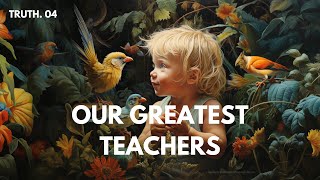
A parent reflects on how their infant son teaches lessons about nutrition, presence, and living aligned with nature. The child's body immediately rejects processed foods while thriving on raw fruits and plant-based milk, revealing what's truly nourishing. The speaker argues that children's pure feedback and natural instincts offer adults a blueprint for simpler living, deeper community, and letting go of control.
33 years old now, for the past 14 years, I'm in this whole field of personal development, spirituality, questioning life, consciousness, growing more, more and more into your highest version. And over these, like almost one and a half decades now, almost half of my life, I was learning so much from so many different people, so many different coaches, so many different teacher. I read like hundreds of books. I, I, I attended so many seminars, so many courses I, I took, I took one on one coachings and basically everything you can, you can think of that is out there. I spent a lot of time just by myself doing silent retreats and attended big, big seminars with thousands of people and everything in between. But there's one person that I would call my greatest teacher. The one human being that impacted me, where I'm at right now in my life and my journey the most, by far the most. My greatest teacher is actually my son, Leonel. He's 16 months old now, almost 17, and he's sleeping behind me. If you're watching the video podcast, you see our, our beautiful little bamboo hut in the jungle and he's taking his, his morning nap right now. And that's why I don't know how far we can, we will, we will come in this episode, but when he wakes up, we will do a break and I'll continue at another time. So over the past almost a little bit more than two years, so his 16 months, plus the nine months of the pregnancy, almost like two years since a little bit more than two years, I was researching so much about this topic. What do children really need? What do children really need? And what can we learn from them? Not how can we teach them something? We don't need to teach them anything. They are already so pure, so perfect, so wise. We can learn so much from them. And in the beginning, during the pregnancy, it was more a theoretical quest of reading books and doing courses and learning a lot. And since his birth, I had the chance to put all of that into practice and learn so much more. And I would say when I look back into the past two years, I would say children teach us everything we need to know about how to live a good life, that he asked for, that he demanded these changes. And yes, he has a very, very beautiful and very clear way of articulating what is right and what is wrong. And I see myself as a father in the responsibility to hear him and to create a setting, to create a life where it's actually easy and effortless, that he is able to fulfill all his essential needs. And when I check in where we are right now, like, physically and my inner development, I would say it's actually not hard. It's actually not hard to live a good life. It's actually pretty easy to live a good life. But most people are so far away from that, and their children tell them this, like, every day. We just need to listen. So this episode is dedicated to all parents, to all future parents, to all human beings who are maybe saying, now, I cannot see myself as someone who puts a. A human being into this world. Doesn't feel right, doesn't feel, doesn't resonate with that, because the, the world I see right now is not fit for children. Maybe after this episode you will think differently, because we, as parents, we as adults, we are invited. When such a pure, radiant, loving light being enters our lives, we are invited to rethink everything and then to act on that. And this is what we did over the past two years. So when I look back two years ago, when we held the positive pregnancy test on our hands, I lived a life that was dramatically different than now. In Berlin, in Germany, capital, three and a half million people around me in a beautiful apartment overlooking the river in one of the fanciest districts of Germany. Had a nice rooftop terrace, around 130 square meters, four rooms, nice kitchen. It was basically a really great apartment for a young couple living their lives, going out, seeing friends, and living the good life. And then we. We had this positive pregnancy test on our hands. And we immediately realized that the life that we were living at this time is not suited for children. Because this thought of, okay, when Leonard is there, what will we actually do? He needs to. He needs to be with other children. He needs to be in nature. He needs to be, like, playing around. He doesn't. It's not a good idea to put him in his own, like, children's room and turn on the TV just so that he is. He's quiet. No. And then we realized, okay, we actually walk for, like, 10 minutes and cross a huge, huge, huge, huge crossing with a lot of traffic just to get to a playground. And I had, back in the days, I had this routine of every morning going for a walk, going for a walk at the river. And then I, I passed this playground. And in 80% of the time, there were no children. And I was always wondering, where are all these children? Yeah, they're inside. Inside and on some, some devices or. Yeah, getting parked by their children at some kind of daycare or whatever. They were not there. They were not outside. They were not playing. And one of the saddest things was when I passed this playground, there was actually one child with the daddy or with mommy and parent was sitting on the bench and waiting until the time is over. And the child is like roaming around and looking and there's nobody and it's boring and the playground is actually felt a little bit artificial. Like, couple of things to do. And yeah, that was it. And I was so sad. And we were like, no, we cannot see ourselves putting a children into this world. That would feel so wrong. And then we asked ourselves this question and this opened everything that is there right now. We asked ourselves the question, what does the children really need? How can we provide the ideal setting for children to thrive? And how can we, how can we create the ideal setting for their parents to thrive as well? Because we realized, okay, in this, like seeing this lone parent sitting on the bench and waiting until, until his or her child doesn't want to play there anymore. I can, I could see that in their faces. Like they were not fulfilled. Like waiting on a park bench or driving, playing with some kind of cars with their children. Like, of course that is not fulfilling to an adult who's like intelligent and creative and smart. This is not suited for them. So we realized, okay, either when we become parents in this setting in the big city, we can give up our lives completely and become full time parents and be at home and sitting on the, sitting on the, on the, on the carpet and playing with some kind of, some kind of, some kind of like police car or whatever. And like, yeah, what, what is this? What is this? This is a joke. This is not suitable for intelligent, smart human beings who are grown up. No. So we can either give up our lives completely or we can let our children suffer, which result in. We will suffer as well. So it felt like a situation that, where we cannot win, where we, where we would like, put everything in there that we have and it would still like be so far away of being enough so that all his needs would be met and our needs as parents as well. So we realized we need to make a change. We need to leave Germany. We need to go to Bali. We need to live in the tropics where he can be naked all the time, where he can be outdoors. We need to live in nature. We need to grow our own food, prepare our own food. Back in the days, we were ordering some kind of app or dinner every day. Every day. Not every day. Sometimes we like cooking, but most of the time we were just like, okay, oh, chef, okay, yeah, Indian food, whatever. Let's order. And now I'm preparing all my food, like, 95% of my food, like, by myself. I'm in the kitchen with Leonel. He's enjoying that a lot. And he's standing there with me on some kind of small table. And then we are in the kitchen and creating the green juice together. And he loves that. Yeah. And back in the days, I was working so much, maybe like something between 8 and 10, maybe sometimes 12 hours a day. I was sitting in front of the laptop, I had calls, I was preparing things, I was launching things, I was. I was living the entrepreneur lifestyle. And now, most of the time, most of the time, I'm just. Just in being, in being. And of course, I'm working on projects that are way bigger than what I did in the past, but in a totally different way. In a totally different way. Like, the amount of hours I work every week is like, I don't know, 20, maybe 20. And at the same time, I'm working, like, all the time. And I'm working not at all. Because, of course, when I'm with Leone and we are playing, like, down at the river, and then I'm with him, and then I have an epiphany for some kind of project that I want to embark on in my business, and it's like creativity overflow. You could count that as work. But actually, I'm with my son and some ideas are flowing in. And so the quality of the. Of the thoughts, the quality of the ideas, the quality of the creative output that's taking place right now is through the roof compared to what I did then, like. Like a zombie hacking, Hacking on some kind of keyboard and having one call after the other. And this was it. I wouldn't say inspired by him. It was demanded by him. And that's a good thing. That's a really, really, really good thing. So I'm taking care of my body, like, really well right now. Spending a lot of time, a lot of focus on my essential human needs, which I neglected back in the days as well. I surround myself with positive, amazing, smart, loving human beings. Not for the sake of. I need people in my life. I'm actually super happy alone. I'm super happy just to be with Leone, but the people that are there are, like, so grateful for them. And, yeah, I'm living a completely different life than what I did back then. And this is a lot, A lot cost by Leona. And that's why I want to dive in today's episode into the essential human needs of children. The basic Needs of children. And how can we as adults create a setting where they are thriving? And as a side effect, we are thriving actually. They are telling us everything that we need to know about how to live a good life. It's really that simple. It's really that simple. And I want to tell a lot of stories of the past two years and maybe inspire you to rethink your priorities in life. To rethink how you're living your life, to rethink where you are living your life, to rethink with whom you're living your life. To rethink, like really your inner state, your inner state, how you are approaching life. This episode could potentially, if I would have listened to it or watched it two years ago, it would be like exactly what I needed at this time. And maybe it's the same for you. Let's see. I want to start in the beginning when we were preparing for the birth. Melina was pregnant. We were really thinking a lot, how can we? How can we. I'm just amazed by the beautiful jackfruits that are growing there. I have three jackfruit trees here, and they are ripening more and more like immense, immense, immense fruits. Yeah, this is the setting we need. I'm so looking forward to harvest them and to sit here on the. On the grass with Leon and just to munch on this drag fruit and be like in bliss together. When we were. When we. When we. When we were preparing for the. For the birth, we were thinking a lot, what is the ideal start into this life for this precious little gem? And pretty soon it became very clear that the standard way of birthing a human being feels so wrong. Like in a hospital with people who are supporting the birth that are paid to do that. And actually most of them don't like their jobs. They are just here because they are paid to do that. In a setting where it's all about timing. The faster a birth is, the more, the better for the, for the efficiency machine of the hospital. The more they. The more money they earn with it. And if it's not going fast enough, we actually need to do a C section because it's safer. But actually the hospital earns more money with it. And the doctor can take his golf lessons on Friday afternoon. Yeah, it's such a broken system when you really, like, pull away the curtain. This whole system of welcoming little children, innocent human beings into this world, this whole system that is out there is so broken, Is so broken. With a lot of pressure and with a lot of fear, the mommy to Be is laying there in totally the wrong position, like laying on the bed. How could you birth a child like this? This is. This is so against nature. This doesn't make any sense. You don't feel. You don't feel. You don't feel held. You don't feel really supported. It's more like, okay, you need to. You need to go like, quick, quick, quick, quick, quick. And then somebody's coming in and doing some check on you. You don't know this person. And then they are gone. And you don't know what they did, and you don't know what is. What is going on right now. Yeah. I talked a lot with my mom about my birth, and that was in the hospital, that was with a C section. And that was not a pleasant experience. And because of that, I really sense that I want to do things very differently. And Elena and I were 100% aligned on that. I'm so grateful for that. Yeah. When I was born, I want to tell a story that's actually very, very sad. When I was born, I was already 10 days past the due date. Like, the whole notion of a due date is so, so hilarious. Thinking that you are able to predict the exact day when a human being should be born. Hey, butterfly predicting this how that's. It's not in a machine. It's nature. It's nature. Like when you look, when I look at this jackfruit tree, there are jackfruits that are bigger, that are smaller, that are more like this shape, that are more like rounded shape. It's nature. There are variations. So the assumption of being able to predict by exactly by the date the arrival of a child doesn't make any sense. So. Yeah, but in the days when I was born in 1990, my mom was called to the hospital because I was already 10 days past the due date. And the doctors were getting very afraid. And then after a couple of hours, didn't get any progress, of course, no progress, because my mom was afraid and she was not relaxed. And when you're not relaxed, you cannot let go. So the whole birthing process is a function of how much you as the mother, are able to let go and to surrender and to give in. The faster your birth will be, the more you are able to surrender, the more you're able to let go, the faster the birth will be, and the less painful the birth will be. And maybe it will be orgasmic. Maybe it will be the most beautiful experience of your entire life when you're in full surrender and full trust and completely Relaxed. And, of course, a setting in the hospital is not supportive for you being relaxed and feeling taken care of and trusting. And so my mom was like, ooh, she was very tight. And she was, like, afraid. And of course, when she's tight, the birthing process stops. When you look into nature, it makes so much sense, because when the mother is afraid, the birthing needs to stop because she's afraid, because there is some kind of predator coming. It's not a good idea to enter the birthing phase when there's a predator coming. So that's why the mother looks for a safe space in some kind of, like, corner in the bushes where there's. Where there's no danger, and then she can surrender completely. And when there is a predator coming, she's, like, immediately birthing stops so that she's able to run away. That makes so much sense. When you look into nature, you get all the answers. But we, as human beings somehow created a system that's not supportive. That's like a. It's. That actually feels like a predator being around the corner all the time. And then you ask of the mother to really let go and to surrender and to birth his child. That doesn't make any sense. So, yeah, in my birth, the process stopped. There was no progress. And then the doctor said they did some kind of, like, measurements, and they checked the color of the water. And then they were like, we need to do a C section, like, really quick danger. And my mom was like, okay, okay, let's do the C section. And then I was. I was there, like, pretty fast. And she passed away because of the narcotics she got. And then I was there, and she was. She was not there. And then I was, like, cleaned and bathed and measured and everything. And when my mom arrived back and the doctors gave me to her and put me on her chest, her immediate feeling was like, oh, something feels wrong. I feel no connection. I feel no connection to this little baby. I feel no connection. I feel no, like, emotions of being a parent. And that's not because she's a bad mother or something is wrong with her or something is wrong with her body. That's a natural reaction as well. When you don't go through the natural birthing process of birthing your child, like, through your body. When you rob your body of this experience, then your body realizes, oh, okay, no, baby. Baby must be. Must be dead. And then it makes so much sense to disconnect from this. From this baby. And when the baby later comes, because when the baby later, like, gets put on your chest. After your body realized there's nobody, there's no baby, it's a, it must be dead. And you get it. It's like confusion. Your body is, your body is completely confused because this essential experience of natural birthing was not taking place. And then it's a perfect reaction of your body to not develop these emotions. And this lasted for a long time, for months. She was getting more and more used to her role as a mother, to what time she spent with me. But mostly for the first month, she didn't feel as a good mother and she didn't feel a lot of connection with me. And that's, that's so sad. And that's so sad and even more sad realizing that this is the reality for actually here in Indonesia where we, where we are right now. I had a chat with, with Putu. His son was born on the same day as Leone. So we had a, had a nice connection and I was, I was having, having a chat with him and I was having a chat with our midwife that supported the birth. And they were telling me that here in Indonesia it's absolutely normal to birth your child with a C section and not with natural birthing because it's safer. They say, like they created a nice marketing campaign around, around birthing children in this unnatural way and that in the, like, for most of the, for most of the, for most of the birds, it's already in the, in the second, second generation. So there are, there are children and their parents were born with C section as well. And when these children grow up and they will get children as well. So the third generation of birthers, when this takes place with a C section as well. Our midwife, midwife told us that the birth body, because it's so disconnected from the natural birthing process over three generations that the body can lose the ability to birth your children in a natural way. And when I heard that, I was shocked. I was like, how could we as human beings arrive at a point where we lost the ability for the most natural, for the most beautiful, for the most important thing on this planet? And of course, it's pretty easy to see the consequences that this will have. Like when the start into your life is disconnected. It cost me a lot of work to connect back with me, to connect, like really deeply connect with me and to develop this full trust into the life, into life, into the universe. That was a lot of work. I'm 33 years old and I'm not fully there yet. And yeah, every time I dive into that that makes me so sad and it makes me so angry. Like out of, out of the need for efficiency, we created this machine that robs as human beings of the most important experience of our entire lives. Because how we enter, how we enter this, this incarnation is so important. It's so, so, so important. It decides on whether you are able to develop this unconditional trust into life and the strong bond with your parents or not. Of course you can do a lot of work, you can do a lot of coaching, a lot of therapy later and you can close this gap. You're not lost just because you had a birth that was just like wrong. Everything is still possible, but it makes life so much harder. And that's why it's very important for me to share this message. Because every time I hear from parents that they decided for a natural birthing process, I'm like, oh, one more baby, one more light worker, one more little gem that will have a easy and beautiful and effortless start into their lives. It gives me a feeling of hope for this world because we need more, we need more of these, of these little light workers that are bringing out of their pure love, that are bringing so much change into this world. So for us it was very clear. We will have a natural birth. So not in a hospital, we will have a home birth just with a midwife and not with some kind of like doctor or whatever, just with a midwife. And besides that, just Alina and I and we will go through this process at home. We will create a beautiful setting, we make it really nice with a lot of candles. We will have a birthing pool and then we'll see where the flow will take us. And yeah, there were a lot of obstacles on the path. Lionel was one and a half weeks over the due date. Like me and the doctors were very afraid. We had some kind of regular check ins in between. We did some ultrasounds to see whether everything is good. When I, when I, when I would be able to go back, I wouldn't do them at all. But there we were a little bit afraid and we were like, oh, let's see whether he's moving and everything. But if I would be able to go back, I would do not do any check ins. No. And I would really work on the connection of us with this baby. And I think when we are connected, we will realize everything. We will realize everything. We will know what is going on and then we are, we were going a little bit crazy because he was in the wrong position. He was turning and wrong position like There is no right position. It's all. It's predicated as well on this. On this mechanistic worldview of. This is how a baby should be born in this position. And he was turning the other way around. But then in the end, he was. He was. He was fine. It was. Everything was beautiful. And all the. All the. All the, like, headaches we were having was not necessary, but we stayed, no matter. No matter how, like the doctors and every. Everybody was, like, telling us and be safe and come to the hospital. We were aligned with our path. No, we will have a home birth and everything will work out. And I credit Elena immensely for that, for her trust, for her, like, everything is good. Everything is good. That was. That was beautiful to see, like, her connection with this baby and her belly. And then we had the home birth. It was the most beautiful and at the same time, the most challenging experience of my entire lives. Being there, supportive, fully. From very early in the morning to very early in the evening, we were going through our process. Yeah. And then Leona was born. And then we held him, and we're just, like, both crying and crying and crying. And we saw him and it was like, oh, my God, look at this beautiful little baby. This gift of life. And so much. We were so grateful and so proud that we gifted this human being the most beautiful start into his life. And then, yeah, we were at home. And then we had our first night. And then we spent many days, just us together as a family. Not going out, not going anywhere. Just really developing this strong bond. And we decided for lotus birth, I don't want to go super deep into this topic. You can look it up. Lotus birth means that you. After the birth, you don't cut the umbilical cord, but instead you leave it there until it falls off by itself. So many people in the spiritual and conscious sphere, they're letting the cord pulse, and after a couple of hours, when it's dry, they cut it can be fed by the breast? No. Like the connection between the baby and the placenta. The placenta nourished the baby for the past nine months. So there's a very intimate connection. And just cutting this because you think it's over, the baby is there and doesn't need the placenta? No. That just felt really wrong. So we decided to let the. The two of them, I would say, connected until the cord falls off. And that was three days. Three days of marrying me. That was a. For me as a vegan since 13 years, it was a. It was a very, very interesting Experience to marinate this piece of meat every morning and every night with salt and with lavender so that it's not rotting. Then we had the placenta in a beautiful bamboo basket, and it was connected to our son. And we slept together three days and three nights. And sometimes it was a logistic challenge to carry him connected to the placenta and to wash the placenta and then to wash him. But it really invited us to slow down. So the first three days, well, while you was connected to the placenta, it was a. Yeah, our life was really slow. Really, really slow. And. Yeah, and I would do it the same, like, anytime again. And then it fell off. And then we. We dug a hole in our garden and then we put the placenta there. And, yeah, we honored this organ that nourished our little baby boy so well. So, yeah, that was the start into his life. And there were no fluorescent light, no pressure, no hectic, no uninvited people. It was just love, just pure love. In the first days, our midwife, amazing, amazing woman, Amazing woman. We felt so supported, and at the same time, we didn't need that much of a support. Most of the time she was living, she was sitting in the living room. We were even joking that our birth was going so well that our midwife was able to eat a pizza next door in the living room. Because next day when we woke up after our first night, we opened the door and we saw half a pizza in the fridge. And we were like, where is that coming from? And then we realized, oh, okay, that was hers. So, yeah, she didn't have a lot of things to do. So mostly the two of us were going through the process, but me, her, us sensing that she's being there, and if. If she's needed, then she could come and she could support emotionally. And that was. That was beautiful. So, yeah, I so appreciate that we were able to. To give Lionel this start into his life because that caused so much of his incredible trust into life. Like, when is. It's. It's so crazy when. When he's with one of us, with me or with Elena, and then there is a stranger coming, like a person that Lionel never saw before in his entire life. And that's a. That's a person that's very, very looking, very friendly and smiling, not too over the top, as most people are when they see children of, like, some doing some. Some crazy things and being, like, overly, overly positive. And he's like, oh. But when something is genuinely genuine, genuinely, genuinely friendly, he's like, of course I can go with you. And then the other person, like taking him and going somewhere and showing something. Him and we, as his parents, we could just like go and be. And he was, he. He wouldn't even question what's going on. This is the. There you see the level of trust he has in life. And when you see other children. Yeah, for a couple of months we gave him to daycare. And then one time I brought him there and he was like seeing his favorite nanny and playing. And then there was another child who was there for the first day. And then her mom left. And this little girl, maybe three years old, was just like crying and crying and crying and crying nonstop. And I could see it in her eyes. He was. She, she was, she was, she was throwing up as well. I could see it in her eyes and her whole system how afraid she was. Like, how afraid she was. And it's. This touched me deeply and was like, oh, my God, I feel so sorry for you that you need to experience that. But at the same time, I can, I can understand her mom, of course, we need to have time for us and we need to have space. And maybe she was super stressed and super overworked and just were enjoying a little bit of time for herself. But yeah, as I said in the beginning, like, the standard way of raising children is just like, lose, lose. Just children are suffering, the parents are suffering, and it's like, well, such a broken system. And yeah, you see, you really see his deep, deep, deep level of trust into life, into. Into, into existence, into the universe. And this is strongly related to, to his birth. Yeah. Let me take a sip of. Sip of ju. So let me think. Where do I want to. Where do I want to connect? I want to show you a book. It's holding it in my hands right now. And this book impacted me so deeply. I read it multiple times. I listened to it multiple times as an audiobook written by a woman called Jean Liedlov. The English title is the Continuum Concept. Holding it in My Hand in German. And in this book, if you haven't read it and you are parents or you are expecting parents or someday in the future, maybe you want to become a parent, you need to read this book. And even if you are already 65 and you never had children and you're never. You don't plan on getting children, read this book anyway. It's such an eye opener. And this woman spent a lot of time in the, in the Amazon, in the jungle with tribes who are very, very far away from modern civilization. And she was Intrigued by this question. Why are these children so happy? Why do these children barely cry? Why do these children, like from a, from such a young age, are so confident and so strong and so mature? Why is it such a stark contrast to children in the Western world? And she was studying them for many, many, many years. And she worked, she worked with one tribe, the iguana, very closely spent their, spent a lot of time there. And in this book she shares her observations and as well the process she had later on when we, when she was back in the US working with parents, working with children and. Yeah, and this book, it's just, it's a gem. It's. This book is. I see the price on the back. €9 and 95 cents. This book is worth thousands, thousands of euros, easily. Yeah. And one of the major differences between the iguana and the western civilization is that the parents, when the children are born, are carrying them around like everywhere they are going. Constant skin to skin contact. And she explains that the pregnancy is not over. After nine months we think, okay, baby is there now like total change on every level. And he can sleep by himself in his own bed. No, babies just need to be born after nine months because their heads, because of human evolution, their heads are getting so big. When they would stay longer inside, the mothers won't be able to birth them naturally because their heads would grow too big. But actually the pregnancy is not over. After 9 months of inside pregnancy should follow 9 months of external pregnancy, so that after 18 months a child is really able to be independent and to go into this world. Of course, with nine months of age, he's not able to get a job and prepare his own food and everything. But when you fulfill all the needs that this little baby has, then after nine months he will be so independent, he will start like crawling, crawling away. And only when he has some essential needs of food, of sleep, of love, of something, some he encountered some problems, he hurt himself, whatever. Only then she will come back. He will come back, or she will come back and get the support of the mother, of the father or some kind of, some, some other kind of caregiver, and then he or she will be on his own again by nine months. Of course, nature is not a machine. You cannot, you cannot like, you cannot count exactly on nine months you will be independent. But this whole notion of for the first, around nine months, maybe for some children it's a year. Maybe for some it's only seven months, whatever. Constant skin to skin contact when the baby was in the mother, constant skin to skin contact. They were basically one. They were basically one or organism. And this should continue for at least nine months even though the baby is born. And this is the picture you see on the COVID of the book. Beautiful indigenous woman carrying her son. And every time I look at this, it moves me, it moves me deeply because the level of strength you see in both of them because they are so connected, they are like together. That's beautiful to see. And when a child gets this essential experience fulfilled, that for the first 7, 8, 9, 10, 11, 12 months, however, however, however, how much time it needs constant skin to skin contact, like sleeping together, eating together, like doing the, doing the houseworks together, doing everything together. When this existential need is fulfilled, then only then the child is able to grow independent of the mother. When it's not fulfilled. I research this topic deeply. When this essential need is not fulfilled, there will be a constant craving of the child for this feeling of being supported, being held, being cared for unconditionally. And this extends to adult life as well. So much of the behavior we are seeing in the modern world of people trying to get a. Oh, Liana is awake. Okay, let's continue the podcast later. All right, Afternoon nap time. Let's continue the podcast. Let's see how far we'll come when this existential need is not met. In the first months of this human being's life, this can manifest itself as all the behavior we are seeing in society. Like people approaching life with this attitude of I want to do as less as possible and I want to get as much as possible. Like this whole notion of self maximizing behavior. Like in my job, I want to work as little hours as possible and I want to get as much money as possible. In my, like, this is this, this phenomenon of, this desire of I want to push a button and then I want to get like all the things that I, that I, that I desire, but I don't want to do something for it. Like, you could call it laziness. And I believe this is an unnatural character trait. This is not something like there are some people that are lazy or, or other people that are not lazy. No. If we in our first months didn't experience this feeling of being unconditionally cared for, like carried around, not needing to do anything and being in full peace and full love and full harmony, like getting so deeply nourished, then only then we can develop this, this character trait of actually, I want to do something, I want to, I want to contribute, I want to give, I want to put my Gifts to best use. And if that's, if this need is not met, this can manifest in like Grown up men, 40 years old, 50 years old, always looking for the quick fix, always looking for the get rich quick theme. Always looking for the magic pill that makes you super fit and gives you the six pack. Always looking for the ten step program in order to build amazing passive income so that you don't have to work again in your entire life and you are always taken care of. This is a manifestation of this desire that's present with any three month old baby. And when this desire is not getting met like it manifests in our adult life and I believe when we are deeply cared for in the first 6, 912 months of our lives, then we actually don't want to just receive. We want to do, we want to put our gifts to use. We want to be a contribution to society. And it doesn't fulfill like receiving doesn't fulfill us more than giving fulfills us. So it's actually nice to put in the work in order to earn money, to get a nice body, to have an amazing dinner, to have an amazing relationship. It fulfills us to do the work. Because this part of ourselves that just wants to be carried around and doesn't want to do anything, this part like got everything it needed and now we can be fully grown up adults. And this is so rare in society because most of us didn't experience the first months including the birth of our lives as nature intended us and intended it to be. And then we run from coach to coach and from therapy to therapy session. Or maybe we don't even recognize that there is a problem and we try to struggle us through lives hoping for the weekend or for the next vacation where we are just like laying on the sun bed in the all inclusive, all inclusive hotel club and getting pampered for two weeks. But then afterwards we need to get in the hamster wheel again and need to work and complain about life. This is not how life should be like. And the root, the root of really wanting to work, the root of wanting to be productive, these roots are, are developed in our first months. So it became crystal clear for me that for the first 6, 912 months we need to carry around, carry Leona around like everywhere, like every nap. We are not letting him sleep in his bed. It's not even his bed. We have a family bed together, but we don't, we don't, we don't put him down. We, we will carry him around for at least 22 hours every day. So including sleep time. And when he's sleeping, he will sleep like really close to our bodies and we will be like together in the night and daytime when he's doing his naps, we. He got a nice sling and I was carrying him, carrying him around for three times a day, two hours each, sometimes even longer. There were days where I was carrying him, carrying him around while he was sleeping for seven, eight hours a day. And yeah, when he was awake, of course, the same like skin to skin contact when Alina was breastfeeding him. Skin to skin contact when we were like preparing dinner, having him in the sling on the side or just like holding him and with the other hand that's available, preparing the food. And that sounds like a 24, 7 job. And it actually is because of our lifestyles. There was a moment a couple of weeks after the birth where I had an epiphany. At this time, we were living in the Thrive village, in the community that we founded. And there was everything we needed. There was housekeeping every day. We didn't need to make any beds or clean any dishes. We didn't even need to prepare our own food because there was a nice restaurant. They served vegan, vegan smoothie bowls and pad Thai in the evening. And it was really nice and we really enjoyed it. But then there was one moment where I had an epiphany that our lifestyles are not in alignment with this need of, of Leona and with this need of every baby to be carried around because it was so interesting. I tried it many times. When he was sleeping, I put him in the sling and he slept like beautifully. And then I set myself on a chair and wanted to get some work done on the laptop. I was not sitting for two minutes. And he woke up. He woke up because. And it's. That gets beautifully described in this book because where we are coming from and these tribes that are living far away from Western civilization are still living this way. They're living very active lifestyles so that it's totally normal that the person who is carrying you is moving because this person is doing something. And deep, deep down in our bodies, like this feeling of I'm held, I'm taken care of, I'm carried around. And then there's no movement, like no movement at all. Deep down in our bodies, like this feeling of I'm held, I'm taken care of, I'm carried around, and then there's no movement, like no movement at all, is deeply frightening because this can mean that the person who carried you is dead. And then you need to wake up and you need to cry in order to get attention so that somebody finds you. Because the worst case is the person died because of some, I don't know, poison or whatever. And then you are laying there and as a three month old baby, of course you're, you're super helpless. You need to cry. The only chance you have is to cry so that maybe someone finds you and picks you up and there is movement again. So because of this deep seated, knowing that movement is. Movement is safe and stagnation, non movement is deeply frightening because of that. I was on my feet all the time. And no, I didn't sit down when I had him in the sling because it didn't work. He woke up after, after a couple of minutes, maybe, maybe immediately. He was sleeping like deeply with his mouth open, like sleeping like this. And then I sat down 10 seconds, woke up and I was like, how is this possible? But of course, yeah, he showed me. I want to be moved around, I want to be carried around. I don't want you to sit. And at first there was kind of resistance in my body because it's much more exhausting to move around than to just sit on a chair and work on your laptop for two hours while Leonel is sleeping. But pretty soon I accepted that and I was like, okay, you want me to move around and I will move around. And then I was walking. I was walking all the time in our garden to the, to the beach. I went for like many, many, many, many kilometers every day. And the first days where I did that in the evening, like my feet hurt so deeply. The evening when I went to bed and actually put my feet up and it was like, oh, relief, because my feet were hurting because of so much walking that my body was not used to. And when we compare that to how our ancestors lived, they were active. We as human beings are there are meant to walk. And when we compare that to how we in the, in the Western world are living right now, where we are sitting and then getting in a car, where we're sitting again, driving to work, we were sitting again, then getting, after an afternoon, getting in the car again, where we maybe go to the gym, where we move our bodies for an hour and then we get in the car again and then we are seating and sitting, and then we arrive home and then we are sitting on our chair and having dinner and watching television. We're sitting all the time. Good friend of mine used to say, sitting is the new smoking. It's true. It's true. We need to be active in our body. Like it actually when my, when my feet hurt in the first weeks after he was born because I carried him around so much, I actually was, was very glad that my body showed, showed me this, how unfit I am, that it's something entirely new to walk for 15 km each, each day and carry this little human being around. And I was, I was very happy about that because I was like, yeah, of course my body needs to get in shape. And it's not that I, that I was overweight or something, but I was not used to walking 10, 15, 20 kilometers every day. And that's what I meant in the beginning with children show us like they teach us everything we need to know about life. Of course we need to, we need to live active lifestyles. And the epiphany that I had in this moment was we build our lives optimized for comfort. A nice restaurant where we can order our food, had a nice housekeeping that cleans our, cleans our, our. Our. Our house every day. We had a nice comfortable chair where we can sit and work on the laptop and don't need to do anything. That's, that's exhausting. It's physically straining. And this is a life that's in massive misalignment with the needs of this little human being. So my lifestyle completely changed when I had, of course I was, I was, I was still, still working, but when I had meetings, I didn't do them on the. Sitting on a chair behind a laptop, but I was doing walking meetings and I was sleeping. I put my, put my headphones in and I had a phone call without video. And we were discussing everything that we needed to discuss and it worked out really nice. And before, when I wanted to read a book, I was looking for a nice comfortable space in some kind of hammock on a nice sofa. And then I was reading. And these times were over as well when I wanted to learn something. When I, when then I was walking in our garden, he was sleeping and I was reading the book while I was walking. Pretty unusual, but it worked. And I wrote, read a lot of books during this time. And it was nice. It was really nice. I felt fit. Like my body was like now finally my body felt really relieved to have this little impact in my life that demanded me, that demanded to be carried around. And my body really appreciated this invitation to walk more. So this is like the fundamental pillar that I want to, needed to discuss. And it worked out really nice. And before, when I, when I Wanted to read a book. I was looking for a nice comfortable space and some kind of hammock on a nice sofa. And then I was reading and these times were over as well when I wanted to learn something. When I. Every parent, every future parent, like our children need to have skin to skin contact for the first 6, 912 months. And they will show us when it's, when it's, when it's enough. So many people came to me and said like, oh, you will spoil your baby. Always carrying him around. He will be like super, super, super annoying later because he got everything he needed. No, no, no, this is, this is fear based belief. This is so wrong. When we give our children everything they need at the moment where they had, where they got everything they needed, they want to be independent. Right now when I sometimes in the morning open the door, going into the garden, opening a coconut and a. I'm carrying him, Leonel on my, on my hip. And then we are somewhere where there's something interesting happening, like the door with the key or he sees something like in the garden and he's like, I want to go down, I want to go down, let me down. And then he wants to walk by himself. Yeah. So that's very, very important that we, that we embrace, that we embrace this unconditional giving. Because there's a built in mechanism. Nature is so smart. There's a built in mechanism when he received enough and then he want to, he wants to be independent, he wants to be free, he wants to be by himself. And only when there is a, there's a depress, a pressing need like hunger or he's tired or he hurt himself or something, then he will come and then he will need this. And even now, like I'm having him in the sling from time to time and he enjoys that. But more sooner than later he's like, I want to get out. And yeah, he's the living proof that when we give everything and we really fill this cup like completely full, then it's done, it's over, it's fine. I believe that never in his life he will be in a situation where he will enjoy receiving more than giving. No, because his cup is full and like 9 months, 10 months, 11 months are enough. And then for the rest of our lives we can, we can, we can give and we can be independent and we can, we can, we can be productive human beings that are in service to society. It doesn't take, so it doesn't take that much. But of course it's a sacrifice. It's a sacrifice for us as parents to change our lifestyles. And then we stopped ordering at the restaurant and we started preparing our own food and we went to the market and bought our fruits. And then I was standing in the kitchen in the evening, I was cooking and he was with me. And he enjoyed that so much. He enjoyed that so much. Compared to sitting on the sofa, getting on WhatsApp, ordering at the restaurant, waiting for the food, sitting again, eating the food. No, he always showed, like, even now, it's so interesting that when action is. When there's action, when there's things going on, he's super quiet and he's at peace. But when there's nothing going on, he's, like, cranky all the time. It's such an intense contrast to his mood when we are here at my home compared to when we are at Elena's home in. In Uluwatu, in the south. South of. South of Bali. She has a really nice, really nice Airbnb, like, fancy Airbnb. Pretty, nice place with a small pool, two stories. Nice, nice, nice house. Like, in the past, that would be, like, super satisfying for me. But yeah, I was discussing that with Alina a couple of days ago. When Leona is there, like, even if we, the three of us are together there, he's like, I'm crying all the time because this house, there is no life. There's nothing going on. Everything is dead, like walls and tables and super satisfying for me. But yeah, I was discussing that with Alina a couple of days ago. When Leona is there, like, even if we, the three of us, there is nothing going on compared to when we are here in the morning. The first thing we're doing, as soon as the eyes are open, the doors are open, and then he can go into the garden and are together there, he's like. And crying all the time because this house, there is no life. There's nothing going on. Everything is dead. Like walls and tables. And he can go outside, he can go to the neighbors, he can. He can play with the dogs. There is there. There are so many things going on. And then it's only like two, two minutes. And then we are down at the river, and that's his favorite spot because there are. There's, like, water. There is nothing going on compared to when we are here in the morning. The first thing we're doing, as soon as the eyes are open, the door, the doors are open, and then he can go into the garden and he can go outside, he can go to the neighbors, he Can. He can play with the dogs. There is. There. There are so many things going on and then it's only like two, two minutes and then we are down at the river and that's his favorite spot because there are. There's like water, there are stones, there is sand, there is, There are st. There are. There are like trees and there's so much going on. There's so much going on. There are other human beings and yeah, most important things that I learned that there are stones, there is sand, there's. There are stuff. There are. There are like trees and there's so much going on. There's so much going on. These little human beings are told there are other human beings and yeah, really at peace and really quiet and just like looking around when there are things going on, when there are other children, when there are other adults, when there's vibrant nature, life is chilled. Life is super chilled. I remember a couple of. Couple of months ago we. We attended a birthday party and there were like, I don't know, 10 children or like from. Leona was the youngest one year old, all the way up to 12, 14. And these children, they were like actions, running around doing things. And the only thing Leona did was just like sitting there and watching and watching these older children what they are doing. And they having the time of their lives and they are like running around and laughing and crying and everything. So much action was going on. And then 15 more adults and he was like, so at peace. But when he's alone or with one of us, with one of his parents in a dead house where there's nothing going on, he's crying all the time. And he shows us. I need to be. And the author of this book, I can highly recommend it, the Continuum concept. You need to read this. She describes it beautifully that children are learning, especially until the age when they, when they're not able to walk, they are learning passively because when they are carried around and then there's action going on around them, they are learning. But when they're in a, in a dead environment where there's nothing going on and there are no other. There are no other, no other human beings, there's nothing to learn. And that's why he's deeply uncomfortable and that's why he's crying. And that again, yeah, leads me to the realization that in order to have a pretty relaxed life as a parent, you need to have a community, you need to have other people around you, you need to have other children around you and you need to live in Nature. Because when we are outside, he's a completely different boy. Sometimes we are in Uluwatu, and inside he woke up, slept beautifully. He ate like he had a poo. Needs are met, but his essential need of learning, of discovery is not met in this dead house. And then he's crying all the time. And as soon as I put him in the sling and we get on the scooter and we drive to the beach and then we are there, like, I could do a meditation. I could do a meditation there. I could just sit there and meditate. And he's exploring and there's a, like coconut shell and there's a. Some kind of. Some kind of rocks. And then he's playing with the waves and he's super relaxed, he's super happy, he's super centered, super grounded because he's outside and there are things to explore. Yeah. And before he started walking, it was the same. It was the same. I had him in the sling. And when there are things going on around him, when I, at the time, we lived in the community and when I had a meeting or when we had a community circle and he slept. Oh, already awake. Wow. We need to continue the podcast tomorrow. All right, third attempt. Leona is sleeping again. It's the next day. And this leads us already to, like, beautifully beautiful example of the next point that I want to bring across that we cannot plan. Children teach us to stay in the moment and to not plan. But before we dive into that, I want to, I want to tie the last story I told, like, really neatly together. The. I think every, every parent or even every human being that is not a parent, like, already witnessed children who are crying. And most of the time, of course, sometimes they are tired, then they want to sleep, sometimes they are hungry, then they want to eat, sometimes they hurt themselves, then they want to be comforted. Of course, let's leave those situations aside. But besides that, most of the times when children, like young children are really crying, it's not because they want, like the reaction that most people show when they're one and a half year old child is like crying. Most people, like, try to try to entertain, try to do something. They grab some kind of toy and do like this, this, this, this, this, and want to, want to, want to end for, for everybody only listening to the audio podcast, I was like pretending I had a rattle in my head that I need to, I need to, I need to, I need to have a bite that some people are not seeing me. They try to entertain, they try to do Something. And this only leads to the baby crying more. And then they are confused and think like, okay, we need another toy. We need to do something else. But no, children don't need more attention. They actually want less attention. They don't want to be the center of attention. They don't want, like, the worst situation for a baby is like five adults looking down on him and be like, okay, what is he doing next? This is like, totally overwhelming. This is. This is. This doesn't feel safe. This doesn't feel safe for the baby. The baby wants to be already said that. The baby wants to be part of the lifestyle of a busy, busy adult. Busy adults that are doing their thing and the baby just wants to be a part of. Because when everybody's focusing their attention on the baby, it cannot learn anything because there's nothing going on. Everybody assumes that the baby will be like, in the lead and doing something, and they are able to witness that. But it needs to be the opposite. The baby needs to be just witnessing, just observing. And that's why this inherent reaction that most people show when baby is crying to do something and to entertain and to grab some toy or to do whatever things to entertain this little, this little being that's actually wrong. We need to rethink how we are living. And every time, Leone, apart from being tired, being hungry, etc. Every time he's crying, I really, I really think, like, okay, I zoom out. What is the situation right now? Is there something to learn for him? Is there something to observe? Or is it like, super boring? Because there's nothing going on and we really see that in the place where we live when we are in Elena's home, like, there's not so many things going on. And that's why he's crying a lot more than when he's with me here. And that has nothing to do with me or with Alina. It has to do with the surrounding. With the surrounding. Because here there are things going on and there are like, neighbors and he can go everywhere and we stay, we play at the river and the nature is going on and there are some, like, some animals coming and the dog and a cat and, and butterflies and. And birds and so many things. Yeah. So this is very important to have in mind. Children teach us, hey, I don't want to be the center of attention. I want to be part of a life of a busy adult who's doing just his thing that I can learn from, that I can observe. So, like, my, my attitude towards Leonel is not to focus all my attention on him, but to do my thing, what I need to do right now and let him be a part of that. So our mornings always begin with us going together in the kitchen and I will open a coconut and pour it in our huge can and then I will put some coconut water in his bottle and some coconut water for me. And then we're drinking that together and then afterwards we are going into the kitchen again and then we are preparing the breakfast and I'm just doing my thing, I'm doing my green smoothie and whatever and let him be a part of that. And he stands next to me and plays with everything and observes and what is Robert doing with a blender? And then later he's cleaning everything. And that's basically how unspectacular our days are. We are not playing with some kind of toys all the time. Actually, Leonel has almost no toys like here. The only thing that he has, it's, that's something we, we got as a gift from, from the Thai Airways crew when we flew some kind of animal cards with like paper cards with some, some kind of animals on it. But every time I put them out, he's like playing with them like for two minutes and then it's boring. And that's it. He has no toys. We're not playing with toys here. I am doing my thing and he's a part of that. And then we go. This morning we went to the local market and I put him in the sling and then we go some, go shopping for some groceries and he's a part of that. And he's like so relaxed. He's so relaxed. And we get on the, we get, we get on the scooter and when we drive and then we arrive at the local market and everybody is like super friendly to him and he gets some grapes and some bananas from, from really friendly ladies and then I'm buying things and then we are maybe stopping at the ATM and getting some cash and like normal life, like normal life of an adult. And the, the, the most important thing is the activities that I'm doing need to be in alignment with me, need to be in alignment with nature, with life, with universal law. So that it's interesting for him. Of course, when I'm. And I try that many times when he's up and I think I just need to do some email newsletter. It only takes 10 minutes. And then I sit and I sit myself on the, on the desk, on the desk and start my email program. And then I start typing after like One minute he's coming and he's. He's crying because he's like, oh, what are you doing there? I want to. Either I want to be sitting with you at the desk and I want to observe what you're doing. And of course I want to type as well, but, yeah, I cannot write an email newsletter like that. Or I want to be with you. Like, I want to participate, I want to be a part of that, and I don't want to be, like, parked in some kind of corner with some kind of toys. That's boring. I see you as my role model from which I can learn how life works. Like, young children see their parents as their role models, as their. As. As. As the most important people that teach them how life works. And that's why it's of absolute importance for the child to be a part of that and to always, like, go where the. Where the parent is going and to observe and to learn and to imitate and to do the same. When I'm in the. In the kitchen and I'm preparing my smoothie, of course Leona does the same. He. One of his most favorite activities is like starting the blender and then stopping it again and then starting it again and stopping and starting and stopping and starting it. Of course, that's what I'm doing. And he's imitating that. And this is our invitation as adults to really rethink how good of a role model are we. And that doesn't mean that we need to be perfect in everything, but that we need to follow our natural path and not waste our time with some artificial things that are not even in alignment with us. It's so beautiful. That's why I said in the beginning of the episode, like, children teach us everything we need to know about life. Every. Every activity that I'm following that is not in real alignment with me is not in alignment with Leone. Something that is in alignment with me will be in alignment with Leona as well. Like, be in the kitchen and opening the coconut and doing some, like, manual labor, like physically doing things that's interesting for him. They can see, they can witness, they can learn. Or being with another. Like when. When. When. When Mari, my friend, is visiting with his daughter. She's four years old. Beautiful Joy. That's always amazing. We talk, we have a chat. We, we. We. We just, like, hang out. And then Joy is there and Leona is playing with her, and he can, he can. He can learn how we are interacting with each other, and then we are doing some kind of things in the garden, or we organize certain things, or we on the property next door, just observing the papayas or making plants, how to set up the permaculture garden there, whatever, whatever we are doing. And he's a part of that, and that's beautiful. And he's super quiet, and he's super centered in these situations because these are like. Like being in the physical world, doing some things that he can observe. That's amazing. That's amazing. But, of course, being on technical devices all the time, that's boring for him. There's nothing to learn. Like, the only thing that he can do is sit next to me and look at the screen, but that's boring for him after 20 seconds. And of course, it's not good for him. So it is really our invitation to check in. How good of a role model are we? Are we living in alignment with our nature? Are we living in alignment with what really serves us? Or are we following some kind of artificial, Artificial schedule and doing certain things that are not even good for our body, like being attached to technical devices all the time and so on? It's very important. It's very, very, very important. So what I already said is that this podcast is quite a beautiful example. It's my third attempt, and I don't know whether I will be able to finish it while he's sleeping or not. I don't know. I can just surrender. I can just live in the moment. Like, one of the most, most, most, most important things that Leonel taught me was to not plan, to just be in the moment. Because with him, I cannot plan, because he is, like, 100% connected in the present moment. When he's tired, he's sleeping. When he's not tired anymore, he will wake up. When he's hungry, he wants to eat. When he has energy, he wants to play. Like, it's all. It's we cannot plan that children show us that we as human beings are not. Are not some kind of machines that can be scheduled. But in the way we designed our lives in the Western world, we assume that this can be scheduled. Like how we are working exactly at the same time every day, planning our vacation three months ahead. This follows the assumption that we as human beings are some kind of machines that can be scheduled, but life cannot be scheduled. Life can only be experienced in the present moment. And Leone lives in the moment 100% of the time. And when the moment is beautiful, then he's smiling and he's laughing, and he's just doing his thing, and when the moment is not good, he's crying and he shows me that. So every attack, like I think the lives of most parents are only that stressful because they are not surrendering to the rhythm of their child. They are, they are trying to, they're trying to follow their schedule, their agenda. Like they're getting up in the morning and thinking, okay, I want to do this and then this, and then we will have this play date and we go there and then a lot of frustration is coming because the schedule can. Is deeply frightening because this can mean that the person who carried you is dead. And then you need to wake up and you need to cry in order to get attention so that somebody finds you. Because the worst case is the person died because of some, I don't know, poison or whatever. And then you are laying there and as a three month old baby, of course you're, you're super helpless. You need to cry. The only chance you have to be maintained because the child wants to spend more time at breakfast or doesn't want to put clothes on or. And so on and so on and so on. And when we design our lives so that we can really follow the impulses in the present moment of our child, then life is super relaxed. The moment I have is to cry so that maybe someone finds you and picks you up and there is movement again. So because of this deep seated knowing that movement is. Movement is safe and stagnation non movement is deeply frightening. Because of that, I was on my feet all the time and no I have any agenda when this podcast will be finished, how I will record it, then I will be stressed when I'm right now sitting here with, okay, maybe, okay, he's sleeping right now. He's sleeping since 30 minutes. Okay. We were up for four and a half hours in the morning. So from past experiences, that means that he should be very tired. He will sleep for, I think at least one and a half hours. I will have an hour left. Maybe this will work. Okay, I need to hurry. But maybe he didn't sit down when I had him in the sling because it didn't work. He woke up after, after a couple of minutes, maybe, maybe immediately. He was sleeping like deeply with his mouth open, like sleeping like this. And then I sat down 10 seconds, woke up, will wake up in five minutes again. And then I will need to continue the podcast in the afternoon or tomorrow. Maybe he And I was like, how is this possible? But of course, yeah, he showed me. I want to sleep for three hours and I can be moved Around, I want to be carried around. I don't want you to sit and talk for the next two and a half hours and this will be like an epic four hour podcast. Everything is possible. Everything is possible. I don't know. I don't know. And it's like I can only lose when I try to stick to my agenda and when I let that go, I'm super relaxed. Super relaxed. And of course, that's easier said than done because we are, as adults, we are living lives that are dependent on certain schedules. At first there was kind of resistance in my body because it's much more exhausting to move around than to just sit on a chair and work on your laptop for two hours while Leona's sleeping. But pretty soon I, I accepted that and I was like, okay, you want me to move around and I will move around. And then I was walking. I was walking all the time. Like being at, for example, working, like being at a certain, at a certain point, at a certain, at a certain time, at a certain place, doing certain things. This is super unnatural. And children are so connected with themselves and with the present moment that they show us everything. But actually this way of living is the way we as adults are invited to live as well. This is what I'm. In my past podcast episode, I talked about my surrender experiment of living in the moment, following the guidance of life, not trying to plan ahead. In our garden, to the beach, I went for like many, many, many, many kilometers every day. And, and the first days where I did that in the evening, like, my feet hurt so deeply. The evening when I went to bed and actually put my feet up and it was like, oh, really? Because my feet were hurting. Not trying to follow any agendas, not trying to, like, just having the audacity of thinking that I am in control of my future is so when we really think about that is so outrageous. Of course I'm not in control by what this because of so much walking that my body was not used to. And when we compare that to how our ancestors lived, they were active, we as human beings are there are meant to walk. Incredible infinite wisdom of universe will present me even. And when we compare that to how we in the, in the Western world are living right now, where we are sitting and then getting in a car tomorrow, I'm not in control of that. I'm not in control. I'm invited, and Leonel is my biggest teacher, to live in the present moment and to let any thoughts of the future go. Let any thoughts of the past go and be here now. We were sitting again, driving to work. We were sitting again, then getting after an afternoon, getting in the car again where we maybe go to the gym where we move our bodies for an hour and then we get in the car again and then we are seating and sitting and then we arrive home and then we are sitting and enjoy. And that's why when, when, when, when his needs are met, he is like he's. He's sitting on our chair and having dinner and watching television. We're sitting all the time. Good friend of mine used to say sitting is the new smoking. It's true. Purest manifestation of absolute joy. And it's so beautiful to witness that when he's laughing he's like ah, the richness. That's true. We need to be active in our body like at the richness of laughter. The richness of just fulfillment is so good. Actually when my, when my feet hurt in the first weeks after he was born because I carried him around so much, I actually was. Was very glad that my body showed me this. How unfit I am. That it's something entirely new to walk for 15 kilometers each day. Contagious. This is why, that's the reason why. And that's the reason that it is not tainted by some kind of future worries. Okay, maybe I need to worry. Will I have enough food for tomorrow? Will my parents still love me? Whatever. No, he's fully in the present moment. But at a certain point we as adults and carry this little human being around. And I was very happy about that because I was like yeah, of course my body needs to get in shape. And it's not that I was overweight or something, but I was not used to walking 10, 15, 20 kilometers every day. And that's what I meant in the beginning. Develop the attitude of not living in the present moment. Why is that the case? Because for most of us at a certain time with children show us like they teach us everything we need to know about live adulthood. It becomes obvious that this present moment doesn't feel right. My needs are not met up until this time when of course we need to live active lifestyles. And the epiphany that I had in this moment was the baby's needs are not met. The baby is just crying. And hopefully that will lead to. We build our lives optimized for comfort. A nice restaurant where we can order our food, nice housekeeping that cleans our, our, our. Our house every day. We had a nice comfortable chair where we can sit and work his or her needs being Met again. And then everything is beautiful and he's in peace and he's centered and grounded and everything's beautiful. But at a certain point when. And this is strongly connected with not, not. Not being. Not being held, not being. Not being kicked on the laptop and don't need to do anything. That's. That's exhausting. It's physically straining. And this is a life that's carried around as much as. As the baby needs it. An acid misalignment with the needs of this little human being. So at a certain point, the baby or the child realizes certain moment. The. The present moment is not good. My needs are not met. And then it develops completely changed. When I had. Of course I was still working, but when I had meetings, I didn't do them on the. Sitting on a chair. This capacity for thinking into the future. Okay, mommy is not there and I'm crying right now, but maybe mommy will come back in the next minutes. Okay, I can be patient behind a laptop, but I was doing walking meetings and I was sleeping. I put my. Put my. Put my headphones in and I had a phone call without video. And we were discussing everything that we need. Okay, maybe mommy will come in the future. And then maybe Mommy comes after 10 minutes and it's. That's good. Okay, it worked out. So we developed this habit of being able to project certain needs into the future and when they are not met in the. In the present moment, then needed to discuss. And it worked out really nice. And before, when I. When I wanted to read a book, I was looking for a nice. We can be okay with that. And that's comfortable space and some kind of hammock on a nice sofa. And then I was reading. That's something. That's something really nice that we developed this, this habit. But. And these times were over as well when I wanted to learn something. When I. We are living in this mode way too much. Way, way too much. Of course it's really nice that we as adults, the moment we don't have food and we are hungry, that we don't. That we don't like, that we don't like, cry and scream and throw ourselves on the floor and be like super desperate that there is no food. It's super nice that we know, okay, dinner will be in an hour. That's something really, really helpful to navigate life. When I found a new book then I was walking in our garden. He was sleeping and I was reading the book while I was walking. Pretty unusual, but it worked. And I wrote Read a Lot of books during this time. And it was nice. It was really nice. I felt fit. Like my body was like now finally my body felt really relieved to have this little impact in my life that demanded me, that demanded to, to be carried around. And my buddy really appreciated this invitation to walk more. So this is like the fundamental pillar that I want to every parent, every future parent. Like our children need to have skin to skin contact for the first 6, 912 months and they will show us when it's, when it's, when it's. But most of us are living in this mode way too much of projecting their needs in the future into the future and be. So many people came to me and said like oh, you will spoil. Like okay, I don't feel loved right now. Maybe I will feel loved when I found my, my, my ideal partner. Okay, I don't feel connected to my body right now. Or maybe your baby always carrying him around, he will be like super, super. I will feel connected when I have the six pack and when I lost 20 pounds and super annoying later because he got everything he needed. No, no, no. This is when I'm super fit. And then we project our happiness, our fulfillment like so far into the future and we attach it to certain outcomes and when the. This is, this is fear based belief. This is so wrong. When we give our children everything they, these outcomes don't don't materialize themselves then that's a recipe for disaster. But even if they, even if they materialize, we connected our happiness to this certain outcome and need at the moment where they had. As long as we are not there yet, as long as we don't have the perfect partner, as long as we don't have the six pack, as long as we don't have the perfect job, as long as we don't have the per the passive income and the successful business and whatnot, we are not happy. And this is a recipe for a lot of regret later in life. So it's our invitation. I can highly recommend you to check out my. They got everything they needed. They want to be independent right now. When I sometimes in the morning open the door going into the garden, opening a coconut and I'm carrying him Leonel on my hip. And then we are somewhere Previous Episode the Surrender Experiment we are highly, highly, highly encouraged to connect more to the present moment. And Leona is teaching that where there's something interesting happening like the door with the key or he sees something like in the garden and he's like I want to go down, I want to go down, let me down. And then he wants to walk by himself. Yeah. Every day. And the more I follow that, the easier and the less stressful. So that's very, very important that we, that we embrace, that we embrace this unconditional giving because was my life. Yeah, it's that simple. Taking a deep breath right now and really appreciating this present moment with everything that's there. There's a built in mechanism. Nature is so smart. There's a built in mechanism when he received it. Yeah. That's a beautiful way to live. That's really love. And then he want to. He wants to be independent, he wants to be free. He wants to be by himself. Really beautiful way to live. To let go of any future outcomes to let go of. And only when there is a. There is a depress, a pressing need like hunger or he's tired or he hurt himself or something, then he will come and then he will need this. And even now the future plans to let go of any future agendas and just be here. I'm living in this beautiful place, immersed in nature. To this side is the jungle. To the other side is my house where my beautiful son is sleeping. It's amazing. Life is like I'm having him in the sling from time to time and he enjoys that. Good. Life is good. But even if there are things, but more sooner than later, he's like, I want to get out. And yeah, he's the living proof that when we give everything and we really fill this cup like completely full, then it's done, it's over, it's. It's fine. I believe that right now that are not good. Like my, my finger is hurting a lot because I never in his life he will be in a situation where he will enjoy receipt. Because I heard it when I opened the coconut today in the morning. That's just like one tiny example. There are bigger things in my life going on with, with which I'm not happy. Everything that we are talking about like leads us to, to, to certain really pillars of what children are teaching us and how we as adults should think more than giving. No, because his cup is full and like 9 months, 10 months, 11 months are enough. And then for the rest of our lives we can give and we can be independent and we can be productive human beings that are in service to society. It doesn't take so it doesn't take that much. But of course it would be living. One part is nature, one part is community. I don't have a community right now. We are living here just by ourselves. Of course, I'm connecting more and more to the people living around. It's a sacrifice. It's a sacrifice for us as parents to change our lifestyles and here. But it's not community and there are not other children with whom Leona can play every day. And this. And then we. We stopped ordering at the restaurant and we stopped really. It's hard for me to accept that it's not there. And at the same time, I know even though this is a nice goal to really build this community and started preparing our own food. And we went to the market and bought our fruits. And then I was standing in the kitchen in the evening, I was cooking and he was. He was with me and he enjoyed that so much. He enjoyed that so much. Compared to sitting on the sofa to grow our own food and to be independent of the system and to have other children and being on WhatsApp, on ordering at the restaurant, waiting for the food, sitting again, eating the food. No, he always showed like, even now it's so interesting. It's a really nice goal. But the moment I connect my happiness to having reached this goal, I lost. And that's why even if it's. It's really important for me to. To stress this point. Because living in the present moment cannot be contingent on that. When action is. When there's action, when there's things going on, he's super quiet and he's at peace. But when there's nothing going on, he's like cranky all the time. It's such an intense. Everything is perfect. Living in the present moment needs to be. Our recipes contrast to his mood when we are here at my home. Compared to for life. No matter what. No matter what. There are beautiful things that are going on to. When we are at Elena's home in Uluwatu in the south. South of. There are sad things that are going on. There are things that we happy with and the things that we are unhappy with. South of Bali she has a really nice. Really nice Airbnb. Like fantastic. And all of that. Wants to be accepted. Wants to be accepted. Wants to be. Yeah, just like. Yeah, it's okay. It's okay. And the Airbnb, pretty nice place with a small pool, two stories. Nice, nice, nice house. Like in the past. That would be like super satisfying for me. But yeah, I was discussing. And I'm in the moment and I can feel the sadness of some needs that with Alina a couple of days ago, when Leona is there, like, even if we the three of us not being met. And I can feel the gratitude for other needs being met. And I will stay in the present moment and I won't escape into the future. And when we are together there, he's like I'm crying all the time because this house, there is no life. There's nothing going on. Everything is dead. Really think that through. We are invited to change our lives a lot because so at like walls and tables and there is nothing going on compared to when we are here in the morning. The first thing we're doing as soon as the eyes are open the door, the doors are open and then he can go into the garden. And how much of the western way of life is not only you can go outside, you can go to the neighbors, you can play with the dogs. There are so many things going on and then it's only like two minutes and then we Western like almost everywhere in the world is so much so predicated on down at the river. And that's his favorite spot because there's like water planning on scheduling on agendas on like even starting a business with a. There are stones, there is sand, there's. There are stock. There are. There are like three five year business plan which is such. It's just ludicrous. It's. Yeah. So yeah. Big takeaway. Big big. There's so much going on. There's so much going on. There are other human beings and yeah that's one of. One of the most important things that I learned that take away living in the present moment. These little human beings are totally at peace and really quiet and just like looking around when there are things going on, when there are other children, when there are other adults, when there's vibrant nature, life is chilled. Life is super chilled. I want to connect to this, this point. I remember a couple of. Couple of months ago we. We attended the birthday party and they were like I don't that we talked earlier of letting the children be a part of. Of. Of the life of a busy adult and not try to entertain them, not to create. Not like the way we treat children. Ten children from Lionel was the youngest one year old all the way up to 1214. And these children, they were like actions running around doing things. And the only thing Lionel did was just like sitting there and watching and watching these older children what they are doing and they having the time of their lives and they are like from such an early age we put them at a special place that running around and, and. And. And laughing and crying and everything designed for children Like a kindergarten. This whole notion for me needs to be. Needs to be rethought everything that so much action was going on and then. And 50 more adults and because designing a special place just for children where they are mostly children with maybe two or three adults who make sure that he was like so at peace. But when he's alone or with one of. With one of us, with one of his parents in a dead house where there's nothing going on, he's crying all the time. And he shows us I need to be. And like the author of this book, these, these children don't hurt each other like when they're off. I can highly recommend it. The continuum concept. You need to read this. She only children. They cannot learn from adults. Of course it's nice. It's nice to have other children around. They can learn from each other. But the ideal setting would be. Describes it beautifully that children are learning, especially until the age when they. When they're not able to walk, they are learning passively because when they are carried around and then there's action going on around them, they are learning. But when they are in a. In a dead environment where there's nothing going on and there are no other. There are no other human beings, there's nothing to learn. And that's why he's deeply uncomfortable and that's why he's crying. And that again, yeah, leads me to the realization that in order to have a pretty relaxed life as a parent, you need to have a community, you need to have other people around you, you need to have other children around you and you need to live in nature. Because when we are outside, he's a completely different boy. Sometimes we are in Uluwatu and inside he woke up, slept beautifully, he ate like younger children, older children. Adults 20. Adults at 30, adults at 45, adults at 60, adults at 80, adults at 8. Like the hyopu needs are met 115. Like everybody, this would be, in my opinion the ideal setting for all of us to thrive. Because what is really important, and Jean Lidlov talks about that in her book in great length, that through observation, children are learning the most. And if Leona would have children that are a little bit older, maybe at 2 years old, maybe at 3 years old, he could learn from them. And these in turn can learn from the children that are four, five. But his essential need of learning, of discovery is not met in this dead six. And can care for the children that are younger and can show someone like Leonel hey with a knife. You need to Be careful. Hey, you need to do this. Hey, when the fire is burning, don't go there so closely. Ah. Hey. You are using the spoon in this way in order to eat your dragon fruit. So this close. And then he's crying all the time. And as soon as I put him in the sling and we get on this, like, learning from each other is. This is crucial. And we scooter and we drive to the beach and then we are there. Like, I could do a meditation. I could do a meditation there. I could just sit there and meditate. And he's are invited to create settings where this is effortless and this is possible. So even if we design special places for children, putting all the children in the same age in one. In one. In one room and the older children in another room and the younger children exploring and there's a, like coconut shell and there's a. The room is. Is not beneficial. They need to be together because they can learn from the older ones. They can. They can support the younger ones and their learning journey. And when there as well would be adults of different ages, that would be the. The most perfect. The most perfect learning experience for everybody, I think, for us as adults as well. Imagine living like, of course, we maybe have our parents close by or maybe our grandparents, but really imagine how it would be living, sharing life every day with somebody who's 115 years old and who has experienced everything and is so deeply connected within himself or herself. And just like, is such a. Some kind of. Some kind of rocks. And then he's playing with the waves and he's such a. Such a center of peace and groundedness that would be so valuable and to really see how they are approaching with a late stage in life. And yeah, I was able to do an interview with Carol Sanford, amazing author and speaker and coach, and she were relaxed. He's super happy. He's super centered, super grounded because he's outside and there are things to explore. Yeah. And before he started, he started walking. It was the same. It was the same. I had him in the sling. And when there are things going on around him when I. At the time we lived in the. She has a disease that will prove in the community. And when I had a meeting or when we had a community circle and he slept. Oh, already awake. Probably lead to her living only a couple more months. And we were talking about that in the interview and. Wow. We need to continue the podcast tomorrow. All right, third attempt. Leona is sleeping again. It's the next day. And this leads us already to witnessing how she deals with her like beautifully beautiful example of the next. Her own like finality of like this. When, When I would imagine that I want to bring across that we cannot living only a couple of months. Of course it would. I would freak out in the moment. Plan children teach us to stay in the moment and to not plan. And of course it's a, It's a nice invitation for me to the moment. Before we dive into that. I want to, I want to tie the last story I told like really neatly together the. And to enjoy every second. But to really be able to I think every, Every parent or even to, to. To connect with her and see how she deals every human being that is not a parent like already witnessed children were with this. With her own mortality. That was so valuable. That was so valuable. And imagine having this around you every day and at the same time crying and most of the time, of course sometimes they are tired, then they want to sleep, sometimes they are hungry, then they want to eat, sometimes they hurt themselves, then they want to be comforted. Having newborn babies around you and everything in between, um, of course, let's leave those situations aside. But besides that, I mean this feels so rich. This feels so rich. Most of the times when children, like young children are really crushed, there's this huge desire inside myself to create such a system and I know that it will be. It's not because they want like the, the, the, the reaction that most people show when they're perfect for Leona. Having his grandparents around and having his parents around and maybe having his great grandparents around and having his uncles around, having his aunts around, having younger children around, having older children around. Yeah, that's why for me the like one and a half year old child is like crying. Most people like try to try to entertain, try to do something. They grab some kind of the goal to create community and do like this, this, this, this, this and want to, want to, want to end like so strong. So, so, so strong. And for, for everybody only listening to the audio podcast, I was like pretending I had a rattle in my head that I need to. I need to, I need to, I need to. I embarked on this journey the moment when we had the positive pregnancy. Never mind that some people are not seeing me. They try to entertain, they try to do something. And this only leads to the baby crime test on our hands because we realized Leonel needs community and we as parents need community as well. Paying more. And then they are confused and think like, okay, we need another toy. We need to do Something, anything else. But no, children don't need more attention. They actually want less attention. They don't want to be the center of it. Of course, it's interesting to see that the different attention they don't want. Like the worst situation for a baby is like five needs that he has all need to come together to form with adults looking down on him and be like, okay, what is he doing next? A really thriving setting. We embarked on this journey of community and then we started the thrive village and then we lived there and he was born there. And for around six, seven months of his life we lived in the community and there were other children around. It was like in theory pretty nice and there were many beautiful things. But the location. We lived in a resort, we rented in a resort and we had our nice restaurant and we had our housekeeping and we had our pool and everything. And after a couple of months when the children really settled there in the beginning was like, oh my God, we have the pool and everything is exciting. Everything was perfect. But after a couple of months it became more and more obvious that for the, for the slightly older children, 4, 5, 6, it became a little bit boring because like it was still, it was still like most of the times this, the perpetuation of this consumption lifestyle. The parents sitting at home, working on their laptop, children playing at the pool and then ordering some food from the restaurant. It was not this, like deep, deep, deep in my heart, this vision or this feeling I have of living together, immersed in nature, connected to the land. We were not able to manifest this because of the location and we lived in this resort. And then after a couple of months, the older children, they got a little bit bored. And what happens when children get bored? They did all kinds of mess. They started to, they started to disturb the staff and they, they stole certain things and they, they played games out of, out of like, yeah, out of like really interrupting them and their work and their flow and. Which was not nice, which was not nice. But of course they are trying to create any, any sort of adventure. But imagine these children, 4, 5, 6, being like in the food forest with their parents learning how to grow a mango tree and when can we harvest it? And climbing, climbing this tree and really being immersed in nature. Nobody would, would arrive at the idea of trying to disturb anybody because it's so rich. Like the learning experience every day would be so rich. And that's why there's a strong driver inside myself to create such a system where like the older children, 4, 5, 6, 8, 10, whatever they can really be of good use. And this connects as well to are these children that were held and carried for the first part of their lives or is there still this okay, the soon they get presented an iPad, it's oh, I don't need to do anything. I just can sit on the sofa and I'm passively entertained. Or do I really. Because this, this just unconditional receiving phase of my life was, was really fulfilled and now I want to, I want to put my talents, my gifts and my, my physical body and my strength to good use. So the deeper I dive into this rabbit hole, the more I realize everything needs to come to come together to create the perfect self setting for children. We need nature, we need community, we need to grow our own food. We as adults need to live lifestyles that, that are in alignment with our needs. We need to live physical lifestyles. I don't want to, I don't want to encourage everybody to quit technology altogether. No, maybe we will do that in the future, I don't know. But for the present, for the, for the present moment, it's not, it's not about, not about quitting that altogether, but maybe focusing the work with technology to times like this when Leona is sleeping so that when he's, when he's awake, I'm able to like be in the physical world with him again. So really to create, to create small containers where we can follow maybe our online business. If we are inclined to follow that, that's perfectly fine. But I think the more we will live in the real world, the more we will live close to nature, the more we realize actually now I thinking, thinking about that in the past I have, I have worked on these technical devices for 8, 10, 12 hours a day. I think it won't be possible anymore for me. It won't be like any physically possible anymore because. And that's, that's another thing that children show us. They are so pure, Their bodies are so pure. And the purer a body is, the more sick it gets. When there is something going on that is not beneficial, that's toxic, that's not good for the body. That's why there are people that can really survive and actually feel like properly okay in their bodies when they are smoking one box of cigarettes a day or when they are eating at McDonald's every night. Something that is so toxic for the human body that when you would give that to a newborn child, probably it would die immediately because this body is so pure. This body is so pure. I see that, I see that all the time. When. Because of my journey for the past 13 years, I'm vegan, and I'm really. I'm really sensitive to nutrition already. But the moment Leona was born, I really question how I'm eating, because I know that he will imitate everything that I'm doing. And when I'm sitting on the sofa munching on some chocolate or some vegan ice cream that I don't want to give to him because there is sugar, there's sugar, refined sugar in it, or. Or there's, like, gluten in it, and I don't want to give it to him. Maybe I should not eat it either, because every time, it's so interesting. He thrives. He thrives on raw foods. He thrives on raw fruits. He thrives on watermelon. He thrives on dragon fruit. He thrives on papaya. He thrives on mango. He thrives on coconuts. This is what he thrives on. And sometimes when in the past, when we. When we had dinner at a fancy restaurant and then we ordered some, like, baked potatoes out of the oven or some lentil curry or whatever, of course, everything that we were eating, Lionel wanted to try as well. And of course, we cannot say no to him. So when we are eating it, he deserves to eat it as well. And I remember one night when we had this lentil curry, and Leon, I was eating this lentil curry, and he was really eating it because it was, like, salted. And he was like, there were, like, a lot of stimulation to his taste buds. When you give. When you give children something with salt, something with. With refined sugar, of course they will eat it because it's a huge stimul stimulation of. Of the. Of the taste buds. And I remember, like, we had this lentil curry, and the next morning, Leon had, like, such intense diarrhea, everything coming out, and he was not feeling well. And it took a couple of days, actually, on raw fruits. And just like the. I shared that on Instagram the other day. Like my. My raw. Raw vegan milk recipe that I prepare, that I prepare for Lionel every day that he loves so much, because the moment he. He stopped breastfeeding, he didn't want it to. He didn't want breast milk anymore. There was a moment he was like, no. And I started to prepare his. His milk made of coconut milk and cashew and only the, like, the finest ingredients. I prepare that. And he really thrives on that because it's natural. It's not processed. It's made. It's made it's made. It's made, like, completely fresh, only maybe even a couple of hours old when he's drinking that. I prepare that in the morning every day together with him in the kitchen. It's a beautiful process. And it took a couple of days after the lentil curry for his body to be. To be well again. And I remember a time in my life where I was eating, eating at McDonald's for maybe three nights a week. And I was eating so much fast food and starting my day with some kind of cereals with milk that are heavily sugared with so much, so much like gluten, and I felt okay. And then when I transitioned my diet to vegan and to, in the beginning, raw vegan, for the first four and a half years, I was eating only. Only raw fruits, veggies, nuts, seeds, like really clean, clean, clean diet. I got so sensitive that there were moments when I was having a raw cake made out of, like, lots of nuts and dates. And I was eating like two slices or maybe three slices of this cake because it was so delicious. I was feeling very unwell the next day. And there were moments where I was really frustrated because in the past, I could eat every. I could eat at McDonald's, I could do everything. And my body was feeling okay. And now I got so clean, I got so pure that my body rebels when I. When I just eat three slices of raw vegan cake. And I'm like, this is a joke. Why is that? But then when this feeling passes, I'm really grateful for the purity of my. Of my body. And I see that with Lionel really well because his body is so much more pure than mine, so much more clean than mine, that he will show immediately which foods are good to him, for him, and which foods not. And basically everything that we are consuming in the. In the civilized world is bad for babies and is bad for adults as well. Everything with sugar, everything with salt, everything with gluten, everything with dairy products, products, all kind of animal products are not good for the. For the body of the baby. You can, you can just make. You can, you can just test it. You can give. A newborn baby, can give him a steak, a piece of cake, some kind of sausage, whatever, and you will see that it's not. Not well for the body. Of course, at some point when you feed, when you feed your body something that's toxic, when you feed it over and over again, the body will adjust to it. It's called the law of vital adjustment. That's why we could arrive at a point where I was in my. In my teens, eating at McDonald's for three, three times a day, which is basically junk, junk, junk, junk, junk, and maybe two slices of tomatoes on it, that's okay. But the rest, 98 of these chicken burgers or cheeseburgers that I ate is like pure poison for my body, pure poison. But my body tolerated that because it adjusted. And that's not a good thing. Of course it's a good thing so that I can survive, because survival is the ultimate goal. And when you feed your body poison, like again and again, again, it will adjust. And that's why there are people out there smoking boxes of cigarettes every day or eating five cheeseburgers for dinner and still feeling okay. But my goal is, and Leon shows me that every day my goal is to become so pure that I, that I'm so sensitive that everything that is not good for my body immediately, immediately evokes a reaction. And yeah, Yonel's body is, is. Is exactly that. And yeah, he shows us how to live. He shows us how to eat, he shows us what not to eat. And of course, everything that I'm sharing today is simple in theory, but if we would really follow, that requires radical changes in the way we live our lives, the way we eat, the place we live in, if we want to live lives really connected with nature, where our children are thriving and can be naked. That's a huge one for Leonette, that he can be naked almost like all day. I remember last year in autumn, we flew to Europe, because in Europe we started another community. And then we stayed at the community for almost two years and almost two months. And it was in late autumn, it was raining a lot, the weather was cold. And of course, when we went outside with Lionel, we need to put a lot of clothes on, maybe two or three layers. And this process of dressing it was the biggest pain in the ass. I hated it because Leo, they hated it to put on the leggings and then the pants and then the jacket and then the hat and the scarf, and he hated it. And seeing how simple life is with him in the tropics, the more we wake up in the morning, we open the door and he runs around when it's very early, then there are still a lot of mosquitoes. And then he comes back in pretty soon, and he spent the first hour of the day inside. And then at maybe 7 or 7:30, we go out and there are not so many mosquitoes anymore. And then, yeah, we start our daily routine. But he can be naked all the time because of the weather. And that's beautiful. Life is so much easier with him here in the tropics compared to when we lived in. When we lived in Europe. And that's another thing that we can learn from children. Where do we as human beings, where do we as adults belong? In places where we can be naked all the time. Because being naked is so good for our bodies. Like, it can breathe, it can absorb the sun. The way my skin is, the way my, like, everything, the way my body feels here in the tropics. It's something completely different than winter in Germany that I. Yeah. Where I spent most of my life, where my hands in winter got really dry and hurt and my eyes were not feeling good and my skin was. Yeah. I think we as human beings belong to the tropics. I believe that strongly. Life is so much easier with Leonel, and for me, the same. That's why Bali is my home. And I don't mean this like everybody needs to come to Bali, but if we would really follow the advice of our children closely, things become pretty clear now. What is the situation right now? Is there something to learn for him? Is there something to observe? Or is it, like, super boring because there's nothing going on and things become pretty. Pretty clear through not. And the thing is, maybe you're having children and they are already five, six, and it's easy for them to dress, and you're like, okay, I cannot relate to that. And this is what I meant with the Law of Vital Adjustment. Of course, if it's normal that we need to dress every day. When we would stay in Germany, at a certain point, he would surrender and he would be like, okay, I give up. We need to dress. Okay. But only because some, like older children are tolerating something that's not beneficial for them doesn't mean that it's the good, that it's the right thing. Only because your children tolerate getting dressed, tolerate eating, eating, tolerate having busy parents that are always gone, that are always, always, like, in the office and daddy only coming for bedtime or whatever. Only because parents. Only because children tolerate. That doesn't mean it's the right thing. And the younger a child is, the more it's connected with what is really right. The less work the Law of Vital Adjustment has already done. And the purer the being is, and the purer the being is, the better it shows us what is good and what is not good. Yeah. When I look back onto my journey over the past two years of really shifting everything, shifting everything on the outside, shifting Everything on the inside, letting go of agendas, living in the present moment. And yeah, being on the person. We really see that in the place where we live when we are in Elena's home, like there's not so many things going on and that's why he's crying a lot more than when he's with me here. And that has nothing to do with me or with Elena. It has to do with the surrounding. With the surrounding. Because here there are things going on and there are like neighbors and he can go everywhere and we stay, we play at the river and the nature is going on and there are some like some animals coming and the dog and a cat and, and butterflies and, and birds and so many things. Yeah. So this is very important to have in mind. Children teach us, hey, I don't want to be the center of attached you to create the ideal life conditions for children and at the same time for parents. Like the more I'm on this journey, the more I realize how broken the system is, the more I realize how, how, how, how up like our, our lives like collectively are. And I try to, I try to approach this realization with acceptance and with humility and with patience. And I invite myself to not, to not dive into this. Everything is shitty and we need to change. And now, now, now, now, now because with this attitude of now, now, now, now, now, now, now we started on our thrive villages and just to create a setting like as soon as possible led to not creating the ideal setting and led to the community, the community getting dissolved at a later stage. So I'm really trying to hold me in this patience. I want to be part of a life of a busy adult who's doing just his thing that I can learn from, that I can observe. So my attitude towards Lionel is not to focus all my attention on and surrender and be in the present moment. But this feeling inside myself is very strong that we are living so disconnected lives and our children are showing us that. Yeah. And the problem is that out of this feeling of not living right. And I think deep down if we as adults would become so pure as our children are. And this begins with our food, this begins with meditation, this begins with how we treat him. But to do my thing, what I need to do right now, treat our bodies. This begins with where we are living. This begins with the quality of the air that we are breathing. When we begin on this journey of opening ourselves to this purity and realizing what is broken and becoming more and more and more and more sensitive. The more we realize, the more it becomes obvious that out of this, out of this feeling of our lives, don't feel aligned, don't feel right. We put way too much and let him be a part of that. So our mornings always begin with us going together in the kitchen. And I will open a coconut and pour it in our huge can. And then I will put some coconut water in his bottle and some coconut water for me. And then we're drinking that together. And then afterwards we are going into the kitchen again and then we are preparing the breakfast. And I'm just doing my thing, I'm doing my green smoothie and whatever and let him be a part of that. And he stands next to me and plays with everything and observes. And what is Robert doing with a blender? And then later he's cleaning everything. And that's basically how unspectacular our days are. We are not playing with some kind of toys all the time. Actually, Leonel has almost no toys like here. The only thing wait on our children, because that's a parent. Yes, that's something we got as a gift from, from the Thai Airways crew when we flew some kind of animal cards with like, paper cards with some, some kind of animals on it. But every time I put them out, he's like playing with them like for two minutes and then it's boring. And that's it. He has no toys. That's a pattern I. I observe very often here in Bali as well, that parents are not living their lives aligned with what is really right for them and maybe even like, gave up a little bit and focus every. We're not playing with toys here. I am doing my thing and he's a part of that. And then we go. This morning we went to the local market and I put him in the sling and then we go some go shopping for some groceries. And he's a part of that. And he's like, so relaxed. He's so relaxed. And we get on the breathing on their children and the burden that are. That they are putting. We get, we get on the scooter and when we drive and then we arrive at the local market and everybody is like super friendly to him and he gets some grapes and some bananas from through that on their children of like, you are my only, only one. Like, I need to put all my energy, all my love, all my attention to on you create such a burden for the children under which they. They cannot thrive. And from really friendly ladies. And then I'm buying things and then we are maybe stopping at the ATM and getting Some cash and like normal life, like normal life of an adult. And the, the. The most important thing is the activities that I'm doing need to be in alignment with me. Need to be in alignment with nature, with. I think it's, it's very, very important that we, that we acknowledge life with universal law so that it's interesting for him, of course when I'm. And I try that many times when he's up. And I think the self responsibility of our children that they, that they are responsible for themselves and that they only belong to themselves. That we don't. That we don't fall into this trap of seeing my children as some kind of. I just need to do some email newsletter. It only takes 10 minutes. And then I set and I sit myself on the, on the desk on the desk and start my email program. And then I start typing after like one minute he's coming and he's, he's crying because he's like, oh, what are you doing there? I want to. Either I want to be sitting with you at the desk and I want to observe what you're doing and of course I want to type as well. But yeah, some kind of property, some kind of something that belongs to me. Some, something that I cannot write an email newsletter like that or I want to be with you. Like I want to participate, I want to be a part of that. And I don't want to be like parked in some kind of corner with some kind of toys. That's boring. I see you is there to make me happy. Leona is individual. Like of course in the beginning, his first years in life, he needs me to survive as my role model from which I can learn how life. And I'm happy to serve him, but he's not there to make me happy. Actually I see it more. I see it more as he is so connected life works like. Young children see their parents as their role models, as their as, as, as the most important people that teach them how life works. And that's why it's of absolute importance for the child to be a part of that and to always like go where the. With a parent, with himself, with his purity that he knows how life really works. And I'm. Abram is going and to observe and to learn and to, to, to imitate and to do the same. When I'm in the, in the kitchen and I'm preparing my smoothie, of course Leonard does to learn from that. And I'm able to create a setting where his needs are met. And as a consequence My needs will be met as well. This is how I see him as my biggest teacher and my biggest, like, really straight. He's in his teachings. He's really straight. He's like, okay, when we are in this house in Uluwatu, that is like that. The same. He. One of his most favorite activities is like starting the blender and then stopping it again and then starting it again and stopping. And starting it. Stopping it, starting it. Of course, that's what I'm doing. And he's imitating that. And this is our invitation as adults to really rethink how good of a role model are we. House. I don't mean this like, in a disrespectful way. It's not haunted. There is. And that doesn't mean that we need to be perfect in everything, but that we need to follow our natural path and not waste our time with some artificial things that are not even in alignment with us. It's so beautiful. That's why I said in the beginning of the episode, like, children, teachers, not. It's a. It's a pretty nice house. It's actually a pretty, pretty nice house. But there's nothing going on. And he's crying and he's like, such a straight teacher. He's. He's telling us this is wrong. And then when we are down at the river and he's playing with the rocks and the sticks and everything, like, he's happy and is everything we need to know about life. Every. Every activity that I'm following that is not in real alignment with me is not in alignment with Leona. Something that is in alignment with me will be in alignment with Leona as well. Like be in the kitchen and opening the coconut and doing some, like, manual labor, like physically doing things that's interesting for him with this. I'm learning. I'm learning how life should be. We need to live in nature. We need to be. They can see, they can witness, they can learn. Or being with another. Like when. When. When. When Mary, my. My friend is visiting with his daughter. She's four years old. Barefoot, we need to be barefoot. We need to be naked. We need to grow our own foods. We need to live physical lives. We need to hug each other. We need to live in community. We need to have children around. We need to have old people around. We need to have young people around. We need to grow our own food in our own food forest. And, yeah, old, beautiful Joy. That's always amazing. We talk, we have a chat. We just hang out. And then Joy Is there, and Leona is playing with her. And he can learn how we are interacting with. This is how I see my role as a parent with each other. And then we are doing some kind of things in the garden, or we organize certain things, or we on the property next door just observing the papayas or making plans, how to set up the permaculture garden there, whatever we are doing. And he's a part of that. And that's observing him, learning from him how life really works. And then that's beautiful. And he's super quiet and he's super centered in these situations because these are like. Like being in the physical world, doing some going, going and implementing my skills in order to create such a system where it's like pure, pure fun. Pure, like effortless, effortless life for him. And cannot highly recommend you. Gnd loves things that he can observe. That's amazing. That's amazing. But of course, being on technical devices all the time, that's boring for him. There's nothing to learn. Like, the only thing that he can do is sit next to me. Beautiful book. Because when we see how the iguana are living and look at the screen. But that's boring for him after 20 seconds. And of course it's not good for him. So it is really our invitation. It. It baffles me, like, how far that is from the standard way of living in the. In the civilized Western world. And one thing that in the beginning really shocked me. But the more I'm diving into it, I'm opening my. To check in. How good of a role model are we? Are we living in alignment with our nature? Are we living in alignment with what really serves us? Or are we following some kind of artificial. Artificial schedule and doing certain things that are not even good for our body, like being attached to technical devices all the time and so on. Myself up to this, to this. To this view of release. That's very important. That's very, very, very important. So giving Lionel the responsibility for himself. What I already said is that this part, I don't see myself as being responsible for him. He's responsible for himself. And that is. That is something that's actually very hard for most parents. This is quite a beautiful example. It's my third attempt, and I don't know whether I will be able to finish it while he's sleeping or not. I don't know. I can just surrender. I can just live in the moment. One of the most, most, most, most important things that Lionel taught me was to not plan to not trying to protect our children from everything, just be in the moment. Because with him, I cannot plan. Because he is like 100% connected in the present moment. When he's tired, he's sleeping. When he's not tired anymore, he will wake up. When he's hungry, he wants to eat. When he has energy, he wants. I try to let him really do his own thing, and I let him go wherever he wants to go, and I let him hurt himself. And that's sometimes pretty hard. And that's sometimes a topic of a lot of conflict between Elena and me. Has to play like, it's all, we cannot plan that children show us that we as human beings are not some kind of machines that can be scheduled. But in the way we designed our lives in the Western world, we assume that this can be scheduled. Like how we are working exactly at the same time. Because she's more like, we need to protect him. And when he's time every day planning our vacation three months ahead, when he's like, running and he's falling and he's hurting himself, this follows the. The assumption that we as human beings are some kind of. Some kind of machines. She sees that as oftentimes as a bad thing. And we had a lot of arguments about that. That can be. That can be scheduled, but life cannot be scheduled. Life can only be experienced in the present moment. And Leona lives in the moment 100 of the time. And I'm like, he's learning through that. He's learning that something. A place where it's wet because it rained, it's slippery, and I'm not here to. And when the moment is beautiful, then he's smiling and he's. He's laughing and he's just doing his thing. And when the moment is not good, he's crying and he shows me that. So every attack, like, I think protect him from not slipping. I'm here to let him. The lives of most parents are only that stressful because they are not experience this and to let him learn this in a safe setting. Of course I want. I won't. I won't let him walk something. Surrendering to the rhythm of their child. They are. They are trying to. They're trying to follow their schedule, their agenda. Like, they're at a place where there's a. Like he can fall down for 10 meters and he. He can. He can be dead immediately. Of course, that's not what I'm doing. But these getting up in the morning and thinking, okay, I want to do this. And then this and then we will have this play date and we will go there and then a lot of frustration is coming because the schedule cannot be maintained because the child wants to spend more time at breakfast or doesn't want to put clothes that are. That are so lethal that a child through his exploration and so on and so on. And when we design our lives so that we can really follow the impulse and die immediately, that's a wrong setting. Like having built houses in the present moment of our child. Then life is super relaxed. The moment I have any agenda when this podcast will be finished how I will record it basis where there are cars and small, small child that just learned to walk. Just walks and there's a car and then you get hit by a car and then it's dead again shows us how unnatural. And I will be stressed when I'm right now sitting here with okay, maybe okay, he's sleeping right now. He's sleeping since 30 minutes. Okay. We were up for four and a half hours in the morning. So from past experience how artificial the setting is the life of the iguana. There are no that means that he should be very tired. He will sleep for I think at least one and a half hours. I will have an hour left. Maybe this will work. Okay, I need to hurry but maybe you many dangers that are like this like a car or like a 20 meter cliff or like some will wake up in five minutes again. And then I will need to continue the podcast in the afternoon or tomorrow maybe he will sleep for three hours and I can, I can kind of electrical device that can give you a shock and you are dead immediately. We are talk for the next two and a half hours and this will be like an epic four hour podcast. Everything is possible. Everything is possible. I don't know. I don't know. And it's like I can only lose when I try to stick on my invited to create settings that are safe and Montessori philosophy to my agenda. And when I let that go, I'm super relaxed. I'm super labels that as a yes space. A yes space that where you don't need to say no to your child. Like he or she can go and he can do whatever he's and of course that's easier said than done because we are as adults we are living lives that are dependent on certain schedules capable of It's a yes space. And you are not like oh no, don't go to the power plug and no, don't go to this technical device and no, don't go There. And no, don't do this. Like being at, for example, working. Like being at a certain, At a certain point, at a certain. At a certain time, at a certain place, doing certain things. This is super unnatural. And don't take that everything. Every time I say no to Lionel, I'm. Children are so connected with themselves and with the present moment that they show us everything. But actually this way of living as the way we as adults are, I'm doing damage to him because I'm really limiting his exploration. And yeah, I see myself in the responsibility to create these. Yes. Spaces and then he can do everything and he can fight it to live as well. This is what I'm. In my past podcast episode, I talked about my surrender experiment of living in the moment, following the guidance of life, not trying to plan ahead, not trying to follow any agendas, not trying to like, slip. And he can hurt and he can, he can just having the audacity of thinking that I am in control of my future is so. When we really think about that is so outrageous. Of course I'm not in control by what this. He can hit himself some kind of wall or whatever. There are stairs and then he can fall down and he can. Incredible infinite wisdom of universe will present me even he can have a. Like, he can hurt tomorrow. I'm not in control of that. I'm not in control with his knee and that's fine. That's okay. I don't want to. I don't want to protect him. I'm invited, and Leona is my biggest teacher, to live in the present moment and to let any thoughts of the future go. Let any thoughts of the past go and be here now and enjoy. And that's why when, when, when, when his needs are met, he is like he's. He's the self. I want to protect him from that because if I would be protecting him, this, these, these parents purest manifestation of absolute joy. And it's so beautiful that I like on every corner of every table, there's something to protect this corner so that the children don't hurt themselves. That's why we. That's how we raise children that are not full to witness that when he's laughing, he's like, ah. The richness connected with their strength through slipping three times where it's wet. We are learning that we need to be careful on surfaces that are wet. The richness of laughter, the richness of just fulfillment is so contagious. This is why. That's the reason that it is not tainted by some Kind of future worries. Okay, maybe I need to worry. Will I have enough food for tomorrow? Will my parents still love me? Whatever. No, he's fully. And there we. That's how we become masters of of our world through making all these experiences. And this begins with you are in the present moment. But at a certain point we as adults self even at 16 months old I say to him, you are responsible for your develop the attitude of not living in the present moment self. I'm the passive role, you are the active role. So when you need something you come to me. I'm not here to entertain you. I'm not here to check the. Why is that the case? Because for most of us at a certain time in childhood it becomes obvious that this present moment doesn't feel right. My needs are not met up until this time when the baby's needs are not met. The baby is just crying and hopefully that will lead to his or her needs being met again. And then everything is beautiful and he's in schedule whether it's time to eat. I am not here to. I'm not here to do peace. And he's centered and grounded and everything's beautiful. But anything in an active role. I'm living my life at a certain point when. And this is strongly connected with. I'm doing my thing. I'm letting you be a part of that. And whenever you need something it's your not. Not. Not being. Not being held, not being. Not being responsibility to tell me it's your responsibility to just do it to just. When you are. When you are thirsty you just get some water and if you cannot get some carried around as much as as the baby needs it at a certain point the baby or the child realizes certain moment. The. The present moment is. Is not good. My needs are not met. And then it develops this, this. This capacity for thinking into the future. Okay, Mommy is not there and I'm crying right now, but maybe mommy will come back in order by yourself you need to tell me and then I can give you some water. So this is a fundamental, fundamentally different way to see our roles as parents. We are not the active role. We are just there doing our thing in the next minutes. Okay, I can. I can be patient. Okay. Maybe mommy will come in the future and then maybe mommy comes after thing like preparing dinner and letting our child roam around in the garden, in the forest with the neighboring kids, whatever. And when they actually need something. The iguana as soon as the 10 minutes and it's. That's good. Okay, it worked. Out. So we developed this habit of being able to project certain needs into the future. And when they are not met in the, in the present moment, then we can be okay with that. And that's something, that's something really nice. Their babies start crawling with 8, 9 months. As soon as they are crawling, they let them crawl everywhere. They're not even looking for them because they, they know you are responsible for yourself when you need something from me, that we develop this, this habit. But you can just crawl back. You will, you know where your home is, you know where, where I am. And there is a, is a big community, it's a big tribe, there are other people around. So when you need something, we are living in this mode way too much. Way, way too much. Of course, it's really nice that we as adults, the moment we don't have food and we are hungry, that we don't, that we don't like, that we don't like, cry and scream and throw ourselves on the floor and be like super desperate that there is no food. It's super nice that we know, okay, dinner will be in an hour. Something you just tell. And this is really challenging for most parents because that's something really, really helpful to navigate life. But most of us are living in this mode way too much requires a lot of trust, a lot of trust in the capabilities of projecting their needs in the future, into the future and be of our children. But the sad thing is when, like, okay, I don't feel loved right now. Maybe I will feel loved when I found my. We don't develop this trust. And maybe in the beginning it feels a little bit unnatural. My, my ideal partner. Okay, I don't feel connected to my body right now. Or maybe I will feel connected when I have the six pack and when I lost £20 and when I'm super fit. And then we project our happiness, our fulfillment, like so far into the future, and we attach it to certain outcomes and we need to allow ourselves to dive into that. And it's really important to do that because when we don't trust the abilities of our children, they will notice. They will notice. And at a certain point these outcomes don't materialize themselves, then that's a recipe for disaster. But even if they, even if they, they will not trust in their abilities as well. When I am this like, helicopter mom and be like, oh, I need to protect you from anything, you cannot materialize. We connected our happiness to this certain outcome. And as long as we are not there yet, as long as we don't have the perfect partner. As long as we don't have the six pack, as long as we don't have the perfect job, as long as we don't have the passive income and the successful business and whatnot, we are not happy. And this is a recipe for a lot of regret later in life. This. You cannot do this. Oh, you're not old enough to play. To play with a knife. Oh, you're not old enough to do this. Oh, you cannot. You cannot drink by yourself. Let me feed you whatever truth. So it's our invitation. I can highly recommend you to check out my. Through this, our children are learning. Oh, yeah. Okay, I'm not capable. Okay, I'm not capable. And then we grow, we not grow into fully, fully developed, mature, independent human beings. And there is still this part of ourselves. Previous Episode the Surrender Experiment we are highly, highly, highly encouraged to connect more to the present moment. And Leona is teaching that every day. And the more I follow that, the easier and the less stressful is my life. Yeah, it's that simple. Taking a deep breath right now. And that's. That's how we develop all these limiting beliefs of I'm not good enough, I'm not capable of. I'm not pretty enough, whatever. Because our parents or, like, really appreciating this present moment with everything that's there, other caregivers approached us with this attitude of, no, you can't. Yeah, that's a beautiful way to live. That's really gonna do this by yourself. And I need to protect you from slipping at the wet surface. No, I don't need to protect you. You are responsible for yourself and when you. Really beautiful way to live. To let go of any future outcomes, to let go of any future plans, to let go of any future agendas and just be here. I'm living in this beautiful place, immersed in nature. To this side is the jungle. To the other side is my house, where my beautiful son is sleeping. It's amazing. Life is good. Life is good. But even if there are things right now that are not good, like my. My finger is hurting a lot because I slipped enough on wet surfaces. You will have learned that you need to be careful on wet surfaces. And you can, you can, you can. Because I heard it when I opened the coconut today. In the morning, you can draw this. This, like, that's just like, one tiny example. There are bigger things in my life going on with which I'm not an allergy to every other thing that we need to learn in our lives. And the Sooner we learn. So I believe like when Leon is like three years old, he will be happy. Everything that we are talking about like leads us to like certain really pillars of what children are teaching us and how we as adults should be living. One part is nature, one part is community. I don't have the community right now. We are living here just by ourselves. Of course I'm connecting more and more to the people living around here. But it's not community. And there are not other children with whom Leona can play every day. And this much more independent than other 6 year olds. You already see that when we are down at the river. He's like climbing sometimes I'm really amazed about his really. It's hard for me to accept that it's not there. And at the same physical capabilities already he's 16 months old and he can climb like some kind of rocks that are way higher than him and his time. I know even though this is a nice goal to really build this community and super confident and sometimes, sometimes he slips and he hurts himself and then he cries for a second to grow our own food and to be independent of the system and to have other children. And that's a really nice goal. But the moment I connect my happiness to having reached this goal, I lost. And that's why even if it's. It's really important for me to, to stress this point because living in the present moment cannot be contingent on. And then he checks okay, Daddy is still there. All good. Sometimes I, I, I comfort. Everything is perfect. Living in the present moment needs to be our recipe. Sometimes not. Sometimes he's like okay, I just. And then I will, I will climb again. And he develops he like his physical, his physically for life no matter what. No matter what. There are beautiful things that are going on. The capabilities are developed already so strong and, and I'm. And I'm pretty amazed by that. And then there is this urge inside myself that wants to, that wants to ignore sad things that are going on. There are things that we happy with and there are things that we are unhappy with. And all of that wants to be accepted. Wants to be accepted, wants to be yeah, just like yeah, it's okay, it's okay. And I'm in the moment and I can feel the sadness of some needs not being met. And I can feel the gratitude for other needs being met. And I will stay in the present moment and I won't escape into the future. And when we acknowledge him for that and was like oh, well done. Wow, I'm so Impressed how you're climbing this, how you're climbing this rock. But I always try not to do that because through me, it's the same thing through me. Really think that through pressing how amazed I am what he's capable of, he learns as well. Oh, Teddy is amazed that I can climb this. Okay, maybe that's not that we are invited to change our lives a lot because so much of the western way of life is not only the Western, like almost everywhere in the world is so much so predicated on planning, on scheduling, on agendas, on like even starting a business with a five year business plan, which is such. It's just ludicrous. It's. Yeah. So. Yeah. Big takeaway. Big, big. Not what he expected. Maybe that's not, that's not good. It exactly leads to the opposite. We think through takeaway, living in the present moment, through praising our children for how well they are doing certain things, we are supporting this behavior. But actually it leads to the opposite. It leads to people questioning. I want to connect to this, this point. Why is mommy so happy that I. That I'm able to draw a picture that we talked earlier of letting the children be a part of, of, of the life of a busy adult and not try to entertain them, not to create, not like the way we treat children that from an early, such an early age we put them at a special place that is designed for children, like a kindergarten. This, it leaves them with some kind of, some kind of give you a whole notion for me, needs to be, needs to be rethought emotion. And it's not our task to criticize, it's not our task to praise, it's just our task to let them learn by themselves. Yeah. And the thing is when, of course, when they. When. Because designing a special place just for children, where they are mostly children with maybe two or three adults who make sure that these, these children don't hurt each other. Like when there are only children, they cannot learn from adults. Of course it's nice, it's nice to have other children around. They can learn from each other. But the ideal setting would be like younger children, older children, adults 20, adults at 30, adults at 45, adults at 60, adults at 88, adults at 115. Like everybody, this would be in my opinion the ideal setting for all of us to thrive. Because what is really important, and Jean Liedlove talks about that in her book is in great length that through observation, children are learning the most. And if Leona would have children that are a little bit older, maybe at 2 years old, maybe at 3 years old, he could learn from them. And these in turn can learn from the children that are 4, 5, 6, and can care for the children that are younger and can show some. Some, some. Some. Someone like Leonel. Hey, with a knife, you need to be careful. Hey, you need to. You need to do this. Hey, when the fire is burning, don't go there so closely. Ah. Hey. You are using the spoon in this way in order to eat your dragon fruit. So this, like, learning from each other is. This is crucial. And we are invited to create settings where this is effortless and this is possible. So even if we design special places for children, putting all the children in the same age in one room and the older children in another room and the younger children in another room is not beneficial. They need to be together because they can learn from the older ones and they can support the younger ones in their learning journey. And when there as well would be adults of different ages, that would be the most perfect learning experience for everybody, I think, for us as adults as well. Imagine living like, of course, we maybe have our parents close by or maybe our grandparents, but really imagine how it would be living, sharing life every day with somebody who's 115 years old and who has experienced everything and is so deeply connected within himself or herself and just like, is such. Such a. Such a center of peace and groundedness. That would be so valuable and to really see how they are approaching with a late stage in life. And yeah, I was able to. To do an interview with Carol Sanford, amazing author and speaker and coach, and she has a. She has a disease that will probably lead to her living only a couple more months. And we were talking about that in the interview and witnessing how she deals with her own finality of, like this when. When I would imagine living only a couple of months, of course it would. I would freak out in the moment. And of course it's a. It's a nice invitation for me to the moment and to enjoy every second, but to really be able to. To. To connect with her and see how she deals with this, with her own mortality, that was so valuable. That was so valuable. And imagine having this around you every day and at the same time, having newborn babies around you and everything in between. This feels so rich. This feels so rich. There's this huge desire inside myself to create such a system. And I know that it will be perfect for Leona having his grandparents around and having his parents around and maybe having his great grandparents around and having his uncles around. Having his aunts around, having younger children around, having older children around. That. Yeah, that's why for me the, the goal to, to create community is like so strong. So, so, so strong. And I embarked on this journey the moment when we had the, the positive pregnancy test on our hands because we realized needs community and we as, as parents need community as well. Yeah. And of course it's, it's interesting to see that the different needs that he has all need to come together to form a really thriving setting. We embarked on this journey of community and then we started the thrive village and then we lived there and he was born there and for around six, seven months of his life we lived in the community and there were other children around. It was like in theory pretty nice and there were many beautiful things. But the location. We lived in a resort, we rented in a resort and we had our nice restaurant and we are. We had our housekeeping and we had our pool and everything. And after a couple of months when the children really settled there in the beginning was like, oh my God, we have the pool and everything is exciting. Everything was perfect. But after a couple of months it became more and more obvious that for the, for the slightly older children, 4, 5, 6, it became a little bit boring because like it was still, it was still like most of the times the perpetuation of this consumption lifestyle. The parents sitting at home, working on their laptop, children playing at the pool and then ordering some food from the restaurant. It was not this, like deep, deep, deep in my heart, this vision or this feeling I have of living together, immersed in nature, connected to the land. We were not able to manifest this because of the location and we lived in this resort. And then after a couple of months, the older children, they got a little bit bored. And what happens when children get bored? They did all kinds of mess. They started to disturb the staff and they stole certain things and they, they played games out of, out of like. Yeah, out of like really interrupting them and their work and their flow and. Which was not nice. Which was not nice. But of course they are trying to create any, any sort of adventure. But imagine these children, 4, 5, 6, being like in the food forest with their parents learning how to grow a mango tree and when can we harvest it? And climbing this tree and really being immersed in nature. Nobody would, would arrive at the idea of trying to disturb anybody because it's so rich. Like the learning experience every day would be so rich. And that's why there's a strong driver inside myself to create such a system where like the older children, 4, 5, 6, 8, 10, whatever, they can really be of good use. And this connects as well to are these children that were held and carried for the first part of their lives or is there still this okay, the soon they get presented an iPad, it's oh, I don't need to do anything. I just can sit on this on the sofa and I'm passively entertained. Or do I really. Because this, this just unconditional receiving phase of my life was, was really fulfilled and now I want to, I want to put my talents, my gifts and my, my physical body and my strength to good use. So the deeper I dive into this rabbit hole, the more I realize everything needs to come, to come together to create the perfect setting for children. We need nature, we need community, we need to grow our own food. We as adults need to live lifestyles that, that are in alignment with our needs. We need to live physical lifestyles. I don't want to, I don't want to encourage everybody to quit technology altogether. No, maybe we will do that in the future, I don't know. But for the present, for the, for the present moment, it's not, it's not about, it's not about quitting that altogether, but maybe focusing the work with technology to times like this when Leona is sleeping so that when he's, when he's awake, I'm able to like be in the physical world with him again. So really to create, to create small containers where we can follow maybe our online business, if we are inclined to follow that, that's perfectly fine. But I think the more we will live in the real world, the more we will live close to nature, the more we realize actually now I thinking, thinking about that in the past I have, I have worked on these technical devices for 8, 10, 12 hours a day. I think it won't be possible anymore for me. It won't be like any physically possible anymore because. And that's, that's another thing that children show us. They are so pure, their bodies are so pure. And the, the purer a body is, the, the more sick it gets when there something going on that is not beneficial, that's toxic, that's not, that's not good, not good for the body. That's why there are people that can really survive and actually feel like properly okay in their bodies when they are smoking one box of cigarettes a day or when they are eating at McDonald's every night. Something that is so toxic for the human body that when you would give that to a newborn child, probably it would die immediately because this body is so pure. This body is so pure. I see that. I see that all the time. When. Because of my journey for the past 13 years, I'm vegan, and I'm really. I'm really sensitive to nutrition already. But the moment Leone was born, I really question how I'm eating, because I know that he will imitate everything that I'm doing. And when I'm sitting on the sofa munching on some chocolate or some vegan ice cream that I don't want to give to him because there are sugar, there's sugar, refined sugar in it, or, or there's, like, gluten in it, and I want to give it to him. Maybe I should not eat it either, because every time, it's so interesting. He thrives. He thrives on raw foods. He thrives on raw fruits. He thrives on watermelon. He thrives on dragon fruit. He thrives on papaya, he thrives on mango. He thrives on coconuts. This is what he thrives on. And sometimes in the past, when we dinner at a fancy restaurant and then we ordered some, like, baked potatoes out of the oven or some lentil curry or whatever, of course, everything that we were eating, Leonard wanted to try as well. And of course, we cannot say no to him. So when we are eating it, he, he, he, he. He deserves to eat it as well. And I remember one night when we had this lentil curry and Leona was eating this lentil curry, and he was really eating it because it was, like, salted, and he was like, uh, there were, like, a. Lots of. A lot of stimulation to his taste buds. Um, when you give, when you give children something with salt, something was with refined sugar, of course they will eat it because it's a huge stimuli. Stimulation of, of the, of the taste buds. And I remember, like, we had this lentil curry, and the next morning, Leon had, like, such intense diarrhea, everything coming out, and he was not feeling well. And it took a couple of days, actually, on raw fruits. And just like the. I shared that on Instagram the other day. Like my, my raw, raw vegan milk recipe that I prepare that I prefer for Lionel every day that he loves so much, because the moment he. He stopped breastfeeding, he didn't wanted to. He didn't want to breast milk anymore. There was a moment he was like, no. And I started to prepare his. His milk made of coconut milk and cashew and only the, like, the finest ingredients. I prepare that. And he really thrives on that because it's natural. It's not processed. It's made, it's made, it's made. It's made, like, completely fresh, only maybe even a couple of hours old. When he's drinking that. I prepare that in the morning every day together with him in the kitchen. It's a beautiful process. And it took a couple of days after the lentil curry for his body to be. To be well again. And I remember a time in my life where I was eating at McDonald's for maybe three nights a week, and I was eating so much fast food and starting my day with some kind of cereals with milk that are heavily sugared with so much. So much like, gluten, and I felt okay. And then when I transitioned my diet to vegan and to, in the beginning, raw vegan, for the first four and a half years, I was eating only. Only raw fruits, veggies, nuts, seeds, like, really clean, clean, clean diet. I got so sensitive that there were moments when I was having a. A raw cake made out of, like, lots of nuts and dates. And I was eating, like two slices or maybe three slices of this cake because it was so delicious. I was feeling very unwell the next day, and there were moments where I was really frustrated because in the past I could eat every shit of, like, lots of nuts and dates. And I was eating like two slices or maybe three slices of this cake because it was so delicious. I was feeling very unwell the next day, and there were moments where I was really frustrated because in the past I could eat every shit I could eat at McDonald's. I could do everything, and my body was feeling okay. And now I got so clean, I got so pure that my body rebels when I. When I just eat. I could eat at McDonald's, I could do everything, and my body was feeling okay. And now I got so clean, I got so pure that my body rebels when I. When I just eat three slices of raw vegan cake. And I'm like, this is a joke. Why is that? But then when this feeling passes, I'm really grateful for the purity of my. Of my body. And I see that with Lionel really well because his body is so much more pure than mine, so much more clean than mine, that he will show immediately which foods are good for him and which three slices of raw vegan cake. And I'm like, this is a joke. Why is that? But then when this feeling passes, I'm really grateful for the purity, food, snot, and basically everything that we are consuming in the. In the Civilized world is bad for babies and is bad for adults as well. Everything with sugar, everything with salt, everything with gluten, everything with dairy products, products, all kind of animal products are not good for the, for the body of the baby. You can, you can just make, you can, you can just test it of my, of my body. And I see that with Leona really well because his body is so much more pure than mine, so much more clean than mine. You can give a newborn baby, can give him a steak, a piece of cake, some kind of sausage, whatever, and you will see that it's not, not well for the body. Of course, at some point when you feed, when you feed your body that, that he will show immediately which foods are good to him for him and which something that's toxic when you feed it over and over again, the body will adjust to it. It's called the law of vital adjustment. That's why we could arrive at a point where I was in my, in my teens eating a food snot and basically everything that we are consuming in the, at McDonald's for three, three times a day, which is basically junk, junk, junk, junk, junk, and maybe two slices of tomatoes on it, that's okay. But the rest, 98% of these chicken burgers or cheeseburgers that I ate is like pure poison for my body. Pure poison. But my body tolerant in the civilized world, is bad for babies and is bad for adults as well. Everything with sugar, everything with salt, everything with gluten, everything with tolerated that because it adjusted. And that's not a good thing. Of course it's, it's a good thing so that I can survive because survival is the ultimate goal. And when you feed your body poison like again and again, again, it will adjust. And that's, that's why there are people out there smoking boxes of cigarettes every day or eating five cheeseburgers for, for dinner. And still, still dairy products, products, all kind of animal products are not good for the, for the body of the baby. You can, you can just make, you can, you can just test it feeling okay. But my goal is, and Lionel shows me that every day my goal is to become so pure that I, that I can give a newborn baby, can give a mistake a piece of cake, something. I'm so sensitive that everything that is not good for my body immediately, immediately evokes a reaction. And yeah's body is, is, is exactly that and kind of sausage, whatever, and you will see that it's not. Yeah, he shows us how to live, he shows us how to eat. He Shows us what not to eat. And of course everything went well for the body. Of course, at some point when you feed your body that I'm sharing today is simple in theory, but if we would really follow that requires radical changes in the way we live our lives, the way we eat, the place we live in if we want to live lives really connected with nature, where our children are thriving and can be naked. That's, that's a huge. That's a huge one for Leonel that he can be naked. Almost like something that's toxic. When you feed it over and over again, the body will adjust to it. It's called the law of vital adjustment. That's why we could arrive at all day. I remember last year in autumn we flew to Europe because in Europe we. We started another community. And then we stayed at the community for almost two years and almost two months. And it was in late autumn. It was raining a lot, the weather was cold. Point where I was in my. In my teens eating. And of course when we, when we went outside with Lionel, we need to. We need to put a lot of clothes on, maybe two or three layers and this pros at McDonald's for three, three times a day, which is basically junk, junk, junk, junk, junk, and maybe two slices of tomatoes on it. That's okay. Says of dressing it was the biggest pain in the ass. I hated it because Leo. They hated it to put on the, the leggings and then the, the. The pants and then the jacket and, and then, oh, the hat and the scarf and he hated it. And seeing how simple life is with him and the. But the rest. 98% of these chicken burgers or cheeseburgers that I ate is tropics. We wake up in the morning, we open the door and he runs around. Pure poison for my body. Pure poison. But my body told me and it's very early then there are still a lot of mosquitoes. And then he comes back in pretty soon and he spent the first hour of the day inside. And then at maybe 7 or 7:30, we go out and there are not so many mosquitoes anymore. And then, yeah, we start our, our daily routine. But he can be naked all the time because tolerated that because it adjusted. And that's not a good thing. Of course it's. It's a good thing so that I can survive because survival is the ultimate goal of the weather. And that's beautiful. Life is so much easier with him here in the tropics compared to when we lived in, when we lived in Europe. And that's another thing that we can learn from children. Where do we as human beings, where do we as adults belong? In places where we can be naked all the time. Because being naked is so good for our bodies. Like, it can breathe, it can absorb the sun. The way my skin is, the way my, like, everything, the way my body feels here in the tropics, it's something completely different then winter in Germany that I. Yeah. Where I spent most of my life, where my hands in winter got really dry and hurt and my eyes went on. And when you feed your body poison, like again and again, again, it will adjust. And that's. That's why there are people out there smoking boxes of cigarettes every day or eating five cheeseburgers for. For dinner and still feeling okay. But my goal is. And not feeling good, and my skin was. Yeah. I think we as human beings belong to the tropics. I believe that strongly. Leon shows me that every day my goal is to become so pure that I. That life is so much easier with Leona. And for me, the same. That's why Bali is my home. And I don't. I don't mean this like everybody needs to come to Bali, but if we would really follow the advice of our children closely, things become pretty clear. Things become pretty, pretty clear through not. And the thing is, maybe you're having children and they are already five, six. And it's easy to. And I'm so sensitive that everything that is not good for my body immediately it's easy for them to dress, and you're like, okay, I cannot relate to that. And this is what I meant with the law of vital adjustment. Of course, if it's normal that we need to dress every day. When we would stay in Germany, at a certain point he would surrender and he would be like, okay, I give up. We need to dress. Okay. But only because some, like, immediately evokes a reaction. And yeah, all the children are tolerating something that's not beneficial for them doesn't mean that it's. The good, you know, body is. Is. Is exactly that. And that. That it's the right thing. Only because your children tolerate getting dressed. Yeah. He shows us how to live. He shows us how to eat. He shows us what not to eat. And of course, everything that tolerate eating, eating, shit, tolerate having busy parents that are always gone, that are always, always, like, in the office and daddy only coming for bedtime or whatever. Only because children tolerate that doesn't mean it's the right thing. And the younger a child is, the more it's connected with what is really right. The less work the law of vital adjustment has already done. And yeah, that I'm sharing today is simple in theory, but the purer the being is, and the purer the being is, the better it shows us what is good and what is not good. Yeah. If we would really follow that requires radical changes in the way we live our lives, the way we eat, the way the place we live in, if we want to live life. When I look back onto my journey over the past two years of really shifting everything, shifting everything on the outside, shifting everything on the inside, letting go of agendas, living in lives really connected with nature, where our children are thriving and can be naked. The present moment and yeah, being on the person, that's huge. That's a huge one for Leonel that he can be naked almost like pursue to create the ideal life conditions for children and at the same time for parents. Like, the more I'm on this journey, the more I realize how broken the system is, the more I realize how fucked up our lives collectively are. And I try to approach this realization all day. I remember last year in autumn we flew to Europe, because in Europe we started another community. And then we stayed at the community for almost two years and almost two months. And it was in late autumn, it was raining a lot, the weather was cold. And of course, when we. When we went outside with Lyone, we need to. We need to put a lot of clothes on, maybe two or three layers. And this process acceptance and with humility and with patience. And I invite myself to not. To not dive into this. Everything is shitty and we need to change. And now, now, now, now, because with this attitude of now, now, now, now, now, now, now we started on our thrive villages and just to create a setting like as soon as possible led to not creating the ideal setting and led to the community, the community getting dissolved at a later stage. So I'm really. I'm really. Hold me in this patience and surrender and be in the present moment. But of dressing it was the biggest pain in the ass. I hated it because Leo, they hated it to put on dirt. This feeling inside myself is very strong that we are living. So discard the leggings and then the pants and then the jacket and connected lives. And our children are showing us that. Yeah. And the problem is that. And then. Oh, the hat and the scarf out of this feeling of not living right. And I think deep down, if we as adults would become so pure and he hated it. And seeing how simple life is with him and our children are. And this begins with our food. This begins with meditation. This begins with how we treat our bodies. This begins with where we are living. This begins with the quality of the air that we are breathing. When we begin on this journey of opening ourselves to this purity and realizing what is broken and becoming more and more and more and more sensitive tropics. We wake up in the morning, we open the door and he runs around. The more we realize, the more it becomes obvious that out of this, out of this feeling of our lives don't feel aligned, don't feel right. We put way too much weight on our children because that's a, that's a parent. When it's very early, then there are still a lot of mosquitoes. And then he comes back in pretty soon and he spent the first hour of the day inside. And then at maybe 7 or 7:30, we go out and there are not so many mosquitoes anymore. And then, yeah, we start our, our daily routine. But he can be naked all the time because that's a pattern I observe very often here in Bali as well, that parents are not living their lives aligned with what is really right for them. And maybe even like gave up a little bit and focus everything on their children and the burden that they are putting through that on their children of like, you are my only, only one. Like, I need to put all my energy, all my love, all my attention to on you create such a burden for the children under which they, they cannot of the weather. And that's beautiful. Life is so much easier with him here in thrive. And I think it's, it's very, very important that we, that we acknowledge the tropics compared to when we lived in, when we lived in Europe. And that's another thing that we can learn from children. Where do we as human beings, where do we as adults belong? In places where we can be naked all the time. Because being naked is so good the self responsibility of our children that they, that they are good for our bodies. Like it can, it can breathe, it can, it can, it can absorb. Responsible for themselves and that they only belong to themselves. That we don't fall into this trap of seeing my children as some kind of property, something that belongs to me, something that is there to make me happy. Leona is individual. Like of course, in the beginning, first years in life, he needs me to survive and I'm happy to serve him, but he's not there to make me happy. Actually, I see it more, I see it more as he is so connected with himself. With his purity that he knows how life really works. And I'm able. The sun, the way my skin is the way my to learn from that. And I'm able to create a setting where his needs are met. And as a consequence, my needs will be met as well. This is how I see him as my biggest teacher and my biggest, like, really straight. He's in his teachings. He's really straight. He's like, okay. When we are in this house in Uluwatu that is like there like everything. The way my body feels here in the tropics. It's something completely different than winter in Germany that I. Yeah. Where I spent most of my life. Where my hands at house. I don't mean this like in a disrespectful way. It's not haunted there in winter. Got really dry and hurt and my eyes went. It's a pretty nice house. It's actually pretty. Pretty nice house. But there's nothing going on. And he's crying and he's like such a straight teacher. He's telling us this is wrong. And then when we are down at the river and he's playing with the rocks and the sticks and everything, like, he's happy. And with this I'm learning. I'm learning how life should be. We need to live in nature. We need to be barefoot. We need to be barefoot. We need to be naked. We need to grow our own foods. We need to live physical lives. We need to hug each other. We need to live in community. We need to have children around. We need to have old people around. We need to have young people around. We need. Not feeling good. And my skin was. Yeah. To grow our own food in our own food forest. And yeah. I think we as human beings belong to the tropics. I believe that strongly. This is. This is how I see my role as a parent of Life is so much easier with Lionel. And for me, the same. That's why Bali is my home. And I don't observing him, learning from him how life really works and then going and implementing my skills in order to. I don't mean this like everybody needs to come to Bali, but if we would really follow the advice of our children, create such a system where it's like pure, pure fun, pure, like effortless, effortless life for him. And cannot highly recommend you Gene Dietlove's beautiful book. Because when we see how the iguana are living, it baffles me like, how far that is from the standard way of living in the. In the civilized western world. And one thing that in the beginning really shocked me. But the more I'm diving into it, I'm opening myself up to this, to this, to this view of release closely. Things become pretty clear. Things become pretty, pretty clear through not. And the thing is, maybe you're having children and they are already five, six, and it's easy for them to dress and you're like, okay, I cannot relate to that. And this is what I meant with the law of vital adjustment. Of course, if it's normal that we need to dress every day. Giving Lionel the responsibility for himself. I don't see myself as being responsible for him. He's responsible for himself. And that is something that's actually very hard for most parents. Not trying to protect our children from everything. I. I try to let him really do his. When we would stay in Germany, at a certain point, he would surrender and he would be own thing. And I let him go wherever he wants to go and I let him hurt himself. And that's sometimes pretty hard. And that sometimes a topic of a lot of conflict between Elena and me. Like, okay, I give up. We need to dress. Okay. But only because some, like older children are tolerating something that's not beneficial for them doesn't mean that it's the good. Because she's more like, we need to protect him. And when he's. That it's the right thing. Only because your children tolerate getting dressed, tolerate eating, eating shit, tolerate when he's like running and he's falling and he's hurting himself. She sees that as oftentimes as a bad thing. And we had a lot of arguments about that. And I'm like, he's learning through that. He's learning that something at a place where it's wet because it rained, it's slippery. And I'm not here to protect him from not slipping. I'm here to let him experience this and to let him learn this in a safe setting. Of course I want. I. I won't. I won't let him walk something at a. At a place where there's a. Like he can fall down for 10 meters and he, he can. He can be dead immediately. Of course, that's not what I'm doing. But these. Having busy parents that are always gone, that are always, always like in the office and daddy only coming for bedtime or whatever, only because parents. Only because children tolerate that doesn't mean it's the right thing. And the younger a child settings that are. That are so lethal that a child, through his exploration, can Die immediately. These, this, that's. That's a wrong setting is the more it's connected with what is really right. The like having built the less work. The law of vital adjustment has already done cases where there are cars and small child that just learned to walk just walks and there's a car and then you get hit by a car and then it's dead again. Shows us how unnatural, how artificial the setting is the life of the iguana. There are not many dangers that are like this like a car or like a 20 meter cliff or like some kind of electrical device that can give you a shock and you are dead immediately. We are and yeah Invited to create settings that are safe. And Montessori philosophy labels that as a yes space. A yes space where you don't need to say no to your child. Like he or she can go and he can do whatever. He's the purer the being is. And the purer the being is the, the better it shows us capable of. It's a yes space. And you are not like oh no, don't go to the power plug. And no, don't go to this technical device. And no, don't go there and no, don't do this. What is. What is good and what is not good. Yeah, don't take that. Everything. Every time I say no to Lionel, I'm. When I look back I'm. I'm doing damage to him because I'm really limiting his exploration. And yeah, I see myself in the responsibility to create these yes spaces and then he can do everything and he can slip and he can hurt and he can, he can, he can hit himself some kind of wall or whatever. There are stairs and then he can fall down and he can, he can have a, like he can hurt his knee and that's fine, that's okay. I don't want to, I don't want to protect himself. I don't want to protect him from that because if I would be protecting him, these, these parents that are like on every corner of every table, there's something to protect this corner so that the children don't hurt themselves. That's why we, that's how we raise children that are not connected with their strength. Through slipping three times where it's wet. We are learning that we need to be careful on surfaces that are wet. And that's how we become masters of our world through making all these experiences. And this begins with you are self. Even at 16 months old, I say to him, you are responsible for yourself. I'm the Passive role. You are the active role. So when you need something, you come to me. I'm not here to entertain you. I'm not here to check the schedule, whether it's time to eat. I am not here to, I'm not here to do anything in an active role. I'm living my life. I'm doing my thing. I'm letting you be a part of that. And whenever you need something, it's your responsibility to tell me. It's your responsibility to just do it to just. When you Back onto my journey over the past two years of really shifting everything shifting are when you are thirsty, you just get some water. And if you cannot get some water by yourself, you need to tell me that I can give you some water. So this is a fundamentally different way to see our everything on the outside, shifting everything on the inside, letting go of agendas, living in roles as parents. We are not the active role. We are just there doing out the present moment and yeah being on the thing like preparing dinner and letting our child roam around in the garden, in the forest. Pursue to create the ideal life conditions for children and at the same time for parents. Like the more I'm on this journey, the more I realize how broken the system is, the more I realize how, how, how, how up like with the neighboring kids, whatever. And when they actually need something. The iguana, as soon as the their babies start crawling with 8, 9 months, as soon as they are crawling, they let them crawl everywhere. They're not even looking for them because they, they know you are responsible for yourself. When you need something from me, you can just crawl back. You know where your home is, you know where I, where I am. And our, our lives like collectively are. There is a, is a big community, it's a big tribe, there are other people around. So when you need something, I try to, I try to approach this realization with acceptance and with humility and with patience. And I invite something you just tell. And this is really challenging for most parents because it requires a lot of trust, a lot of trust in the capabilities of our children. But the sad thing is when myself to not dive into this, everything is shitty and we don't develop this trust. And maybe in the beginning it feels a little bit unnatural and we need to allow ourselves to dive into that and it's really important to do that because when we don't trust the abilities of our children, they will notice. They will notice and at a certain point they will not trust in their abilities as well. When I am this like helicopter mom and be like oh, I need to protect you from anything. You cannot do this, you cannot do this. Oh, you're not old enough to play, to play with a knife. Oh, you're not old enough to do this. Oh, you cannot, you cannot drink by yourself. Let me feed you whatever through to change and now, now, now, now, now because with this attitude of now, now, now, now, now, now now through this our children are learning. Oh yeah, okay I'm not capable. Okay, I'm not capable. We started on our thrive villages and just to create a setting like as soon as possible and then we grow we not grow into fully fully developed mature led to not creating the ideal setting and led to the community the community getting dissolved at a letters. We were independent human beings and there's still this part of ourselves and that's how we develop all these limiting beliefs of I'm not good enough, I'm not capable of I'm not pretty enough whatever. Because our parents so I'm really other caregivers approached us with this attitude of no, you cannot do this by yourself and I need to protect you from slipping at the wet surface. No, I don't need to protect you. You are responsible for yourself. And when you slipped enough on wet surfaces you will have learned that you need to be careful on wet surfaces. And you can, you can draw this analogy to every other thing that we need to learn in our lives. And the sooner we look trying to hold, hold me in this patience learn. So I believe like when Leon is like three years old he will be and surrender and be in the present moment but much more independent than other 6 year olds. You already see that when we are down at the river he's like climbing sometimes. I'm really amazed about his physical capabilities. Already he's 16 months old and he can climb. And this feeling inside myself is very strong that we are living so disconnected lives and our children are showing us that like some kind of rocks that are way higher than him and he's and the problem is that super confident and sometime sometimes he slips and he hurts himself. Then he cries for a second at out of this feeling of not living right and then he checks okay, Daddy is still there. All good. Sometimes I, I, I confide and I think deep down if we as adults would become so pure as our children are. And this begins with our food. This begins with meditation. This begins with how we treat our bodies. This begins with where we are living. This begins with the quality of the air that we are breathing for them. Sometimes not sometimes he's like, okay, I just. And then I will. I will climb again. And he develops. He. Like, his physical. His physical capabilities are developed already so strong. And. And I'm. And I'm pretty amazed by that. And then there's this urge inside myself that wants to. That wants to acknowledge him for that and was like, oh, well done. Wow. I'm so impressed how you're climbing this. How you're climbing this rock. But I always try not to do that, because through me, it's the same thing through me. Ex. Breathing. When we begin on this journey of opening ourselves to this pure pressing. How amazed I am. What he's capable of. He learns as well. Oh, Teddy is amazed that I can climb this. Okay, maybe that's not. That's not what he expected. Maybe that's not. That's not good. It exactly leads to the opposite. We think through praising our children for how well they are doing certain things we are and realizing what is broken and are supporting this behavior. But actually it leads to the opposite. It leads to people questioning, becoming more and more and more and more sensitive. Why is Mommy so happy that I. That I'm able to draw a picture? It leaves them with some kind of. Some kind of emotion. And it's not our task to criticize. It's not our task to praise. It's just our task to. The more we realize, the more it becomes obvious that out of this. Out of this feeling of our lives, don't feel aligned, don't feel right. Let them learn by themselves. Yeah. And the thing is, when, of course, when Leona is doing some behavior that is not in alignment with our society, for example, we are now training to not pee. Not pee into the. Into the house, but pee into the garden or pee into the toilet. And we're successful sometime, and sometimes we are not successful. And of course, when he's. When he's peeing inside, I will tell him the moment I see him peeing, I immediately take him, put him to the garden, let him pee there, and I tell him every time afterwards, Leona, we don't. We put way too much. Don't pee in sight. When you need to pee, give me a sign, or go on your own into the garden and pee there. And we're getting better and better and better. Wait on our children. Because that's a. That's a paradigm. Of course, I'm. And I'm very clear in this communication. I'm not like, Leonard, please. That's a pattern I observe very often here in Bali as well, that parents are not living their. Please pee not inside. It's not good. I'm like Lionel, you don't pee inside. That's not good. Go outside or give me a sign. My lives aligned with what is really right for them and very clear in my communication. But that won't lead to him developing limiting beliefs of daddy don't love. Daddy didn't love me because he already, he already developed this trust in life and this unconditional love that he received in the first months of us carrying him around all the time of experiencing the skin to skin contact. Through that he developed this like I'm good, I'm good, I'm good, I'm beautiful, I'm perfect. And it's just about my behavior. It's not about my being, it's just about my behavior. Maybe even like gave up a little bit and focus everything on their children and the burden that they are putting. And Daddy doesn't like that. I pee inside and I need to pee outside and that's fine. And it's not like I peed inside and through that on their children of like, you are my only, only one. Like I need to put all my energy, all my love, all my attention to on you create such a burden for the children under which they, they cannot. That is the reason why I'm a bad child. No, no, no. He doesn't draw this line, this line because I'm good already developed over the first months. And that's why it's so important to carry our, to carry our children in the first months until they become independent so that they, that they really soak this love, this I'm amazing in. And then we can cry and criticize them when they are doing behavior that is, that is not supportive for society. That's not, that's not good. And yeah, on the other, on the other side, I don't, I don't need to, I don't need to praise him. I don't need to encourage him to do anything like I let him Be yourself responsible for himself. When he wants to climb this rock, he will climb this rock. When he wants to sit on the. I think it's, it's very, very important that we, that we acknowledge the self responsibility of our children. That they, that they are responsible for themselves and that they only belong to themselves. On the grass. He will sit on the grass. When he wants to join me in the kitchen cutting a papaya and eating it, he will, he will, he will join me in the kitchen. He is the active role, I am the passive role. Yeah. I don't try to. That we don't. That we don't fall into this trap. I don't try to force him to do anything. I don't try to put him to bed at a certain time. I don't try to feed him. I'm just doing my thing. When I'm eating and he's hungry, he will obviously join me. Oftentimes I'm sitting here in the garden and I'm eating my morning papaya. Some days he's coming and he wants some papaya as well. And then I give him some, and then he's eating it. He's roaming around. And then when he finished his piece of papaya, he's coming back and he wants more. Sometimes he's eating a lot when I'm eating my papaya, and sometimes not. We don't have any fixed schedule. When it's of seeing my children as some kind of. Some kind of property, some kind of something that belongs to me. Some. Something that time for food. I don't. I don't believe, like so many, so many, so many, like experts on. On raising children, tell you what children need, like, strict routines. Eating every day at the same time, going to bed every day at the same time. I don't believe that. I don't believe that because it's the same. It's the same is there to make me happy. Leona is. Leona is individual. A mechanistic worldview of believing that we as adults need the same. No, we don't need this. Like, of course, in the beginning, his first years in life, he needs me to survive, and I'm happy to serve him, but he's not there to make me happy. Same. We need to live, like, in full alignment with our human needs. And when this is set, then we will develop our own rhythms. Sometimes Leonel sleeps 10 hours a night. Sometimes he sleeps 12 hours a night. Sometimes he sleeps 13 hours a night. Sometimes he's doing two naps a day. Sometimes he's doing one nap a day. Sometimes he's sleeping for 40 minutes. Sometimes he's sleeping for three hours in the day. Actually, I see it more. I see it more as he is so connected. Sometimes he's hungry, sometimes he's not so hungry. There are so many influences on him. Who am I to judge that now is food time? No. So he's the active role. I'm doing my thing. And whenever he needs, with himself, with his purity, that he knows how life really works and ate something from me, he needs to come to me wow, wow, wow, wow. Able to learn from that. And I'm able to create a setting where his needs are met. And as a consequence, my needs will be met as well. This is how I see him as my biggest teacher and my biggest like really straight. He's in his teachings. That was already a pretty intense ride. Let me check. My battery is almost done. But I think, I think we covered almost anything. Everything that is important. Let's do a quick recap. What are children teaching us about life? Children teach us to live in the present moment. To not plan, to not have any agendas for the future. Children are teaching us to feel our emotions, to cry when we are sad, to love when we are happy. Really being all in in the present moment. Yeah. Children teach us that we is really straight. He's like, okay, when we are in this house in Uluwatu that is like that house. I don't mean this like in a disrespectful way. It's not haunted. There need to live in alignment with nature. We need to live outside. Children teach us there's not. It's a, it's a pretty nice house. It's actually a pretty, pretty nice house. But there's that. We need community. Children teach us that we should focus on ourselves, be responsible for ourselves and let them be. Nothing going on and he's crying and he's like such a straight teacher. He's tally responsible for their, for their well being as well. To have like full ownership for our lives. Don't complain if you're not happy with something else. This is wrong. And then when we are down at the river and he's playing with. Do something, change it. If you're not happy with how you're living, if you're not happy with your body, then do something. You have full ownership over your life. You don't need to be the victim of anything that happened because everything that happened in your life just happened, just happened. And it's your invitation to surrender into that and to do whatever you need to do in the present moment. Don't force anything. Don't like, don't put the rocks and the sticks and everything. Like he's happy. And with this I'm learning, I'm learning how life should be. We need to live in nature. We need to be force anything. Just let life happen and surrender into that. Barefoot, we need to be barefoot. We need to be naked. We need to grow our own foods. For me, like these topics that we dove in are the cornerstones of, of a life. Well Lived. We need to live physical lives. We need to hug each other. We need to live in community when we live in the present moment, when we live in nature, when we live in community, when we need to have children around, we need to have old people around, we need to have young people around. We need to treat our bodies as the pure temple they are for our soul. When we treat them with respect, when we let them breathe fresh air, when we let them eat pure food, when we let them move, when we let them experience a lot of skin to skin contact with other human beings, to grow our own food in our own food forest. And yeah, this is how I see my role as a parent, of observing him, learning from him how life really works, and then going and implementing my skills in order to create such a system where it's like pure fun, pure beings. When we let them be naked as much as possible, we're living a pretty nice life and things will become pretty easy for us and for our children. And parenting right now, like for the past week. Elena's in Europe right now because she's having some appointments there. For the past week. I'm alone with him, like, full time. There's no nanny, there's no kids club, there's no nothing. All right, take number four. My battery died. And Leon, I woke up. Yeah, yeah, yeah, yeah, yeah. You will play with everything that daddy's playing with. I know there's a. There's a nice technical setup that is very, very interesting for you. Okay, let's try to finish this episode before hit Leon, like effortless, effortless life for him. And cannot highly recommend you gndloves. I will disassemble the whole setup. That's. That's not a yes space for children. That's pretty exciting. What everything is going on here. So thank you for watching maybe. Beautiful book. Because when we see how the iguana are living it, it baffles me, like, how far this episode will give you a lot of. Oh, that's not possible. That's not possible. Come sit on my lap. We'll go to the river soon. There's more. Yes. Space. Maybe this episode will leave you with some. Some realizations that you need to change your life. It was the same for me. The past two years was a constant process of. This is not right. This is not working. This is not working. This is not working. But that is from the standard way of living in the. In the civilized. So, yeah, this was my process over the past two years, like changing everything. And I'm not even Western world. And one thing that in the beginning really shot done with it. Yeah. Going for it. A life in nature and community and alignment with all the children so that they can be free and their parents can be fulfilled and everything is flowing beautifully into each other. And that's a big endeavor because life is as we know it, is so far away from that. What do you want? Yeah, yeah, yeah. Here it's on. Knocked me. But the more I'm diving into it, I'm opening myself. Now it's on again. Myself up to this. To this. To this view of release. Everything that I'm doing with the podcast is living in the gift economy, and it's a gift from me to the world, giving Lionel the responsibility for himself. If you feel the urge to contribute, to send some support, that would be really valuable for me to be able to continue this work. I don't see myself as being responsible for him. He's responsible for himself. And that is something that's actually the link is in the show notes. There you can. You can support my work and what I'm doing. I highly appreciate that. Thank you for your time. Thank you for diving with me with us today into this such important topic. And let's talk in the next podcast. Yeah. And now we will go to the river where there is more of a. Yes. Space than here. Yeah. Let's go. Bye. Bye. Thank you. Very hard for most parents not trying to protect our children from everything. I. I try to let him really do his own thing, and I let him go wherever he wants to go and I let him hurt himself. And that's sometimes pretty hard for.
More from Robert
Impact Business Builder vs Embodied Longevity Coach | Custodian Games Mallorca
Regenerative Government Advisor vs. Conscious #1 Athlete | Custodian Games Mallorca