I Invented a New Sport That Grows Better Humans.
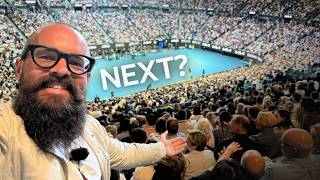
Robert Gladitz proposes the Custodian Games, a new sport designed to train four realms of human excellence: physical, emotional, mental, and spiritual. Unlike traditional sports that focus narrowly on physical performance and favor male bodies, this cultural sport aims for true gender equality and holistic human growth.
Chapters
I'm at the Australian Open right now, one of the biggest sports tournaments in the world. We just saw the winner's ceremony. You see that the energy is electric, and that's exactly why I decided to invent a new kind of sport, one that feels like this but doesn't just train hitting a ball with a racket. It trains the full human skill set the future demands of us. On my way to Melbourne. I am so excited for this week. Thank you, my man. Help is cake, mate. Thank you. Why am I even here? I mean, there are multiple wars happening right now in different places of the world. The climate catastrophe is progressing. AI is taking over the world. The beaches and rivers in Bali, where I usually live, are full of plastic. And our young generation— Yeah, is drowning in addiction to these devices. Not only our young generation. And lose their capacity for critical thinking and creativity. So yeah, we collectively have a lot to do, and yet Robert is here for 7 days in Melbourne to watch tennis. Why? I'd like to tell you about an idea that I've been working on for the past 12 months now. I believe that If we want to create a bright future on our planet that really works for everybody, we need a different culture. We have to make things like sustainability and personal development and caring for the planet and caring for each other— we have to make these things cool. We have to make them desirable and sexy, and they need to be at the center of our culture. They need to be what children growing up value because their heroes embody it. If these good things stay on the fringe of culture, I believe we have no chance. And what's the most powerful vehicle on our planet to influence culture at scale? Of course, it's sports. Good luck! Good luck! I mean, like, of course. The greatest icons are always sports stars. This is the reason why people from all over the world, and especially the young kids, are hyped. And of course, the reason for that is not because they want to see somebody hitting a yellow fluffy ball with a tennis racket. Sports is about excellence. Sports is about overcoming obstacles and physical mastery, realizing your dreams. And this is what inspires us. And yeah, most of all, it's the story that is as old as humanity. The story of the young guy going out into the world in order to measure his capacities against the old guard and make his dreams happen. Like And Shelton, the guy that caused this frenzy and that will very soon here in the big arena compete against Kasper Rudd, an older experienced player. So yeah, let's get in there and see if today is the day where dreams are turned into reality. I'm excited, I'm fucking excited. Let's get it! He did it! He did it! So, for the past year, I've been asking one question: What if we would use the contagious energy of sports not to grow one-dimensional performance heroes that in the end mean very little, but to cultivate the very capacities we need to embody in order to be able to build a thriving future on our planet? Like emotional intelligence and leadership and creative problem solving? What if these were the disciplines in the sport of the future that are performed and celebrated in arenas all over the world? Just what we saw yesterday. I feel that this has the potential to truly shift culture and with it move the needle on our global metacrisis. So the new sport that I invented and that we are currently working on bringing to life is called the Custodian Games. A custodian is a steward, a guardian, a caretaker, somebody who dedicates everything they do to the thriving of life. They serve as lighthouses in the crazy times that we are living in right now and lead by example. And the Custodian Games train us in all aspects of life, of human potential. And that's why we call it a cultural sport for a thriving civilization, a training ground for the humans these time demands. These are the custodian games. So my intention for the upcoming 7 days here at the Australian Open is not just to watch some tennis. I see this more as a, as a field trip to gather information and inspiration and continue to fine-tune the concept. Sport of tennis is quite different to what we are building, but structure-wise there are actually a lot of similarities to to how we envision the custodian games to manifest. I'll take you guys on the journey with me. It's going to be a hell of an adventure. What sports is doing so well is that it unites people. Like, Australia is Today not one of the really big tennis nations. And still there's this one guy, Alex de Minoor, who makes them dream. He's playing the quarterfinals right now against the world number one, against Carlos Alcaraz. Oh, good one, good one. Do you think de Minoor has a chance? Yes, yes, yes, yes. You think he can win? He just broke him, he's gonna fucking win. I'm sitting here with a group of Australians from all walks of life who don't know each other. Wow. Wow! Because it has to be so good, so delicate. You have to rob the ball of the bounce, because if you don't, the Aussie's gonna be there. And the majority of them probably don't even play tennis themselves. Incredible tennis. Incredible. They all cheer for this one guy that they don't even know personally and have a great time. But even more important than that, everybody feels like a part of something that is greater than just themselves. Wow! 5, 5, 5! What's happening here reminds me so much of summer 2006. I was 16 back then and the FIFA World Cup was taking place in Germany. And before, in Germany, it was not very— it was just not— it was just not a thing people did to openly, publicly celebrate joy and pride with your team, with your country. Yeah, I think the, the sense of guilt that was very strong after the Second World War ended, that really gripped us as Germans, was still there. But then on July 8th— I'd like to show you something— Germany was playing for the third place against the almighty Cristiano Ronaldo. And then I was sitting there in this stadium, and this is what happened. [SPEAKING GERMAN] There is a documentary about what happened that summer It's called Deutschland, ein Sommermärchen, Germany, a Summer Fairy Tale. And when I watched that again a couple of years ago, I cried and cried and cried. And this is not because I'm a particularly huge fan of the German football team, but it's because What happened there gave us all the permission to feel proud again, the permission to openly feel joyous. I remember there were flags everywhere. Everybody celebrated, like random people, strangers in the streets were hugging and singing and It was just like life, life got celebrated, connection got celebrated, belonging, unity got celebrated. And this is what moves me to tears every time I feel that, every time I feel people uniting for a common cause. I'm so touched. I feel this is the greatest force in the universe. This is love. This is unity. This is belonging. And we need reminders. We need reminders again and again. And sports is so good at giving us these reminders. But we have to talk about the big elephant in the room. Even though there are just as many women, 128, competing in the Australian Open as there are men, 128, and the fans too are very mixed, traditional sports and tennis too is fundamentally and structurally designed for men. They're about discipline and repetition, doing the same monotonous thing day in and day out, like a machine, fully locked in. This is what you need to be in order to succeed at these games. Yeah, you have to basically neglect everything else that might be important in life. I mean, like of the top 50 women's tennis players, which is almost half of the Australian Open draw— of the others I couldn't get any information— of the top 50 women's tennis players, only 4 of them are mothers. It still makes global headlines if a woman competes at a high level, takes a break from the sport, gives birth, and then comes back and continues to play at this high level. That's, that's insane. One of them is Elina Svitolina from the Ukraine. She gave birth to her daughter in October 2022, and less than 6 months later, she was back on the court again. Before she gave birth, she was number 3 in the world, and afterwards continued to to win titles. Elina, may I ask a question? How difficult is it to be a mom and an athlete at the same time? Not easy, but it's all about the balance. Yes, you do it well. Here on the big stage at Rod Laver Arena, the quarterfinals of the Australian Open. Not even an hour, 2 years after giving birth, to be in the top 10 in a Grand Slam semifinal. Always have been my My dream to come back here after maternity leave, it was my dream to come back in top 10, always been my goal. Oh wow, what a story! Holy moly! Congratulations to Elina Svitolina for beating the odds, for making it to the semifinals of the Australian Open against the 3rd seed And still it bothers me that traditional sports is built on a body that resets every 24 hours. But the female body doesn't work on a daily rhythm, but on a monthly rhythm. The female hormonal cycle is not designed to produce constant peak output each and every day. And of course you can force it to act like a male body. You can even force it to act like a male body for quite a long time, but it won't fully adapt to this unnatural stress. It destabilizes over time. But yeah, most, most female athletes only realize that long after their careers are over. So if somebody like Switolina succeeds within the current system, it's not because it was designed for them to fit, but they survive despite it. And sure, women's tennis is one of the most advanced and respected and empowered sports systems out there. Like here at the Australian Open, women play in the same tournament, they receive the same exposure, they compete for equal prize money, something that's still very rare in our global sports landscape. But no money in the world can make up for female athletes ruining their body over grueling 11.5-month-long seasons and day in and day out practice whether they feel like it or not. The game itself is the problem. It just is. And no, that does of course not mean that physical excellence is not for women. Of course it is, but it's not the full story. There needs to be a balance. So we are building the Custodian Games on all 4 realms of human excellence, all 4 archetypes. Of course, there is the Guardian, the fiery, the physical, the determination, the discipline, the willpower, the masculine archetype. Of course, that's important, but it's just one of 4. There as well is the Romantic, the feminine archetype, the emotion, the heart, the vulnerability, the connection, the softness. And there's the Genius, the second masculine archetype, the mental realm, which is all about strategy, about figuring things out, about clarity, about systems design, about structure. And the fourth one is our second feminine archetype, and it's called the Mystic. And the Mystic lives in the spiritual realm. It's about surrender, it's about letting go, it's about presence, about calmness, and about the ease and the playfulness that comes when we don't take life so serious and we don't hold on to something specific, which is the opposite of the current sports landscape, but a skill that is so crucial for the path forward for us collectively. The Custodian Games as a sport are designed to train and grow the entirety of human capacity. The physical as well as the emotional. The mental as well as the spiritual. And as a result, we, in contrast to any other sport that is out there, create a balance between the masculine and the feminine. It's the first sport out there that structurally doesn't favor men but creates true equality and doesn't just pay out equal prize money. In designing a new sport, I became very aware of the double-edged sword that sport— that makes sports on the one hand so magnetic and on the other hand causes billions around the world to give up their power. The way sports is witnessed around the world is that we look at the athletes in the stadiums and on the screens. We see Novak Djokovic, the GOAT, the greatest tennis player of all time, and we glorify him, we admire him like an object. And that's the same reason why Ben Shelton, after yesterday's practice session, got chased down by all those young girls. They're not there for him, they're there for an image. Because they don't even know Ben Shelton. Yeah, this idealization, this put— putting people on a pedestal, that's not healthy. This looks like admiration, but in reality it's abdication. When we put athletes on a pedestal and turn them into objects of awe, then we become the spectators. Spectators watching them without any agency. When I see someone as superhuman, I give up my responsibility to become fully human myself. And yeah, we don't see this just in sports. We see this everywhere, like with film stars, with music stars, with even the average influencer on social media. But what if we shifted the narrative from looking at the success of the hero and instead focused on the process that brought them there. Like, don't see them as objects, but see them as subjects. Like, I want to know even more than seeing Novak Djokovic lift the trophy. I want to know what does Novak Djokovic have to do every single day to become the Novak Djokovic that the world celebrates. The thing is, this is almost impossible given how storytelling is done right now. He's a perfect 10. He is the best player on the planet again. Of course, like, I get it. I get goosebumps when I see moments like these. And at the same time, yeah, traditional, traditional sports media is only object-focused. It's only about the final serve and the championship point and the lifting of the trophy and then happy end. Would you please give a warm welcome— But what we don't see is the silent doubt before the big match or the 100th repetition when no one is applauding, or when you wake up in the morning and your whole body is hurting and you just don't want to train. Ah yeah, yeah, he was down 2 sets and then got lucky because his opponent retired out of injury. Yeah, I think we all, we all could see today that Novak's reality is much more characterized by the doubts and the struggles and the challenges than by lifting the occasional trophy. And he is the GOAT, he is the greatest of all time. Like, how might that even be for all the other tennis players out there? So yeah, instead of Novak the legend, let's shift to Novak the pattern that can be studied. But to make this shift, we have to change the way sports get narrated. Good. Show you the way that it go. God is good, but his life is hard. But it gets better when you grind it small. Friend, sports could be the greatest school of human development on the planet. But instead, we turned it into mass entertainment. This device has the potential to change that. Because when I see through somebody's eyes, I cannot worship them anymore. I can only recognize myself. And my own challenges in them. And yeah, I don't like that it's manufactured by Meta. Please, Fairphone, make smart glasses. I want to buy one. I love sports ever since I was 4 years old and started kicking football. And yeah, over the years I added many other sports: skiing, snowboarding, badminton, table tennis, running. Recently I started playing padel, which I really like, and even tried some really, really crazy ones. Basaball, for example, highly recommend it if you get a chance to try that. Plus I watch probably every single sports documentary on the internet. Some of my favorite ones, if you want some really good ones, are definitely— let's see— In the Arena, portraying Serena Williams. Excellent, goosebumps. Oh my God, this is so good. Senna, portraying Formula 1 icon Ayrton Senna, who passed away tragically in a race. This one is really emotional. Muhammad Ali, the documentary is great. Yeah, there's so many great ones. And every time I watch one of those, I don't watch them just for entertainment, but mostly to study what the ingredients the ingredients of greatness and peak athletic performance are. Of course, each path is different, but the one story that all of them tell is one of determination, unwavering commitment, full focus on their goal, with fierce passion. All in! Refusing to give anything less than their best. But determination is not the right word. Maybe it's madness? "Madness is the key to greatness." Brilliant Nike ad, huh? And it's so true. We have to be obsessed with what we are doing. Otherwise, what's the point of doing it? Oh! What I'm obsessed with is not tennis. It's much broader and harder to define. I call it custodianship. It's a way of life that maximally contributes to the thriving of life. And this encompasses everything. It's how I consume, it's how I eat, it's where I live, it's my relationships, it's my work, it's being a father, it's how I treat my body. I remember one conversation with my girlfriend back at the time where I told her I'm already doing so much and still I feel that I'm not fully all in. I feel like if there was somebody holding a gun to my head and asking me, okay Robert, if for the next month you will not be fully 100% all in, dedicated, committed to your path in life, I will shoot you. I'll come back, you cannot avoid it. The only way to avoid it is to be 100% fully all in. I know that I could, I could be more, I could do more. And I don't mean this in a way of like hustle, of like working for 18 hours a day non-stop and then burning out after 5 years. It's not the path of the custodian. And that's probably why I love being here at the Australian Open. That's why I love watching these sports documents. That's why I love studying elite performance in general, because it's this constant constant reminder to be all in, to be fully 100% committed, dedicated to your path in life. Be it tennis, be it custodianship, whatever that is. Yeah, be madly obsessed with the thing, with the path. Oh yes, today we see the semifinals. Elina Svitolina faces World number one arena, Sabalenka. What I'm going to ask you is, your 10-year-old self, if she was looking at you right now, what would she be thinking and saying? How proud would she be of you right now? Oh, I don't know, I'm sensitive right now. I think she would be just super proud that, yeah, I was able to make it here. Oh wow, electrifying! Fighting Tennis Arena rocked the arena like no other. Svitolina didn't stand any chance. Oh, reminders like these to be all in from people who are in the arena just like me, although a different kind of arena. I enjoy them so much. Of course, when we talk about all in, we have to come back to the GOAT, to Novak Djokovic, the greatest of all time. He is 38 years old now. He hasn't won a major title in 2 and a half years. This tournament was— yeah, nobody thinks he's still able to beat his opponent today, Jannik Sinner, age 24, against whom he lost his last 5 matches, but I still believe in the power of the GOAT. Let's see, Novak, let's see what you can still bring to the table. Yes, awfully hard to take on the full. That was brave. And you get up there, Novak Djokovic. What The fuck? The GOAT. The GOAT. The first set he played so badly, like I was 100% convinced that he will lose this match, and he came back. Thank you. Beyond words. And they see Djokovic chase down an unprecedented 25th Grand Slam title. Match point, match point. Wow! Wow! Incredible! Incredible! What is that? The GOAT is back! The GOAT is back! Oh my God! Oh my God! Starts come without darkness, and it's been a long time since Novak has won a major. He goes through the final where he will face Carlos Alcaraz, who He's gone through a 5.5-hour epic tonight. I am still integrating what happened yesterday. I need to share with you one concept that explains the phenomenon of sports so elegantly and why it touches me so much. It's called Redemptive Catharsis. And Redemptive Catharsis combines two ideas. Catharsis is the emotional release or purification that occurs when deep feelings such as pain or grief or guilt are brought to the surface. When we're carrying something heavy with us and then through an outside trigger this gets expressed through an emotional outburst. And redemption is the process of transformation that follows suffering. It's like a, like a coming back to wholeness, a coming back to integrity. And when we put these two together, redemptive catharsis refers to the emotional breakthrough where pain or shame or failure are the very sources of profound transformation and healing. Oftentimes it's the moment when a person faces their deepest wound, releases the emotional weight that's attached to it, and emerges with their renewed sense of purpose or clarity. Not by escaping the pain, but by being purified by it. And my favorite example for that I'd like to share with you: sprinter Sha'Carri Richardson. She was always seen as a child prodigy from an early age on. She was fast. But then in 2021, 2001, her mother died, and her way of coping with that and all these emotions was marijuana. She was tested positive, she was banned from the Tokyo Olympics, and yeah, everybody made fun of her. People said she doesn't have the elite mindset necessary, and she started questioning herself The world didn't just punish her mistake, but the world changed the entire narrative about her. People said, "She wasn't that good after all." "She has a lot of hype but no substance." Like, these were the headlines. And she didn't even qualify for the 2022 World Championships. And her reaction was to go inward, to work on her emotional regulation, to become quiet, to change her training environment. And then 2023 came. Worlds in Budapest. She barely got through the qualification rounds, and again the voices came up again: Sha'Carri O'Neal, no chance against the Jamaican sprinters, she will not win any major title. And then this happened. Is she just going to do it? Oh, on the near side, right at the end! They were getting ready from nowhere in lane 9. It's an incredible performance from Sha'Carri Richardson. Richardson came through like a rocket in lane 9, her first global final, and she tastes gold. You see in her face, you see see in her face what is happening in that moment. You just see it. It's not about this race, it's about everything that came before, all the emotions. And then here, later on, you see the release, you see the freedom, and this is What Redemptive Carthasis means. It's what transforms breakdown to breakthrough, pain into power, failure into freedom. And it's the story behind every great sports achievement. And every time I watch that, every time I watch a story like that, I just have to cry. It touches me so deeply. I watched Sir Kerry Richardson run these 10.65 seconds over and over again, and every time still, I'm so deeply moved. Woo! There you see it, the Australian Open are approaching the finish line. Today we see the women's final. Oh, powerhouse Aryna Sabalenka, world number 1, reaches for the crown against Elena Rybakina. That's got to be a showdown. Holy shit, let's get in. So many people, full house. That was it, the women's final, and all in was not enough today for Irina Sabalenka. You could definitely feel Her disappointment. Yeah, that's how sports is. That's how sports is. A trained surrender to, to be here for what we can do and then let go and surrender to the outcome. Yeah. Thank you, have a good evening. Bye, Jim. The last day of the Australian Open, the men's final. I'm so excited for this day because today we will not only see amazing tennis, we will for sure see one of two stories of redemptive catharsis. Either the story of Novak Djokovic, who already won everything you can win in tennis, and yet he kept going for the love of the game. But now he's 38 already. People say that he no longer has it. Still, there he is in the final competing for the title. But for him, it won't be about the title. It will be about showing what it means to keep choosing the arena long after it's no longer necessary? Or will we see the story of the 22-year-old Carlos Alcaraz, who was never doubted for his talent but always doubted for his way of being— too playful, too expressive, too happy. He just didn't fit into into a sport that was built on suffering and on control. And then a lot of injuries seem to, yeah, confirm that he might be too weak, not made for epic 5-set battles. And yet here he is in the finals, and if he wins today, he will complete a career Slam, winning all 4 major titles at age 22, something not even the GOAT has achieved, and proving that happiness and playfulness and joy might not be contradictions to success but actually the very things that bring success. We didn't get just one story of redemptive catharsis, we got both. You could feel that for Novak, just standing here in this final again, which he had not expected after the last 2 and a half years were not very successful for him compared to all the other part of his career before. Oh my God, I feel so emotionally rich. And at the same time, my notebook is full. That was the main purpose why I came here to the Australian Open, not just to watch incredible athletes, but to to nourish the new sport that we are birthing, the Custodian Games, and to nourish the vision that one day the Custodian Games will take place in an arena like that. 15,000 people not watching tennis, but watching multidimensional athletes developing and training and celebrating all parts of being human, the physical, the mental, the emotional, and the spiritual. That's the North Star. One day, 7-year-old kids not having posters of Carlos Alcaraz and Novak Djokovic in their bedrooms, but having posters of custodians, because they are the lighthouses that drive forward culture. This is the future. Towards which we are moving in the next episode. You will see how the custodian games actually look like because our first Origin event. So excited for you to see that. Ah, please leave a comment under this video what emerged for you during our journey here in Melbourne at the Australian Open. It was a lot of fun. Yeah, I feel very rich flying back home to Bali. Thank you, see you soon.
More from Robert
Impact Business Builder vs Embodied Longevity Coach | Custodian Games Mallorca
Regenerative Government Advisor vs. Conscious #1 Athlete | Custodian Games Mallorca
8 Changemakers Escaped to the Forest to Confront the Meta-Crisis - Here’s what happened.