Why Teams Struggle to Adopt AI in Microsoft 365 and How to Fix It with Robin Daniels
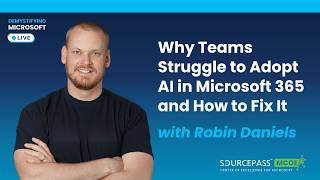
Robin Daniels, Chief Business Officer of Sensei, explains why companies struggle to adopt AI in Microsoft 365: traditional HR tech is transactional, not motivational. His platform embeds AI-driven learning directly into Teams and Outlook rather than forcing users to a separate app. Sensei's new partnership with Pax8 includes 100 AI courses teaching prompt engineering and Copilot usage for small businesses.
Chapters
All right, let's go for it. Hello and welcome to today's episode of the Demystifying Microsoft podcast. I'm your host, Nathan Taylor, and today I'm joined by Robin Daniels. How you doing today, Robin?
Good, Nathan. I'm really good. Spring is here, sun is out, nothing to complain about. How are you doing?
I'm doing great. Same thing. It's a beautiful day here. So I'm excited to nerd out about some technology together. So, uh, why don't we start off with, uh, why don't you tell us a little bit about yourself, Robin Daniels?
Yeah, I am— I'm the Chief Business Officer at a company called Sensai, and we're squarely in the, in the Microsoft ecosystem. And I'll get into that maybe a little bit later, um, but I basically spent 25 years of my life in technology. I love— I've always loved how technology can really impact the way that we work and the way that we live and just what a difference it can make if really done well. And so I grew up kind of as a nerd. I'm actually from Copenhagen, Denmark, where I was born and raised. And then when I was 21, I ended up moving to California 'cause I wanted to be with all the other nerds of the world. And I spent a lot of my career there. And now I kind of split my time between US and Europe, which is an interesting thing to do in today's world. But I still have like spent the last 25, nearly 30 years now at the forefront of technology I love tinkering with technology. I actually started my career as a programmer. Eventually I moved over more to the go-to-market side. So I've been more on the marketing and product side over the last couple of years, but I still love technology. It's just, I think it's such a game changer if done well. And yeah, I'm excited to dig into that today.
Awesome, awesome. Well, it's always fun to nerd out with a fellow nerd and just talk about this stuff. We love the technology. Why don't you tell us a little bit about Zensai and just tell us what the product is and how it fits into the ecosystem?
Yeah, for sure. So I spent, as I said, over 25 years of my career really working, I would say, at the forefront of technology, various companies including Salesforce and LinkedIn, Box, Matterport, WeWork. I've taken a few companies public. And during that time, one thing I became kind of obsessed with is how do you create high-performing teams? How do you create culture that's high performing? It's what CEOs wanna know. It's what CHROs wanna know. It's what honestly all C-level leaders wanna know. Even managers wanna know how, what's the alchemy that goes into creating a high performing environment. And it's a mission that I've been on for a while now. And so when I had the opportunity to join Senseye, what we are really all about is we are all about how do we unlock human performance with the help of AI. Like we think of these two as being very much both at the individual level, at the team level, and of course at the company level, but do so in a way that's really kind of inspiring and motivational for you. I think for the last 20, 30 years, I think we've been oversold on the promises of HR technology when in reality it was just kind of focusing on making sure we got paid, we took our vacation, that we were compliant with various policies that we had to have in our company and so on.
Nothing wrong with that.
It's very important to get paid. It's very important that you take your vacation. But we also know now from all the data out there, whether you look at Gallup or McKinsey or HBR, that that alone is not enough for people to be motivated to do the best work in their life. And so what our platform really is, you can think of it as it's a platform that is really focused on a singular thing, which is how do we motivate people to have the knowledge, skills, and performance that they need every single day to do incredible work. But in a way that's both additive and beneficial for them. So they feel joy and motivation to show up every day. But of course, so it also leads to better business outcomes, better results for them. So it's about learning the right skills. It's about having the right goals and making sure that your goals are aligned with your team and the company. It's about being engaged with the people you're working with in a way that's very deep. So you feel the sense of belonging because we know from all the data out there that says if you feel a sense of belonging, a sense of being part of something, you will naturally show up and do better work. When I see this data that says unhappy people don't do as great work, it's like, yeah, of course, of course, that's obvious. And if you're in a zone of, you feel trust, transparency, love, camaraderie, then you will show up and you'll do better work every day. Maybe not the best work all the time, because every work is different, but that's ultimately what we're trying to do. So we fit basically, if I had to put ourselves, I know it's a long answer in this category. Like, we're basically a platform that's in the HR tech category, and I think the HR tech category needs a revamp because it's been oversold and underdelivered for so long. But we're trying to really deliver something new within the Microsoft ecosystem.
That's awesome. Yeah, I think there's a lot of space to grow. I mean, as you said, there's a lot of the tools that are just a new UI on, you know, reading your annual security, you know, company security plan and your, um, you know, claiming your PTO, right? It's just a new UI for that, that, you know, and I was like, it's a crazy platform, very expensive, but in the end you just use it to claim your PTO and that's about it. And I do think it's, it's time for that to change.
Um, I mean, think about it, right? I mean, I, I told you some of the companies I've worked for and, and it's like, go take this course and it's been like, and then you have to log into this platform and you have to let them go give an update here and it's just like such a And the reason why we're so bullish on what we're doing is we're 100% built on Microsoft, which means that we follow kind of the Microsoft look and feel. You know, it's integrated completely into the Microsoft stack. So if you're interacting with Copilot all day, then we show up in Copilot. If you're using Teams or SharePoint or even Outlook or Word or so on, like, and our thesis has always been, the way you optimize human performance is by being there when people need it the most, not this extra thing you have to go do. Like I said, I've had access to learning platforms before and, "Hey, go take these great courses," and I never did it because it was always this extra thing that was something I had to remind myself or, "Oh, go give high five or kudos to somebody here. Go log into this platform." I never did it because it was just like not part of my workflow. Of course, Microsoft has been the best at really making sure that all their apps are connected and that you're in the flow of work. They've talked about this for many years and we want to follow that model because we believe that the key to unlocking human performance is by being in the flow of where they are. So they get that skills, knowledge, and motivation they need in the moment when they need it. So if you're working on a document, we can show up there through Copilot and say, hey, maybe here's who you should connect with, or take this course because we can see you're working on this here. Maybe you should learn this skill. Or if you're a manager, you can go into just Copilot and say, hey, give me an update on what my team has been up to and how they're feeling over the last month, you know, like what's going well, what's not going so well. So I can go in and diagnose that and maybe become helpful. So it becomes much more natural as part of how you're working and these extra things. So we think that's a huge superpower for us. And of course, key, key unlock there is that we don't just do this for HR leaders, but CIOs who really, of course, are deeply instrumental in managing their Microsoft environments. They love it as well because it's just like there's really very little to manage because it looks and feels and acts like a Microsoft tool in that way and you get it as part of your platform, meaning all the AI that we have now on our platform, which is everywhere, it just is included. We don't charge extra for it because you're already using that from Microsoft. Anyway, I think there's just so many benefits of being part of that Microsoft family that has really opened up my eyes over the last couple of years, just how powerful that is.
Absolutely. Well, and the learning is a real necessary thing. We were talking before we jumped on the show, I'm a 20-year technology nerd. I was an engineer. I sell this stuff. I'm in the nuts and bolts. I'm in the admin portals. And I don't feel like I can keep up with the rate of change. I mean, Copilot. Now we got Copilot Co-Work. And, you know, I went home from work the other day just like, "Am I completely behind? Is everybody else, you know, 10 steps ahead of me on this AI journey?" Because it's just, it's moving by the day.
It's staggering. It is.
And so I think I think being able to help people, you know, learn more. And I also feel like our attention spans have changed, right? Telling people to go take a 6-hour course. I think people take courses in 5-minute chunks because that's how we watch YouTube and that's how we— that's the kind of time we have between meetings. And I think finding ways to make that more accessible and help people, we desperately need it.
I'll tell you, you know, you're probably not as behind as you feel you are. I'll tell you just a quick anecdote. I mean, I feel the same if I go on X or LinkedIn even, or any of these platforms, I feel like people are out there doing incredible stuff that's just 10x or 100x their productivity every day. And they're growing their business by gazillion points every month and so on. So I feel this kind of FOMO. And then recently I went to a go-to-market event for leaders, CMOs, CHROs, and CHCROs. And it was interesting, everyone feels behind. There's this like, this general, and it made me feel honestly a lot better cuz I'm like, wow, okay, I actually think we're doing a lot of the right things. You know, we have, we're using AI every day in our, the way we work. We're using AI in our go-to-market, we're using AI in how we build our, so we, we are, could we do more? Of course, probably. There's probably, there are probably companies that are ahead of us, but there are also many companies I think that are probably, and it's probably true of you too, right? You're probably having this like, FOMO feeling, which I have deeply as well. And I'm just trying to like sometimes step back from it because it can also drive you a little insane that, because you also need to just actually pick a path and then actually see it come through. Because so often I think we do end up doing something and we just instantly move on to the next thing without seeing the impact of it. And I think that that's probably something we can learn from. So, you know.
Yeah, absolutely. How do you, how do you think people are approaching, like how are you guys approaching training people on AI? Like, like, growing that experience? Because, you know, there's, you know, like you said, I think we're probably in a better spot than we think. I'm trying to use it every day, trying to learn more about, but I do use it every day, but trying to grow in it every day. But your average information worker doesn't think that way. So how are we getting people deeper into this AI ecosystem so they get value out of it?
Yeah, so last year we struck up a great partnership with Pax8, one of the largest hyperscalers, distributors of kind of in the Microsoft ecosystem. Amazing company, amazing growth, and, and just like what they do for the ecosystem is, is fantastic. And we struck up a partnership with them that basically where we did a couple of different things, because one of the things that they really wanted to make sure of is that all their MSPs and their customers were really understanding how to use AI. Because what we just talked about, we're certainly not alone. I think we're probably ahead of many, but they're probably also behind, but The majority out there are still quite behind when it even comes to the basics of using AI in everyday. And so we said, let's come up with a special version of our platform that's really targeted for smaller businesses and really targeted so they can understand how to use AI. So we even put in courses into this platform, something that we normally don't do. Normally when it comes to content and courses, we partner with Go1, LinkedIn Learning, Open Sesame, and those kind of companies and other platforms. But there was such a hunger for like just basic learning around how to use AI and Copilot. What does it do? How do you set up a prompt? How do you engage with it, you know, through Teams or through Copilot and, or through SharePoint and so on? And so we ended up creating quite a few courses that we now put into that, that kind of special version that we have sold through the Pax8 marketplace. And it's been received super well because what it does is it basically gives all these MSPs and their, by default, their customers, access to some very basic AI training that they're all like, and of course it's all centered around Microsoft, like how do you use AI in a Microsoft environment for maximum impact? It benefits Microsoft because Microsoft really wants all their customers everywhere to understand how to use AI because if you don't understand how to use it, at some point you're going to go as a customer, why am I paying extra for this when I don't use it? We know how powerful it is when you know how to use it and how sticky it can become. And so Microsoft is interested in that. Paxata certainly is because they know they can see much more stickiness and adoption of their platform by doing that. And so we basically said, okay, let's create a special version of our platform. It's basically kind of really focused on basic learning. They can of course then sell to their customers. And in that version we actually put a bunch of these courses. I think we've put in maybe close to 100 courses now.
Wow.
And anything from like very basic, like beginner stuff to more like intermediate stuff to more advanced level stuff of how to use AI across a number of different things. In PowerPoint, in Outlook, you know, as, as you're trying to synthesize data and all the stuff that you probably do on a day-to-day basis. But where most people just go, where do I even start? How do I even like get going with this here? So that's what we're trying to do. And, and of course, the secret there, coming back to what we talked about earlier, is that it's in the flow of where people are already. It's already in it. So if you're into Teams all day or Outlook and so on, it just shows up where you are.
So it's a beautiful—
right now That's awesome.
Well, you wrote a book about, uh, was it The Human Success Playbook, which is very much about this, right? And, um, I haven't had a chance to read the book, but I did was review and just kind of some of the, the synopsis and stuff. And I really like where you're approaching it from. So tell us kind of the premise of the book, because I think that's a really interesting, uh, perspective.
Yeah, so when I joined, uh, the company back in 2023, we were actually called LMS365, and we were basically just selling a learning platform. And I joined because I could see the potential if we kind of expanded the vision out a little bit. And so we changed the name of the company to Sensei in 2024 because we wanted to not just be pigeonholed as just an LMS. And we want to expand the vision out of not just selling a learning platform, but selling a platform that unlocks human performance, which we then called human success. And we thought one of the best ways of of telling people about this, educating the market and really making people understand how you infuse humanity with AI in a way that's really additive for both is by laying out kind of a playbook for this. And so we wrote a book about it. I wrote it with our CHRO, our Chief Human Success Officer, Nina. She's the world's first Chief Human Success Officer and our CEO Rasmus. And so we wrote this book together over the last year and it's basically based on hundreds of conversations that we've had with customers. With industry experts from Gartner and Fosway and IDC and so on. And also just like partners and just talking to experts around where we see this going. And so we wrote this book and we wrote it as a narrative because a lot of us, the three of us find sometimes business books can get a little dry. So we wrote this as a narrative based on, again, on the conversations that we think every is happening in every company, right? And the setup is this, The book basically starts with a CEO who's being asked by his board to cut 40% of the company and use AI to kind of become more efficient. And you can imagine this conversation is happening all over. You see it in the news, right? With Salesforce doing layoffs and Meta doing layoffs and Oracle doing layoffs and all like, so these conversations are obviously happening and we get to hear from our customers. And the CEO says, no, I'm gonna show you that investing in people is going to lead to better outcomes and better results. And this is what the tension has always been for, I think, as CEOs and people leaders. If you ask any CEO across the world, what's your most important asset? They pretty much always go, our people. Our people are the most important thing in our company, right? And then you ask them, well, what are you doing to help them grow and learn and become focused on the right things? And they go, they kind of like hesitate a little bit. Because they don't know what the outcome is of investing in people. Like, I wanna invest in people, but I don't know if it's gonna lead to anything better. And so the book is basically set up as kind of like the hero's journey of a CEO, kind of like Luke Skywalker, you know, who's facing some pretty impossible odds. And then he fights back and he shows over a period of time, he's, he's been given 6 months by the board or 8 months in the book to basically turn this around or else he's gonna get fired. And it's, it's like that tension, you know, so you have kind of a time, crunch, kind of like, you know, that always makes it a little bit more exciting where he has to come up and figure out a way to solve this. And so the book is centered around this premise of how do we integrate, you know, learning, growth, development of our people in a new way with AI. AI is not the bad guy here. AI is basically just another teammate, another tool to use and so on. The bad guy is really ignorance or trying to think that We wanna replace people with just technology. We don't wanna be on that side of history. We've made that kind of clear from a philosophical perspective. And so the book is really set up as a way of like teaching you how do you ensure that your people in your company who are showing up every day probably have some fear about their jobs and the future of their workforce and so on. How do you show that investing in them, giving the tools and skills that they need to be successful leads to better business outcomes? How do you measure it? How do you do it? How do you organize yourself? So the book has all these kinds of different principles that's laid out, but much more of it as a narrative, right? So one of the things that we, for example, talk about is, just to make it a little bit concrete, this idea of the human success score. What does that mean? That means that if you're going to invest in people, give them the skills, knowledge, motivation they need, the learning that they need, well, how do you know that's going to pay off? Well, you're going to see that if you can correlate your success to the business outcomes that you see. So maybe revenue growth, maybe it's profit. And so it's kind of like we said, there's a score that we're gonna give every single company who can figure out how to like measure this. And of course you can do this in our platform, but you can also figure this out yourself. If you have people who are highly motivated and they're showing up every day and they're performing really well and they're learning skills for the future, not just for the past, then that will lead to better business outcomes. And I think all the data shows that that's true, but until you actually put that together in kind of a formula, then it's very hard to go in and make that case, right? And so, so that's what we're doing in this book here. And we just released it on May 4th. It's Star Wars Day. So, uh, we're all nerds. So we, we feel like to release this on, on a very important day because that's what I feel like the day when we fight back against this kind of evil empire. And to be clear, it's just, When I see all these headlines of companies laying off people due to AI, it's both sad and my heart goes out to people being laid off. Yeah. Because I've been laid off myself and I've also had to do layoffs. It's super tough, both cases. Yes. But I also think it's, we just lack a little bit of humanity. Again, I think of it this way. If you are sitting on endless amounts of cash, boatloads of cash, like some of these companies are, you don't have the courage to take the time to invest in your people, to give them the skills they need to be successful. I might recognize they don't have the skills we need right now, but then invest in their growth and potential.
Yeah.
Over the next 6 months, even if it costs your bottom line a little bit because you're sitting on all this cash. If you don't have the courage to do that, I think we're missing a little bit of something as a human society. And I also get it. If you're a small company and you're just fighting for survival, you're not cashflow positive, I get it. Sometimes you have to make tough calls. I've had to do that. And again, I've also had to been laid off myself. That's just the nature of being a startup or a scale-up. But if you're a big company and you're sitting on billions of dollars and you can't even invest in your people who've given so much to you, then what are you basically saying to the world around how you think about humanity?
Well, I think it's a cultural and like a core values mindset that you have to decide where you're gonna land. There is a real temptation, and I think COVID started this. We went from being in the office together and I could walk around and I'd have to see you eye to eye at the water cooler to now everybody works from home. And there's varying levels of that, but most companies can't keep people in the office. And there's a whole class of employees that I don't think value being in the office, which is a bummer because I think, like, I think early on in my career I learned so much in person. And I, I feel sorry for the younger people who just aren't getting that experience. They don't get to have that. Um, So now you've got that variable. I think in COVID we also got a lot more efficient because we were able to say, hey, we're going to do virtual meetings, we're going to do all these things. And then AI's come along and we've gotten more efficiencies. But I think it's easy to get into this, it just becomes variables we're stacking to make ourselves successful. And like, you lose the human element. And I think AI can either make you lose the human element or you can choose to to highlight the human element and really lean into that and say AI is going to make us more productive, but we're going to see humans be more productive. We're going to see humans have better outcomes. And I think there's a leadership ethos you've got to make sure you're holding on to because it's very easy to get sucked into that. Just becomes a line on the spreadsheet, right? It's a P&L. It does. Not a human. That's right.
And that's what I fear is happening in a lot of these companies because what the board just sees is all these headlines about how much more efficient you can get. And so they go pressure the CEO or the executive team to make, become more efficient using AI and without really knowing the details. And I, I love, there was a, a talk at a recent conference that I went to by somebody from ElevenLabs, great AI company that's growing super fast, right? And they said, you know, every time they get more efficient in a workflow or a team, they use that efficiency not to try to get rid of people, but to invest in new people or in getting closer to the customer or doing something that's more groundbreaking. So I love that mindset of not just like taking that to cut. I mean, you have a choice. You can either use it to cut costs or you can use it to grow your business. And I think we're at such a moment in history where you have to take a stand on which side you want to be on. I know which side I want to be on. And I get it's not always an easy choice because you're not, But I also think if all you're doing is just trying to please shareholders all day long, then I'm like, is that really why your business exists? Just to please shareholders, right? Like, are you not trying to do something meaningful in the world that changes how we operate as a society? I think that that's ultimately— and maybe it's because I grew up as a little bit of a dreamer, honestly, and maybe I'm naive in that way, but I've always wanted work to be a little bit more meaningful. So what you just said resonates deeply with me. I think during COVID this idea of just working remotely, we lost a little bit of touch with being there for each other, you know, with work.
Work. Yeah.
Yes, it is, it is, it is work. Uh, but there should also, I think in the best of cases, what I've seen work become is kind of like a, an extension of who you are, become such a part of your identity and your friendship group and, and, and your group learning and growth and so on. Not all the time, you know, sometimes a job is just a job, but in best cases, a job can become so much more than a job. A job, really.
Yeah, yeah. I also think we're headed towards— it's a couple years away, but in 2, 3, 5 years, there's going to be this curve. We're seeing it now, like, in the, um, in the personal life side. Like, I don't know if you have friends who are buying, like, digital flip phones. Yeah, yeah. And they're doing this disconnect thing where they're like, I leave my iPhone at home, and on the weekend, yeah, you're gonna have to call me. I can't even get text messages because I got an old Nokia brick phone. And I, I'm here for it. I love it. I love this idea of, like, hey, I'm becoming less and less digital. Well, that's happening on the personal side, but I think there's going to be a thing that happens where a lot of these businesses are going to wake up in a couple years and go, we automated and AI'd the entire business, but now nobody has any of that knowledge. We can't take the next step because we've gotten rid of all the people who built that, who knew that, where we took their knowledge, digitized it, but that digital version of them can't think, can't create.
Totally. And I'll tell you an example from the danger there, from, from the, the where I spend a lot of my time. Our big bet for this year and the next year is really around can we get in front of as many people and create community around this idea of human successes. I mean, like, it's really become very clear to me. I've been with the company for about 3 years. When we get in front of people and we can evangelize and talk about what this idea really is and the core of it, people love it. They're like, how can I be a part of this? But you don't get that by seeing a 10-word Google ad. You don't get to fall in love with this idea of human success or what we stand for and what it can do for you and your company or even your own career. And so I wanna lean into doing kind of these non-scalable things. I think we've become obsessed with efficiency and scale, right? And sometimes I think we have to go back to doing non-scalable things. I mean, the best, when I think back on my career at Salesforce, Box and LinkedIn, especially those three, the best customers we always got by far, the ones who became our evangelists, our references, the people who would go back for us were the ones that we got to spend a lot of time with because they just felt like they were part of something bigger than themselves. They weren't just another customer. They weren't just using us for the product. They felt like it was more than the product, that I'm part of this. For Salesforce especially, that was such an impactful, moment in my life that this CRM administrators that we were out talking to, right, kind of a maybe a boring job, but they felt like they were part of a group of pioneers who were helping their companies get into the future. And we nurtured that and we helped create that community around that. And I think there's such an opportunity now again to get people together. People are hungry for it. They're hungry for human connection. You can feel it.
They are. They are. Yeah. I mean, I'm here reading articles about the death of social media. I think people are finally recognizing how dead it is. So That's that where people want real connection. Well, let me change topics a little bit.
Sure.
You guys are leaning into the agent world, right? And Microsoft's leaning into this. Explain to me what it means, what an agent means and how you guys are leaning into that and what does that look like? Because I think it's a word, it means a lot of different things.
Yeah, it's a great question. Even I've been confused. I've been having to educate myself over the last year because I think there's a lot of different definitions. I think to me what it means basically is the idea is of AI or the promise of AI has always been that you have this thing that's working for you 24/7 in the background, right? And so on. And it's just like always there doing your bidding and you set it to go and you come in the next morning and it's done all this work for you. And that's, that's how I think of agentic AI. It's kind of like this engine that just works with without you having to prompt it. I think a lot right now people are used to AI, you're going in, you're setting it in motion somehow. But I think of agentic AI as kind of always working for you and doing things much more proactively than reactively. And so I think that's the simplest explanation. It's like it's this proactive thing. I come in and it's like, oh, here's what's happening with your team. Here's who's doing well on their performance and all this stuff. And here's what you should be doing, Robin Daniels, to actually motivate this, this part of your, your team better, or this department's not doing so well. And just being kind of super proactive about all the things that we need to do. I think of Agentic AI as that. And so, and, and there's a lot of like happening in this industry. So what we're doing with it is we're basically agenTifying, if that's a word, everything that we do on our platform. So it kind of can show up for you proactively. You know, you come in as a CEO in the morning, A CEO will wanna know different things than maybe a manager who's like a mid-level. A CEO might wanna know, you know, what's the sentiment of my employees and what should we be doing as, what should my team leaders, my C-level executives be doing in order like, hey, our engineering team is doing well, but our marketing team is struggling a little bit here. Give me some things we should be doing and go set that in motion automatically. Manager might wanna come in and find out, you know, some more tactical things around, okay, how we doing on reaching our goals, you know, for this project that we've set. Who's actually learning the right things in, in cadence with the goals that we've set and so on. Like being much more proud and then setting that in motion. Of course, you know, going and pinging maybe Nathan, hey Nathan, here's a course you should be taking in the next hour or so, right? To help you with reaching that goal. So I think of agentic AI as just something that's always working for you. This promise that we've had for a while is now finally coming true and we use it basically every part of our platform has been, uh, become part of that Agentic platform from Microsoft. So it's there when you need it, it's always working for you, and it's trying to give you the insights, the actions that you need. Because I think we've had insights for a while. What's different about Agentic AI is now the actions, right, as well.
Yes.
That is either starting on your behalf or maybe forcing you to start yourself, because there's still some stuff, of course, that AI just can't do, right, that you still need to proactively do. Go have that conversation with someone or blah, blah, blah. We can see from the messages that you've been exchanging with Susan that there's some misunderstanding, go have that conversation. But it can also maybe start some workflows and so on. That's how we think about agentic AI and we're leaning all into that. As I said, because we're built on Microsoft, we don't charge extra for this. We're not like the Workdays out there or the Chebos or Cornerstones where they go and charge a lot of money for AI and you're starting to wonder how much am I spending on this, it's all part of our packages. I think we have a huge advantage again because of the relationship that we have with Microsoft to just include that for free.
Yeah, amazing. I think I'm seeing—
I would love to hear your take on it. How do you describe it when somebody asks, what is Agentic AI? What do you say?
I almost feel like there's tiers of it and maybe it's definitely adjusting. Like you said, it's evolving. You know, if you're in the Frontier program with Copilot, you're starting to see it. I'm seeing it as like Outlook is now prompting me, "Hey, would you like me to clean up your calendar?" You know, "I see that somebody canceled this message. You want me to remove it?" There's an agent sitting there waiting to help me clean up my calendar. And I open Outlook Mobile, I now have a "Would you like to know the next 3 things you should prioritize?" on the bottom of my Outlook Mobile. And I've started clicking it because it does a really good job of saying, You got 150 emails, but here's 3 things you should pay attention to. So I think totally kind of that, that piece that's going and proactively kind of offering a service, you know, I'm helping with something. Um, no, obviously there's, there's the promise of maybe automating things, and that seems to be where it's heading of like, okay, do this for me every day. Um, I think, I think all of us struggle with that piece because we don't trust AI fully.
Yep, yep.
It's hard to know how to automate things, but I sense that I'm learning the infrastructure for that. So to me, I really think of it as almost like an employee or a helper or a domain expert that's showing up when you need it. Like you say, okay, you're in Outlook and it sees you doing something. Hey, would you like me to help with this? Because I looked at the context and I pulled some things together. So Microsoft's really talking about how agents are going to almost have identities almost like employees or users. Users in Office 365. Like, oh, okay, this helps me understand it as well. This is an agentic HR helper that answers HR questions. Here's an agentic billing bot that can go answer a billing question instead of hitting, you know, Jane in accounting. You're going to the agent going, hey, did we get this bill? Did they pay this bill yet? That kind of stuff where it's taking low-hanging fruit, turning it into, you know, a one-stop shop to get your questions answered or help you accomplish something.
Agree. I think that's a great way of putting it. And I think it's evolving. I mean, it feels like just in the last year it's been moving so fast, right? And I think everyone is still like figuring out how do you set it in motion? I think that's what I'm seeing, like where there's a gap still. And I think we have some education to do in the market. I think people are still using AI very reactively. And I think we're getting a little bit better at using it proactively in an agentic way. But it's still too much. I go into Copilot or ChatGPT or Claude and I ask it to do something and it's like you're really not seeing the full potential of it. I mean, then it becomes kind of a glorified way of optimizing something and it's great at that. Honestly, it can be super valuable. There's no doubt about it. Like write me a draft of this email or synthesize this data and so on. Amazing. But it's still like not living up to that promise of it working for you 24/7 when you're sleeping. That's how you ultimately become way more efficient and you, Avoid this whole question of, you know, hey, why don't we just cut 50% of the company and just use— because if you can show that and it leads to growth, right, that's the whole theory. It's going to lead to more growth on new opportunities because you'll have more time to focus on the things that really matter. Think about how much time most people spend on admin work, answering emails, doing expenses, setting up meetings. It's like mind-numbing. Even I, you know, used to do that. Now it's like, honestly, most of it's automated for me with AI, right?
Yeah, I agree. It's definitely been like Copilot CoWork. It's been incredible for just triaging the mailbox. You can lose 4 hours a day on your mailbox, right?
Yes.
Copilot's doing a great job of just taking that into like a 10-minute triaging session, and then I go, okay, I've cleaned up a bunch of stuff. I know some key things I need to look at. Let's move on. So it's powerful.
I mean, like, I used— we use Teams a lot. I'm sure, you know, everyone probably listening here using And I'll come in because I travel a lot, sometimes I'll miss these long team threads, right? And I'm like, just summarize this for me and tell me what to do. What should I take away, you know, of this? And it's just so good. I like taking all this so I don't have to read like 5 days worth of like discussion going on. It's amazing. It's amazing.
Well, Robin Daniels, that was awesome. It's really, really interesting to see where the industry's going. It's always fun to, you know, out of this conversation, I got a little bit of camaraderie of like, I'm not the only one who feels like the world is moving faster than I am. So thank you for that. Really fascinating platform you guys have, and I'm excited to dig more into that. I think you guys are positioned in a really great spot. There's such a need for all these things, and I love your guys' approach. So thank you for spending some time with us today and sharing your thoughts around this space.
Well, Nathan, you're definitely not alone in feeling like there's some— there's more to go, but it's been awesome, awesome to meet you. Thanks for hosting me. And yeah, have a great weekend.
Awesome. How can, how can people learn more about you and your product?
Well, you can find me personally on LinkedIn. It's the best place to find me. I post a lot there. And if you want to learn more about our product, just go to senzai.com. That's a Z or a Zed, you know, if you're in the UK. Z-E-D-I-N-S-A-I.com.
Awesome. Well, we appreciate you being on the podcast today, and we look forward to, uh, talking with the rest of you on the next one. We'll talk to you soon. Thank you.
Take care. Bye.
More from Robin


How to cultivate trust with teams to ensure alignment? | Robin Daniels, CBO, Zensai