Compliance Gaps Kill Funding--How tot Fix the Legal Signals Lenders Notice Before You Apply
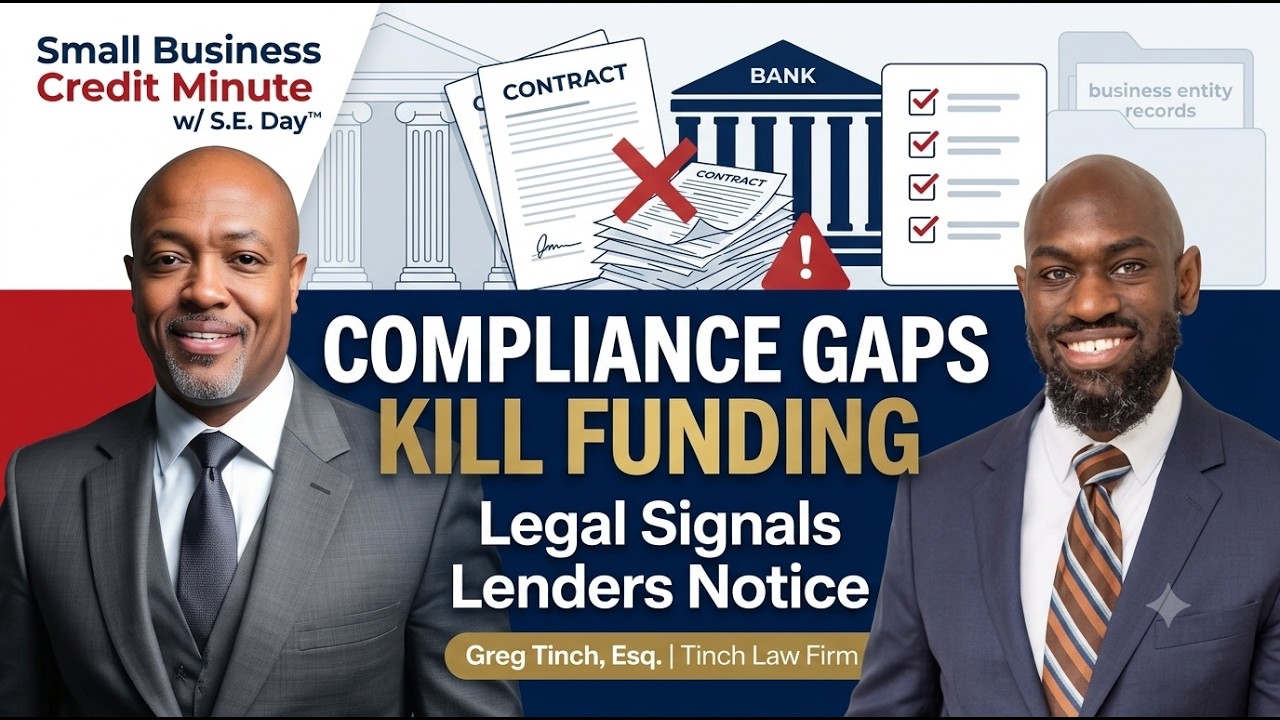
Attorney Greg Tinch explains how compliance gaps block small business funding. Lenders check entity formation, operating agreements, annual reports, and intellectual property ownership. A 90-day cleanup covering state good standing, consistent legal names, and proper documentation can fix the signals that make lenders hesitate.
Chapters
Welcome to the Small Business Credit Minute with S.E. Day, the podcast helping business owners build stronger business credit and real profit growth without the confusing finance speak. In minutes, you'll learn how lenders actually evaluate you and how to align the 3 pillars that decide approvals: business credit, cash flow, and compliance. I'll break down underwriting in plain English so So to show you what's hurting your fundability and give you one clear action you can take away immediately, if you want to become lender ready to receive business loans, business credit cards, and build bankable business strength the right way, then this is your Credit Minute. Qualify first, apply second. Let's get you funded. Stay tuned, I'll be right back. Business owners do not get funded because they apply. They get funded because they qualify. The FSBO LenderReady cohort helps established businesses align the 3 pillars banks actually review: business credit, cash flow, and compliance. In 90 days, participants organize the LenderReady document stack, strengthen bankability, and prepare for smarter conversations with lenders. For bank and community partners, this creates a stronger pipeline for qualified borrowers and a repeatable path to capital readiness. Register now at fsbonly.com. Qualify first, apply second. Welcome back to the Small Business Credit Minute. Today's conversation is about the pillar business owners often ignore until it becomes expensive: compliance. Most owners think compliance means filing an annual report or keeping a license active. That's part of it, but from a lender readiness standpoint, compliance is much bigger. Is the legal and operational proof that your business is real, properly structured, and authorized to operate legally consistent and not creating unnecessary risk. A lender may review your cash flow, a lender may review your credit, but before they trust either one, they want to know, is this business legitimate, consistently consistent, properly documented, and legally clean enough to fund? That is why I invited Greg Tinch, Esquire, of the Tinch Law Firm in Maryland to join the show. Greg brings a legal strategy perspective for entrepreneurs and businesses navigating contracts, compliance, intellectual property governance, and legal risk. Greg, welcome to the Small Business Credit Minute.
Hey, thanks, Sandy.
It's a pleasure having you on. I wanted to put a legal mind behind this. They hear me all the time. I've been to law school, but you're the, you're the lawyer, you're the barred attorney. So I want them to hear it from you. So when business owners hear the word compliance, they often think it means taxes and state filings, but compliance is broader than that. From a lender readiness perspective, I view it as an evidence trail that proves a business is legitimate. Greg, when you advise entrepreneurs or small business owners, How do you define compliance in practical terms to them?
I would echo your sentiments on it because, you know, if you make a representation, um, a smart lender or partner won't just take your word for it, right? They're going to want to do their own due diligence and corroborate what you said to them. Also, under contracts, I'm sure you've spoke about this in the past, but there's representations and warranties, right? So—
Yeah.
Before you sign a contract, you want to verify that the representations that the partner is making are true and that they warrant what you expect to get out of the deal. So, yeah, to your point, a paper trail that corroborates what you represent about your business. I think of that broadly as compliance.
Exactly. You know, I tell business owners all the time, an EIN alone doesn't make you lender ready. A lender wants to know whether the business is legally formed, active, in good standing with the State Secretary of State's office, and operating consistently across all public records. So from your perspective, why does proper entity formation and good standing matter so much? Not just to your business, but to the lending world.
Right. So proper entity formation, you know, the entity itself, I mean, not to get too deep, but it's a legal fiction. So it's not really a person, but the state treats it like it's separate from Sandy. Sandy has an LLC. Sandy's LLC is separate from Sandy. So, you know, if Sandy's LLC can have its own obligations, it could take out loans theoretically. Um, it could sue people and be sued.
Mm-hmm.
And importantly, legally, um, if Sandy— if Sandy's manufacturing lawnmowers, Sandy's at Sandy's LLC is manufacturing lawnmowers. You sell one, um, somebody uses it and chops off their foot, right? They, they sue Sandy's LLC for whatever they sue for.
Right.
They get a judgment for $2 million, but Sandy's company is only worth $1 million. Well, the recovery will be limited to $1 million because the entity, the LLC, shield Sandy behind the LLC from liability. So, um, that is, that is really why, um, a lot of businesses use the entity forms generally, like LLC corporation. I feel like I kind of strayed from the question, but I hope that—
But no, you touched on a very good point because I don't normally talk about you know, like an LLC, we know it has limited liability protection, right? But from a legal standpoint, you just touched on it and you touched on some really good points of the purpose behind having that separation from you as an individual, from your company as an artificial person, right? It is operating on its own. And what I used to say, all your company needs is for you to do your due diligence. And run the day-to-day operations because it can live way beyond you, uh, because it has its own Social Security number, it has its own birth certificate. It doesn't need you, it just needs you to run day-to-day operations, but it is a legal entity within itself. So that's very good that you touched on that. So some compliance issues, uh, look minor to the owner. But to a major lender, a bank, an attorney, a government agency, or future buyer, what are, what are a few small compliance mistakes that can create larger consequences for a business that you've seen in your dealing with businesses as an attorney?
Yeah, one killer is every year in March in Maryland, Uh, personal property tax filing is due. For the majority of businesses, it's just a flat, like, $300 if you're not over the revenue threshold. Um, there's a revenue threshold where it changes, but I think it's somewhere in the 7 figures, I want to say.
Yeah.
But, um, in any event, if you miss this, your business is going to be out or not in good standing, right? And if it's not in good standing for long enough, the state will revoke your charter, which the word charter is a legal word that means like you're basically— you're a certificate that authorizes you to— you authorizes the entity to do business in the state, right?
Mm-hmm.
So if you lose that charter, then whatever There's no entity to be on the other side of contracts with vendors. There's no, like, that liability shield goes away, right? The legal fiction just evaporates, and then you're back to being a sole proprietor, which means your personal assets and effects are at jeopardy if you get sued, if the entity gets sued.
Absolutely. Absolutely. Um, that whole legal protection, that legal shield, I want to dig into that a little bit. A lot of entrepreneurs create an LLC and assume they are protected, right? But if they're not, if they do not operate the business properly, that protection becomes weaker. And where we're going here is a word that is in the legal realm, piercing the corporate veil, right?
Mm-hmm.
That statement, what does it mean to protect the corporate veil? And what should small business owners be doing consistently?
Right. So, yes, just by way of quick background, I talked about if the, if the charter gets revoked and you revert to a sole proprietorship, you can get sued. And instead of the entity stopping your liability, your liability then becomes like your house, car, all your personal stuff. So, um, uh, I'm sorry.
But no, where you were going here— well, just touching that a little bit— where you're going here is basically you have a company, like in Maryland or many states, you have an LLC set up and you're doing business, you're operating business, you got contracts, you got whatever, and you're doing it in the business name. And then for some reason, you either don't pay your annual filing taxes or you start to pierce that corporate veil. And when we're talking about piercing corporate veils, we're talking about, say, an instance is you're using the company's debit card like it's yours. You're, you're paying your mortgage with the company's debit card, or you're taking your wife out to dinner on the company's credit card.
Right.
You're now starting to treat that company like it's, like it's a personal piggy bank. And that's kind of piercing, piercing that corporate veil. And you can lose protection of that company.
Sorry, I strayed from the yellow brick road. I'm back now. So, yes, we were talking about piercing the corporate veil. So the problem is the state doesn't want you to just form an entity so you can Um, you know, parade around like you have this business, but then if something goes left, pretend like, oh well, I have a business that doesn't have any assets. I wasn't doing— and then people can't like recover if they're legitimately injured or the business is negligent. So yeah, um, piercing the corporate veil, where you're vulnerable is, um, we haven't gotten to an operating agreement yet. We talked about filing the charter to establish the entity.
Right.
But there's a document called an operating agreement. It's not specifically required, but it is— I will say it's required because it's a contract that discusses how you relate to the other— for an LLC, the other members, or for a corporation, how the officers and shareholders and directors relate to each other.
Yeah.
But you need that. The state has a kind of statutory regime to fill gaps, but it misses a lot of pieces like money. How do you get paid? There's no really de facto provisions about that.
Right. What happens to the account if one of the members die? So Greg is talking about that operating agreement. Now, from the legal side, like he said, it's not necessarily required. However, from the banking side, and this is why I say you need to have a lawyer, you need to have a banker, you need to have a CPA as a part of your advisory team, because Greg is speaking the legal side of it. On the banking side, banks require you to have an operating agreement for your LLC or your bylaws for your corporation, because otherwise Otherwise, you're not in compliance and they will not open an account for you if you do not have that paperwork with you. And that paperwork is very important. I look at the operating agreement and the bylaws kind of like the will, a will for your company. So you got your birth certificate, you got your Social Security number. Now you have a will and testament of if I, as the managing member of my LLC, die, Well, if I have a couple of million dollars in the bank in the company's name, what happens to that? And this is where that operating agreement will come in and be able to guide the bank on what they should do with those funds in that account.
Exactly. So the—
very good.
I've, I've seen even this year, I saw a dispute. You know, the problem is, um, What happens if— well, what comes up a lot, what happens if, you know, the members in the LLC are friends? The participants in the LLC are called members.
Right.
So you start off as friends, but there's some business decision. You guys eventually like fall out and one member either voluntarily wants to go or the remaining members want to oust that member. So how do they go? Do they even have cause to get rid of them? And the membership, like the right to participate in the entity and the decisions, is not— is kind of like bifurcated from what happens with the money. So—
Yeah.
I think there's provisions about like how you oust a member, but there's not provisions necessarily about like what happens to the money. Is it— and what if you're a sweat equity member and there's an investor partner member? Like, how do you split the money then? Because the sweat equity person is going to say, like, well, there was value to what I did, but the default rule likely says it's according to your, your, the money that you put in in the first place, like your initial capital contribution. So—
Exactly.
Yeah. You need to kind of break that stuff out and you want to do it before there's a fight.
I agree. I totally agree. Listen, my company does— when we structure a business for someone, we automatically build in and build out those bylaws or the operating agreement. But folks, I don't do this willy-nilly. I've been to law school, so I understand those parts of those agreements. But this is where, you know, Greg and, you know, the Tench Law Firm Can help you out because there, I'll tell you this, there is no standard operating agreement language that's good across all 50 states. Your operating agreement is like a will. You put in it what you and your members, your, your other members, or you and your board of directors decide what goes into that operating agreement or those bylaws. So it's not one standard language. This is where having an attorney as a part of your advisory team, they can sit with you and understand what your needs are, where you're going, and then advise you on the proper language to include in that operating agreement. Again, an operating agreement is a will. It's a will for your business. What happens in your demise, or you need to, like Greg said, oust a member or get rid of a board of directors? What do you do? So there's— this is why you need an attorney on your side. So, Greg, I want to, I want to jump into contracts a little bit. Most owners think contracts are only about disputes, but I see contracts as a part of a fundability strategy as well. They prove revenue, they, they prove customer relationships, obligations, repayment sources, and, you know, business stability. Why should small business owners treat contracts as a part of their financials? credibility in their business.
Yeah. I mean, I would say generally about contracts, good fences make good neighbors, right? Like everyone should know.
That is definitely legal speak. Good fences make good neighbors.
Everyone should know what's expected of them. Like, what do you, what do you promise to do? What are you getting in return? If something goes wrong, what do I— what do I have to do? If the other party gets sued, do I have to give them their money back? That's indemnification.
Yeah.
Do you identify the parties correctly? If you contract with the vendor to make you something, who owns it after it's created, because that's not just cut and dry.
It's not. It's not. And now that you brought that up, AI is taking over right now, right? AI is the big thing. I use it in my business, and a lot of other business owners are using AI. Some of them are using the paid version, some of them are using the free version, right? So a question I pose to an attorney And the answers have been— they've been on point. But you know, like I know, U.S. laws have not even caught up to AI and cyber. They're not. We are so far behind the power curve, and this stuff is, is advancing every day. So the question is, if I create a logo If you will, right? That's, that's kind of the common thing. If I create a logo using AI versus the paid model versus the free model, who owns that logo? Do I own it? Does the, does the AI company own it? Who owns that?
The paid versus free. Um, who owns it? Yeah, that's an interesting question. Um, huh.
And this is what I've been getting.
This—
it's an interesting question because it's one of those you got to be careful because it can easily be a Pandora's box. And one thing I was told, well, If you do the paid version and you create it, you own it because you are paying for that. Now you got to make sure you read the terms of service on the, on the paid product. But if it's free, then a lot of these companies are pulling your information to train their AI.
Yeah.
So if it's free, you may not own it and you may see it somewhere else and you can't do anything about it. Now, well, go for it.
I feel like that's more relevant to privilege than ownership. So, you know, if— so a logo, I see logos in my practice as, like, they're trademarks, right? Like, the IP asset is a trademark, but the design itself, I think, is copyrightable because it's an original work of— it's a work of authorship. that is fixed in a tangible medium. But the definition of copyright is an original work of authorship fixed in a tangible medium. So what I would push back and say, is it original if you typed it into an LLM and said, draw me this, and it produced something?
Yes.
Is it even an original work of authorship fixed in a tangible medium? Now, I would say you could attach yourself as the trademark owner If you start using that logo in commerce, because that's the hook for trademark, is using a mark in commerce. So if you take this thing and you start using it in commerce, I will say, well, yeah, you can file a trademark application for it and assert yourself as the owner. That's no problem. But filing a copyright application, I would say maybe pump the brakes because I don't know. I don't know if it qualifies for copyright protection.
So people, listen, listen closely to that. Now, we are like AI-using crazed people right now. We use AI for everything.
Yeah.
But when you're talking about running your business and putting things out there, you got to be very careful. And this is why I implore every one of you, man, get to an attorney. Talk with an attorney. At least let them know. And like Greg's case, Greg does intellectual property as well. So you need to talk with an attorney and find out what you can and you can't do because you can get in trouble down the road.
Yeah, it, it's definitely nuanced. Like, I'll tell you, there's a, um, there's a copyright principle called work for hire. So it generally goes, if Sandy hires a vendor to develop his logo, the vendor doesn't own it. Sandy owns it. But it doesn't apply to all copyrightable subject matter, right? Like if you hire a vendor to write you custom software code, my recollection is it doesn't apply to that. So like, yeah, you know, work for hire broadly, but—
Yeah.
There are these nuances and like It doesn't apply in some cases, it does. So yeah, you're right. I think it's, it can be worth, like, rather than just relying on assumptions, it can be worth getting a kind of like tailored opinion to your specific use case.
Because another thing is like a lot of people are using AI to create apps for their business, right?
Yeah.
And there's a lot of software companies out there that are writing apps Who owns it once that app is done? Because all of the dynamics that are working in that app to make sure that you can, you can utilize your product or your services the way you're planning on using it, using it. Who owns that? That is that intellectual property or people? This is something that you need to talk with an attorney about. Okay. Um, Hey, I'm a radio show host. I got some legal background. I'm a radio show host. But you need to talk with— You're an attorney. You need to talk with somebody that practices this stuff on a regular. So I, of course, I implore you to get a talk with an attorney, get one on your team. At the end of the show, I'm going to put out Greg's information. Give Greg a call. He's the guy on this. This is what he does. So these are just little things. So, Greg, we're gonna move on. Okay. So at my company—
I'm sorry. Yeah, I could nerd out on that. I was even having more thoughts like, oh, what if you put a trade secret in the AI? I think you may defeat your— I think you could defeat your own trade secret.
Exactly. You may be giving away your own trade secret, but see, Greg, here again, on the paid version or the free version, if I'm paying for it, it still should be mine. But how—
but you're right to— you said look at the terms. I think that's the key because I think Gemini, Gemini doesn't train the paid version. It says like disclaimer, we don't use your chats to train our models versus— exactly. I won't speak on Claude, but yeah, the free tier of like ChatGPT, I think there's no such disclaimer. So.
Right. And these companies are running, uh, I mean, they are, they're jumping to go public now. So they're not looking at the nuanced stuff. They're going to be looking at trillions of dollars.
Exactly.
And, uh, I was talking with one guy and he said, listen, ChatGPT and those AI training models, they're free right now. And he said, but once these things go public, The $20 that you're paying, you can forget it.
Yep.
Because it is helping people grow their businesses and they're gonna make you make sure you pay for this stuff. So right now you're— we're kind of in that legal limbo of who owns what, what's being trained, those terms of services. But I think as this thing grows, it's gonna get a little bit more specificity to it because now these companies Especially once they go public, they are now opening themselves up to litigation if they are doing something, especially if I'm paying for the service and I see my stuff somewhere else. Now I can come after you because I paid for this service. As long as I understood my terms of services and I didn't violate it, then we'll be good. I got it. So, Greg, as we move on, like I said, my company at FSBO, we teach owners to build what we call a lender-ready document before they apply. And compliance documents are a major part of that. And, and you touch on this. One of the things that I've told people is you got to be careful when you create an LLC, for instance. So my company is FSBO, it's For Small Business Only, no comma, LLC. You got to be careful because you could put down for small business only, comma, LLC, and that could create a whole nother profile. So you have to go with what's on that letter from the IRS. And I, I, as a testament, I almost hate to say you can't trust the IRS because, Greg, here's the situation that happened to me. I have another company, it's called Real Estate Investment Management Corporation. That's the full name of the company. When I completed my SS-4 with the IRS, and I didn't catch this— I teach this stuff, but I didn't catch this. I created that company 8 years ago. I go to a brick-and-mortar to open up— brick-and-mortar bank to open an account. Mind you, I already have an account that I've run thousands of dollars through this account, right?
Right.
And it's with a, um, Um, a fintech. I go inside the brick and mortar and they are looking at my paperwork and she says, Mr. Day, we have an issue. And I'm like, what's the issue? She said, your company is called Real Estate Investment Management. I said, no, my company is called Real Estate Investment Management Corporation. She looks at my IRS letter and it says Real Estate Investment Management.
Mm-hmm.
So they couldn't open an account because my Secretary of State information said Real Estate Investment Management Corporation. And the bank wouldn't open the account. So when it comes to compliance, it's a major part of that stack we keep. So what legal and compliance documents should serious small business owners keep organized and updated? What would you say?
Yeah, um, you should You should have the EIN letter. Um, you should have your charter. You could get a stamp cop— well, you should have got a stamped copy of it back from the, um, S-Stats, whatever state Secretary of State. They should have given you a stamped copy of your articles of incorporation or articles of organization, what— whatever the charter is.
Right.
That the EIN certificate, that's with the IRS. Um, If my firm is structured as a professional corporation in Maryland, but, um, it's small, so I elected the pass-through tax. I filed a, um, S corp election form with the IRS. That's another IRS thing.
Yeah.
Um, what else? Your articles of, um, not articles, uh, the operating agreement, bylaws. Um, your reports from the bookkeeper, right? Like your annual reports, the cash flow statement, income statement, and balance sheet.
Right.
You need to keep those, um, you need to keep them updated at least like, I would say at a minimum like quarterly. But, um, they just give you information about your business. And then also it gives visibility and transparency to whatever like lender or partner investor Mm-hmm. So they could corroborate what you're saying about your business. Um, your IP assets also can be line items on your, um, on your statements as well. They can support the valuation picture that you're telling investors. Um, what other documents? You know, one thing that I— when I was prepping for our discussion, I wanted to talk about, um, I had a case where, um, 3-member LLC, they launched to, to sell a new, like, renewable energy product.
Mm-hmm.
One of the members was a kind of like sweat equity guy. He got upset about the compensation. He felt he was being undercompensated. So he sued and, um, he sued and he wanted to get a share of like the, you know, the invention was kind of pre-revenue. So I think he wanted to get like access to the patent or like ownership of it.
Hmm.
Um, and this company, luckily, they had agreements in place to assign the IP to a holding company. So it wasn't even like held by any of the, the actual inventor or the like main company, they had assigned it away. So it technically wasn't an asset and it wasn't up for the guy to get access to. But, um, generally I wanted to talk about like assignment means who owns the thing.
Yeah.
And an entity can own property, right? So, um, you— and when you file a patent, if you file a patent as a just like small inventor, The inventor de facto owns the patent. So if you want to move the patent from the inventor to the entity, you have to record an assignment. But there has to be an entity, right, to assign it to.
Yeah.
And if the, if the entity didn't exist at the time of patent filing, you have to file a separate instrument to transfer the ownership. So That's important. I would recommend, like, if you're a product company or there's some, like, core IP that is driving the value for the company, you gotta— and usually it's the founder, right, that invents it and then they spin up a company around it.
Yeah.
But they gotta get that invention and they gotta give it to the company and not them personally. Because, like, what if you get mad and you walk away? You take the patent with you. What's the company left with? Like, how are they— they have nothing to monetize. So, wow. Yeah.
People, this is why you need an attorney on your team. I keep saying it. Especially, I talked with a guy and he said, yeah, a friend of mine, we've been friends for 30 years. And, you know, he's back in the company. And I said, well, do you guys have anything in place? He was like, no, we're just good friends. He knows that I'm gonna take care of him. I said, listen, listen, I'm not trying to tell you about your friendship, but I'm just telling you from the legal side, money changes people.
Yep.
And when you go to start making money and you don't have your paperwork set up properly, you're going to lose more than just a friend. You're going to lose a lot of money.
Yep.
So just, just that example of what you gave, a 3-member LLC, and they're all doing this business, and now one wants to break camp. Listen, people, when everything is harmonious, life is great. But when those— when that harmony breaks, it can go to hell in a handbasket very, very fast.
Yeah.
So, Greg, I'm gonna keep going here. So a business can have strong cash flow and still be vulnerable if it does not own its own or protect its brand, its content, its inventions, its software, logo, course material, or product design. How does intellectual property tie into business credibility and long-term financial strength?
Yeah, so I would say, you know, where I encounter this, when a founder comes to me with their idea, I think generally I want to know where do they want to go with it? Like, Is it, you know, is it something like you want to have control over the life of the product, or you want to build a brand and like add more products or services to the brand over time? Or are you just like, you want to monetize it as quickly as possible and that's the goal? So, you know, if, if you want to build a company and eventually take investors, Mm-hmm. you probably need to set up a corporation because it's, it's easier for a corporation to issue, um, equity or whatever stake to attract investors. And right, when, when companies— when investors do their due diligence, at least for like software companies, they're going to want to see that you're organized as a corporation versus an LLC. So, um, but an LLC, I think it's easier to— there's less like compliance to keep up with on an annual basis.
Right.
There's less kind of like formalities that you have to observe constantly. So, um, yeah.
But I concur there. I concur because people— LLCs can't issue stocks. Corporations can. So, and you can be an S corp, um, but you can't issue stocks as an LLC. So when you talk about trying to get investors, you have to understand from a credibility standpoint and from a credit standpoint, That credit is based on those members and not necessarily the LLC itself. Greg touched on something earlier when he said that his law firm, he does the pass-through taxation. So now an S corp can still do pass-through taxation, but a C corp is double taxed.
Mm-hmm.
You are taxed on any distributions in the corporation itself because it is an artificial entity. It is taxed on its profits as well. However, under the corporation, you can have shares and you can issue shares of the corporation. And all that stuff is set up whenever you structure it with the Secretary of State's office. You can put in how many shares you want, or— and I think for some, it's if you go like over a million shares, I think it's Virginia. If you go over a million shares, then You have to have some more paperwork attached to that corporation, but it's, it varies state by state. So you have to get with your Secretary of State's office and find out those things. But as Greg is saying, you want to protect everything you have, your trademarks, your copyright ownership. You write any books or marketing assets, you want to protect that. And You want to protect your asset, uh, up front rather than looking at it as an afterthought. Like, he brought up the scenario about those 3-member LLC and somebody had some, you know, had filed a patent. Hey, if that person— if I filed the patent and I didn't turn it over to the LLC, I still own that patent. And you're right, if I walk away from the LLC, what does the business make money on? Because I own the patent. So you got to be careful as you grow your business and put things out there, but it's best to get it done up front the right way before you really get into the nuts and bolts of your business. So, Greg, are you familiar with the benefit— the beneficial ownership statute under the transparency, uh, the CTA? Are you familiar with that?
I don't think I'm as familiar as you are, but I, I did look to see, did I have a compliance problem? Yeah.
Okay, so now what this is, is— and this has been going on for years, but it really came into play after 9/11, after 2001, when the, when the U.S. Patriot Act was created. And there was a section in there, Section 326, in the original version of the U.S. Patriot Act, and it's verification of identification. Basically, before 9/11, you could go into a bank and you could open up an account on your company, and you didn't have to attach your Social Security number or anything. Everything was on the business. Yeah, those days are long gone. I, I had businesses before 9/11, and I had them after 9/11, and now with that compliance issue you have to file an annual BOI report. Well, when this administration came in, the president said he's not going to enforce it. It was going to be for foreign companies. But what you have to understand is the BOI reporting requirement is a law. It's under the Corporate Transparency Act. Okay?
Yeah.
Which means it is a standing law. It's good law. The administration can say they're not going to enforce it, but it's still the law, and Financial Crimes Network will investigate. Okay, so on that, you may not necessarily be familiar with the, the CTA, Greg, but you understand that once it's an act It's the law, and it's still good law. And if it's still good law, you have to adhere to the law. So what I've been telling people is, when this guy is out of office and you have not filled out your BOI reporting requirements, FinCEN can come after you, and you can't say, well, the president didn't enforce it. They're gonna say it's the law. You know what you should have been doing. So, uh, Greg, kind of reemphasize the need for you to actually adhere to the law instead of getting yourself in trouble down the road.
Yeah, I mean, it's, um, it's to your point. If, you know, if you're out of compliance, maybe the regulator doesn't come that day. But if you're out of compliance, you're vulnerable, right? Like, they could— whenever they do come knocking, it's just there for them to ding you. And it, it always costs more to fix it than it would have cost, like, an investment in the first place to be in compliance.
Yeah.
So, and then once you get tagged, you still got to do the compliance. You just got to pay a fine on top of it. And there's going to be, like, time pressure. So, um, yeah, and you can go to jail on that too.
Now, I will tell you, many of the banks are— if you go and open an account, because they get dinged on compliance as well, many of the banks are making sure they get that information to file your BOI reporting requirements.
Okay.
They make sure that they give you a document in the bank when you open an account. to sign that document. But if you're not opening an account or you've had an account open, you can't depend on the bank to come back and say, well, Mr. Day, you need to do this report. They're not going to do that. It's on my back. I'm the owner of the company. It's on my back to file that report. And people, it's painless. It's one document. You do it online. It's your business. If you're not doing anything nefarious, then what's the problem with filling out the BOI report? You are the beneficial owner. I'm the beneficial owner of my company. I'm not trying to do anything nefarious or put money in accounts in other countries. I'm running a legitimate business, so it shouldn't be an issue in doing the compliance part of that. I'm just saying, get it done. Don't wait until, uh, big brother come knocking on your door because it's too late then. It's too late. So this one is It's the legal side, but it's more on the, on the banking side. But I'm gonna pose it to you anyway. So with banks, banks and this whole, you know, ownership of, of documentation, why do you see the importance of having all of those documentations? I know you touched on a little bit of it earlier, but having all of the compliance documents together before ever walking into a lender's office trying to secure money?
Well, you know, one non-bank reason why it's important to have this compliance stacked together, I guess it's non-bank, but it's also related. In Maryland, you can apply for— was it my— well, I'm sure it's called something different now. It used to be called the Minority Business Enterprise Designation, which gives you—
Yeah.
Yeah, it gives you an advantage in bidding on state contracts, which could be like pretty transformational for your business if you're early stage and you win one. But you have to have— they're going to ask for like bylaws, they're going to ask for your financial reports like 3 years back. I think they want a business plan, they want the charter, they want certificate of good standing. So if you want to get that, which is like theoretically commercial value, commercially valuable, at least levels the playing field between like you and these bigger competitors.
Absolutely.
You need to have your stack in order. Um, investors, when they do their due diligence, they're going to check all of that. They're going to check the assignment records like I was talking about for the patents and trademarks. Like, if you do negotiate terms for a deal, they're going to check and make sure all that's in order. And if it's not in order, I don't think they're going to give you like, okay, here's a warning, you get 15 days to cure it or 30 days to cure it. They'll just walk away and you just may miss your opportunity. So, yeah, I think the stack is pretty critical from those perspectives. And the, you know, the bank as a, like, potential partner, they're assessing your creditworthiness. Um, yeah, so they want to make sure all that stuff's in order and you're legit. Like, basically the story that you're telling them about your business, they need to corroborate that all your representations are true.
Absolutely. So, Greg, this is where we bring it home. Okay, so a business owner listening right now may realize that, you know, they haven't been keeping the legal side clean. We don't want them to panic, but we do want them to act. So if a business owner had 90 days to, say, clean up their compliance before applying for funding, uh, what should— what in your— from, from, from a legal eagle standpoint, what should they prioritize? Right now, you know?
Yeah. Um, you know, before I, before I answer that, I just wanted to relay this quick anecdote because I thought about you. So, um, I, I had a consult and, um, a founder took out a— well, they didn't have their stack together. They couldn't just go to the bank for a lot of reasons. So they took out—
Right.
alone on very unfavorable, predatory, possibly illegal terms. Oh my goodness. And it just kind of like snowballed for years. And they kind of thought like, well, I don't have any other choice. And then, you know, you— when, when you finally do decide to go like ask somebody, hey, is this right? Because it doesn't feel right. And they're like, no, it's not right. You know, what do you— but you, you, if you, if you don't have your stack together and you can't get funding from a, like, regulated lender, right, you just open yourself up, you know, you just make yourself vulnerable. It made me really sad.
Yeah.
Yeah, it made me really sad. So I guess all that to say, like, yeah, this is an amazing service. I hope people are listening, they subscribe, Yeah, because this is pretty invaluable.
And see, it's good having you on, Greg, to talk about that because you, like me, we're both business owners and the, the listeners of this, of this podcast are business owners and we're just doing our thing. You and I happen to be attorneys where we understand compliance issues really from a, from, from a, from a professional standpoint, but we understand how it applies. to our business. The majority of business owners don't have legal backgrounds, right?
Sure.
The majority of the business owners have a passion of what they want to do, and they go about making that happen to make money. All we're trying to do is make sure you have everything aligned before you step out the door. And you may say, Hey, attorneys are expensive, man. I can't afford to talk with an attorney. You don't know what you can afford until you call an attorney and talk with them, right? Uh, we're all out to make money, but I'm telling you, spending money, having— speaking with an attorney is priceless if you're landed in court on a contract. review and your stuff is not together, or someone is suing you and your stuff is not together, the $400 or $500, the $1,000 you may have paid, paid an attorney to review your document stack, man, it's going to be well worth it. If you, if you're going to court and you have to defend that, it's going to be well worth the money you paid. So don't think just because an attorney is out there that I can't afford them. Talk with someone, talk with someone to make sure your document stuff is important. And like Greg just said, he hit up on it, alternative funding. And that's what that person was doing because they couldn't qualify to go into a regulated industry like a bank to get money. And it's probably because their document stack wasn't in order. You can get your stuff in order, people. I've been talking about bank statements, 90-day review. These are simple things. The Secretary of State's office, you file and gotten your EIN, you got your stuff registered with the state. Keep going on that to make sure that it's aligned properly and you can do what you need to do. So you don't necessarily have to fall by the wayside just because you don't have a legal background. And I'm sure Greg can attest to that.
Yeah, um, we talked about AI. You know, one thing's for sure, these tools are incredibly powerful. I think the The trap can be if you— I use Claude principally. If you ask Claude to write you like a legal instrument, it'll definitely do it and put it out there like, yeah, I did it. This is— you won't hire anyone to do a better job than this. Now, the problem is you don't know whether Claude hallucinated when Clause 5 or whatever, right? Or paragraph 5. If you don't have the, the background, you kind of don't know what's right and what's wrong.
Exactly.
Yeah, if you give it the right context, it could do a great job. It's, it's a little scary.
But if you don't know the right context because you're not a lawyer, it can get you in trouble very fast because now you're putting that out as representing So, Greg, a final question for you. What is one compliance mistake you would tell every business owner to fix before they apply for funding, if you will?
Yeah, um, sorry, I wasn't even trying to duck your question. I just, uh, had that on my mind with the—
Oh no, it's not ducking. It's not ducking. Believe me, I'm gonna touch on this again. I promise you I'm gonna have you on the show again because We're gonna have more issues come up.
I appreciate it. Um, I think you touched on a lot of it. I would say, um, huh, I guess I would prioritize with the, like, problems that'll cause you the most pain. I think if you have— if there's IP, I'll just revert to my kind of breadbasket. If there's IP that's core to your business, Make sure that it's protected.
And that's intellectual property, people.
Yes.
Intellectual property.
Yeah, it's, it's for every business, really. It's like trademark your brand. So, you know, if you're, if you're advertising under a name, if you have the money, you should file a federal registration. The way it works is, is basically it doesn't matter how long you've been using it. Whoever files a registration application first will get the mark. So if it's, if it's important and you have some brand recognition, some traction, audience loyalty, you need to file that application because if somebody beats you there, then it's a lot more. It's, it's $350 to file it. And the PTO, you talked about the cost of attorneys being prohibitive, and it is for some practices, but I'll tell you, the USPTO It's a, it's an agency. Um, it is not— it's self-funded. But anyways, it has a public-facing mission.
Yeah.
Self-funded. They generate enough revenue to fund itself. But, um, it has a public-facing mission, which is to say, um, they have public outreach channels. There's actually like a series of video courses, webinars that you could take that'll walk you through like a patent. What is a nonprovisional versus a provisional? How do you file it? How do you use the PTO interfaces? There's trademark boot camps that'll walk you through like, okay, here's how you search, here's how you prepare the application, here's how you file. So if you really want to get up to speed enough that you could do it pro se without an attorney, you can. But, um, Yeah, I, I think you and I both just want to see like the community and the ecosystem get stronger. So—
Exactly.
Forgive me, protect your brand. Don't let anyone come and snatch it out from under you. If you have it on Instagram, someone could see that you have followers and just go file an application, and then you're like fighting with them trying to get— trying to get a toehold. So—
Wow.
Don't let that stuff, um, Same thing with the patent. If, uh, if there's a race to get to the patent office and you lose by a day, then the subject matter goes to the prior filer.
So, um, man, that is, that is serious information there. That really is.
And we already touched on like title to the assets. So yep, um, record those assignments. Talk to an attorney and do an audit if you need to. But that stuff that makes your business go and really has value for your business, if the title gets away from you, then it's— it can be a mess. It could really like tank your business.
Exactly. Well, audience, here's your Fundability Fix in 60 seconds. I always try to give it to you. Before you apply for business funding, pull your compliance file and check 5 things. 1, Is your business active and in good standing with the state? 2, do— does your legal business name match your business bank account, your tax records, your invoices, your contracts, and your website? 3, do you have an operating agreement, bylaws, or ownership records that prove who controls the business? 4, are your licenses, permits, insurance contracts, And leases current? And 5, can you hand a lender a document stack without scrambling? Because here's the truth: compliance gaps creates doubt, doubt creates delays, and delays kill deals. Qualify first and apply second. Greg, thank you for being on the show today. Um, you put out some serious information, uh, that people needed to hear from Legal Eagle, uh, because this is the kind of stuff that can save them time and money down the road. So I appreciate you being here.
Yeah, thanks for inviting me. I appreciate it. Absolutely.
It's been fun.
Absolutely.
Audience, if you got— if you like this episode, please download it, share it with a fellow business owner, and leave a review so more business owners can learn to grow smarter and faster. And remember, your dreams deserve a chance to grow, just like your business. Thanks again.
More from S.E.

When History Gets Reduced to a Holiday, We Lose the Lesson - How Juneteenth Turns Fun into Education


When Members Lack Financial Knowledge, Progress Slows (Why Frontline Leaders Must Teach)
Weak Financial Literacy Slows Business Growth—How Chambers Helps SBOs Make Smarter Money Decisions

Messy Books Kill Profit and Scalability (Fix Your Numbers Before They Cost You)

HR Mistakes Kill Profit and Funding (Use a PEO to Get Compliant and Bankable)
Exit Rich, Not Ripped by Taxes (Use an Employee Stock Ownership Plan to Buy Out Your Shares)

Are Your Communications Costing You Money ~ And Can AI Fix It Without Killing Your Voice?