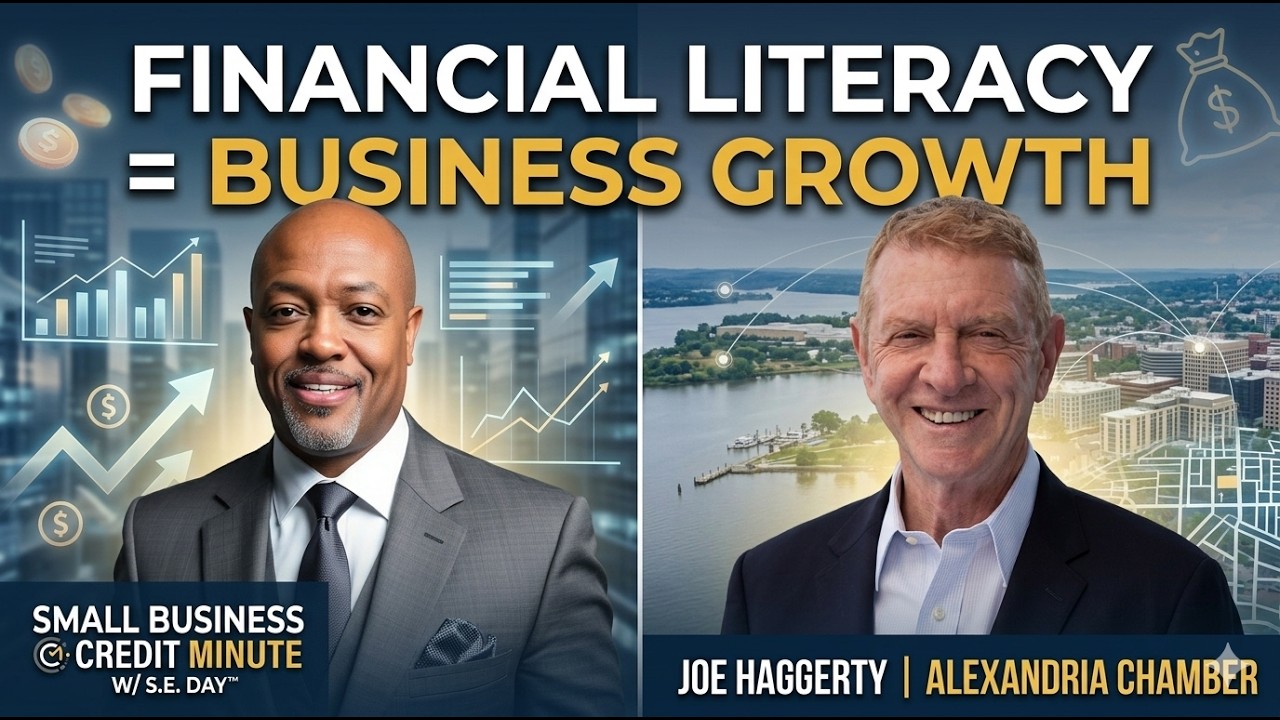
In this episode of the Small Business Credit Minute, host S.E. Day interviews Joe Haggerty, President & CEO of the Alexandria Chamber of Commerce, to explore why financial literacy is a non‑negotiable skill for small‑business owners. The conversation covers how a solid grasp of money fundamentals improves investment decisions, cash‑flow management, risk mitigation, and credibility with lenders and investors. Haggerty explains common pitfalls—confusing revenue with business health, delaying financial organization until a crisis, and misusing debt—and shows how the Chamber’s programs (career‑focused financial‑literacy initiatives, cash‑flow planning assistance, advocacy for local funding, and connections to larger financing sources such as SBA and corporate‑backed grant programs) directly address these gaps. The episode also promotes the Chamber’s Small Business Credit Survival Boot Camp and a free business‑credit starter kit as practical tools for entrepreneurs. Throughout, the hosts stress that stronger financial literacy not only protects individual businesses but also bolsters the resilience and competitiveness of the broader Alexandria community.
Chapters
Entrepreneurs do not fail only because of bad products or weak demand. Many fail because they do not understand the financial side of the business well enough to make strong decisions under pressure. In this episode of the Small Business Credit Minute with S.E. Day, I sit down with Joe Haggerty, President and CEO of the Alexandria Chamber of Commerce, to discuss why financial literacy matters for investment decisions, cash flow management, risk reduction, investor confidence, and long-term growth. It is a timely conversation because the Chamber ALX positions itself around supporting businesses, cultivating community, and offering advocacy and professional development for the local business ecosystem. Welcome to the Small Business Credit Minute with S.E. Day, the podcast helping business owners build stronger business credit and real profit growth without the confusing finance speak. Today we're taking a slightly wider lens on business success by talking about financial literacy in support of National Financial Literacy Month. A business owner can have drive, talent, they can have vision, but without financial understanding, growth can become expensive, risky, and unstable. Qualify first, apply second. Stay tuned, I'll be right back. In today's competitive world, your business deserves more than just hard work. It deserves the financial freedom to grow. Building business credit is the key to unlocking opportunities. With strong business credit, you can expand faster, invest smarter, and reduce your personal risk. Start building your business credit today because your dreams deserve the chance to grow, just like your business. Secure your spot at the next Small Business Credit Survival Boot Camp. Joe, welcome to the show.
Thanks. Very happy to be here with you today. We have 1,000 members from large to small. Many of them face financial challenges in their business, and so let's talk about it.
Absolutely. So jumping right into it and talking deeply about financial literacy— excuse me— from the Chamber's perspective, why is financial literacy such a critical skill entrepreneurs must have, not a nice-to-have?
It's probably a critical skill for everybody to have, but particularly if you want to have your own business, if you want to be successful, if you're entrepreneurial, you really need to understand How money works, where you can get that money, how you invest it, and how to analyze your own financials so that you stay successful.
That is perfectly put. You spoke on it from a business standpoint, but you also looked at it from a larger lens, right? As a small business owner, these are things that you need to have in place. So entrepreneurs make decisions every day about spending, hiring, equipment purchasing, marketing, expansion. How does financial literacy improve the quality of those investment decisions?
So most, most small and even medium-sized people who are getting into business for the first time have a dream, and their dream is about their product, whatever it is, their location, their community. But they really need to understand the numbers behind it to make it go. When they, when they go to get a loan from somebody, whether it's the SBA or a bank, they've got to really have a well-planned strategy that the bank or that lending institution really feels they can support to lend them the money.
And that drives us right into the next question because we're talking about cash flow. Cash flow problems shut down more businesses than bad ideas. Okay. In your view, what should every entrepreneur understand about cash flow before trying to scale or grow their business?
Great question. You, you don't have cash flow unless you have the money. Either someone's lent it to you or a family has put together some cash for you and you go at it. But you have to carefully plan how that cash is spent, and you've got to know that your customers are going to come in and spend money with you to make that happen. And that doesn't happen all the time. Many businesses face financial problems right from the start without selling enough. So you've got to be able to analyze it quickly and make some decisions quickly.
You know, Joe, I don't know who put these questions together, but they are just flowing and rolling together because what your response Rolls into the next question, right? Many owners confuse revenue with strength. That's a big problem. How can better financial literacy help entrepreneurs distinguish between, say, sales activity and actual business health?
You have to have a business plan that's based on, on some financial important things to you and your business. You have to watch it regularly, and you particularly have to watch your cash flow, not just It's nice to have some cash in the bank, but you better make sure you're not going to pay it all out for your next salary for your employees.
Exactly.
So that has to be watched carefully, and that's the owner's job to do that.
So financial literacy also plays a defensive role when it comes to handling your finances, not only your business finances but your personal finances. How does it help entrepreneurs Identify and mitigate risk before damage is done.
So anybody who's in business these days has to, has to understand how money flows, how it works, how it works in your organization. And we see many businesses that have problems. They go through their money too fast, and then there's no place else to go get some more money because they, they've hit their max in borrowing. So you, you just have to watch it, you have to manage it, and And you have to have some knowledge about it.
Well, you know, you just— a follow-up to that is, and you just touched on it, do you think too many small businesses wait until a crisis hits before they try to get financially organized?
Yeah, again, often small businesses have a dream for the business and they may have a good product, but they don't always know what the customer flow will be and how much money will come in. And so that's the challenge for them, to figure that out quickly. Otherwise, they're going to have some major problems. And often they get scared and they don't want to talk about them with their banker or with anybody else. And next thing you know, they, they don't have any cash and they're out of business.
So driving into still the subject on this whole financial literacy, I was talking with a lady yesterday and she said, you know, she grew up in her household that all debt is bad. And I said to her, no, some debt is good, but you have to be able to pay pay for that debt, right? So debt can be a useful tool or serious trap. What should business owners understand about managing debt wisely and protecting the business from overextension?
Sure. Almost everybody needs to borrow some money to get their business going, whether it's from family or whether it's from a financial institution. But they better know what their monthly plan is, and they better have a plan. And often that institution that lends you money will help you with that plan. At the chamber, we meet with people and we help them with their cash flow management plan. And you just have to have it and you have to stick to it.
You know, I'm glad you said that about the chamber because from what I'm hearing, your chamber is not like a lot of chambers that I've been through, right? When you say you're actually working with your members and sitting down and helping them put those cash flow structures together so their business can grow, This is actually a chamber doing its mission, giving back to the small businesses, right?
We hope so. Well, we help them find the right institutions to loan them money. We help them know where the money might be more available, and they really need to work with the institution itself to modify their plan sometimes. They may be a little too aggressive.
Got it.
But let's get it done right. Let's open and let's Let's go from there.
Okay, okay. So investors, lenders, and partners look for confidence in numbers. How does financial literacy improve an entrepreneur's credibility when asking for capital or trying to build partnerships?
So the first thing you're going to be asked when you are borrowing money from anybody, even your family, is how you're going to pay me back. And you better, you better have a plan for that. And, and it better— if it's all— if you have some kind of a plan out there and they can see it. People can ask you questions, but you really need to be able to answer them and be practical with your answers that it's going to work.
Absolutely. So chambers often sit at the intersection of business, education, advocacy, and community building. What role can an organization like the Alexander Chamber of Commerce play in helping entrepreneurs become financially stronger?
Yeah, it doesn't really start at the entrepreneurial level. It starts in school. We do a CareerCon, which is a career learning for kids in high school.
Mm-hmm.
And we actually would like to see more schools do more in financial literacy, but that's a job for both the schools and the parents. But when they're going to become an entrepreneur, open their own business, they really have to be skilled at it. And they may have to get some more education themselves in terms of learning about money management, but we can help them with that too.
So that goes right into, on a follow-up, how does advocacy programming, networking, and business education work together to strengthen local business, your— the actual local business base?
Well, advocacy for us means talking to elected officials and making sure there's some money available for the most part. And we do a lot of that. And so, for instance, the City of Alexandria has money available to help new businesses. But they want to see a plan, and they want to know that that plan will be followed. And they're probably getting the loan from some other institution.
Okay.
But we got to put them all together.
Well, and this is kind of a diversion a little bit, but recently I heard that JPMorgan Chase was doing about $80 billion, $80 billion in helping the community small businesses come up to par. And some of that money would be given directly to small businesses, but some would be put through Organizations like chambers, small business, state small business credit initiatives, SBDC. Is that something that the chamber may be looking at in trying to procure funds like that for small businesses within the Alexandria area?
Yes, and usually when one of the small business associations or Small Business Administration comes to us and they say they have money, our first question is, okay, how do businesses access that money? Do they go to you? Have you given it to a bank to give it to them or a credit union? We want to know that, and we will help our businesses apply.
Okay.
You know, one of the problems during COVID was that people didn't have a banking relationship, and when they went to get some money, nobody knew who they were and nobody knew what their plan was. So you've got to be working together with the lending institutions.
And I talk about that on the show, about small business owners developing relationships with their lenders, not just putting money in an institution or a bank, but actually get to know the branch manager. For a number of reasons, right? Because it can actually build that relationship when you're ready to borrow money. If that manager knows you, they can definitely speak up on your behalf.
Absolutely. And relationships are important in all types of business.
Absolutely.
But when you have a problem, you know, most— so half the small businesses in the United States are very successful. The other half are struggling all the time, and some do go out of business. But you need to know your lending people. If you have a problem, you've got to go to them, be honest about it, and if they know you, they're more likely to be able to help you and help you more quickly.
Absolutely. Absolutely. So, Joe, looking ahead, how do you think stronger financial literacy among entrepreneurs can not only improve their individual businesses, but the strength and resilience of the broader Alexandria business community?
It's better for all— it's better for all of us when businesses are thriving and growing and Competing with each other. I mean, competition is what it's all about. So we have a lot of nail salons, we have barbershops, we have physical training groups that are competing with each other, and there's plenty of people who want their services. And when they're all growing, it's better for the whole community. It's better for everybody. It creates jobs and it makes for a good community.
Absolutely. So Joe, what is one mistake business owners repeat too often that you've seen?
The big mistake I see too often is really not being honest with themselves about the financial issues. It's not so much about their product or their customers, it's the finances of it.
So Joe, as we wrap up, what do you want Alexandria entrepreneurs and business owners to remember from this conversation?
Well, 2 things I think. One is Really get your financial capital learning up to speed and stay with it all the time and talk to financial people that can help you. And secondly, understand the Chambers of Commerce in the United States are here to help you too. And we offer all kinds of learning for you too, and we will advocate for you to get that money.
Absolutely. Joe, this was strong because it refrains financial literacy from something people think is optional. Into something that directly affects everyday decision-making in your business, not only in your business, but in your home life, in your cash flow, in your risk, your credibility, and your growth. Joe, this was strong because it reframes financial literacy from something people think is optional into something that directly affects decision-making, cash flow, risk, credibility, and growth. This is a message more entrepreneurs need to hear, not just during Financial Literacy Month, but throughout the year. So I implore you, if you are in the D.C. area and Alexandria area, come and look at the Alexandria Chamber of Commerce. And if you're not, any city where you are, go and talk to your local chambers of commerce. They can actually help you when it comes to financial literacy and making your company strong. Joe, thank you for joining me on the Small Business Credit Minute as we celebrate National Financial Literacy Thank you so much. And talking about this really important subject. And for the audience, this is always me telling you that if you want to do a credibility fix real fast, go to our website listed in the show notes, grab our free business credit starter kit. It can help you get started today to improving your business credit. And if you've enjoyed this episode about financial literacy coming from a Chamber of Commerce perspective, Download the podcast, share it with other business owners so they can learn to grow faster and smarter. Until the next episode, your dreams deserve a chance to grow, just like your business.