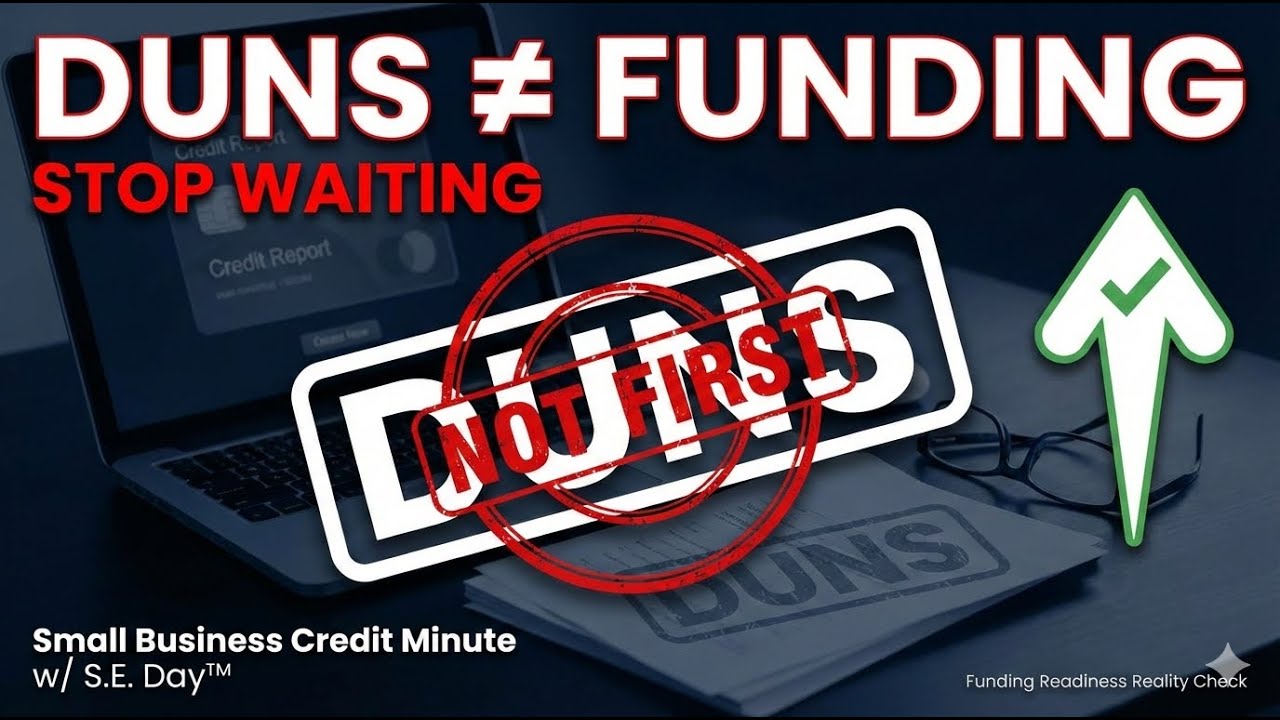
A DUNS number is just a file label from Dun & Bradstreet, not business credit itself. You only need it if you want D&B reporting and a Paydex score. Many lenders skip D&B entirely and focus on identity consistency, banking stability, and cash flow instead. Build fundability in layers: lock down identity and compliance first, then add DUNS as a later amplifier.
Chapters
Welcome back. Let me ask you something that triggers a lot for business owners. Do you really need a DUNS number to build business credit? People talk about the DUNS number like it's a golden ticket, like you can't do anything without it. Well, here's the truth. A DUNS number can be very useful, but it is not a magic key. And in many cases, it's not even step one. I see business owners stall for weeks or months because they believe, I can't build business credit until I get my DUNS number. That belief is costing you time, momentum, and approvals. So today I'm going to break this down clean: when a DUNS number matters, when it doesn't, and how to use it the smart way without pausing your entire fundability build. By the end of this episode, you'll know what the DUNS number actually is and what it is not, exactly when it becomes important in the business credit process, And the correct order of operations to build fundability without wasting time. So let's jump in. Truth number 1, a DUNS number is not a business credit. It is not business credit. A DUNS number is a numerical identifier, a profile number used to organize a business credit record inside Dun& Bradstreet. That's it. It does not create a score by itself. It does not prove fundability by itself. It does not cause approvals by itself. So think of it like this. A DUNS number is a file cabinet label. Business credit is what you put inside that file. Your credit profile gets stronger because of reporting trade lines with Dun& Bradstreet, on-time payment history, consistency and verification across systems, And when applicable, utilization behavior and account management. If you have a DUNS number but no reporting activity, your file is basically empty. Truth #2: You need a DUNS number if you want a Dun& Bradstreet reporting and D&B scoring. Simply put, if you want a Paydex score, you need a D&B profile that can receive reporting. That's where a DUNS number becomes relevant as infrastructure. But here's the critical point. You do not need to stop everything and wait on DUNS before you build fundability. While D&B setup is happening, you should still be building parts lenders actually punish you for ignoring, like your business identity consistency, compliance footprint, banking business stability. Start trade lines and vendor accounts that build payment history, especially those that report to Dun& Bradstreet. So yes, get the DUNS number process going, but no, don't treat it like it's the beginning of the journey. Truth number 3: Not all lenders rely on Dun& Bradstreet the way people think. Here's what a lot of bad advice shows up online. DUNS is required to get funding. That statement is too broad to be useful. Many underwriting decisions focus on business credit files that aren't Dun& Bradstreet, bank statements and deposit behavior, cash flow stability, verification systems and identity matching, and important time in business signals and industry risk. So if someone tells you you must have a DUNS number, Your next question is required for what exactly? Which lender? Which product? Which underwriting channel? Is it a, is it a hard requirement or just a nice to have? Because in the real world, a lot of approvals are won or lost on fundamentals. Does this business identity verify cleanly? Do bank statements show stability? Do deposit looks look consistent? A DUNS number can't fix those. Truth number 4, DUNS becomes powerful when you see it strategically. When you use D&B strategically, it can become a credit amplifier, but only if you handle 3 things correctly. One, your D&B profile must match reality and match other systems. If your business name isn't formatted one way at one bank, another at the state, and another with D&B, you're creating verification friction. And friction is where approvals go to die. Number 2, the payments must be reported properly. It's not enough to pay. The account has to report and report accurately. Number 3, trade lines must be meaningful. A profile full of tiny irrelevant accounts doesn't signal the same strength as clean, consistent payment behavior that reflects real business activity. The point is, D&B can strengthen the story, but it can't replace the story. The real problem? The DUNS first myth distracts you from fundability stack. If you remember one thing from this episode, remember this: fundability is built in layers. DUNS is one layer, useful in the right moment, but the layers that matters first are identity, compliance, banking, reporting activity, clean underwriting signals. If those layers are weak, DUNS is just decoration. So here's a step of action you can take today to get started right. Start with the DUNS setup, but do not worship it. At the same time, tighten your fundamentals. Lock your business identity consistency across all platforms. Build a compliance footprint that doesn't raise red flags. Strengthen business banking stability, separation, prediction, predictable deposits, clean statements, and add trade reporting credit trade lines and pay them on time every time. That is what builds fundability. If you want an exact step-by-step order to build business credit without wasting money and wasting months, go to our website, get my free business credit starter kit at fsbonly.com. It's also in the show notes. And remember, your business credit isn't just a score, it's your company's future. Always qualify first and apply second. Thank you for tuning in to the Small Business Credit Minute. I hope you enjoyed today's episode on DUNS number, when you need it and when you don't need it. If you got value from this Credit Minute, please forward the podcast and download it, share it with a fellow business owner, and leave a review so business owners can learn how to grow faster and smarter. Until the next episode, your dreams deserve a chance to grow, just like your business.