Financial Illiteracy Costs Communities ~ Credit Unions Can Change It

In this episode of the Small Business Credit Minute, host SPEAKER A interviews Lee Morgan, President and CEO of Penair Credit Union, about the pivotal role credit unions can play in combating financial illiteracy. Morgan argues that financial literacy is a core mission for credit unions because they exist to serve members and strengthen communities. He explains how lack of financial knowledge hampers individuals’ ability to secure capital, manage debt, and achieve the American Dream, especially among lower‑to‑middle‑income and aspiring small‑business owners. The conversation highlights the trust credit unions enjoy, their non‑profit ethos, and how programs like Penair’s NOW financial‑literacy contest directly improve members’ debt reduction, savings, and credit scores. Morgan outlines essential curriculum topics—budgeting, living within a budget, understanding loan terms, and avoiding debt—while emphasizing that education should begin as early as age two or three, using simple allowance‑allocation exercises. The interview also covers the importance of supporting entrepreneurs, helping them become lender‑ready through hands‑on budgeting and cash‑flow training. Morgan stresses that genuine commitment, staff certification, and measurable outcomes (member feedback, letters, program results) are required to move beyond “checking a box.” He concludes with a call to action for other credit‑union leaders: make a firm commitment, allocate resources, and embed financial‑literacy initiatives into the organization’s DNA.
Chapters
Welcome back. As I mentioned before the break, my guest today is Mr. Lee Morgan. Lee is the President and CEO of Penair Credit Union, where leadership, service, and community impact are central to the institution's mission. Lee, welcome to the show.
Thank you so much. Appreciate being here.
Absolutely. So today we're discussing why credit unions are uniquely equipped to lead the financial literacy movement, how education drives long-term membership, and what practical steps institutions can take right now to build financial power in the communities they serve. So Lee, as I said, welcome to the show. I know you are busy. We're going to jump into the questions and just have a good time. So the first question, why do you feel financial literacy is not just a nice community initiative, but a core mission issue for credit unions, for the credit union movement?
I think ultimately, you know, we're here for our members. We're here to help the communities which we're serving. Financial literacy is the main backbone of that. People need to know how to handle their funds, handle finances, do projections out if you're going to be a small business owner or even a large business owner, to be able to understand how finances work. You know, I wish we would spend more time in our, you know, our school system teaching financial literacy. But by the time the individuals, you know, students get out into the real world, they don't have a true concept of how to, you know, even, you know, balance a checkbook. I know people don't use checks anymore, but you still need to keep track of those transactions. And then the empowerment of understanding how your money works. Money's leverage. And if you don't know how money's working, you can't have the leverage that everyone else has. And most individuals, you know, it's the American dream to own a home. And, you know, and if you don't know how to handle finances, that dream gets further and further away. And so I think it's great for us to support our community, you know, do financial literacy. That way, you know, people become better citizens. They own homes, they buy cars. They support small businesses or they open up small businesses. So, you know, credit unions are in a position of trust. You know, we're a non-for-profit where we're going in and, you know, we're really helping, you know, the community the best way we can to give back. And, you know, we're not looking at just the profit margin. We're looking at how we can make a difference each and every day.
You know, Lee, and I mean, you're right on point. And one of the things that I love to say is how you do one thing is how you do everything. So looking at some stats, uh, several months ago, I realized that the largest subset of small business owners that are starting small businesses, they're coming from the, you know, lower to middle income track communities. But the lower to middle income track communities are the most financially illiterate individuals in the country. So if you can't manage your checkbook at home from a business owner standpoint, it's going to be very hard to manage your checkbook in your business. Oh, so from your perspective, what is the real cost when— and you touched on some of it— what is the real cost when financial literacy is missing in the community?
Tell you what, what happens is it removes the ability to get capital because you're not, you know, you're not controlling your finances. You know, you're running paycheck to paycheck or, you know, bounced check to bounced check.
Right.
And that has a tremendous impact on your ability to borrow funds. It has an impact on your ability to, you know, start your small business. So we need to be able to teach financial literacy where people understand Why is it so important to, one, pay your bills, but two, not to get into debt to a point that you cannot move forward? And that, you know, the American dream is to not just own a home, but is to do something that you love to do.
Right.
I've always— whenever I mentor young people, I'll say, find out something you love to do and then find someone willing to pay you to do it. And if you can't find someone willing to pay you to do it, Create it yourself. But if you don't have financial literacy and you don't know how to control your finances, you don't know how to balance your books, you can't do it. I mean, I'm, you know, I have an accounting degree, but I'm not a CPA, and you don't have to hire a CPA to balance your books.
Exactly.
Not throwing anything against CPAs. I have a bunch of them that work for us. But the situation is, you know, most small businesses don't need a CPA. Most of them Just need to know how to, you know, what, what are my monthly expenses? What is my income?
Right.
And you just run the numbers and say, hey, listen, if I'm positive and I have enough to pay the taxes, then I'm doing well. And, and you're able then to do some projections to see, is it worth what I'm doing? Uh, I was talking to someone the other day, you know, we're still part of the gig economy. People have a primary, uh, uh, focus on their job. But then they do 2 or 3 other businesses, and a lot of them are just things they enjoy doing. I mean, it could be baking cakes, it could be, you know, making YouTube videos, it could be doing anything. But then you need to know, okay, how much am I paying for this? What kind of income stream can I get? And is— can this be a viable business? If it's a, you know, if it's a number 2 or number 3 gig that you're doing and you're making profit and you're enjoying what you're doing, enjoy yourself.
Enjoy yourself.
It may not be a situation you're going to retire, but it will be a situation that you're able to move forward. And some of those do turn out to be businesses that you can retire doing.
Absolutely. Absolutely they do. Lee, I've been a part of the credit union movement since the early 2000s. Went to the World Council of Credit Unions. board management operation was looking at doing, setting up a credit union in South Fulton County of Atlanta, right outside of— in Georgia, it's right outside of Atlanta. So I know the power of credit unions, but credit unions have always been community-centered, unlike banks that are focused on income tracks. What makes them especially qualified to lead the financial literacy efforts instead of leaving that role to schools and other organizations?
Well, I do think it takes every avenue. It takes the schools to get involved. It takes the colleges to get involved. It takes the Chamber of Commerce and different groups to get involved. But I think credit unions, the reason why we can lead this is people trust us. They understand how we're developed, that we're here for the community, that we're here for our members. If you go through most communities and look at the local credit unions and ask them, you know, tell me about the credit union, people get, you know, gleary, just almost like they're crying because they love their credit union. They understand that, hey, listen, here's an organization that believes in me. I believe in them. And that, you know, we're there to help. And, you know, we can't do all things for all people, but I tell you what, credit unions hands down will do the right thing at the right time when it needs to be done. And that's how, that's how we're focused. I've been in the credit union industry almost 32 years.
Wow.
The only reason I haven't ever left this industry is because it was the right thing to do. I've always enjoyed That at the end of the day, we can do, we can do what's right. I don't have to look at the profit margin or say, hey, listen, if we refund these fees, we're gonna lose some money. No, if it's the right thing to do, that's what we're gonna do.
You know, one of the things I used to say, um, I had a situation once where, uh, a customer of mine had filed a bankruptcy, right? And they were a member of a credit union. They had their car loan with the credit union. And what you're saying, they believe in their relationship with the credit union so much, they didn't file the bankruptcy and include that car loan. They filed it on everything else, but they were like, I am not ruining my relationship with my credit union because they were there for me when I needed them. So what you're saying is really truth to power. How does financial education strengthen that relationship between your members? And your credit union over time.
We have a NOW program that we've been putting on for many years now, and where we do— it's a contest, and, you know, it's a financial literacy contest. And, you know, the main focus there is one, changing people's lives, but having people be able to look at other people in their situation and see how They have overcome, how they have reduced their debt, increased their savings, made their Beacon score much better. And you know, so there's a situation where I can tell you about it. I can train you how to do financial literacy. But if I'm able to bring up a family or three families that we just had three families go through it, and they say, and and they do interviews, and they're telling you. Hey, listen, I'm a teacher, or I'm a doctor— not a doctor, but a dentist, or, you know, police officer or whatever. And here was my situation, and I've come to the credit union, and we got a financial advisor that sits down and helps them. And now they say, listen, I've reached— I've reduced my debt $17,000 while increasing my savings $10,000. And they do it over like a 6— I think it's a 6-month program. That's changing because, you know, you need to be able to see someone that's similar to you that have overcome.
Exactly.
For you to then connect. You know, if you go to certain groups and they'll just tell you, yeah, you can do this. Well, if you look around everybody that you know, no one's ever accomplished that.
Right.
You don't know it's possible. But if you start meeting people that have done it, then it opens your eye. And now you start seeing other people in the community. Oh, you know what? These people have done it too. So I can make a difference.
Exactly. So in your financial literacy programs, what are some of the most important financial literacy topics that you feel credit unions should be teaching their members?
Well, one is living within a— build a budget, living within that budget and the importance of a budget, a family budget, an individual budget if you don't have a family, and say, you know, let's look at how much you pay for your monthly subscriptions and let's see what that's doing to your budget. And then staying within that budget because, you know, uh, You go to some of the, you know, if you're buying a car and they'll start you at 84 months plus, that may be great for your monthly payment, but that may not be great for what you're trying to do on your budget.
Exactly.
You need to really look at that budget and say, okay, you know, I'm gonna have to buy a car every so often. I'm gonna buy a house and I need $10,000, $20,000 for a down payment. And then you can budget that out. And yet, you know, you may have to forego pizza 4 times a week.
Right.
You may have to forego certain, you know, a vacation here or there, but at the end of the day, you're following that budget. So if we can get someone on a budget and let them see where their financial position is, and then see that if they just do a few steps, they can hit their goal, long-term goals, short-term goals, you're— and see, you're not just changing their lives because as I said before, they may have children that are watching this. They may have uncles and aunts and grandparents or friends friends or family that are watching that transformation in their lives. And now some people see it and say, you know, it's kind of like a family that's never been to college and the first person goes to college. Then all of a sudden the second, the third, and the fourth and other people go because now they see it's not just a dream, that it's a possibility.
Absolutely. You know, Lee, I, as a certified financial educator, I am into this subject with you, right? So in what you said when you brought up family, how early should financial literacy begin and what role should credit unions play in reaching the children, the teens, the young adults?
I think as soon as they can know what money is, they should be. I like that. I'm going to say 2, 3 years old. I mean, If you start training people young, teaching them how, okay, I get, you know, I get an allowance and I'll just say, okay, you get an allowance, you're gonna put, you know, 10% aside for your religious, what we request on that side. And you're gonna put so much aside for, you know, your future. And then you're gonna put some aside for, you know, maybe that future toy. And then, hey, I get to spend this much.
Right.
If they get The use of that at a very young age that, you know, by the time they're grown, one, they're gonna have a nest egg.
Yes.
Because I always call it found money. If you find money and, you know, if your grandparents send you, you know, you're young and your grandparents send you $100, that's found money.
Exactly.
You know, if you take some of it and put it aside for your church and put some aside for your savings and you lay the rest out, the way it's supposed to go and you spend your $10 and you may say, oh, I had a lot more. Yeah, but wait.
Yeah.
By the time you're 55 years old, you're, you know, you got $2.3 million of foul money sitting there and you're not really worried about anything else.
Exactly. You know, I, I, I gotta show this. I actually ended up writing a book with a co-author of mine, um, The Adventures of Finance and Literacy, and she's a branch manager at a credit union, and I had her on to talk about the boots on the ground. You're talking, you know, from your position, the strategy of it and how it all ties in. And she was on the ground, boots on the ground every day dealing with members that come in the door. And of course, she sees it firsthand when they walk in and want to get a car loan and don't even understand the terms, don't understand anything about it. But we ended up putting this book together, and one of the questions I asked her was similar. When should children learn? And she said, as soon as they know how to count. And I was like, really? She was like, yes. I mean, she said, what are you teaching them to count for? You're teaching them numbers. At the same time, you should be teaching them financial literacy. So I thought that was a very powerful point. And, and here you are as a senior leader within the, within the movement, and you're saying the same thing. 2 or 3 years old, they should be at it.
Well, you know, she, she's actually boots on the ground. My job is to support people like her.
Exactly.
Give them the resources, the time that they need to put that face-to-face financial literacy into our communities and our members. Because if I'm not supporting it, even though she wants to do it, it's not going to be done.
Exactly.
And so I know for, for LeasePen Air, we strongly support it and we strongly put our money where our mouth is on that. And we really ask our team to, you know, one, get their— become financial— get their certificates so they're financial, like financial counselors, and to be able to help our members in a way that truly makes a difference in their lives and in their families' lives.
Now, Lee, I reviewed your website, and one of the things that you guys are doing at Pinair that a lot of credit unions are now starting to think about this, but they're not into it yet, the small business owners. So small business owners are often overlooked in traditional financial literacy conversations because once they start a business, you just assume they know what they're doing. But why is it important for credit unions to include entrepreneurs in this mission?
Well, I'll tell you what. I mean, they need help as much as everyone else, but they also are the ones that are going to be job creators. They are, you know, ones that are going to provide a lot of services to our local communities. And so if we can be there at any step to help them, We need to take that step, you know, but the first thing that they need to do is ask for help. You know, I know a lot of people, they're really entrepreneurial in their mindset and they know, I mean, one, you give them a dime and they just, they'll make it to $10. I mean, they just know what they're doing, but they don't have the financial backing, the understanding as well as they should. And so come go to a credit union that really is looking out for yourself, out for them and to really sit down and have those type of conversations. Because one, they may be geniuses in, in the business they want to create, but they need help on how to manage their finances.
You know, Lee, one of the things that my company does is we act as an intermediary. Our goal is to get small businesses lender ready. And I had a conversation with a regional bank president here recently. And we talked about, you know, the business and coming on and putting together some cohorts for him. But one of the things that he said that made a lot of sense, he said, we will tell small business owners what they need and they'll walk out of the door. I said, but the problem is they don't understand what you just told them. They don't know how to go about getting it. And this is where credit unions and what you're saying, you're not just telling them what they need. what they need, but you're actually helping them understand it. So now they can go back and put together their P&L. They can go back and put together a solid balance sheet and make sure that a business plan has adequate cash flow in and even projections that can make them lender ready. So this is, this is very good in where the credit union stands in that gap. of being able to educate the small business owner. So this is— I appreciate you saying that. So what— how can credit unions, in a way that actually changes behavior, provide financial literacy instead of just checking a box? We did it, we did it, we got a financial literacy program in place. How, what, what can you do from your intentions to execution and making that happen for those small businesses?
Well, I'll tell you, for us, it's really trying to see what the outcome is. I mean, you can check the box and say, yeah, we, we provided it, but we really want to see what differences are we making in our communities? What, you know, what kind of resources are we putting out there to try to help out? And, you know, we're not 100% perfect. We, you know, we always can get better. But I think it's really, what are you trying to accomplish? And, you know, if you're just trying to check a box, your heart's not in it and you're not willing to even make any changes. Normally, you're just passing the time.
Exactly.
For us, we see it as a valid tool not only to grow the credit union, but also to help our members and our communities prosper.
Well, in saying that, in saying that, Lee, what does success look like when credit union— let's go specific. What does success look like when Penn Air truly commits to financial literacy as a long-term strategy in helping not just the small business owners, But the families that you serve?
Well, I'll tell you, for me, when we do our NOW program and I go in the room, we're doing a presentation, having those families come up to me, shake my hand and say, hey, thank you. Thank you for offering this. And this is what it meant to us. And I see that. And I've had, you know, you go into a branch or whatever and have members stop you and say, listen, I had a financial issue. I went to so-and-so and they really took time to sit down with me to go over a budget, and now I'm doing so much better. When you hear that, then you know you're doing— you and your team are doing the right thing. Because as we get in the community, you know, we have teachers that come to us and ask, hey, can y'all do some financial literacy for our school? We do a lot for UWF here. And, you know, so we have people in our organization that will go out and do financial literacy, do presentations. And when you, you know, and if I go out, I'm out in the community and I have, you know, uh, some of the deans, uh, you know, different people from the university or even from the high schools and elementary schools come to me and say, hey, listen, your team is doing a great job.
Yeah.
To me, that lets me know we're doing good. Um, you know, If I wasn't getting that kind of feedback, I'd be wondering, what are we doing? Because I do, I receive letters from members thanking us for what we're doing. A lot of times they're thanking, you know, individual financial counselors that we have that they're, you know, that are talking to them, helping them build budgets, and it makes a difference.
You know, Lee, You're on the money, and that's beautiful that you're in the community and you're getting that real-time feedback. As we go into closing, and this is— I'm going to put you on the spot here because other credit union leaders are listening out there. So for those other leaders that might be listening to this show, what is the first step you feel they should take if they want their institution to become strong, a stronger force for financial literacy in their community.
Make a commitment. Make a commitment. You know, get a plan together to get your personnel, as you said, the branch manager, get individuals that are in the— that are face to face with your members, right? Get them certified, send them to school, let them learn how to build budgets, let them learn how to communicate one-on-one with the members. and small business owners so they can help those community members. I mean, just saying, hey, we're in financial literacy and we're going to donate a certain amount of money to, say, the elementary school, that's good, but it's not financial— you're not really helping the financial literacy, you're checking a box. So the first thing you got to do is commit. You know, like I said, we have our NOW program. We have, you know, we have groups that go into the local schools That's financial commitment that we make every year, and it's not just a line item for us. It's something that, you know, we want to participate in. We want to see results. And because we're committed, our team knows we're committed. They knew it's come— they know it's coming from the top down that, hey, we're going to make a difference in every community that we put a facility, every community that we touch. We're going to make a commitment to them. And when we do that, then our team knows, hey, they're committed. And so if they need resources to go to a local school, we're going to give it to them.
Well, Lee, as we close out, I want to ask one additional question, and this is a much broader topic. You and I had a conversation offline about the education system in the country. If you could offer advice of one thing that we could change in our education system about financial education, what would that be and why?
Well, I think again, start young, start early on. I mean, I'm not saying kindergarten, maybe, you know, probably, probably about then, kindergarten, first grade, start, you know, understand, you know, get and have them understand what money is. Have them understand how, you know, they can see their parents' use of money, or, you know, they can see how people are utilizing it and what it gets. And then, because I think a lot of times we, we train kids that, you know, well, we only make so much, so we don't, you know, we, we can't do what we want to do.
Right.
Well, if you spend all of it, even though it may be a small amount, yeah, you're right. If you're able to adjust yourself a little bit here and there and your kids see the difference. I'll use an example. You know, when my kids were growing up, we, once they got to a certain age, I won't say the exact age, we gave them a budget and said, this is your Christmas.
Mm-hmm.
That you don't go into debt for Christmas. So, we told them early on, you never go into debt for Christmas. Here's your budget. Figure out what you want to do. And they literally bought their own Christmas. Yeah, that seems a little odd, but you know what? We trained them. Now that they're grown, you don't go into debt for Christmas.
There you go.
Ever, you know, and that's just us, you know. Um, and so those are, you know, other teaching budgets and everything else, teaching them just one fundamental item that, hey, listen, you don't Throw out a credit card for Christmas and go to $2,000, $3,000 in debt, and then it takes you 12 months to pay for Christmas. And by the time you get it paid off, you're at the next Christmas because life is tough.
And so it is.
You, if you can learn financial literacy where you can make a budget, live with your budget, your life is gonna be a lot better off than not.
Lee, this has been a powerful conversation and you've made it clear that financial literacy is not just a side program. It's a force multiplier and it builds confidence, it strengthens relationships, supports better decision-making, and gives people real financial power. And when credit unions like yours lead that mission well, they do more than just serve members. They also help shape stronger families, stronger businesses, and stronger communities. So thank you so much for joining me on the Small Business Credit Minute.
No, thank you. And thank you for everything you're doing.
Absolutely. Business owners, if you want a simple roadmap to start building business credit the right way, go to the website, grab my free Business Credit Starter Kit. It'll walk you through the first steps to get your business lender ready today. And remember, your business credit isn't just a score, it's your company's future. Always qualify first, apply second. Thank you for tuning in to the Small Business Credit Minute, and I hope you enjoyed today's episode on financial literacy.
Thank you.
Literacy and how it builds financial power, why credit unions must lead this mission. If you got value from this Credit Minute, please download the podcast, share it with a fellow business owner, and leave us a review so we can grow faster and smarter in helping small businesses. Until the next episode, your dreams deserve a chance to grow, just like your business.
More from S.E.

Compliance Gaps Kill Funding--How tot Fix the Legal Signals Lenders Notice Before You Apply
When History Gets Reduced to a Holiday, We Lose the Lesson - How Juneteenth Turns Fun into Education

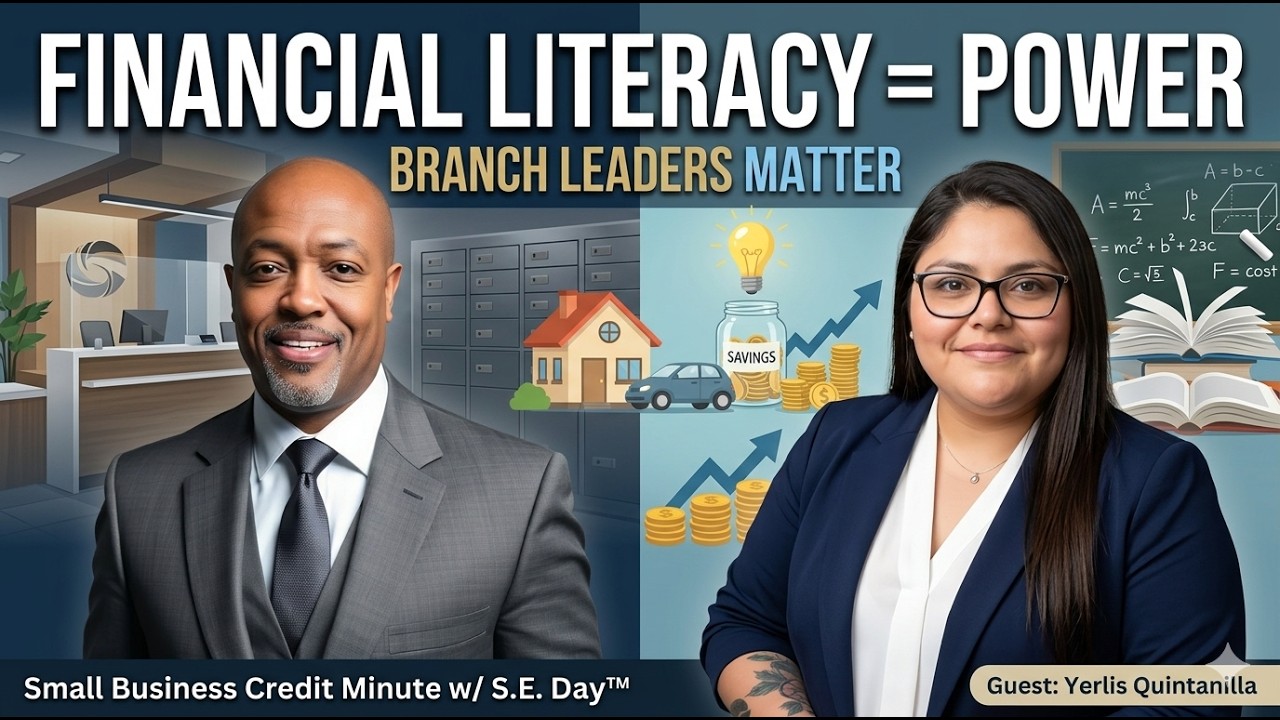
When Members Lack Financial Knowledge, Progress Slows (Why Frontline Leaders Must Teach)
Weak Financial Literacy Slows Business Growth—How Chambers Helps SBOs Make Smarter Money Decisions

Messy Books Kill Profit and Scalability (Fix Your Numbers Before They Cost You)

HR Mistakes Kill Profit and Funding (Use a PEO to Get Compliant and Bankable)
Exit Rich, Not Ripped by Taxes (Use an Employee Stock Ownership Plan to Buy Out Your Shares)

Are Your Communications Costing You Money ~ And Can AI Fix It Without Killing Your Voice?