Exit Rich, Not Ripped by Taxes (Use an Employee Stock Ownership Plan to Buy Out Your Shares)
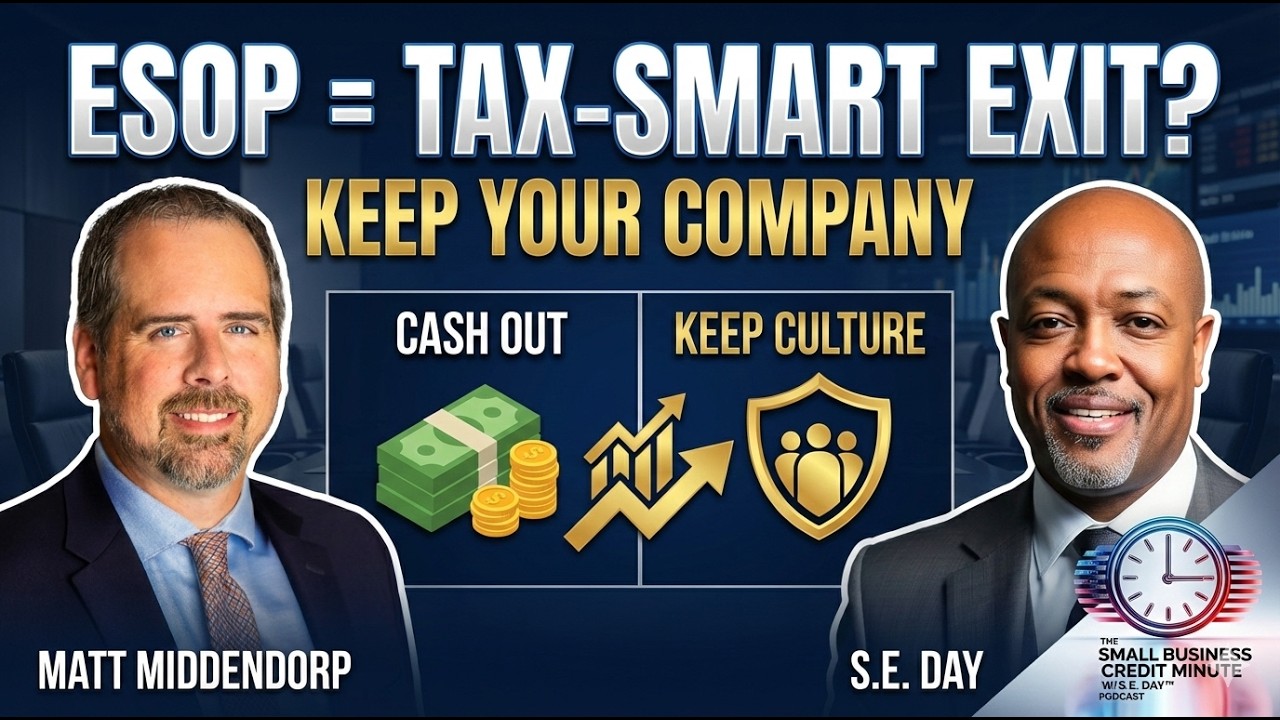
In this episode of the Small Business Credit Minute, host S.E. Day interviews Matt Mittendorf, director of ESOP consulting at Vision Point Capital, to explain how Employee Stock Ownership Plans (ESOPs) can serve as a powerful exit strategy for profitable, owner‑operated businesses. The conversation walks listeners through a plain‑English definition of an ESOP—as a business transition tool, a qualified retirement plan, and an employee‑ownership vehicle—followed by the characteristics of companies that make good ESOP candidates (15‑20+ employees, U.S.‑based, profitable, culture‑focused). Matt details the mechanics of an ESOP transaction, emphasizing that the seller sells the company to a trust overseen by a trustee while retaining day‑to‑day control, and outlines financing options (seller‑financed, bank‑financed). The bulk of the discussion focuses on owner liquidity and tax advantages: ESOP sales are treated as stock sales, qualifying for long‑term capital gains, with possibilities to defer taxes and, for S‑corp owners, eliminate federal and most state taxes on earnings. Design levers such as payout timing, interest rates, and acquisition mode are presented as ways to tailor cash‑flow outcomes. The episode also highlights employee‑level benefits—enhanced retention, a 4‑5% productivity boost, and substantial retirement wealth—while stressing the need for clear communication, annual share‑value statements, and ongoing cultural reinforcement (training, communication committees). Matt shares cautionary anecdotes about private‑equity exits that erode culture, contrasting them with ESOPs that preserve legacy and control. Common misconceptions (high cost, complexity) are debunked, and the practical next steps are outlined: a feasibility study, valuation, “what‑if” scenario modeling, and an online self‑assessment at esopready.com. The episode closes with a call to action for owners to evaluate cash‑flow consistency and leadership bench strength before exploring an ESOP.
Chapters
What if you could create real personal liquidity without selling your company to a competitor and potentially cut your tax bill dramatically and lock in a retention engine your competitors can't easily copy? Today we're breaking down ESOPs, employee stock ownership plans, with Matt Mittendorf of VisionPoint Capital. This episode is for the owner who's thinking about an exit strategy in the next 1 to 10 years, especially if you're profitable, Have a strong management team, and you care about keeping your culture intact, then this episode is for you. By the end of this conversation, you'll understand how an ESOP can create meaningful owner liquidity while potentially reducing taxes, why employee ownership can drive retention and productivity with the right incentives, and how ESOPs can preserve legacy and keep the company independent For continuity. Welcome to the Small Business Credit Minute with S.E. Day, the podcast helping business owners build stronger business credit and real profit growth without the confusing finance speak. Qualify first, apply second. Let's get you funded. Stay tuned. I'll be right back. In today's competitive world, your business deserves more than just hard work. It deserves the financial freedom to grow. Building business credit is the key to unlocking opportunities. With strong business credit, You can expand faster, invest smarter, and reduce your personal risk. Start building your business credit today because your dreams deserve the chance to grow just like your business. Secure your spot at the next Small Business Credit Survival Bootcamp.
Welcome back. So the question today is, what if you could create real personal liquidity without selling your company to a competitor? And potentially cut your tax bill dramatically and lock in a retention engine your competitors can't easily copy. Today, we're breaking down ESOPs, employee stock ownership plans, with Matt Mittendorf of Vision Point Capital. Matt, welcome to the Small Business Credit Minute.
Mr. Day, retention engine. Are you kidding me? I am writing that down. That is amazing. That is perfect. I mean, Honestly, I don't care if anybody learns anything from this. I think at this point, I've taken enough away that this is the best time I'm gonna spend in my day today. Retention.
Perfection.
That's fantastic.
Matt, tell us a little bit about yourself and Vision Point Capital.
Sure, not a problem. So my name is Matt Midnorp. I'm the director of ESOP consulting here at Vision Point Capital. I'll make a very long story short, right? So Vision Point is a valuation firm. We are involved in roughly 1 out of every 10 ESOP transactions in the country every year. We do business valuations. We do ESOP valuations for trustees. We do litigation valuations. We have a specialist who loves going to court and testifying. And my job is I help business owners transition their businesses to an ESOP.
Got it.
And we'll talk more about that. That's the whole point of this, right? So, but I'm a former business owner myself. I get it. I get what being an entrepreneur is all about. I get how that idea consumes somebody.
Yeah, I love it.
So, this is working with business owners, helping them figure out what's next for their business. Is my passion. It's what I do every day. And apparently, I drive retention engines.
Retention engines. Love it. So, Matt, we've been throwing around this acronym of ESOP, you know, Employee Stock Ownership Plan. In plain English, what is an ESOP?
Sure. So, an Employee Stock Ownership Plan in very plain English is 3 things. Number one, it is a business transition tool. Right now, helping business owners transition out of their business isn't necessarily part of it, but it can be, right? It's not the only thing. It is a qualified retirement plan. And we're going to dig into what that means for a business from a tax standpoint. Right. And it's also an employee ownership vehicle. So how do you get employees more invested in the success of the business? All of this, by the way, without having to give up control, without having to give up your identity as a business owner. And leaving your legacy intact.
So it's not to give it away. Is a structured transaction where the company funds the buyout?
Yeah. So basically what happens is an ESOP trust is created. That trust is overseen by a trustee. And I want to be really clear to everybody on here, that trustee is not involved in the day-to-day operations of your company. That trustee oversees the trust. They're the person who is buying the company from you.
Okay.
Right? Now, here's what's really cool about that though, right? Or a better way to say it is you're selling the company to the trust.
Got it.
But in that process, the people who oversee the company now continue to run the company. So if you're in control today, you stay in control. If you want to make sure you're getting top dollar for your company, right? You don't have to sell out to private equity. You can do the ESOP. But yeah, so again, we're going to talk about all this stuff But I think the big thing to take away from this is, yes, absolutely, the seller is selling the company to a trust, and there are different mechanisms for that to happen.
Okay.
But we'll talk about this. We'll talk about the details of that. But that in the short short is what's happening.
So excuse me on that.
Yeah.
What kind of company is actually a good ESOP candidate?
Sure.
You know, there are all types of businesses out there, small businesses, But what type would be a good candidate for an ESOP?
Absolutely. So, through this process, minimum of 15 to 20 employees, right? So, not a huge company by any stretch of the imagination. You have to be a U.S.-based company. Sorry if you incorporated in the Virgin Islands or something like that, people. I'm sorry. You can't do it. You got to be a U.S.-based company. It's a U.S. law. You need to be profitable. You got to be a company that's sellable, right? So, I know you work really hard on making sure companies are bankable. Right, that they can borrow. And honestly, it's kind of the same thing with ESOP, right? You're building a company that other people want. They want to be a part of, right? So, and that's the same thing, right? You need to be profitable. You need to have company culture that aligns with— some people who own companies get in their car every day and they get in their 4th Corvette and they drive home and they don't care what happens at work, right? That's usually not somebody who owns an ESOP.
Okay.
They are people who typically have their names on the local high school football scoreboard or in the gym. They're heavily involved in their communities. They recognize that their legacy is bigger than just the trust fund they leave their kids.
Okay. Now, you said something and I just want to clear it up. It must be a U.S.-based company.
Yes, sir.
Right now, You know that in some places you can go from state to state and you can have what is called a foreign corporation from one state to another because you don't want to start all over in a new state. Will a company like that qualify?
Well, as long as they're in a United States state, absolutely. That's not a problem. Yeah. I mean, honestly, we have businesses that work all over the country. That's just part of the deal, right? Most businesses aren't just local. They serve a broader audience and that's a broader client base. And you shouldn't be expected to be only working in Wisconsin or only working in Texas or California. Heck no, that's not fair.
Fair enough. I just wanted to be clear for the audience that even if your company is a foreign corporation in the US operating in the US, not a virgin, not an outside OCONUS, if we will, your company can qualify for an ESOP. So, with now knowing the companies that should, who should not do an ESOP?
Well, so, let's just talk about that. I think that's a fair statement, right? If you're an owner and you're looking to sell your business and you just want to do this when you're done and walk away, yeah, ESOP can facilitate that, but it doesn't do it well, right? Almost every ESOP transaction, the seller gets paid out over time. There is a portion of that that is seller-financed, even if it's for a short period. Right? So, if you just want to be done, gosh, this probably isn't the right fit, right? It's not a fit for people who don't build culture. It's not a fit for people who don't want to engage employees on a day-to-day basis. If you're in an ivory tower, sorry, ESOP's not the place to go, right?
Got it.
Now, strategically, it could make sense. But most people, when they look at it, go, no, I don't. It's not. That's not what I'm about. I'm looking for something different.
Okay.
If you want to stay invested in your company, right? If you want to stay and make sure if your identity is tied to your company as a business owner, then ESOP makes a lot of sense. But again, that's not everybody, right? It's about that staying in control. If you're ready to give up control, if you're ready to give up your identity, if you don't care about your legacy, then yeah, absolutely. ESOP doesn't make any sense at all.
Okay. Okay. Now let's dig into some owner liquidity and tax reduction. All right. Let's talk about what owners care about most— liquidity, right? I want to make sure that I can touch my money when I can, when I want to touch my money and can move when I want to move. How does an ESOP put real money in the owner's pocket?
Sure. Absolutely. Let me tell you a story. I think this is a great example. I have a client that owns a pool company. They have retail locations as well as pool construction. The owners of this company, there's 4 owners. The owners, the original owners are in their 40s. And by the way, for the audience, it is a husband and wife, the wife's twin sister and her ex-husband. And then on it. So fantastic people. But that dynamic sounds scary. They were amazing. They were amazing.
I was ready to go, man. I was ready to leave already. I know, right?
Yeah, just build it up and then let everybody down in your audience. I'm sorry. So, so here's what's going on, right? They're in their early 40s. They're not going anywhere. They're going to stay in their company for the next 10 to 15 years. But they recognized they had built something valuable and they wanted, like you said, to pull some liquidity out of it.
Mm-hmm.
So what did they do? They had other things they wanted to do. They were investing in other properties. They were doing other things with money. And they wanted to do that on a bigger scale. They wanted to diversify their income from their business. So, they sold 100% of their company. You don't have to sell 100%, but they sold 100% of their company to an ESOP.
Mm-hmm.
Pulled the money out, a portion from the bank, and the rest of it, they're going to get paid out over time while they're earning interest for doing so, by the way. And they're making those other investments. So, again, you— and by the way, guys, like I said, they're still working there. One other really cool part about this is the way they structured it. They're going to continue to earn shares inside So now that's interesting.
That's a very good point. Meaning you can, you can diversify personally while keeping the company intact. I want to go out and do other things. I want to— I still love my company. I love what I do. But here's a real estate investment piece that I want to tap into or a fintech I want to tap into. I don't have to sell my company, dissolve my company. It can still stay intact and I can pull money out of it. Now, you know, that's getting ready to talk about some tax implications there. So, owners hear tax advantages and assume hype. Where can tax efficiencies show up in an ESOP transaction or in a company like this with an ESOP?
Sure. So, we're going to attack this from 2 angles. Let's attack it from the seller standpoint. Okay. What happens when you sell to private equity most of the time or a third party? You get a check. Not as big a check as it used to be, right? But you get a check up front. You're going to pay ordinary income most of the time on that check. So you're going to get taxed to oblivion. And that's already, by the way, after they made an offer that was here and then went through due diligence and hit you with a baseball bat wrapped in barbed wire and got it down to here and then gave you a bunch of earnouts that you're never going to make. So you're actually only going to get this and then they take taxes out, right? So the promise in that first phone call of big X, Never, ever comes to fruition for 99% of the people that go PE. But it sounds really cool. So let's contrast that from a seller standpoint with an ESOP transaction.
Mm-hmm.
First of all, it's a stock sale. So you're getting taxed at long-term capital gains, which means you have a basis that's very different. Right. And so, so automatically your return is better as a seller just because of that. Oh, yeah. And by the way, you don't have to sacrifice price in an ESOP, you can make just as much, if not more, than selling to private equity or a strategic buyer. The other part of that too, though, is there are strategies, which is a whole nother podcast episode, where you can actually defer taxes if you don't need the money, right? So you're not— you get the money, you defer the taxes until you start drawing on it. And for some people, they don't need it at all and it goes to their heirs and they never pay taxes on it, right?
Yeah.
So there are a bunch of different ways to manage that tax benefit from a seller standpoint.
All right, everybody listen. This is a strategy-level education session, okay? Uh, Matt is not giving you tax advice. I am not giving you tax advice. Refer to your CPA or an ESOP counsel for specifics. You can call Matt offline and Matt can give you all of this information, but on this show, this is education, education only. Okay, now—
You actually stole my next line. You actually stole my next line, so that's perfect. Former banker here, right? So as much as I hate to say it, I know better. Okay.
Clients in tax and tax law, so he's not going to put you in. You can call Matt.
Okay.
So Matt, what's the biggest misconception about ESOPs in taxes?
So let's talk about the company impact because here's the big thing that a lot of CPAs don't know, right? When I talk to CPAs, they're like, Oh, it's expensive. It's, it's too complicated. Well, no, it's none of those things. It actually costs less to sell to an ESOP if you find the right person to do it for you than it does to sell your business through a business broker. Right. They're taking 5%, 6%, 8% of your transaction.
Right.
If an ESOP person tries to charge you a success fee, turn around and walk away because you've got a business broker who's pretending to do ESOP. ESOP people charge a flat fee.
Got it.
And it is a fraction of what you pay to go through that. So it's not expensive. It's not expensive to maintain. And the crazy part is, is the CPAs don't know about the tax benefits of ESOP. All they know is the stuff that their M&A brokers tell them before they buy them a nice dinner. Right?
Right.
So here's what's cool about ESOP. And actually, we should probably warn people if they're driving right now, you might want to pull over.
We'll have them in the show notes.
I promise you that.
Yeah.
If you're in an airport or someplace where You're not allowed to just pass out and faint from something that you're hearing. Just be in a safe place, okay, for this, because here is one of the secret sauces of ESOP. Here's what's kind of cool about it. If you're an— let's just take that pool company, for example. They're an S corp.
Right.
Okay? Because they're an S corp and they sold 100% of their company to an ESOP trust, they no longer pay state or federal taxes.
What? Whoa, whoa, whoa, whoa, whoa.
Okay, I know, right?
I see what you mean, folks. Pull over. I mean, this is one of those things I have to replay on this, 'Cause that is powerful information.
So the K-1 that goes to the shareholders now—
Right.
Will then go to the ESOP who does not have to pay.
Ah, 'cause it's the trust. Got it.
Qualified retirement plan under the—
Got it.
It's a law established in 1974. It's the same law that governs your 401, right?
Yeah.
So now that is proportional. So if you're 100% employee-owned, boom, done. In 46 out of 50 states, you don't pay the state either, right?
Got it.
But if you sell 30% of company, you get 30% of the benefit. If you sell 40%, you get 40% of the benefit. So that benefit is proportional based on how much you sell. Obviously, 100% is the most tax efficient, but it's got to meet your goals, right? You got to figure out what you're trying to accomplish. And that's part of my job.
So, Matt, that rolls me right into the next question. If an owner's goal is substantial liquidity, what levers matter most in the ESOP design?
What levers matter most? That is a beautiful question. Okay, so let's take this apart in a couple of pieces.
Okay.
If that's all right. So, from a lever standpoint, the questions I guess I want to ask, what do I want to know is, when do you want your money? Right? Do you want most of it upfront? A chunk of it upfront? Do you like the idea of earning 7%, 8% interest and getting paid out over time? And by time, by the way, I mean 5, 7, depending on the company cash flow, 10 years, right? So, what is really important to you personally? What do you consider a win personally as a shareholder selling? I want to know that. And I want to make sure that I'm structuring it through those levers.
Mm-hmm.
What do you want your company to look like after? So, when I'm pulling the levers on that, I'm asking questions about Are you in acquisition mode? Because, by the way, ESOP is the only qualified retirement plan that can borrow money to make acquisitions. Right. That's kind of cool.
Yeah.
Are you in acquisition mode? Are you— you know, if you're not paying taxes anymore, what are you going to do with that money? Do you want to buy? If that's the case, I want to structure cash flow after the ESOP sale. I want to look at your projections and figure out how do we structure it so that makes sense. Are you looking for organic growth? Like, so, so where do you want that tax savings to go once the seller is paid off? Right. And again, from an employee standpoint, for the first time, you're aligning the financial goals of the employees with the financial goals of the company. So I want to make sure that we're establishing a benefit that keeps them engaged, that allows you to hire and retain better talent, but doesn't build a benefit so fast that the company can't afford to pay it if somebody leaves.
Got it.
Right.
And that's going to go right into that whole next segment of because it's called an employee ownership stock ownership plan, program, plan. What's the incentive for the employee? Why do employees' ownership actually improve retention for the employees when it works?
So, if you're an employee and you work somewhere, And you know that the things you do on a day-to-day basis that make the company successful. First of all, a lot of companies don't even define what that is for their employees, right? No, they don't. How do you impact the bottom line as an employee of a company? So suddenly you need to do that, right? If you want, one of the really cool parts about ESOP is if you're a company that right now doesn't communicate that to your employees, you need to start doing it even if you're not going ESOP. How does the typical— how does that employee in that role establish day-to-day success of the company? Is it about waste, shrink, loss, sales, revenue? Like, where does that happen? So, you need to be clear about that. And that can have a massive impact. And when you do that, employees feel like they're part of something. And feeling like you're part of something is a major driver for keeping people in a role.
And you know, Matt, a lot of business owners, Especially small business owners. I'm not talking about those massive corporations that where everybody's just a number.
Yep.
But when you have somebody that starts something from the ground up and they've had employees on with them, uh, for 10, 20, 30 years, you know, from the point of inception, those people actually care about their employees.
Yes.
They know that when they sit and retire, they finally give it up. They want to make sure their employees are taken care of as well. And, you know, a question is what drives productivity? You know, is it ownership alone or the way the company runs the ESOP? You know?
So, it's amazing, right? So, after an ESOP is established, studies have shown that there's a 4% to 5% increase in productivity in that first year after. And I think a lot of that comes from the motivation we just talked about. Heck, when I was in banking, I worked for big corporate banks. I was incredibly successful there. But man, did I enjoy my time in community banking a lot more, right? Because I got to see the things I did in the community every day. So when I, when I closed a deal that built a building, I got to go walk into that building and see it with the owners, not because I had to go find the next deal, but because I was invested in what happened there.
Totally.
And if you're working in an ESOP and you're being recruited to come in, or if you're already an employee, employee, you see that involvement and it makes, it psychologically makes a difference. But there is a financial side to this too, right? So, I'll talk about this company more in a minute, but I just completed a feasibility study for a company that's in the process of becoming an ESOP now because of the outcome.
Okay.
And part of that study and the projections that we created was what does an employee balance look like in 10 years, 15 years? And the owner The seller was more excited about the fact that the average employee inside of his company in 10 years was going to have $900,000 in their retirement account.
Wow.
Than he was about the $20 million he was making. Right. So, here's what's amazing about that is there is a massive retirement gap in this country. 80% of the people in the United States don't have enough money to retire.
Right.
If you as a business owner can make sure that your employees are part of that 20% that do, you're changing lives. You're creating wealth, not just giving them a job.
So, how do you communicate the benefits of an ESOP without confusing the employees? How do you communicate that to them?
Well, we've already talked about a lot of it, right? It's, they don't need to know, what about compliance?
Right.
They, for the most part, don't need to know that the executive who's making $500,000 doesn't get as many shares as the— I'm like, back up— is capped or limited on the number of shares they get compared to a part-time employee, right? They don't need to know that. What they need to know is the company has a value. That value is going to be calculated every year. And every year they're going to get a statement that shows the value of the shares they own. And I want to be clear, when I say own, these are beneficiary ownership shares. They don't directly own anything. It's a beneficiary ownership. They don't get voting rights or anything like that. So you get this value that's determined year to year. You're getting a statement showing how much your shares are worth and you're getting shares every year. So you're seeing that balance go up and you know how you directly are impacting that.
Right. Okay. Very good.
That's what they need to know. They need to know this is how I help my company be more successful. And this is how it comes back to my bottom line.
Okay.
Now, training management's a little bit different than an everyday employee, right? The management wants to know the ins and outs of it. And that's fine. But that is done continuously. And in a good ESOP culture, I worked for a company that created ESOPs that wasn't ESOP. And we were a team of experts and we still, we still had regular training on our ESOP, what it is, how it worked and what happened, because we didn't take any of it for granted. If you're in a company, you're going to need to continue to build a culture around that. And a lot of successful ESOP companies actually build a communications committee just to do that of internal people, the rank and file that are passionate about it enough to influence the others in their organization.
So, you just addressed my next question of what are some of the common retention mistakes owners make after launching an ESOP. You got to be able to communicate this to your staff.
Yep. You can't just assume that because you are one and they get a statement once a year that they're going to be staying excited about it.
Exactly, exactly. Okay, very good. Very good.
Good ownership cultures take work.
Good ownership cultures take work. And I think that's something that resonates with every business owner, especially one that If you're considering an ESOP, if you're considering an ESOP, some of these things you're already doing. Yeah, you already have a good culture and you care about your staff. So now let's roll into the legacy part.
Okay. Love it.
How can an ESOP preserve culture better than, say, an outside sale of the company?
Mind if I tell you a story?
Tell me a story.
Okay. I mentioned this company just a minute ago, right? So, I have a manufacturer in the construction industry, actually right here close to me, who sold his company to private equity 7 years ago. Got one of those calls out of the blue and went through the negotiations. He didn't feel good about it when he was done. By the time they got done beating him over the head, but he sold the company to them. He was ready to transition, right? Fast forward 2 years. He had never lost a foreman in the entire 25-year existence of his company. 2 years after he sold to PE, none of those foremen were left.
Yep.
They had lost almost all of their major customers. The company was dead.
Yeah.
So guess what he did? He bought it back for pennies on the dollar.
Yeah.
Basically, for the price of accounts receivable. Yeah.
Smart.
He built it back up. He got all of those foremen back. He got all of the clients back. He got all of his key employees back.
Yeah.
5 years later, it's even bigger than it was before. He's still doing this. Right now, he's going through that process.
And that's what I was getting ready to say. I bet you this owner didn't know about ESOPs.
Nope.
He heard private equity. He heard money coming in. He cared about his company. But I want to transition out. And it can hurt later on. It was good that he was in a place that he could come back in and buy the company and build it back better than it was before. So, with that being said, what does business continuity look like in an ESOP transition?
So, here's the beauty of it. He works there every day. His other 50% owner works there every day. His 50% owner is my age. His 50% owner is not going anywhere. He's looking to step out. He's looking to transition out. So, in the next 3 years, he'll be staying at his place in Florida all winter, right? So, from a continuity standpoint, the people that run the company in the day-to-day going into the transaction are the same people that run the company after the transaction.
Got it.
So, when we talk about control and identity as a business owner, That's exactly what I'm talking about. The control of the company stays with the people who run it. Yes, there's a trustee, but the trustee doesn't know how to run a manufacturing construction business or a pool construction business or an engineering firm or any of those things.
Right.
They trust the people to run it.
So, Matt, with that, let's wrap it up. If an owner wants to keep the name or keep his name on the door, What's the ESOP path that protects that brand for the owner?
You've asked some really good questions, and I'm going to answer this by saying it depends on the owner and it depends on what they're trying to accomplish. My job— so the really cool part about ESOP is the process to become an ESOP is you don't have to call me and say, Matt, educate me and then just become an ESOP. There's some steps in between. And the first step is something called a feasibility study. So we have conversations, we get to know each other, I understand your goals for your For yourself, for your company, for your employees. And then the first place where you would really have to stick any financial obligation into it is a stepping stone called a study where we create a valuation. We take that valuation and we take your company's financials and we say, okay, if you're an ESOP, this is the impact on you as a seller, meaning how much money are you going to make? What's your return? What's the impact on the company? Meaning how do those tax benefits really look? And cash flow because of it and the impact on the employees. Now, from there, we say, what if? What if we did bank financing instead of seller financing? What if we only sold 30 instead of 100? What if we, what if, what if? Those what-ifs are all included, by the way. It's not extra. Because the goal is when you're done to have a decision-making tool to say, yep, ESOP is the path I want to go, or nope, I think that PE offer actually makes more sense.
Got it. Got it. So audience, if you're thinking this might be the best exit that protects your people and your profit, then go back and re-listen to this again. Listen to the part of liquidity and the incentive sections and write down 2 things: your cash flow consistency and your leadership bench strength. That's where the ESOP conversation begins. Matt, What's the first step you suggest owners take this week if, if to see if an ESOP is even worth exploring for them?
That's an easy one, actually. I have a website that is designed and created just for that reason. It's called esopready.com.
Okay.
esopready.com. You can go there, you can educate yourself, you can actually take an assessment. That allows you to look at your company the way it is today. And it actually gives you a score that says, yes, you can, this is fantastic. Or yes, you can continue this conversation, but there's some things that need to be addressed. Or nope, this just doesn't match what you're trying to do.
Right.
And then from there, schedule some free time with me. Let's talk through your situation specifically. My job is to do 2 things basically for my clients, educate And manage expectations, meaning I'm not gonna make you promises that I can't keep.
I love it.
I love it.
That's what I do. Matt, let's close this the right way. People, if you want a simple roadmap to start building your business credit the right way, go to our website. It'll be in the show notes. Grab your Business Credit Starter Kit. Uh, it's the— it'll walk you through the first steps of getting your business lender ready starting today. And remember, your business credit is a Your credit score isn't just a score, it's your company's future. Always qualify first, apply second. Thank you for tuning in to the Small Business Credit Minute, and I hope you enjoyed today's episode on ESOPs and how they can benefit you as an owner and your employees. If you got value from this Credit Minute, please download this podcast, share it with a fellow business owner, and leave a review so folks can hear of good topics that Matt brings to the table and can help them grow smarter and exit smarter. Until the next episode, your dreams deserve a chance to grow just like your business. Thank you again, Matt, for coming on.
Oh, thank you so much. I appreciate it. This is a fantastic conversation.
Well done. Absolutely love it. And we'll do it again.
Yeah.
More from S.E.

Compliance Gaps Kill Funding--How tot Fix the Legal Signals Lenders Notice Before You Apply
When History Gets Reduced to a Holiday, We Lose the Lesson - How Juneteenth Turns Fun into Education


When Members Lack Financial Knowledge, Progress Slows (Why Frontline Leaders Must Teach)
Weak Financial Literacy Slows Business Growth—How Chambers Helps SBOs Make Smarter Money Decisions

Messy Books Kill Profit and Scalability (Fix Your Numbers Before They Cost You)

HR Mistakes Kill Profit and Funding (Use a PEO to Get Compliant and Bankable)

Are Your Communications Costing You Money ~ And Can AI Fix It Without Killing Your Voice?