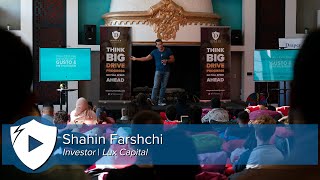
Shahin Farshchi discusses how founders should balance chasing large markets with initially focusing on a narrow, defensible niche that can expand. He uses multiple case studies — Subspace (building low-latency routing to kickstart esports adoption in specific geographies), Zillow (using the Zestimate to drive consumer traffic and seed a two-sided marketplace), and Facebook (launching within Ivy League colleges) — to show that successful startups pair product innovation with creative distribution strategies to 'kickstart' growth and then expand into broader markets.
Chapters
Founders have this constant struggle or conflict where they are being told by investors, by their own egos to go after huge market opportunities, but at the same time the conventional wisdom is to go after a niche market where they are advantaged. How are you going to find that niche that will expand? So I can give you a couple of examples of companies that we funded and experiences that we've had. So a couple years ago I got to know a very talented founder who was in the process of selling his company with his co founder. He was a serial entrepreneur and he started multiple companies in the telecom ISP business and he was selling his most recent company for a modest amount of money. So he was able to be comfortable at the end. But he had much larger aspirations and him and his co founder had worked together before. It was clear that they are able to build great teams, ship products, but they hadn't proven that they could really build a big company. They were able to build and sell a company for a modest amount of money, but not a multi billion dollar business. And so I met them when they were in the process of selling their company and they shared this vision that back in the early days of the Internet, the Internet was used for moving documents around. So a technical paper or a report or some kind of again text document. And it wasn't until the late 90s when a company called Akamai came around and developed a technology called Content Delivery Networks which allowed the network to be used to stream video. And then if you fast forward a few years later, Amazon came around and built tools like EC2 and the storage products that enabled companies to store large amounts of data online. And that gave rise to companies like Dropbox and Box. And later there was compute resources available from the likes of Microsoft through Azure and AWS and Google Cloud that enabled a whole slew of software as a service companies to become possible that weren't possible before. His hypothesis was that the next key enabler for the Internet is low latency real time communications. So the ability to hit a button here in California and cause something to take place in New Zealand or in Chile, and that exists today, but through very expensive build outs that are normally done on behalf of very large companies. I want to have a very, very quick link between one known geography and another, but it doesn't exist to be able to connect two arbitrary points anywhere on the surface of the globe. And so areas that would benefit from this are an area that's emerging called esports. So if you're playing Fortnite here in California, you want to be able to engage with a player that's in Southeast Asia. And so he built a technology using AI and ML that would intelligently route traffic over the Internet. And he launched this product. Well, first he built a company and I was fortunate enough to be his partner. And we were able to fund this company when it was being created at the inception stage. And, and over the past couple months they were able to launch their product and basically put Fortnite allow Middle east players basically to play Fortnite and be connected with the broader global community with very, very low latency. And that was actually they enabled one of the first teams in India to qualify for the semifinals as a result of having that region connected with very low latency and very high speed with the rest of the planet. So that's an example of a founder or founding team with a vision, with aspirations that are able to quickly execute and hope to dominate what's expected to be a very, very large market. Founders have this constant struggle or conflict where they are being told by investors, by their own egos to go after huge market opportunities, but at the same time the conventional wisdom is to go after a niche market where they are advantaged. And that is the multi billion dollar question. And companies that have succeeded are ones that have been able to do this right? Now, either they were lucky and in the right place at the right time, or they did it properly, by design. And so if you look at Facebook, sure, Facebook was aiming to become the dominant social network, but they focused initially on Ivy League colleges. Now was it obvious that by focusing on Ivy League colleges and only being like invite only or having. So first it was, I guess, invite only and then it was you have to have an Edu A Edu address. At some point they hit critical mass and it was a free for all. But you need to create a Kickstart. And different companies have different ways to do this based on their product and based on the market they're going after. And that requires a ton of creativity. And that's what in my opinion, makes or breaks most companies. I was talking to the founder of Zillow. So Zillow is a real estate site and at that time there was another company called realtor.com back in 2006 where people could look for houses or homes or apartments that were being listed for sale or for rent. And the innovation that they did was come up with the Zestimate. So how many of you guys know what the Zestimate is? So the Z estimate or Zestimate, however they. Okay, so A few of you heard of it. So a Zestimate is a product that Zillow offers that uses algorithms to determine the price of your home. So to get people to visit Zillow and try it out, homeowners or people who were interested in maybe buying a home or people who were just curious to know what their buddy's home was worth or what the neighbor's home was worth, will go on to Zillow and zestimate the homes around them. So that was how he kick started traffic onto this website to create a two sided marketplace of customers visiting and people willing to list their properties. Mark Zuckerberg kick started by focusing on a very, very target market, targeted market, and then being able to expand from there. So I think the answer is yes, you need to focus your limited resources on a niche ish opportunity, on a narrow opportunity, knowing that if you execute on this narrow opportunity then you're going to be able to kick start your business. In the case of the example that I just gave you, our company, Subspace, the low latency communications company, didn't seek out to build out a low latency network around the planet which would have cost many tens of millions of dollars and then flip a switch and then, okay, you know, who wants to come, you know, put their product on our network. They went after a specific market, which is esports. They went after a specific customer, you know, Epic, and they asked them which geography is a geography that matters to you. And that was the Middle East. And the expectation is that there's going to be a network effect that's created by players that want to play the game and then esports publishers that want these people on their platform therefore go to this company to expand the new geography. So a lot of the innovation doesn't just go into your product, it goes into your distribution. And how you're able to kick start your business is one of the key innovations that you bring to bear. And there is no rule. All you have to know is that I have to do something very creative to get this thing off the ground. And you can look at all the successful companies. For example, in the case of Google, they had a very, very clean homepage and that's what got people. A lot of them were academics like myself who wanted a very, very clean destination or landing page to be able to put in their search and get the results. Or maybe it was the I'm feeling lucky button. That was something that sparked curiosity in a lot of people and made them go visit it. So, you know, I don't have an answer for you. If I had an answer for every business out there, then I probably wouldn't have been standing here. I would have been building many multi billion dollar companies myself. But what we look for from investors is creativity from the founding teams. Part of the is how are you going to find that niche that will expand? Not a niche that's going to stay a niche, but a niche that's able to expand into a broader large market. And that will help you maintain a competitive advantage, whether it's switchover costs for other customers to get in there, or habit. You know, like everybody's used to going to one place, creating some kind of unfair competitive advantage and staying power as you expand. Sam.