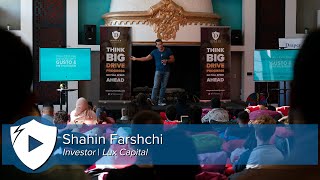
Shahin Farshchi explains that merely inventing a working technology is not sufficient for market success; companies must integrate technology into products, prove unit economics, build distribution, and demonstrate addressable market potential. He uses Mobileye as a case where technology became valuable only after productization and distribution, and reflects on his own transition from academia to venture capital — noting a shift in bargaining power toward founders and the need for investors to continuously reinvent themselves and offer operational, network, and experiential value beyond capital.
Chapters
Building a technology alone, even if it's magical, is not valued ultimately by the public markets or by acquirers. And the reason for that is because technology has gotten so complex, integrating that technology into a workflow to generate some kind of value out of it is as complicated and requires as much work as inventing the technology in the first place. What are the experience, experiences or changes that I went through as a professional and as a human being, going from an academic setting to a investment business setting? And it required. So the answer may be different for anybody you ask, but for me, it was multiple reinventions over multiple phases over the past 12 years. And I find myself continuously reinventing myself as we go along. So I entered venture at the tail end of an era when companies were valued for their technology. So I entered this business with the expectation that if I find a great technical founding team who have invented something amazing, then by default, these companies will be valuable. And what I witnessed over the course of the first four or five years as an investor was that building a technology alone, even if it's magical, is not valued ultimately by the public markets or by acquirers. And the reason for that is because technology has gotten so complex that integrating that technology into a workflow to generate some kind of value out of it is as complicated and requires as much work as inventing the technology in the first place. So if I invent a widget, let's say I'm a components company and you're Apple, I invent this widget. The amount of work that Apple has to put into taking this widget and putting it into a laptop, so that that feature that the laptop is enabling will get customers to buy more MacBooks is a lot more than, or on the order, at least of the effort that goes into building that technology in itself. So for you as an entrepreneur who's building a technology, not only do you have to build that technology, but it is on you to show the benefit of that technology, to take it all the way to some kind of product that shows economic benefits or shows value for it to become interesting for either an acquirer or for going public. So in the case of mobileye, mobileye made chips and made software for backup cameras on vehicles. So it's an Israeli company, they started in the 90s, and it took them over 10 years to build these products, ship these products into vehicles, show the broader public that, hey, we can make money selling these things, and then autonomous cars becoming a thing, so that intel then bought them for many billions of dollars. So they, at no point in time, were interested in just selling for their technology, and they were able to capture maximum value after they started selling their product, showing great unit economics on their products, building a distribution channel for their products, and ultimately getting acquired not just for some technology, but having distribution and showing great unit economics and having the potential to address this great future market, which is autonomous vehicles. So for you as frontier tech and entrepreneurs, you have to think all the way, not just to the point of showing that your technology works. And so that for me, was a big awakening. And so I had to not just think about, okay, can I get this to work? But. But all these other things. Product, great unit economics, building distribution, establishing competitive advantage. I had to start thinking about all those things. So I had to train myself and learn from people, especially my founders, as to how I can end up, how I can do that and be good at that as a coach and as an investor. And then more recently, I came to the realization that I. And again, like, when you're an academic, there are a small number of spots available for a lot of talent. So if you look at the best universities, the best universities, the best labs, have four or five spots open, and you, as an academic or an applicant, really need to show your talents to get into one of those spots. And when I started doing venture, venture capital as a business was one where there was far less capital than there was talent. And so VCs kind of thought of themselves as king makers. So, you know, all of you guys in this room had great ideas, and all of you guys had to somehow find your way into my office. And if I bestowed, you know, my, you know, term sheet upon you, then you had a chance of being successful. Over the past 10 years, that has completely flipped around. So now there's far more capital in the system than there are great founders. And so the same dollars are going after the same people. So now the founders have the upper hand and they have their choice of which investor that they want to partner with. So the question isn't, okay, you know, should I back this great founder or grant that great founder? For me, the question is, how can I convince that great founder to choose me as opposed to that other investor who's offering them similar, if not better terms. So what I have to do is show that I have a great group of founders that are working closely with me, that can be mentors or peers, that this founder wants to be part of that an ecosystem, this partner wants to be a founder of that I will work very hard and my partnership will work very hard. As a team for this founder to see to it that they succeed, that we have experiences that we can bring to bear. Having seen good times, having seen bad times, having seen multiple types of conversations, whether it's acquisition conversations, whether it's partnership agreements, whether it's trying to hire a superstar executive as a CEO from a big public company or a board member, all of these things that the company may go through trying to make the point that, hey, we can be your partner, the best partner for you over the long term. This is a dynamic that didn't quite exist or a mentality that I didn't quite have to your question as an academic before I got into venture. And these are constant reinventions that I find myself being subject to over the course of my career. And you will constantly have to change. This is a business of constant change. And. And so one year there's one set of challenges, the next year there's a new set of challenges, and you have to reinvent yourself to be able to be prepared for those new challenges.