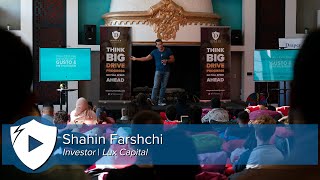
Shahin Farshchi (Lux Capital) explains what attracts him to startup teams and technologies: he prioritizes founding teams that can attract top talent ("gravitational" teams), tell a clear, persuasive story for both engineers and lay audiences, and have domain experience on the demand or supply side identifying unmet customer needs. He prefers concrete problem/market insight plus enabling technology over buzzword-driven ideas; cited areas of interest include mobility, automation, robotics, sensors, semiconductors, and human–machine interfaces (example: Control Labs). He emphasizes founder resilience and the team’s ability to navigate regulatory, competitive, and technical risks.
Chapters
What does it take to be a gravitational force of talent? What do you need? What does that team need to have? Well, a, they need to be able to go up there and not put out a bunch of technobabble and put up equations as to how they have the best technology on earth and be, you know, over self confident about it. But they have to be able to tell a story and not just excite a top engineer, but excite someone who's a layperson. What are we looking at right now that others aren't looking at? And it's sorry to disappoint, but right now pretty much all the crazy stuff, now that frontier tech is a buzzword, is being talked about. So quantum computing and CRISPR and gene editing and autonomous cars and personal airplanes and vertical takeoff and land electric autonomous jets. So everything right now is being pursued and being funded. And so I would say that what excites me isn't quite the buzzwords, so to say, but people who have spent time either on the demand side or on the supply side of a certain industry or pain points that have a unique perspective that hey, like I tried to buy this product and this product doesn't exist because the technology is not good enough or nobody's bothering to build it. And I believe that if this product existed, I could go after these customers because I was one of those customers or somebody who was on the sales side, somebody who was selling something and customers wanted something different, something better, and the technology didn't exist. So somebody having that very, very unique perspective and preferably there being a technology that would enable that is something that excites me a lot more than fitting within the vertical of a buzzword, if that makes sense. In areas that I feel like as if I'm advantaged are mobility broadly. So I've let our investments in autonomous cars and technologies, sensors and semiconductors that would enable autonomous cars. So those are areas that I've done a lot of work in robotics and automation. So there is probably dozens of companies that are making robotic arms that do that, do pick and place, but few of them have really understood pain points. Whether it's in logistics, whether it's in warehousing, whether it's in factories and automation as to what problem specifically needs to be solved. And the question that was asked earlier as to what niche can expand into a broader market, they haven't quite been able to position themselves properly just yet. So the company that has the right technology, knowing where to put it, that can help it then expand into the broader market is something that excites me a lot. But broadly, mobility, automation, human machine interfaces. So we've been typing on these QWERTY keyboards for the past, you know, 80 years, 90 years. How is that going to evolve? That's an area that I find interesting. And we recently invested in Control Labs, which was announced a couple months ago that is being acquired by Facebook. So that would be one example. But other examples as to how we would better interface with machines is another area that I'm passionate about. But again, it really goes back to the problem statement that's articulated by a founding team having very, very clear, having a clear vision as to what the problem is and how to penetrate and then how to expand from other questions. Question here. Okay, so the question is, what are the top three criteria that we use to make investments? One is I look for people that are magnets. Talent, a founding team. It could be one person, it could be two people, three people. A team that can attract amazing people. And the reason for that is because if you can attract amazing people, then you will be able to punch above your weight. And by punching above your weight, it is going to be very easy for you to raise money. If you can show that you can do with five people and $100,000 what a team of 50 people need with a million dollars or $2 million, then it would be extremely straightforward for you to raise money from high quality people. And then again, if you have that ability to attract, then you will use that to attract even more amazing people and that will create this virtuous cycle. So what I'm looking for is the kernel of that virtuous cycle which traditionally has led to amazing companies. So then to your question, what does it take to be a gravitational force of talent? What do you need? What does that team need to have? Well, a, they need to tell a great story. They need to be able to go up there and not put out a bunch of technobabble and put up equations as to how they have the best technology on earth and be, you know, over self confident about it. But they have to be able to tell a story and not just excite a top engineer, but excite someone who's a layperson, who would bring the non engineering skill sets to the table. So tell a story that's going to get everybody excited as to how this is going to be the basis for an amazing product, how this product has a near term application that can grow into something massive and then be able to tell the story to attract again investors and attract customers. Hey, here's why you should take a risk on this. Here's why you should invest in adopting this. Here's why you should be partnering with me. So we should be doing this together. So telling the story and being able to articulate that vision and articulate how this can be a massive company. So massive, I would say gravitational force for talent, being able to tell an amazing, amazing story and then showing confidence that they can build an amazing organization. Does that answer your question? Oh, how much time do you guys have? I don't think I have time in 15 minutes and 27 seconds to go over all the things that there's always far more reasons that's not the right way to look at something. Because if you spend enough time, you will come up with enough reasons not to invest in something. And what I tell my partners is that, listen, if anybody is negative towards this opportunity, then they have luck and probabilities on their side because there's always a greater chance that a company will fail. So if you bring up reasons not to invest in a company and choose not to invest in a company in a startup company, then you're probably right. There is an 80% chance, 90% chance that you're right. And so you can come up with a bunch of reasons why not to do something. Oh, this founder can be hot headed at times and lose their temper. Sometimes this technology requires it may infringe on somebody else's patents and somebody else may end up coming after them or there is a reason why this technology may not work or regulation may not work in their favor. If you look at every single company that's a multi hundred billion dollar company today, they face multiple existential threats over their lifetimes. Whether it was right now, Mark Zuckerberg is facing Congress. There's all kinds of challenges that face companies at every stage. But so long as you believe in the team and you believe in the team's ability to share a vision and you believe in a team's ability to attract amazing people like everybody in this room. And then it makes you feel more comfortable that if the technology doesn't work or if regulation is imposed against it, or if the incumbents try to sue them, or if the market takes a nosedive and there's a depression that this company will end up finding a way to figure it out. Is this going to have to Sam.