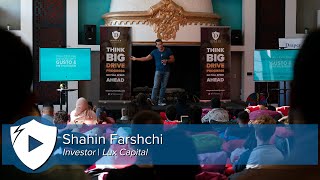
Is your Company Digitally Relevant with Shahin Farshchi, Lux Capital

A recorded interview (dtv / Digital Transformation Channel) in which Layla Medeiros (Infostretch CMO) interviews Shahin Farshchi (partner, Lux Capital) about what “digital” means for companies and how to judge genuine disruption. Farshchi emphasizes that digital/AI should be tool-driven toward clear business problems (not buzzword-led), argues accessibility and open-source tooling have democratized AI/robotics, and expects automation to augment rather than simply eliminate jobs (with education/retraining as the remedy). He discusses regulatory lag but gives the autonomous-vehicle testing rule as an example of proactive regulation. He recounts Lux’s early investment in Planet and outlines four broad space company categories (earth observation, communications infrastructure, launch, signal analysis), and addresses social risks like fake news as a byproduct of widely available information that can be mitigated by better AI and education.
Questions this video answers
March 16, 2018
Layla Medeiros (host, CMO at Infostretch) and Shahin Farshchi (guest, partner at Lux Capital)
Chapters
Hi everybody, my name is Layla Medeiros. I'm the CMO at Infostretch and I'm pleased to welcome some of you back to dtv, the Digital Transformation Channel. And I'm excited today to bring you Shaheen Farshchi, who, his name actually means carpet seller in Persian, but he's chosen a different route as partner at Luck Lux Capital, one of the hottest VC firms here in Silicon Valley. And Shaheen, welcome. Welcome to dtv.
Great to be here, Leila.
So, Shaheen, you are at the center of all things digital. You are working with companies in AI, robotics, space technology, and one of the things we love to better understand from you is how are you understanding what is actually legitimate and what is a disruptor as opposed to a follower in this space?
Sure.
Digital is also a word that is used across many different things. So also can you help us define what your perspective is on digital and what it means?
Sure, sure. So there's certainly a lot of books, buzzword driven ideas out there. There are people trying to use AI for different things and as a result of having AI in their headlines, they hope to be able to hire people, raise money and hopefully find some kind of interesting business. The reality is that it should be the other way around. We're really excited about founders who identify tools such as AI to go after really interesting business opportunities and build massive enterprise value around those. So digital is also a term that has been abused over the past few decades. There are companies that are taking traditional content, doing traditional business and putting some kind of digital spin around them. And we as investors try to avoid those. We are very excited about companies that find unique uses of these kinds of technologies, digital included, to make very interesting businesses in areas that are either unexplored or areas that could be vastly improved by leveraging these technologies.
And digital, you know, AI, robotics, they've been around for a while. It's not a novel concept. In fact, my dad worked for a company called Digital Deck for some of you who may recall. But what is happening now that's bringing these technologies, machine learning, robotics back, why is it hot now versus like 5 years ago or 10 years ago?
I think if you'd asked your father, Digital Robotics, AI was always interesting, was always curiosity sparking. I think that what makes it interesting today is because it's a lot more accessible. So back in the day you would have had to be a 10 year PhD engineer at one of these large technology companies to be able to be exposed to these kinds of tools. But now with an undergraduate degree or even without an undergraduate degree, knowing how to code, being able to access the Internet gives you exposure to all these great technologies related to AI, related to blockchain, related to computer vision. And there's a bunch of open source tools out there that are maintained by communities of many, many thousands of developers that again, allow you to very quickly leverage and build something very interesting without having to be part of a large organization or without having to have many millions of dollars of investment behind you, as was the case for your father back in those days, which is why we hear a lot more about these technologies.
Very exciting. But also with innovation, as you probably know, comes risk. And a lot of what we've seen in the areas, particularly robotics and AI, are a little scary. I just read a tweet about, you know, fake news and AI having something to do with that. So what have you seen and heard about things like that?
So you're touching on two points, Leila. One is the threat that robotics and automation can bring. It's the threat of jobs being destroyed. It's the threat of robots taking over the world, Terminator style. So I'll tackle both of those, perhaps first, before we start talking about fake news, which is an entirely different topic. So when you talk about robots versus jobs from a first order, easy to assume that a machine can, on a one for one basis, take over a human's job. Now, if you look at the course of history, there have been many machines that have been introduced into society. And if you look at the trend of technology adoption, it has been accompanied by greater employment. And it's those societies who are quicker to adopt new technology are the ones that benefit from less unemployment. And the inverse is also true, where societies who do not adopt innovation suffer from greater unemployment. So it's not my expectation that the proliferation of AI and robotics will suddenly change this trend and on a one for one basis, start eliminating our jobs.
Right.
It's my expectation that these technologies are going to augment us, empower us, and help us be more efficient so it can be better at our jobs and be able to spend more times, more time with our loved ones and our families. So the expectation is that more automation, more robotics, will make humans more efficient. We will produce more, costs will go down. And again, if you look at history, whether it's TVs or refrigerators or semiconductors and electronics, as cost has gone down, demand has disproportionately gone up. So there will be more jobs, more demand created as a result of technology superpowering humans. And the question that Remains is, well, what happens to those older jobs. It's my expectation that the onus is on our educational institutions to keep people trained so that they will be ready for that shift as their jobs become augmented with robots, so they can be well prepared for that new job that comes about as a result of automation.
And looking at it as an augmentation opportunity.
Correct.
The people can actually do something that's more suited for them as opposed to redundant.
Correct. Correct. So we hear a lot about autonomous cars. There was a rule that was passed that expects autonomous vehicle companies who are doing testing to do so without human drivers. However, that requires humans to be remotely overseeing these vehicles. So rather than a test pilot being behind the vehicle, behind the wheel, this test pilot now needs to be at a remote location. Now this test pilot needs to be trained to be able to use the computer as opposed to a steering wheel and a brake and a gas pedal to control these vehicles. And it's my expectation that as the cost of autonomous transport comes down, there's going to be more demand, hence more demand for these remote operators. So on a net basis, there's going to be more jobs that are better. As opposed to cooking in the sun in traffic, you're sitting in an air conditioned room behind a controller controlling autonomous vehicles. And so going back to your earlier question, the fears in my opinion are legitimate fears. However, it's my expectation that these fears can be addressed with the proper adoption of this technology and the proper re education and training of workers. And we're seeing that today in healthcare. So all healthcare professionals need to undergo continuous training to maintain their licenses. That should be the same for every professional. Unfortunately for non healthcare professionals like ours, the onus is on us to go out there and continuously train ourselves. I hope that educational institutions will take that responsibility upon themselves and keep everyone who they train and put into debt when they go out of the workforce to be continuously trained and ready for the new jobs that become available to them.
And some of the highly regulated industries like financial or health care, we work with many of those companies at Infostretch. With a lot of this innovation coming forth, do you see those regulations or anything changing to accommodate for a new generation of technology that's coming out?
I think it'll have to change. I'm not seeing the regulations move as quickly as I'd like. However, the new regulation that I just mentioned earlier about testing autonomous cars was a surprise to me. So it shows that regulators are aware that of the trends in technology and they are trying to get ahead of These trends obviously to benefit their constituents. We were early investors in a company called Planet. When we met the company, it was a group of very bright eyed entrepreneurs building satellites literally in their garage. They graduated with physics and math PhDs, they had worked at NASA putting mobile phone components into small spacecraft, launching those, and showing that you can actually make a viable spacecraft using conventional mobile phone components, which probably wouldn't have been possible five years ago had it not been for the proliferation of smartphones and this technology becoming extremely reliable. So their vision was to give away images captured from space and open source their satellite designs. And the expectation was that non governmental organizations would be able to track refugees, track endangered species, track deforestation. These organizations otherwise do not have access to satellite imagery that governments and very large and powerful corporations otherwise have access to. And so with that, given the vision of the founders and their passion and this new opportunity, we chose to back them. Shortly thereafter, large Fortune 500 companies also became interested in being able to capture daily images of every point of the surface of the earth. And so that has turned into a very interesting business. So if you look at the space landscape, there are four broad categories of space companies. You have Earth observation companies like Planet, which are taking some kind of signal from space, whether it's pictures, whether it's synthetic aperture radar, whether it's gpsro, which is used for weather measurements, picking up some kind of signal from space. So that's one category. The second category is communications infrastructure. So OneWeb has talked about that. Elon Musk is talking about launching communication satellites through SpaceX. Facebook is talking about that. So providing some kind of communications infrastructure, whether it's from satellites to the ground or vice versa, or, or between satellites is another broad category of space technology companies. The third is launch companies, so companies that are providing low cost launch to space. And the fourth is companies that are doing some kind of analysis on the signals that are being captured from space.
Interesting.
Okay. And so I think they're all very interesting. Unfortunately, there's been only one exit to the point you brought earlier in that space, which was Skybox, which was acquired by Google, was later acquired by our company Planet. I am very optimistic. I expect there to be many more interesting exits in that space in that area. Although I would caution many founders before they go about raising a lot of capital to offer some kind of business that is space based, they should kind of take a step back and think about that business as to whether or not it's even an interesting business and take the veneer of space off for a Moment and look at the very basic economics of their business. Before they go about raising the tens, hundreds of millions of dollars to make that space communications company or that small launch vehicle company, think about the basic economics of the business that they were building before getting too wrapped up and excited about the space aspect of what they're doing.
Right, right. Which is exciting. But, yeah, you do have to kind of come back to Earth and think about.
Very well said.
Thank you. So, Shaheen, this has been great. Very enlightening. Is there anything else that you think would be important for some of our viewers to think about or better understand as they try to define how they're going to sell into the world of digital?
Well, one question that you asked earlier that we didn't cover is the notion of fake news.
Yes.
So I think fake news is a unfortunate byproduct of information now being readily available to the masses. So if you look at every new technology, there's always. There's always been a negative byproduct that's resulted, and society as a whole has become more educated and better equipped to deal with that. So if you look at the Industrial Revolution, our big cities were covered in smog, Louisiana, New York, the Bay Area. We had basically our big cities polluted as a result of cars and factories. And all the positives of the employment and the creature comforts and the technologies came with pollution. And over time, regulation, education cleaned up our air so we're able to have our lunch and eat it, too. Speaking of eating, think about food. So over 100 years ago, a little bit over 100 years ago, starvation and famine was a big problem even in developed countries. But then food became widely available through technology, through processed foods. So now food is accessible. But now you have this epidemic around metabolic diseases, diabetes, people not eating right, and people are now starting to get educated as to what is nutritious, what is not nutritious. And hopefully in the next 20, 30 years will have these metabolic disorders and diseases addressed again as a result of education. And if you look back 10, 15 years ago, the information that our parents had access to was the information that was broadcasted on television or was read in newspapers. And now you have all these sources and means of distributing and consuming content. An unfortunate byproduct of that is fake news. And so if we better train our AI to weed out the fake news, or if we as consumers of news are more educated in time, then hopefully the negative effects of fake news will go away and those who distribute that kind of content will be less incentive to do so.
Right. Right. Well, I share that hope and belief. And again, thank you so much for taking the time to add some of your insights on dtv. I love dtv.
More from Shahin
Library of Minds episode with Shahin Farshchi, General Partner at Lux Capital

Lux Exotica Pilot Episode - Aeva empowering autonomous cars to see the world better than we do.