Shahin Farshchi | Circuit Talk: Funders and Founders
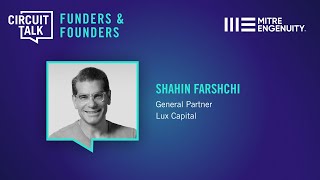
A conversation between John Cole (MITRE Ingenuity) and Shahin Farshchi (Lux Capital partner) about investing in semiconductor and deep-tech startups. Farshchi describes Lux Capital's focus and funding scale, recounts his path from engineering to VC, discusses what makes semiconductor startups investable (large differentiated technical advantage, strong teams, software/tooling/ecosystem), the role of the CHIPS Act in expanding manufacturing capacity, facility and foundry constraints, and advice for technical founders and recruiting engineering talent.
Chapters
Foreign.
Welcome to Circuit Funders and Founders. I'm John Cole, Senior Manager on the semiconductor team at MITRE Ingenuity. We are a nonprofit dedicated to solving problems for a safer world. Our semiconductor team is hard at work meeting the nation's challenges around semiconductor breakthrough technologies and the Chips Act. Circuit Funders and Founders is part of MITRE's Circuit Talk podcast and video series and it elevates the revolutionary disruptive work being done by semiconductor entrepreneurs and investors. This is an exciting time to be working with semiconductor startups. The nation is waking up to just how critical they are to our national and economic security. I'm joined today on Circuit Funders and founders by Dr. Shaheen Farshji, a partner at Lux Capital. He's has a PhD in electrical engineering from UCLA and he's worked as a software engineer at a number of startups and he co founded Vista Integrated Systems which made wireless vitals monitors out of technology he developed while pursuing his PhD. Dr. Farshi invests in teams accelerating the future with feats of engineering and a lot of his deals have been investments in semiconductor startups such as Nirvana, acquired by Intel, Aeva, Silicon Clocks and Mythic among many others. So Dr. Farshtey, welcome to Funders and Founders.
Great to be here. Thank you, thank you.
Maybe you can start by just giving us the 30,000 foot view of Lux Capital. Where Lux come from? How'd you get involved? What does IT invest in? How's it different from other firms?
Sure, Lux been around for the past 20 years. We've funded over 250 companies over the course of 10 funds. We invest across healthcare and technology. We do everything from de novo to growth stage investing. We're currently investing out of a billion and a half dollar pool of capital. Half of that is dedicated to venture and early stage, the other half is dedicated to growth. And so we have a team of 10 super dynamic high energy investment professionals that basically scour the world for super high quality teams are looking to revolutionize or build the market with a unique new technology. I'm a semiconductor guy by training. Thank you for that intro John. So I did a PhD in electrical engineering. Prior to that I was a huge car enthusiast and a science fiction nerd and so that's what got me into engineering. When I finished undergrad I graduated into the dot com bust and so I decided to pursue my passion for cars. Went to gm, was more of a west coast kind of startup guy than a big company guy. So I came Back to the PhD in electrical engineering and like many bright eyed Naive graduate students. I started a company around my research, which was a great science project but not a great business. And I learned to make that distinction. That experience became very valuable in my career moving forward as a venture capitalist. So my role in the venture capital industry was very serendipitous. I got a great piece of advice from a friend which was get to know investors before you're asking them for money. So I reached out to a bunch of VCs as a grad student and postdoc saying hey, you know, I'd be happy to send interesting ideas your way, I'd be happy to do diligence for you for free. And a lot of VCs took me up on that. Lux Capital at that time was raising its first institutional fund. They asked me to put together a deal Flow Reports and I did that for some time. I also worked on a few new investment opportunities as well with them. It was a delight working with them. And when they raised that fund they said, hey, would you be interested in joining us full time? And I said absolutely. I couldn't imagine joining any other team. So it has been an amazing journey. For the past six years I've led investments in rockets, satellites, driverless cars, manufacturing, computer vision, AI communications tools and infrastructure for these past 16 years and it's been fantastic. And so I'm now based in California. We're a New York and California based team and I'm always on the prowl for great teams that are looking to accelerate the future with exciting new technology.
Both inside and sort of outside the semiconductor industry. Right, so that's right, that's right. Rockets to, to self driving cars, to semiconductors. But you've got a number of successful semiconductor investments under your belt already. We rattled a few off when I started up just we talked about mythic or I mentioned mythic nirvana. I saw Flex logic side beam in the semiconductor space. What kind of tech and teams are you looking for right now?
So as you know, semiconductors are a very exciting industry at the cutting edge of technology, but it is also a very mature industry. So as a startup you need to be significantly differentiated to be able to outmaneuver and out compete incumbents. In the semiconductor industry today you have very, very consolidated and well entrenched incumbent chip companies. And on the other side you have very consolidated, entrenched large customers. The OEMs, the automotive companies, the consumer electronics companies. And they don't like taking risk on new technology. No Apple executive wants the iPhone to be delayed because of some chip that came from a startup that had a few issues with its compiler or with its drivers, or had issues with yield. And so as a startup, the value proposition has to be significantly better or significantly more attractive than what's available from incumbents today. And so you need to have a multiple to perhaps even an order of magnitude improvement over what's out there to be to be able to compete as a startup and have a chance of penetrating this very conservative and very challenging and very unforgiving market for incumbents, let alone small startups.
Where are you seeing companies that are doing 10x better or an order of magnitude better than what's out there?
That's a good question. There's a lot of folks like that coming out of universities and labs that are taking a fundamentally different approach to solving a problem, whether that's fundamentally new circuits. In the case of Mythic, they're using analog circuits to perform inference for neural networks. There are a handful of companies or folks that are using new semiconductor materials. There are a handful of folks that are using new algorithms. And so I think there is interesting new approaches to solving a given problem. If that new approach can yield that multiple or that order of magnitude improvement, then it becomes something interesting for an investor like us to come in and say, okay, we're going to take on the status quo with this new approach. So again to your question, John, there's folks coming out of universities, there's a lot of folks coming out of large companies that have spent time doing research in a certain space where there just wasn't appetite on behalf of that incumbent to disrupt their own business, and they choose to leave that large incumbent employer and do what they're doing in the context of a startup. We see many of those as well. So these people come out of labs, they come out of small companies that come out of big companies. But the emphasis here again is on the people that are carrying these ideas forward. Because ultimately, at the end of the day, you know, we as investors are not investing in a circuit. We're not investing in lines of code. We are investing in people who will carry these innovations forward and attract great people to build upon these innovations and be able to accomplish what many view is the impossible, which is taking on these large incumbent semiconductor players and selling to these customers that absolutely do not want to take any kind of risk whatsoever.
Yeah, well, so you said people a few times, and you yourself built a company sort of based on technology. You know, you mentioned in the beginning that you built it on technology developed during your PhD. So you have that firsthand experience of launching a deep tech company out of the lab into the commercial space. What needs to happen right now in this space to encourage more technical founders to take their research projects and launch companies, or what's missing in the ecosystem to support more of that?
Right now, I feel like there is plenty of capital out there that is seeking very unique and special opportunities. I think what's missing, and I keep going back to people, are leadership teams who deeply understand the concerns of the market that they're selling into and what those customers want to see. There's a need for leaders who have long relationships with these customers so that they can earn. So the companies that they work with, these startup companies, can earn the trust of these incumbent companies. I think there also is a need for more software engineers that have an interest in working in the space. There have been a lot of software engineers over the past five, 10 years, spent a lot of time focused on ML and AI. There aren't a whole lot of software engineers that have an emphasis on compilers, on firmware, which is what's needed to make these novel technologies useful by the customers. If you go to any mature semiconductor company, you'll see that there's probably more than half of their workforce writing code to help their customers use their products. If you look at Nvidia, their huge advantage is in the software tools in the ecosystem that they've built. That makes it very attractive and advantageous for customers to adopt their products versus competing products. So I think, to answer your question, it's folks on the software side and people who deeply understand the industry that they're selling into, knowing that it's not just offering the shiny objects, but is providing assurances of continuity, of continuity and support that a lot of these customers want to see before they're interested in buying a product from a vendor that didn't exist until recently.
So definitely, you know, understand the customer. I get that you must have portfolio companies. If you're, if many of your portfolio companies depend on software engineers, they're competing with, you know, the, the Googles of the world for that talent. How do you coach them or how do you get them, you know, help them get to that level where they can sort of compete with either other software opportunities or, you know, all the other opportunities software engineers have out there.
So when my companies ask me to speak to recruits to help them get over the line, I really tell them about the promise of the technology and I tell them about how what they're doing is going to be super unique and special relative to whatever else they'd be doing at a place like Facebook or Google or Netflix. And so it's less about those people who are driven by, I guess, you know, comfort and compensation, and it's people that are more driven by, hey, like, I'm going to bring a product into the world that doesn't exist, and I'm going to create applications that until now were not possible. That is not something that you can do at just any company. And it is the hope that the management teams and myself can convince them of that path, that they'd be going on, again, achieving the impossible at these companies.
That's a lot to ask from a founder.
Right?
You're asking.
Well, one.
One is asking for them to be very technically adapt at something and then also be. You mentioned being a leader and then also be able to sort of sell a vision and dream of building something, you know, really great in the world that's, that's, that's challenging to pull all together in one person.
Huh. And I think that are those are the core attributes of a leader or a leadership team. So ultimately, the leader needs to be able to articulate a vision. They need to express that vision and make it real for the people that they're trying to recruit and the people that they're trying to raise money from. And they have to hold their teams accountable towards delivering that vision. And there's a lot of leaders out there that are good at elements of this, but are not good at all of the above. And that's where you see companies run into trouble. And so sometimes you don't. One person to your point, John, isn't able to do this. So let's say you have a brilliant scientist who's been designing circuits for the past 20 years and has come up with this new method to be able to make, you know, cutting edge, for example, accelerators using an older technology. No, there's more available in the United States, for example, for strategic reasons. And they are able to, alongside them, bring on an industry veteran who spent many years, you know, running multiple businesses as a GM or perhaps even a CEO of another semiconductor company or a customer to a semiconductor company and has that, that has that credibility in the industry, or perhaps even a younger entrepreneur who has the drive, who has the energy to, to go out there and preach the vision of the company and get a lot of these industry folks to sign on and really appreciate the benefits the company can bring to bear for them and get them to take a risk on and adopt these new technologies. So it doesn't necessarily have to be one person, it could be a team of founding team members that can pull this off.
You know, we talked a little bit about some of the challenges that you face outside of that. Right. There are deep technical challenges, especially with a conservative industry that may not want to move as quickly as the founder does. And facility constraints are another issue that we hear about over and over again, especially for semiconductor startups that are trying to launch.
That's right.
I'm curious what you think about capital requirements. I mean, they're notoriously high. And these kinds of investments, do we need to get more investors in this space? And if we do, how do we convince more investors in this space? Or are there too many already?
So a lot of folks tend to lament the lack of investors and semiconductors, but I see it differently. I think every investor wants to make money. There is no reason why all investors shouldn't be investing in semiconductors. Every investor that has capital to put to work can and should be investing in semiconductors. The reason why they are not investing is because it is a space that is viewed as one that requires a ton of upfront capital, that faces fierce competition, and in most scenarios does not generate attractive returns. And so those investors decide to go after vertical SaaS, B2B2C, E commerce, name your enterprise, Stack Security, name your topic du jour. And venture capital. So the onus is on us, those who are optimistic and excited about semiconductors, to make the case that if you invest in the right companies and with great governance guide them on the right path, you could indeed generate giant outcomes. And it doesn't mean that every single company will success will be successful, and every single CyberSecurity company, or B2B, you know, SAS or whatever company is not successful either. But the expectation is that if you're able to manage the amount of capital that you need to raise, if you're able to attract customer interest earlier on, versus having to ship products in volume before you can attract customer interest, and if you're able to build a very rich software suite that attracts developers onto your platform, and even perhaps before there is a physical semiconductor product is a very appealing way to go. So, for example, in the case of nirvana, they launched their AI environment Neon before they'd actually launched their chip. So they offered a software product that was running on FPGAs in their cloud that allowed developers to experiment with the tools that their product had to offer. And so that was a very efficient and creative way to create mindshare around their product, which was accelerating training neural Networks in the cloud. And so not every company is going to have the same recipe, but the notion of trying to build a relatively standard product, let's say, for example, a 5G modem or a microprocessor or a microcontroller, and trying to go head to head with the incumbents who have billions and billions of dollars of cash being generated from their other businesses that they can reinvest into this and the ability to build all the legacy infrastructure that's needed to support, you know, to be backwards compatible. Being, you know, going head to head against these guys with those kinds of products, conventional products, is extremely difficult. And so I think there are very interesting new areas to be explored. And for example, Nirvana at its time was one of them. There weren't a whole lot of people that were trying to build accelerators for the cloud back in 2014, or in the case of Mythic back in 2015, you know, people were still catching on the notion of training AI in the cloud. There wasn't a whole lot of conversation about accelerating inference on the edge. So being early with a very unique value proposition can put you in a very attractive position.
Yeah, but you, you shook your head pretty vigorously when I just mentioned the word facility constraints there. Have you seen that with any portfolio companies that seem to resonate a little bit?
Yeah. So if you just, just taking a step back, I mean, the basic math is, you know, Nvidia, Qualcomm, Broadcom, the large Fabless semiconductor companies are huge customers of the likes of tsmc. So if you're looking for capacity and you're competing with Qualcomm for capacity at a tsmc, well, good luck with that. So you are, it's kind of like having a huge payload on a rocket and having and somebody else trying to jam their tiny cargo on the side. Well, if there's no room for that tiny cargo, since the large payload is paying for most of the launch, you're not going to really get a lot of capacity if you needed it. So here, that is a fundamental challenge that many fabless semiconductors companies that are smaller and nascent space by having to compete for capacity now, hopefully there's going to be a future with the CHIPS act, that there's going to be more capacity available domestically and there's going to be less competition at concentrated foundries. And I'm very excited about that future.
Well, that's great. I mean, that leads me to my next question. There's potentially a flood of money coming in from the Chips Act. $50 billion headed into the semiconductor space for R and D and for infrastructure. You think about that money, how do we ensure that some, you know, or a lot of it gets into the most sort of creative, disruptive spaces.
So it's not my expectation, I'm not an expert on the legal side and I haven't read everything word for word, but my expectation is that a lot of this money is going to go into building manufacturing facilities. I do not expect this money to be directly made available to innovative startups or even large incumbent companies that are doing R and D. I think if you are a Samsung, a tsmc, a Intel, you know, you have access this capital to build another manufacturing plant. Now, whether it's going to be operated internally or operated as a foundry, I'm, I'm not too sure about the specifics there, but it's my expectation that the greater availability of manufacturing for these fabless upstarts is certainly a positive.
Yeah, just the idea of having sort of more facilities and generating more access and capacity for everybody.
That's right, that's right. Now, is there going to be investment available for next generation process technologies? Is there going to be technology available or money available from this for innovative chip companies? I, I don't, I don't think so. But again, don't quote me on that because I'm not the expert there.
Well, so some of the, some of the problems you're talking about when you think about say fabless companies, right, Their, their access to foundries, some of that access is opened up by mpws, for example. Right. There are more, more groups that are sort of offering that. What do you do for somebody developing a new material or developing even a new tooling for semiconductor production?
Yeah, yeah, that's tough. So I worked on our investment in molecular imprints which we ultimately sold to Canon and there, there is a facility in upstate New York, Sematech, that makes it possible for, you know, new companies to experiment with or design new processes into a commercial scale. Fab. Will the chips act, make more of those available? It would be nice. I'm not sure if, if that capacity would be available to people that are building novel process technology. However, taking a step back, I think the most desirable partners for these companies that are offering new process, new metrology, New Testament technologies are the incumbents themselves. So it's the ASMLs, the land researches, the applied materials, the cannons of the world that the startups should be seeking to partner with in order to accelerate and mature their new process related technologies.
Yeah, yeah, certainly they control the production, working closely with them is, is your best, best bet.
That's right, that's right, that's right. And perhaps the chips act puts more resources into their hands. That makes it easier for the startups or makes it easier for them to engage with the startups.
Well, I follow you on Twitter and I would encourage all of our viewers to follow you on Twitter as well. But I, I saw a tweet recently from you about sort of investors are shying away from, from hard tech when times are tough and how you thought that was kind of a myth. So maybe you can just talk to me a little bit about that tweet. Like what's.
Yeah, yeah, sure.
Investing around semiconductors and around, you know, deep tech.
Sure, sure. So when times are tough, investors tend to scrutinize individual investments deeper. Now scrutinizing doesn't mean sitting on the sidelines. Scrutinizing simply means that they are more diligent when it comes to sourcing and investing in new opportunities. And new opportunities need to be, it needs to be more, I guess, apparent to investors that A, there is a path to generating A, a large return on this investment and B, the unknowns associated with getting there are predictable. So for example, if there is an opportunity to invest in a semiconductor company, for example, that could revolutionize, let's say manufacturing, for example, with this novel computer vision capability so that robots can train themselves instead of having to be pre trained by experts, then for example, they would be very interested. And, and by the way, you also have executives who really understand the industry very well, who can attract amazing talent that can realize this. And the roadblocks that are ahead of the company are well understood. And there is a sense that the, the unknowns are, are, are known and they're quantifiable and the risk is quantifiable, then investors would be super excited about doing something like that. So there shouldn't be the assumption that investors completely write off certain areas when times are tough. They continue to invest in everything so long as it is a attractive opportunity, meaning that it has the opportunity to invest to generate huge returns and the risks that are along the way towards generating those returns are understandable and underwritable. And so when entrepreneurs come to me and they say like, oh, there's no funding for this, I say absolutely not. So long as it can make it clear to an investor that there indeed is a huge reward for investors if you are successful and these are the unknowns that you expect along the way that will be challenges. And here's what you plan to do to address those. And if an investor can be made comfortable, then they would absolutely invest even in the hardest of times in these kinds of things. I think what investors would, would shy away from, John, is the notion that hey, we're going to build something that's better than the incumbents because we're just really smart. And it's. Since it's going to be better, it's going to be very valuable. Broadcom is a Avago is next billion dollar company, therefore this company will be more valuable. That kind of hand wavy I would say lazy types of, I would say pitches are not going to kind of pass muster in an environment where people are, are applying a lot more scrutiny. An observation that I've made coming out of the last cycle is that investors went from trying to allocate capital or trying to, I guess the better word would be trying to deploy capital, which is looking at opportunities and looking to check boxes. Okay, did the founding team go to a Ivy League College? They spend five, 10 years at a, you know, blue chip company. Is there a market report that indicates that this market is very large? Can they tell an interesting story? Like they looked at these attributes and they checked boxes to deploy capital. And now we're back in the normal realm of investing and underwriting, meaning applying very, very clear criteria and actually looking for deep explanations as to how particular outcomes can generate value, hence returns to investors. So when someone says that hey, this could turn to a big company, we look for the bottoms up analysis as to which markets will convert, what will they pay, how much margin will this company generate, how quickly will it grow and how does that in turn convert into a multiple upon which this company's revenues will be valued? It is that kind of analysis that's done that's leading to making very diligent investment decisions as opposed to again the prior construct which was kind of checking boxes and deploying capital.
Yeah, so you're saying move away, move away from making your case on comps. Right. So looking at other deals that are being done and actually trying to look for a unique bottom up approach to justifying the future value of your startup.
I think comps are always good. But if you dig deep into the numbers of a lot of these incumbent companies, if you look at Silicon Laboratories for example, this is an extremely high margin business that's growing rather healthily, hence the multiple that's applied to it. You can't just assume that if you offer a better product then you'll automatically be overvalued by the markets. The markets will apply a multiple to you that yes, had to some extent has to do with what your competitors are doing, but also looks at your fundamentals. And so you have to ask yourself what are the fundamentals that I can realistically deliver and how will my business grow and what's expected to be a more and more competitive market over time?
Well, Dr. Parshi, I've heard you give sort of a talk on your career before on YouTube and sort of you talk about exiting undergrad during the dot com bust and how that kind of shaped where you went and then exiting grad school, you know, sort of the 2008 crisis or thereabouts. Right. What kind of advice do you give folks that maybe are sort of themselves exiting, you know, this year or next from grad school? Where should they find the optimism for for their careers?
So my advice to folks is go out and get experience. People who are more technical is to go out and get experience and actually shipping products, starting from scratch, taking an idea from or a product from concept stage to product stage and getting it out to market and really understanding the steps involved there. I think that is a invaluable experience. I advise them to get accustomed to working with other teams that complement them so they understand kind of where their strengths are, where their weaknesses are and trying to accomplished complementing themselves, being able to complement themselves with those skill sets that they lack and building and running over time, amazing teams. So you know, it's just really getting out there and building stuff and working with people and recruiting people and running world class teams that I think every great technical person should aspire to this graduating today.
Well, thank you and Dr. Farshi, thanks for joining us today on funders and founders. It was a great pleasure to talk to you about startups and semiconductors and investment.
Likewise John, these are great questions. Thank you for doing this.
More from Shahin
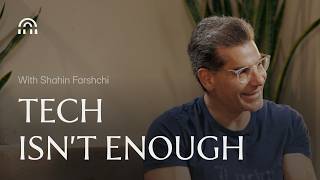
Library of Minds episode with Shahin Farshchi, General Partner at Lux Capital

Lux Exotica Pilot Episode - Aeva empowering autonomous cars to see the world better than we do.