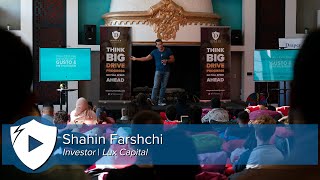
Shahin Farshchi of Lux Capital: venture capital in semiconductors / nanotechnology, Part 1
This content was created by Shahin Farshchi. This content was uploaded by Shahin Farshchi. This is a YouTube video titled "Shahin Farshchi of Lux Capital: venture capital in semiconductors / nanotechnology, Part 1" created in October 2012. The content is a detailed presentation by a speaker named Shaheen from Lux Capital, explaining the fundamentals of venture capital, investment risks, and the process of funding startups, particularly in technology sectors like semiconductors, energy, and AI. The talk covers venture capital fund structures, risk assessment, market considerations, and expected returns. Although the title references Shahin Farshchi, the speaker in the excerpt is identified as Shaheen, and the content is a monologue rather than a conversation.
Chapters
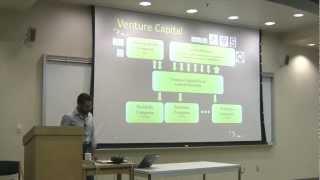
Hello, my name is Shaheen, I'm with Lux Capital. I'm here today to tell you a little bit about venture capital and about starting companies in the technology space, especially in fields relating to electrical engineering. Manish gave a background on me. Lux Capital, we're investing for a $200 million fund. Now we've been around for a little over 12 years. We've invested in almost 30 companies over the course of that period. And I joined in 2007. And since I joined, I led up two semiconductor investments. I'm on the boards of a couple of our semiconductor and energy companies right now. And I'm spending a lot of time looking into the general energy, electronics, robotics, artificial intelligence and healthcare IT spaces as well. So since our time is limited here, I'm going to power through this. If anybody has any questions, please feel free to interrupt me and I'd be happy to provide some more color. So hopefully today we'll talk about what VC is, how VCs go about making their investments, and I'll give you a couple of examples of venture backed companies. So first question, what's VC for? Maybe the one or two of you who haven't heard of VC in this room, capital invested in a project which there is a substantial amount of risk in a new and expanding business. So you know, just some more color around what venture capital is. Typically when anybody refers to vc, they're referring to a venture capital fund which is a limited partnership. Here in the middle of the slide. Funds for the, for the, for this, the actual money for the fund comes from what's called limited partners. These are people like the Stanford Endowment, like the Harvard Endowment, pension funds, corporations, other entities that have large amounts of money that they'd like to invest and put to work. They take a small fraction of that and put it into very high risk assets, venture asset classes with venture capital being one of them. Now this fund is managed by a management company. Many of these are the firms that you've heard of. Kleiner Perkins is an example up the street here. Foundation Capital as well, Lux Capital, also an example, which is the firm that I'm from. These management companies manage the funds which invest in individual startup companies. And these are typically C Corps. So every Fund may have 10, 20, 30, 100 startup companies included in it. And of course there's cycles. So you hear of Fund 1, Fund 2, Fund 3. So these refer to the limited partnerships that are formed from which these individual investments are made. So any questions on this slide? Okay, so the actual management company consists of several entities There's a general partners who are financially responsible for the money in the fund. This is the general partnership. They normally hire associates, myself being one of them, to help make the investments, to help manage the investments, to help with raising money for the fund. So we help with the day to day activities of the fund. Then there's venture partners that are brought on a part time basis that are formally affiliated with the fund, who help bring optionality for the fund, help introduce new entrepreneurs, provide guidance on the strategy as well as advisors. So this should give you a sense of, you know, who the players are within an individual management company. So here's a quick little statistic on the amount of money that's gone into startups from venture capital over the past several years. You see a massive peak back in 2000 when over $100 billion went into venture capital. Fast forward out to 2007. We had a little local maximum over there and then you see, you saw it drop. And right now we're pretty much on track for about $26 billion of vent going into startups this year. This slide should give you an idea of the breakdown as to where that money is going. We're seeing almost a third of that money going into software. We're seeing less money going into the more hard technologies, which I'm sure a lot of the guys and people in this room are interested in. Industrial and biotech and med devices are obviously lower than they were before. And we're seeing more money going into software and media. But we're going to focus more of our time today talking about more hardware oriented technology, technologies and companies. So you know, the question here is, you know, how do VCs go about doing their jobs? So the question is, you know, how do we evaluate investments? So the diligence process is really understanding what we don't know. We try to understand the risks associated with making investments and we try to understand how we can be rewarded by taking on these risks and hopefully overcoming them. So I'm going to talk about the individual components of risk. But these risks can include technology, as many of you may be aware of, market, future, financing, competitive sort of pressures, and whether or not you can really have the people that would make this company a reality and make it successful. So you know, how much money is needed to get to where the company needs to go and at the end how well would you be rewarded for taking on these risks? So I'm going to tell you a little bit about some of the elements of the risks that go into funding a new startup. So one big one that a lot of you probably are aware of is technology risks. So first question, is this technology even going to work? And if it does work, can you take it from a bench scale and scale it up to a commercial scale? And when I say scaling up, it means scaling up performance, bringing down the cost, and fitting it into existing industrial processes. And many people tend to discount the. The importance of being able to get a technology or a process to work within existing processes and within existing settings. And I'll talk more about that later. So, again, can we overcome the technological challenges with bringing a new technology to market or making a new company successful? The second risk is around the market. If you're able to prove the technology, introduce a new product, will the market care? Will the market buy? Is this a growing market? Where is the market window? These are all big questions that a lot of people probably don't spend as much time on as they should. The reality is that there's a lot of great solutions out there, There's a lot of great technologies out there. But more often than not, we see markets not willing to pay for these solutions, not willing to attribute value. So it's good to know at the onset, who's the customer? How much are they willing to pay? How important is this pain point? How quickly will they switch over? How much time do we have to actually start executing on this opportunity? Then the second big question is competition. So the competition can come from other small companies. It can come from large companies who have big R and D budgets. It can come from other inferior, even alternatives to the solution that you're trying to bring to market. So competition, obviously is a big one, and then there's the reward. So if we go ahead and overcome all these challenges and risks, how will we be rewarded? How will we, as an investor be rewarded? And obviously the investor reward is in the form of probably two outcomes. One is the company being acquired. So a lot of people think that if I simply prove a technology, then Broadcom or Qualcomm or Applied Materials or one of those guys are going to buy my company for hundreds of millions of dollars, if not billions of dollars, and I'll be on my way. But the reality is that a lot of these people are looking for deals and want to spend pennies on the dollar to acquire new technology. So the reality is that you have to make sure that what you're creating, the company is going to be a strategic fit for these companies, meaning that they'll be able to provide an access, providing these big companies an Access to a new market that they're not in today. For example, Broadcom bought up a bunch of wireless companies back in the early 2000s because they didn't have a wireless business. So companies, for example, like Innovents became Broadcom's wireless business at a time when they didn't have a. At a time when they were focused on the cable modem business, for example. So, you know, better positioning amongst their competitors, better economics on their current product offerings and business. So really, you know, for MA to really become a reality, it's a one plus one equals three type of expectation. And then there's the public offering, which is very, very rare and is something that, you know, many venture capitalists and startup founders shoot for, but it's not something that really can be realistically expected because the IPO markets aren't as hot as they probably were before 10 years ago. So, you know, the reality is that public investors pay for a company based on their confidence in the company's future earnings. So drive future earnings. It depends on the business that you're in. For a semiconductor company, for example, it could be revenue, you know, margin on that revenue. It could be future design wins and the pipeline at that company. You know, for a drug company, it could be having something in the clinic, you know, a blockbuster cancer drug, you know, vaccine or something, you know, in the clinic, close to being put on the market. That can give you a good sense of there being future revenue and margin at the company that the IPO markets would invest in. And then in the case of energy, it's having a technology that's been proven, you know, at a sort of pilot scale where a large developer would be willing to help you spend hundreds of millions of dollars build a plant that puts out some kind of commodity that would be advantaged economically and again, secure some kind of future source of revenue. So again, the reality is that public offerings are lucrative, though they're rare, and one has to be really cognizant of what the drivers are behind them. So this should kind of give you a sense of who VCs are, what they do. Again, trying to understand, knowing what they don't know, trying to see how they would get paid for taking on a certain risk on a new venture and then basically helping that venture succeed. So now I'm going to tell you a little bit more about the process of coming up with a new idea and trying to think through the process of turning this into a company and getting it funded and taking it to where it needs to go. First of All. Are there any questions so far? Yes, go ahead. So that's a very good question. I was hoping to talk about this and I'm glad the question was asked. The question is, what's the hit rate? The reality is that if you take a step back and think about what the people who are putting money into venture capital firms are expecting. So if you look at, for example, if you put yourself in Stanford's shoes, the Stanford Endowment. So the Stanford Endowment can put money into the public markets. They can invest in stocks, index funds and maybe get 5 or 6% per year. So if they're taking the risk and taking on the illiquidity, meaning that their money is going to be locked up for the next 10 years. In a venture capital firm, their expectation is to return something on the order of 20% on their investment. And for a fund overall to generate a 20% IRR, then the expectation is that every single investment has to make at least 10 times the initial investment. But the reality is to your question, that that doesn't happen every time. So out of every 10 investments a venture capital firm makes, the reality is after every investment is made with the expectation that everyone is going to be more than 10x, maybe one or two generate that kind of, that's a big maybe. Maybe you have one or two Facebook Google type outcomes, the rest become maybe three or four, kind of get most of your money back and the remainder are going to be losers, most likely. I mean that's what the statistics show. And the reality is that you see less and less of these huge home run type venture profiles. Which begs the question, if you're a larger fund and you need to generate a 20% IRR, how many home runs are there happening every year overall and what's the likelihood of you being the bigger fund investing in every single one of these to be able to generate that kind of outcome. Which is why we're seeing more firms that raised massive funds back earlier in the decade now raising smaller funds for this because of this unfortunate reality. Does that answer your question? So that might be a long winded answer, but any other questions? Okay, so a little bit about the process here. So again going back to the previous slides. Startup comes in pitches, VCs perform their diligence, they understand, try to understand the technology, understand the market, understand the challenges of the business, understand if the business is successful, what kind of comparables are there, the point towards how much they'll get paid for this investment, how much more money is this going to need to get? All these questions answered. And then they offer a term sheet that provides a basic outline as to what kind of a stake they would get in the company in exchange for the money that they've put in. Different things I'm not going to go into right now because of time, but I can go back to this later if anybody wants to learn more about just the terms under which VCs investors Sam.
More from Shahin
Library of Minds episode with Shahin Farshchi, General Partner at Lux Capital

Lux Exotica Pilot Episode - Aeva empowering autonomous cars to see the world better than we do.