Meaningful Relationships
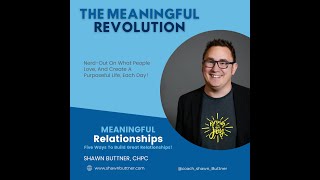
Sean Buttner, a high-performance coach, argues that relationships drive meaning and performance in our lives. He offers a five-step framework: model the connection you want, learn others' ambitions, remove their barriers, co-create solutions together, and develop people-skills to manage group dynamics. The pandemic has left many isolated, and he's built an online community where listeners can share wins and challenges.
Chapters
Hey, everyone. Welcome to this episode of the Meaningful Revolution podcast. Again, I'm your host, Shawn Bontnar, and today we're gonna be talking about the power of relationships. So the whole idea of this podcast is how better would our lives be if we had just 1% more meaning in our life every day? And for so many people, our relationships, our connections to other people are where we find meaning. It's that special relationship between a parent and a child. It's that special relationship with your spouse, that special relationship with your close friends, with, you know, the people in your community that you see all the time, right? And so there's these. This quality of life that's really tied to our relationships. And if we're really, you know, trying to find meaning in our lives, to feel inspired, to do our best work in the world, to really provide for our families, to leave our communities better than we found it, then it's essential that we focus on this aspect of our relationships. And, you know, many people, and maybe you've been in this, maybe not in this situation, but, you know, the last three years have been really rough because we haven't been able to see the people that we wanted it physically. You know, we've been starved for that. That physical community of being at a concert or being at a bar or restaurant or, you know, going to community events, you know, movies in the park or movies in general, you know, all that kind of stuff. And people kind of shrunk. You know, they've gotten a little more guarded, a little bit more like, stuck in, trying to protect themselves from COVID From. Trying to protect themselves from all the crazy that's going on out in the world. And so, you know, when you do that for too long, you are kind of shutting down this part that you find really a lot of meaning in. And so it's time to focus again on the relationships in our lives, the important relationships in our lives, feeling that connection to those around us. And so how do we do that in today's world? That's what we're going to be talking about today. Welcome to the Meaningful Revolution podcast, where we talk about people's passions and hope to inspire you to your own. We also answer the question, what if you could just add 1% more meaning to your life every day for the next year? So join us on this Meaningful Revolution. I'm your host, Sean Butner, certified high performance coach, and we have a really great episode for you today. So let's get into it. When we're talking about relationships, you know, and how it helps people find meaning. Again, like, if you were to think about who are the people in your life that have inspired you the most or have really influenced you the most? You know, again, it's going to be parents, grandparents, it's going to be maybe a teacher or mentor. It's going to be someone that you met at a certain point in your life. But, you know, when you think about big moments or big things that influence how you think, it's usually going to be a relationship and a person. So as we start to advance in, you know, 2022 and beyond and figuring out how this world, where a lot of changes happen the last few years, you know, we really need to be the ones that are leading our relationships. And that idea of feeling inspired, feeling that you can help people really move forward, is going to be a huge, huge focus for folks. And I really do keenly believe that. So how do you lead relationships? How do you figure that out? We'll talk about that here in a second. But, you know, I've had a lot of clients as a coach this past two years of people who have lost their communities, right? You know, people that have lost jobs because the economy or, you know, whatever reason it is. But, you know, there's somebody that I was working with and had worked at a company for 17 years, the only job she had, she poured everything, every waking hour into that job, and they let her go. And she's like, now what? How do I handle this? You know, and it can be really tough, you know, be really frustrating. There's a lot of emotions, especially in her particular situation that came up, but ultimately she's like, I feel lonely. You know, I don't have the co workers or the customers that I know that I'm making a big difference in. And it was crushing, you know, and so I think maybe again, you know, not maybe you're in the situation, maybe you're not, but if you've lost that community and you feel lost, you know, you could turtle up or get grumpy and yell at people randomly out on the street, which is not cool. But you know that there's, there's something there that we really need, need to, to focus on. So how do we get into building relationships, leading relationships, how do we get into pushing all that stuff forward again? So I wanted to offer five ideas on that during this podcast here. But before we do that, I also, since we're talking about community, I am launching something called the Inspired Community, which should be live by the time you're listening to this and the link will be in the show notes below if you'd like to join. But it's a place for you to ask any questions. If you have any feedback for me and don't want to send me an email, you can go there. It's free to join. Meet some of the folks that are on this meaningful revolution with us all. I'd love for y' all to connect. I'd love to be able to have a place where you'd be like, hey, like I'm doing this really cool thing. We can cheer you on where, hey, I really am struggling with this. We can use the hive mind of the community to help advance you. So it's not just me giving advice. Although as a high performance coach, there is a method that I can use to help, you know, a proven, structured way to really help people advance. But there's so much more than that and so much more perspective in the community that I think could serve every one of us. And I'd love for y' all to, you know, be part of this journey with me again and to, to really just come together and inspire each other. Right? That's the whole purpose of this podcast. And I really hope you'll join us there again below in the show notes or just community.seanbutner.com and no biggie, if you're not into that too, I get it, it's another thing to sign up for. But yeah, it's pretty cool. So that said, now when it comes to leading relationships, when it comes to really connecting strongly, right, There are like the, the basic things that you'll learn in personal development or in business that are just kind of common sense, right? Because, and let's take, you know, a step back and define what connection is. And to me, and this is probably because of my goggles as a coach, it's really a co creation and co influencing process between two people, right? And it usually is when you respect each other. It usually is when you know, you trust the other person to not have an agenda with you, you know, so if you have someone that is open to listen and brainstorm with you and it's not trying to push you into marrying that guy or push you into taking that job or pushing you to give you their money for investments or whatever, you know, it's someone that has your best interest and is fighting for your best you, I think that's when we have really great connection. Which is why I think parents tend to be the number one relationship most people have, or a grandparent or a family Member for that matter. Because it's that I just want you to grow up, be healthy and be successful. Right. In most cases. So you know, having that type of relationship is really important, really great to facilitate. So if that's the kind of connection we're trying to create, we're trying to lead, how can we do this in a business context? How can we do this more in our personal lives? How can we do this more in our community I guess is the question. And so again the basics are, you know, make sure you're appreciating people, right? Make sure that you're actually listening, that you don't have an agenda and you're actively self aware to know when you might, that might come up. And it's natural, it's human nature. So it's not that it's a bad thing necessarily. Unless you're highly manipulative, then that is a problem. But I think for most people they have good intentions. I think for most people they really do want that connection. And sometimes you are just not aware of where things are coming from. You know, it's how you're taught. It's, you know, maybe you do want a particular outcome and you're being extra pushy and it's all needed in time, but it's not, shouldn't be your default, right? So okay, five things to do to really lead connection to lead those relationships. And you know, the first thing to really think about is, you know, how are you role modeling great relationships yourself, right? And I think this is often overlooked. I really love this question for people to diagnose themselves because you know, if you're like, oh, I want someone that unconditionally loves me, but you're constantly judging everyone around you. You know, you're not being congruent with what you want and what you're putting out in the world. So you're gonna get the same type of thing back or you're going to push away the people that might give you that, that like unconditional acceptance. And that's not to say like acceptance is putting up with abusive behavior or putting up with bullying or putting up with, you know, things that are not cool, right? But it is accepting that people where they are and being willing to work with them through it. You know, I, I think there's tons of people that would be like if someone is needy, just cut them off right away. And I think in our culture we've had this like, we don't put up, there's a zero tolerance or anything that might be construed as abuse. And there's a lot of really, like, I don't want to discount that. There has been a need for that in particular groups in society. And, you know, there is room for nuance. There is room to understand and, and give people the benefit of the doubt cautiously without letting them off the hook for truly atrocious behavior. Right. So there's a fine balance there is what I'm saying. But. But are you leading and how you treat others, how you would like to be treated? You know, kind of the golden rule, I, I think, is the. The first main point here. So the second point, and really making sure you're connecting, making sure that your connections are helping inspire you to the next level other than, you know, role modeling the behavior that you want, it's actually asking questions and being interested in what people are going after. Right. What are. If you were to take a list of the five most important people in your life right now, what are their big goals? What are they struggling with? What are they hoping for in their future? And if in that list of five people that have come to your mind right now, and you're like, I don't know any of those, like, go ask them. Right? It's a very simple thing to do. And when you ask them, cheer them on, like, oh, you know, you have a kid, I want to be an astronaut. Like the classic, I want to be an astronaut kid. And you're like, oh, awesome. You know, when you go into space camp, you know, how can we help you train to be the first person, maybe the second person on Mars, the first person on Pluto, whatever it is. You know, but, you know, give some energy, give some encouragement. Don't necessarily discourage them, but help there. Help them figure out the way to get a little bit closer, and you'll build that relationship and it'll feel really great, too. In it. You see some kids buying lemonade out on the street. You know, buy a cup of lemonade and tell them it's the best couple lemonade ever, even if it's super sugary or not. Because it's not to reward people for showing up. It's to encourage people to continue going. Right. And I think that is something that we miss a lot in, in today's world and building relationships is that sometimes, you know, you're never gonna be the best without a bunch of failures, without a bunch of messiness. I mean, take a look at this podcast. I think I'm still trying to find the words, trying to find, like, what we're really pushing for Other than this idea of if we interview people that are really passionate about things that they love, that will inspire other people to go out and do the things that they really love. And then, you know, trying to put some structures and some, you know, tactical strategies too around it to help people find that meaning and explore that meaning so that, you know, they can live a higher quality life, you know, so that this is all a work in process, but it's in motion, it will get better in time. I'm very confident in that. And I think that assumption that people will improve over time if they're excited about it is something we need to really highlight a lot more. So, yeah, that's point number two. Third point in building really connected relationships is to really, you know, other than knowing what people are going for, what their ambitions are, what they really want, it's also knowing how they're struggling, right? So how so for that, the kid that wants to be an astronaut, like, what have you tried about being an astronaut at 7? That hasn't really worked for you. And it's like, oh, I don't know how to build a spaceship. Like, okay, you know, how can you help support or mentor or network and find people that maybe work at NASA and have, you know, or sign them up for space camp or whatever that is to really help them explore that, that passion a bit more. So yeah, you know, knowing the struggles, knowing, you know, what holds people back, it could just be at work, you know, you want to build some better relationships with your teammates. Knowing the jobs that everyone hates to do and then being the one that's like, how can we make this fun? How can we make this easier? How can we remove this barrier so that thing gets done and people aren't like grumbly about it, right? And in my experience in tech, building tools was a really, you know, easy way to help people on the team. So and being technical kind of helps. And if you had. Software engineers are notoriously lazy anyways, so if there's something that's really putting a drag on people, they, you know, you could build a website or a quick little program that'll help solve that thing. I think really good software and programming all comes from solving those day to day issues of like, this thing drives me nuts and finding ways to automate things. But, you know, so be the person that is removing barriers for others around you. And that's a core tenet of leadership, right. The fourth thing to really focus on if you know, the first one is role model, the second one is know what Their ambitions are. The third one is know what they're struggling and help remove the barriers. The fourth thing that really helps build relationships and help lead the energy in relationships is to co create, right? So if you can be the person in your friend group, the person in your on your team, the person in your community organization is the person in your family that is constantly encouraging brainstorming so that everyone feels like they've had a say, that they've participated in what we're going to do for vacation, the project that we're going to really push hard for this next quarter, the business goals that we're going after, the where we want to be in a relationship in the next year. You know, if you're the person that is helping facilitate that brainstorming, that co creation, then one people will like you a lot more. But that's also something we talk a lot about in leadership. You know, it's not projecting what you want all the time, it's helping people come together to figure out what works for everyone. And you'll get people that are more enthusiastic about the action you want to take the project or the vacation or any of that. You get people that will go the extra mile because they have a little bit of skin in the game, you know, so it's such an important thing to really be co creating with folks as you go on. And you know something that I think in my career that really showed that that type of co creation is again, I'll go back to the coaching, like for me a really great coaching relationship and it's a connection. You know, this is really kind of encapsulating something that I do all the time. It's a bad coach will tell you what to do and that's really more consulting anyways. But you won't get rehired as a coach if you are constantly telling the people what to do. But you know, and the great thing about the this science based certified high performance coaching process that I am certified in is it's a series of open ended questions that help guide people to the answers. And my job is to help brainstorm along the way. So when, when I'm doing my job great, I'm helping people brainstorm as a coach, which is why I really do believe in this. But in business too, the teams that I've been on were like, hey, we need to hit these numbers. You guys are really smart. Like what do we need to do? What's getting in the way of this? How can we make this happen quicker? You know those types of Questions are what the great leaders that I've worked with personally have really embodied also so personally in coaching, in business, in teams, I've recognized that as something that's really helped. And so I think having that on top of mind is really important also. So the fifth thing to really help connect with people, to build relationships, to help us feel inspired and supported by our community, is to have a strong set of like what I could say, strong side of people skills. These are all kind of people skills. So I, I think I want to get a little bit more granular here. I think connecting and leading relationships also comes down. Like showing an interest, right? You have to again like with that co creation, you have to be able to listen and really empathize. You know, it's why is someone being quiet in this group? It's why is someone not speaking up? Why is someone talking over everyone and kind of understanding how people work? That's kind of what I'm trying to get at. It's like understanding how people work, people's psychology and how to help move groups through that. Right? So if you are in a business situation and you have someone that never says anything and someone that's always talking, how do you make it so that everyone is. How do you facilitate that? That's what I'm trying to get at. How do you facilitate that group of folks so that everyone feels heard? Right. That's a very tricky skill. Again, it's notice first off, it's being aware of where people are, how they're interacting, you know, and I love playing this game in meetings of like who's the quietest person, who's the loudest person, who's the person that seems the most anxious, who's the person that seems the most confident, who's the person in the room that probably knows the most, who's the person who's actually going to make the decision in that type of group scenario. And it's using your knowledge of relationships and connection to help move the project forward, to help people advance in their lives that I think is so important. So to sum it up right, the five things you can do to really help improve your connections, improve your relationships, help you advance so that you feel more inspired every day and more experience, more meaning in what you do is to just work on improving your relationships using one of these five techniques is to role model how you would love to be treated in relationships, to know people's ambitions, what they're going after and to support them to know what people are struggling with and help them remove barriers, to co create solutions in your individual or group relationships and then to help groups and group dynamics and you know, to understand that and help move the group forward towards a common goal. So excuse me. So those are the five things that I've found helpful as always. Like it could be always be tricky and sometimes you want a sounding board to figure out the right words to say to figure out how to problem solve a situation like that. And I would love for you again to join our community and@community.seanbutner.com or in the link below. And I think we can help support you in that, you know, part of the this finding meaning again is connecting with people and I would love to co create, I'd love to support you, I'd love to know what you're going after and how we can help remove any barriers you have using this exact set of steps that we talked about today. So if that's you, hit that link again. Otherwise, next episode we're going to be talking about actually doing the meaningful work. So as we're talking about this meaningful revolution, as we talk about how the people that are really going to win are going to be the people that can press their performance edge. And in order to do that you need to really be connected to feeling the day your relationships and working on the meaningful things that will advance your life and everything we talked about today. So I hope you'll join me then, you know, go listen to that next episode when it drops. It should be very soon. And with that said guys, go out there live with more joy, more growth, more impact in your communities, feel inspired and we'll talk to you in the next episode. Take care. Thank you for listening to the Meaningful Revolution podcast. I hope you enjoyed this episode and if you could please share this episode with three people that you think might enjoy it and like and subscribe on Apple Podcasts. Leave a comment Please rate us because that helps us get the word out. So until next time, listen to the next episode right after this. I know you'll love it and we'll see you then. Take care of.










