The Hard Things are OK
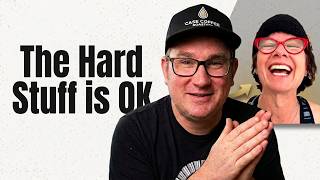
Sherry and Sean discuss why modern life feels overwhelming and why we're pressured to hide our struggles. They critique toxic positivity and the bootstrap narrative, arguing that honest conversation about hard things, not forced optimism, is what actually helps us feel less alone.
Chapters
Okay. Well, it's spinning around. Oh, there we are.
We're live. Here we are. There we go. Hey, everyone.
Hi. Hi, Sean.
Hey, Sherry. How are you doing?
It's good to see you.
That was my. It does this from time to time. Can't just distinguish between Sherry and the Apple version. Yeah. Not gonna say it again.
You know, what's really funny is that's such a great spot to start. I mean, not that that's really a hard thing, but it could be, like, I think, you know, I think for us, we really don't. Not that we don't care. I don't mean to make it sound like that, but. So we're talking about the hard stuff. Talking about hard stuff is okay. And I know a lot of people who might stress out about trying to do something and have it, you know, go well, for instance. And I think maybe Siri jumping in like that was such a beautiful reminder to us how little control we have over things that happen in our lives.
I want to say just how hilarious this is, because we were literally talking about, you know, we should go lie to prove that we're not bots, and then start. And then the robot voice goes like, how hilarious is that?
Honestly, Sean. And by the way, hello to anyone. Unreal. And I believe Sean is real, although I really don't know because he's not in front of me. Are you?
I. I'm real. I'm not sure if you're real, though. But, like, I think we can agree that.
We can agree that that's, like, something else that's in our world that we would have never been asking five years ago. And, you know, I'm just gonna. I'm gonna just throw everything in our basket today that it's like, I think this has been a lot of hard stuff going on. And I mean it on a personal level, and I mean it on a global level. People that I know, there's. There's a lot. And maybe there's always been a lot of hard stuff, and I'm just paying more attention because we're talking about it. That's possible. But what do you think? Do you think. Do you. Do you think that things are harder right now?
I. It feels harder. I mean, I definitely think it feels harder. I think with how much we can view of the world through our little box. Like, we also can see a lot more. And I think, you know, if it's not in our immediate community, it used to be it was. If it was in our immediate community, then it would, you know, we would see it and talk about it, but if it wasn't in our town or state.
Right.
Or country, like far enough away, you know, we're. Now it's like anything that happens is on your screen. Yeah.
And you're right. And even though that's been the case for a while, I also think coupled with that is that it seems to me, and you would know this better than me, but it seems to me that there are so many more platforms and so many more news channels and so many more, you know, information channels. Right. That. That it feels as if we're seeing so much. I was just saying this to you before we went live, that my nervous system feels, like, really overloaded.
Yeah. Yeah, I think so, too. And we were talking a little bit before the call, too, about there's a time sometime in the last 10 years where I just began immediately distrust anything on the screen. You know, there's connections like this where you're with a friend or someone you've met and like, okay, I know this is solid and everything else is kind of questionable, you know, like. And I think we're in an environment too, where if you have an emotional reaction, like, my first gut reaction now is to be like, why am I feeling this? And who is trying what? Who benefits from this? Wow. This is, like, from. I studied, like, information security years and years and years ago.
Yeah.
And like, how people can be, you know, manipulated is pretty intense.
Yeah. So this is interesting because we're a little bit. We're doing a little bit of a different conversation than we might normally do and yet totally pertinent, I think. And what I love about our conversations is that we always just show up with what's here. And I think that for me, and I hope for anyone listening now or later that that's helpful in a way because it shows the depth and breadth of the hard stuff humans go through. And I mean, we haven't hit this part of the conversation yet, but here we go with it. But how our culture really doesn't give a lot of space for, hey, I feel like my system's overloaded, or hey, I'm in grief right now, or, hey, you know, this. This hard thing just happened to me, and I'm just trying to figure out how to be like. Like, we don't get to do that much because I don't know. I don't know why.
Yeah, I don't know why either. But I agree that it's not a clip. Common conversation. You know, maybe it's a bit of optimism. Yeah, I think it's a little optimism. I think it's a little bit of not wanting to burden people with what's going on. I think we have some weird social norms, too, of like, how. How. Hey, how are you doing? Like, you're just supposed to say, good, and then. Then you can start the real conversation. And I think that's fine. But I also think we're missing out on a lot of the connection, a lot of the humanity that we can.
Find between people and you and I neglected to start like we normally start, which is fine. But I'm gonna say it right now because I always love to. I know she's not. Probably not watching, but she may be one day. Susan Cain. That'd be great. Wrote it. One day that Susan Kane does show up. But Susan Cain, author of Bittersweet, which is a book that Sean and I just happened to be reading at the same time, had coffee, and we were like, why? You're reading that book, too? And it has really sparked for us this ongoing conversation. And I think it was Susan, you tell me if this is right, but I think it was Susan who might have been pointing to the fact that particularly America was born. It was sort of like, you know, the new world. It was the new country. People were optimistic, just like you said. People were like, I'm going to go and make it. Like, we, our country, sort of grew out of this, like, you know, positivity of making pulling ourselves up by our bootstraps for goodness sake. Was that.
I think so, but feels like. I think that's true. Yeah. I think the whole experience of looking forward and reinventing yourself and being able to reinvent yourself over and over again is part of that, too. Like, why worry about everything that happened before you integrated here? What happened that last business that failed? Why would you worry with what happened to you in high school when you're here now and can be successful or can do things now to change the future? I think that seems to me, and that we might guess we're kind of talking about this, but, like an American type of value.
Well.
And it's not.
Oh, sorry. Go ahead.
Oh, no, no. I'm just thinking out loud, you know, and, like, trying to put that value in this environment. We are not. We find ourselves in the world. This is sad.
Yeah. And you know what? I want to make sure that we say. Because you and I are both coaches, right? We are both people who. I'm gonna go in and project on you for a minute. Right. We. We believe in growth. We believe in possibility. We believe in being able to transform, you know, ourselves into. To who we want to be in the life we want to have. And. And yet I think that there's a. Just a. There's a balance missing. And I think that's all that, you know, when we started talking about this, that's what we really noticed was like, I'm all for optimism and positivity. I'm. I'm all for people, like, wanting to create the way that we want to have our lives look like and feel like. And, you know, I feel like also personally, when I. When I push down my feelings, when I disregard what's really true for me, when I ignore or try to, like, spiritually bypass then the joy that is there, it is not quite. There's something off about it.
Yeah, I think we've used the term toxic positivity, where there's such a rush to get to that forward view that you actually can't process or feel through what's happening now. Yes, I know that's very much your brand, is to be here in the moment, to take things as they come. And part of your spiritual practice, you know, and, you know, you can't have, like, we're. We talk a lot about duality. I can be looking into the future. I can be feeling things now. I can have things in the past that are preventing me from living the life that I want to or helping me live a life that I want to. And everything can be true and happening at the same time.
Thank you for bringing that in. I think. I think we need to bring that in every single time. Right. Because I was. I was not brought up that way. I was brought up with really black and white thinking. And I don't think that serves me, and I don't think that serves anyone, truthfully. I think life. Life is all of that, you know, and it's interesting. I'm just going to throw this in because it's been a conversation I've been having a lot. As you know, I've had a number of deaths and also big loss in my life over the last number of months. And I was talking to someone recently about grieving, which has been a topic, you know, but I would. I've been playing around with. Sometimes instead of saying I'm grieving, I've been playing around with saying I'm loving, just not again. Not to. Not to bypass the feelings of grief, because it actually doesn't. I. I found that sometimes I'm still. I'm still crying and still feeling a Lot of emotion. But I'm playing around with what if I. What if I change around the language of what I'm feeling? And, and I think it's just one of those examples of the. The myriad of things that are happening at once, right? So, yes, it's sad and yes, it's love. Yes, it's, you know, and. And my brain interprets things differently depending on the language I'm saying to myself. And so I think part of it is this. This for each of us, right? Because I think this is a very personal thing when we're going through something hard. Knowing, like, knowing which. When to just be flat on the ground and like, you know, I can't get up right now. Knowing when to, like, pull ourselves up. Knowing when it's okay. When we trust someone enough to just say, like, hey, here's where I am. Knowing when maybe it's not so safe. I just think it's. It's not black and white.
No. Yeah, it's not. It would be so much easier if it was, though, Sherry, right?
It would. I listen to a podcast this morning and I'm so sorry. Bless her heart. It was a brand new podcaster, so I don't remember who it was, but I will remember. I'll post it when I do. But she was talking about grief, and it was beautiful. She was just doing. She was just doing this whole, like, it could be this, it could be that, it could look like this, it could look like that, it could feel like this, it could feel like that, it could be this. Like she was just giving people total permission, right, to experience grief however they were experiencing it. And I love that. And I also love. I think this fits into our conversation in that one of the things that, that of course, I think most of us know who've ever been the grieving person is that the hardest thing in the world is when someone says to you, oh, I hope you're feeling better today. And it's like, okay. What? She was talking. She was talking about that, like, that people so bad. I mean, they love us, of course. People so badly want us to feel better, but it leaves the person grieving in that place of like, do I want to make her happy right now? Do I want to be true to myself? Is it okay? You know, are they saying it's really not okay, that they're tired of me crying? You know what I mean?
But it's so loaded because it's also like, what is better, right? Like, what does that mean?
Right? Exactly. Right. And it. But I think it goes back to that, you know, when we're going through hard stuff. And partly, I think, why you and I want to do this, these open conversations, is that it's, like, normalizing. I just feel like we need to normalize more of what's true for human beings, and not just. I mean, we all know this, right? It's like the elevation. And I love highlight reels. I love those beautiful moments. I love the beautiful dinner table where no wine is spilled on the tablecloth. And there's a whole normalizing of over here that I think needs airtime.
Talking about in a world of AI, we're talking about proving our humanity through stuff like this, where you're in front of people, you know, like, being messy because life is messy, and being witnessed for that by other human beings in the real world is a really beautiful, connective thing. And it's. You know, my wife's a therapist, and she's been talking a lot about how therapeutic, like, a chatbot could be, like, chatgpt for handling emotional things. And it's still kind of figuring our way through that. And it's one thing to have someone there that you can talk to and talk things through with, and there's another thing to have someone that understands how it feels to be where you're at.
Yes. Yeah.
And I think a lot of these conversations that we have are trying to, when we're in the growth group, is to witness people where they're at and how people come in really uneasy, and they come in a little bit afraid or a little bit ashamed to talk. And then through sharing and support, like, it's really transformational. And there's so many people, almost strangers, through this community that we were both part of. But, like, I see them, and I'm like, oh, you know, there you are. Yes.
Oh, Sean. Oh, that was beautiful. I love that. I love that so much, what you just said.
Yeah.
Oh, there you are. And I think also in the same. In the same moment is kind of a sense of, oh, here I am. You know, at least for me, when I'm. When I'm allowing myself to be vulnerable, to feel what's really going on, there's this, like, something. Such a sense of, like, coming home and letting go of all of that. Yeah.
Because when you. When you see that humanity in someone else, you're also revealing that to be true for you. And I think that's. That's really powerful and impactful.
I love that. I know we have to hop off right now, but, you know, I want to Appreciate you, Sean, because talk about being messy. You know, I love that we've made this commitment to one another to just hop on and just have a conversation. And whether anybody comes or nobody comes, or people like it or they don't like it, or we like it or we don't like it, but that it's just a testament to the process of being alive, and I love that. I want to thank you, but.
Likewise. I feel so much more like the directive of my life doing these, if that's a way to say it, but, like, I'm gonna go do some. A bunch of more work when we're done after this, but, like, I'm more motivated and more aware, and I think these conversations help ground me in that. So thank you too, buddy.
Ah. And listen. Thank you anybody who might be watching now. We. I'm sorry, we don't see the comments. I don't know why, but it doesn't. You know, we'll. We'll comment later, but just to thank you now, if you're watching. Thank you. If you're watching later. And just. I. I just love that it's like, let's all just start to maybe talk a little bit more about the hard stuff so that we can all support each other in allowing in our lives and accepting it.
Yeah. Well said.
Thank you, Sean. We'll see you next year. Okay, Bye. Bye.










