The Meaningful Revolution: Follow Your Interests (2/6)
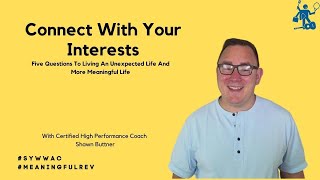
In this solo coaching episode of the "Start Your Week with the Coach" series, certified high‑performance coach Sean Buttner explains the first of his five‑C framework – Connect with Your Interests. He shares his personal journey from a childhood fascination with computers, through a 14‑year software engineering career, to becoming a professional coach, illustrating how following his interests shaped his professional path and sense of fulfillment. Buttner defines "well‑spring activities" as hobbies that replenish energy, resilience, joy, and presence. He then presents five reflective questions designed to help viewers identify, schedule, and deepen their own interests: (1) What activities bring you the most happiness? (2) How are those activities planned into your day? (3) Who can you discuss your interests with? (4) What would you commit to doing consistently for the next two years? (5) What obstacles prevent you from engaging more with your interests? For each question he offers practical tips – using a calendar to block time, seeking community, focusing on one pursuit to develop mastery, and recognizing hidden agency over one’s schedule. He emphasizes that cultivating interests fuels personal growth, creates a sense of legacy, and can lead to unexpected career opportunities, echoing Steve Jobs’ idea of connecting the dots in hindsight. The episode ends with a call to action for viewers to share their passions, engage with the community, and tune in to the next episode on the second C – Commitment to Action.
Chapters
What are the things that you nerd out about in your life? What are the things that you're obsessed about? What are those things that drive you to get up early in the morning or to go the extra mile or to do something completely ridiculous because you enjoy it so much? Today on Start yout Week with the Coach, we are going to be Talking about the second or this is the second video in the series, the first of the five Cs, which is Connect with your interests. And why is that so important? We'll get to that here in a second. Start your week. Great. Start your week with a coach. I'm your host, certified high performance coach Sean Butner. And we're going to talk about something that'll help you advance in your life this week. So let's go. When we connect with our interests, it's, you know, what I like to call a wellspring activity. It fills up our energy to be more resilient, to feel more excited about life, to feel that sense of joy, to be present, to feel progress, to grow. And a lot of times, especially in my life, and I'll share that with you folks today, it's led to places where I never thought it would. So, for example, growing up I had always been obsessed with computers and technology and video games and all that kind of stuff. So I would always just be around technology trying to figure it out for fun, right? And it just fascinated me. So when my grandmother gave us her old word processor when I was in, I think probably like fourth grade, I spent all my time trying to put games on it, trying to mess around with it, just try to learn about it. And that was that, right? So I've always had that kind of interest in computers. And so fast forward in high school I take, I think one semester of computer programming and fast forward through college and go to business school, get my graduate degree through business school, take another programming class in Java. And my first job after all that schooling was as a sophomore engineer. And I never would have guessed that just wanting to be around computers and goofing off would have led to a what is now a 14 year career as a software engineer before I went full time into being a coach. So, which is another interest that I had. So as I'm, you know, going through the early phases of my tech career and just learning and really becoming a professional at it, switching it from that interest and hobby into a job where, which isn't always the best thing, it kind of took some of the joy out of it, especially being on tight deadlines but because I had a broader experience than a lot of the folks that went to school for computer engineering, I could bring some different skills to it. And so in my first career, a lot of how I was effective and a lot of the value I added was noticing group dynamics, facilitating meetings, pulling requirements out of people, making sure everyone felt like they had a voice at the table when we were talking about things. And so that led to some initial success with the skills that weren't necessarily related to, you know, the actual job of coding. Right. It's a lot of those soft skills. So. And then I realized as I'm going on there that I really love mentoring people, right. I like hap, you know, having one on one conversations that are really super deep with people on, you know, what do you want in life, what's going on? Who do you think was the most quiet in that meeting the other day? Or who do you think, you know, didn't let anybody else speak, you know. And so as we thought or as, you know, we thought through this, I had an opportunity to get certified as a high performance coach, right? So at this point I had left my first job at Walmart, I had started my second main gig at Apple as a software engineer. And I'm like, I want to get into management. I think, you know, having some extra coaching skills is really going to help me. I kind of like that, those one on one conversations, it's something that I had, you know, talking with my best friend and from like kindergarten, you know, in middle school and high school, at night we'd walk around on these golf courses and just talk about life, you know, girls, what we wanted to do with their lives, what was in store for us, you know, there was no topic that was off limits and it's some of the most fun times that I've had. So fast forward again, certified as a coach, thinking I'm going to get going to management, you know, in a technical role. But I fall in love with the work. It reminds me of those times on the golf course and the impact and the conversations. It's just something that lights me up, right? And to this day, when I talk with potential client, when I actually talk with one of my clients, when I talk with any of my friends and we get into what we want in their life, it's the best day ever, right? It's the best experience. I crave this type of thing. And so if I can do that every day, it's a good day every day. So that's kind of not where I thought I would end up right. You know, I found that out as a. In my career as a technical person, you know, in software. I got into software after business school because I was just interested in computers. I went to business school because I thought it'd be, you know, kind of a bunch of different skills that would transfer because I didn't know what I wanted to do. But looking back, all of those interests, all of those decisions have brought me here, to where I feel very fulfilled, to where I feel very successful, to where I wake up and I'm really excited every day to do videos like this, to meet my clients, to spend time with my wife, to hang out with friends, you know, all that kind of stuff. And that's the power of following your passions, following your missions, following the things that are interesting to you and pull you, you know, and you think about all the time, right? And so that's why it's super important to cultivate hobbies, to cultivate these passions. Because a lot of times, it's like an onion. You peel back one layer, you get a layer deeper, and you realize something a little bit more closer to what you really want. And as a certified high performance coach, people a lot of times come to me to figure out clarity. Like, I want to do something bigger with my life when I don't know what that is, or I think it's my. It might be this, but I'm not sure. I'm afraid to take that first step, like. And so, you know, this is. A lot of my work is helping people identify what makes them happy, identify what is interesting to them, identifying the things that they nerd out with in their lives, and then helping them figure out how to add more of that into their life. Because all you do is work, and you don't cultivate these things that fill you up that really help you, you know, just feel like a human being. It can be really miserable, and I don't want that for you. So. Okay. That said, you know, with the first c of the five Cs of the meaningful Revolution framework is, you know, cultivate your interests. I have five questions for you on what can help you figure that out and add more of it into your life. Right? So the first question, question number one, is what activities, interests, or hobbies give you the most happy or give you the most happiness each day or each week? So what are you doing consistently? Is it, you know, you can see the guitar behind me right now. So I like to play guitar. That's another interest that I have. I like, you know, Messing around with computers. I like, you know, the coaching stuff is now my career. But, you know, I could talk about that all the time. I love talking and having conversations with people where they're passionate and you get to figure out, like, why is this so fascinating to you? What are those things for you? What is so fascinating? What is like your catnip? What is drawing you? And while you do it, you just light up and you feel invincible or you feel in flow and it really helps you. It's such an important thing to at least know that or connect to that pretty regularly. Right. And are you doing that each day or each week? Right. So whatever works for your schedule, of course. But if we could get you do it every day, you are going to feel happier, more confident and just more zestful with life. Right. And that's a good thing. Okay, second question is, what are those activities that really light you up and how are they planned into your day? Right. And I say planned because I know, at least for me, like, and I've resisted this pretty heartily, right? But I live and die by my calendar. So if I don't have rest and relaxation on my calendar, it's not going to happen because it's not a priority. It's not gonna, you know, my systems aren't going to ping me to say, hey, it's time to take a break. And so that's super important. So, you know, every morning I try to do at least 30 minutes of just goofing off on the guitar because I like music, I like playing music, I like performing music. My neighbors probably don't hear, but that's okay. You know, that's something I do for me to kind of get into the day to get pumped up, to get, you know, feel that sense of excitement again, that sense of connectedness, that sense of, you know, I did something that was exciting. So how are those planned into your day? Third question is who could you talk to about your hobby or interest or mission this week? Right. And is it, you know, going over minute details with your friends? Is it finding a community of musicians that you meet, you know, in your community or in your neighborhood pretty regularly or online or wherever that is for you? You know, who are you talking with about these types of things regularly? You know, because it's one thing to have an interest, but if you're not sharing with people, if you don't feel like you're in community, you're helping, you know, people figure it out or figure out the next level for them because you are a Little bit further ahead on the path. You know, you have that sense of progress. And like, I remember when I started to first, like, brew beer and it tasted like garbage, but then, you know, I've been doing it for three years. And then I, you know, went to the supply store where they. You get all the grains. There's somebody starting out just like I was, and I gave them some advice to help them have a better quality, you know, beer crafting experiment or whatever, just off the top of my head, you know, so that they're not so, you know, so you can share that knowledge and that, that sense of joy that you get from that activity. So, yeah, really think, who are you regularly talking to about your hobbies or interests and missions every week, and are they sick of you? Which is kind of funny. But maybe getting more people and growing that community can really help you feel that sense of connectedness. And that's the reason for that particular question. Maybe another way to look at it too. Fourth question here is, what is something you'd love to do consistently for the next two years? Maybe you're like some of the people that I work with, who I call them creative types. And all they do is have 500 million things that they want to get accomplished every day. And so every day it's a new idea, but it's a new car to chase. And what ends up happening is you have so many different things. You haven't really focused in on one thing to really get that sense of progress again, to get that sense of community, to see if you actually really love it or not. Right. I think there's nothing wrong if you're that type of person. So I'm not trying to say you only have to pick one thing forever, but I find if you can go deeper into a topic in about a year or two timespan, that you develop some mastery, you get some of that. It helps you in different areas of your life too. You know, I learned when I was learning how to make candy when I do this other thing I needed, you know, I can borrow this technique and help you cross pollinate, but you really want to stick with something for a while to feel accomplished. Okay, fifth question for you is, what keeps you out from working on your hobbies, interests, or missions even more? And this is like, what gets in the way of it. It's like, well, maybe I work five jobs. And so I just, you know, I'm in survival mode. I don't have time to paint. I don't have time to, you know, roast coffee or whatever the interest is. And so that's something to note or it's like every time I get started, I don't have space where I can set up my little workstation to make furniture or, you know, so I maybe need to get a space or this is really important because so many times we don't realize we have a lot more agency and control over what we do and what's going on. So this is just kind of help tease out anything that maybe is holding you back or a lot of times it's like there's no nothing really standing in the way of me, you know, adding a little bit of gardening time every day, you know, especially during the spring and summer. So that can really help get your back in the game, get you connected into, you know, what really lights you up. So, you know, following your interests brings a lot of fun spice, a lot of interest and interesting things into your life. You never know where it's going to lead you. Like Steve Jobs once famously said at the Stanford speech, I think commencement speech, it's while you're living your life, you can't see how everything's connected, but when you look back, you can connect with us. So just like I shared in my story, it was, you know, talking with my friend in junior high and high school on the golf course, interested in computers, you know, figuring out coaching. Like, I don't like, I didn't really connect the dots that I love talking one on one with people that, you know, technology can really help fuel a career as I try to figure out, you know, more of how I wanted to leave a legacy. And it's the same with you. How are the things in your life helping you create the legacy that you want to leave? So go out there, guys, nerd out. If you have an interest, please share it below this video or send me an email so we could cheer you on. I'd love to help build and connect with the community in that way, you know. So next week we are talking about the second sea of Meaning, which is a commitment to action. I know you guys are going to really love it. I'm really super stoked to be doing this series for you guys. Also, either on the blog or below this video on YouTube, you'll have a link to the series. So if you want to see all the videos together, that's a way to do that. But until then, guys, see you guys next week. Take care. And this is Sean Butner signing off. Sam.










