Ways to Deal With Social Anxiety
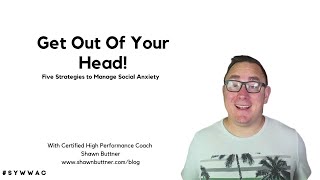
In this YouTube coaching video, certified high‑performance coach Shawn Buttner shares five concrete tactics for managing social anxiety, framed by his own journey from a quiet introvert in high school to a public speaker and tech professional. He begins by describing the four types of introversion and recounts a pivotal high‑school performance that taught him anxiety is a mental construct. Drawing on personal health routines, he emphasizes that physical well‑being (exercise, sleep, nutrition) underpins emotional regulation. He then outlines the "three‑second rule" for initiating conversations, advises focusing on one or two people at networking events to avoid overwhelm, suggests keeping hands busy (e.g., cooking, chopping) to calm the mind, and recommends systematic exposure therapy—gradually confronting feared social situations like open‑mic performances. Throughout, he references Tim Ferriss, Susan Cain’s Quiet, and his own coaching practice, concluding with an invitation to a free one‑hour strategy session for personalized high‑performance coaching.
Chapters
Hey everyone, welcome to start your week. Great at start your week with a coach. I am Shawn Butner, certified high performance coach. And this week we're talking about five different ways to manage social anxiety so you can put yourself out there in the world. And I speak to this partly because I'm a self proclaimed introvert. You know, we know that there are four different types of introvertism. One of them being an anxious type, one of them being more kind of daydreamy, one being just kind of reluctant and then one just preferring company, small groups, you know, to give you an overview, I've done a video on that I believe before. I'll put that below in the blog here. But why is that important, right? It's one thing to identify or self diagnose, but it's another thing to have it practically impact you, right? So if you've ever been at a large social gathering and felt the desire and need to have a job, right, so that you're a little bit occupied, it keeps people at a distance a little bit, but it also gives you something to do to kind of manage some sort of anxiousness that you're feeling, then you might be an introvert. And it's useful to have some strategies to help you navigate out in the world, right? And you're in good company. You know, on Tim Ferriss podcast he talked to Susan Cain who wrote a really fantastic book called Quiet the Secret Power of Introverts. I think I got that right. So quiets the main point and she talks about how we're all, you know, we all that introverts live in an extroverted world. And we need to recognize that in order to not, you know, feel bad about ourselves, to feel like we can contribute, to feel like we can actually step up and lead in a lot of things. And so it's such an important book and you know, Tim's interviewing it and he's like, yeah, you know, we have these family dinners or friend dinners. I'm so filled with anxiety that I have to like go to the bathroom five times to just kind of calm myself down. I'm always the one cooking. And I really identified with that. And it got me thinking like, you know, in my journey of overcoming social anxiety or at least having it affect my life a little bit less, I've learned a couple things and I think it's really important because you know, for me it really started with necessity. You know, I needed to figure out how to approach strangers and not feel like I was going to die. I felt like that Would negatively impact my ability to make friends, to live a happy life. And I recognized that in high school because if you remember me from high school, if you're one of my peers watching, you know, one of my old classmates, even probably some of my old friends, I was a fairly quiet person. I would tend to blend into the background. I would try not to rock the boat at all. I'm pretty sure there's a group of people that think I didn't speak at all because of just how quiet and reserved I was when I was younger. But, you know, the necessity came in when I realized that I'd be going off to college and I wasn't going to have my support group that I'd worked on since I was in kindergarten, right? So I had my close group of friends that were all going to a different college. And I knew, like last year that there was this feeling of like, I'm either gonna be lonely or I'm gonna figure this out, right? And that really weirdly put a fire under me to try to like, okay, I gotta do something to figure this out. And I had a opportunity present itself with my friend Sarah, who was running the. This, like, coffee club thing after school in the auditorium. And we were buddies, and she's like, hey, like, you know, we need poets, we need musicians. And I know you started to play guitar. Would you want to do like 15 minutes up on stage for this after school thing? It would really help me out. And I remember thinking about it, thinking about going through that experience. I feel like the sweat in my face and scalp as I said, okay, yeah, I'll do it. And at that time, I had only had like three months of guitar lessons. Could barely switch chords, definitely could not hold a tune, arguably still can't. But I have had voice lessons and things because I love music so much. And so music for me was a way to kind of get out of my shell a bit and run this experiment. That's how I approached it. Like, this is a life experiment where maybe if I can get up and this is terrifying and I do it and I don't die, then I know I don't die and it's going to be less impactful going forward. So, you know, I remember practicing a couple songs and I had what I consider a weird sense of music. I had friends make fun of me, and my close friends would always make fun of me for my choice of music, which really sucked. You know, it's something that I really was trying to connect with people and, you know, have that Regent but that's a whole other video, probably, but so practice these songs. And I remember stepping into the auditorium. You have that high school auditorium smell, which is very distinct. And I don't know how to describe it other than that. And I remember sweating bullets and my mom, my grandmother out in the crowd. There's probably about 50 people, parents and students and all that stuff. And I remember walking up on stage, and thankfully they had the bright lights on you, so you can only kind of see, like, the silhouettes of people in the very front row. Otherwise, you're just kind of. It's too bright. It was really hot. I remember sweating right away. I remember kind of goofing up my first couple of chords and then kind of choking on my words as I'm trying to, like, sing and play at the same time. And then I took a deep breath, like, okay, I'm here. So far, so good. Not dead. Let's go. And so I started going, you know, got into relaxed a little bit. Got kind of started singing a song that I didn't think anyone else knew, but it was cool. And I remember seeing this, like, punk rock kid in the front, very barely, and it looked like he was singing along to this song. And I remember the sense of relief, like, oh, like, this kid who didn't really pay attention to me thought he's probably too cool for me, was singing along, you know, And I had that realization that, oh, maybe more people are rooting for you than not. More people, when you put yourself out there, want you to succeed, want to see you, like, move forward, don't want to hurt you just because they're evil people, you know? And I know the Internet has changed a lot of that. This was before a lot of Internet trolls and stuff, but I still think that that basic belief is true, that most people want you to be successful and be happy. So I remember that. I remember finishing that and remembering, like, oh, like, I didn't die. That's really good. And it also. I realized that this was all in my head. And there was this psychological skill of being able to quiet or shut that off in order to do what you got to do. And so those are three things that I've learned from trying to handle my social anxiety. And, you know, it led to doing open bikes and getting paid in beer and street change and burritos and all that kind of stuff. You know, it led to this career where I'm talking to strangers in front of a camera, which is the really big head trip that I won't try to Psychoanalyze right here in real time. But it gave me a quality of life. It helped me connect with people in a more deeper way. As a software engineer, when I was doing that work in corporate, to really understand and connect with people and build allies, you know, and just kind of work the social aspect of being on a team more than just the solving, you know, computer problems. So, yeah, I'm very, very thankful for that experience. That was such a pivotal thing for me. And then again, you know, realizing that people are cheering you on, that you can overcome your social anxiety, and that it's a skill that you can hone. So I'm going to get into five different things that have really helped me in managing my social anxiety over the years. The first thing is, the first thing to do is to work out the emotions, right? The times when I've been the last or least anxious in big groups or social situations, as been when I've been really working on my health. So there's a period of years where I was marathon training and after you run like 13 miles because you don't want to die during the race. I guess that's a theme of not dying, trying to do hard things and not dying. Just are so tired that you, for me, it kind of worked out a lot of that emotion. So it's just kind of always just super chill. So I think that's really important. Are you taking care of your health? Are you eating right, sleeping well, drinking enough water? All the stuff we talk about in high performance that I'm always talking about with my coaching clients and making sure that we have strategies to make sure all those different areas are in account and taken care of and optimized. So really make sure you're taking care of your health. But work out the emotions is super important. Second is the three second rule in a fundraising or networking environment or, you know, you're going along with your spouse and you need to meet people. For me, I'll get caught in my head if I think about it too much. So if I see somebody that looks interesting and I want to talk to you, I do the three second rule, you just count to three, two, one, go and say something, right? And you realize that I've fumbled that enough times to realize that it doesn't really matter, right? People generally are accepting and yeah, you can only make yourself feel kind of weird about it for a while and you're like, okay, like, this is just what happens. You kind of give in to that. Like, okay, this is just where we're at so super, super helpful has helped me approach strangers again in these social situations and, you know, prevented me from thinking about, like, oh, they're gonna notice that I have something in my teeth and not tell me. And, you know, that kind of st. I also, as someone that is a little bit more introverted and prefers working in small groups or one on one, each time I go into, like a networking event, I will try to pick one or two people that I want to make a solid connection with. And that's a win for me, right? That grows my network by one or two people each time, and it makes it a lot less overwhelming in trying to manage all the different folks. Okay, number four, and this is something that Tim Ferriss mentioned in his podcast that I linked in the blog post with Susan Cain, is that, you know, get your hands busy, right? If you're hosting a dinner, you know, do cooking, chop vegetables for people, you know, clean up, whatever you gotta do. But sometimes, you know, through that again, that motion, you can kind of quiet your mind enough to enjoy the experience or to make that one or two, or meet those one or two folks that'll really connect with y'. All. Okay? And then we'll say number five is again, exposure therapy, right? You have to have a reason to. To face social anxiety. For me, it was going to college in my story, and then you got to get up in front of people, right? I did open mics in high school, in college that were really terrible, and these are all terrible, but I did it. And I learned a lot about myself. I know that I learned that I wouldn't die. I learned that I could improve and work this as a skill that again, has helped me face fear and helped me do tougher things in my future at that point, right? Which is now my past, which is kind of a weird thing to get into right now. But, you know, it improved my quality of life over my life being able to say, like, okay, this is anxiety. I have a couple of tools that I can use to kind of leverage it to move this around so that I can be present and be here and, you know, do something cool. So I really do think that those five things of to work out, be healthy, number one. Number two, the three second rule to not get caught in your head and just say hi or whatever comes out of your mouth. Three, to work a few people, not the whole crowd when you're in a networking situation. Four, to get busy doing something because that movement helps relieve the anxiety. And then five, to have your reason to address social anxiety and Just get exposure and prove to yourself that it's not as bad as you think. So those are my five things that really helped me deal with my social anxiety. It still comes and goes, ebbs and flows, but being aware of it and having these tools in my pocket have helped me really succeed in my 15 years in tech and now as a certified high performance coach. So there's that. If. And I just want to point this out too, if you're interested in having that one on one experience because you don't like big group coaching groups or big seminars and classes. I do offer one on one coaching and to qualify for that you apply for a free one hour strategy session. You can go to SeanButter.com book and or schedule. I'll put it below in the blog. Can't remember what the URL is off the top of my head, but what that'll do is we'll have a one hour conversation where we go through the science based high performance process. We take a look at your life, some areas for you to improve. You walk away with a plan, you walk away with some encouragement. And if we think we can work together and we vibe really well, then we can talk about entering a coaching relationship after that to get you to that next level. Because sometimes hearing or watching a video on YouTube or somebody's blog or video course can only get us so much. And you need that personal touch, you need that ability to ask questions, to get feedback in real time in order to maximize your growth and your potential. So I'd love to meet up with you. So just starts off with like a 10 minute questionnaire where we talk about your life. So when we do that free one hour session, we can hit the ground running. I have an idea of where the process might be able to help you the most. And also it helps me kind of weed out people that are just kicking the tires. You know, I don't, I love doing free coaching sessions. I don't love people that are just trying it out but not willing to do the work or have already decided that, you know, this isn't going to work for me, then I don't know why they sign up, but I get enough of those folks where I want to try to weed those out. So if you're open to some new ideas, if you're open to try some different things to change your life, if you're open to having a really good conversation about where you are in developing a plan for you to perform higher, please click on that link. Okay. That said, go live with more joy, more personal growth and more impact in your communities. I will see you guys next week. And this is Sean, but Ursuline hanging off. Take care, guys. Sam.










