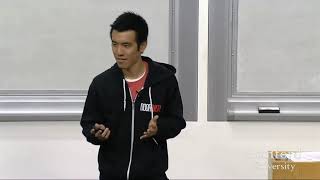
In this monologue, Stanley Tang recounts how, during his junior year at Stanford, he and co‑founder Tony Xu identified a painful delivery problem for small‑business owners by interviewing dozens of shop owners, including a macaroon store owner named Chloe. To test the hypothesis that a delivery platform could meet this need, they built an ultra‑simple landing page (paloaltondelivery.com) in an afternoon, listed PDF menus, and used their personal cell phone as the order line. The site generated real phone orders, which they fulfilled manually by driving to restaurants, using Square for payments, Google Docs for order tracking, and Apple’s Find My Friends to locate drivers. This "do‑things‑that‑don’t‑scale" approach let them learn the logistics, customer preferences, and driver assignment logic firsthand. Over a few weeks the call volume grew from one to ten per day, confirming demand. Tang distills three lessons: treat startup ideas as experiments and test hypotheses; launch quickly with a minimal product; and embrace non‑scalable, hands‑on work early to gain deep insight before automating at scale.
Chapters
It was my junior year at Stanford, and at the time I was really passionate about how do you build technology for small business owners. And I sat down with Chloe, the owner of Chantal Guyon, a macaroon store in Palo Alto at the time, just learning about what her problems were in general. I remember she took out this really, really thick booklet and she showed me pages and pages of delivery orders. And a lot of these orders she had to turn down because there's no way she could have fulfilled them. She had no drivers, and she was the one who ended up having to personally deliver all these orders. Over the course of the next few weeks, we talked to around another 150, 200 small business owners. And when we brought this idea of delivery, they kept agreeing with us, saying, yeah, this is a really big problem for us. We don't have delivery infrastructure is such a huge pain for us. There's not any good solutions out there. Which led us to wonder, delivery is such an obvious thing. Why hasn't anyone solved this before? Right? We must be missing something here. So we thought maybe because people have tried this in the past, but they failed because there wasn't consumer demand for this. So we thought, ok, how can we test this hypothesis? So we decided to create a simple experiment. We spent about an afternoon just putting together a really quick landing page. And when I went on the Internet, I found some PDF menus of restaurants in Palo Alto, stuck it up there, and then had a phone number at the bottom, which was our personal cell phone number. Actually, we called it palo alto delivery.com and this is actually what it looked like. Super, super simple, ugly. Honestly, we weren't really expecting anything. We just launched it and all we wanted to see was would we get phone calls from this? And if we got enough phone calls, then maybe this delivery idea was something worth pursuing. So we put it up there. We weren't really expecting anything. And we're driving back home and all of a sudden we got a phone call. Someone called, they wanted to order Thai food and we were like, oh wow, this is a real order. We have to do something about it, right? So we're in our cars and we're like, okay, let's just stream by Siam Royale, pick up some pad Thai, and let's try to learn how this whole delivery thing works. And we did. And the next day we got two more phone calls. The day after that we got five, and then it became seven and then became 10. And then soon we started gaining traction on campus with palo alto delivery.com, which is pretty crazy because think about it, right? This was a landing page. You had to look up PDF menus to place your order and they had to call in. This isn't exactly the most professional looking site yet. We kept getting phone calls, we kept getting orders, and that's kind of when we knew we were on onto something. So I think another key point to remember is that we launched this in about an hour, right? We didn't have any drivers, we didn't have any algorithms, we didn't have a back end, we didn't spend six months building like a fancy dispatch system. And we didn't have any of that. We just launched. Because at the beginning, none of that is necessary. Right at the beginning, it's all about testing your idea, trying to get this thing off the ground and figuring out whether this was something people even wanted. And it's okay to hack things together at the beginning. At yc, there's a mantra we like to talk about is doing things that don't scale. So at the beginning, we were the delivery drivers. We were customer support. We spent afternoons just going down University Avenue passing out flyers, trying to promote DoorDash. We used square to charge all of our customers. We used Google Docs to keep track of our orders. We used Apple's Find My Friends to keep track of where all of our drivers were. Just hacking together solutions, just trying to get this thing off the ground. Another thing about doing things that don't scale is that it also allows you to become an expert in your business. Driving helped us understand how the whole delivery process worked. We used that as an opportunity to talk to our customers, talk to our restaurants. We manually dispatched every driver and that helped us figure out what our driver assignment algorithm should look like. For the first few months when we got started, we would manually email every single one of our new customers and we would personalize all these emails. If I see someone order chicken skewers from orange Hummus, I would say, oh, I love orange hummus. How are chicken skewers? Feedback like that was really valuable and our customers really, really appreciated that. And now, of course, we've scaled across different cities. Now you have to worry about building out automated solutions and dispatch systems and figuring out how do you match demand and supply and all that fancy technology stuff. But none of it matters at the beginning, because at the beginning it's all about getting this thing off the ground and trying to find product market fit. So there's three things I would say that I learned from doing. Doing doordash is first test your hypothesis. You want to treat your startup ideas like experiments. The second thing is launch fast. We launched in less than an hour with a really simple landing page. And finally, it's okay to do things that don't scale. Doing things that don't scale is one of your biggest competitive advantages when you're starting out. And you can figure out how to scale once you have the demand and maybe once you've scaled, then you go get that ice cream. Thanks.