5 Reasons New Businesses Fail | Webinar | BOSS Startup Science
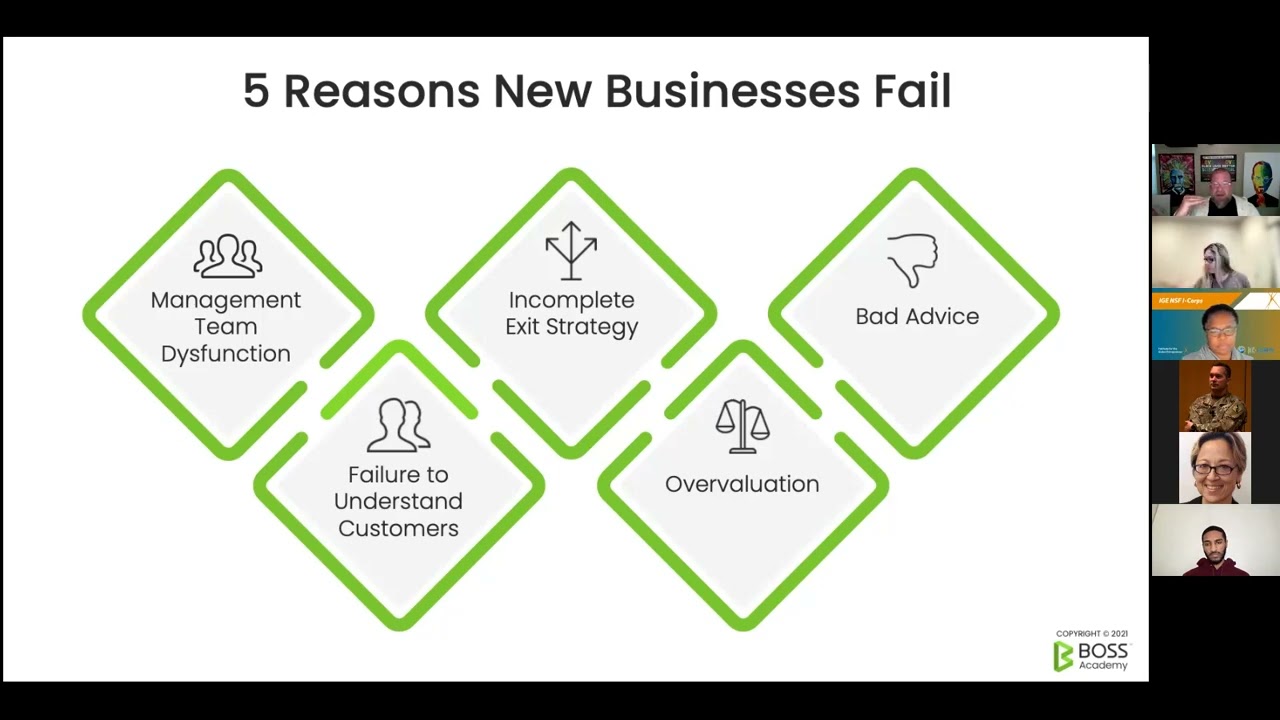
In this 90‑minute webinar, entrepreneur‑investor Gregory Shepard walks the audience through the BOSS Startup Science framework, which maps a startup’s journey from vision to exit. He outlines a seven‑stage lifecycle (vision → product → go‑to‑market → standardization → optimization → growth → exit) and highlights the most common reasons new ventures stumble, such as dysfunctional teams, weak customer insight, missing exit plans, overvaluation, and poor marketing. Shepard then dives into practical tactics: hiring the right people, instituting Kaizen‑style standardization, and managing valuation and exit timing. A key insight is the “ticking‑time‑bomb” view of growth businesses—most founders should aim to exit around $50 million ARR/valuation before market contraction sets in. He demonstrates how to use Crunchbase to study potential acquirers, assess ecosystem saturation (using the social‑media platform landscape as an example), and recognize when an industry is moving from expansion to contraction, signalling it’s time to sell. Shepard also shares personal anecdotes about failed exits, dilution, and the costly need to rebuild a customer base, framing these as avoidable mistakes. Throughout, he ties the methodology to a broader mission of reducing wealth inequality by improving entrepreneurial success rates.
Chapters
Innovation Capital. And, you know, we are blessed this evening to have Greg Shepard speaking to us about a project that he has embarked on. So Greg is an incredibly accomplished entrepreneur in his own right, then an accomplished investor. And now he's kind of in giveback mode. And he realized the thing that he could give back that was most valuable would be his experience and his wisdom. So they're building out this Boss Startup Science project, which started as a curriculum and is now becoming a computer platform that walks entrepreneurs all the way from having an idea to getting to an exit. And today what Greg's going to do is give us a little overview of the project. But it's open to entrepreneurs from campuses and from off-campus and from all walks of life. We are funneling young companies that Catalyst is working with that seem very promising into it. Sorry, I'm, I'm at a garage. So with that, I'm going to turn it over to Greg, and I will go on mute to get the car noise out of the background. Greg, thank you for doing this.
Oh yeah, it's, it's absolutely an honor. Can you guys see this, the right screen here? Do you see the—
Yep.
Yep.
OK, so I'll tell you a little bit about, you know, who I am and that sort of stuff, and I'll try to make this part a little brief because it's kind of embarrassing. I feel like I'm bragging about myself, so I'll just kind of go over it, but I started building companies over 20 years ago. I've built and sold 14 companies across different forms of technology. I've won 4 private equity awards for transactions between $250 and $1 billion. I have a Forbes book. I've done 100 articles, all different articles all around most major publications. I've also invested in and funded and exited 14 companies that have sold. And so I have a pretty good track record. There's this thing that was bothering me. I spent a little bit of time in politics and I was trying to figure out how I could help those people that were marginalized. And so I did a little research and during my stay in politics where I was the chairman for congressional candidates and senators. And what I found out is that 4% of people have the ability to get out from check-to-check living. And out of that group of people, 98% of them do it through some form of windfall. And out of that group, 75% of them do it by starting a business, but 90% fail trying to do that. So then what I did is I said, okay, well, let's study why these entrepreneurs were failing. What were the main reasons why they were failing? And some of the data that came up was really upsetting to me in terms of the inequality from female founders and people of ethnicity and immigrants and all this stuff. It was just like, a drastic difference between those people that have the ability to succeed and those people that don't. My background is that I have autism and dyslexia, and I wasn't able to go to school. And I struggled my own way, and I spent a lifetime trying to get where I am. And I look back and I see that 80% of the entrepreneurs out there have some kind of neurodiversity. And I thought to myself, well, this could be fixed, right? Because most of this has to do with education in one form or another. So this is the data that I found. This was something that was— I mean, this really bothered me. And so what I said is I said, okay, my objective is to fix income inequality and to make sure that the entrepreneur matters and they don't make the mistakes that can be avoided And by doing that, help with wealth inequality, really try to rise people up. Because the data, the last data I just found out was that 67.7% of the United States lives check to check. And that shouldn't be the case in the richest country in the world. And so I said, okay, well, what can I do here? And I coined this this word altruistic capitalism. And it's the concept of using capitalism for altruistic outcomes. So leveraging the concept of capitalism to create a better world in the future, and entrepreneurs do this. So I came up over the last 20 years with this thing, the Business Operating Support System. That's what BOSS stands for. And this methodology was something that I used myself in all of my startups and all of my investments. And then what I did after we finished the study is we started aligning the study to BOSS and making sure we didn't miss anything, making sure that if there was a point in which an entrepreneur was going to fail according to the data, that there was something baked into BOSS that would help them understand that that was happening, that that minefield that they're in is right there. And also at the same time, that they have the ability to navigate around it if they just knew what was coming. We created a series of different courses. Initially, when I started, I was just doing lectures at universities and I was just trying to help entrepreneurs. And what happened was, is they were all saying, you know, can you help me? Can you help me? And I got overwhelmed and I said, well, if I just write all this stuff down and create a curriculum, then the entrepreneurs can do it whenever they want. These courses are all stuff that came out of my head because I have the experience, but the courses were designed by one of the people that we have is a CIA, ex-CIA person who writes curriculum, retired. Another one is a fighter pilot who wrote curriculum for fighter pilots, and another one is a university professor who specializes in how people learn. What we did then is we put together these different courses designed for different ways of learning. So it's watch, listen, and read. So you can do it any of those ways. And then there's actual practicum in there. So as you're going through the courses and answering questions, you're building your market sizing. When you're done, your market sizing will show up in your inbox. As an example, these different courses will show you how you're proceeding, how you're going through the courses. And it's centered around making sure that you don't make these mistakes that are really obvious to those of us that have done it a bunch of times, but nobody knows if it's your first time trying to do a startup. When we went through these different ways of people failing and how they failed, we tried to put together some themes, some different— some things that were cued in, that were specifically kind of rallied up a lot of stuff. The first one is the management team dysfunction. There's a lot of pieces that are included in this, and the primary thing is that what we saw repeatedly was that a startup entrepreneur would get a company and they would go hire a really experienced executive. That experienced executive doesn't have experience necessarily working in a startup. They're used to working in corporate, and they're used to hiring people underneath them to actually roll up their sleeves and do the work. So as a result of that, you see that the, the management team is spending more money than they should. They're not getting the people that they want to get, and there's misalignment from the perspective of being a real startup, a real startup, you know, rolling up your sleeves and getting in there and gritty and making things happen. This failure to understand customers, this was a really big deal. What we do with BOSS is you create an ecosystem. The ecosystem allows you to understand who is connected in some way in the world that you're in that we call an ecosystem. And that's made up of different components, customers, partners, acquirers, different people that work in the ecosystem, watering holes where the people that you're trying to sell go to, go to, so on and so forth. The next one was an incomplete exit strategy. I can't tell you, I probably— I look at, I think, about 100 deals a month. And when I look at these deals, I have seen nothing, not a single one with an actual exit strategy. The reason why this is so important is because if you're trying to cross the ocean and you're 1 degree off, you're going to end up in a different continent. The exit strategy tells you broadly, generally where you're going all the time. Investors that invest in companies don't get their money back until you exit. So if you don't have an exit strategy, if you don't have a plan in mind for that to happen, then your investors are going to start getting anxious. The other thing is that if you don't have an exit strategy in mind, you may be building a company that isn't fit for the person that's going to acquire your company. When you go out there and you're trying to build a company to sell, the acquirer usually buys a company to either make or save money on their side. And if they're making or saving money on their side, it means that there's a connection to the customer. If your customer isn't the same as your acquirer's customer, they're not going to be interested in you. That's because companies buy companies because they already have a lifetime value established for that customer. They already have a customer acquisition cost. That customer acquisition cost happens once. The way that they make money on buying companies is by selling other products to the customers they've already paid for, raising the lifetime value of that customer. So if you don't have an exit strategy, you don't have your ICP, your ideal customer profile, and your persona aligned with the buyer of your company. If you don't have that happening at the same time, you're going to be building a company and selling customers that they aren't interested in, and your exit's going to fail. That's just one example. There's a whole list of examples, uh, to help you understand why you should have an exit strategy. We don't have enough time to go over it. It's all in the courses. But the other thing I want to point out is the next square, overvaluation. Overvaluation means that your company is selling for more than it's worth. So initially you may have like a million-dollar valuation in your company, and it's very tempting to try to prevent the dilution of your business to other investors in the, in the stack by valuing your company higher and then making it so that everybody gets a bigger piece. But it doesn't actually work like that. There is market valuation. People understand the value of companies generally. If you have investors, you may get away with overvaluation initially, but this thing builds on itself over time. It builds on itself, and investors like me may do the first round. You come back to them in the second round and they look at the valuation and they say, there's not enough room in here, so I'm not going to go ahead and put money into it. And then you run out of money and the company dries up. That's an example of overvaluation. Another example of overvaluation is when you go to sell your business and the value of the company has grown so much that it's not— it just doesn't make sense for somebody to buy at that value. That means that the company ends up getting purchased at a lower value, which you didn't plan for the whole time, and everybody is upset because they didn't get the gains that they had hoped for. And now you've created a scenario where the transaction may not even go through at all. In today's market, as an example, you know, you see what's going on in the stock market. Private equity companies are offing assets that have overvaluation at 40% discounts by the masses right now. Those founders are in— I mean, that's bad shape. It's a bad situation. Many of those companies will just go out of business. So protecting the valuation isn't growing the valuation out of control. Protecting the valuation means keeping it in balance with what is, what is good for that market. When you understand your exit strategy, you understand the multiples on either top-line revenue or bottom line that you should be working on. Those multiples— so let's say you're making $1 million a year and the multiple's 10, you have a $10 million company. Or let's say that they're giving you 20 times bottom line and you're making $500,000 a year. Those are— that's how multiples work. Now, what drives multiples are what's called valuation drivers. Valuation drivers are growth, margin, and retention. Now, if you haven't planned your exit, you don't know what growth, margin, and retention numbers need to be for your acquirer. And therefore you don't understand what the multiples are for that market. And this is not something you can fix when you, when you're trying to sell your business. It's way too late. You have to do this from the very beginning all the way through to the exit. The last point that we saw over and over was just bad advice. Um, you know, there's a lot of people out there, everybody has their opinions. Sometimes somebody's talking to a one-hit wonder who built a company and sold it, and they give them a bunch of advice. The majority is actually investors. The investors are trying to build a company that makes up for their 90% loss rate. So the way that they think is, I'm going to throw money at a whole bunch of deals, and I know that 10% of those companies are actually going to be successful. So they try to make it up with that 10% by piling money in and telling the entrepreneur to grow, grow, grow, grow. And it's a reckless process, and that's bad advice that causes the overvaluation and drives the whole company down into the ground. So these are some of the, some of the things. Now, this is something that took us a long time to figure out, and it was a real epiphany. And the concept is that there is a life cycle for startups. And it's important to have a lifecycle because you don't know where you are if it's a map, right? If building a company is like a GPS, right? You have to know where you are, you have to know where you're going. So where you are is where you start, where you're going is your exit, and then you follow the directions. So what we wanted to do is show entrepreneurs this lifecycle to show that there is a stage that's called vision, there's a stage that's called product, go-to-market, standardization, optimization, growth, and exit. These little green dots in between are the opportunities to raise cash after you validated the thing before and show what you're going to do with the money in the following steps. This lifecycle should take between 3 to 5 years. That's how long it takes for me and the entrepreneurs that go through this process. It works like this. In the very beginning, you're putting together your structure. You know, how your company works, what your key performance indicators that are directly tied to your valuation drivers, which I spoke about earlier. Your North Star is your guiding light. It's, it's like when you're crossing the ocean and you're focused on the North Star and you know you're always going the right direction. There's a lot of pieces in there. All this stuff is inside of the courses, okay? So I'm going over quickly, but don't worry, it's inside of the courses and they're only like 2 to 5 minutes each. So they're made for entrepreneurs like me that has the attention span of a fruit fly. Right over here you have strategy. The strategy defines what the organization needs to do and when it needs to do it, with who, and so on in order to reach its goals. Execution is actually doing the work. So this is grinding up your sleeves and doing the work. Strategy is good for executives. Execution seldomly works for executives that aren't willing to grind and get in there and do the work itself. Standardization is extremely important because standardization ensures that everything is always going the same way. Otherwise, what you have is you have duplication with dilution, meaning every time you start to stack rank people underneath you, the communication flow is broken like telephone tag, and it's broken and it's broken and it's broken, and now your KPIs are off because everybody's doing things differently. 33% of the cost of growth— uh, sorry, one of the highest costs of growth is payroll, and 33% of payroll is what it costs you to get an employee productive. So if you're paying somebody $100,000 a year, $33,000 of that is just burned up, not including recruiter fees to get them productive. So there's a lot of investment. Now, if you haven't standardized things, it's going to take you longer to onboard people. And when they're onboarded, their performance is going to not be the same as the other people in line. So standardization ensures that the process is duplicating itself without, you know, producing bad cells, right? It's producing good results, good people that are following the same protocol. So when your data comes in, you know, across the board, that your numbers are correct. If this person's doing things this way, and that person's doing things that way, at the end of the day, the data is not going to line up and you're KPIs are essentially useless. In addition to the fact that it's going to cost you a ton. And when you get to an exit, if you haven't standardized— they call it documentation— if you haven't standardized your business, when you go to show your business to somebody and you go through due diligence, they're going to ask you, how does it work? And what they mean is detailed, how does it work? They're trying to find opportunities to optimize where there are redundancies that they have already. And if you can't spell out for them how the company functions, it's not going to work. The example I give to people is like trying to put together IKEA furniture without instructions, right? I mean, IKEA furniture is hard enough with instructions, and if the sequence isn't right, the furniture just breaks. It's the same thing with the business. Kaizen is continuous improvement. This is where you get into optimization. This is where you actually start really focusing on what you can do to make sure that people are doing things faster and more efficiently. And the math that goes along with this is, is also very simple, and that is that if somebody is doing things 5 times a day and each time it takes them 10 minutes, that's 50 minutes. If that activity is happening with 10 people, you can see that you're talking about close to 10 hours of work, if each one of these people is getting $100,000 a year, that equals a wage, right? So you can see what the efficiency or the non-efficiency costs, waste costs actually are. You get that from standardization. You look at your standardization and you can start making continuous improvement by looking at your standardization and using numbers to calculate the cost of the inefficiencies. And that goes into the, the scaling up, what they call scaling up. Scaling doesn't mean that you're just growing. That's not scaling. Scaling means that you're getting economies of scale. That means that your costs are here, your income is here, and it actually should start to peel away, not parallel. It should start to peel away like that. If that's peeling away like that, it means that you've done kaizen appropriately. This is where you can sign up. Um, that URL and that information is also in the chat, so anybody can go in there and do that. And, um, this has— there's blogs, there's webinars, you can follow us on social media. I have a Forbes radio show that has some pretty exciting people on it, um, and I write articles every month. We do webinars all the time. There's a blog. The website's really, really useful, and I hope this was helpful. I was trying to give everybody a quick overview of some of the basics because I didn't want to go in too deep. I think that we should set up a series, and I can actually go over the courses one at a time and teach everybody in a series of different courses. I'm— I welcome anybody has any questions about anything. Um, my personal story— everybody wants to know my personal story, so I'll just tell you. Um, you know, I grew up, uh, poor. Uh, we lived in tents for a while. Uh, I did a TED Talk on this also. I, uh, built the company, my first companies, from scratch and made it to where I am, uh, the hard way, which is what I'm hoping I can prevent you guys from having to go through, um, but by, uh, coming up with these courses and teaching everybody everything. Are there any questions?
Hey, Greg, it's Scott. First off, not a question but a comment. You know, since we've got so much leadership here, the goal of this abbreviated talk was for you guys to go out now and make sure that all of our young entrepreneurs in these organizations know that this is available. And I think Jill is recording it, so it's available to them We'll figure out how we make it available to them, and then we'll push it back out to the invite list so they can see it, and then we'll figure out the right way forward.
Okay, and Elliot, Elliot had a question. He's got his hand up.
Yeah, Greg, thank you very much. Very informative. And, uh, me coming with my, you know, I do have a business, but also with the Army Reserve and all my Army experience, it really hit me what, when you're talking especially about altruistic capitalism and how to get these communities into successful businesses, it's In a lot of ways, it parallels some of the leadership training issues that we try to find in the military, that certain skill sets, not just to run like a successful company from your viewpoint, but just run a successful organization. And it did make me think that, you know, early education or the high school stuff doesn't teach those skills that people need to be entrepreneurs. And I didn't realize until I was an officer how much I learned by working my mom's print shop as a kid. that you do learn a lot by actually owning your business and your capital, which makes me kind of wonder too. I understand the point of exit strategy and why we do it, but when you do that, we are going to create a class of wealthy people that'll just kind of move out and move on. Whereas if you build a sustainable business that actually can build generations that learn these skill sets of owning a business and owning capital and knowing how to run organizations, it's almost like a different strategy in itself. And I don't know if you even think that's one worth pursuing or— I mean, because altruistically it looks like it'll benefit more than making more rich people, it actually trained people to know how to run an organization and build companies on their own and grow from there. I know. Just curious about your thoughts.
Yeah. So to your point, you know, in the study I did, I found out that, you know, typically if somebody has wealth and they're a new wealth owner, they can keep wealth for 4 generations. So you're changing 4 generations deep. If those practices that the people learned are passed from generation to generation, then you can build a really good company. So, I mean, a really good future for people. Also, to your point, the, the, the main gravity of this in a lot of ways is to teach people. It's a teach a man to fish kind of scenario, right? You're teaching people how to, how to make themselves successful. All you have to do is have an idea, and this program is supposed to help you take that idea into something that creates success for you in the future. The other thing that I noticed is that when I started doing the research, I mean, you have people like Elon Musk and Steve Jobs and Richard Branson. I mean, the future of our country is made out of entrepreneurs. It's not made out of big corporate. Big corporate buys the stuff from that entrepreneurs engineer and build. So, you know, I feel like this is an opportunity for me to contribute to the future of our of developing a better future, right? I mean, sustainability and all these things, they're all coming out of entrepreneurs. I mean, Elon Musk, there were other people with electric cars, but he's the one that turned it. Now everybody's making electric cars and solar panels and Tesla Powerwalls and so on and so forth. And that's just an example. And if you think about these entrepreneurs that create these opportunities, it's like a drop in the pond. The drop is a big disruptor, but the circles, these circles representing opportunity get bigger and bigger outside. So if you think about what happened when Steve Jobs introduced the iPhone and that little drop happened, and then, I mean, all of the things that you see, social media included, wouldn't even be there if that phone wasn't there. So you can see how those circles of opportunity get bigger and bigger.
That's great. Thank you.
Yeah, thank you. And thank you for your service as well. I mean, I love what I'm doing here. I really do. And I'm passionate about it. And I hope that, um, I hope that, that everybody here starts to utilize this, you know, utilize this to help these entrepreneurs move their life along. Any other questions?
Hey, Greg. Um, first of all, nice to, nice to meet everybody virtually. Nice to meet you, Greg, virtually. On the hiring, I've fallen into it myself in that trap where you hire overly experienced and the resumes are fantastic and they've been— the individuals that I've hired, um, have excelled in their roles in larger companies. Intel, IBM, and folks like that. I have found in startups that sometimes when you bring executives on at that level that have had tremendous success, even in startups, I will say, but when I say that, they've been part of startups that had, you know, 100+ people and a pretty substantial amount of funding. You know, I found that doers, especially in the early, early stages, are paramount, but it's also you need doers. To your point, they— it's that ramp time, so they have to have enough domain experience or enough drive and a little bit of domain experience to sort of sprint to get to where you need, need them. How do you strike that balance, um, on the hiring? Um, and how much skill do they need, or how much time do they need in the role or in the, in the specific domain that they're— that you're going to be hiring them for?
So to me, there's a difference between a leader and a practitioner, right? So a leader is somebody that leads people, and a practitioner is somebody that does the work. You don't need leaders early on, not very many, and you don't need them until you need them. So there's a stage in the life cycle, like a lot of entrepreneurs, they'll hire marketing people right out of the gates, but they're still a year away from their go-to-market strategy. Right, so you only hire the people that you need at the time you need it, and you start with practitioners. The data says that about 87% of leadership comes from people that started as practitioners, so the popular way to go through a startup is to start with people that aren't leaders and develop them into leaders over time. So personally, what I do is I find people like Jill, who's on the call right here, who's worked with me for I don't know, 18 years. And, you know, you find people that you're— that you're— this person is really smart, they have the ability to learn, and you understand if they are somebody that is more strategic thinking. So more of a visionary versus a practitioner, somebody that can actually— that actually enjoys doing the work. One of the things that I do when I talk to people is I say, what do you love to do? People are usually good at what they love to do. So I ask them what they love to do, and if they say, I like leading teams, and it's an early-stage company, not a fit. If they say, I like getting into spreadsheets, and I like, you know, writing content, and I like this, and I like that sort of thing, that's what you need right now. One leader can support a lot of practitioners, and some of those practitioners will definitely want to move up. When you hire in leadership at the top, you're closing the opportunity for the practitioners. That costs motivation.
Yeah.
Right. So if instead what you do is you say, okay, it's, it's the world's your oyster, everybody has a chance, you can move up, it's all open to you. If you can't find somebody, then you move it in. In the course of a startup too, you know, there's a case where you have the right person in the wrong place and the wrong person in the right place. And sometimes you're hiring people and you're— you sort of cross-train them, right? And when you cross-train people, we call it a draft. So the concept came from the military where, you know, you get drafted, you disappear, you're working, you come back, and your life is supposed to be back to the way it was. So what we— what I'll do is I'll say to somebody, right now I'm going to draft you and you're going to work in this other functional area for a little while. And that functional area is going to get you cross-trained, and that gets you sort of some insights into understanding where they're really good and where they enjoy being. If the key here is also to remember that people won't stay if they're not happy, it doesn't matter how much you pay them, right? They'll eventually leave.
Agreed.
So you, you need to figure out what they want to do is the primary thing. What do you want to do? What do you enjoy doing? Sometimes You meet somebody and they just want to put on their headphones and work, and other people want to be on Zoom calls all day, right? So it depends on that person and what they want to do. Some people love spreadsheets, some people like Word documents. So, you know, you work through it and then you try to figure out what their, what their specialty, what their superpowers are, and then you focus in and feed them what they already love, and you will have success over time.
And I appreciate that. Thank you. Sometimes it's hard to suss that out, but, um, but I appreciate all your feedback there. It's definitely helpful.
Yeah, the one of the keys to doing that is the North Star, right? In the North Star, you're saying what your company is, why should somebody be interested in buying your products or services, who are the people that are going to be buying your company, when are you going to sell your company, how much are you going to sell your company for, and all of those things. And the motivation there is that everybody has complete alignment. Alignment equals speed. So to your, to your point, the way that you can suss that out is by working on alignment. As you work through alignment and you start to get people more and more aligned and you make— and you create an environment where it's okay to be honest, right? It's okay to say, look, I don't like what I'm doing right now. I like what that person's doing. You're like, okay, well, let's see if we can make that work. Early on, you just tell the people, and I've done this. I mean, Jill's been through 4 or 5 different functional areas, and I would, I would say, listen, I'm gonna put you in here for a little while because that's where I need you, but if you're not happy, we can try something else. As the company grows, opportunities start to spring up. But to what I said earlier, if you hire good high-level executives, like really experienced high-level executives, You're closing off a lot of the motivation that's going to make these people work really hard to move up. You know, it's, it's really a downhill battle, plus the fact that, you know, they're not going to be the people that are going to roll up their sleeves and get into the grind of a spreadsheet or something.
That's right.
You know, in the background, you guys, I'm showing you some of the, some of the classes and some of the things so you can see that. It helps you. And now I'm gonna dive a little bit into why entrepreneurs fail. I think this is really useful, and then we'll go back to questions again. So when you look at these 5 core reasons why entrepreneurs fail, it's really easy to say, oh, well, they ran outta cash. Well, the question you have to ask is, why did they run out of cash? You know, did they run out of cash because the investors weren't interested? And then what you end up going back to is overvaluation and all of the things that I talked about before. It's not as simple as you ran out of cash. It has to do with why did you run out of cash? You always want to use the tool 5 Whys. The right team. So this is— we spent a lot of time on this already. You guys got that down. Pricing and cost issues. This is a substantial issue. This has to do with understanding your customer. Sometimes people overprice, sometimes people underprice. Most of the time people don't understand, understand what's called unit economics, which is the cost of what you're selling and the cost of selling it and the cost of operations coming out of the whole product. Most of the time what they'll do is they'll say, well, you know, I'm going to sell it for this and I'm buying it for this, or it cost me this to make it, and they're not incorporating the cost, what's called cost of So cost of each functional area. I've talked about functional areas, so let me just drop on that a little bit to help you guys. There's core 4 functional areas, okay? There's sales and marketing, there's service and support, there's product and engineering— and product engineering goes through everything— and shared services. That's IT, tech, legal, HR, all that sort of stuff. So these 4 functional areas directly tie to the valuation drivers. So if your valuation driver is growth, your top-line growth, that's sales and marketing. If your valuation driver is retention, then retention is service and support. Margin is shared services because that's where finance lives, right? So the 4 functional areas that are aligned are aligned specifically to the valuation drivers so people understand what they're, they're supposed to be doing. The not the right team thing, when you dug into that— so we asked 1,200 entrepreneurs that failed, we asked, why did you fail? And they gave us a lot of data. And when we dug into it, not the right team, they, they didn't— they realized they didn't even understand what they were supposed to be doing. They didn't understand how they contributed to the success of the company. But if you divide it in those functional areas, you can align it directly with the valuation drivers. So they understand exactly what they're supposed to be doing and exactly how that contributes to the company overall. Product without a business model. This is the, the biggest thing. This is huge. I compare this to not having an exit strategy. You would never build a product without a customer. Why would you build a business without a buyer? And knowing who that is up front. This is the same scenario. These are people that have, have this great idea, and then they build a product, and then they go try to find out people that buy it. What you need to do is you need to have a concept, build a user advisory board filled with industry people and customers. Those people will validate your product by buying it at the end of your product cycle. If you can get past the point where you've built a list of people that are future users, right, of your software or whatever, whatever it is that you're doing. And then you're taking them along the ride, you're showing up, you're getting feedback. Hey, how does this look? Okay, let me fix that. How does this look? And at the end of it, those people buy your product. You have— you're validated because the exact target customer that you're after bought your product after going through the journey. Poor marketing. This is really big. And a lot of people spend money on search, social display, things like that. Those forms of marketing have huge customer acquisition costs. They also don't usually bring much retention, right, because they're impulse most of the time. So poor marketing means understanding the narrative. So how you're talking about your business, throughout. That narrative should weave in and out of all of your messaging. We have courses on all this stuff, just to reiterate that. Ignoring customers— this is a really big thing nowadays. This doesn't happen as much in big companies. You know, every time you walk out of a store, they ask you for your feedback. You go to a restaurant, they ask you for your feedback. You use software, they ask— they're hassling you constantly for your feedback. That's because this is so important— understanding that customer. And I don't mean understanding them just once. The customers change, environments change, so you constantly need to make sure you understand the customer. It's really important to make sure your product people get the direct delivery of customer feedback. And customer feedback happens in chat and email, but the customer feedback people, the support people that are inside there looking at the business and dealing with customers When they have a customer on the phone, even if the customer is complaining, even if they're trying to cancel, or a new customer comes on, you need to do a retrospective to understand what happened so that you can make sure that doesn't happen. Because as my mom used to say, if you see one cockroach, there's thousands in the wall. So if you see one customer that's unhappy, I guarantee you there's more than that. Lose focus. This is a big one because Entrepreneurs have— investors call it shiny thing syndrome. And so you see entrepreneurs going from pivot to pivot to pivot, because entrepreneurs, we're all the same. We all have— we see opportunity everywhere. And in your own business, the more you get into it, you see opportunity here, you see opportunity there, you see opportunity there. Stay focused on your North Star. Stay on the map. Stay where you're supposed to be. If you're going to make a change, Really, really think through it. Don't just make impulse changes and don't add unnecessary things that haven't been validated by your user advisory board to your product. Make sure you only build what they want. The big mistake that people make in the process of building a company is they build the entrepreneur's vision instead of the customer's pain points. So your vision kicks it off. But from that point, from that minimal viable product, from that point forward, everything you build should come from your customers, not from you. You have to let go of that as an entrepreneur. Lack of passion. Don't start a business that you don't have passion in. Because it's hard to start a business and it's a brutal place. And if you don't have the passion, you just won't stay alive. And that's where burnout comes from. And the pivot goes back to, you know, having shiny thing syndrome. And I hope that helps everybody. That's the end of the presentation. Are there any other questions? I got a question. Let's do it.
All right.
I just want to say nice to meet you guys, by the way.
Excited to be here.
So my question was, Um, pretty much about like valuation of a company. Like, how do you come up with, with the right pre-money valuation for, for an early-stage startup? So, uh, the market— this changes all the time. Right now, um, pre-revenue early-stage companies that are in product are typically— well, it depends on the industry. So what's your industry? Um, adventure sports, uh, outdoor recreation/adventure sports. Is it a software or is it a service?
Uh, physical product.
Okay, so valuations on that are gonna be lower, probably $500,000 to $750,000 for an early-stage business. Um, the way that they work is that— I'll tell you the, the economics behind it, how it— how mechanically it works. That'll help you out with it. Okay, so when you're doing your exit strategy, if you see like a software company that's in the real estate sector And you, you look inside of Crunchbase or PitchBook or anywhere you can see acquisitions, you'll see that acquisitions are taking place at, let's say, 2 to 5 times top line, right? So you're like, okay, they're doing 2 to 5 times top line, meaning how much gross revenue you have for a mature company. And then you go backwards and you say, okay, through the lifecycle, you go through each stage of lifecycle and you start deducting valuation as you go. So in order to prevent valuation, you start out with a low valuation company and then you grow over time. Rounds typically are, you know, between 10% and 20% up each round if you validated the previous one. So you, you can, you can just take where you are, go 10%, 15%, 20%, boom, boom, boom, go all the way out, say, okay, it's going to be overvalued, undervalued, and then you stay on that every time you do a round. So you want to stay real low. I can tell you something that is really helpful. You're going to get diluted early on, and that's okay because you make it up when you're more successful. And if you're not more successful, it doesn't matter anyway. So you start out with a low round, with a low valuation, and you get the attention of the investors. So let's say you start out at $500 grand and everybody's telling you $1.5 million. You start out at $500 grand. You hire $25,000. They take a big chunk of your company, but you know that on the next round that you have, you would have validated your business, your customer, and your financial model. And now at that very next stage, you raise your valuation by like $1 million. Now what you did is you, you reverse diluted the previous round, right? So every time you do a round, you're making up for what you sold earlier. Does that make sense?
Yeah.
Investors—
also, investors are in early-stage companies, so we're talking about like pre-revenue companies. Investors are throwing a lot of money, or a little bit of money aggregated, a lot of money out to multiple businesses, right? It's just this splatter thing, right? And they're trying to spot the ones that are going to work, and those are the ones that they'll continue to fund. So getting an investor on board, you're not trying to get that one round, you're trying to get them to keep funding you the whole time so that you're not spending the 50 to 60% of your time trying to find new investors every single time. So you start by giving investors confidence, but just like your first customers, you have to get somebody to believe in you to start out with. That first investor will add value to the other investors because Other investors will go, well, they saw something, maybe I missed something. It looks like a good deal. Okay, I'll do it too. Every time you validate, you raise the valuation, investors have confidence, they put more money in, investors talk to their friends. This is very true. We always talk to— hey, I got this deal. You know, that's how it works. So that one investor will bring more investors, your valuation will grow, your investor base will grow, and you'll start getting follow-on rounds where you can make up for the For the, for the hit you took early on. The hard part, if any of you guys have already started a business, is trying to get that first round. It's really hard. And a lot of times when you're out there trying to get that first round, what you run into is people going either it's not enough, they want to do a bigger round, or it's too much. The ones that say it's not enough, it's the wrong investor for that time in your lifecycle. The ones that say it's too much, say, what can you do? Right, and start figuring out how to get that early money in. I would say that, like, the, the one of the core things that I think I've seen work repeatedly for validation of the customer and the product, and also to get money in, is, is crowdfunding. Put your product in a crowdfunding platform and let people play with it. That will tell you so much about how your product— what people think of your product. Put it in your social media, invite people to come and do it for free to start out with, just get information. It's really critical to just get as much data as you possibly can. Information is power in a startup. Lack of information causes startups to go out of business every single day. To your point about valuation, the simple math is, Look at what the multiples are at exit, and then look at what— where you are. Look at between 10% and 20% increases round over round and make sure you're not getting overvalued. If it's a lifestyle company, then— and you're not going after an exit and you're going after trying to support yourself, your family, whatever, you're trying to build something for yourself, then the investor is not going to be focused on the exit. They're going to be focused on returns. Right, they're going to be focused on dividends that are coming back to them. So those sort of businesses you build completely different. I don't have a lot of experience in those things. I've only done one, so I don't have a lot of experience in those. Most of my experience is in software. Thank you so much for the answer, very helpful. You're welcome. Any other questions? Greg, I know that, um, A lot of the leaders— leadership in attendance will be asked by their team, you know, is BOSS the right course for me? And you kind of hit it that this is still applicable for lifestyle companies. Yeah.
But specifically for technology.
Yeah, I mean, you know, it's made for growth, what we call growth businesses. These are businesses that will eventually exit because that is the That's what changes people's entire lives. Lifestyle companies uplevel their lives, meaning it makes their lives better, but it doesn't— it's not multi-generational wealth. And what I'm trying to do personally is change the future of a family, you know, so like my family, right? I mean, we were— we had no— we were, you know, we didn't have any money. Let's just say that, okay? And sometimes food was a problem. And what I did changed the course of my entire family's life— my brothers, my sisters, my foster brothers, my adopted siblings, everybody, right? That's what I'm trying to do. So the courses are built for that, but they are still applicable if you're building a lifestyle company, because you still need to think through things like who is your persona, the person you're selling, and then who is the ICP, the business you're selling? Who's that ideal customer profile, the business you're building? Right? They're 2 different things. If it's a B2C, you have both of them. If it's a B2— sorry, if it's B2C, you have one of them, persona. It's B2B, you have both of them. You're not just selling the business, you have to sell the person that works at the business. So you have a— all that stuff is in these courses. So market sizing is another one, right? Understanding the size of your TAM, Samsung, your total addressable market, your serviceable market, your attainable market, right? So you understand if you're in a lifestyle company, you're putting a restaurant or a bar or something together, how much business there is around you. That's really important because it— the mapping that you use for that is also the same mapping you use to figure out your marketing, right? Who are they and where are they helps you understand how to get in front of them. And getting in front of them is the first, uh, what's called a market qualified lead. So somebody that knows who you are. And then you get into a sales qualified lead, which is now you're dealing with a qualified prospect. Um, so I would say that it is good for both lifestyle companies and also growth companies. You just have to filter it out. You have to watch it and you have to go, okay, this is, this is clearly built for, uh, for a growth stage company.
Great, thank you.
I think also, generally speaking, you guys are going through these courses. As you go through them, if, if they're not answering your questions, just ask. Just tell us what it is and we'll help you, right? And not only will we help you, it'll help us improve our product. Back to what we were talking about before with listen to your customer, right? So we have entrepreneurs going through this and they're constantly telling us, and then we're updating these Courses all the time. Initially, as an example, we had like 3 courses in one course and it took them like an hour and a half to get through it. So we divided up into 3 different courses. Now they're 30 minutes each, right? And then people were like, oh, this is great, I can do this, right? I can, you know, work my 3 jobs or 4 jobs while I'm trying to build my business and fit this in between. There's a listen version in there so you can listen to it in the car. Right, so if you, if you're just driving somewhere, you can listen to them. So it's, it's built to try to help you in the way that you learn. If it's not doing that, please, please tell us, because the chances are there's other people like you. What other questions do we have? You guys are making me sad. I don't— I feel like I didn't do a good job because people aren't asking questions.
I could talk to you all night, actually. But, uh, one thing I'm curious about, uh, because I like to see now the cross-fertilization between what I see on the military side and then on my entrepreneurial side, is how do you develop decision-making? Because I've seen from big companies, medium companies, and obviously it happens a lot in small companies, that everybody just basically puts out fires as they happen. They don't actually do What I see, like on the military side, where you actually develop like a decision-making process, you develop courses of action. I mean, we call them battle drills, but that's just like, how do you react to certain things? So like if an incident happens, how do you automatically have to— that, and that seems to be— When I get to companies, it seems like they start focusing on these fires and they lose the focus, like you say, on the exit strategy or the whole purpose. It's easy to get distracted in the day-to-day crisis. So I'm just wondering how you develop people from your experience, which is different than mine. To start thinking more how to manage things, manage crisis, and then stay on target?
That's a great question. I'm actually glad you have— I love this question. Jill's smiling because she's heard this 100 million times. But when I was building BOSS, I interviewed the Navy SEALs, I interviewed fighter pilots. That's how I got the guy who's writing the curriculum, actually. He retired from the military and started working for me. And I interviewed fire department and police department. So I was trying to figure out exactly what you're saying, and the best analogy that I've ever got was from the smokejumpers in wildfires. And I asked them, I said, so how do you handle the fire? What do you do when there's fire? You just put it out? He goes, no, no, if you try to put out the fire, while you're putting out the fire, there's another fire being lit up behind you and one growing in front of you, and you're just constantly chasing the fire. He says you have to create fire lines. You have to enclose, contain the fire, and then you have the ability. Otherwise, you just have to let it burn, and then it burns to the fire lines. So what I tell people is, I say, sometimes you have to let the fire burn to get, to get a handle on it. It's very tempting for a lot of people to jump into a situation where there's, you know, some sort of fire going on in the business, and then They're just all hands on deck diving into the fire. In the meantime, they don't understand how the fire got started in the first place, and therefore they haven't contained it, and there's more fires happening behind them as they go. So the first thing I tell people is I say, why don't you contain it first and then we'll put it out? That's the first thing. The second thing I tell people is that— Another thing that I learned in this process was understanding how to diagnose what, what the fire is. And the Toyota Production System— Toyota went through this big thing. They were the, in the, the real inventors of agile and lean and all this stuff. It all came out of Toyota Production System. They were building horrible cars, and the Japanese decided, okay, we're going to get in here and we're going to figure out how to make a really good car. And what they did is they put together one of these things called the TPS, the Toyota Production System. The Toyota Production System includes The 5 Whys. And the 5 Whys is a process where you ask why 5 times. And I'll give you an example. Let's say that you have a restaurant and there's food in the restaurant. You walk into the restaurant refrigerator and the food's bad. You're like, okay, why is the food bad? Instead of saying, okay, let's throw that food out and putting new food in, right, which would be the wrong decision. Why is the food bad? Well, the food's bad because it got wet. Why did the food get wet? Because there's a leak in the ceiling. Why is there a leak in the ceiling? Because the, the building manager hasn't maintained the ceiling. Why hasn't the building manager maintained the ceiling? Because he doesn't have budget to fix the ceiling. Now you have the real problem. So what I do is I say, first, let's focus on containing the fire. I use the 5 Whys most of the time because it's very simple, easy for people to understand, to drill in. And I say, let's contain it, fix the ceiling, then we'll come back through and buy new food for the, for the refrigerator in the restaurant. So that's typically how I like to handle it. There's, there's a lot of different tools that help you out with this, including wargaming, which Scott taught us, and I was able to sit in on a war game at Camp Pendleton and really see it working, and it was very exciting. But the simplest, fastest thing is first focus on containing it. Second, figure out what's happening, fix that, then put out the fire.
That's great.
Thank you.
Yeah. Did that answer— did that help, or do you feel like that helped?
Oh yeah.
I mean, I, I mean, I come from the military side, so I see all the ways it's done, but it's curious to see how they actually approach it from an entrepreneurial side, which is You know, there's some similarities, but I do see that's probably one of the biggest problems I've seen in a lot of businesses that people just don't know how to handle crises or know how to manage, you know, decision-making and planning and so forth.
Yeah, I mean, a lot of times, you know, we are creatures of emotion and, you know, one of the important things is to keep your emotions inside of logic. So I always envision a square representing logic and a circle representing emotion and you keep the circle in the square And if you do that, you're gonna have much better success because your emotions lie to you. Sometimes you're angry and you do dumb things. That's an example of your emotions lying to you, right? So keep the logic in check, keep your emotions in check, and focus on solving what's causing the problem instead of the problem itself. It's, it's, uh, and, you know.
Hey, Greg, there's a question in the chat from Gwen, and it is, how do you build a team? The—
you start out based on the lifecycle. So you're— if you're at vision, what you need to focus on at that very time is listening to what you need during the vision phase, right? So the vision phase should mostly just be you, maybe a co-founder, but you're trying to establish the vision. Then you need to immediately understand your ecosystem, understand all the different moving parts that weave in and out of the tapestry that you're in, your industry. Following that exact point, you need to go out and you need to say, okay, now I understand my ecosystem and I understand my vision. Then you build your user advisory board. The user advisory board will validate what your product is and how it works, give you feedback and groom it, and then you go in to start building your product. That's where you start your first team member, your first team member, and a lot of people argue with me about this, but the first team member is a product owner. Okay, there's a difference if you're building software, there's a huge difference between an engineer who's coding and a product owner. The product owner represents the voice of the customer. So the concept is that everybody else in the business funnels to the product owner and the product owner builds the requirements and then hands them off to the engineer in that scenario. You need to have a product owner because if you don't, you pay for it 3 times over by the engineer doing what, what engineers do, which is build based off of what they think, not based off of true product requirements that come from a product owner. And each stage of the process in building out a team is one step just like that, one step at a time, one step at a time. And that's why it's building a team is Really is, it is really a creative process. It's not as much a logical process. I think it's a really creative project because, you know, a lot of times you're trying to find somebody who represents the values that you have, which is another reason why you want to do your North Star, and somebody that understands the work ethic that you have and understands what is expected of them. and balances out the culture of your business, meaning you have some people that are more reactionary, and you have some people that are not as reactionary, and that, that balance is really important. So it's really a— it's an art. It's hard for me to lay that out. It's a pretty broad question. Are there any other questions? I want to, I want to round out a couple of things. I want to make sure that this is really clear. I get into a lot of debates with investors and people in the industry about this topic, but I, I'm passionate about it because I can't tell you how much data supports that if you don't do this, you have some serious problems down the line. And that is understanding the end state, understanding your exit strategy. They don't teach it a lot. And, you know, there is a, a, a just a slew of problems that come if you don't focus on understanding where you're going. Uh, it's, it's just, it's just fundamentally important that you understand that. Figure out where you're going before you start your journey. You don't like leave the house to go on a vacation without understanding where you're going. Uh, you don't build a product without understanding your customer. And everything that you do is building something to sell to somebody else. So why would you not consider that in the first place? It's really, really important. Another thing to understand is that when you have an idea, the market— in a bull market, everybody is trying to, to buy and buy and buy. So a company that is focused on making money does well in a bull market. companies when it's a bear market and things are going down, and then people are focused on saving money. So if you're building a business in a bear market but you're selling, making money, the mindset of the people that you're talking to isn't making money, it's closing in and saving money. That doesn't mean that you have the wrong product, it means you have the wrong narrative. So you can change the messaging to fit what's going on in the market. as you move out. The buyers of your company with regards to an exit strategy are the same way. A synergy, meaning that there is some combination that benefits the buyer, is either to make or save money, right? They're either going to save money somehow by buying your business, manufacturing, whatever it is, something like that, or they're going to make more money by what I said earlier, which is the CAC to LTV. In either scenario, you have to make sure that there is an alignment with that. The other thing I would say is that the process of selling a company is— has been proven to me over and over in all the investments and all my own stuff and all the kids that go through the schools and stuff— is you start out by getting a company to a point, you get a partner, you do an integration with the partner, then you take a round from the partner, and then you sell it to them. So the people that you choose in your exit strategy are the same people that you want to do partnerships along the way. Because they are your buyers. The reason why they do that is because there are big risks in buying company culture fit, technology integration, and customer fit, right? So you want to get those things out of the way. What's the better way to get it out of the way than to do partnerships with them as you're building your business so that you're, you're, you're giving them that comfort all along the way? And then you go, hey, look, we're doing a round of funding. Are you interested? Yeah, I'm interested. Do a round of funding. When you do that round of funding, what you do with them is you give them a right to buy the company within a certain amount of money at a certain multiple and all the math that goes with it. And what you're doing is you're starting to get yourself positioned for a process, which means that you have more than one buyer interested in your company. And now what you're doing is you're marching towards that goal. When you get to that goal, if you even get that far, because usually they buy it before that happens, You're— you have a whole bunch of people that are interested. Typically, businesses are like a bell curve, right? So if you're going up the bell curve and you're going up the bell curve and you're peaking, they're not going to want to buy your business when it's peaking. There's no upside for them. So if you have to know where you are on the bell curve, the life cycle is supposed to serve that. So understanding where you're going to exit, how much you're going to exit, and all that stuff that I talked about before tells you where you are on that bell curve. So you can position your sale right in the middle so they see upside. And that also gives you the opportunity for earnouts and all kinds of other things you get out of a deal. And that they're not at the peak of the— of this whole thing. The only time that there's an exception to that is in the scenario where there's a really good synergy and, you know, they're going to be able to double their LTV on the same customer acquisition cost, lifetime value based on the same customer acquisition cost they paid for those customers early. So when you see companies like Apple and Google and Salesforce and Microsoft and all these guys buying companies. You see Facebook buying Instagram. They have a customer acquisition. They bought this customer, they paid for this customer. Now they're selling this customer an Apple phone, a watch, an Apple TV. They're selling them movies, they're selling them music because they've already paid for the customer. Amazon is a perfect scenario. Amazon acquires a customer and then they retain that customer, increasing their lifetime value off of that same investment to acquire that customer. By selling them everything. I mean, web hosting all the way down to socks, you know, and, uh, Prime, you know, entertainment. And the everything works that way. So if you keep that in mind when you're looking at your exit strategy, that approach is called a walled garden. So you have, you know, you're sending the customer through your walled garden, keeping them in your wheelhouse, right? So if you understand that and you understand all the components that are in a walled garden, which you get by doing your ecosystem you can see what they're missing. And you can see what they need. And it helps you understand where your position is in this entire business strategy. As an example, you know, Salesforce, Salesforce isn't just a CRM, they buy entire ecosystems to sell CRMs to, right, they buy things that plug into them. So understanding the acquirer, understanding your ecosystem, understanding that walled garden helps you understand what to build into the future. It's a, you know, it's a 5-year process. You need to understand where you're going.
That's a—
that is a marathon. It's not a sprint. So start and make sure that you understand where you're going before you start going. Otherwise, you're going to be a victim of overvaluation, you're going to be a victim of having the wrong ICP or the wrong persona, you're not going to be building the product that saves or makes them money in the right market. And you may be building a product that doesn't fit into their walled garden strategy. And then you're going to be stranded. So that's, that's something that's really important to remember. And investors are different. There's different investors that are early on than down the road, you know. So you want to make sure that the— when you're pitching investors, that you're pitching investors that have a thesis that match up with where you are. Otherwise, you're wasting your time. I can't tell you how many deals I look at on a daily basis where there's— they're trying to pitch me a product and they haven't even looked at what we're interested in buying. And I just— I'm wasting their time and I feel bad So, you know, you only have so much time. Make sure that you understand the investor, the stage that you are in the lifecycle, and what their thesis is, what kind of businesses that they're interested in, right? This is really important in that process. I'm just trying to brain dump as much as I can on you guys to try to help in any way I possibly can. Thank you. Any other questions?
Greg, when you get into the growth stage and you've defined an exit strategy and you're marching towards it, you start to get a real business. And I mean by that, by you have sort of predictable revenue and predictable growth. You sort of level off and you reach that inflection point or that goalpost where you're at that exit point. How often do you move the goalpost? Goalpost and then become one of those companies where you add additional features or products onto your existing offering to, to make it stronger? As, as you mentioned, as a possible acquisition target would add to either enhance their current products or to add more features to make them stronger. Have you— when you hit that exit strategy or you hit that, that goalpost and you have predictable revenue and predictable growth, How often do you go back to your shareholders and say, okay, this is where we are, um, and high five to everybody and ching ching, um, do we keep going and do we roadmap new features and, and, and new product offerings, or do we, we look for a suitor that's someone that we've done technical integrations with or enhanced their or offered more to theirs?
You know, I'll tell you my personal, you know, when I looked at the data, right, I see this huge cliff of companies failing after $50 million. So when I looked into why they were failing after $50 million, a lot of it was overvaluation, but a lot of it was also that the original management team couldn't support a company past that size.
Mm-hmm.
So what happens is they start trying to hire other people in. Those people don't have the tribal knowledge that the original founders had.
I agree.
They don't have the same passion, right? So then the company starts to diminish. So for me, you know, and there's also the time cost of money, right? So, you know, and the risk, right? The longer you hold on to a company, the longer you have an opportunity to fail. That's just how it works. It's just unquestionably. And how far are you going past where you are absolutely positive the buyer wants you to go. You, you know, you want to be able to go to the table saying that you can add those features, that you can do these other things, you can get a better CAC to LTV ratio, better customer acquisition cost lifetime value ratio on these customers over time. You don't want to say, I've done everything we can do. And this is maxed out. And, you know, now I'm going to hand it over to you. Good luck, right?
Your point, entrepreneurs, we're constantly thinking of the next new and we, you know, to go back to hark back what you said, said to stay on course and not get thrashy.
But yeah.
Yeah, I try to— if I get a buyer on the horn, I usually sell the company, right? I, I try to sell the company because you can do another one, and the next one you're going to be way better than the first one.
Yes, sir.
You know, you're just going to get better and better. I mean, the first ones took me years and years, and then they get faster and faster. And, you know, I was able to sell the last one in a year and a half. You know, so, uh, you know, it's— yeah, I mean, it just— you, you get better at it. So don't get yourself tied up into something that's going to go forever. And you're— you know, there is a natural risk, right, of a bad decision, a market move, somebody buys somebody, you know, something happens, right?
COVID breach, you know, you could have a breach. I mean, you know, we deal with security, but I mean, it's— I mean Everyone's susceptible to it, you know.
Yeah, I mean, so, you know, I think of it as a ticking time bomb, right? So, you know, I'm like, I want to, I want to look at the business, I want to make sure I get the return that I want to get out of the business, and then I want to get out of the business. Yeah, I want to move on to something else, you know. Um, and the, you know, the longer you hold on to a business, the more likely you are to have something happen, you know, uh, especially growth businesses. Because there is always somewhat of a— I mean, there are exceptions to this, of course. I mean, everybody could argue exceptions in all of these things. But the general progression of this shows that the decline happens after 50 million. So you see like this 50 million, and then what happens is typically they step over that boundary and they're in the— it's like crossing a river.
Yeah.
And, you know, you're in the middle and you do— you can't go backwards. And the current gets more and more gnarly as you get to the edge of the river. And not a lot of people get washed out. So typically we sell them at like 50. So we try—
ARR, $50 million ARR, right?
$50 million in valuation.
Gotcha.
Because, but that, you know, that varies, right? I mean, it depends on the business you're building. I mean, so there's a, that's a pretty big question, but there's There's a lot of variance in there, but $50 million exits. You also have to think about when you look at your exit strategy and you look at the people that are in your ecosystem that have acquired companies before. So I go into Crunchbase and I look at it and you can see their strategy. You can, you can look and you can see acquisition, a year later acquisition, look at what those companies are, and you, you start filling in this wheel of their walled garden and you can see their strategy. You can see what they're doing. Right? You can see the multiples. You can see what they paid for them. You know, it's all right there. It's really easy. So you, you know, if you're one of those things and then you decide you're going to keep building, maybe they fill that one up by buying somebody else.
Yeah.
And now you have to go to another one of those end-state businesses. But there's typically not that many in, in, in the world, right? I mean, you think about social media, you know, how many are there, right? And, you know, TikTok has pretty much sealed it up, right? You have Facebook, which is everything. You have TikTok, which is video. Instagram, which is pictures. Twitter, which is text. Pinterest, which is images, right? Infographics and other forms of images. You start to see the world closing up. And there's, you know, so in the world of social media, anybody could have looked at social media and seen this view of the whole ecosystem and they would see that the video piece hadn't been filled up. And that's where TikTok stepped in and then they were successful. But now you sort of look at it and go, what's left? Yeah, maybe the businesses that work with those platforms and then that creates its own little ecosystem and so on.
Gotcha.
Generally, when I look at businesses or ecosystems, I look at expansion and contraction. So what you see is you see the problem and you see all these businesses being built outside of that. Those businesses, businesses, businesses. Then you'll start to see a contraction. So those business— a lot of them will go out of business, some of them will get acquired, and you'll start to see it come in. When you start to see an industry start to come in, you better sell. Yeah, that means it's very, you know, closing up. Yeah, yeah.
And things will get like commoditized on, on, and, and other things that that weren't before. Um, so appreciate that. Thank you.
Yeah, and the more it starts to contract, you know, the more— the less opportunity there is for you to exit. You know, it's a— it's a— I've seen it. It's— I mean, this stuff has happened to me. So, you know, I built a company without knowing the exit strategy, and I had to, uh, get rid of— I tried to sell it, and they were like, okay, we'll give you 50% of what you're asking because 50% of your customers we don't care about. So I said no, and then I had to fire all those customers and rebuild to the new ICP. And if I had just done that in the first place, I— it wouldn't have taken me the next 3 years.
Yeah.
To rebuild that customer base, you know, and, and investor capital that caused dilution, you know, I mean These are avoidable mistakes.
I appreciate that.
Yeah.
Any other questions from the group? Awesome. Well, Scott had to hop off, so I guess this is a good time to pause and close out if no one else has anything to table. Um, I'll go ahead and send out the recording to our friends at UCSD. And I did put in the chat a couple times access to the courses, but like Greg said, we're here for help. Or if you have any questions or the courses don't make sense or you have suggestions, um, we'd love to hear from you. And I'm going to go ahead and stop
More from Gregory


Startup Science Founders Academy Pathway Podcast | Ep 4/16 | You're Building for the Wrong Person

Run Your Business Like an Investor to Operate Better | Tyrus Shivers x Startup Science
Startup Science Founders Academy Pathway Podcast | Ep 3/16 | The Founder Mindset

Why Our 2024 Financials Don't Tell the Full Story | StartupScience.io Founder Q&A