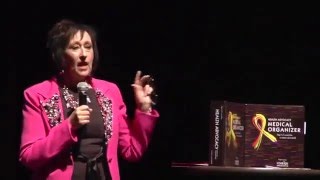
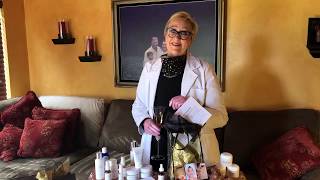
This is a spoken YouTube presentation led by Susan Elizabeth Santsche (cancer survivor) promoting the use of a Health Advocacy Binder to organize personal and family medical records. Through personal anecdotes and multiple testimonials, speakers argue that keeping organized records can prevent unnecessary tests and medication errors, save time and money, and ensure critical information is available in emergencies; the talk includes a dedication to Teresa and points viewers to a website for more resources. The speaker states the project has inspired over 5,000 people over seven years and gives concrete examples (e.g., an avoided $2,600 echocardiogram and an estimated ~25% reduction in redundant tests).
Chapters
If your phone rang at this moment and it was an emergency room that needed to have critical health information that could save your mother's life, could you get your hands on it? If you're like most Americans, the answer is no. Unfortunately, we have not taken the opportunity or the responsibility to take charge of our health care records. As a two time cancer survivor and the wife of a disabled husband, our family knows the value. Today, in this video, we're going to give you some tips and some strategies to teach you how to become your own health advocate and how to have that information at a moment's notice. My journey back to good health has inspired me to create the Courage Awareness Movement and the Health Advocacy Project right here in this building. Over the past seven years, we have inspired over 5,000 people in our audiences to teaching them to stand up and take charge of their health. We want to inspire you and your family to stand up and take charge of your health.
When I had gone through my second battle of cancer, my daughter was actually cutting her hair one day. And when she heard that I was diagnosed the second time, she said she jumped out from around the corner of getting her haircut and she goes, susan, what I want you to do is I want you to go get a binder and I want you to tab it and I want you to put your surgery notes, your doctor's notes, I want you to put your lab reports, I want you to ask for every piece of information. Because when you go in and you listen to the doctors, you're going to be like deer in headlights. And she was right. It became the only thing that I could actually have some sanity to understand what was actually happening at the moment. It allowed me to take my emotions and transfer the information. Seven years later, as my bookkeeper will tell you that it's probably the only thing that's organized in my life, but at least I have a place and a semblance that I can go back and I can reread what my path report was because it's really important for us to create a team, a team with our medical professionals that can kind of help give us that information. Because those poor doctors have so much information, and especially now that we have Google and we can look up and we can give ourselves 100 more diagnoses than we really have. But it helps us narrow it down and understand what we were told so that we have the information, so that we can ask a better question.
Why not, Whenever you go to the doctor, write it down what test you had and what you were supposed to do because they're going to walk through that front door. They're not going to remember. So those are the kind of dates and stuff that you really tend to forget about. And if you have a record and this book could be part of that record. Classic example. Getting back to the grandson. We're going to have an echo. My wife that happens to be a caregiver that is in the medical field says, no. On October 8th, we had an echo. And the physician says, no, yes, we did. And Jeanne was the one that performed it. He said, oh, yeah, I remember that. We would have had another echo. And Those echoes are $2,600. He didn't need it. Well, if we hadn't had that, I would have said, oh, it was probably two or three years ago. We probably need it. It was written down. She opened up her book and it's an absolute diary. Much in my opinion, you could probably eliminate about 25% of the tests that are done today, number one. Number two, people would be healthier because they wouldn't be prescribed improper medication and. Etc, etc, etc, and there would be no duplication of tests. I think that we could see a substantial drop in the cost of health care.
You know, a big part of it is being tied in with doctors that really will follow through with you. And Christopher, as you know, had leukemia. There were some other issues that came up that weren't cancer related. And.
Once we got through the leukemia part of it, we still had to follow through with other issues. I think that notebook that you've created was a huge, huge help. Huge help.
And it's been really important to be able to have all that documented, all the information so that they know what he's gone through in the past.
You know, I've always said to people that it's important that they be their own advocate. As a patient. It's really important to know what your medical history is, what your allergies are, what surgeries you've had. And of course, you can't remember all of that necessarily. So it's important to have it written down and bring it in. And it's really helpful when patients bring in their information. And the organizers are very nice because they're kind of like a chart. You know, they're organized and you can find what you need fairly easily. Yeah, it's not just a stack of loose papers and you know, that the patient may have gathered over the years and not really knowing where anything is in that stack. It's organized and easy to access. Not to mention it's just important to know about your health. You know, if you move, if you change doctors, your doctor retires, you know, then there's the worry, well, what about my chart? Where's my information? You know, you've got it all. You're taking care of yourself.
We were traveling, ended up taking to the ER and we had the book with all the information. So they knew exactly what kind of surgery, what kind of chemo, chemo he had been taking, what kind of meds he was on. You just can't remember all that stuff. You know, several friends that are single family members and friends we've also talked about this about, you know, as a family member, I have no idea what my brother's health history is. And he's a single guy. So if he has this in the house, if he gets sick, there is a place to go for information. I wouldn't even be able to tell you what kind of insurance he has. That's what the book is. If you use this and keep it up, it will give information for years to come. You know, even your kids would be able to use it if you kept your book up and had some of your records in there. As things are genetic, you can actually pass that to your kids.
It's very important. Doctors move away, retire.
Those records could be lost, you know, forever in our situation. Still, Stephanie had many doctors, many labs, and many hospitals in San Francisco as well as locally.
Faxes didn't make it up here a lot of times, but I had a copy of everything. This gave control back to me.
And it helped me put order back into my life.
Well, it's a win, win situation. And the other thing I've noticed, too, in talking with breast cancer survivors is that all of us philosophically have to make sense out of the suffering and the maladies we have in our lives. And it's my feeling that most of us think that if what we've experienced can benefit anybody else in any way, that's a huge contribution. And this gives people who are even survivors of breast cancer the ability to put their data into a place where it won't just sit in some dusty basement of a hospital, but some place where it can be used dynamically to help both them, other current patients, their children, and their children's children.
Your health is your greatest wealth, and it's important to have all your records and information. Some of us might think that all of this information is being taken care of. We have to realize that so many medical facilities now are downsizing, moving, doctors are retiring, where are those records going? It's really important that you gather all of your family's health history and you have it all in one place. It is your right and it is your responsibility to gather and collect all of your family's health history so that you have it all in one place. But take the time to read it so that you understand your family's health legacy. It's as easy as asking for it, gathering it, reading it, storing it, and getting a team of professionals to take care of you in the manner that your family so deserves. Knowing your health records like your life depends on it can save you time, money, money and peace of mind. And it's as easy as having a system that you can keep at home at a moment's notice. The life you save could be your own. Help us inspire others to stand up and take charge of their health by becoming their own health advocate.
The Health Advocacy Organizer was dedicated to a young woman. Her name is Teresa. And if you go on the website, you can watch a really great little story. So, Theresa, this is in your honor and in your legacy. She was a teacher and she would want her memory to be known as a source of knowledge. So every year we acknowledge her, that her life is not for nothing, but it lives on with each and every one of our families to teach us a better way to start getting in control of our health care information.