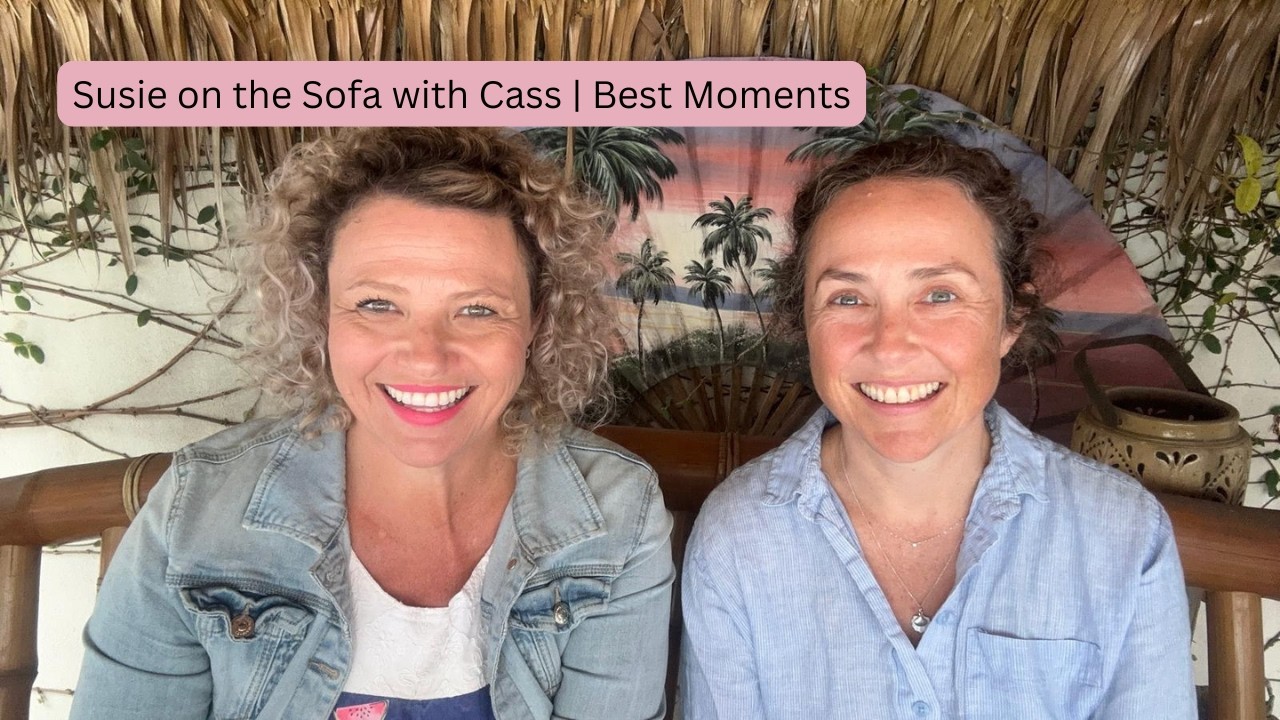
In this episode of "Susie on the Sofa," host Susie Taaffe interviews Cass about her first Camino de Santiago pilgrimage. Cass began the trek confident that her youth, fitness, and experience walking would allow her to cover 20‑30 km each day without difficulty. By the third day she suffered a physical breakdown, becoming "broken and humbled" and forced to take two rest days, which bruised her ego. The conversation explores the emotional despair that followed, including thoughts of quitting and comparing herself to older, less fit walkers who seemed to manage fine. Cass describes how the Camino forced her to confront the gap between what she thought she wanted (a fast, high‑performance trek) and what she truly needed (rest, self‑compassion, and a slower pace). She recounts the care she received from a kind albergue owner, the necessity of adjusting her daily distance from 25 km to as little as 7 km, and the practice of kindness toward herself. The dialogue reinforces the Camino’s lesson that it provides what you truly need, not what you think you want, and that there are no medals or competition—only a personal journey and a modest certificate at the end. The interview highlights humility, self‑love, and the importance of listening to one’s body and heart during challenging endeavors.
Chapters
So from what Cass has told me, though, and I think that this is, but this is kind of good, like a way to see how you can challenge yourself, which when you don't even know you're going to, like Cass started the Camino and has told me she thought, I'm fit, I'm young, like I can walk 20, 30 kilometers a day, I can do this, like a million, not even a million, probably gazillions. Real word. Real number of people have walked the Camino. I can do it. I'm fit.
I can do it. I'm young. I'm fit. There was definitely a healthy dose of Australian should be right, mate.
And that feeling like, are you committed to it? Like, I can do that. That's not that hard. Like, how hard can it be? I'll commit to that. That's something. And you sort of just make that decision and, you know, okay, I'm going to get there. Yeah, I've got to do a bit of research to get the right equipment and things like that. Not hard. I've done that before. Tick, tick.
And then off you go.
And then I think that that's when life, um, you've made a commitment, but then life has other ideas.
Yes. Yeah. So the Camino, um, there's a saying that the Camino— well, actually, that my dear friend Al, uh, says— is that the Camino gives you what you truly need, not what you think you want. And they are very, very different things. So I went in with the expectation that I could walk the Camino with no problems. Yes, it would be hard and it would be challenging, but I thought there's no— there's— I'll just be able to walk it because I walk frequently and I'm young and fit and healthy. And on the first Camino, I think on day 3, I was broken and humbled, and my ego took a real— it had a real reality check that actually this is a lot harder than I thought it was going to be physically, emotionally. I was like a deer in headlights, had no idea what I was supposed to be doing. I remember thinking on day 1, um, that there would be not, not necessarily a marching band and a, and a, and like a big banner saying, hey, Cass, here's the Camino, this is the way you go. But something— I thought there would be something that would tell me this is the way that you go to start the Camino, and there was nothing.
So is it more just like a quiet, oh, okay, this is on me?
Yeah, this is on me.
I've got to do this.
I have to figure it out.
Yes.
Um, and you, you become better at seeing the signs of where you need to be going. But it was, it was definitely a reality check. Um, so physically, I was broken on day 3.
Um, I know she went dark for— there was like a week where she went really dark. Like, we were like, oh, we're not getting much from her. Like, uh, like, I could— you could feel her energy was just in a world of hurt.
I was in a world of hurt.
And it wasn't just physical, it was emotional despair and physical despair and And that's what I wanted to talk about. It's like when you commit to something, and like she's committed to a Camino publicly, like everyone at home knows she's walking a Camino. Like, like I'd say some pretty like thoughts of quitting and thoughts of maybe I can't do this and all those thoughts, like, like who am I to think I can do this? But then also you get the ego, it's like, well, why could everyone else do it? How come I can't do it?
How come I can't do it?
And I think that that's why you put yourself in extreme situ— in this extreme situation. You didn't know you needed this.
No.
But your heart knew you needed it. Like, you got what you needed. You thought you were going just to have some nice time exercising in the fields.
Yeah, yeah, yeah, yeah, yeah. It was not.
And instead, you were very quickly, as you said, humbled.
Very humbled.
And then you have to, um, look at it like you have to sort of zoom out and look at the bigger picture and And, um, I'd love to hear your thought process, like how you adapted your mindset. I suppose you would have— that's what you were doing to think, okay, like I need to reassess this.
Yeah. And, uh, yeah. And the humbled word, I was definitely humbled. So, um, uh, the Camino, people from all ages of life and all walks of life walk the Camino. And I was walking with people who were much older than me in their 70s and, and people who were in worse— well, I would say not as good physical shape as, as I was, and they were not broken. So I was like, how, how can you do it and I can't do it? Why is this so hard? Um, but my body physically stopped me from being able to move on day— after day 3. Um, and I had to take 2 rest days, which really bruised me. It really bruised me. Um, to be—
I'm like young and fit and I'm on rest days on day 4.
Um, and I had planned to walk I'd planned to walk 25-ish kilometers a day, um, but I had to stop. And I had to stop in a place, uh, it actually turned out to be a really lovely place for my soul and for my heart. I had a wonderful albergue owner who looked after me.
What you needed.
Yes, what I needed.
Yes.
Um, someone to care for me and for me to receive some care. Um, and then I had to readjust my plans. So the 25 Ks that I thought I was going to be able to walk every day, I couldn't. I think when I finally started walking again, the first day I walked 7 kilometers. Um, it took me between 4 and 5 hours.
That's nearly crawling.
It's nearly crawling. And I was, I was nearly crawling, and the pain wasn't completely gone. Um, but it was bearable enough with reg— with breaks every 10 minutes, um, taking my pack off. Um, you know, I, I could only— I had— I think I had to, I had to readjust my expectations because I thought I was going to finish the Camino in X number of days. 800 kilometers divided by 25 is however many days. And it did not pan out that way.
Um, I love that, how you said you had to readjust your expectations. So, yeah, and I think that readjusting our expectations of ourselves is actually showing yourself kindness and grace. It's— would you feel like it was that sort of a process?
Yes, it absolutely was. Um, and I had to— there was a lot of self-love And a lot of compassion and kindness. And I guess probably digging down into it— why am I actually here? Am I here to try and smash out 25 kilometers a day? Am I here to— if I continue doing that, I will injure myself so much so that I won't actually be able to finish the commitment that I've made.
And I really— Was there a gold medal for getting there the fastest?
No, there's no medals. There's no medals for getting there the fastest. There's no medals for taking no rest days. There's no medals for anything.
You walk the kilometers, you do get a little nice certificate at the end, but it doesn't matter how long it takes you to get there or how you get there.
How you get there? No, no, there's no gold medals for, for pushing through and limping into Santiago. There's no gold medals.