She Walked 800km Across Spain and Blew Up Her Whole Life | Susie on the Sofa with Cass Ep 1
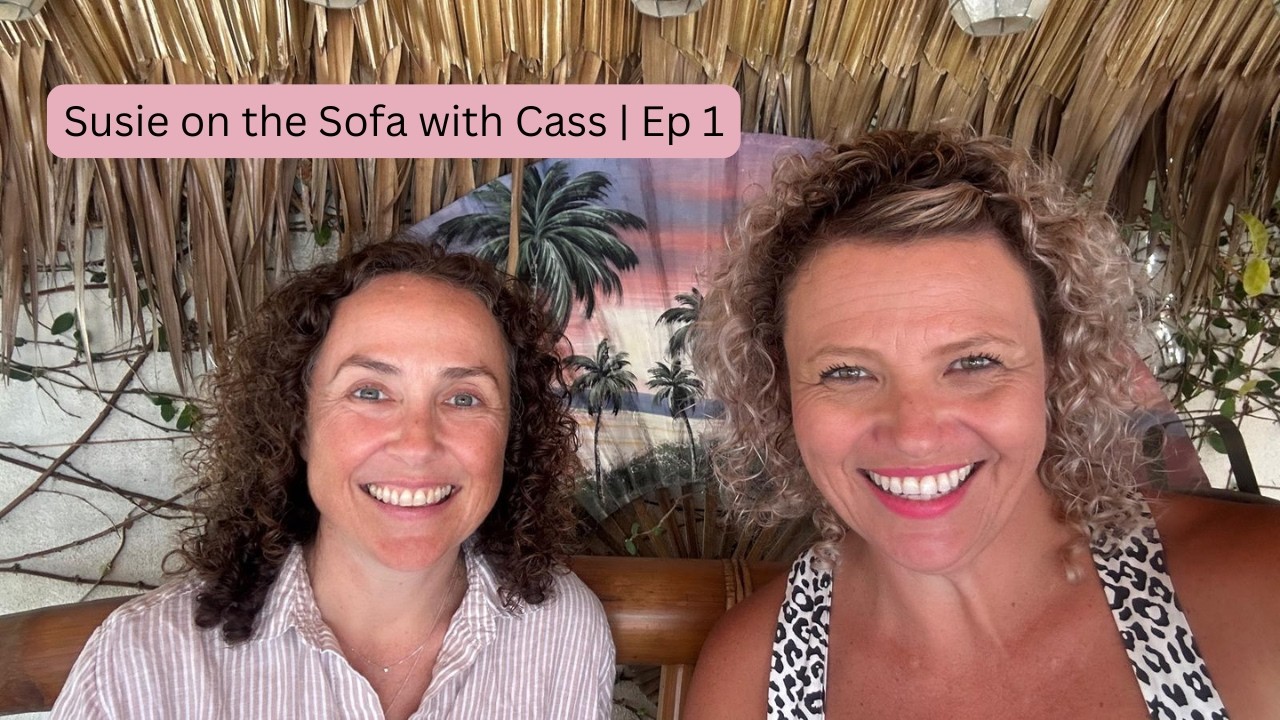
In this inaugural episode of the "Susie on the Sofa with Cass" series, host Susie Taaffe interviews her sister Cass about her two Camino de Santiago pilgrimages that together covered 800 km across Spain. The conversation opens with the sisters’ shared "North Star" – helping themselves feel better – and frames the Camino as a deliberate "boggle‑button" experience: breaking life into pieces to see how they re‑assemble. Cass recounts the practical logistics of the walk (daily distance, packing, albergues, navigation, safety as a solo female pilgrim) and the constant micro‑decisions that create decision fatigue. She describes how physical strain mirrored emotional baggage, using body‑pain as a map for inner work, and how the pilgrimage became a moving meditation. The duo explore the communal "guardianship" of the trail, the instant camaraderie among pilgrims, and the supportive culture of sharing supplies and care for sore feet. Cass contrasts her first Camino (naïve, ego‑driven) with the second (more emotionally demanding) and reflects on the addictive, soul‑soothing nature of the experience. They discuss how the Camino’s stripped‑back conditions foster gratitude for simple things—water, hand soap, a warm shower, even snoring in a shared dorm. Finally, they consider how to translate Camino lessons into everyday life through micro‑moments, intentional slowing, and appreciating basic comforts without needing to walk the full route. The episode ends with a mutual affirmation that the Camino is a gift of space, simplicity, and connection.
Chapters
Hello, welcome to Susie Unshaped. I'm Susie, and this is a series that I have with my beautiful sister called Susie on the Sofa with Cass. Meet Cass, my amazing sister.
Hi.
And we were just talking this morning about how we wanted this series to go, and we were like, what is— why are we doing this? Why are we recording this? And we both agreed that our North Star metric for our lives is to help ourselves feel better. And the point to record this is to help shine a light on how we did that, in the hopes it might shine a light for you as well. So welcome, Cass, to the series.
Very exciting.
Yes. And so Cass has just come back from I like to call it a boggle button life experience.
Hit the boggle button.
She hit the boggle button, which is basically where you blow up your life into a million pieces and you see where all the pieces land. And it can be messy and it can be elating, it can be exciting, it can be lonely. So that is what we want to dig in a little bit, um, in this series and talk about both of our experiences in sort of blowing up your life so that you can rebuild it in a way that makes you feel good on the inside, like that gives you goosebumps, that gives you the little wiggle that makes you go, yes, I love this, and living from that. So, Cass, do you want to tell us a little bit about why you decided to blow your life up?
Sure. Um, uh, I That's okay.
This is very you. Look, in fairness, I threw this on her last night after she came off 15 hours of flying from Europe. So I will lead her into it because I forced myself to do the 31-day challenge, so I am quite used to thinking on camera. Yeah, and it is also a way that I process. So, um, It's— and it might not be Cass's way of processing. We will find out. So you went to— you decided to go to Europe. Yes.
Okay. So I, uh, went to Europe in April 2025 with the intent that I would walk a Camino de Santiago pilgrimage walk and then see where life unfolded from there. So that one decision to go and walk an 800-kilometer pilgrimage across Spain led to spending 14 months in Europe, uh, bookended at both ends by a long pilgrimage, a long walk across Spain, um, and many, many adventures in between. Uh, it came around my midlife. Um, yeah, and it was an incredible experience. Obviously lots to unpack and lots to debrief on. Yeah.
Okay, so for those that don't know about what a Camino trail is, just explain a little bit more about the process so they can understand what you decided to do.
Okay, so a Camino de Santiago is a very ancient religious pilgrimage, and it's essentially— the history of it is that Um, uh, people through Spain— sorry, people through Europe would walk to a town in Spain on the eastern side of Spain called Santiago de Compostela, where Saint James is. Saint James was a, a saint, um, and his remains are buried at the— or in a crypt in the cathedral in Santiago de Compostela. So the history is that people would walk to his remains and ask for a blessing or for, uh, sickness to be healed or for some sort of religious purpose or internal purpose within them. Generally it was a religious purpose, and they would walk from their homes to Santiago de Compostela as part of a, a pilgrimage, a religious pilgrimage. Um, it has now formed over the years— it was revived in the early '90s, and it's now formed into generally set walks. So you start in one town in Spain or in, in somewhere in Europe— they're all over Europe—
and you walk towards Santiago.
Um, they range in, uh, distance from 100 kilometers up to— the formal ones can be 800 kilometers, 1,000 kilometers. Um, and you walk every day with a backpack, um, and eventually arrive in Santiago. And it's, it's less about the arrival into Santiago as the journey, but the, the journey is the destination. It's less about Santiago being the destination, but it's about every day the decisions you make, the walking that you do, the people that you meet, the connections you form, um, to eventually arrive at Santiago de Compostela. But the destination is in every step in the journey. So it's a long walk across Europe.
In summary, it's a very long walk. It's a very long walk. And the hardcore pilgrims actually carry everything that they need, including water, food, their clothes. Lesser hardcore pilgrims can get it shipped ahead, but I think that— would you agree that when you're going inwards, it's sort of a metaphorical experience to carry all of your belongings with you on that journey to really get the full experience?
Absolutely, yeah. So you carry, yeah, you carry your physical stuff and you get with your physical baggage and you carry your emotional baggage as well. And it is definitely a metaphor because you start with too much physical baggage and emotional baggage and you shed it along the way.
I love that. Yeah, you've got the physical baggage physically, and then I know that you like halved your pack weight pretty quickly. I did, because it's like, um, probably 20-25 kilometer days, sometimes even more, which in miles is like around the 16-18 miles per day. But every day, yeah, for up to 800 to 1,000 kilometers, which is like 500-600 miles. Like, I, I can I can only imagine because I obviously haven't done one yet, um, but I can only imagine that you have no idea what you're getting yourself in for.
You have no idea. It is, uh, I remember feeling like a deer in headlights when I started the first one. You don't know where you're supposed to be going, you don't know what you're supposed to be doing. How do you know where you're going? You have apps obviously, but, uh, there's, there's so many processes. There's a whole trust process that you go through, along with the shedding, along with the connections. Um, but yeah, you have no idea. I was like a deer in headlights for the first week on the first Camino that I did. I was like, what have I gotten myself in for? How much stuff have I got on my back? Why is my— why is my— why are my hips hurting? Why are my shoulders hurting? And yeah, it's, it's a whole experience to, to unpack.
And I love that because I like— Cass and I are both very much into like your body talks to you. And so I remember when she was on the Camino and the certain parts of her body that were hurting, and we'd look it up. We have this book that shows us what, um, what body part represents what emotional baggage that you've got.
Yes.
So I think that that was a really interesting correlation to look at. Yes, you had physical ailments because you were carrying physical things, but Also knowing you were there to shed the emotional baggage, and maybe the physical ailments were pointing you in the direction of what might need shedding emotionally.
Absolutely were. Absolutely. Through the first one and the second one, it was very interesting.
Yes, and we will unpack the second one a bit later because I'm really interested to understand the— once you think you know what you're in for, but I'm guessing the second one shows you a whole lot of stuff that you had no idea was there. But I want to jump back to the part where you talked about learning to trust yourself. Because Cass and I were talking this morning about how important the process is to learn how to trust yourself. And when we were younger, we used to backpack in Southeast Asia a lot, and The Lonely Planet Southeast Asia on a Shoestring was my Bible. Like, I love that book. I slept with that book. I read that book. We were planning here, we were going there. And I think those early backpacking days were fantastic because They allowed you to learn to trust yourself, trust that you can figure things out, and the consequences weren't really very big. Like, the stakes were not high. Okay, you didn't make it to your destination, or that hostel was full, so okay, we just go to the book and we'll find a hostel. Or there's none there, a guide will help us find a hostel. So, so the stakes aren't so high. So I love it that then you've built on that experience on a Camino where you think, well, I've done that, but this is a very different experience. So it's learning how to trust yourself in a new environment. So explain some— like, I remember you saying that your brain was just so full of Camino decisions, like a million decisions that you don't have to make in normal life. So can you just talk about like a day in the life of the pilgrim and the decisions you were making and And what was consuming your thoughts at that time?
Yeah, yeah, for sure. Yeah, so it— and, and the Camino is, it's a very— once you get into the routine, it is a, it's a very simplified day, but you have— you're constantly making decisions, and the decisions start as soon as you wake up. So, um, what time am I waking up? What time do I want to start walking? Is it a hot day? Do I want to walk in the heat? If it's a cool day, maybe I can start a little bit later. And then, um, when you start, how, how far are you actually going to walk that day? So you have to— so how far are you going to walk that day? When are you going to stop to have a break to eat? When are you going to stop to have some water? Uh, where's the next bathroom? Um, uh, how much stuff are you going to carry? Are you going to carry your bag? Are you not going to carry your bag? Um, and they're just— they're— you're constantly making decisions. So on When you actually decide, okay, I'm going to walk 25 K's today, sometimes there's deviations. So you can take the normal route or you can take the road less traveled, which is a deviation. Generally it's longer. So do I want to walk further today? Do I want to have a different experience to everyone else? Do I want to walk with people? Do I not want to walk with people? Do I want to stop and look at the cathedral or the church or the historic relic or the Roman bridge or whatever it is? Um, uh, yeah. Do I want to walk with people? Do I want to talk today? Do I not want to talk Do I want to have headphones in? Do I not want to have headphones in? Like, it's just, it's constant decision-making all day. Have I eaten enough food? Have I drunk enough water? Um, do I want to stop in this town? When do I want to eat lunch? Do I want to take my shoes off? Do I want to swap my socks? Do I need to put on more anti-friction cream? Um, are my feet, uh, am I getting any hot spots? Like, you, you become— and, and then once you actually get to the destination in the afternoon, it's like, okay, well then I need to make all the decisions for the next day. How far do I want to walk? Where am I going to stop? What route am I going to take? And you do become, you get decision fatigue because it's every day you have to make these decisions and every day you're walking through different places and you're staying in different places and you're meeting different people. And it's, they're life decisions, but they're just in this microcosm of a Camino bubble. And it's new, every single day is new. Unless you've walked that particular Camino, you don't know what towns you're gonna be walking through. You don't know what services are gonna be there. Are they gonna have a cafe? Is there gonna be a bar? Is it Sunday and then everything's shut? So do you have to actually make sure you have enough food to cover you for a couple of days? And then you get to the end of the day and you fall exhausted into bed and then you wake up and do everything again the next day for 800 kilometers.
So it's actually not really about the walking, but I think probably, did you go into the experience thinking, oh, I can walk 25 kilometers a day? Like, that's not that, like, I can do that. I'm fit. Like, I love moving. I walk a lot at home anyway. Like, you think it's about one thing.
Yeah.
And guess what?
Yeah, it's not. It's absolutely not. And I, I was very naive and, um, ill-prepared and, and had a real Aussie spirit. Oh, of course I can do this. This will be easy. She'll be right, mate. Um, and I'm fit and I'm healthy and I'm young. And I thought, oh yeah, of course I can walk 25 Ks. That's not a problem. Without factoring in, uh, that I have to walk 25 Ks every day for 6 weeks, that I'm carrying a backpack, that that's a physical weight, but then there's the emotional weight as well. Um, and the— I didn't really prepare well enough for the elevation, for the uphills, for the downhills. I bought some hiking poles, um, thinking these are— I don't need these. Well, these are, these are for old people.
Yeah.
These are for old people. Um, so I had no idea how to use them. I, I was literally like a deer in headlights. I had no idea what I was doing. Um, and the Camino humbled me within about 3 days.
So that was pretty fast.
It was pretty fast.
As Cass will attest to, I think that's why anyone that's walked a Camino, you say that and it's an instant kindred, like, bond.
Yeah, it is.
Isn't it? Because you're like, I see you, like, I know where you've been, I know how you felt, like, within— yeah, a parameter. But yeah, like, it's like, it's like an I see you. Yeah, it is.
Like, it's like a secret club. I see you.
It is like a secret club.
Little shells and arrows, which are the signs that you follow on the Camino to know which way you're supposed to go. Um, but yeah, it is, it's an instant connection, it's an instant bond. And in normal life, you see people and you meet people that have done Camino and you instantly connect with them. But even when you're, you know, some days you're walking through big cities, um, some days you're walking through small towns, some days you're walking along the ocean, some days you're walking along the road and you see someone ahead with a backpack or you see someone with a shell. And you instantly know there's a kindred spirit. There's someone that I— that will help me. There's someone that will help me if I need help. It's, it's a, it's a, um, I mentioned it before, it's a little bubble and it's a really safe little bubble. And, um, yeah, you have an instant connection with people.
Yeah. So let's just talk about that for a second because I haven't actually even spoken to you about this, but the safety aspect of it, like you were in the middle of nowhere.
Yeah.
Walking as a solo female, but I don't remember you ever once saying you didn't feel safe.
I never felt unsafe. Um, I walked, uh, 800 kilometers across the north of Spain and then kind of through the center of Spain. And most days I walked on my own. Uh, I would walk with other people sometimes, um, and sometimes— and, and the 2 Caminos that I did were, uh, different in volumes of pilgrims.
Okay.
So the first one had fewer pilgrims than the second one. Um, but even, even when I was on days when I was walking alone, I never felt unsafe. I never got that, that spidey feeling, that sense of, oh, this is an unsafe environment. And you always know that there's people ahead or there's people behind. So if you need something, you can stop and someone will eventually come along. Um, even in the towns that I walked through and the places that you stay at night, like, um, in normal life, you would never leave your phone charging on a table in a hostel.
Yeah.
Not in a million years. Or you would never leave your, uh, backpack unattended. You'd always lock it away in a locker. But in— on the Camino, it, it is such a safe environment for everyone, for There were lots of solo female travelers. Never ever once did I feel unsafe. Did I? I never felt threatened. I never felt— yeah, it was— it's a wonderfully safe environment.
So there's nearly like a guardianship.
Yeah.
Like a guardianship of the Camino Trail.
Yeah.
Probably both energetically and also within the community and the bubble, that everyone is there to support everyone else on their journey. And I was just thinking when you were listing all of the tasks And it nearly sounds a bit like it's like a moving journey of meditation because you get so caught up with all these things that it's nearly like you get snapped out of everything else and you're really grounded into the present moment. Because the present moment, like, you need to know where that water is because if you don't know where the water is, you can't walk 20 kilometers without water. Well, you can, but it would hurt.
And people do. And you learn that, you learn the lessons really quickly. Um, but it is like a moving meditation. Um, you, you, you become really present in, in the moment that you're in, um, because it is— it's a simplified version of life, even with all of the constant micro decisions that you have to make. But all you need to worry about for 800 kilometers is the next step and the next step and the next step after that and the next step after that. And yes, you need to worry about the food and the water, and you only run out of water a few times.
Yeah, you learn that quickly.
Yeah, you learn that lesson very quickly. Um, but it does become a moving meditation, and then the, the community of pilgrims are all in this moving meditation together, and we're all there for the same reason, and we are all there to help each other. And it's, it's wonderful to see, um, the connections that people make and the help and the, the kindness and compassion that people show to each other. Like, if you have, if you have sore feet There will be any number of people there offering you Compeed Band-Aids. Do you want a foot rub? Do you have enough ointment?
Yeah.
Do you need some anti-friction cream? Do you have some painkillers? What can I do to help you? I have, I have either knowledge or a skill or some supplies, and I want to help you.
And I suppose, like, you obviously choose to do a Camino because you're looking— we're not looking for something. We all know that we're looking for some— we're looking to find that part of us inside that we have forgotten about. Um, and so, lost my train of thought on that, but anyway. Oh, I suppose to have that support in that process, when I think probably these days we all know that everyone's so disconnected in life, that I do think that that feeling of support might be even a part of the nurturing that our souls are missing.
Mm-hmm.
Because we all live such compartmentalized lives.
Yeah.
We get like keep calm and carry on and just keep doing things, and we probably don't feel like we have that level of support out there. So it sounds like I'd never thought about the Camino as the experience of how about imagine if you felt for however many weeks just constant support in your journey, like knowing how that feels. Um, I I think that that would be such a soothing balm.
Yeah.
For the soul. Like, when you feel alone and you go on to do something difficult, maybe it's just retraining the soul and ourselves that support is there.
Yeah.
We just either need to know where to look for it, remember to ask for it.
Yeah.
Um, and also it's a, it's a two-way street. It's like when you're receiving support, you're giving support. It's that flow. And I think that Well, that goes back to us. That's why we're recording this. It's like helping ourselves, but if that can help others at the same time, like, that's what our North Star metric is. Like, that's why we're talking today. That's why, um, we're sharing this, because I think it's the point.
It is the whole point.
And you—
and you— it's— it's— you hit the nail on the head. It's remembering to ask for support, because I went in as We are both very strong, independent, uh, women, and I don't need support, I don't need help. And, uh, you know, if people— people want to help on the Camino particularly. I think generally in life though, people want to help, they want to have a connection, um, and it is missing from society in so many different aspects. And you go into the Camino, and like I said, if you've got a blister, people want to help you. They physically want to help you. Do you have Compeed? Do you have blister wool? Do you need— Do you need me to lance your blister? Like I have seen women who don't.
That would not be me. No. She's a medico, not me.
But women who have never or people who have never met other people quite happily sitting down and tending to their feet and caring for their feet. Like it's such a. Oh my god!
That just like gave me like biblical chills. It is.
Yeah, it's beautiful. And these are pilgrims helping other pilgrims, and there's. People who run the hostels who will wash your feet for you and tend to your feet. Yes, that is— And these are the— because your feet are the most—
I've got so many chills right now with the— because I can just see, like, to me that feels so ancient.
It is, it is.
It is so ancient.
You know, your feet— nowadays we've got these fancy sneakers and toe socks and anti-friction gel, but way back in the day when people were making the pilgrimage, They just had some leather bound to their feet and people would tend to their feet. And they're the most important physical part of being able to walk the Camino, to be able to get to Santiago, to see the remains of St. James and to have that amazing experience and to see that kindness and compassion and connection still through the feet and everything else as well. But the feet are just, they're so important.
Well, they're such a symbol for the metaphor of the journey.
The journey, yes.
Isn't it? Without, if your feet are injured or hurt and you don't look after them, you can't complete the journey. You can't complete the journey. So if you like to flip that, that's kind of a part of why you're doing it, because you're trying to heal your injured vessel.
Yeah.
That has been broken down by life, basically. And by life, I like to call it like an autopilot life where you've forgotten yourself, you've forgotten to remember who you are, and I think that going on a pilgrimage like this, it's the first step in that remembering to take care of your vessel, being the feet.
Yes.
In the journey of life. So yeah, it, it is—
the Camino is, is, is life in this tiny little bubble. And you can see all the decisions, like the feet and the water and everything, is just a metaphor for life decisions. And you get to experience it on a daily basis and you think, wow, this is, this is incredible.
Yeah, so now that's what I want to ask you is about the second Camino that you did, because obviously you go in thinking, well, um, I know what I'm doing. I'm gonna move that a little bit. I know what I'm doing, I've done this before, I got this. And so I'm really excited to hear, because I know there's going to be some clangers, um, of Where you were blindsided on the second one, thinking, I've done this before, I know what I'm doing.
Yeah, yeah, it was, um, I definitely went in with the, with the mind frame of, I've done a Camino, I know what I'm doing, um, I got this nailed. And again, uh, the— so the physicality of it floored me. I remember, uh, the first day I was practically skipping along the trail, and the trail was up and over the Pyrenees. It Very steep, but I was skipping. I was on a high. You've got the adrenaline, you've got, um, all of this, you've got all of these other pilgrims around you, you've got this big pilgrim energy, as my dear friend calls it.
And you've also completed one, so you know, I can do this, like, I've done this before, there's nothing new here.
There was definitely some ego and some cockiness going into the second one. I know, I know what I'm doing. Um, but you forget about the physicality of it. So you are still putting a backpack on and walking 20, 25, 30 kilometers a day. Um, the— so logistically, the second Camino that I did was easier to follow. There were more signs. Um, so I, I literally couldn't get lost physically. Um, but it brought up so many different challenges, um, physically, emotionally, within my soul that I hadn't expected. I thought I was just going for a nice walk across Spain.
Yeah. Oh no, no, no, no. No.
And the— so the second Camino actually asked more of me emotionally than the first one did. Significantly more of me. It really— and perhaps because I'd done the first one, I was more open to lean into the second one. But it really asked me to lean into it more than I had on the first one. And I was very ill-prepared for that.
So do you think that that's why people get addicted to Caminos? Because I would say there's a real addictive quality to Caminos.
Yes. You meet people who have walked 10, 12, 20, 30 Caminos, that have been walking Caminos for, for 40 years. There is such a broad range of people, and it is a, it is a really addictive— let's call it a holiday. It's not really a holiday.
Yeah.
It's a pilgrimage. Um, but people do get really addicted, I think. I think because each Camino is different. Even if you walk the same physical trail multiple times, you have— you meet different people, you stay in different places, um, you have different connections, you have different You go at different times of the year, so each Camino is different. And however you choose to approach your Camino, if you, if you go in really deep, if you, um, are there to make connections, whatever you want out of the Camino, it will provide. It provides what you need, not what you think you want.
I love that. God, isn't that life? It is. We're going to give you what you need, but not what you want.
Not what you think you want. I'm going to give you what you need. Um, but yeah, it is very addictive. People go because it, it provides a balm for the soul. It absolutely provides a balm for the soul. It provides beautiful connections.
Um, but it doesn't give you the easy way to get it. It doesn't give you the easy way. You've got it. What is it, that, um, that nursery rhyme? We can't go over it, we can't go around it, we've got to go through it.
You have to go through it.
You have to go through it. You do.
You do.
And I think, um, that goes back to like, obviously not everyone can take a year off to do a Camino. So, um, if you were to think of it like in a— like, how could you get bits of a Camino experience in everyday life? Like micro experiences? Like, is it, um— well, over to you. Like, how do you feel like you could incorporate some of the experiences you had from the Camino in everyday life.
Yeah, and there, there are, uh, so many discussions while you're walking Camino with other people about how do you integrate this beautiful feeling. Because you, you— I was lucky enough to be able to walk a whole Camino, so 800 kilometers, 6 weeks. Not everyone has that amount of time. Not everyone has the ability to, to go to Europe to walk a Camino. And there's, there's so much— some people only walk it for a week. Some people walk it for 6 weeks. Some people walk from, uh, for thousands of kilometers. Um, but there is a lot of conversation about— because everyone has their own experience and they have this beautiful experience in whatever shape and form that comes. And there's a lot of conversation about how do we take this into daily life? Because you can't walk a Camino forever.
No.
It's not realistic. Some people do. There's one guy who picks up trash as he walks the Camino always. But you can't— most the large majority of people have to go back to their normal life. Um, so the experiences that you have— so, and it's, it's the simple things. Um, you know, you are walking with your feet every single day. Yes, your feet are not physically touching the ground, also though some people do it barefoot.
Yes.
Um, but it— and you're always in nature, you're always outside. So, um, standing with the sun on your face, um, putting your feet on the grass, spending some time in nature, whether that's, um, at the beach or walking through a forest or even just standing in your garden and— or you're on your balcony if you're in an apartment with a balcony and looking at this— look up at the sky and watch the clouds. And it's those simple experiences which you have day after day, moment after moment on the Camino that you can, you can easily bring into your life.
Okay, so you don't actually— I think she's giving you the cheat codes here. I don't think you need to go through the pain and the suffering. To see the beauty. To see the beauty. It's the micro moments.
Micro, yeah.
And when you're in the depths of that agony, you appreciate them so much. And it's like back to simplicity. It's like you appreciate the water being cold. I think she even had a fountain that had wine coming out. Yes, I did. I'm sure that was greatly appreciated. But, but you, you go through the pain to nearly strip yourself back to the bareness of this, like noticing the beauty all around you and the simplicity and like the kindness. And so I think that's the—
that's—
there's the hack.
Yeah, if you want to walk 800 kilometers, go right ahead. It's an amazing experience. But you don't, you don't need to walk the Camino. You don't need to put yourself through it to Appreciate a smile from a stranger, um, a glass of water when you're thirsty, um, the ability to look up at the sky whether it's raining— because it rains.
Yep.
It's not always sunny.
There's a whole system for that.
There's a whole system. There's a system.
There's lots of systems.
Um, but to appreciate the rain because after the rain comes sun and after the sun comes rain again.
That smell. I love that smell when the rain comes on the soil. I think it's called petrichor, which is a really weird name for Oh, I didn't even know that was a— Petrichor.
Oh, it's a beautiful smell.
It's a smell, and it's so— where we're from in Queensland, like, we would get big thunderstorms and you'd always get that smell before they'd crack, and it would be boiling hot, and you knew the storm was coming. You could smell it.
Yeah, and there's that anticipation, and when it finally cracks, it's amazing.
So I think that that seems to be it. It's like you go to that depths of, like, not despair, but like suffering nearly. It's sort of— it's very biblical in that.
It is.
It's the fact that you go through the suffering so you can come out the other side and nearly realize what's important.
It's exactly it. Um, you do— you— the second Camino really stripped me bare, and you come out not, not reborn, but that's a very, again, very biblical way of looking at it. Um, but you do— you, you really appreciate the very simple things because that's all you have. You have simplicity. You have A pack on your back, and if you're lucky it's nice and light. You have very little personal belongings, you don't have anything of luxury, you— everything is stripped back to the very bare essentials of what you need to survive.
And it's so funny because actually last night I said to Cass, um, she goes— I said, oh, it's very quiet here in the morning, so you will be able to sleep in. Um, and she was like, what, so you mean I don't need my silicone earplugs?
I don't need my sleep system.
Because there's snoring in the albergues. So they stay in albergues, which are very basic hostels, basically, like nearly like what monks would stay in kind of thing.
Yeah, yeah, there's no luxuries in, uh, in the albergues. So the albergues are pilgrim-only hostels that you stay in every night, and they are bunk beds in a room. Sometimes you might be lucky and only have 4 bunk beds in a room. Sometimes you might have 150.
Wow.
People snore.
And there's no pillows, is there? No, there's sometimes— sometimes there's pillows.
So you, you are given a mattress and a pillow And if you're lucky, you might get a disposable sheet and a blanket.
Wow.
Um, so it's very basic, basic accommodation, basic showers. Uh, like I said, no luxury. There's no air conditioning, there's no heating, uh, there's no fans, which for a Queenslander is brutal.
Yes, we like that sort of thing.
Um, so everything is stripped back to the very bare essentials. So you, you strip back physically and then you strip back emotionally. Emotionally, and, and you, you become so appreciative of simple things. Like in an albergue, if they have hand soap in the bathroom, that is a luxury. If they have hand towels, that is a luxury. If they give you a towel— generally they don't give you a towel, actually 99% of the time they don't give you one.
Oh, that's right, you had little travel chamois.
Yeah, didn't you? Yeah, we took our own towels.
So ways I think you could practice this at home is to just take a step back and look at your life through like new eyes. Like, I have foaming hand wash, which I really like the smell of.
Yeah.
From Trader Joe's.
It's delightful.
It's so nice. Clementine, it's really nice.
Yeah.
Like, to really appreciate, like appreciate the things that you have right now and appreciate, like, because if they were all stripped back, like you would be so grateful for foaming hand soap.
Yes.
And like, I think that we forget because we're so caught up in the busyness of life. We forget at— like, imagine even like back when the toilets weren't even in the house, like when you had to go outside to— or there wasn't even a toilet and it was like a chamber pot under the bed. Like, yeah, like running water is a luxury. Like, we all have these phones, like we're so connected. Yet we feel more disconnected than ever because we've forgotten to take that step back and just appreciate a tiki hut that we're sitting in. We haven't mentioned the tiki hut. That's a whole other conversation. But appreciate a tiki hut that just appeared for us to film in.
Yeah, but you do, you, you absolutely appreciate everything. You even, you get to the stage where, um, I appreciated the snorrets. I got to the stage. So you know, you you can you can choose to do the Camino in whatever way you want. You can do you can stay at the public albergues or the municipal albergues, which are the basic of the basic. You won't sometimes you don't even get a sheet or a pillow. Okay. Or you can stay in five-star hotels every night. The choice is up to you. So when you when you when you go to an albergue and it has a luxury like hand towels, so you don't have to wipe your hands on your on your pants, or, um, that, you know, there's really hot water, or there's enough hot water for all of the pilgrims to shower, you become very appreciative. And then I, I found, interestingly, on the first Camino— and this continued in the second one— so we would pass through it. I chose to get a hotel room in some of the bigger towns, so I would stay 2 days, have a rest day, explore the town, and I would get a hotel room. And I never in my life thought that I would Uh, miss the snoring.
Oh wow.
It's— and it's not the— it's not the act of snoring, but it's the fact that— so when you're in a hotel room, which I love a lovely hotel room, I love a hotel room, but when you're on Camino, when you stay in a hotel room, you're disconnected from the other pilgrims.
It disconnects the energy.
It disconnects the energy.
Nearly the sacredness of it.
Yes, yeah, yeah. And a hotel room is nice, but you don't have I, I never thought I would miss sleeping in a room with other people who snore and who get up at 5 AM and undo their zips and redo their zips and rustle all their plastic bags.
Oh, the rustlers! We hate the bloody rustlers! Keep your rustling to yourself! That is so interesting because you think, I just really want a break from that. Yeah. And you get there and then miss it.
And, and it's a little bit lonely. And, and yeah, I really miss it.
So there must be like a real energetic pulse. There is going through it, and it's so. I think it's so good that you tried that to understand.
Like you would only ever know that if you if you had done it to experience it.
You would think, oh God, those people that can just stay in all the hotels all along the way, like how lucky are they? But you don't realize that's not the point, and you're missing that.
It's the connection.
Comrade comradeship.
Is that camaraderie?
Camaraderie. Yeah. Putting two words together don't exist. I do that all the time.
Comradeship.
I think. I think it's a word. Comradeship? Anyway, you're missing that part, which sounds like it's quite integral that you don't realize that you need.
Agree.
Yeah.
And it, it was a really interesting insight because I thought, I thought that I would love staying in a hotel room. But even if you— so, and you again can choose how much you want to engage with other pilgrims. So when you're in a host— when you're in an albergue, you can choose to engage in conversation. Maybe you have a shared dinner, maybe you sit and have a cup of tea. Maybe someone needs help with their feet. So you can choose to engage with that, or you can choose to keep to yourself. And people on the Camino are very respectful of your space and your boundaries and your choice. And, um, if you choose not to engage, you, you don't have to, but you're still part of this.
The energy. Yeah, it's like the energy.
And, and when you disconnect and go to a hotel room, which is totally fine.
Yes.
Absolutely fine. Um, however you choose to do your Camino and your journey and your life is okay.
It nearly feels like that supports It's taken away, even though it actually isn't, but it still feels that way.
I, I— that was a real insight for me that I, I, I missed being part of the albergue community, and I even missed the snoring.
Wow. Yeah, I would never have thought that would ever be in a sentence, ever. I'm surprised I actually am not up on murder charges for like trying to kill people when they're snoring. It bothers me that much.
Well, you've got the right system—
silicone earplugs. Silicone earplugs, which you didn't have on the first time.
I didn't have on the first time. First one, then on the second one.
Okay, so anyone that does the Camino, silicone earplugs.
Or if you just have a snorer in your life, okay, earplugs.
Okay, yeah, yeah. Do you think that they've come— because I used to try earplugs, but do you think that earplugs have actually come a lot— a long way? Because they used to hurt my ears.
No, so the silicone earplugs, they don't actually go into your ear canal. You just create a seal. They're the swimming earplugs. They're just swimming earplugs. So you just You get a little ball of silicone and you create a plug. You plug the hole so it doesn't actually go inside the ear canal.
Okay.
They do not hurt. Hot tip.
Hot tip for everyone that sleep is troublesome for, because I know that's a lot of people.
And if you sleep in it, if you live in a busy city and it's a noisy environment, if you've got housemates, if you've got a snoring person in your house, if you've got squawking birds at 5 AM.
Australia, we're looking at you. Crows.
Um, the silicone earplugs are a game changer.
Okay, brilliant. Well, is there anything else you want to add for this episode on Susie and the Sofa with Cats?
Oh, the, the Camino. There's so, there's so much to unpack about the Camino, but it, it is, it's, it, it, it's a life journey, but you don't actually need to walk it to experience it, to know, to come back to basics, to, to figure out what actually makes you feel amazing.
So I think maybe the takeaways might be, I think number one, the essence of a Camino is that you've carved out yourself space.
Yeah.
You have given yourself a block of time.
Yep.
You choose the Camino because you can't get out of it. Like, it's from there to there. Like, there's no shortcuts. Like, it is a linear— it's a linear process.
Yeah. Isn't it? Yeah.
You're probably in a very nonlinear— Process, but it's a linear process. So I think that giving yourself space, you probably don't need to go through the hardships and the challenges.
You can if you want, it's beautiful.
But yeah, just— and by— it's nearly gifting yourself some time to reconnect back inwards, to appreciate The simplicities around you, basically. Yeah, if you wanted to summarize it.
Yeah, and it is a gift. It is a gift. Everything on the Camino is a gift. Um, but the simplicities, the, the gratitude, and the, the gratitude for simple things. Um, uh, like I said, a smile from a stranger, or if you're, if you're having a tough day or someone else is having a tough day and you say to them, are you okay? Are you give them a hug. Like, it's, it—
there's—
it's the basic simplicities that bring you joy, that you don't need the latest whatever for. You don't need—
yeah, because we're so busy consuming, and everywhere we look we're being told what to consume that's going to make us feel better. Yeah. And the Camino strips that all away, because even if you have some of those luxuries, they're too heavy to carry, so they have to go because it's It's like, well, it's my hips or my feet or whatever the luxury is. So you get it stripped away from you out of necessity.
Yeah.
So instead of that, you guys, you don't need to strip your luxuries away out of necessity. You just need to gift yourself the space to sit in appreciation for the simple things. Yeah. You don't need the fancy things.
You don't need the fancy things. You don't have any fancy things. By the end of it, you have very little, and everyone smells a little. There's a definite pong no matter how much you shower and wash your clothes. But you, you, you—
Are you hand washing your clothes, or is there machines?
Hand washing and machines.
Okay.
But you—
there's—
you've got all your stuff. If you carry a bag, everything's jammed in the backpack. And if it's sunny, that's great, but your bag sweats.
Yeah.
And if it's raining, things get a little bit wet. So there's things—
there's everything And I'm just gonna end this on a little story about Cass and I when we were backpacking when we were younger. Um, and we were laughing at how it's so quickly how you can desensitize to luxuries. So we'd started at a hostel, we were in Bali, we started at a hostel there, and I think it had a Western toilet. Oh, that was like a real luxury. Oh, that's amazing, yeah. And I think it did have a nozzle out of the side of the thing, out of the wall for a shower. Anyway, then we went to Gili Trawangan, which was this tiny little island that had no cars. And we were like, right, okay. And we went into this beach bungalow hostel, like, it's backpacking, like, it's basic as it is. And in there, there was no— so it was a squat toilet, which is common in Asia. And for a shower, there was a bucket and a tap. And like, at first you're like, oh God, Oh my God, I don't know. Uh, and then by day 3, you're like, whatever.
Yeah, you like fill up the bucket, pour it over.
Yeah, you just like get used to it. So I just think that that's like just a funny story of how quickly we can adapt up and down.
Yeah, yeah, yeah. And, and the Camino gives you that every single day because different conditions, you don't know what you're gonna get. But you do become, you become appreciative of the fact that you have running water.
Yes.
And that you have a toilet regardless of Whether it's a squat toilet.
Yes. Um, yeah, exactly. And look, you still have a bucket.
Yeah, you can always, you can always do this.
Like this, like this.
Yeah. But yeah, it's the simple things, the simplicity, and being really grateful for all of the gifts that, that we have access to.
Yes.
Internally and, um, yes, it's in our surroundings as well.
Completely. Well, There we go, I think. Episode with Cass on the couch, I wanted to say, but it's actually Susie on the sofa. Or maybe it's Cass on the couch and Susie on the sofa. Couch was really hard to say. It's really hard. But we love you lots, and we will see you again soon because this is only the beginning. Bye! Bye!
More from Susie



How to run your day from intuition instead of autopilot programming (including FEAR)

Code HEATWAVE for 30% off - my gift for your thighs! #heatwave #chafe #california skanties.co

Heatwave proof 🔥save your thighs - use code HEATWAVE for 30% off! #heatwave #california #thighs


