The Biggest Lies You Tell Are to Yourself | Susie on the Sofa with Cass Ep 6
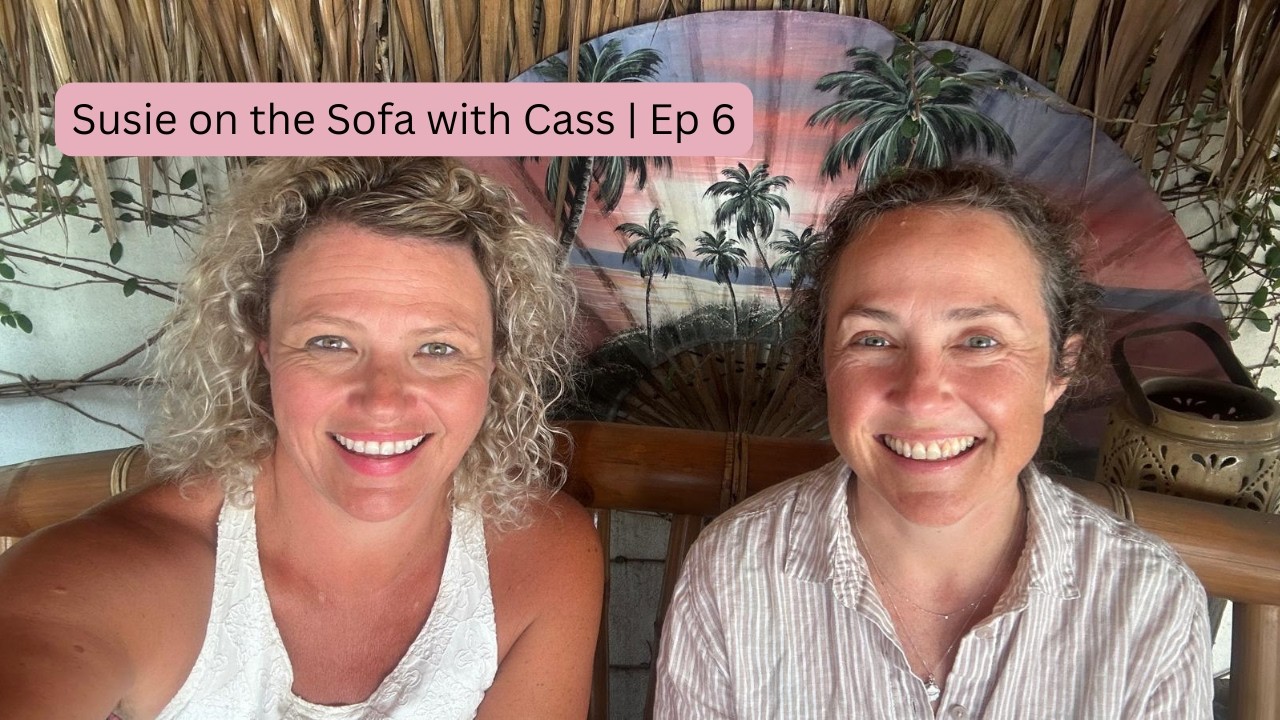
In this informal, conversational episode of "Susie on the Sofa with Cass," host Susie Taaffe and guest Cass explore the theme that the most damaging lies are the ones we tell ourselves. They discuss how negative self‑talk and internal belief systems act as "emotional shapewear" that restricts personal freedom. The dialogue delves into childhood conditioning, recalling how parents and society label children as "good girl" or "bad girl," creating a lifelong people‑pleasing narrative that must be dismantled. Cass shares her 14‑month European pilgrimage, bookended by two 800 km Caminos, illustrating how long journeys can strip away external identities. Spiritual references to Conversations with God and Dr. Demartini’s balance theory provide philosophical framing. Practical self‑care experiments—massages, hot‑tubs, first‑class simulations—highlight the guilt that arises when we prioritize ourselves, and tools like affirmations, post‑its, and journaling are offered to re‑wire negative thoughts. Susie introduces her free 31‑day challenge for structured self‑discovery and emphasizes that worthiness is inherent, not earned. The episode concludes with a playful meta‑moment: Susie mentions a song she created affirming "you are enough," planning to use it as an outro, and jokes about being the perpetual "homework giver," reinforcing the episode’s core message of self‑acceptance.
Chapters
Hello, welcome to Susie on the sofa with Cass. I've now said it like that so many times that I'm going to have to say it like that every time because now I kind of like— it's like spirit fingers. Spirit fingers! Cass is here! Anyway, this is an extension of Susie Unshaped where we're interviewing Cass about a boggle button life choice she made to sort of just blow everything up, which I have decided is not the right words, but right now we're gonna use that. Throw out all the pieces in the air, let them land, sift through them and see which parts are important, which parts aren't. And she allowed herself, she gifted herself 14 months overseas in Europe, bookended by 2 Caminos. Uh, very long walks. Very long walks.
Basically.
Which we have done other videos on that, like episode 1 will give you great depth on that. Um, but yeah, the very, 2 very long walks. like 800 kilometers carrying your pack, carrying your belongings. It's— it makes you dig deep, and it makes you shed the baggage that you're carrying physically that you don't need, and the emotional baggage. So her journey is so in line with the Susie Unshaped mission, which is to remove the emotional shapewear that is suffocating your soul, basically. So, um, yeah, yeah, here we are. Would you like— should I open it?
No, don't.
So, um, we were just talking before about what we wanted to talk about on today's episode, and we thought we've sort of jumped in probably a little— oh, there's a very large truck. Our tiki hut is not—
High quality recording.
Our tiki hut is not soundproof yet. Um, we have jumped in and expected you to know the stuff that we have learned before. A boggle button. What, what we started learning, like, probably I've been looking into this for about 11 years now. Cass has been doing similar sort of stuff because I drag her along yapping in her ear all the time. Oh, I just realized this, I just realized that. Anyway, back to basics. Step 1, we have to clean. Like, I'm not sure, we just assumed this, but it's—
we—
yeah, what they say about assume.
Yeah.
Makes an ass of you and me. A-S-S-U-M-E, if you didn't get that. Um, negative self-talk, like, and it's, and it's what we've been talking about. It's the awareness. Like, are you speaking to yourself nicely? That is step one in all of this.
Yeah. Um, and it's something we've both been practicing for quite a while, but it, it's a— you don't even hear yourself. You don't. And that's the, the biggest Once you actually start listening to what you're saying out loud about yourself, what you're saying internally within yourself, the messages that run through your head, uh, you could be nice as pie to everyone in your life and the most awful person to yourself.
Oh, well, that— yep, clanger. Because— and this is another quote from our book, gorgeous Maureen, we love you— um, the lies that you tell I've got it wrong here. The biggest lies you will ever tell are to yourself.
Yeah.
And though what she means by that are the lies that you're saying, like any negative thing about you, like anything negative about you is a lie. It's not true. We're all divine miracles. And if you want to dig into that more, try my 31-day challenge. It's free. Just look at the playlist, start on day 1, which is me uncovering, like removing all the layers that makes us not feel like we are enough right now. So that is— so that's what she means by the lies we tell ourselves are the worst we'll tell. Like, you lie to yourself more than you lie to anyone else out there.
Mm-hmm.
And it's all of the— anything that makes you feel like you're not enough, basically. So I'm not rich enough, I'm not thin enough, I'm not smart enough, I'm not strong enough, I'm not fast enough, I'm not whatever, dot dot dot. Enough is basically an unaligned belief system designed to keep you from remembering who you are, which is you are a miraculous creation of God, the universe, spirit, whatever you want to call it. It goes by many names. And I know that some people, um, and I did do a spiritually homeless, um, episode because for some people the word God just has an instant repellent.
Yeah.
Would you say?
I would agree, yes. Um, for whatever reason, it doesn't—
it—
the reason doesn't actually matter, but it's, it's— if someone says you are, you are, we are creations of God, people go, oh, because they think we mean—
they assign it to like a set religion.
Yeah.
And then, and then what Cass and I have discussed at length about religion is take all the good parts of all the religions out there And anything that wants to incite fear, control, make you feel bad about yourself—
Guilt, shame.
Kick them out of bed.
Yeah.
Kick them out of bed. All the religions are brilliant, but only take the good stuff. Like, I'm being serious. I don't know, I might get 1,000 hate comments in from this, but I am being dead serious that I believe in all religions, but I only believe in the parts where they tell you you're a miracle and they tell you that you're amazing and the good parts of religions. Nothing. Not the sin, not the guilt, not the—
Shame.
Shame. All of that is just designed to make you forget that you are, like, you are made from the same magic that makes the entire cosmos. Like, you're made from the same magic that creates the sun and the stars and the moon and the waves and the birds and the beautiful flowers and all of the beauty in this world. That's Your essence as well. So when you understand that, like I think we probably did have to go into that a bit to understand why if you say anything bad to yourself, you're lying to yourself because it's just not who you are. So if you like, I actually have my beautiful Auntie Sal. I love you so much. If you're watching this, hi, we love you. But she has a pattern of speaking negatively to herself. So whenever I see her, I catch her and I'll say, Sal, sweeter. I say, swear, ja. Swear, ja. And she goes, oh, oh, because she can't even hear it.
Can't even hear it.
She can't hear herself saying it because it's become so automatic.
Yeah.
And to this day, like, I've been doing this for 12 years and I still have to flip it in my mind. Like, if I say— like, I might— something will happen and I'll think something negative, and I will flip it now that I know that I'm a miraculous divine creation. And I'm like, well, that Can't be true because I know who I am. I know where I come from. The essence of my soul, my heart, my cells, my DNA is all infused with this divine creation energy. And that is why they're like— it's actually funny, if you do my whole challenge, by the end of it, it's nearly comical that you couldn't just love yourself completely and know, because you know who you are. But that's why I call it living from your heart in a 3D world, because the 3D world will whip you right back around. Like even your massage.
Yeah, yeah. I went for a massage on, uh, the second Camino. I can't remember what town. Um, and I— the intent was good. I was going there to self-care, to take— to, to have someone.
And it's a luxury.
It is a luxury on the Camino. Yes. I'm not sure I met many other people that would treat themselves to a massage. But I knew that I wanted to have a proper day of rest, and that included a massage. Um, and I went in with it, yeah, this is going to be amazing. I'm going in to receive care for my physical body and for my, my mental capacity to just have a break. And I asked the lady to— um, she asked if I wanted to do— if I wanted the massage soft or hard, and I said hard because, you know, my muscles are sore and, um, that's going to be the best thing for me.
That's what you should do.
Thought I should do because that's what you do for sore muscles. You get a strong massage, and for the first half of the massage, I kept thinking, "You should be enjoying this. You should be relaxing. This should be really good for your body. You should be. Why aren't you? Why aren't you making the most of this?" So your head was ruining the experience. Was ruining the experience, and it was. And I caught myself about halfway through the massage, and I was like, and my my brain literally went, "Stop! Stop!
Enough! It's enough!
It's enough! You have gifted yourself this massage." Um, on the Camino, just receive, receive the care and enjoy it.
Yeah, it's not a job.
It's not a job.
It's not a job. It's like self-care, check. On your to-do list, self-care, tick. Like, it's— you've got it, that awareness of, uh, of— so flipping— you had to flip that negative pattern in your head that was ruining the experience for you. So that's—
yeah, because I thought I should be. It was, it was comical. Yeah, comical in real time.
Stop, stop.
And then I promptly fell asleep, and I'm sure it was great. I don't know, she could have stopped massaging.
So you remove the expectations around what it should be, what it should be, and just allowed what it was to be what it was. And I wonder if any of you have ever had that, you know, when you have these expectations about how something is gonna go Does it ever go that way?
Like, please, if it does, oh, let us know.
But it's not. It's all— it never goes the way that you like. It never does. Like, certain things can, but you always— like, there's always going to be something that stuffs up and that you're going to have to adapt to and change. But it's not— it's changing your perspective on it.
Yeah.
And I think, um, and I do talk about this in the 31-day challenge, but Changing your perspective is such an interesting concept because we've been taught so much duality. This is good, that is bad. Like, a massage is good, but you still made it bad.
Like, still made it bad.
There is split— there is a split perspective on everything. And, um, Neale Donald Walsch in Conversations with God does this brilliantly, um, at showing you like the, the 2 facets of each side of something you think is good about how it can actually be bad. And something that we a society say is bad and how that can actually be good from a really, like, a much larger scale. Yeah, philosophical perspective. Um, and it's brilliant. If you don't like reading, Spotify has the audiobook.
Highly recommend.
Yeah, 11 out of 10 on that one. Yeah. And not being overwhelmed.
And don't be put off by the conversations with God if God— if the word God triggers you.
Oh, that's all right. She's gonna tell you a story.
Yeah, so I was flying away from Brisbane. I can't, I can't remember where I was going. Um, and Suze had loaned me— I'd not read Conversations with God, and she had loaned it to me, and I had the book with me on the plane. And luckily I had a spare seat next to me, and so I put the book down next to me, and the gentleman on the other side of the spare seat looked at it and went, oh, Conversations with God, are you religious? And I was like, uh, I hadn't read the book. I had no idea what the book is about.
I don't know. Yeah, I'm not sure.
I'm just going to read this book and find out. Anyway, he then tried to recruit me to come and join his church. And after reading Conversations with God, it could not have been further from— I, I now want to find that man and say, please read this.
Please read this.
Please read this. And then let's have that— we'll redo that conversation.
Because really what it— what the book is about, um, it's kind of what I unpacked in the 31-day challenge. which is that you are divine mirror. Like, there is no punishment, there is no sin, there is no hell, there is no anything. Like, why would— like, and he goes through it really well. It's all this dialogue, and he explains it so much better that I can't even explain it anywhere close to how good he does it. And it's sort of like, he even like says, well, why was Hitler— like, what about Hitler? And I remember I opened up to that page. Like, I just opened— when I first got the book, I just cracked it to the Hitler page. Like, how could Hitler be good? And I'm not going to say the answer, but just Google it. I'm sure that it's out there because it's a brilliant explanation of it from a philosophical perspective.
Yeah, yeah.
So, um, yeah, definitely recommend. But that's what I was talking about, that— and I did a course when my marriage was ending, um, which is Dr. Demartini. I can't remember what the name of the course was, but Dr. Demartini, um, is again about balancing every And apparently if we live too much in one and not enough in the other balance, that's when we, like, that's when we're out of alignment. And it does, like, um, you feel out of sorts because— and I think if you think about, like, you know, self-righteousness and stuff like that, it's— that's sort of like an unaligned belief system because it's like, I'm right and you're wrong.
Mm-hmm.
But the point is that no one's right and no one's wrong because there is no right and there is no wrong. And something you think is right can equally be argued for the wrong. And I remember Demartini did an exercise on the last day, um, and it was someone who'd lost someone and that was grieving, like really grieving for them. And he brought them up to the stage and he made them list out all the positives for the passing of that person. And it seems like a, yeah, a hard exercise to do, but when you dig in and And you can find positives, even though you're in so much grief because of the sadness. He made this lady bring out so many positives, like, okay, what's another one? What's another one? Until he actually got her emotions about it more balanced around something that she was like, this is the worst thing ever. And he got her back into more of a neutral zone. It's like, I can see the benefit. And doesn't mean you're not going to miss that person and that you don't love them and that you can't grieve them. But just showing how the neutrality of the act, like of the event, actually did exist when you look at it from other perspectives.
Interesting.
So, did I digress a bit? Was I trying— we were just trying to say, stop thinking, say bad things about yourself.
We might have digressed.
We went very deep. We can come back.
We can always pull back.
I think I was trying to explain why they're not true.
Yeah.
Yes.
Yeah. And conversations with God will help with that belief or the awareness that the way that you have always thought about yourself or thought about certain situations and the way that you see yourself, it doesn't necessarily mean that it's right.
Mm-hmm.
And that the, the, just because you've always done something one way doesn't mean That it's right, or that you've always spoken to yourself like— I'm very guilty of speaking very, very harshly to myself, um, but it's not true and you can undo it. And but it takes conscious choice and awareness.
Conscious choice. That's how, like, we are getting t-shirts, bumper stickers, bumper stickers. Conscious choice. It's a bit of that tongue twister.
Conscious choice.
Yeah, conscious choice. CC, the CC factory. She knows things. But so watch how you're speaking to you. It's like I still have to catch myself. It is not like we are programmed. We've had 40, like however long you've been here, and potentially other lifetimes of DNA stored within you that with this like self-flagellation, this bashing yourself. Yeah, bashing yourself up. But do you get a medal for that?
No, no, no.
There's no medals for making yourself feel bad.
No, I'd be, I'd be gold star.
I'd have gold stars all over my chart. See, the point is, like, what we're trying to get to eventually is once you start noticing them, the conscious awareness, then you flip it. And when you do my 31-day challenge and listen to Conversations with God, you will know, like, your truth, because it will be shown to you 43 different ways.
Mm-hmm.
So that you understand why it's not true and why you are amazing and so special. And then We get to create our life from that place, not from shoulds, expectations. And that's a big thing. Like, Cass, I think you felt like you had so many shoulds and expectations, you had to remove yourself from life.
Yeah.
To Europe, do Camino, and just get away from it all to give herself the space.
Yeah.
To like strip it all off. And like the— did we do— did I talk about the Inanna Anyway, Inanna is like the heavenly goddess and she has to go— no, she doesn't have to, she wants to go and see her sister in the underworld. And to do it, she has to strip off all the titles, all the robes or the jewels or the crown. She goes in there naked and with nothing. She is no one. And that's what we need to do, is you need to strip back, like, like my— what school did you go to? What degree do you have? Do you not have a degree?
Yeah.
Are you a mum? Are you a daughter? Are you a sister?
Are you a friend?
Like, all of those— pull off all those layers, and then that bareness of you, that's what the Camino was doing. Well, it was forcing it on you.
Yeah, yeah, it strips you. It literally strips you bare. And I think I sent a message to beautiful dear friend Alice saying, this, this thing is stripping me bare. And it— you can choose not to lean into it, but I leaned into it, and it was tough. It was really emotionally tough because without all of Those layers. Who are you?
That we've been taught to identify ourselves as. I remember when I did that with— it was beautiful— Maureen. You'll hear about her a lot. She has taught us many things. Um, um, we sat around in circle, um, in a women's circle, and we all spoke about our experiences with the Inanna process she had us do when we listened on the ground and she had drumming. And it was like a really beautiful spiritual process, or call it like peeling off the onion layers. And it got to me, and it was actually interesting because a lot of people hadn't understood the tasks. They still said, oh yes, I'm a mother, or I'm a wife, or I'm gonna be an amazing— like, they still— it was so hard to identify. Like, who are you if you don't have a single title? Your education doesn't matter. Like, if you're stripped off, like, your work title, like, your work history, your— what, you won the coloring-in competition in grade 3? Like—
Scaling day.
Yeah, take it all away, and then That's the place you build from. And I was like, I have no idea. Like, I have no idea who I am. And so I was like, if I wanted to start like trying to— but I was like, I don't know who I am, but I know I love sunshine. I know I love the beach. I know I love, um, like, look, you know, what, what do I love? I love music. I love looking at like, you know, the dapple when the sun comes through the trees and that you're like sitting under like the dapply sun.
Mm-hmm.
in the shade, on the grass, under a tree. Like, it's like, that is how back to basics that we need to go to actually— then that's what we build on, and that will become a part of your magic toolbox.
Yeah.
But really, your identity is none of the labels. Like, none of it. You are none. Like, and I think we have been— we've spent our whole lives like And striving for that achievement because, and so then it's a bit like, you know, tourists that check off all the sites and they don't really, like, they're just like, hey, Big Ben, seen it. Like, Tower of London, seen it. Like, it's sort of like you go through the motions, but you're not living it.
Yeah.
It's like, did, like, it's like, yeah, the checklist. The beds haven't been done again today. And they won't be. And they won't be because there's no medal for making my daughter's beds every day. Um, but that's what the same sort of thing, like, there's no medal for checking off the checklist. And we were watching this beautiful movie, um, is it A Slice of Heaven? The Kate Hudson?
Yeah.
And she gets a terminal illness diagnosis, cancer. Um, and just watching how she then chooses to spend her last time on Earth. And I don't think it's this movie, but it's another movie where it was like death is what makes life matter. Like, that imminent ending, which will— our human bodies, all of them will die. They're only designed to live for a certain amount of time. And but I think that was saying, like, if you didn't have an end date, how much would you procrastinate? Like, how much of your bucket list would you get through? Like, your experience? Like, That, that is the point. It makes the mortality real so that we can actually, like, live this human experience and get all of those things that we want to experience, like, do them all. And that's the point.
It is, it is. And back to stripping away all the titles and the— all the identities that you have, walking into Camino, you take all of those you take them off. Like, they— and it's— it, it is the perfect environment. Not everyone has to walk a Camino, but just the awareness that you could meet anyone on a particular day, and the first question is not, what do you do? Do you have kids? Where do you live? What school did you go to? I wouldn't—
So the identities are like— you're nearly—
you go in there identityless with a much reduced identity.
Yes.
Because you don't have your fancy car, you don't have your fancy jewelry, because who's taking jewelry on a pilgrimage? Um, you're all there in the same boat with the essentials for what you need. And you remove— you take— make a decision, conscious or not, but you remove yourself from your life and your identity and you become a pilgrim. And we are all pilgrims. And I wouldn't know what half of the people that I walked with did in their, in their real life. I remember asking a woman on the most recent Camino, so what do you do for— we— she mentioned that she had to go back for work, and I said, oh, so what do you do? And she looked at me like, why, why would you ask that? And she told me. And then she—
yeah, like, but it's so interesting because it's not a thing.
It's not a thing. It's not a common thing. Yes, where are you from? What's your experience? Is this your first Camino? Why are you walking? How are your feet? Um, where are you stopping tonight? Do you want to walk for a while? Have you seen this lovely flower? Have you seen the, um, the house martin birds that build their nest underneath the eaves of a house? Like, these— they're the conversations you have. And It's, it's never about— and, you know, kids and life comes up, but it's not the first question. I think in real life you, you naturally go to, what do you do for a job? Where do you live? And you can make these judgments about people based on what they're wearing, what car they're driving, and you can kind of get these insights. People give you hints about what their life is like. But on Camino, it's— that's gone from day one. You're all just a pilgrim with a backpack on your back.
Yeah, so you strip it all and you put on the pilgrim identity.
Put on the pilgrim identity. Yeah. Um, but that also gets stripped away.
Yes.
Yeah.
And you're just a person trying to survive. You're just one of the many ants marching along, one by one, trying to survive the experience and make connections. Yeah.
Yes. Yeah. Um, where were we?
We were— yeah, no, we were on, um— oh, we were on that death.
Oh yes.
Um, because the point is That. And in my 31-day challenge, I bang on about this a lot. I'm just going to give you the abridged version.
Mm-hmm.
The point is, we came here into these human bodies. Our souls came in to experience life as a human. And we— Cass and I watched this movie called The Host the other day, um, on Netflix. I think it was— it's like 10 years old or something. It's not that new. But it was about an alien race that came in and, um, sort of invaded the— they wanted— they didn't have human bodies, and they, they were— I don't even know how they got in there. Anyway, they got into the humans and took over the bodies so that they could experience life as a human. And in it they say all the other galaxies and all the other planets, no one is— there's no species that's form is as developed as a human. to be able to feel the experience. Like, and this is also in, um, like if you think of City of Angels, the movie, um, where Seth, he's the angel and he's fallen in, like he's infatuated with Meg Ryan. She's a human and she's a doctor, and he doesn't, he doesn't realize that he can give up his angel wings and incarnate as a human. And he chooses to do that once he finds out he can. He loses all his angel powers, but he still remembers he was an angel.
Mm-hmm.
He does notice he's lost his powers though. Just to be able to experience the feeling of her love is the major point. But there's also a very comical story about a pear because he nearly gets caught when he's still an angel. And he says she's eating a pear and he's like, what does that taste like? And she looks at him like, you don't know what a pear tastes like? And he goes, I don't know what a pear tastes like to you. So then she describes it, and that's the idea that our souls up in the universe, they conceptually understand what a pear is.
Yeah.
They can't taste the, like, slightly crunchy, slightly soft, slightly grainy, sweet, like juicy, like that. Those senses, it's those senses that a human body in its miraculous form can taste and feel, and you can get goosebumps, and you can like feel the warmth of a hug, and you can feel like we're here to experience it all. Like all of those feelings, conceptually, our souls without this human journey, we can't feel like a human feels. And that was it. Sorry, that was my point. At the end of the Kate Hudson movie, um, she says once she's passed over, crossed over, she says, oh, what I would give to just feel— was it his love one more time? Like, feel his arms around me and feel his love one more. Like that, that sensation in your body. That's why we're here. So that once you can kick all that negative and I'm not enough and not remember, you're actually here to experience all the things that you want to. Like Play the, play the, um, in a perfect world game. Like, yeah, like, what does your life look like?
Yeah, if for you. Yes, not for your kids or your partner or your job. Or if you had a day, what would you do? What is gonna— what will make you feel amazing?
Yeah, right. Write it all. Like, it's actually quite a fun exercise to do, to sit there and like write it all down. Like, where do I want to go? Like, is there anything I want to look— like, I can't paint. And one day, like, as in— no, sorry, as Maureen says, everyone can paint. I am not a master of the arts. But one day with the kids, I went to like our big, um, what do you call— Bunnings is like a Home Depot.
Yeah.
Yeah, hardware store. And we went and got like 20 of the little paint tester pots I think they're like $5 each or something. And we've got some massive canvases and we all just painted and mixed colors and it was so much fun. And like, just because I am not a, like, a technical artist doesn't mean I couldn't— like, we enjoyed it so much just painting on those canvases and like, wow, yeah, I really can't paint. Or what if I blend these colors together? And I ended up making backdrops for when I was on lots of podcasts for Scanties. Oh, that's cool. I made beautiful, like, pale pink, like, the colors I could, and white and pink, like, sort of floaty backdrops to put behind me so I had a solid backdrop for the, um, video, um, on the podcast. And so, like, start writing that stuff down. Do you want to write a book? Do you want to write a memoir? Do you want to write poetry? Like, it doesn't matter what it is, it's what lights you up.
Yeah, what makes you feel good.
good. Mmm.
And, and it gives you a really good insight into you, the real you, with, with the layers stripped off. And, you know, I would— and you think it— and try it out. Like, maybe you think you might like painting, but actually when you, when you either write down that you would like to paint or that you, you actually go and do painting, you think, actually, no, that's not for me. Maybe, maybe I want to bake a cake. Maybe I want to, I don't know, go for a walk in nature. Maybe I— but it—
in nature, is it beach or is it in the hills or like in a tree canopy or in like wide open mountain tracks? Or it's sort of like digging into— and I think that that's why it's good to start at like the super high level stuff, like I want to climb Mount Everest. I don't know, absolutely none. But, um, but you might not be able to climb. Like, it's good to like get the high-level stuff. I want to travel around Europe. I want to, um, like, I don't know what they are, whatever the big— that might seem out of reach. You've got to dump all the stuff that's out of reach down. And actually, like, if you don't write it out, how do you even know what you want to do? Yeah. So get the high-level stuff and then you can filter it down. It's like, well, maybe I can't climb Mount Everest, but maybe I could, like, maybe I can start— maybe I should— maybe that's saying I want to go for more walks in like rocky climb. Maybe I want to start rock climbing. Maybe I want to start— like, it'll help you filter through to like, I can't do that yet, but what can I do that is along that path?
Yeah.
And who knows, you might get so into it that you end up— your why to do it becomes so strong that you end up doing it. But it's sort of like play. In a perfect world, what would you do? Like, I remember, this is really funny, I love— I would love to fly first class, and to this date in my life it hasn't happened. And so I played this game when I was in the little cottage like a couple of months ago, and I was like, okay, well, what is it that I like about first class? It's like, oh, well, they have like a nice big long seat that's like all made up, and, and you can watch movies, and like you get little nuts in a little tray that are heated up and a nice drink, and I said, well, what's stopping me from making first class right here in my lounge room? So I set up the couch, like, with the— I made it all up nice, nice blanket, nice pillows. I went and I warmed the nuts and put them in a little bowl. I had a few crisps as well, and I got myself a nice little drink. And then I flicked through the TV and I was like, what movie would I like to watch? Like, that experience is no difference—
different.
Different. To a first class experience. Yeah, I had to serve myself, but you know, like, I'm okay with that. Like, it's more the perspective. It's like I can actually experience the part I want to experience in first class right now on my in my lounge room. Yeah.
Yeah.
So that's a really good example.
That is a good example. Like, if you get the kids to serve you, but that's I know that's a different.
Oh, Lucy, my sister. Oh my god! We Cass and I, the three of us used to babysit this family. Down the road. Anyway, what— I can't even remember if it was me or you that was down there. Anyway, one of us was babysitting him and they were like, oh, do you want to play airplanes? Was it airplanes or— yeah, yeah, airplanes.
Yeah.
And I said— we were like, oh yeah, sure, how do we play? They were like, okay, so you sit on the couch and then we go— you order food from us and we go and make it and bring it back to you.
This is a game that our other sister had invented. Invented?
Trained. No, it was a fun game for them to play where she She sits on the couch and they go and get her snacks and drinks. I was like, that is brilliant.
Brilliant.
Yeah. So maybe that's it. Maybe you can train your— get your kids to play airplanes. But it's like another thing, like Cass and I, we banged on about how much we love this hot tub, but I used to always do this in the bath, but the hot tub's even better. And there was that terrible movie Hot Tub Time Machine, so we're not going to try and travel, but you can Like, if you're sitting in a hot tub and it's the same temperature and you close your eyes, you could be sitting in a hot tub out on the balcony of the penthouse that's overlooking the whole of, like, the beautiful beach and the headland. Like, if your eyes were closed, you would feel the same in either hot tub.
Yeah.
Like, it doesn't feel like the experience with your eyes closed is exactly the same. And the same with baths. I used to do this and travel to like the most luxurious hotels, or I'd see like an ad for one of those penthouses right up with the glass walls and the bath was right on the edge overlooking like coastline or beaches. If you just close your eyes, the bath water would feel the same, and you can just imagine that you're looking out to that. Like our hot tub, we can imagine we're looking straight out onto the beach on like a high cliff overlooking all the beautiful rocky outcrops and Like, you can imagine hearing the waves. Like, the experience is the same. You still feel the same. It's only what your eyes are seeing, and you can change that by closing them. You can change that by closing them. Or having a tiki hut, which makes us look like we're somewhere really exotic. And we are somewhere exotic, but just not as exotic as a tiki hut would.
You can bring your laptop out and put a little screensaver on.
Yes.
Put a photo on it.
You could.
Then you see the same thing.
And squint a little bit and see the same thing. Like, But the experience, do you know what I mean? The experience is what we tell it is.
Yeah.
If I close my eyes and I'm in a 7-star luxury hotel overlooking the, like, Manhattan skyscrapers in a bubble bath—
You're there.
I'm there.
Yeah, yeah.
It's the same.
Yeah, yeah.
And this is all designed to make you feel, feel better, enjoy this life.
Yeah, yeah. Because it's easy to go through It's— and we are conditioned to—
Heavily conditioned.
Heavily conditioned to be so awful to ourselves and so negative and so mean. And it, it really takes effort.
Worth it.
Like, it's— that is actually something that is worth your— worth time and investing in, is speaking to yourself kindly. But it, it's hard because we are conditioned, heavily conditioned.
It's a constant reminder. Maybe Like maybe you need to stick the Post-it notes. If you go to scanties.co, I have heaps of affirmations that you can print out. Maybe you need to print them out and stick them up around the house. Like if you need triggers to like you might need a physical trigger.
Yeah.
To remind yourself. Swager, swager, swager, swager. The reason we're doing that is a video from my son when he was really little and he was like making me a video and he was cool. He was like, "I love you, mummy." No, "I love you to the moon and back." Mummy darling sweetheart or something, and then the person videoing was like, "What do you say to mummy sweetheart?" He's like, and then he goes, sweetheart. It is very cute.
And I guess that it's having the awareness to listen to how you speak to yourself. Maybe you might, maybe recording yourself might if you, and that would feel scary.
Like when I threw you on the spot, how scary did were you like? Hang on a second. I was like, I don't know what to.
And I'm just— I'm like, I got over that. Um, but maybe, maybe if you're not sure how you speak to yourself, or you think you speak— I think maybe if you think you speak to yourself kindly, or you think you speak to yourself okay, you're not negative towards yourself, record yourself or write down the thoughts that come into your head. Because the thoughts are really hard to, to pick up in real time because they're really deeply formed in your—
and they get away from you very quickly. You've got to nip it, nip it in the bud really fast. Like, hang on a second, no, no, no. And even you say, what about those 2 girls? What were they banging on about? That's not true. And you say, that's not true. I'm a miracle and I'm amazing. Mantra. I'm a miracle. I'm amazing. Oh well, the actual mantra I think that the, like, the big spiritual philosophers, they use Is, I am who I am and that is enough. It's like, you don't need to change anything, lose weight, get more money, any of those things. Like, right now I am who I am, which is amazing.
Yeah.
And a miracle.
Yeah.
And that is enough. Like, it is enough.
Yeah. And those— it's like, I'll be happy when I get that promotion, I'll be happy when I lose another 5 pounds, I'll be happy when I fit into my jeans from 10 years ago. I'll be happy when—
I'll be, I'll be content with anything when—
when—
If there's anything in the future, no. It's like, now. How can I— what can I do for myself? Oh, oh, we've got— they agree, they agree. What can I do for myself? Red alert! To make me happy right now. Yeah, like, what can I do? Can I close my eyes in a bathtub and pretend I'm in a— well, can I gift myself the time to have a bath? Because I love baths.
Yeah.
And then close my eyes and pretend I'm there? Or can I make myself a nice cup of tea? And do I just need a bit of time and space for myself to even sit here and figure out what would make me happy?
Yeah, yeah, because you might not know, and it might not be obvious. Um, and I think these are not questions that we have been, um, conditioned to ask.
No. We've been conditioned to ask, what do other people need, or what's my next achievement, or my goal, or what, like, thing I need to do. But right now, like, I'm give— I'll give you the hot tip. The Cliff Notes are right now, this present moment, is the only thing that's real. Like, the past doesn't exist. So if you're carrying any resentments, anger, all of those things, yeah, like, how heavy is that backpack? Really bloody heavy. Like, do you need to— like, what about if we just put— took it off and just like, just took it off for a bit. Like, you can pick it back up if you want to, but— or if— or take it off. Or just like, just imagine like all the— like the anger and the resentments and the bitterness, or all of those things that you carry, they don't exist because the past is not real.
It's not real.
It's gone. There's like— it's not there.
Yeah. The only real thing is right now and now and now.
Yeah.
And now.
And that's why, you know how they always say like, um, manifest your reality? You get to choose each moment. It's— each moment is literally like the old films where it was like a still shot and a still shot, a still shot, a still— like each moment is the only thing that's real.
Yeah.
Like that's it. The future doesn't exist and the present doesn't exist. Right now is the only time that you're ever going to experience.
And that— it's such a— like, when you, when you understand that concept, you realize how much— and I'm absolutely guilty of this— how much of the— how much of my time is spent thinking about things that have happened in the past, or pre-planning future conversations that are never going to happen, and worrying about future conversations that are never going to happen, or worrying about something that's happened in the past, or regretting something that's happened in the past.
Again, it's done.
It's like you can't—
Is it Lion King where he's like, he hits him in the head with the thing? Where he's, that's the past, that's gone, it's not real, or something. He does, you know, the monkey.
Rafiki?
Yeah, the monkey hits him in the head because I think Simba's feeling bad because he had his dad killed. Well, he didn't, Mufasa did. But we will talk a lot about movies because I love to use movie references. Like, the past is gone. Like, there's nothing you can do about it. All you can do is consciously choose how your now moment in this present moment is going to go.
Yeah, yeah. And once you— once you— again, awareness, consciously thinking about this now moment being the only moment, and you'll catch yourself thinking into the future or into the past, and you'll— it's like, it's— I started laughing at myself. I was like, oh, there we go again.
Oh, you're running away.
Oh, you are like 3 steps ahead. No, no, no, we'll come back to now. It was laughable, absolutely laughable.
Um, that doesn't mean you can't plan for the future.
No.
But it means you're choosing it from your now self. Does your now self feel like that, like, trip— well, I'm, I'm a very clicky, a very happy clicker on book trip, book trip— but like, make the decision from the now you. Will that make me happy?
Yeah. Yeah.
When, like, so you can still plan for the future.
Yeah, we're not saying just sit and do nothing.
No, but it's like coming from a conscious choice of, is this going to feed me or is this going to eat me?
Yeah, yeah.
And I'm not also saying that things aren't going to be hard. Like, the Camino was hard.
Oh yeah.
Stanties is my version of being a pilgrim, building the business as a side hustle with 3 very young kids and working at the same time. Um, that was my Camino. My why had to be so strong. Like, it was hard as anything. Same with you. Yeah, yeah. But my why was so strong, and I— but, and I did actually keep consciously choosing it. Like, this is— so when I'm sitting on the floor rocking in tears, is this worth it? And my heart was just like, yes, yes it is. This is, this is, this is yes.
Yes.
This is yes. Yes, yes, yes! My face is so red, I'm like boiling. But anyway, I'm like a red tomato. Um, but yeah, yeah, so it's the choosing, checking in. So even when the business was so hard and I was crying and like everything was overwhelming, I would check in with myself. Is, is this what I'm supposed to be doing? And it was always yes. Yes, it is. Yes, it was so strong. And but I did consciously choose along— like, I could have stopped doing it if my heart had said, no, I think I've had enough.
Yeah.
This isn't fun. Like, it wasn't fun, but my drive for the why, which was it helped me feel good about my body, and I was so sick of the messaging out there telling women that their bodies needed to be shrunk and squished and they weren't enough as they were. And that why was enough to keep me going, because I'm like, if any— if I help one woman not feel bad about her body, the whole thing's been worth it.
Yeah.
Don't you think?
Yeah, I do, I do. Um, and I think, yeah, absolutely, if you can help one person.
And that would, that would, that would actually be like what I was my fuel at that time was customer reviews. I used to get the most beautiful emails and messages from people just basically saying how I had, like, how this product had changed their life.
Mm-hmm.
Because they— and that's why I've done so much around the emotional support as well with Scanties, which is what led to Susie Unshaped, which is what led to the challenge, and what's— well, it's what we're talking about here. It's like, not only do we have this physical shapewear that we're having putting that jam down our throats.
Yeah.
The emotional shapewear is really sneaky and subtle, and it's been, been plastered on your entire life, and it's so hard to see. And that's what drives me now, is this, like, talking about emotional shapewear, which is basically just anything that doesn't make you feel like you're enough, that doesn't make you feel like You're worthy. See, the worthiness to receive it in the first place—that's where, like, that's the part we need to get first. It's like you're worthy because you are. Yeah. Like you are here right now in this moment listening to us. Therefore, you are worthy. Yeah. Every single one. Full stop. Full stop. Full stop.
Every single not not worthy when you blah blah. Not worthy when you blah blah. Now, right now.
You are worthy of love. And I think that— and I know they say in dating, like, if you don't love yourself, there is no way that anyone else can love you. Like, if you can't receive the love from yourself first, just hang up your boots. Like, it's an inward job. You can chase and chase and chase and chase. You are always going to eventually end up feeling that hollow, like, oh, well, I'm not really feeling that much better. Like, you get the love bubble at the beginning and stuff, but then fast forward, there's usually like a 3-month mark when the love bubble dies. And then you— then people break up at the 3-month mark and the 2-year mark, it seems to be. And I think it's because it takes that long to realize you're still left with you. Do you know what I mean?
And that, that they might have plugged a hole or filled a need or a desire, and, but at the end of the day, you still have you.
Yep, you. That is one constant you will always have.
It's all an inner journey.
Yeah, everything is inside. And only once you realize you're worthy and accept it and constantly remind yourself that you are worthy, that's when you can— that's when you give yourself the space to start creating the amazing life. Because once you're worthy, you're worthy of that self-care. Like, you're worthy of doing things that bring you joy, even when, like, the old conditioning might make you feel guilty or, like, um, shameful or, like, any of those emotions that the old conditioning brings up. That's the stuff we're trying to remove.
Yeah.
Remove. And then you get to consciously choose a life that brings you joy. As I said, it's not necessarily going to all be easy.
And it's not going to be easy, and we're not, we're not preaching Pollyanna.
No, no, no, definitely not. Like, Scanties was hard, the Camino was hard.
Life is hard.
Life is hard, but it's you consciously choosing, staying true to you and your why and your inner voice and your heart, which we're peeling the layers off so we can hear it more loudly. Yeah. And then you will get faster at it. Like, You'll get faster at— once you know that you're worthy, at any point in time, you are worthy. Like, that's it, full stop, full stop. There is no parentheses.
No.
There's no clauses.
No, not worthy when.
Nope, right now. Some of you might just need to turn us off and just go and have a little nap. Do you know what I mean? Like, go and have a little nap, or go and just, just push your to-do list to the side. Leave The tidying, the folding, the washing, the dishwasher.
All the things screaming at you. All the things screaming at you.
Like oh, I'll have a rest once I've done that. Da da da da da. Just today, this is your permission. We are writing you the permission slip, giving it to you to just spend the next hour doing something that brings you joy. Yeah. Like if you're in the middle of a workday or whatever, like if you can't right now. Put it in your phone. This is my permission slip, in through the phone, to do something for an hour just for your own, like, to make yourself feel good. That's it. That's what self-care is.
Yeah, it doesn't need to be a fancy spa or a massage or a shopping spree or a holiday, or—
It's giving yourself the time with the only purpose of making yourself feel good.
Yeah. And knowing that you are worthy and deserving.
And also not doing the massage thing.
Don't do the massage thing. Don't should your way through it. That's the other thing though, that like, if you, you know, you can take the time, and it's— and this is what I did in the massage, is that I took the time, I gave myself the space, I gifted myself something that I knew would, would be good for me. But then I felt guilty about it. Not guilt, maybe guilt's not the right word, but you could— it If you— when you, when you take the time with your permission slip to sit in a bath or listen to some music or go for a walk or get into the kitchen, whatever it is, notice if you feel guilty about taking the time.
Well, you will feel guilty if you're not used to doing this. We can nearly guarantee you will feel guilty. You're going to feel guilty. Yeah. And so then just—
you feel like you should be doing something else.
Yeah. Ask yourself, why do I feel guilty? Why?
Yeah.
And that's where the patterns and the programming will come up.
Yeah.
Why? Like Anna in bed, not going swimming training. She's got— because she's gonna drink too many cappuccinos and she's gonna get enormous like a whale, and then nobody's gonna like her, and then she will be kicked out of the herd and die.
Yeah.
That probably doesn't make a lot of sense, but it was on one of our other videos. But it's like these irrational thought processes.
Yeah.
And I needed to say to her, I'm going to give you the Cliff Notes, that doesn't happen. Like, you cannot swim for a month and have a cappuccino in bed every morning, and that's still not going to happen.
Yeah, yeah.
Like, it's an irrational fear and the guilt and even the shame—
Shame.
To stay in bed to sleep in, which she is sick, she's not like— she needs the rest.
Yeah.
And drink cappuccino. Like, absolutely stay in bed and drink the cappuccino if that's going to bring you joy for the morning. Like, absolutely do it. Here, let's just like— whatever. I'll bring you the cappuccino. I'll bring you the cappuccino. Do you know what I mean? That's why I said, don't be ridiculous. Like, it's that balance between the guilt. I should be doing something.
Yeah. And, and that the guilt will be there for sure.
It's like, no, you shouldn't. Your actual, your sole job for that hour is to kick that guilt out of bed.
Yes. Keep the shoulds out of bed.
And they're like, this is for me. And the reason it's for me is because I know I am worthy. Because 2 girls on the sofa just told us. Susan Cass said I'm worthy. That's what you can say. You can do this. Susan Cass said I'm worthy. So the shop is shut for an hour. The mum shop, the friend shop, the wife shop, the husband shop, the employee shop, parent shop, the closed—
everything closed for an hour. We are doing Spanish siesta.
Yes, they just close everything down, close it all down in the afternoon, just time for you. Oh yeah, the Spanish have got a whole system for it.
That's Zoe. They know, and they know how to enjoy life, don't they? They are very, very much enjoying life.
They are very good at enjoying life. They don't care. Like, no one opens the shop. Like, it is closed. Like, nope, everything is like, that's at my time. And if you've got kids at home and you can't get yourself the space, find someone. You might not be able to do it straight away, but get them some form of care. A friend, a sister, a mother, uh, whatever it is. And drive somewhere and give yourself the space and the hour.
Yeah, yeah, yeah.
Like, get out of there.
Yeah, don't stay. Because I think if you— for mums in particular, probably everything at the house is screaming at you. You should be doing the dishes, you should be unpacking the dishwasher, you should be doing the laundry, you should be tidying up the playroom. I don't know, putting the books away, whatever, cleaning the pool, whatever.
Yeah, the to-do list is smacking you in the face.
Yeah.
And it's not going to help with the guilt. And you'll be, oh, just do that. Oh, just do— no, get away from it. Go somewhere. Yeah, go and like sit in your car and watch the sunset. I do that quite a bit actually, just sit in my car like in a nice spot and like watch the sun setting. Oh, like my kids all think I'm mad because I'll be like, when the sun sets, I go crazy. Look at the clouds, look at this! And it's so funny because they start doing it now. They'll be like, oh, Mum, look at that sunset over there! Look at Those colors. And it's like, I go crazy for the sunset. I am a sun lunatic. Yeah, I love the sun. I love the sunset so much. That's why we have a tiki sunset behind us. Yeah, we do have a tiki sunset. So that's, uh, that's your permission slip.
Yeah, yeah.
Find yourself an hour. Kick the guilt or shame or whatever negative feelings about you giving yourself the space to just do something For you, and you'll only you will know what that is. Yeah. And then don't do the massage and start guilting your way through it and trying to shoot it. And like, I think what you were trying to do is make it worth it. I've got to make this massage worth it. Yeah. As opposed to the actual point of them. The massage was worth it when you received care. Yes. And and you lumped in a few. You like threw in a few other conditions with it. But The massage, the worth of the massage was you gifting yourself time to be cared for.
Yes, to receive care.
Yes.
Yeah, yeah. So don't be like me.
But just watch. But the point we're trying to train you is, is the awareness.
Yeah, the awareness.
You've been doing this forever and you still spent half a massage—
And I still spent half a massage shoulding on myself and guilting, and my brain literally went, stop, stop, stop it.
Yes. So yeah, if the word should comes up, it's Why? Yeah, like a little annoying kid, like, but why? But why? But why? Imagine your 3-year-old self. Like, that's when we got told all these things. We were like given all these conditions and put onto us to control us, because toddlers are like— you need to control them. But really, really, that's what we started learning, all these, oh, I'm a good girl if I do XYZ. And like, and I know with my parenting, all the parenting books were you never say good girl, good boy. It's always about the behavior. So they don't— because they take it to heart at that age. They're like little sponges. So it's like, well, that was pretty silly behavior, not you're a silly person.
Yeah, you're a silly boy.
So they do, they do teach that now. But we grew up in the bad girl, naughty girl, good girl, good girl, people pleasers. Yeah. Oh, but then I'm a good girl.
Yeah. And that's just— that was— kick that out.
It was, it was— everyone did it. Yeah.
That's what parenthood is.
Yes, kick that out of bed.
Yeah, yeah.
You're all perfectly amazing right now, enough exactly as you are right now, because Susan Cass said so.
The 2 girls on the couch.
The 2 girls on the sofa in the tiki hut.
2 girls in a tiki hut.
2 girls in a tiki hut said that you're enough, and so it's got to be true.
Someone on the internet.
Someone actually— I made a song, and I will link it at the end of this video because I literally made A series of songs about this, and it's it's basically stop. You are enough right now, and it's because someone on the internet told you, so it must be true. And with that, we will leave you. And if I'm clever enough, I will try and put the song on the end because I think it would be a great finish. Yes. In fact, we might do that with all the episodes. Oh, that's not silly. Like an outro. I think that's an option. No idea how to do it. We'll Google that. Okay. I know. Just five five five five five. Okay, we love you all. And permission slip, more homework. You know, I say I'm giving out homework all the time, but—
I think you should just stop saying that.
I'm the homework giver now. Thanks, Maureen. Yes. Okay, love you lots. Bye.
More from Susie



How to run your day from intuition instead of autopilot programming (including FEAR)

Code HEATWAVE for 30% off - my gift for your thighs! #heatwave #chafe #california skanties.co

Heatwave proof 🔥save your thighs - use code HEATWAVE for 30% off! #heatwave #california #thighs


