Why Are You Doing This? The One Question That Changes Everything | Susie on the Sofa with Cass Ep 5
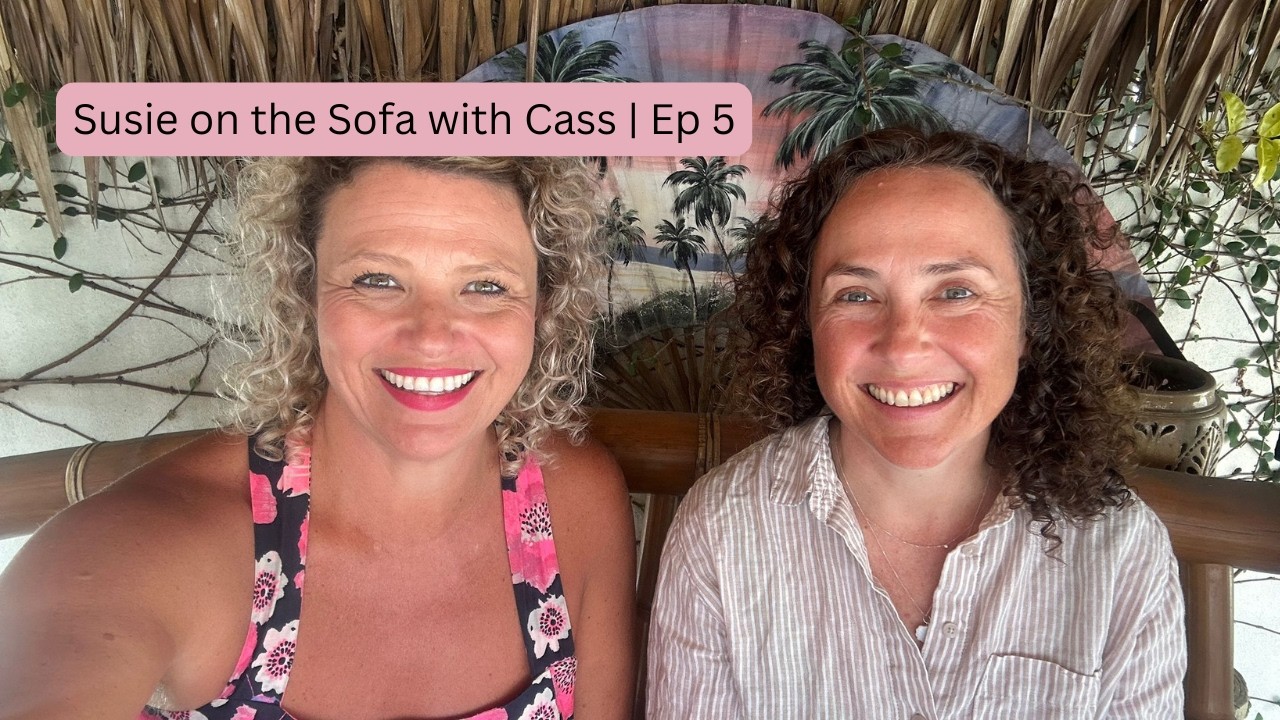
Susie and her sister Cass explore why busyness often masks unworthiness and perfectionism. Cass describes how mental chatter ruined even a massage on the Camino de Santiago, and they discuss the shift from doing self-care as obligation to receiving it as healing. They share cheap ways to rest: student spas, foot soaks, massages you can actually afford.
Chapters
Hello and welcome to Susie on the Sofa with my darling sister Cass. Ta-da!
Hi!
And we had— Cass had just got back from the most incredible 14-month trip to Europe. She bookended, um, the 14 months with 2 Camino walks, and that— well, you tell them, Cass.
Oh well, they are 800— oh well, very long pilgrimage.
Very long. And there's other videos about that, so if you want to dig into the walks Specifically more. Yeah, you can do that.
But they're essentially long walks, uh, they're very old religious pilgrimages, uh, to a place called Santiago de Compostela in Spain. Um, yes, I had 14 months in Europe, or 14 months away, 14 months in Europe. Uh, Camino de Santiago walk at the start, learned a lot of lessons. Camino de Santiago walk at the end, relearned a lot of lessons and learned new lessons.
Horrendous working holiday, a working ski holiday in Germany in the middle. Yeah, let's just say there was a lot of what we call— I don't know, it's lessons or just learning just made. I suppose a lesson is learning, isn't it? A lot of life, a lot of life stuff, a lot of life stuff in real time. Um, and what's interesting is Cass and I were just talking about this, um, we were like Cass was like, but how can we sort of, um, like, I feel like I'm from a privileged position that I was able to take off this 14 months.
Yeah.
To go and do these things, and not everyone can do that. And I was like, uh, me. I would have, back when my life was falling apart, which it did, back when I had an unexpected divorce when the kids were 5, 3, and 1. So I found myself a single mother, um, financial ruin basically, and So I think we want to kind of like just bounce around like the things that Cass discovered when she did it her— like this way, when you can blow it up and you can give yourself the space and time. But she's going to give us the hacks that we can— that for people like me that have kids and a job and like we can't just blow it up in that way, but it's like the hacks she's learned we can actually integrate In these crazy busy lives, um, because we know that that's not realistic for everyone.
Yeah, it's, it's— and it— I was incredibly lucky, and I went— I worked very hard to be able to put myself in a position. This wasn't gifted.
And it was planned for— you planned it for a long time. Like, like, to wrap your head around doing something like that, you still need to, like, think about it.
It was at least— I would say it was an 18-month process.
Yeah.
To actually make the decision and make sure that I was comfortable and set up enough to be able to quit my job, uh, move out of my house, sell all my belongings, put what I'd kept—
Teeny tiny bit in storage.
Teeny tiny bit in storage. And now I don't even know why.
I know, but it always— I know it's always there.
What's in there, but that's okay. There's definitely a fridge. One thing they tell you not to store is a fridge, and I kept a fridge.
I know. It'll last for a month wherever you go and then it will die. Perfect.
Money well spent. Um, so it wasn't a, it wasn't a snap decision, um, and it was a huge decision and not one that I made lightly because it, it meant leaving and leaving all of the comforts and all of the, uh, ideas and dreams and hopes and future planning that I had to Step out of life, essentially.
And that's probably why we're calling it the Boggle Button.
Yeah.
Because that's what you were doing. You were like, I've been doing it with these, like, letters. I've been making my words with these letters, and I am out of words. Like, I can't— that's how you play Boggle, isn't it? You— the— all the— or you press a button and all the dice come up and there's all different letters and you make words, I think. Well, that's what I mean by Boggle Button. So you— and then you get to re-hit it and it all comes up and it all lands down and you get new letters to work with.
So Yeah.
You were kind of like, these letters aren't working. I don't— I can't remove one letter or this. Like, I need all the letters to— like, just give me the new— yeah, just give me the new pieces.
I had tried. I had tried multiple different jobs thinking maybe it's just this company, maybe it's just this working environment, maybe it's just this living condition, maybe it's just this town that I'm living in. Maybe I'll move to another town. Maybe I'll try a similar job in a different company. And it just wasn't moving the needle enough.
Yeah, you tried a lot of parameters beforehand. hand, and I can promise you she has worked like literally nearly around the entire of Australia, um, some beautiful places, some a bit more remote. But you have tried to— yeah, you have tried to bang that peg into the hole. I love this analogy. I will use it a million times. I always get confused if it's a square peg or the round peg and the square hole, which doesn't matter. Doesn't matter. There's a hole and the peg doesn't fit. Yeah, no matter how hard you bash it. So it's Like, she— so to do the big blow-up was like a long process of trial and error to try and make things that fit.
Yeah.
And I think, um, like, obviously for me, my life blew up and I, I had different parameters. I had 3 very young kids. I had a job that I liked that wasn't— I needed the money to pay for rent, to pay for food, to buy the kids clothes. Like, it was like I was in a certain situation. So I think it's a really nice way to play between the two and what Cass found when she did it that way and how I sort of came to the similar realizations even though I did it in a different manner. Yeah, basically. So, um, so for everyone that can't just up and move, um, for various reasons, a million different reasons, it's, it's a scary decision.
It's not an easy decision. I think we mentioned it in one of the other episodes Where when you have, when you, when you have all of the options in, uh, in front of you, what do you do?
Oh yeah, what do you do?
What do you do? Um, and I knew, I knew I wanted to go and walk a Camino to Santiago because a very dear friend, Al, had walked it and loved it. And I love walking and love being outside and love being in nature. And I know that that's one of the things that helps regulate my nervous system.
So her stories on that kind of a little bit while we're recording this, they helped shine a light for Cass. Like, um, as in, this might be a way that you could, um, uncover some of the parts of yourself that you were looking to find. And that's really, if we wanna boil it all down to like a really simple basic thing, is the Camino gave you time and space to learn about yourself, to learn how to trust yourself, to learn how to check in with yourself.
Yeah. Yeah, to learn what brings me joy. Yeah, the trust and the listening to myself and then trusting myself to act on what is best for me was a lesson that you learn every single day on Camino. You know, we've spoken about that, even pulling up at a crossroads. Do you take the left path, which is the one that all the pilgrims take because that's what the guidebook tells them to do, Or do you take the deviation, which will likely be longer because it is a deviation?
Yes.
Um, and so you have to walk more kilometers. And then learning how to listen to myself in each situation and then do what, what is right for me. And those lessons kept coming every single day. But the trust and the confidence in myself to look after myself, listen to myself, make the right decisions, um—
And not do what you should do.
What you should do.
Yeah. Should. So Should is a dirty word. Write that down. The swear jar is a should jar. Anytime you say should, kick it out of bed. It is an expectation with zero value. It actually— you're doing it for something, someone else's expectation that you're trying to fit in the mold of, and it is going to eat away at you. Like, so next time you say should, just Ask yourself, why should you? Why? And keep, and keep, and keep asking why, why, until you get to the end of actually, it's— I don't want to do that for me. Like, this is what we're like working through, is trying to get you to be able to dig into why you're doing the things that you're doing. And are they coming from— well, I suppose it's love or fear, really, because love is like, is it feeding me? Is it nourishing me? And fear is if I don't do this, like, fear is a should. If I don't do this, will I get— and I won't be accepted, I get kicked out of the tribe, and then I die. Like, that's literally what it is. It's like fear is— it's a fear of death. And this is a primal, like, this is like caveman style. If you got kicked out of the cave, well, that saber-tooth tiger—
Dinner.
You're dinner. Like, you're dinner. You don't have the protection around you. So, it is our, like, primal need to be accepted in the tribe. So, what we don't realize now is that there isn't any saber-toothed tigers, and things that our body is telling us we need to do to be in the tribe is actually eating us and not feeding us, because we're forgetting who we are. So, it's a relearning how to check into yourself. And actually, I'm just going to bring up— because now I've said, now you die, the death thing. I'm just going to bring up the death thing. So let's talk death. Let's talk death. So everybody dies. Like, it's true. It's a fact. That is nearly the only guaranteed thing in this life is that every single one of us will die.
Yeah.
Yet we're all so, like, afraid of it. And we're also sort of like— I think there's a song that I don't know if Bette Midler wrote it, but The Rose by Bette Midler. It's in my Susie Unshaped playlist on Spotify. But It basically says that you're so afraid of dying that you never learn to live. And like, it kind of is, it's this fear that everyone has about dying. Like even the primitive, like tribal caveman, like, and it was back then, you did need, we needed to survive so that we could procreate and the humans could grow and evolve and et cetera. But it's, I don't really think I'm saying this very well. Would you like to chime in on the death thing?
Well, I do think it's a, And there will be a physical death for sure. Um, we— I absolutely agree, we will die. It's not, it's not an if.
This human body will die. Yeah. Yeah.
Um, and I think fear keeps you trapped in— this might be going off on a tangent, but the, the— it, it shouldn't take a near-death experience, although frequently it takes a near-death experience or a terminal illness diagnosed A terminal diagnosis or something significant to happen in your life for you to go, is this all there?
Like— Well, yeah, it's like a major trauma. And that's like, well, just look on Netflix. Like, Cass and I have been watching Netflix. We love a little, a little good movie together. Um, and, and, um, the common theme is like some sort of serious trauma, like, um, Soul on Fire, the little boy that— and we watch a lot of these true stories because I actually do, I always cry in them because I cry at everything, but They are so uplifting. And the message is the same always. Like, he was burnt to, I think, 97% of his body. They gave him less than 1% chance to live. And he makes a decl— oh my God, I've got goosebumps. He makes a declaration to his mother. I think he's like 8 or something.
Yeah.
As he's going into the first surgery, he goes— she said, you— this is up to you. You have to choose to live.
Yeah.
And she said, it's your choice, like, whatever you want. And he declares to her, I choose to live. And it's just then, like, obviously he has major battles, and, and then he doesn't have things— like, he has to adapt and learn how to live. And, and I think there's always a slump in the section where they have to remember that they chose to live, and then they have these most amazing, um, like, resurrections in being spokespersons. Like, like, if you think about all the motivational speakers, so many of them have been through severe traumas Like that. And that's why I think we can resonate with them. Why we resonate with that is because if they've done that and I have my little old life here and I don't have to face anywhere near the amount of battles, yeah, and they've come out the side to create a life that they love, like, that is amazing. Do you— I think that that's the point. Am I making myself clear?
Yeah, I think so. I— and, and it, it It doesn't need to take, uh, burns to 97% of your body or a cancer diagnosis, or you don't even need to walk 800 kilometers twice, um, to, to realize that you— we all have the opportunity and the chance and the capability to shape our own life, knowing that we will leave at some stage.
Yes, I think, I think it's It's like the word choice comes to me, but it's actually the conscious choice.
Yeah.
It's like switching from autopilot and consciously choosing, what do I want? Like, what do I want? And not what is expected of me, what should I do, not all of the things that are actually not coming from me. What What do I want? Okay, there's the question. What do you want? Do you— like, I don't think you— lots of people don't even know.
No. And I, I think when I, when I quit my job and decided to, and decided to take time off, take a step out of the corporate career space, a lot of people said to me, well, what are you going to do? What do you want to do? And I was like, I don't have a clue. I still don't have a clue, but that's okay. But I've become more comfortable with the uncertainty of the future. I know what I don't want to do. And for me, it was easier to think about what don't I like, what doesn't bring me joy, what do I not want in my, in my life in the future. Because the what do I want question was actually very overwhelming. It was overwhelming and it gave me real, uh—
You don't have any— there's no parameters that you have to work. It's a bit like, I kind of think of it like this, like imagine you can design a house. You can design and it's a blank canvas. You can design anything. Like, that to me is overwhelming. Whereas if I have house that I've bought and I'm just renovating it and I already have bones to work with, that is a whole lot easier. And I don't think I could actually design a house from scratch.
Well, you'd go to other— you'd go to other houses and get inspiration because you couldn't—
like, if you— it's a thing. Yeah, if you have— you can do anything.
Yeah, yeah.
What would you do? Record in a tiki hut?
Yeah, but it's like that game you play in a perfect world, or if, if you have If you know that, that the world is going to end in 3 days.
Yes.
Or 1 day, what do you do? What do you choose to do?
Oh, actually, that's a really good exercise. Maureen had us do it. I think she said, you've got 24 hours to live. I think she only gave us 24 hours, like, and then I think we like closed our eyes and I think she gave us about 10 minutes and she was like, design what that 24 hours would look like. And yes, teleportation is available. You can move wherever you want to go, whenever you want. You can have— you can instantly bring whoever you want to bring. But the point was, it's a very fast way to realize what's important to you.
Yeah. Um, and it's a wonderful exercise. And if you've never played it, play it. Just let yourself dream for 10 minutes about what, what would— because it's— if you have limited time, you think about instantly what's going to make my heart sing.
Yeah.
What's going to bring me joy?
What's my last experiences like? Yeah. Who Do I want to experience one more time? Like, yeah, and it's probably not going to be scrolling on Instagram like that, or making the beds. Yeah, or making the beds. You're not going to be doing the washing. You're not going to be exercising when you're exhausted. You're not going to be making the bloody beds. And I'd— P.S., the beds are not made today. Actually, Cass made our bed, but the girls' beds are messy, and that is just not— that's not happening today.
But it, it, it's a—
that's a really good point. Maybe that's the question you should ask. Like, it's like, if I only had a week left to live, would I do this? Yeah.
Yes.
That's a pretty fast way to tell. Would I go to that thing? Would I see those people? Would I— like, do you know what I mean? Does that, does that qualify bringing me enough joy of the experience to make it a part of my last week on Earth?
Yeah.
And start living that way for everything.
Yeah.
Don't you all go quit your jobs on us. Have a safety net.
Yeah, don't quit without another job unless you can.
Or do, or do. But actually, I do want to just touch on that a little bit because, um, as you said, people can't just quit their jobs. Like, they've got real responsibilities. Like me, I had kids, I needed a job, um, but I did scanties, my side hustle, on the side. Like, I knew that that was my passion And yet it was hard. Like, it was really hard to have a job. I had 3 kids and I was starting a business on the side as well. And I got myself help. I had, I had au pairs at that time and they were fabulous. We had some amazing girls from all over the world. And I had to sacrifice my space in order to get the help I needed and in a way I could afford. Like, I couldn't afford a full-time babysitter. Um, like, that would have been like— I, I would have earned less than them, probably. Do you know what I mean? Like, um, so au pairs were a fantastic way that I could get help in a way that could help me achieve this dream and in a way that, like, fit in my life. So, and maybe you can't have an au pair, maybe your house doesn't have enough space. I would actually rent houses that had space for the au pairs because If I had an au pair, it meant I could work more, and so I could actually earn more money. And do you see what I mean? Like, you've got to see the whole effect. Get a house that an au pair can live in. Or it might not be an au pair, but like, do you have friends that work opposite like rosters with you? Can they do the kids one day and you do the kids on the day you have off and share care of the kids instead of flogging yourself?
Yeah.
Like, where else can you find ways that you can get yourself support?
Yeah.
So you can do the things that light you up. And Scanties, like, uh, it was a battle, that business. Like, it was a battle. But if you don't know Scanties, I call them Scanties Anti-Shapewear, and they are underwear that loves you back.
Mm-hmm.
I have branded them Anti-Shapewear because I was so sick and tired of everyone being told that they needed to be 2 sizes smaller.
Mm-hmm.
And in actual fact, it was that messaging that has made me dug in. Well, why do we hate our bodies so much? Like, why? Like, where has this come from? And Cass and I were talking, and it's only been around literally since probably after the First World War, I think. Like, and then the flap— was it flapper? Flap? What was it?
'20s?
'20s. So around the '20s when that slender flapper look came in. And then after the Second World War when the pharmaceutical industries and the advertising industries, they got together and then they started promoting weight loss pills that Big Pharma sold. They They promote, oh, like uppers for the housewives. And like, it was like, it was all on, like, keep your skinny waist and keep your husband happy, or what? Like, like absolutely out of control. I think they were selling cocaine. I don't know if I can say that on here, but like, it was pretty crazy. And so we— it's only advertising and Big Pharma that got together to make ourselves feel bad about our bodies. Before that, we were just trying to survive.
Yeah.
Like, we were eating to live, like to survive. And if you had a bit more meat on you, you were actually considered wealthy. Yeah. And like, it wasn't a negative thing. So this societal belief that our bodies need to be— it's just another way to make you feel like you're not enough. And that's what sparked the whole 31-day challenge, which we haven't spoken about on here because we don't really need to, because there's a whole playlist on that and it's free if you want to dig deeper. It goes pretty deep, really deep actually, um, into why we're here and what is the point from like a spiritual, it's very spiritual perspective. But if you want to figure out, like, like see some of the things that might be keeping you from feeling at home and belonging in your body and in your soul and in your heart, then check it out. But, but I digress. What was I actually talking about? I was talking about— oh, the business. It was so hard. Sorry.
Yeah.
The business was so hard. It was so hard. And I had a crying stool in the kitchen. Like literally I'll just burst into tears and allow myself just to cry in the kitchen. Like it's, it's— I don't think it was supposed to be a crying stool, but it ended up being a crying stool. I think it was for the kids to reach the higher shelves. It was my crying stool. Um, and it was hard, but the, the side hustle of Scanties was such a heart-driven business for me because Scanties told women that their bodies were enough as they are. My messaging tells you you are enough, you're beautiful exactly as you are, you don't need to change or shrink yourself. And the product is bloody comfortable. Yeah, yeah. So you actually feel good in your body. There's no more chafe, which chafe is not making you feel good ever. Like, no one said, oh wow, I've got chafe, I feel amazing about myself right now. Oh, that pain, it just makes me feel so happy in my body. Said no one ever. So it's just switching off that negative programming where, like, the negative loop that you get in, because all of a sudden you have chafe, then you're like my thighs are too big, then my body's not right, then like, how can you go and be amazing if you've got that loop going on? So cut the loop out. And then now we, we get to the space where we can have this awareness.
Mm-hmm.
And so that passion-led business, that kept me— like, I was driven by that because I was like, this has to work. Like, my heart was driving that. Even like, the heart is not necessarily going to give you the easiest option.
I would say not.
Well, Camino wasn't the easiest option, so I suppose Scanties was my own Camino. Yeah, yeah. Hmm. Oh, interesting realization. Scanties was my Camino. Like, that's actually so true because it was like, like instead of sore feet or whatever, I would have product that would come back that wasn't, um, that I needed to somehow get fixed, and, and, and battles with China and the like. Logistics of, like, it's kind of the same. I've never thought of it like that.
And then, and, and similar to Camino, you have to keep coming back to why am I doing this? Because it is, it is hard running your own business, walking 800 kilometers. It's hard. And you have to keep coming back to why am I doing this? What, what is, what is, what joy is this bringing for me? And is for Camino, is this path, or is this path going to bring me joy today?
I've got goosebumps. I have never put that together, that my Scanties was my Camino. Because you've got to dig. And the joy— and because when you said that, like, why am I doing this? And my, my why is because these make me feel better. So if they make me feel better, I can make other women feel better in their bodies. Like, that is a pretty big why.
It's an enormous why.
It's like, yeah, okay, just gonna let that sit. I'm just gonna let that sit for a little bit. I'm not saying you need to start a side hustle that is like going to be that hard, but it's more— that's it, Cass. Yeah, it's the question, why am I doing this?
Yeah, yeah.
That is the North Star metric. That looks like— that's the bumper rails that we want to put up for you. Yeah, why am I doing this?
Yeah, and, and if it, if it's not— if whatever the thing is that you're asking, why am I doing this, If it doesn't, well, if you don't have a good enough answer for yourself, like this.
The only person we're talking to is you to you. Like this isn't a conversation for anybody else. This is all like look in the mirror and say, "Why am I doing this?" Like, why am I bashing that peg in that hole? Yeah, whichever it is.
Which way around?
You may never know. Could be either. But why? Okay, that's it. That's. Well, we just found the description title, didn't we? Why am I doing this? Like, why am I doing this? Like, where is it coming from? Is it a should?
Yeah.
Is it an expectation with zero value? Like, as we said, we looked at those messy beds and we were like, we don't get any medals for making the beds, not making them.
It doesn't—
it—
I like to have the bed made that we sleep in.
Yeah, that was lovely. Thank you. I looked at them and what I said to Cass, I said, I don't get a medal for making those beds.
Girls aren't coming home and saying, thank you, No, definitely not.
They couldn't care less. So it's only my expectation of myself that those beds need to be— why do they need to be made? They don't. There's no medal.
No.
No one's giving me a pat on the back for making them. In fact, the girls say, I don't know why you bother making them, we're just going to mess them up again. But yesterday, I do like to have it all back in one place. Okay, like, I know that I can get it there. I think the fact that I know that I like it— like, if you don't ever want it to be back in place, that's your— like, why? If it's never going to bring you joy. But I know I can get it back in place if I want, and that's enough for me. And then sometimes I do, and today we didn't. No, no, that's okay. No, so that's it. Why are you doing this? So especially like, and, but it can be for the hard things, like for you when you were having to dig deep, for me when I'm on my crying stool, like, why am I doing this?
Yeah.
But it can also be for easy things, like I introduced Cass to yogurt with strawberries yesterday.
And the hot tub.
And the hot tub. Oh yes, Cass, I was sure she was not gonna like the hot tub. Who is a hot tub fan? I know, it's amazing. But she had the— you had the expectation that, well, forever that you don't like hot tubs, really.
Yeah, they're too hot.
They're too hot. Well, guess what we did? We turned the temperature down. Look, no, side note, it took us 2 days to realize that. We're like, oh, we can just press the temperature down. That's not so hot. And then we found like the most perfect temperature, which is about 1 or 2 degrees above body temperature, and Float for ages. Delightful. So that was something that you were surprised. Yeah, I like— I love it. I was surprised. I thought I'd like it, but I didn't realize how obsessed I was going to become with it. And oh, also the Tiki Hut.
Oh yeah, the Tiki Hut.
We love the Tiki Hut as well. We know we should really be calling this Taaffes in the Tiki Hut because they're both— well, we obviously both have the same last name because we're sisters, but, um, uh, the Taaffes in the Tiki Adventure. Talks with Taffs in the Tiki. Yeah, that's a bit too much. But yeah, I suppose it's like, why are we doing this? Why are we having these chats? And it's a way— because it's a way, A, to process what's been going on for both of us. Like, I'm loving hearing all of the revelations on the Camino, and I love that we're documenting it because for you this is nearly like a living journal. Yeah, like, and the unpacking of the bits and pieces. I always love to unpack with another person because I find that you Well, we had that realization that Scanties was my Camino. I would have never had that if we hadn't been talking.
Yeah.
And how the dips and the highs and that is roller coaster. That is the same thing. It's like, I think that okay, clang are coming. I think both of them are teaching you to ask why am I doing this? Yeah. Because I think it's forcing you. Because otherwise, you, like, anything worth sticking to, your why has to be so strong that it pushes through the hard times.
Yeah, yeah.
And so, like, okay, now I'm trying to think, now have I gone completely off topic about how do we get this into regular life? I think it's that question, isn't it? Why am I doing this?
Why am I doing this? Um, and for simple things like Why am I doing the clothes washing? Well, the clothes need to be washed. But eventually they do.
Eventually. But does it have to be done right now, or can I let them pile up?
Yeah. Why am I staying in this job? Uh, do I need to— do I need it to pay the bills? Probably.
Yeah.
Um, does it need to be this particular job? Could it be something else? Uh, why am I walking across Spain when I've got blisters all over my feet and everything's really painful? I know because this is something that I really want to achieve, and I love the time in, in the Camino bubble. Um, but it— they do have to be strong whys. And, and to bring it back to, again, is it eating me or is it feeding me?
Yes. And looking at your why. Yeah. What is your why? Is your why a feeder or an eater?
Yeah, yeah, yeah.
Is your why a feeder or an eater?
It's not always going to be a feeder.
Yes.
Might be an eater.
Why do— why do I need to go to the gym and run 10 kilometers every day? Oh, because I want to be thin.
Or because—
why do you want to be thin? Yeah, like, keep digging down. Because I'm not enough if my body is not— that's all. I'm going to tell a funny story about Anna about this because she always gets— um, this is my lovely friend Anna who has RAMP. an awesome marketing diagnostic tool, which I love. Um, but she always gets like the wobbles if she doesn't go swimming. She goes swimming at stupid early in the morning, 5:30 in the morning, and, and if she hasn't been for a couple of days, she is like, oh my God, I'm like, I am flipping out. Like, she's not going because she's either exhausted or sick or something. Like, she's not just choosing to go because she's able-bodied. She needs the rest.
Yeah.
And I was laughing because I was like, I know exactly where this is going, but I'm just gonna play with her for a little bit. I'm like, Okay, so what would happen if you don't go? Like, what is the greatest fear that can happen if you don't go swimming? She goes, that I stop going. She literally said this, and I knew she was going to say this, um, um, that I stopped going swimming and I just lie in bed drinking cappuccinos all morning. And I said, and then what would happen? And she goes, well, then I would get fat and no one would like me. And I said, okay, I'm just gonna jump to the end here because A, that's never gonna happen.
Yeah.
And B, like, that fear is not real. Like, there's— I don't even think she could possibly sit, drink enough cappuccinos to get so— like, do you know what? Like, her fear is coming from somewhere, probably that primal thing, I'll get kicked out of the herd and then I die.
Yeah, I'm not worthy.
Because I'm not flogging myself when my body is telling me it needs rest, but this little voice is. That's why I dug in. Well, why? Why can't you just have cappuccinos in bed? And she's like, well, because then I get fat and nobody likes me. So I said, so then you get kicked out of the herd and you die. And she was like, haha. And I was like, I knew you. I knew exactly where it was going before she even— like, I kind of baited her a little bit because I did know where it was going. But it, it's like, start questioning, questioning the why. Like, why am I doing this? Yeah.
And is there when you question it, is there a different way? Like, if you find a— if you get down to the why and it is a— it's something that's feeding you, but you hate the activity that you're doing, is there a different way that you can get— you can feed that why, um, in a different way? Like—
Or like, add the— you mean kind of like if you need the job to pay the bills for now, but you want to start a creative project?
Yeah.
Like Can you, um, like, okay, firstly, I think lots of people don't even know what creative project they want to start. So like, firstly, it's like taking it back to that, what do we even— what do I even like? Like, what do I even enjoy?
Yeah.
And it's— I suppose we touched on this and we didn't really put this in the preface, but we've touched on the nervous system in other videos. Um, but you need to get your nervous system down a bit before you can start digging into what brings you joy. Because if you're at a 9 out of 10 and you're frazzled and you're overwhelmed, you just need a long nap.
Yeah.
Like, that's the only thing. Like, do you know what I mean? But that's what's going to bring you joy. If you— you need space and time to deregulate. Like, deregulate, is that it?
Uh, down, down.
I don't know. Take the pressure down. Take the pressure down. Go John Farnham. Um, but you need to bring the pressure down, the internal, like central nervous system, like, to a 5 or a 6, because you cannot figure it out. You can't figure any of this out. And that's why Cass used the Camino to give herself the space.
Yeah.
To be able to bring it down. And some days were hard and she could only do the bare minimum, and other days she probably had more revelations about yourself, was probably when you were at like a 5 or a 6 and you weren't like struggling in pain.
Yeah, yeah.
That's when you have the aha moments after the pain, but bring the central nervous system down to a 5 or a 6. And so look at the video, like, you'll have to work out your own magic toolbox for this. But for us, like, for me, like, if I'm frazzled— and I'm laughing this morning actually because I had— have I told the salad story?
Uh, yeah, I'm not sure.
I'm not sure. Anyway, I was at an 11 out of 10 at Ralph's I love cooking. For me to take a salad to a barbecue is not hard. I was glitching, could not— I spent 4 hours trying to figure out what I was taking to this barbecue. What I took at the end was terrible. It was like, I made a salad like that from ingredients we already had yesterday. Like, it— I glitched massively. I was at an 11 out of 10, and I didn't even see it at the time. It was the next morning I woke up and I was like, right, okay, you are not okay. So Today is you just choose for you what's going to make you feel good. And so I was like, the day is yours, like clear the schedule, you're— this is a day for you. And so I dropped the kids to school, I, um, meditated, I went on a beach walk, I like had a nice shower, like I did all of these things and I was feeling amazing. And then I looked at the clock and it was like 11 o'clock. 11 AM. I had spent— it was only 2 hours that it took for me to bring my level back down because I'd get— I cleared the whole day. Like, I could take the whole day if I— like, I was planning on taking the whole day. It only took me 2 hours once I just— my pure, like, guidance for that day was just do what makes you feel good.
Yeah.
And you'd be surprised once you clear that, like, if you say you don't have time for that self-care or space, that's exactly when you need it.
Yeah.
And if you're trying to operate without bringing that down, that central nervous system down, everything's going to take longer. You've got like everything— You're gonna get frustrated. You're gonna get frustrated. You probably might not complete things, like you're not going to do them as well because you were so this that nothing can flow. Do you know like when you're trying to bash out a work project or something? Like, I'm not a night person. If I try and work at night unless I'm really in the zone, I get confu— like it just takes longer. It's like working with jet lag.
Yeah.
And then in the morning you get up and something that you were bashing through the night before, it takes like 15 minutes. So it's like, that's the same with the frazzled, don't you think? Like, when you're feeling frazzled, everything's gonna take— so in actual fact, if you take out the half an hour, you're gonna do everything twice as fast. So you're gonna buy yourself that time back. Yeah.
And, and things will— like, you know, like we've spoken about in other videos, you know when you're at Sort of nine out of ten because you're swearing at the coffee machine, or you know you're swearing at people in in traffic, or you know you drop your glasses and then it's like the world has ended. Yeah, if you drop your glasses, you can't find your phone, you can't find your keys, which is going to happen on any given day. But if you're at a five out of ten, you're like, oh well, I guess I'll just keep going until I find my keys.
Yeah, yeah, yeah, right, right, exactly. So yeah, look at your auto responses. That is your biggest indicator. Like me, I keep getting stuck on the knobs. My pockets that I have, I have pockets in all my dresses and they are knob height in the kitchen. And I turn around and I'm like, like, like almost like it is, it is like, that's it, coat hangered by the bloody drawer knobs in the kitchen all the time. And so I can tell very quickly where I'm at because if I'm saying an expletive, not good. Yeah, if I'm like, oh, not again.
Oh, you cheeky.
Yeah, you silly starfish. They're starfish knobs. But so you'll know where you're at. And so the— to, to be able to ask these questions, you need to be in that like grounded, centered place. And yeah, Cass actually made a good comment, and that was like, well, what about like— and I didn't know this when I was going through this, when my kids were little and I had a job and I bootstrapping a business at the same time and doing scanties. I did— like, I'm only figuring this stuff out now. And Cass said, well, what about someone that's got young kids, a job, they've got a house to maintain? Like, like, how do they bring their central nervous system down? Like, um, and I was like, well, I think obviously someone in Cass's position is going to be able to stay at a 5 A lot longer.
Yeah.
And even me now with my kids being bigger, like, they're so physically demanding when they're littler, and once they're bigger, like, apart from a bit of talkback, like, they can make themselves food. And well, they obviously don't clean up after themselves, but we're working on that. Um, and so I have more space that I can do things like that. They go to school. But if you've got young kids at home, I know I spoke about the au pair, like finding yourself some help, like Don't try and do it. Oh, I just realized, asking for help. We had a whole thing on that yesterday, didn't we?
Yeah.
Asking for help and being able to receive it. Like, there is no medals for flogging yourself stupid, do you know what I mean? Like, there is no medals for being burnt out, for being the mum or the person that holds— I suppose this is, this is directed at mums because you do have to juggle a lot of things, and those kids are needy. Like, you can't just put them aside or something. Like, you can't just leave work, leave them early. Like, I'm just— Mum's checking out now, I'm just gonna leave off early.
See you in 2 days.
I'm done. So I am talking to the parents out there that, that we're like, you might only be able to keep yourself at a 7 or an 8. And I, I like— this is really bad, but I would actually— I can't say it— I would think about doing things about 9 o'clock in the morning Um, just so I could have a little bit of a rest. Like, like, like, it can be exhausting and overwhelming. And so maybe the best you can do is instead of being a 9, you can find ways to be an 8. Like, there are going to be parts of, like, like, times in your life where you can't be a 5 or a 6.
Yeah.
Like, there's young kids and a job and a house to maintain. Like, there are periods in there, and your why is so strong then because the why is about them. Yeah, the why is like— and so, but then I think this is what we were saying, so what can they do if they're in that crazy stage of life? And it's coming back to the awareness of like, what do you like? What feels good to you? And then crossing the shoulds and the expectations off the list.
And consciously choosing. You use that word, conscious choice.
Yes, yes.
around where you're spending your time. Because, you know, we could all fill up— even, even as someone walking on Camino, like, I could fill up an entire day with busyness. It— pre-Camino, post-Camino, like, you can fill your day. But consciously choosing— if you have a full— if you have an incredibly full life, which we all do, there has to be a trade-off. Because—
And what's eating you or what's feeding you? Yeah, that's Pretty much, that's the little— yeah, that's like you need to run it through the eating and feeding filter.
Yeah.
Is it giving?
Yeah.
Or is it taking?
Yeah. And you go to the obvious ones: scrolling social media or watching TV or online shopping or—
But actually, just a side note for us overthinkers, I'll just say that watching TV can actually be really good if you need to switch your brain off. But, but Is it feeding you or is it eating you?
And on different days it might be doing different things. Like, yes, you know, like the, the things that— so the things you have in your magic toolbox might feed you one day but might eat you the next day. Maybe one day social media, scrolling social media, actually is the right thing for you, but then the next day it makes you feel like crap afterwards.
Yes.
Um, maybe TV watching is great, but maybe on one day it isn't because you need to move. Like, it's It's not— there's no one-size-fits-all.
And, and yeah, and you don't need to be shat on by a bird to realize that. I was trying to use my beach walk from the magic toolbox and it was blowy and windy and awful. I didn't actually want to be doing it, but I wasn't listening in, so a bird decided to shit on me all through my hair. It still didn't stop me. I still took a few more steps and I was like, oh yeah, I suppose I could keep— it's like, you have shit in your hair! Like, turn around and go and have a shower. This is not Peg hole! Stop banging it! Like, but it's in my magic toolbox. It's like, but you said use my magic toolbox. Yes, I will be calm. I will walk on the beach. No. Yeah, listen. Yeah, it's— is it feeding you or is it eating you? Like, I was— I had to bed rot the other day, as the kids called it. Penny said, have you just been bed rotting all day? And I was like, well, but my head was like— I like couldn't think. I was glitching.
Yeah.
I was actually glitching.
Yeah.
And we'd had a bit of like repairs and maintenance around the house, so our schedule and our sleep schedule had been thrown out a bit, like when the tradies were coming and stuff. And I just hadn't had enough sleep. I think I was exhausted. And so we watched a documentary and we watched something else, and I was like, by 1 o'clock I, I had actually refreshed myself and I, I could actually go about and have a really nice day. And we had a great afternoon and We went to a play, we went to my daughter's play, and like doing that, if I hadn't had that rest at the beginning of the day, um, I would not have been able to— like, I would have been dragging myself to her performance.
Yeah.
And, and sitting through a 2-hour like high school performance, whilst they're brilliant, if I hadn't had that rest, that would have been like torturous. Whereas I got to enjoy it because I'd actually rested myself, so I was actually feeling better. Um, so are you bashing the peg into the wrong hole? Don't do it, even if it's in the magic toolbox.
Even if it's in the magic toolbox. And you'll, you'll know in your body, because when— for me, I know that things feel right because my whole body relaxes and I get my lower back.
Yeah. Do you get the wiggle?
Yeah.
Like, you know when you make a decision, and this, for me, it's often if I make a decision that's for me And I shelve the guilt about it because that's always there. We have to just say, thank you, I see you, you're not mine. Um, and then you physically— I'm so excited, like whatever it is, like, oh my God, I'm so excited to do this. But I do have that little guilt thing, like, for— like, we were brought up in a— like, this is our— this generation, I think probably because we were the children of the baby boomers and they'd been in the And like, you have to be productive and you have to be like doing things all the time. Because I think— do you think that that's where this cut— like, it's our generational— that self-care is only becoming a thing now?
Yeah, yeah. And, and yes, I think so. I think that there was real survival instinct, real survival instinct, because Genuinely, there was shortages.
Yes.
But now there's— there's—
Yeah, because the baby boomers that, um, our parents have, the parents who went through the war, so they learned to be, um, like productive and to make things work. And like, it was a real survival— Yeah, survival.
Survival.
And they were the children of the survival parents, so they taught how they were parented. And the world's not like that anymore.
We are not in survival mode.
Well, now it's survival for your central nervous system.
Yeah.
Like, that is literally—
Yeah.
We are at a rate It's survival for your central nervous system.
Yeah.
Like, that doesn't— that— we need to make that sound better because that is like, that's a clanger.
Yeah.
I'm gonna get some better words for it, but it's— yeah, it's like the survival. Like, we need to nurture our central nervous system as our number one priority.
Yeah.
Because you can sleep forever, but if this is frazzled, you wake up feeling tired.
Yeah.
Like, this is key. Like, if you can't get the central nervous system lowered— and as I said, sometimes you can't go to a fibro 6. But find ways. And also, I think that point was, which we went a very long way around, is learning what brings your— like, what makes you come down, what gives you the, ah, like, what feeds you.
Yeah.
Start writing your list of notice when you get the, oh, this is so nice.
Yeah.
Like, is it like— well, this is the first time we've ever had a hot tub, so, and it's only a rental, so it won't be here forever, but Like that when we hop in it, we go, oh, it's so nice. And we use it every day because it makes us feel— and it's not a big commitment. You can just hop in it and you can hop out 2 minutes later if you want to.
Yeah.
Like, just start making notes of the things that make you feel like— like, like for me, I love putting music on and cooking. Well, not in this kitchen, it's like this big. Um, so you couldn't even dance around because you'd hit your elbow and you'd get stuck on the starfish knobs. So this kitchen isn't the best kitchen for cooking, but for me, I'd like normally make like 4 or 5 dishes at a time, and I'd, oh, mix that one and season that one, and like everything would have a place where it was in the cooking cycle. Like, I need to roast that first, and I'm layering that, then I'm cooking that. And it was like a, it was like a moving meditation, like a flow. It's so good. And I would be so into it. And so like, I like the thought of having that time to be able to spend on doing that gives me like, so Point being, what makes you feel like that?
Yeah.
Like, and you need to start, like, is it certain songs? Like, if a song comes on and you love it, put it in a special playlist.
Yeah.
Like, I've got songs in my playlist that I just put them on when I wanna feel like back at, like, at home and in love with myself. Susie-Ann Shape playlist. It's about feeling at home and happy within you and your body. And it's come from Scanty Zandy Shapewear, like the songs about how you actually are enough. Exactly as you are. Sorry, Sarah Blakely, but no, two pairs of Spanx was my final. That was the final straw. I was like, "Rah!" Ah! No women, you do not need to hear this. It was two pairs too much. Two pairs too much. And that's when I labeled it anti-shapewear because I got. I was like, "What? One pair squishing us isn't enough now? We need to be small and make sure we put two on." I was like, "Enough." And that's when I coined it anti-shapewear.
Anti-shapewear movement. Yeah.
And it's like, what— like, that's about physical shapewear, but what is— what emotional shapewear are you wearing around your soul? And that's all the shoulds and the expectations of zero value. Like, no medals for— like, no medals for walking with blisters and injuries. And you don't get a medal for, like, flogging yourself on the Camino. We certainly don't get medals for Making the beds.
Yeah, no, there's. I've just totally lost my train of thought.
Oh, that's okay. I'll give you a medal for that. And for you, you might be someone that can't focus, and I think I'm a creative person. Well, it might have nothing to do with that, but they do say people like to be creative in like in a mess. Like in actual fact, creativity. Doesn't like structure and order. Like, for you, it might eat you more to have the beds not made than it eats me. For me, it's a should. Yeah, it's not a feeding me. But for you, you might actually not be able to relax unless it's done.
I was that person, definitely. But at what stage is everything done? When is it actually complete? And what are you—
yeah, from—
yes, if it's preventing you from actually Do if it's a if it's a procrastination method because you know you're scared about actually having the time to do the thing that you might want to do if it's if it's a controlling mechanism.
Yeah, what do you get for having beds made?
There's no medal. There's no medal.
If anyone knows of a medal for making beds, let us know because we might be saying the wrong information here, but we're pretty sure. There's no metal. There's no metal.
There's no marching band in the morning when you come out of the house.
No string quartet. Who did the beds? Who did the beds?
But I understand, like, I understand my brain is a little more, uh, it's different from Susie's. I do like to have more order in the house, but it, it, it's at the detriment sometimes. It's at the detriment of something else.
Yeah. What are you like? And that's what I'm talking about, is like, we wanted to do a million other things today. The beds weren't important.
No.
So that's what I think is you're saying, is like, are you letting making the beds get in the way of the stuff you actually want to do because you should make them?
You should make the bed.
That, like, that's how we're trying to like describe it. It's like, are they stealing your time?
And your headspace.
And your headspace.
And your—
And not going to bring you the actual like Yeah. Joy that you're hunting, like the stuff that actually does light you up because you should make the bed. Like, you get that we're just using the beds as an example. It's not about beds. You all— we, we get that. It's about like, uh, something that we think we should do, but according to whom? And do we get a medal for it?
Yeah. And what value is it going to add?
And is it getting in the way of things that might add value?
Yeah.
And I like that, how you said, are you hiding behind it?
Yeah, are you hiding behind it?
As an excuse.
As an excuse not to—
'Cause I'm so busy, I can't get to what I actually want.
I'm so busy because the house needs to be cleaned, the dog needs to be walked, the dishes need to be unpacked, that I, I don't have 10 minutes to sit and breathe into my belly in the morning. I'm so busy that I need to answer all these emails, attend all these meetings, that I don't have time to take a walk and go and put my feet on the grass for 5 minutes at lunch. Like, you can, you can make excuses and find things to do to busy your life until the cows come home. I'm very guilty of that.
It's actually really interesting because you saying that— why do we be so busy that we— is it because we don't feel we're deserved? Is it the I'm not enough, I don't deserve this space?
Like, I think, I think there's a lot of it. And I was, I was just going to add to that, even on Camino I had days where I would walk constantly in my head. My shoes are too tight, my poles keep falling down, uh, I don't have enough blah blah blah, how far is it till the next town, this is really painful, the sun's really hot. Like, and it's not necessarily complaining things, but you could fill your head with all of the things that you think you should be thinking about. And then you get— I would get to the end of the day and go, oh God, I didn't, I didn't look at it, I didn't sit and breathe.
You don't even remember it, do you?
No.
And I do that sometimes on my beach walks. I know that you weren't present for one bit of that. Like, what was the point?
Yeah, a massage. That's another really good example. I found myself having a massage. I said— I had all these big, um, grand, uh, statements I would make on the Camino. I'm going to take time for myself and go and have a massage. I sat— I, I consciously throughout the whole massage thought, you should be enjoying this. Is it hard enough? Should you ask her to stop? She must be getting really tired because I'm I wanted a strong massage. Her hands must be getting really tired. Is it— I should be relaxing. And, and I did it. And then, and then I literally, my brain just went, stop, just stop, you're not enjoying this. Um, but I think it's because, I don't know, we feel like we have to prove something. It's not that we feel—
So the massage, do you think that you were trying like to— I want to dig into that a little bit, like the, like the brain thought, like where did— like you probably, like you don't get massages a lot Camino. So you would have been like, really like, I'm gonna get a massage. So please, I want to talk about how a thing in the magic toolbox actually ended up eating you.
Yeah.
And did you flip it around, or did it— the whole thing just—
No, it has a happy ending. Okay.
Oh, not that sort.
Not that sort.
No, no. Oh my God, that was— you didn't pick it up. Not that one. It has a Disney ending.
It has a Disney ending. We're in an American movie ending.
Jesus, is that gonna make it? I think so. I think so.
Um, yeah, so I, I, I knew that I— it was a long— I was playing a long, a long game on the second Camino. Um, and I had a rest day, so on my rest days on the first Camino, uh, I would still walk 15, 20 kilometers around town, seeing the sights, visiting art galleries, doing all the things. And I got to the end of the first Camino absolutely exhausted and shattered and broken. Um, and the second one I said, no, I'm not going to do that. So on the rest days, which is where you'd go into a town and you would stay 2 nights instead of 1 night, so you'd have a whole day.
Yes.
Um, yeah, a whole day off. So, and it was generally for me, it was in towns where there was something that I wanted to see, but I would make a plan that I would have a sleep-in, have some breakfast, rest, go and see the one, maybe two things that I wanted to see, generally one, um, have a massage because I was playing a long game and I knew that my body needed a break. And then I would, um, have a rest and then I would have dinner and go to bed. So maybe I would walk 3 kilometers. Perfect, perfect day. And so in the massage, um, I was like, yep, I'm doing this because it's a long game. I know that my body needs some relief and it would be really nice to, to have a massage, which everyone was like, Oh, you're having a massage? That's a bit luxury.
Oh yeah, it is.
I'm very smart. Um, but in the massage, so the, the lovely Spanish woman had asked if I wanted it soft or hard, and I said hard, thinking that that would be better for my muscles. And then, um, she was— and she was excellent, she was wonderful— but I could really feel that she had to really use all of her body strength. Um, and I then spent the whole time overanalyzing That I should be enjoying this massage, that I should stay awake so that I can actually feel my muscles being lots of shoulds, lots of shoulds, so many shoulds.
Like even the that you should have a hard massage. That I should have as to what do I actually feel like? Feel like maybe you want we call it a swishy swishy, swishy swishy where they a swishy swishy where they just you know what it's very relaxing and I think sometimes that's how you do the lymph anyway. So yeah, that's cats putting expectations. On hard is better, and I need to like the muscles.
It's going to help me get all the way to Santiago.
No checking into what do I maybe I just want to really like a swishy swishy means like you just float. Yeah, maybe you'd like like who knows?
Not a lot of pressure. Yeah, maybe they don't hit all of the right pressure points, but it's very relaxing.
There's no yeah, but I thought I should.
Have that one because my because my muscles were sore. I was very sore.
Okay, so did that? What was the fairy tale ending?
The fairy tale ending was that I I I think it was about I I'd look I'd love to say it was five minutes into the massage, but it wasn't. It was longer. I shouldered my way through probably half at least. Okay, half of the massage before my the shoulds before my body went my mind went stop literally stop was the word that came into my head. I was like. You don't have to make this a, a, a, a, like a—
Well, it doesn't nearly have to be doing something.
It doesn't have to be anything.
Yeah, like it doesn't have to be like you were doing it thinking your muscles needed this. Like, it doesn't actually have to be doing any—
That was the thing that I, I realized, um, was that I had been—
I—
the whole reason that I had gone to the massage, yes, physically but also to receive, to receive care. Like the first— the albergue owner that when I was broken on the first Camino cared for me and fed me and looked after me for a couple of days. I knew that I was going there to receive. It dawned on me, you are here to receive, not, not a punishment.
No, it's not a punishment.
And you don't have to—
and you went through the first half of it like bang, bang, bang, bang, bang.
Yeah. And then I was like, stop. You're here to receive. This This is what you are here for. You are here to do something that's going to make you feel really good about yourself. You've given yourself the space. And yes, I'd given myself the space on the Camino, but this is me carving out time on my rest day, not doing all the other things that pilgrims should do, like see all of the sites and visit all the cathedrals. This is for me. This is time for me.
Yes, to restore you.
To restore me and to receive nourishment and care and just to receive. And then I fell asleep.
Oh, I was like, you went from one end to the other. Yeah. Did you tell her to go softer? I didn't. Oh, you didn't? No, you just changed your mind. I changed it.
So maybe your whole body was tense like that anyways, and I wasn't enjoying it, and then I just went, stop. Oh my God, you're here to receive. And I could literally feel my whole body relax, and maybe that's— maybe she felt it relaxed too.
I'm not sure. She has a sleeper hold in here, maybe. Yeah.
And then I fell asleep and I, I woke up feeling amazing. I think maybe like a 5-minute nap, 10-minute nap, but it wasn't— I just stopped putting this expectation that I was supposed to— we're supposed to be getting something of value out of this. Yes. Massage. When just, just relax and receive.
Yes. And like, for some people, like, money might be tight and you can't get a massage, but like, you can actually be quite clever. Um, like, and I did this even when I was young. Like, look up like the local schools in the area because those students always need to practice on someone. Yeah. And if you just want to go and have a swishy swish, like if you take the expectation off it, like you can get things like that— hair or nails or a massage or a facial. There's lots of like the colleges and the schools and they do them for really like for product value, really. They don't charge a lot of money. So there's other ways, like you don't have to go to a fancy spa. Well, that's why Cass and I used to love going to Asia when we backpack all the time, because we'd get over there and we'd get all of this like stuff that we couldn't afford in our— like, we're now like early 20s, like teens in Australia. We're like, oh my God, we can have anything off the menu.
Massage for $5.
I know, that's amazing. Like, I'll have one. Like, it's just— and that feeling of I can have anything off the menu is such a nice feeling. But maybe you can't have it at the fancy spa down the road, but maybe you can have it at the student spa. Like, there might be ways that you can gift yourself things like that that don't have to be stupid expensive. I just thought I'd put that in there as a side note.
Yeah, and it doesn't have to be a massage.
I'm gonna tell them the story of what Cass and I used to do in China. So when we worked in China together, we're in our 20s, we were— there was no Google Translate that we— anyway, we had an apartment in Guangzhou. And we would be out walking a lot because you had to do everything in person. We couldn't speak the language, but we would take this uni student translator along with us. And at the end of the day, we'd have our showers. And we used to have these muumuu things that we got in India, another trip. But that's a side note we can talk about, and maybe never.
Maybe never.
And then we used to get 2 buckets and fill them with hot water and sit there with our feet in them, in the buckets, in the lounge room, in our muumuus.
With a show on, with a show on, and a dollar. Yeah, a dollar Chinese, a dollar Chinese beer, and it was as good as being at a spa.
It was heaven. Yeah, feet in a bucket. We put hot water. Maybe if it's hot where you are, put cold water. But whatever. You'd be surprised how good feet in a bucket. It's really nice. So that's the point. But like, once you know what makes you feel good, like literally it might. Like we had our feet in a bucket and that felt amazing. Yeah, like you, you can work within your means. Yes, you just see awareness around what is going to make you feel good.
Yeah, and yeah, we try some different things.
Put your feet in the bucket. It's like a metaphor for trying different things.
Try different things. Some things you— some things won't work, some things might work, and you might be surprised at some things that feel really good. Like, yes, in a bucket.
Yeah, feet in a bucket. I think old ladies used to do it a or something. I don't know where we even got the idea from. We actually had to buy the buckets. Yeah, like, we had— there weren't buckets there. We actually went out to buy the buckets to put our feet in. Like, it was a conscious, conscious choice.
A little bit of magnesium.
Yeah, it was amazing. We definitely didn't have magnesium.
That would be nice.
That would be nice. Oh yeah, you could totally do that. Yeah. Um, so that's the point. So we have chatted for way too long, but it is a very important topic though. Yeah. Finding like what's eating you, what's feeding you. Start making a list of the things where you feel joy and the things, things where you're like, oh, look at your language. Like, are you limping? Like, are you going, oh my God, I've got to, I've got to do this, I've got to do that?
Yeah.
Do you have to?
Yeah.
Yeah. Do you? It's a good question. Like driving the kids to school, you probably have to do that, but like you get to drive them. Like that's actually a privilege. It just feels like a chore because Your nervous system is exhausted. That's it, really. Things that actually should bring you joy then don't feel like they're bringing you joy because you're so exhausted that nothing can get through.
Yeah.
Like glitching and me not being able to make a salad. Okay, I'm gonna stop talking now before this timer breaks. Love you lots. Bye.
More from Susie



How to run your day from intuition instead of autopilot programming (including FEAR)

Code HEATWAVE for 30% off - my gift for your thighs! #heatwave #chafe #california skanties.co

Heatwave proof 🔥save your thighs - use code HEATWAVE for 30% off! #heatwave #california #thighs


