Episode 117: Sex after Grief
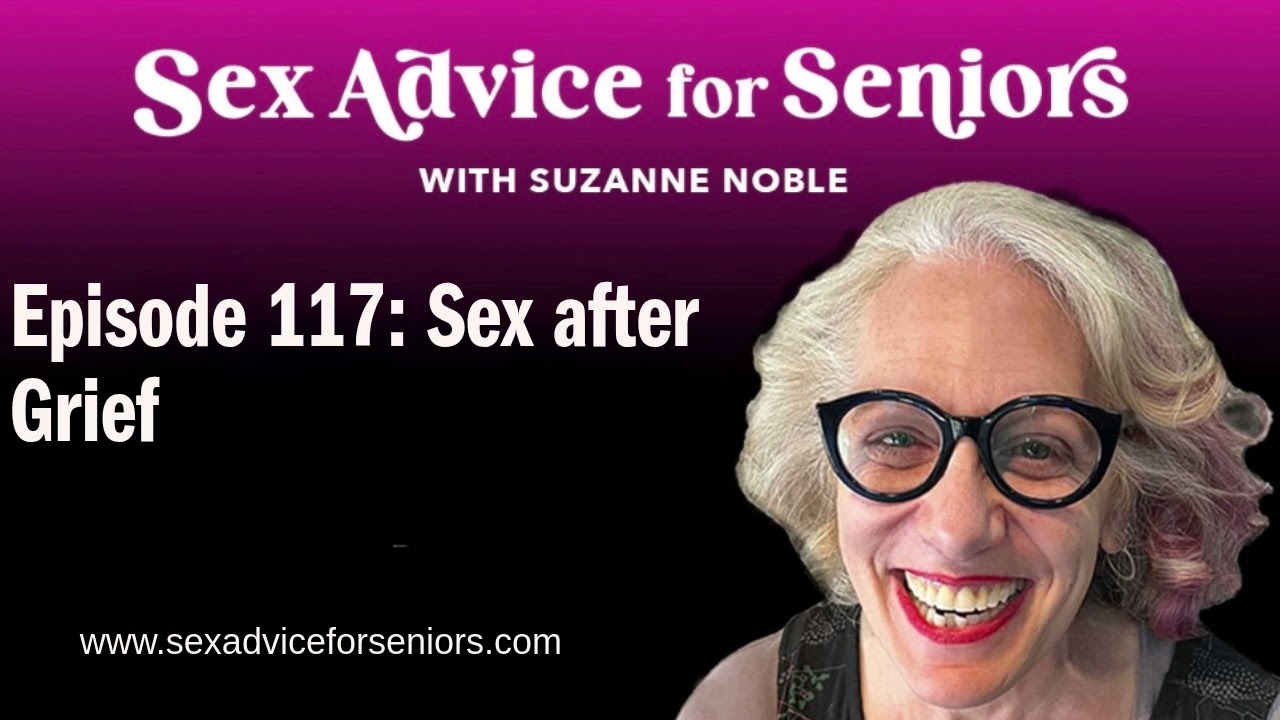
In this episode of Sex Advice for Seniors, host Suzanne Noble interviews senior sexuality pioneer Joan Price. The conversation begins with Joan’s origin story—how falling in love at 57 sparked her first book, Straight Talk About Sex After 60, and later the award‑winning Naked at Our Age. Joan explains why she updated her 2019 book Sex After Grief: Navigating Your Sexuality After Losing Your Beloved with four new chapters that address post‑loss desire (the “widow’s fire”), loving two people at once, coping with life’s curveballs, and moving forward. The pandemic’s forced isolation is discussed as an unexpected factor that intensified grief and reshaped how older adults connect. Joan and Suzanne explore the biological and emotional drivers of heightened sexual urges after a partner’s death, share personal dreams and experiences, and stress the importance of conscious decision‑making. Practical guidance follows: how seniors can communicate desires, set boundaries, and use familiar “base” analogies to negotiate intimacy; how to overcome survivor‑guilt and the fear of betraying a deceased partner; and how to approach modern dating—online platforms, “dumpster fire” perceptions, and taking experiments one step at a time. Joan plugs her webinar “How the Heck Do You Date at This Age?” and encourages listeners to use her books, webinars, and community resources to reclaim a satisfying sexual life after grief.
Chapters
Suzanne Noble: I'm very excited to welcome our new sponsor, Higher Nature, who have created Rekindle, which I'm currently trying out and is working a treat. A 100% natural libido-enhancing supplement for women, which contains clinically backed ingredients to give your sex life a boost. And who doesn't want that? Hi, I'm Suzanne Noble, and you are listening to Sex Advice for Seniors. There's a woman— when I actually first started looking at, is there anyone in the universe talking about sex over 60? I discovered that actually there weren't very many people, but there was one standout person that I discovered one single human being called Joan Price, who wrote this book called Naked at Our Age: Talking Out Loud About Senior Sex. And I was like, oh my God, someone's actually done something about this topic. So I am so excited. You have no idea how excited I am to actually talk to Joan. I've got a million questions for you, and I know that probably we'll have to leave some of those out because otherwise we'll be here all day. But yeah, Joan's— Joan is really, for me, the, the first person, as I said, that I ever discovered writing about this, and the person who really put all of this on the map in terms of senior sexuality. Because, you know, maybe I don't Google enough, but I certainly couldn't find too much about sex over 60 aside from what you've done, Joan. So welcome to Sex Advice for Seniors. And coming at us all the way from Sebastopol, California. Welcome.
Well, thank you, Suzanne Noble. I love that I'm, I'm your single person. Yeah, I've been doing this work for 20 years since I was 61, and I'm now 81.
Wow.
And when I started, there was not a field on older age sexuality. Now there is, and it's wonderful to have people like you who are spreading the word and doing the work and, and helping people with this really important of their lives. Yeah.
And I mean, I actually started a Facebook page called Sex Advice for Seniors probably 5 or more years ago and then just kept it lurking around, adding to it every once in a while before I then actually took it a bit more seriously. I think that when you say there's lots of people out there doing this, I still think, I still think we can probably count them on one hand, Joan.
So that's lots. That's lots compared to Suzanne Noble. 20 years ago.
Yeah, yeah. But it's still pretty taboo. I mean, I'm just, just very quickly, I'm curious to know what made you start investigating this area at pretty much the same age that I am now, actually.
Well, my origin story is that at age 57, after many years of single life, and many years of feeling invisible in the dating world, I fell in love with a man who was 64. And we started having the best sex ever. And I thought, how can this be possible when there's— this is such a mystery? Why haven't I heard that this is what I have to look forward to? And there were no books at the time that, that presented older age sexuality in a positive, lively, sexy way. It was either doom and gloom, or it was very academic, or didn't exist at all. Mostly it didn't exist at all.
Yeah, yeah.
And I was already a writer. I was earning my living as a health and fitness writer, and my darling Robert said, well, you're the writer, write your own. And I did. I started with Better Than I Ever Expected, which is an apt title, right, for my story, Straight Talk About Sex After 60, which I wrote at 61. This didn't happen at the beginning of our relationship, it happened 4 years in.
Yeah.
And I thought I was going to be just a one-book person and then I'd go back to my normal life. And people really had reactions to that book. Yeah, there were those who said, ew, stop writing about this, we don't want to hear it, la la la la, that's disgusting. And there were others that said, oh, finally someone's talking about this. Yeah, and people sent me their questions, and that became Naked at Our Age, uh, the one that inspired you. And it is my multiple award winner, and I'm really proud of it.
Yeah, and, and I'm So glad that you did it because it is something that nobody really talks about. And that's one of the things that has come out of me doing this and stuff on social media is the fact that people are still reacting to the idea of senior sexuality as if it's a big taboo. So it's kind of also around challenging societal expectations about having sex in later life and feeling good about that. I mean, I think like you, we stumble across different ways of having sex in later life, you know, if we're lucky enough to have a partner that is also on board with all of this. And clearly there's a lot of unhappy relationships out there where one person is still raring to go and the other person is like, no, I don't really think so. So, you know, when you get two people who are like, why stop? It is— it's, it's a celebration. And we do need to acknowledge it and say, yeah, this is great stuff. But let's talk about the reason why we're here, because you've actually got a reprint of and a republish of a book that you wrote that was about Sex After Grief: Navigating Your Sexuality After Losing Your Beloved. You've got some extra chapters in there, some extra case stories. We haven't spoken about this too much, to be honest. And so I think it's really a really interesting topic. In fact, somebody wrote to me last week and said, talk about widow's fire, which some people might go, what the hell is that? And widow's fire, for anybody who doesn't know what that means, I didn't, I had to Google it, was that urgency to have sex after someone, your partner usually, has recently died. I know this one very intimately, because I absolutely went very into my sex journey after somebody died. So yeah, I'm very familiar with this. But why did you decide that you needed to update this book?
There were a few reasons. One is the original Sex After Grief: Navigating Your Sexuality After Losing Your Beloved came out in 2019. It won a big award. And then 5 years later, I'm thinking, what about the people who sent me their stories in 2019? How are they doing now? Some said— I have many, many griever stories. If, if for people who aren't familiar with this book, where people who also lost their beloved send it, send in something to do with Sex After Grief, whether it's how they started dating again, or their first date after they tried, or their worst date after after they tried, or their sadness, their feeling they'll never love again or they'll never want to be with anyone else. So I thought about all of these stories and what's happened in the last 5 years. If they talked about their joyful first date with someone new, what happened since then? So I wrote to all of them and I posed that question to them. I said, I'm going to be expanding this book and reissuing it as a new edition, new cover, new content, along with the original book. So anyone who hasn't read the original book, it's in there. It's part of it. What's happened since then? And oh my gosh, I got such interesting stories back. Ran the gamut from this person that I was so excited about in 2019, where married now. And we are still having great sex to the person I met in 2019. Also died. And I'm devastated handling that, or we broke up, it wasn't good. It was turned out to be a way to get back into sex and relationship. But, uh, he wasn't who he put himself out to be. So many different things. And And so this new edition of the book, which, which just came out a month or two ago, has the new chapters, 4 new chapters. And if I can tell you what those chapters are, is that okay? Because that, that will help people know, well, why have a new book? Better Sex, because sometimes the sex that you're having with a new lover is just absolutely insanely wonderful because Huh? It's a new lover and everything is being revved up again. I got— but then what happens after that has worn off. Also a chapter on two loves because I had many, many questions about, do I have to— if I love someone new, does that mean I will no longer love the person who died who is the love of my life? And I wanna help people understand that you can love both. Your heart is big enough.
Yeah.
To hold a place for the person who died and be open to love with someone new. Then chapter on when life throws curveballs, sometimes bad things happen.
Yeah.
Well, how do you deal with that? I don't want it all to be Pollyanna. Um, if that's even a meaningful term for anyone who is younger than we are. Yeah. Um, meaning all sunlight and roses, because bad things happen in life. And then a final chapter in moving forward, which is different how I saw it 5 years ago. So I'm so, so, so honored to be able to offer this to people. And also since 2019, people who didn't think they needed the book or didn't even know the book existed has since unfortunately needed the book.
Yeah, and also obviously we had the pandemic just right after that, which threw people that maybe were recently bereaved into a circumstance where they could have been completely isolated, which, which was an unexpected circumstance to come so soon after publishing that book. So we've never really had anything like that before where somebody, or perhaps somebody died as a result of COVID they couldn't go and grieve properly, because they couldn't see them. I mean, there's all sorts of things that have happened since that book was published, which I suspect are really quite significant on how we think about grieving and what grieving could look like. Because, you know, typically we would— somebody would die, and we would be able to go and spend the last few days, hours, weeks with them, we would be able to visit them in the hospital, we would be able to go to their funeral, we would be to invite friends to their, you know, there would be a whole ritual around grieving that was taken away from people as well. So yeah, that's also something that we didn't really ever have to deal with before.
Oh, you're absolutely right. And compounding the isolation of grief, where, you know, nobody could really understand what you're going through. They can try, maybe they've been there, probably they haven't, but they can't really know. And compounding that with the isolation of— and I can't go out, I can't, yeah, I can't, um, make new connections. I can't even be in the arms of, of a friend, a platonic friend who might understand me and be able to comfort me. None of that could be done, and it was Yeah, quite a lot. Isolation.
Yeah. So one of the things that we, you know, I briefly mentioned was this idea of the sexual urges that we have. And how do you— how do we deal with those sexual urges when somebody has recently died?
That's a good part of the book and a good part of what— why I wrote it, because everyone has a different timeline for getting back to being able to date again and, and getting into a sexual connection with someone, which might not feel like what it used to be, might not be the same form at all. Maybe you were in a 50-year-old marriage and never even had sex with anyone else or limited sex with anyone else. And now suddenly you say, I don't want that right now, I'm grieving too hard. I just want a friend with benefits. Or or I've been in this kind of relationship all these years. I've never experienced my wild side or that widow fire that you're talking about. Let me just explore that. I want to go do that. So it's about all of— and then there are people who go numb and they say, widow fire, no idea what that is. I am absolutely numb all over. My brain is numb. My heart is numb. My genitals are numb. And I I can't imagine why I'd want sex. And then, and then something happens because we are sexual beings. And no matter what our age, we have this inside us. It's physiological, it's emotional, it's a relationship thing where we, we need touch. And we don't just need someone shampooing our hair. We need sexual touch.
And do you think— I mean, I was a bit younger when I first was with somebody that died. And so I was still highly— we were in a very sexual relationship anyway. And he died fairly quickly from alcohol abuse and stuff. But my circumstance at that point was I was already kind of quite highly sexed, and his dying kind of propelled that into another stratosphere. And I wondered, I mean, I just speculated, is this about— is partly— is there an explanation around it being around your body trying to replace somebody that's lost by madly wanting to go out and quote unquote procreate, even though You're not obviously procreating, but, you know, do you think there's something— what stimulates that urgency to have sex? Is there a, is there a deep-seated biological reason why we do that, or is it just random?
I think it's a combination of the biological urge and our life force.
Yeah.
We go into such despondency, even clinical, clinical depression, when, when someone we love dies. And there's so many conflicting feelings of, of guilt and desire and, and all these things. And yet within us, there is this life force that says, I can live again. I need to live again. Yeah, I mean, this is partly survival of the species, is that we don't kill ourselves when our partners die. Yeah, but, um, and I, I don't mean to make light of that feeling because many of us feel that way, you know, what's the point, what's the point, it's over for me too. And then somehow something, or over time, and hopefully with help, um, something emerges in us that says— I mean, for me, it was actually a dream. I was numb for years, and then I had a dream that I talk about in the book, where in this dream I am with someone, a stranger, and he's walking behind me, very holding me close, and I feel his erection. Yeah, through our clothes. I mean, who knows if that's even possible, but a dream can do anything. Of course, through many layers of clothes, I feel his erection against me and I get really aroused. And then I woke up and I was really aroused.
Yeah.
And I sat up in bed and I said, I'm alive. This for me was the turning point when I realized this sexual being that I prized so much before Robert got sick and died. And for those many months and turning into years after that, that's still in me. And I can, I can find hope and comfort and stimulation and Can we say orgasms after all this is— in adjusting to this? It doesn't mean it's automatic, really. I mean, the dream came from somewhere that was within me that I didn't even know about. But what we do about it has to be very conscious, I think, in examining, well, what do I want right now?
Yeah.
How have I lived sexually in the past? What did I believe? And does that serve me now? Because sometimes it doesn't. Sometimes what we believe to be the way we have to behave sexually doesn't serve us right now. It might again, or it might not. We might find we are different people now. But I want to assure people who are listening to this and going, yeah, but eh, I don't know, really, are you talking to me? I'm talking to you.
Yeah, and I, I, I'm very clear about the fact that one of the benefits of being an older person, especially in not in a, not in a relationship, whether it's because your partner has died or you've gotten divorced or, or whatever is going on for you, is that at this stage of life, we can actually really consider what it is that we want. Okay, it might not be, as you've said before, it might be that you want to go back to a traditional type of marriage relationship. It might be that you want to explore your fantasies because you've never done that before. And your relationship that you had before, while it was loving, might have been quite traditional in a sexual sense. And I think that lots of people who have been married for a very long period of time might feel that actually this is a time they can do something different. They can, they can have a friend with benefits. They can have multiple partners. They can, you know, they can be single-ish, whatever they choose to be. I think one of the, one of the things that occurs to me is that it can be quite overwhelming if you've only had one partner or small number of partners to suddenly be in this whole new world of dating with the internet, with, you know, your body looking completely different than it did possibly 40 years earlier. And how do you recommend that people start to move into that place where they think about what's right for them at this point in their life?
One of the big things I think is to accept that when you start getting back into a sexual connection with someone, it doesn't have to be all or nothing. Because that's something we, especially seniors, we didn't grow up to know that we, we have had no education about that. It's either everything, mainly that our partner wants, Right. And, but now we, we have a different way. We've reinvented ourselves many ways. And one way we can reinvent ourselves is by deciding just what kind of and how much sex is right for us in just starting to get back into it.
Yeah.
And I have whole chapters about how to talk to a new partner to say the equivalent of I am attracted to you. I am enjoying kissing you. I am turned on by you, but I am in a vulnerable place and I would like to explore the next steps gradually. And we might just touch a bit more. Remember when we were young and maybe you're too much younger than I am to remember this, We had the baseball analogy.
I was going to say that.
Yeah. First base was touching above the waist. Second base was touching below the waist. Third base— was that already intercourse, or was that just— was that for the home run? Was clothes off touching?
Like, first base wasn't just— I thought first base was like kissing, like kissing, snogging. I thought second base was like feeling up a girl, right?
Oh, I thought breasts were first base.
Well, anyway, the idea is that to the intercourse bit until, until the home run, that was—
that's right.
So the analogy that the intercourse was the home run, right?
So we can kind of go back to that without making it seem like a sports analogy in just saying, This is what I'd like to explore with you first.
Yes.
And, and, and then saying to the person, if this isn't a way you're willing to proceed with me, then, then let's part now. Let's, let's not hurt each other. Let's not, because you, what you don't want is someone who agrees. Yeah, yeah, yeah, yeah. But then once I arouse her, she'll see how much she wants me. And you need to have someone who is is kind and understanding enough to prioritize your readiness.
Yeah, for sure.
Yeah.
And that's about, again, something that I know it's not always familiar to people is how do we communicate our desire, what we want, what we're comfortable with, and about setting boundaries at this stage of life when perhaps in our marriage, there was a very set way that we went about having sex with our partners, right? We— it might have been that, you know, we do it on a Wednesday night at 8 o'clock, or when we've been out to the restaurant, or, you know, whatever, or on holidays, or however you chose to do that. But I know for lots of people of, you know, my age and above, A, we didn't really talk about sex, we didn't get any sex education, we didn't have any— most of us had no vernacular around talking about sex and desire with partners because it wasn't something that we ever learned about. So being able to say to somebody at this age, look, here's how you set boundaries. Here's, here's how you can move slowly through making that physical connection with somebody because you're not going— you're not 16 anymore, or And so there are different ways of going about it. And I think that's a really, really important point to stress is that you, you have the opportunity now to take things at your own pace, whatever that is for you. Could be you want to rush into something, could be that you want to take 6 months of getting to know someone, you know.
Absolutely. We are empowered. We reinvent ourselves as seniors all the time. Yeah, because we are not the people that we thought old people were.
Yeah, absolutely.
And we don't let people say you can't wear that, or you can't style your hair that way, or you can't go out dancing. Uh, we don't let people tell us that. We also don't have to let people tell us this is what is appropriate for you. Yeah, sexually.
Absolutely. So one of the questions that you suggested, and I thought that's a really interesting question, is for people who are lucky enough to have their partners with them, what's the most important conversation the two of you can have now? And I suspect by that you mean, how do we talk about death with our partners? Is that what you meant by—
No, what I meant was Well, that's kind of it. How do you talk about death? But specifically, how do you— let me back up a little bit.
Yeah.
One of the biggest issues that grievers have communicated with me is that they feel they're betraying their deceased beloved if they get into a relationship or even a one-night stand or whatever with someone else. They have such survivor guilt about seeking sex with a new person. They feel they're betraying their partner who's either deceased or no longer capable of an intimate relationship, because that happens too.
Sure.
So I say, and this is how I put it in the, in the book, ask yourself, if the situation was reversed, what would you want for your beloved? Never to love or be happy again? To stay stuck in mourning alone forever? Forever? Of course not. If you are fortunate enough to have your partner with you now, give this great gift to each other. Say, if I die before you, or we can no longer be a couple, I want you to find joy with someone else.
Yeah.
If everyone who now has their partners with them would please have this conversation. You would alleviate so much guilt for yourself, for your partner, whoever is left surviving.
Yeah, it's a— it's a— it's such an important point because, as you say, nobody wants to leave their partner in mourning forever, not being able to move forward in their lives. And feeling incapable of seeking out another person to be intimate with simply because of the guilt that they're experiencing over the loss of somebody that they loved. And, you know, why would you want that? Yeah, but most people, I suspect, don't have those conversations, do they?
But it's— but for those of us who do have partners now, please have that conversation right now. Don't wait till one of you is has lost the other.
Yeah, absolutely. And, um, how do we know when it's time to open ourselves to a new sexual relationship? How do we know that?
We often don't. We often think, um, and that's one of the things I want to normalize. We're never going to be absolutely— or most of us will never be absolutely certain it's time until we've tried it and it works. Until then, we may say, I know it's not time, so I'm not going to try it yet. Or maybe it's time. I wonder if it's time. Take baby steps to try it. Have some first dates with people.
Yeah.
Start with that. If you're attracted to someone and you think you might be ready, have that conversation about, I, I need to tell you that I'd like to go. Just one step at a time and see how it feels. If you feel like you're ready to throw yourself into something, by all means, don't wait for my permission. But if it doesn't work, that doesn't mean it was a failure. That means it was a trial. And then you can back up and say, okay, so before I try this again, here's what I need to understand, what I learned about myself. See it all as a process. You are not doomed. You are not a failure if you try something that doesn't work. It's all part of the process.
Yeah.
If you decide, oh, this person looks pretty good, I think I'll have a few dates with them, maybe get sexual, and then you don't end up liking how that went. Is it fixable? Maybe, maybe not. If it isn't, go, okay, nope, no more. Thank you for being part of this trial. But we're, we're not going to have another date.
Yeah, I'm, I mean, it's inevitable that if you've been with somebody for a long period of time, that when other people come along that you might be sexually attracted to, that you invest a huge amount of hope in that person. And I think that's a very natural response to, especially if you've not been on the dating scene for a while. And I think it's very wise advice to just say, look, all of this is a bit of an experiment. You're going to meet some people who might be great, and you're probably going to meet quite a number of people. I interviewed somebody recently, she called online dating the dumpster truck, or the dumpster fire. She called it the dumpster fire. And there is a lot, you know, if you've never encountered online dating before, having just been married for decades sometimes. It can be just at the one end, you might think, oh, this is an amazing candy store. And at the other end, you think, where did all these people come from? And why are they all so weird?
Well, I want to put in a plug for— are you hearing me right now?
Yeah.
Okay. Something went strange with my headset. I have a webinar called How the Heck Do You— How the How the heck do I date at this age?
Oh, brilliant.
And it's available from joanprice.com. And I really would love to have people with those questions look into that because, yeah, it doesn't have to be a dumpster fire. It can be a dumpster awareness, but you can negotiate that in ways that I have found really work.
That's very useful to know. Very useful to know. I'll be— I think we'll be plugging that one a lot because I know that there's a lot of people out there. I've got a woman currently on my social media who's writing about re-engaging with dating and, and the ridiculousness of the whole thing. So we'll definitely be plugging that, Joan. Thank you so much for coming on Sex Advice for Seniors, and we'll be sharing all the links to your new republished book about grief, which sounds great, and your original books, which also are definitely worth reading. And yeah, just thank you for just being the person that started all of this, because I probably wouldn't be here if it wasn't in some part down to you actually saying somebody needs to be talking about this shit.
Well, I just love being a part of your world now, Suzanne, because I have also looked into what you do and oh my gosh, you— I don't even know how you do all the things you do.
No, I don't either. I don't either. But I do. So yeah. And so far it's going, it's going okay. But I've really, really enjoyed talking to you. It's been an absolute pleasure.
So for me too. Thank you, Suzanne Noble Noble.
More from Suzanne









Why Sex Changes After Menopause (And Why That's Not a Bad Thing) | ft. Dr. Kelly Barron

Why Facesitting Is Trending Among Women: Power, Pleasure & Later-Life Intimacy
