Episode 138: Keeping up with Co-Host Zoe Kors
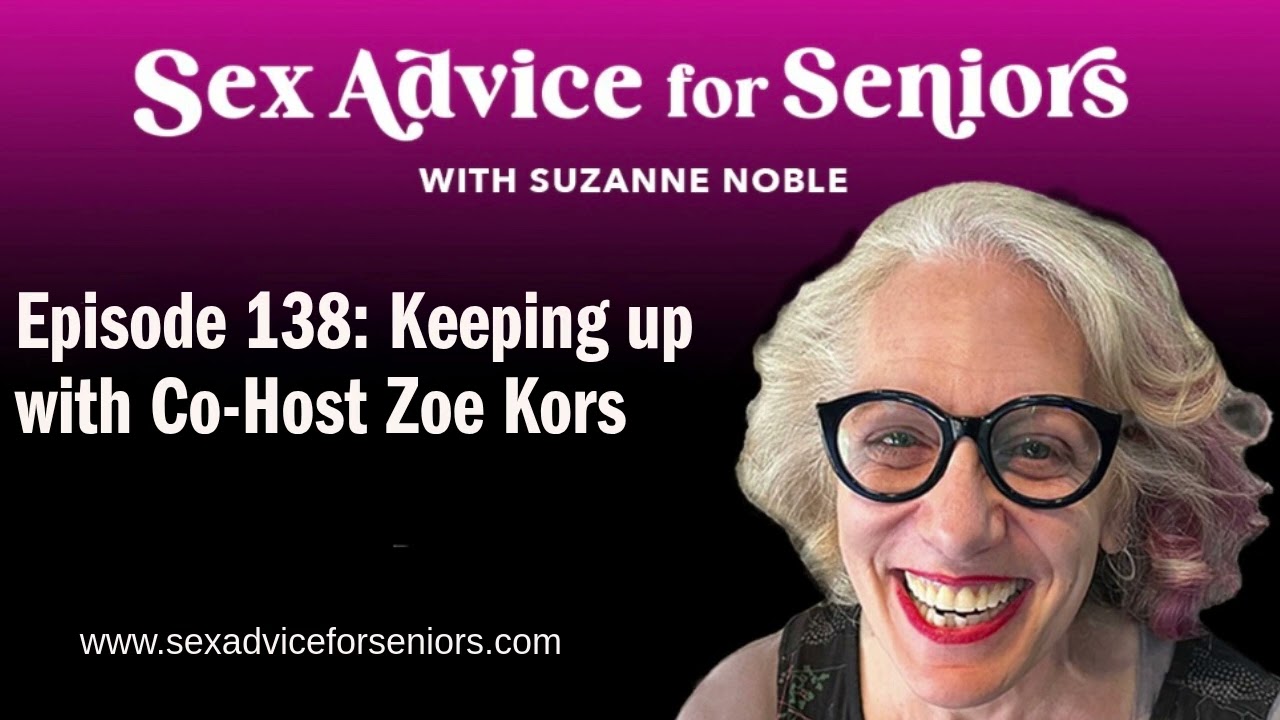
Suzanne Noble catches up with former co-host Zoe Kors about why she left her therapist-training program to focus directly on older adults experiencing sexual distress. They discuss how sexuality gets excluded from couples therapy, the cultural taboos that make therapists uncomfortable with sex, and their own plans: Zoe is hosting women's retreats in Mexico for menopausal women and couples, while Suzanne is considering a Sex-Advice-for-Seniors salon.
Chapters
This week's episode has been sponsored by Oh My Bod, shifting the evolution of pleasure. Hi, this is Suzanne Noble, and you're listening to Sex Advice for Seniors. And today, oh my God, I'm so excited to be back with my old co-host Zoe Kors for a massive great catch-up to find out all the great things that she's been up to. Zoe, it's so nice to see you.
I'm so excited to be here. I've really missed you so much, Suzanne. It feels like forever. And when it's one of those things, when I— when, when we come together and do this, it's like not a minute has passed.
I know, right? But I tell you what has passed is you live in California and there was a whole bunch of activity around there, and I was so worried about you. But what was that like?
Yeah, it was, you know, it's tough. LA is so spread out. I live down south of LAX Airport on the coast. Oh, right. So tons of city between me and the mountains and— or the hills. And, and also just sort of a lot of sand and coastline. So we're never really— I'm knocking on wood— we're never really in a high-risk zone.
That's good.
But it, it was apocalyptic. It really was. It, it's hard to imagine that what happened happened, you know, so much suffering. And it's hard to be in a city where so many people are suffering and there's nothing really that you can do, you know. I mean, you know, there's a lot of support and fundraising and feeding and housing and all that kind of stuff, but, um, but it exists.
Yeah. Anyway, that's it. It was incredibly sad, incredibly awful to watch the whole thing. But I know that— I mean, for those of you who don't know, Zoe is a sexologist, and one of the reasons why we stopped recording the podcast together was because you wanted to develop a training program and take your work in different directions. So what's happened? What's happened? What have you been up to?
How did—
has that happened?
No.
No. Okay.
I'll just be totally transparent here. I did. I created an entire— I have. I'm sitting on an entire program for helping to train therapists, regular couples therapists or individual therapists, to work with people more and integrate sexuality into the work that they're doing and without having it be so anxiety-ridden. I get the reason why this came up was because so many of my clients come to me and say, you know, we have a wonderful couples therapist, we just love her or him. And but they can't talk about sex. The minute we bring up sex, they, they get like, oh, I don't really do that. Or I don't like— you need to go to a sex therapist for that, which is so awkward. And really such a shame. So I sort of had this— one of my many missions is to help therapists be able to not go deep, not do like real sort of clinical sex therapy, but just to be able to know some and feel secure in bringing some of the dynamics of sexuality and even, you know, how arousal works. And there's a difference between desire and arousal. Your listeners are probably extremely sophisticated at this point, but, um, I hope so, otherwise I haven't done my job very well. Yeah. Um, so, you know, and, and really throughout the whole creation of this curriculum, I just started to feel really, uh, down about it. Like, I just didn't— it wasn't what I wanted to do. It wasn't, it wasn't bringing me joy. Yeah, mostly because I think I don't want to work with therapists. And really, I mean, I'm just— I am— I'm, I'm being honest. I think really where I love to spend my time and focus my, my energy is with people who are, are suffering in their sex lives and their intimate lives.
Yeah.
Um, and, and I think for the thing with therapists is that so many of them are those people and they don't realize it. So it becomes really difficult to then, um, bring therapists into an environment where they're confronted with their own stuff unwillingly. Like, it's not really what they're there for, but that's actually what needs to happen. And nobody's fault, I'm not blaming anybody, but we live in such a— and, and I don't know what it's like in Europe, um, I'm certain it's completely different, but in this country, in the United States, especially now with the political situation the way it is and the social situation Women's sexuality is, I mean, in some respects, the ethos is like back to the 1950s.
Yeah, yeah, it's a total, it's a total shit show. But it's so curious to me that sex, which is so much a part of a relationship, should yet be so outside of a normal couples therapy. I kind of don't even really get that, if I'm really honest, because I guess it makes more sense almost for you to do more kind of traditional couples therapy, which you probably do anyway within the nature of your work, just because you have to, right? Like, it's part of your— I suppose that's the challenge. It's like, most people— and this is where I was speaking to somebody the other day about, like, let's just get to the root of what is sex therapy and what does it mean to go to a sexologist? Because I think part of the challenge is that because people don't have the vernacular to talk about their sex lives. And if they're struggling in their relationship, then their normal go-to might be, oh, I'll just see a couples therapist, and maybe we'll be able to dip into that a little bit, rather than going, oh, the problem starts with my intimate life, which spills over into all the other stuff that's going on in my life. Let's go and see somebody with a specialty in sex therapy or sexology, right? So they're— so in a way, that probably the normal default is couples therapy. And you thought, oh, I'll just give them a little bit of a taster session on what it would look like if they delved more into their intimate life. And then they could come and see you for the— all the really juicy stuff.
Yeah.
Right. Yeah. And that might get you some clients. And it also might open up the conversation that they're having with their couples therapist. And it It might just make couples therapy a lot more expansive. But yeah, everything's so compartmentalized that it doesn't work like that, which seems kind of nuts, really.
It does, it does. But it's the same principle as not getting a proper sex education in, in school when we're growing up and not having open conversations at home about, you know, normalizing sex. It's so twisted. And the messages that we— I mean, you got to figure that so many of the therapists that are, that are, can be brilliant therapists. So many of them are, have been raised in households in which sex has been taboo, you know, like idea, like we are not sexual beings. And there's no way then for them to be able to show up on that level.
Yeah, and it's interesting because I, I just did this, um, podcast just literally before this for this, uh, these two women about how to be 60, it's called. And they— we were talking about what did I learn on the sexual journey that I went on, what, you know, what did that teach me. And I gave them like a whole long list from it taught me about male sexual desire. It taught me about how to express my own needs. It taught me about the expansiveness of sexual pleasure. It taught me about the importance of physical touch. It taught me about how being sexually confident can lead to confidence in all sorts of other areas. It taught me about how to just talk about sex just more generally. Like, it just went on and on and on, right? Yeah. Where does it stop? It just, you know, you just learn all of this kind of stuff. But, and then the one presenter said, I just don't think I would have the courage to do that. Right. After, after listening to all of that, she's like, I don't have the courage to do that. And I thought, no, no, I get that. And I get that not everybody wants to go to the extremes that I did. Right. But the fact of the matter is that, that building your sexual vernacular muscle, if you like, and, and building up your ability to be able to talk about sex and desire with your partner and to know what, what gives you yourself pleasure spills over into like so many different aspects of your relationship. So if you can do that, you can pretty much— the rest of it is easy, frankly. You can talk about why it's not really about taking out the rubbish, is it? It's about The fact you didn't— I didn't come last night.
Yeah. And, and the fact that I didn't come last night is, is, you know, it's the same thing that makes you leave your dirty socks on the floor.
That's right.
Selfish. Right. Yeah. And, you know, I mean, the thing is, is that There's, you know, I've been doing this a long time now and it never, like, it never stops surprising me how people are, my clients, you know, they'll get to a point where they're talking about the relationship or they're talking about sex and they're dancing around the topic and they're just, and when I ask them something like, well, tell me about, like, who initiates and how does the bid for sex happen? So many times they're like, well, I don't know. And I'm like, well, well, tell me about it. What happened? You got— you finished dinner last night, you did the dishes, you went in this room and she went in that room, and then what happened? Yeah. And they're like, well, and they, you know, they don't even think about how it is that they're wanting to get sex. It's like somehow it's some ancient, you know, creature inside of them that takes over. It's a very odd thing. We're so disintegrated in, in our sexuality.
Yeah, totally.
And have all kinds of ideas, and we make up all these things about what it means to be a sexual person. And especially when you're in your 60s, 70s, 80s, you know, it's like there's a little bit, at least in the United States, of like, ew, old people have sex, you know.
Yeah, and I was saying to these women, I was like, look, you know, this is the age we can design our relationships. We can choose not to be monogamous. We can choose that we only want to hang out with our dog, you know, if we want, that's fine, or be with a same-sex partner or whatever we want to do. This is the time we can choose this, whatever we, we want— sex or no sex or intimacy or pleasure, whatever. It's the time we we can do that. So anyway, going back to catching up time. So I left you with, I'm going to develop this training program. I was bereft. I was like, no, she's left me. And I had to go on, do it on my own. And 135 episodes later, I'm still doing it and still learning all this shit. And I'm waiting for somebody to just give me like a qualification so I don't have to go and study somewhere. Like, there must be some honorary degree somebody can give me somewhere. Can't they just do that? That would be good. That would be— that would give me some degree of satisfaction. So you did that, and then I— there was something else you were gonna do. What was the other thing you were gonna do? Write a memoir?
Write a memoir. Yeah, I abandoned that as well.
I've started one, but it's not really going to be a memoir. It's going to be like a It's going to be a guide. It's going to be a kind of everything that you guys have taught me combined with everything that I know from my years of roaming the planet and kind of trying to pull all of that together into something that makes sense for older people. So I love it.
I love it.
Um, that's what I'm gonna do.
Yeah, I'm, um You know, it's funny when you start to write, at least when I start to write, I should say, about pieces of my life, it all is so interconnected. Like, I'm not a very compartmentalized person. So as I start to talk about certain things, I have a huge health history, which you know about.
Yeah, I know about.
Yeah. But like, there's a lot of medical trauma and medical stuff and there's a lot of sex and there's a lot. And so trying to find the through line. I finally did. You know, it actually— the— it turns out that it's a book about my love-hate relationship with my body and how— and, you know, the pain and suffering of illness and the joy and pleasure of sex and all of that. Um, but there are parts of my history that I don't really— that are important that I don't really want to dive into, especially my mom is 94. There's some stuff involved in my relationship with her I don't really want to write about it in her last years, you know, where we're enjoying playing Scrabble and having a nice time together, and I don't necessarily want to like dredge it all up and then go hang out with her the last couple of years, you know.
I think having written two of these memoirs, but both from a sexual point of view, that when you write, I remember the first draft of my first memoir, my editor kept pulling out all the family stuff and going, "Not sexy, not sexy," you know, "Not sexy." 'Cause if you go down the, erotic memoir path, then every chapter has to have something that basically gets you off, right? That's kind of the format, is it's got to always lead to an episode that's designed to arouse you. So anything— so I dipped— I dropped in little nuggets around, oh, I remember back when I was blah, blah, blah, blah, blah. Sentences and then, oh, but back to the main act, you know. Yeah, so that's that. And then if you write kind of some— everything, I suppose the thing is that every memoir has to either be, you know, the story of my traumatic childhood or the story of my extreme sex journey or the story of the way I started to love my body when I didn't used to. Yeah, there has to be, there has to be an arc where they are, you know, I'm telling you, I'm preaching to the converted here, but you know, there has to be that revelatory moment. And I remember even in my first book, it was like there wasn't— well, there was the death of somebody that was very significant, which led to me going, you know, going out there and doing all the crazy shit that I did, but You know, the second one, I just said, I'm just still having a lot of sex. Like, there's not really a whole lot more going on there. Like, I haven't found Prince Charming. I haven't settled down. I haven't had, like, a lightbulb moment or anything like that. And there's an aspect of that now with writing again, which is, I still haven't found Prince Charming. But now I'm never going to, because that's just, you know, I'm not looking for him anymore. It's just happy deal, you know, living my life in my— and I suppose that's the thing. It's like getting to a point of just being really happy with where you are.
Yes. I was just going to say that the thing is, is that in any memoir, good memoir, the personal is universal, right? Like that's the point of writing about our lives I think is that there's a little bit of like oh yeah through you Suzanne Noble I can understand now I come to sort of see and grasp that this is— the journey is the destination here I am living every day of my life and not waiting for something You know, happen.
Yeah, exactly. Yeah, exactly. But yeah, you'll find it. And, and I also think I can't really be, you know, now that I'm— now that I've kind of done the deep dive into Substack more than I was kind of before when we were doing things, I'm kind of spending more time there. I'm finding a whole community of sexy people there. And that's the really interesting thing about Substack versus some of the other platforms is that There are a lot of people there now writing about sex, like, in all sorts of different ways. Great, you know, writing about ethical non-monogamy, writing about their own personal sex lives, writing about their sexual journey, writing about being a sex worker, writing about gangbangs. Like, so there's so much there, so much great stuff to read. And I'm connecting with some people, lots of people like me that perhaps rediscovered sex in their 40s and 50s and are doing things, you know, untraditionally. So I think that's another thing as well, is it stops you from writing books because you, you just spend every day doing these basically little essays.
I know, but there's such value in that, especially in this, uh, in this sort of bite-sized culture, you know? Yeah, it's nice. I mean, I think it's valuable to have that outlet. I'm a huge Substack fan even though mine is languishing.
Yeah.
You know, I mean, I think Suzanne Noble Noble— the truth of what has happened since we were working together is that one of the things that I remember saying to you is that I just feel really lost and burned out. And yeah, I think maybe this is valuable to sort of reflect on, is that, you know, I turned 60 last year. I'm April, in just a couple months of this year, it's 2020. I don't know when whoever's listening is gonna be listening to this episode, but yeah, 2025. And, and I am definitely in a period of transition, you know, at 60. And like, what is my— my son graduates high school, my youngest graduates high school, we're gonna, you know, he's gonna take a gap year and then he's off to college. And my mom is 94, so I'm right, you know, they call it the sandwich generation. I'm right between the two of them. And I've been working my ass off my entire life. And, you know, I have a thriving private practice, what, and a book out. And what am I doing? And what do I want to do? And how do I want to spend the last third of my life.
Yeah. And what—
and, you know, my joints ache and I'm hot, and I'm much better now that I'm on HRT. But like, what am I— what am I doing? Where's the juice? Where's the joy? How do I want to be of service? And, and I couldn't hear any of that. I really basically sort of unplugged and said, okay, like, I'm doing this, you know, this curriculum for therapists. Is this really what I want to do? I'm writing a memoir. Is this the time that I want to write the memoir? Is this— and so I really just unplugged as much as I could and still pay the bills and really took time to go inward and have a little, you know, if I were Australian, I would have had a walkabout, but I had an internal walkabout.
I hear that. I mean, not that I think that, you know, 60 is— because I'll be 64 on Saturday. I don't think that it's— but I do remember, and I still feel this way now. And I think this feeling that you've described, I wonder if it is a kind of '60s thing where a bit like you, I think we're very similar in that we just take on too much, you know, and and then we get a bit overwhelmed and we're like, why am I doing all of this? What is all of this about? Right? And I heard you say that you wanted to move to France and I want to spend more time traveling. You know, I'm in Spain at the moment. I haven't seen South America. I haven't seen Southeast Asia. I haven't seen Africa. I thought I was going to potentially do it with somebody that could be like a bit of a travel buddy. But I don't know if that's realistic. And my parents are getting older like yours. And I just think, you know, life is short. You got to fucking get on with it. And my— yeah. And like you, I just keep thinking, what is essential? What is essential that we do? What is up? You know, what gives us joy? What is like, eh, meh. I know if I don't wake up with a burning desire to fill in an Excel spreadsheet, then I don't get joy from it, right?
Yeah.
Even though it might be essential.
Yeah. I also feel— I'm going to try to articulate this in a way that is interesting. I feel as though I have limited bandwidth. I have a reduced capacity for the juggle. Yeah. You know? Like, it's getting harder. And maybe it's just a function of burnout. But I don't have— burnout and not necessarily age, I guess. But I feel as though I give myself the gift of long periods of singular focus. You know, I put the phone down. I, you know, I go for a walk and I don't plan to take care of X, Y, and Z while I'm walking. Oh, I'll catch up on those calls or whatever, you know. Yeah, I, I take one, you know, Wednesdays are my days that I have no clients and I don't— it's a, it's either that I have like less tolerance for chaos and like divided attention, or it's, um, or it, or it's just that I've matured and am curating a much better experience of, of my daily, you know, sort of schedule.
That's a great way to look at it though. That's a great way to look at it is, is how can you curate your your daily life. So it feels like a rich bank of experiences rather than a random set of activities, which is, which is what mine feels like most of the time. Yeah, I look at a page filled with random notes and I'm like, I'm sure there's something on there that's absolutely vitally important, but God knows if I can make any sense of it. And, um, Yeah, no, I, I, I definitely hear you. Yeah. And, um, yeah, and, you know, and also the other thing is you're going to become an empty nester soon, so that's going to change the nature of your relationship with your husband again, because that— which will be lovely, I suspect. Yeah, I bet you're looking forward to that.
Yes, definitely. And he is someone that He really thrives on a lot of focused attention, like quality time. Like, that's his love language, you know, if I can like be with him. But he's— and me, I'm kind of like, you know, I'm the tornado in the, in the couple here. And, and so I'm, you know, I could be doing a million different things and then I come to bed and I'm, you know, I'm ready. And he is like, wait a minute, wait a minute, I need to like connect with you. And You know, and I'm, I'm always sort of giggling because I'm the one who's just— I'm like the dude in that sense. And he was like, I don't know, you spoiled me. He's like, I, I know. I was— I mean, he really is like a dude dude. And, um, but, you know, I mean, yes, I look forward to that. And I look forward to— we've sort of, you know, um, the night of the election in America, in the United States, I just, you know, that's when the idea started to come up about moving to France. And we now have a really wonderful life that of like, we've already sort of taught— we talk all the time about, you know, like, oh, we'll go down to the café, or did you get something at the farmer's market? And like, we're living a parallel imaginary life in, in the South of France, you know, where we have all this time together and we're tooling around and, you know, we're in a convertible and my scarf, my Isadora Duncan scarf, is flowing behind me.
And that's wonderful. Although miniature little toy dog, and, you know, as long as you can speak French, you're good. My friend's been living there for 10, over 10 years, and it's It is difficult. It's a— it's, um, I, you know, I'm in Spain and I just keep— it's so nice here where I am in the Gran Canaries. It's just so nice. And I've met so many nice people who have settled here and they're like, when are you moving here? When are you gonna go and stay here? But yeah, it's, uh, yeah. And imagining— I, I suppose that's the thing, it's like as much as I live in the present, I'm aware of stuff that I really want to do in the future and I just— and I just keep pushing it further and further back, you know, and, and I've got to start making it come forward because it's not going to happen otherwise. And, and, you know, I was looking at some of my friends now who have gotten very into finding a partner. And, you know, I think, well, if I wanted to do that, I would need to push it very much to the front. Of all the other things that I desperately want to do. And it's just not— the situationship I'm in is very comfortable and nice for as long as it lasts. And yeah, so I have no real desire to make any changes to that, really, you know. So that's good. But yeah, and of course Peter is up in Sheffield with his little dog and very happy with his little dog. So that's good. And I know, I know. But anyway, God, that was 30 minutes, man. It's gone so fast. That's crazy.
I know.
Yeah.
The other thing I'll tell you is that, and maybe we'll talk about this another time. I'll come back if you'll have me.
And we can talk about that.
Yes, of course. One of the things that I really have rediscovered is the the deliciousness of retreat, of going on a retreat, and what that sort of opportunity affords you if you use it, especially when you're working on sexuality or intimate relationship, or, you know, a place in which there can be a big sort of opening, connective, or expansive experience. Yeah. Um, so I'm doing a few of those this year and that brings me joy.
Oh, that's going to be exciting. Yeah. When is that?
Well, there's a women's retreat. There are two women's retreats for, uh, menopausal women. Um, and that's, uh, one is in the end of April, um, in Mexico, in Zihuatanejo, Mexico, at a place called Z Fit. I'll give you the links.
Yeah, yeah, yeah.
Um, and so there's one of those in the end of April and one in the end of— no, in the, uh, mid-October. And then there's a couple's retreat at a different— actually a completely different area of Mexico. Um, and it's sort of a medical spa, and there's, um spa treatments and massages and vitamin infusions and all kinds of stuff. And then, you know, and then workshops, like 8 workshops with yours truly.
Amazing. That sounds amazing. And if somebody gifts me that—
I'll tell you, I'm working with a a company called Wellness Marketing Limited that actually curates and produces these retreats. When I used to be the, for years, the senior editor of LA Yoga magazine and the publisher of that magazine, started working with this company that produces. So they tapped me to do these things and I said, yeah, that sounds Perfect for me.
Yeah, that sounds amazing. I know somebody, somebody asked me if I wanted to host. In fact, there's a few— there was a Substack guy who was like, why don't you host a retreat somewhere and you could get all your Substack people that want to come and we could get some experts and stuff. And maybe, maybe that's something to put together for next year to do something like that. I don't think I've got the bandwidth this year, but yeah, definitely next year. I think that would be a Sex Advice for Seniors soiree. Yes, yeah, salon, salon or something would be really fun. So yeah, somebody, somebody needs to work with me on that. But yeah, look, I met someone the other day talking about manifesting and I was like, if you put it out there and you just keep thinking, yep, that's what I'm gonna do, then it will happen. It will happen. That's the way this shit works, right?
It's exactly right. That's right.
Anyway, it's been lovely to see you and lovely to have a chat with you and lovely to have a catch-up. And you look gorgeous as usual.
Yes, you too. I, I, I, I often, whenever I'm gonna see you, I'm like, oh, I gotta put a red lippy on, gotta put my lipstick on, and I never do.
I've been told in Spain that red lipstick is the lipstick of the revolution.
All right, that's inspiring.
So we need to wear red lipstick every single day.
Okay, I got it.
Single day, you got to put it on when you wake up in the morning. It is the signal of the revolution.
I love it, I love it, and it makes so much sense.
Exactly. Somebody told me that when I was getting a coffee.
Yeah. Love it.
In, uh, Cafe Nero. Anyway, see you soon.
More from Suzanne









Why Sex Changes After Menopause (And Why That's Not a Bad Thing) | ft. Dr. Kelly Barron

Why Facesitting Is Trending Among Women: Power, Pleasure & Later-Life Intimacy
