Episode 146 - Why our Partner(s) may Resemble our Parents
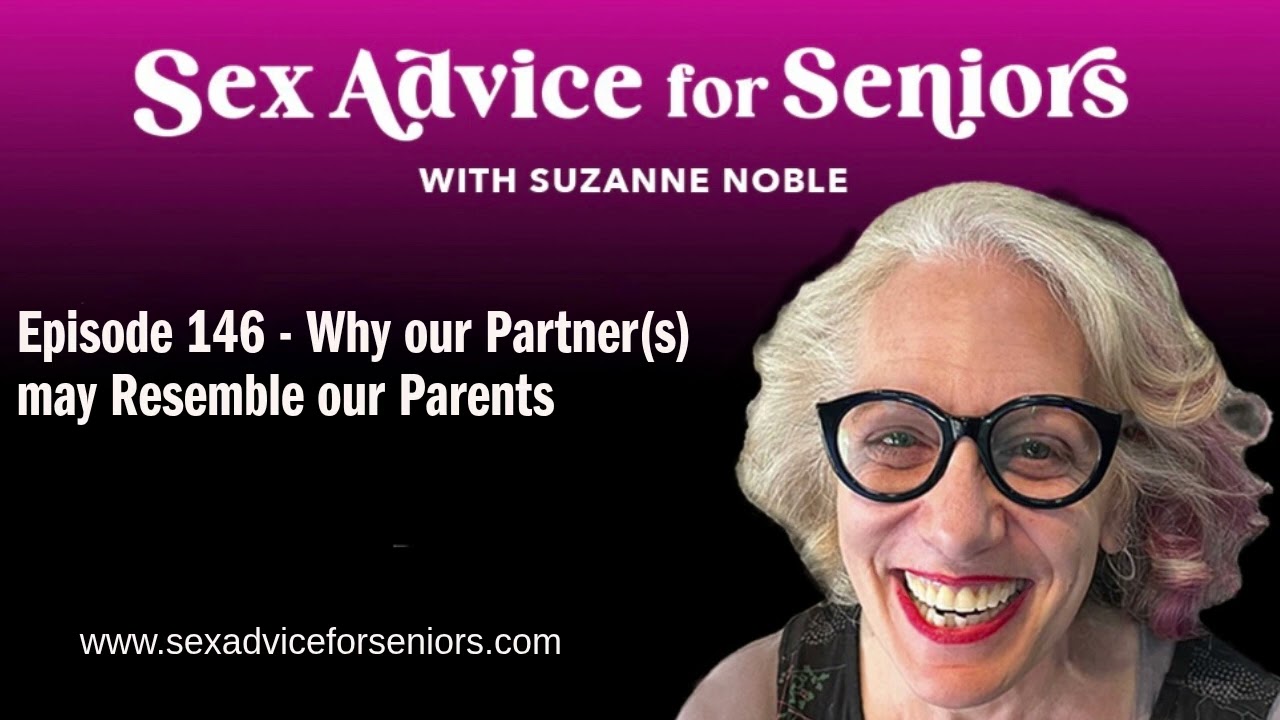
In this episode of Sex Advice for Seniors, host Suzanne Noble interviews advanced Imago couples therapist Shan Merchant. The conversation introduces Imago relationship theory – the idea that each person carries an unconscious image of a parent (the "imago") and is drawn to partners who resemble that image, creating a container for growth and healing. Shan explains how this dynamic fuels the "power‑struggle" stage that follows the honeymoon phase, shares the personal story that led her to write the book From Power Struggle to Peaceful Couple, and outlines how couples can move from conflict to peace. The dialogue explores common unconscious patterns that lead partners to exit the relationship (over‑investing in work, children, hobbies, or affairs), the importance of recognizing these patterns early, and practical tools such as the Imago dialogue, daily appreciation rituals, and gratitude practices. They discuss the controversial advice that partners should be prioritized over children, the challenges of maintaining desire and intimacy in long‑term relationships, and how creative "otherness" moments (e.g., playing piano) can reignite attraction. Aging‑related body changes, self‑affection, and the need for self‑gratitude are addressed. The episode also covers when and how to seek couples therapy, cultural differences in therapy timing (UK vs. US), and a compassionate view of infidelity that focuses on underlying longings rather than moral judgment. Throughout, sponsors Higher Nature (Rekindle) and Oh My Bod are mentioned, and listeners are directed to Shan’s website for further resources.
Chapters
Suzanne Noble: I'm very excited to welcome our new sponsor, Higher Nature, who have created Rekindle, which I'm currently trying out and is working a treat. A 100% natural libido-enhancing supplement for women, which contains clinically backed ingredients to give your sex life a boost. And who doesn't want that? This week's episode has been sponsored by Oh My Bod, shifting the evolution of pleasure. Hi, this is Suzanne Noble, and you're listening to Sex Advice for Seniors. And first off, I just want to say a big thank you to Oh My Bod, who's been sponsoring this podcast for quite a while, and are a really awesome sex toy company run by a woman, which is great. And so thank you to them. Thank you to all the people that subscribe on Substack. Your contribution helps me to do this. And I'd like to welcome to the show this week, all the way from Yorkshire. We so rarely get people that are actually in the UK. It's almost weird, but of course you're not from the UK. So this is consistent in my world because probably over 150 shows I've spoken to like 5 people in the UK, weirdly. But welcome, Shan Merchant, who is actually from New Zealand, and you call yourself an advanced Imago couples therapist. Again, I have absolutely no idea what that means. So welcome.
Great, really, really nice to be here.
And tell me, what is it? What, what does that mean, being an Imago Amaro, sorry.
Yeah, so basically it's a modality of relationship theory. And so, um, Amargo is actually invented by someone called Harville Hendrix, and he basically talked about the fact that we all have an Amargo, which is basically an unconscious image that in some way resembles our parents that we're attracted to. So we're drawn to that type of person who resembles— in some way there's something familiar about them, and we unconsciously sense that that person can— has the potential to hurt me in the way I was hurt as a child. So we're drawn towards them, we feel chemistry, and the whole point of getting into a relationship with someone like that is for growth and healing. So we really see relationship as a container for growth and healing. So that's what, that's what your imago is. So we all have one. So we have chemistry, we're, we're in a relationship with our imago. That's what we believe.
Oh, interesting, because that sounds so unhealthy to me.
That sort of sounds unhealthy, but from a psychological point of view, it's potential for growth and healing because there's no one that is going to trigger us in the way that our partner does in that way because of the fact that they're familiar in some way from our past. So, and we all carry our unfinished business from childhood into our adult relationships as well. So it's all for a purpose.
Ah, interesting. And yeah, so you're— so the modality encourages using that childhood connection. Do they call it trauma in Imago, or do you— you don't use the word trauma?
Personally, we don't really use the word trauma, but we say wounds. You know, we all bring our— we all break— we all have unhealed parts of us that still exist. And so, you know, we bring all of that from the past that's sort of unfinished into our adult relationships. And I guess another way that Imago is very different from other types of couples therapy is we use a tool called dialogue, which is a way of talking that's a safe communication tool. So our sessions are going to look very different to maybe someone that's trained in Gottman or, you know, one of the other types of modalities. But yeah.
Oh wow, that's really interesting. And you wrote a book? Yes, that's called From Power Struggle to Peaceful Couple. Yeah, that addresses, I think, one of the most difficult aspects of relationship, which is the power struggle that I think is familiar to most people in relationship. What motivated you to write that?
So what motivated me to write that and to also become a couples therapist myself was when me and my partner Joe got into our own power struggle. And so at the time I didn't realize that. So we were like maybe, I don't know, 5 or 6 years in. We'd had babies by then, we'd moved countries, we'd started businesses. And so the temperature and the intensity had turned up in our relationship from being a single, from just being two single carefree people. And so then what happened was there started to be lots of arguing and resentment starting to build up and distance. And I was already a therapist by then, but I mainly worked with individuals and I was a dating coach. And I was very concerned because I was like, oh my God, this is really bad. How are we going to get back to the love that we had? And I was so worried about it that what I did is I sort of searched everywhere on the internet. And I was like, as a therapist, I was like, there must be somewhere, something that that I can find that's going to help us work through this. But I was super worried, and then I found Harville, and I read his book, and then I got really excited because I heard about the power struggle stage of relationship. And then I was like, oh my God, that is where we are. So basically, it's not, um, if you go into the power struggle, it's when. So we believe that everyone after the honeymoon stage enters the power struggle, and how harsh that power struggle is really depends on what you bring into it from the past, and also to a degree your, like, communication skills and relationship skills, whether or not you can work through what, what comes up, or whether or not you then go into what is typical of the power struggle, which is what we were having, which is, you know, arguing, fight it, like fighting, distance, resentment. And so, um, anyway, to cut a long story short, we actually went into Imago couples therapy ourselves started healing our relationship, had some really massive insights, um, elevated our relationship. So then I was like, oh my God, I wanna, I wanna teach other couples this. So I became an Imago couples therapist myself. And then also I realized I wanted couples to know firstly that they, if that, they were in the power struggle, and to understand the concept of it. And then also to understand that on the other side of the power struggle is peace. Do you know what I mean? Because when people are stuck in the power struggle, they think, oh my God, like, this is failure, the relationship's broken, I'm not meant to be with you. They might divorce or have affairs. So yeah, it's personal.
Yeah. And I think that, that also, um, as we were discussing before, that sometimes once you get past the honeymoon stage, but you've, you've made the commitment to be with this person, and then you get in the difficult part of the relationship where things are not so great anymore, the immediate feeling is either to just leave, or what often happens, I think, with people that have been in older people, certainly the people that I've spoken to, is that, you know, when people are younger and they don't have kids and they don't have all of that responsibility, and maybe they haven't bought a house together and, and they don't have all that, the— it's much easier to leave because there's, there's not that much risk around it. Yeah. Oftentimes some of this stuff is around risk, and how do you overcome that?
Well, I mean, firstly, you have to be, um, aware of what's happening, because what happens is a lot of people go completely unconscious when they're in that stage of their relationship, and they have what we would call a relationship exit. So not possessing the skills to be able to talk it through with my partner, all the relationship skills to work it through and to get to the other side of it, then partners exit. And usually both partners have an exit. So an example of a relationship exit might be that I put all my interest and energy into the children or my work or my hobbies or going to the gym or into social media or an affair. And so, you know, it just— that's what happens. The energy gets turned outwards. And so it's about realizing— so, so a lot of people only actually realize when they have an affair or when they want to leave the relationship, when they decide that it's over, you know, that they've, um, withdrawn so much from the relationship and developed an outside life that they end up ending the relationship. So you have to sort of know where you are to understand that you need to put your attention back in because it's unconscious. We don't realize we're doing that. We're just trying to— we're just getting our love needs met somewhere else.
Yeah, yeah, absolutely. And I think, how can couples recognize these patterns early and take actionable steps? Because often, as you say, it's unconscious, so you just do it. You just, you just end up kind of spending all your time walking the dog, um, who's got a lot of exercise now, but your relationship has suffered. Yeah. So how do you, how do you realize that this is going on if you don't know that that's actually why you're doing it?
Well, I think you have to first develop a relationship with yourself and be aware that you're unhappy, for example, and what you need, and maybe do some thinking about what needs you, you know, what you long for that isn't being met. And then, so some people do that in personal therapy. Some people, um, might reflect on things on podcasts that they listen to and then, and then end up in therapy, either couples or individual therapy. I really believe in actually educating yourself about relationships. So listening to podcasts, having an interest in it, because there's sort of like a myth that like relationships don't require any effort. And so people sort of just can often not put any effort in their relationship and then slide into a really unhappy, unhealthy relationship when actually they require effort over time. And if you are willing to educate yourself, then you'll realize actually what a good relationship is and maybe compare yourself and go, "Oh, okay, so actually we need to do some work on us." Yeah, it was funny.
I was just this morning when I wake up and I do, you know, I'm just scrolling at some stupid o'clock because I can't get back to sleep. I just stumbled upon a very short Esther Perel clip where she was talking about, you know, that time where people put all their energy into different aspects of their life, different activities often, but not into their relationships. So they come home, they put their feet up, they say, God, I've had such a hard day today at work. I just wanna chill out. I'm gonna turn the telly on and I'm gonna do this. And this is the time when actually that's your time to be with your partner. And if you neglect them on a consistent basis during that time, then ultimately this is where you're going to end up, right? Which is this situation where you probably don't have a lot to say to each other because you've just developed these patterns of, of behavior.
Yeah, yeah, I totally agree that with that. And I think what you're talking about there is, um, the fact that we put all our effort into work, um, hobbies, um, children, and we leave these tiny little breadcrumbs left at the end of the day for our relationship. And on many different podcasts, she's gone into a bit of a rant actually about talking about that. Like, why do people do that? Why is it not flipped up the other way? And that we're putting all our— because this is what I also really believe in— putting your energy into your relationship will power the rest of your life because you get so much aliveness and potential and energy from your relationship. That's how it's supposed to be. People don't realize that. They— a lot of people think that relationships drain you, do you know what I mean? And so they just give it like a few little breadcrumbs. So I totally agree with you.
And it was my father who said something that my friends find incredibly controversial, but I don't. And even my kids, I think, sometimes find it a bit controversial, is that my father and mother have been married for like over 65 years. And my dad said to me when I first had kids, my kids are now in their 30s, and my dad said to me, your first person that you need to prioritize is your partner. Your kids are your second priority and your partner is your first because your kids are going to leave home at 18, 19, 20, whatever, and they're going to call you once a week if you're lucky.
Yeah.
And your partner is going to be there in that place. And if you've neglected them, then you're going to look at this person who is basically a stranger because you've neglected them during the relationship whilst you've been raising kids. And as a result of that, your relationship with your partner has suffered. My friends think this is quite a radical idea.
Yeah.
But I, but I see the wisdom in it because I also think if two people within a relationship are really happy, and I've seen this with friends who have definitely prioritized their relationship, their kids are happy.
Yeah.
Because if mom and dad or mom and mom or dad or dad or whatever are happy, then it— then the happiness energy seeps out onto everything. Whereas if they're not, then everything feels hard.
Yeah, yeah, I totally agree with you. And I was sort of smiling inside when you were telling me about that because my— that's the belief that my partner has about prioritizing your partner first. I want to believe that, but I struggle to do it in practice because I'm so drawn into thinking about my children all the time. However, what we do do is we prioritize our couple work and we do work on our relationship every day. So we have a thing like we meet every morning at 7:00 AM on our sofa. So regardless of what we've been doing before that, we do our own appreciation practice. And that's actually to, you know, basically amplify the positivity and create emotional safety in our relationship. And we like it when our kids see that actually so that we're modeling that to them. But I do struggle a little bit because I just get so drawn into like thinking about them all of the time. But I do agree with that piece of advice. And yeah, it's wildly controversial and a radical concept for everyone.
Yeah. And you know, my dad's like 88 years old, right? So he's very much like, you know, he said to me when my kids were coming up to like 18, 19, he said to me, almost done. What?
Really? Yeah.
You're almost done, you know, blah, blah, blah, blah, blah. That's it, you can get on with your life now. You've done the work, good on you. And of course my kids are like, no, no, kids stay home, Mum, until they're like nearly 30.
And I just went, what, what?
What world is that? You know, and they went, our friends, their parents love having them around. And I said, no, no, that's not my upbringing. My upbringing is you now have the capacity through earning to be able to go and move out. And you need to go and do that because I love you, but you need to do that, right? Yeah. Yeah. It's funny that because I know that especially with modern parenting now, putting so much energy into one's children, you know, and neglecting one's partner, it just doesn't work out well ever. I just don't believe it ever does.
Yeah, yeah, yeah, I totally agree. And the thing about, um, neglect as well is it's really slow and subtle, and you don't actually notice before. It just happens really slowly over years, and then you find yourself in this really distant relationship. So it comes as a shock to people, you know. I'm just— I'm sure you know, when the children do eventually leave home, and then I'm with someone that doesn't even— doesn't— isn't even interested in me, doesn't even notice me, I'm invisible. These are the types of things I hear in my couples therapy room.
Yeah, yeah. And I, and I really don't think it's, it's unusual. And it's, it's not talked about often enough. And I, and I know it is controversial, have loads of people telling me I'm probably a dreadful mother or whatever. But my kids still talk to me on a very frequent basis. So I must have done something right. And one of the other things that you're definitely passionate about is helping people in long-term relationships reignite desire and intimacy, which is another topic that comes up, um, so often. What are some of the challenges that couples face in doing that over time?
So I think, um, desire is really tricky in a long-term monogamous relationship. And so, you know, if we're looking first and just, um, you know, because it comes into, in two different areas, there's emotional safety. So if there's no emotional safety in the relationship why would I want to come towards you? You know, so I often say to my couples, you know, like, is what you're doing, um, inviting your partner closer to you, or are they moving away from you? And so people are like, I'm not getting any sex. You know, maybe I might be having a first session with them, and I'm like, okay, so you're not getting any sex, but what else is happening in your relationship? People— it's almost like this expectation that, you know, um, there's conflict in our relationship, resentment, I don't talk to you nicely, there's heaps of negativity, and I expect us still to have this really thriving sex life that we both enjoy. Like, those two things are like so polarized and opposite. So that's one of the things that I explain to couples, and we work on that. So, um, and then the other thing is just in general around desire, you know. So when we're in a long-term monogamous relationship, things merge over time, you know, everything becomes all same-samey, um, there's no otherness. And I love how, you know, obviously Esther Perel talks extensively about this, and she's written her two books, and she talked one time about her seeing the otherness in your partner. And it's difficult to maintain when you're in a long-term relationship of decades because your partner knows everything about you, um, and also you do so much stuff together. But like, she talked about that. She talked about seeing her husband on a TED Talk and seeing him in his element. And he is more into trauma, and so she's— she talks on pleasure, he talks on pain. But she saw him in his element, and she saw him in his otherness and how attractive he was to her. And then I actually had this really amazing moment, which I call my Isa Perel moment, where I saw my partner playing the piano. And it was actually at the beginning of the year, and I saw her playing the piano and she was singing, and she was playing this in a way that I hadn't seen her play. She doesn't play the piano much anymore because we're so busy with our businesses, and her head was thrown back and she was laughing, and I saw her in complete otherness and I was like, wow. And I felt so much desire and attraction to her, like I was in my— like I'd just met her, like I was dating. I was so impressed. I was like, holy— I was like, we've been together 16 years. And I was like, oh my God, I've just had an Esther Perel moment. And it was amazing. And it's so rich because you can pull that into your relationship and use it. But yeah, it's really tricky and it requires work. And just like, you know, when we say a relationship requires work to have a good relationship having the erotic side of your relationship alive requires work too, and you need to nurture it.
So yeah, I mean, one of the exercises that I practiced with a partner that I had that was something that came again from Esther Perel was she asked, um, every day to write into like a little book, I turned myself on when— and it wasn't sexual, necessarily sexual things, it was just things that I, you know, we just really loved to do. He loved making art and he loved creating things and he loved building things out of bits of wood and just found materials. And when he was like with his, you know, paintbrush or his hammer or his pencil or whatever thing he was using, he was so in it. He was just, you know, and I found that super attractive. And similarly, I engaged with my singing, went back to my singing when we started, when we first got together. So it was like two people reigniting this creative past that they'd had. And we kind of really spurred each other on because we saw the joy that each of us experienced in those moments where we were being creative and in my case, entertaining people. And in his case, like just being an artist and— Yeah. And yeah, the— and that really did. I, you know, I really understood when Esther Perel said that, what she meant by the things that give us joy and also conversely, the things that don't give us joy. You know, like when we procrastinate, when we, when we break promises to see somebody and we have to let people down, when we, when we do things, when we don't exercise, when we don't feel good or eat junk food or when we do things that we know are just not good for ourselves and don't nourish ourselves. And you know how to also support somebody so they do less of the things that don't make them feel good. And, and I think sometimes we lose sight, as you said, of your, of your partner, of those simple moments of joy that people have, right? When they're just in their head, they're not thinking about you or anything else, they're just, they're just doing what they love.
Um, and I think it's the contrast as well, like the polarity of them and their otherness, you know, like of of your partner doing something that you don't have the skill for necessarily, you know what I mean? And it's just so different. Like, I can't play the piano, and to see, to see my partner showing such mastery, I find extremely attractive. And then the other thing that I wanted to say, what you were sort of speaking of as well, is like, what's so closely linked to desire is if we're linked to our own sense of aliveness. Like, if we don't feel a sense of aliveness and feel attracted to ourselves, how can we expect to bring that energy into relationship, or someone really to be feel drawn to us in that way as So it's really— you have to nurture it in yourself too and not let that die.
Yeah. And I think, you know, look, that's— I think, you know, one of the most difficult, difficult aspects sometimes of being older, not just as a woman, or I think, you know, everyone feels it, is our bodies are changing, our hormones are changing, things are happening. Often we are ashamed of looking down and seeing this little spare tire around the middle. And thinking, where the hell did that come from? That doesn't make me feel good. Or why aren't, you know, where did that beer belly come from? Or how did this happen? And rather than just say, you know, I'm struggling to engage with my sexual self because the body that I'm now inhabiting is not the body that I used to inhabit. And I haven't quite got my head around that. Yes. And I might need some support here in feeling good around this when I'm used to it being like that. And I think all of those changes that we go through, if we don't speak up about them, then often that's where the silence comes in is I'm just, you know, I'm, I'll just retreat into myself. And as you said, just, just go off and do something that's, that's something else to, to, to avoid having to think about these things.
Yeah, yeah, yeah, yeah. I can— I totally agree with that. Yeah.
And how do we get past that?
Well, I think it's around, um, working on, um, what— well, I remember years ago I read in a book it was about developing an affectionate relationship with yourself, and I actually really believe and gratitude. And so I often might say to— I used to say this to individual clients when I work with individuals, and now that I more work with couples, well, I only work with couples, but it's about finding aspects of yourself that you like and maybe that you want to play around with. So, you know, maybe you, um, want to dress in a way that makes you feel your own version of feminine, or maybe you really like your hands or your feet, or just finding parts of yourself that you can enjoy and be affectionate for. So loving, it might be too much of a stretch, but, but developing that. And I think that intentionally practicing gratitude really, really helps as well.
Yeah. And one of the things that we just touched on briefly, and again, Esther Perel's written a whole book about this, is our affairs is something that you do work on with couples. And I think that's, that must be one of the most challenging aspects of relationships is when there's some degree of infidelity and how people overcome that in societies where infidelity is not, um, acknowledged as anything but a negative.
Yeah, yeah. I mean, well, an affair for a monogamous relationship is a car crash. It's a total, you know, um, earth-shattering event actually. And I mainly specialize in affairs actually, um, where my area of interest is. Oh right, it is really, really difficult, but I have a lot of empathy for people, for both partners, which I think is why I'm drawn to it, um, because I understand that the person that— no one, no one I have met ever goes out intentionally saying I want to have an affair. People slide into them and they find themselves in an affair. And I often say to my part— you know, my couples, I say, what do you think it was that made you emotionally susceptible to that. Well, I wanted to be wanted, or I wanted to be seen because I feel invisible, or I wanted to be seen as a sexual woman again, or I wanted to be looked at like that, or I wanted to be cherished or seen as important. You know what I mean? It's all about the longing that sort of pulls us in. And so it is very, very hard, but I think the work is around really being willing to sit down and listen and really try and take your partner's perspective in and allow yourself to be touched by that. Because no one has an affair because they're a bad person. That's that's never the reason. There's always some other reason.
Yeah, yeah. I mean, there's, there's also aspects, you know, people that I know, for example, where one of the people in the relationship has got some sort of health condition, or they're significantly older than the other one, and so they're in some state of decline. So maybe they're not able to be sexual in the way that they used to be. And there's That's, you know, it is, it's hard. I mean, I'm, I think more and more there's an opportunity, you know, one of my beliefs is that there's an opportunity at this age to be able to redefine what a relationship looks like. Monogamy is one type of relationship, and sometimes it's not the ideal type in certain circumstances. And sometimes affairs can be reframed in other ways that are not You know, where everybody's participating in what's going on because everybody's aware that people have needs, you know. Sometimes those needs aren't being met. And I think unfortunately, society sort of expects everybody to be this one-size-fits-all for their partner. And often that's really difficult.
Yeah. And so you know what that requires, though? That requires having the courage to be honest. I love that so much, to have these honest conversations, because you're quite right, you know, those types of scenarios do happen.
Yeah, and especially as we age, you know, because shit happens. I mean, if somebody's not sure whether couples therapy is right for them, um, what are the signs that they should look for and how can they take that first step? The signs for, like, what, like, I think, you know, maybe we need couples therapy. Like they're thinking, you know, I'm not sure, I'm not sure if it's right, like what's it gonna, what's it gonna require of me, right?
Yeah, yeah. Well, personally, I see, I, you know, what I say to people is, you know, couples therapy is all about learning how to talk and listen. So it's really about learning to talk in a way so that your partner can actually really hear you. So maybe if you're struggling at home, maybe you're going round and round with the same arguments, you're not able to resolve stuff, or maybe you feel that like you both are trying to doing your best to try and talk to each other, that you— but you're both misunderstanding each other and you need someone to help you with the translation. Maybe it feels like you speak French, I speak English, do you know what I mean? And so, you know, or maybe the intimacy's gone. Maybe you long for that sexual connection in your relationship again, but that's dead and you don't know how to rekindle the desire. Um, things like that. So, um, the thing that I see couples therapy is, is I really just see it as learning a new skill So one thing I was thinking of before I got on this call, actually, I didn't know why I was thinking this, but I was thinking about how in England a lot of people only come to couples therapy right at the end. You know, I— so often people say to me, this is the last chance, this doesn't work for us, then this is it. And so they leave it right to the very end. Whereas I was thinking about in America, people are way more proactive, and they might get married, and then they might decide to have some couples therapy to enhance their communication and elevate their relationship. But in England it's not really like that. And I think that I personally believe that everyone can benefit from going to couples therapy because really you're just learning how to talk and listen. You're learning how to create safety in your relationship. It's not that scary, you know what I mean? Just see if you give it a go and see what happens, you know? Like, that's the way I see it.
Yeah. And look, my son lives in New York and everyone's in therapy. Everyone, right? Um, the way he talks about the the way he talks about, um, his relationships and the way he talks to people that he has relationships with and how he expresses himself, I can honestly say I do not think I have ever been with a man my own age who is capable of that. Yeah, the way he's able to honestly reflect where he is in, in his life and what his desires are and what he— where, you know, what he's capable of giving or not giving, you know, what he's seeing the other person wanting that maybe he doesn't feel capable of giving, like all of this. It's the emotional intelligence around all this is so impressive. And it's almost like you want that sort of training before you even go into a relationship, because at least you're equipped with learning how to speak about your feelings, right? And, and to talk about what's honestly going on. As you say, if you wait until it's almost dead, then it's like you're playing catch-up with, with all of this sort of stuff. Like you're trying to do your PhD after, you know, you, you've like before you've learned anything.
Yeah.
And, and, and that's not ever going to work. You know, it's about building up these skill sets. And I think you're right. It's, it's almost like It's, look, it's never going to happen, right? But it's almost like the NHS or anybody should just, before anybody, you know, when somebody gets to a certain age, it's like, just, we're going to give you 6 free therapy sessions in how to talk in relationships and how to talk about intimacy in your life and how to communicate with your partner about your sexual desires, your relationship, you know, all the, all the stuff that nobody's taught. And, and it makes things so difficult really for, for, for all of us, you know.
Yeah, yeah.
But it's never going to happen.
Yeah, yeah. I know it's tricky, but I have to say, though, I love it when I see retired people come to me for couples therapy. I really, really love that, you know, because they're like, we want to make the most out of the next decades. And I do love that. I love it. I see it more and more. So I do really like that. And then equally, I'm super impressed when I see someone in their 20s 'Come for couples therapy.' I'm like, 'God, I wish I'd done that,' because I started in my 40s, so— and I'm now 51. So, you know, yeah, I totally agree with you.
Yeah, yeah, yeah. And yeah, well, I mean, people in their 20s that are doing that, I just think it's so great because they're gonna set such a strong foundation for their relationship. And even if it doesn't work out, the likelihood of hurting the other person is going to be very low, right? Yeah, whereas the likelihood of hurting somebody because you've been silent for the past 3 decades and you haven't said anything, and then, you know, suddenly just explode one day, uh, which is the story of my life, basically.
Story of your life. Yeah, I, I also think it's more about like not, um, repeating patterns, because, you know, that's what happens when people don't have the skills to stay in the relationship they're in. They're in that, breaks, and they get into the new one, but then the same thing happens.. And so, you know, you really need to learn something new so that it doesn't happen, so you can articulate yourself in a different way. And yeah, so we don't want to repeat patterns. Suzanne Noble.
Yeah, no, no. But you know, some people would say, well, I have a type and that's the type. And yeah, yeah, I have a friend who basically, he's my sort of— he's, he just sits in my ear the whole time and just says, you know, if you just keep hanging out with the same people, then nothing changes. So, you know, you have to, you have to switch it up a bit if you want, if you want something different to happen. You have to deliberately do something different.
Yeah, totally. Yeah, I totally agree.
There's a saying, nothing changes if nothing changes, and it's true about pretty much everything in life.
Yes. Yeah, yeah, yeah.
Anyway, it has been absolutely delightful to speak to you, and we'll put the link to your book, From Power Struggle to Peaceful Couple, which sounds awesome. And anything else that you would like people to know about you, how they can get in touch with you? I'm assuming you do online and face-to-face sessions. You're in Yorkshire.
So yes, I do. Yep, I do loads of Zoom sessions worldwide actually, and I see, uh, people in person if you live in Yorkshire. Um, and you can, um, contact me through my website actually, shannemurchin.com. So, um, I write some articles on my website as well, um, if you want to read about Imago. Um, but yeah, that's, that's the main way to contact me.
Yeah, brilliant. Thank you so much. Have a fantastic day.
I will. You too. Okay.
More from Suzanne









Why Sex Changes After Menopause (And Why That's Not a Bad Thing) | ft. Dr. Kelly Barron

Why Facesitting Is Trending Among Women: Power, Pleasure & Later-Life Intimacy
