Reclaiming Pleasure: Angela Burk on Midlife, Sex, and Self-Discovery
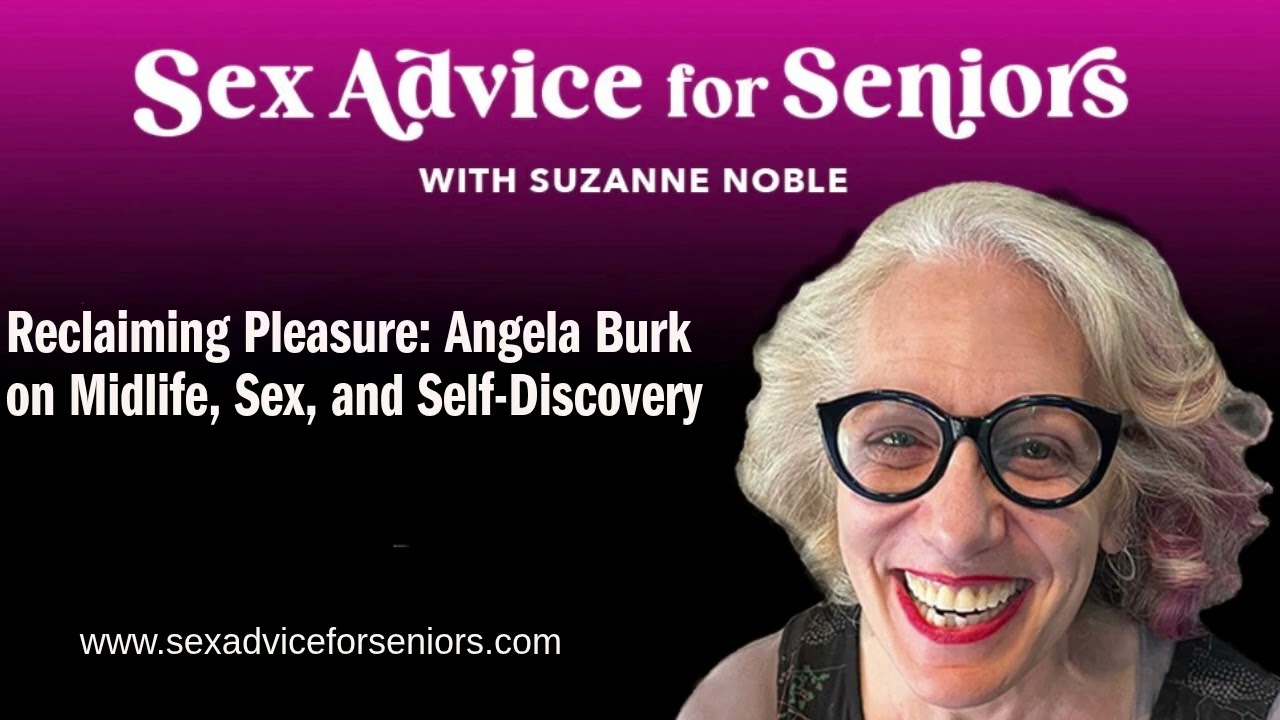
In this episode of Sex Advice for Seniors, host Suzanne Noble interviews writer and Substack creator Angela Burk, author of The Real Girl's Guide to Over 55. The conversation traces Burk’s journey from a shelved book idea at age 35 to a revived project in her late 40s, sparked by retirement and a desire to understand her own body. They discuss the "pleasure pivot"—the conscious reclamation of sexual power after 50—covering early sexual ignorance, the discovery of masturbation and vibrators in mid‑life, and the impact of upbringing and cultural taboos on women’s sexual knowledge. The dialogue expands to broader themes: the growing visibility of menopause and sexuality for women in their 50s, the sudden drop‑off of attention after 60, and the stigma of being labeled a “granny.” They explore practical strategies for communication with partners, including long‑distance intimacy via video, and the importance of honest conversations to overcome fear of rejection. Health‑care navigation is highlighted, with Burk sharing her experiences seeking hormone support, using testosterone, and confronting dismissive doctors. Both hosts stress the value of community dialogue in normalising pleasure for older women. The interview concludes with Burk announcing her forthcoming book, slated for release in December, and the hosts noting potential award recognition.
Chapters
This week's episode has been sponsored by Oh My Bod, shifting the evolution of pleasure. Hi, this is Suzanne Noble, and you're listening to Sex Advice for Seniors. And today I'm with another Substacker. I love meeting people that are on Substack, which, for those of you who don't know and are listening to this podcast because because there's still people that don't know about Substack. Substack is a platform which actually distributes this podcast to Spotify, to iTunes, to Pocket Cast and all those other people, but it's also a newsletter platform. So lots of people use it as a space to write and some people make little videos as well in a kind of Reels type fashion. It's become a bit of a social media place, but it started out really as a newsletter platform. So most of the people that I speak to are writers as opposed to podcasters. And Angela Burke, who I'm here today with, she is another writer and her Substack is called The Real Girl's Guide to Over 55s, which always makes me think of the Girl Scouts for some reason. I don't know why, but it does. I wasn't a very good Girl Scout. We don't have to talk about that. But anyway, she's, she's all the way in San Francisco. Welcome, Angela.
Thanks for having me. I'm thrilled to meet you. And I was definitely somebody who up until June did not know about Substack. And so I'm a newbie. I like to refer to myself as a tummy time girl on a lot of this stuff. But it was thrilling to meet you on Substack. And I'm kind of a voracious reader and I'm loving everything that you're doing and what you're talking about. So it's just a pleasure to be here with you.
Thanks. And why did you start Real Girl's Guide to Over 55? Like, what was the impetus behind that?
Yeah, well, it's really interesting. So I had this idea for a book when I was 35, and as you guessed, it was going to be called The Real Girl's Guide to Over 35, because at that time I felt like I was going through such a big transformation. I was, you know, in the middle of a career trying to decide between how aggressive do I get with pursuing, you know, leadership positions, executive positions. I was a new mom. I had two kids. I was in a marriage.. And it just felt like a lot of transformation. And so I had this book idea because I needed a resource to help validate and affirm what I was feeling and to make me feel not crazy. And so I started this outline. So I had a folder, I had written pieces of paper, Post-its, which I'm a huge fan of, um, lists and chapter outlines and notes and, and thoughts. And I had it in a folder and then life took over. And so I buried the folder. And in November, kind of December of last year, I retired. My partner sold his business and he gave me the gift of retirement, to which I said, cool, thanks. And so I was cleaning out my desk, cleaning off my desk, and I found the folder. And so I thought, you know, there is something to what I felt then and what I'm feeling now. And it's this like kind of reclamation, this fact that I am feeling for the first time in my adult life responsible and focused on myself. So I opened the folder and I thought many of the things that I felt then, I actually feel now, and there are new things. And so in April, I decided to start writing the book. And I created a Substack to kind of just complement my book writing and to get feedback. And also to just release a lot of the things that I was grappling with just as a real girl sitting here in California trying to make sense of all the crazy stuff that's happening to my emotions, my mental outlook, my physical body, my sex drive, everything. And so that's how it all began.
Wow. I mean, I'm trying to get something similar for— I'm a bit older than you. I'm in my 60s and I've been trying to kind of consolidate some of my thoughts around being 60. But you know what? I find that when I write my Substack essays, I kind of pour myself into them. And it doesn't leave me much mental space to do like other activities around writing. I just find I'm a bit exhausted by it all, if I'm really honest. But let's talk about pleasure, shall we? Because one of the things that you talk about in The Real Girl Guide is the pleasure pivot and reclaiming your sexual power after 50. That's really powerful. What does that mean to you?
Well, I'll give you a perspective on what it means to me. And to do that, I need to go back, you know, kind of through my adult years. And if I'm honest with you, a lot of the way my outlook on life was very much not dissimilar to a lot of us who are kind of in this midlife phase and sort of space and kind of looking back. But I really— my whole purpose, I felt for a long time, was to sort of be small, shrink down, not cause grief, not make waves, just kind of exist to keep the peace. And a lot of that too, I think, translated into my own sexual awareness of myself. I didn't understand how my body worked. I didn't understand what I liked. I wasn't overly experiment— you know, I wasn't a huge experimenter. And how could I embrace a partner or any of these sexual experiences if I didn't understand how I worked and what I liked. And, and for the first time, you know, if I fast forward and, you know, I divorced when I was in my mid-40s. I've got to be totally honest with you, like, that was the period of time where I discovered masturbation. I purchased my first vibrator because I became a fan of the showerhead, the removable showerhead. And I'm not embarrassed by any of these things. What I am, I think, slightly sad about is that it took me until my mid-40s to even acknowledge the fact that, you know, how many orgasms did I have in my life? Not many. And I never really had a partner who cared. And if I couldn't expect that from a partner, how— but it was somehow okay for me not to expect it for myself. And that was just like an awakening for me. Does that make sense?
Like, yeah, I mean, look, I discovered the showerhead when I was 10.
So, God bless you. Like, only I think my life would have been very different had I discovered that the power of the showerhead. But it really was this idea that, you know, so much of my life was changing in my kind of mid to late 40s and certainly carrying through my 50s. And it started with the acknowledgment that I have to come first. You know, how I feel, this playing small and keeping the peace and being quiet and being silent just is over. And that extended into pleasure. And again, it kind of came from this premise of, I have this amazing partner now who is interested and open to understanding what I like, but I couldn't be welcoming to that if I didn't understand it for myself.
And do you think, because I, I always say this, that It's much easier to start with a new partner as you mean to go on if you realize that you've had an unsatisfactory sexual life. Sometimes during a marriage, a long marriage, it can be really difficult to come to that realization and then think, well, what am I going to do with this information? Like, how's this person going to deal with that? Like, if I tell them, you know, by the way, I realize I don't even know what I like. Could we check out what I, you know, how would you like to work with me on that? That's often very, a very risky place to be. You worry about what somebody else might think. Whereas when you're going into a new relationship, I always think, well, I might as well tell them what I like because it's, it's new. And if they don't want to do that, then I can just walk away. Did you try within your marriage or did you just come— was, was part of this realization also about other aspects of your relationship? With your partner that you just were dissatisfied with?
Yeah, I think, I think it was just part of a broader set of realizations, and it was also just part of this, you know, this acknowledgment that a big chunk of my life I just spent, um, you know, living for or prioritizing, you know, other people around me. And I, you know, my partner at the time, my kids, and I did those things for very real reasons, for stability, for safety, in a lot of ways because it's what was modeled. And in some cases, I probably did it a little bit for survival. Just silence was sort of just accepted and, you know, even, right? And so it was a lot of the, I think, the culmination of a lot of these factors. But I think for me though, the impetus for a lot of this was, yeah, it made it easier in a new relationship, but I had to get honest with myself. Yeah, and I had to— and it wasn't like, you know, I do have a couple of it, you know, discovering the— you know, I had this sunken bathtub when I divorced. I bought a house for myself and I had this bathtub that had jets and kind of bumped into the jets on accident, or getting my first vibrator and realizing I didn't even understand how it worked. Like, and how pathetic is that, right? Like, you're in your late 40s and you're like, uh, how do I not know this? So I do totally understand the vulnerability and the risk and the scary place that this kind of acknowledgement and ability to give yourself permission to explore and what that feels like. And I think I sort of had that for myself. And then I was also fortunate to find a partner who was super willing and open to that. And also work, helping me work through it. So it was kind of a benefit in that way. But it does, it's a scary place to be. It's risky when you have to acknowledge like, shit, here I am at this phase. This is where I'm at.
And how much of this was a result, you think, of your upbringing? Was sex something that you ever discussed at home? I mean, how did you get to 40-some-odd without really understanding the female anatomy? I'm curious.
Yeah, I think, you know, it probably wasn't something that we talked about a lot when I was younger with my mom. I think it wasn't a conversation that I had with my girlfriends at all until now. This is— this is— yeah, it's really interesting because we just didn't talk about those things. And so— and then I think you kind of get to this space where you're married and you're having kids and life is so busy. Everybody sort of looks at, you know, your existence from the outside and goes, oh, she seems like she's got it together. But there just wasn't time and space. And I certainly didn't always feel like super open and wanting to share it. But I am very, very excited about so many of us who are in this midlife space who are finally having the conversations and forcing the conversation. And what I found even in my own circle is having these conversations is allowing people that I've known for a really long time to feel comfortable and sort of talk about things too. So there's no shame, there's no taboos. But yeah, like, how did I get to be in my mid-40s and not really understand, you know, and I understood the science of it, but I didn't understand what it meant for me. And I just think it was not a conversation that I certainly sought to bring up. I never felt like I had the group of friends to do that in. And it, you know, my mom and I are super close, but— and we do talk about a lot of things, but that's just not something we talk about. And I think a lot of it was me.
Yeah, and I think it's really interesting because I think we don't talk enough about the fact that for so many of us, especially at our age, we didn't have the internet, we didn't have access to a lot of information. Sex education at school was, was pretty much non-existent. And I suspect that there's, that there's quite a lot of people out there who have had a very similar experience to yourself and are just actually, frankly, It's part of the reason why they shut down. And I always say this to people, like, when I— it's very polarizing, the conversation around sex in later life, I find, because quite a lot of the women that I speak to, primarily women that might be people that I know or people that I meet, say, yeah, I'm done with that, you know, I'm done, I'm not having that anymore. And I suspect it's because they didn't really understand pleasure. They never really had pleasure in their relationship. And they reached a point in their life where they they didn't really have to prioritize it because they weren't going to have babies and maybe they'd gotten divorced. And so I think that it's really interesting when somebody who perhaps has had that experience goes, wait a minute, there's a whole world out there that I haven't actually experienced. What would it be like if I tried to experience that stuff now?
Absolutely. And I think you're right. I think that there's a lot of factors that play into it. And Through the process of writing this book, I met this incredible woman in her 80s, and she talked about having loved and lost through her life and lost her husband of almost 30 years and then found new love in her early 80s. And one of the things that she said to me was, it's been an awakening for her too, realizing that the parts still work and she likes it. And I was reflecting on that and then remembering conversations that I had with my maternal grandmother. She and my grandfather were married for decades and decades. And I remember being in my 20s and talking to my grandma about something. And she used to tell me this phrase, which was, "Love is where you find it." And I always thought that that was lovely. And then she'd go on to say, "Like in the kitchen or on the dining room table or in the bathroom or on the couch." And I remember being in my 20s and just kind of going, "Grandma, like, ugh." But now that I'm in this space, I realize like what a wealth of— like, first of all, what a vibrant and super cool chick she was. And I wish I would have known that then and like embraced it. And then the second thing is I wish I would have talked to her about more stuff because I had her in my life until I was in my 30s. And actually through the end of my 30s was when she passed away. And I just wish I would have tapped into my own lack of understanding and sat down with her, because I think she would have told me a lot of shit.
Yeah, yeah. Well, it sounds like it.
Yeah, she was like— she was a little pistol. And, and I remember another time where I was, you know, I'd spent a lot of time with my grandparents when I was in my 20s, and I was helping my grandma put away clothes, and I was putting away some clothes in my grandpa's chest of drawers, and I opened up one of the drawers and I saw this little, like, something that looked like leopard And I picked it up and I held it up and it were just these, you know, underwear, like men's underwear. And she was in the bedroom with me and I opened them up and I turned them around and I looked at her. I said, what are these? And she just started giggling. And I was like, damn, I like what a cool couple they were. And how did I miss all that? And so now being at this age, you know, I sort of feel like I probably have her in me. I just left her buried for a long time. But now she's out. She's kind of open. She's, she's like, she's doing all the things and she's kind of loving it. But yeah.
And so what have you done subsequent to this decision that you've made to, to look at all of this stuff? How specifically have you gone about exploring pleasure?
Well, I think a lot of it is, you know, what I, what I've done with myself, right? So bumping into the jets in the bathtub, finding the showerhead and its multi-use capabilities, you know, buying my first vibrator when I was in my late 40s and figuring out what is it that I like. And then I think a lot of it too was the safety of my partner and realizing that there were certain things that I liked, certain things that would get me to climax more easily than others, and his willingness to just kind of work with me as we went. And, you know, we've had like a lot of— and, you know, I don't want to imply that like our relationship, it's— we've been together for 10 years, so— and it's complicated by the fact that he lives in Australia, I live in California. So there is kind of— yeah, it is complicated. But man, you could get really creative with FaceTime, um, you know, maybe not safe for work pictures, uh, lots of things we do virtually. But also it, especially in the early years, made our reunions super sexy and super fun and super just desiring and wanting. And, and so I think a lot of it though was the fact that I had this partner. Um, first of all, I understood more about my body and what I liked, and I felt comfortable with that for me. And that's where I think it was an important starting point. And then I, I think I had the benefit of finding a partner who was safe who was open to understanding and interested and cared about how I felt, cares, still cares about what brings me pleasure, cares about wanting to make sure that we're doing the things that are not just getting him off but are giving me pleasure as well. And the safety of what that brings is something that I didn't have before.
Yeah, and it's, it's incredibly important. And, and to feel liberated to be able to ask for what you want is a recurring theme that is a thread that runs through every single episode of the show, which is just the ability to communicate with your partner, to be able to express your desire, to be able to feel just safe to say what gets you excited, you know. And I think so many people lack that in their relationship where they're worried or afraid or scared that, you know, of being rejected. And I know that That was my own experience in my relationship. So it does take its toll on you if you've, if you've been rejected by, by someone when you've expressed your desire. Sometimes it takes a little bit of courage to get to, to bring yourself to the point where you ask again somebody new because you're, you know, your history is it didn't work out so well.
100%. And I also think, and, you know, I'd love to hear your opinion about this too, but You know, this kind of awakening or this reclamation, right? It's certainly— it's almost like when you get on an airplane, right? And what is the thing that the flight attendants remind you? If there's a loss of cabin pressure and a mask drops down, whose mask are you supposed to put on first? Your own.
Yeah.
And I think that there is something that I'm seeing happening with this middle-aged, you know, population of us women. Who are reclaiming these parts of ourselves. And I, I wonder if this ability to have the conversation about sex, to have the conversation about pleasure, to be willing to acknowledge that for ourselves, and then, you know, what are we going to do with that information? And that's where I think a lot of things break down. But I wonder if a lot of the safety that we're feeling about having these conversations is coming from this reclamation, this fact that like, hey, I've got to put my mask on first. And for me, I'm a, I'm a slow learner. Like, it took me a while to get to this place. And it didn't necessarily start only with sex, but it started with other parts of my life. And it was this, and I do feel like it's this notion of like possessing myself again, finding the places and the pieces that I actually love about myself. There's so many things that I let go dormant about who I was and my place in the world and my place in relationships and all the things that made me great, I sort of just like pushed down. And that, I think, coupled with the relationships and, you know, this lack of understanding and awareness of my own body and what brings me pleasure, it was like this ratatouille of just muck that I've had to kind of build my, my way out of. But there is something happening with us women in this age. And it's so refreshing. And I, if I look back to when I was in my 20s and looking at women in their 40s and 50s, they didn't look like us now. They didn't act like we are acting now. And so I think for me personally, it was this reclaiming these parts of myself. And it was my whole self, not just my pleasure self, but my whole self that gave me the freedom to be exploratory. That gate, and even just acknowledge like, shit, girl, you know, you don't know what brings you pleasure. How do you, how do you communicate that to a partner when you don't know yourself?
Yeah, completely. I mean, I think that there's definitely been— I went to, on the, on the weekend, I went to an exhibition that was just about the menopause, and it was two massive halls just with stuff to do with the menopause. And so I see that there's a huge amount of conversation around women in their 40s and late 40s and 50s, if you like, around the menopause, around the impact of the menopause. We're seeing more stuff around women in the workplace and how the menopause is impacting them. We're hearing more conversations about sex and menopause, albeit not as many as I think that I'd like to hear. I do think, though, that when— because now that I'm on the other side of that, now that I'm in my 60s, I said to a friend of mine, it's funny that that 50s period seems to be getting a huge amount of attention. And then it seems to kind of drop off a cliff at 60. It's like, we're just like in no man's land, really. And everything that, every interview that I do, every single one, the first question that I get asked normally by the sub-editor, who's the person that, you know, writes the headlines, is, are you a granny? Right? It's always the question I get asked because what they want to do is associate again something to do with my biology, right? Like now, now I'm a granny and I'm a sexual granny, right? So, so like this is, this is where we, this is where I feel I am. And I'm like, I'm not a granny. I don't think I'm going to be a granny for some time. I'm just a woman in her 60s. Why do you have to associate me now with a whole nother set of, you know, of requirements around caregiving, essentially, right? I mean, it's really bizarre how, how I feel like at my age, the requirement is almost to be neutered now is, is that, is that, you know, the 50s, we're hearing, you know, Miranda July, All Fours, is quite a lot of books, quite a lot of activity around women in their 50s reclaiming their sexual selves, and kind of all of that. But in the '60s, it's like, no, no, Granny, you know, like, and I do, and I suspect that I get a lot of interviews purely because I'm, I'm seen as some sort of outlier in all of this. So I think it's really, I think it's really interesting is in, in the way that we, we, it doesn't matter what age we are, we always as women tend to get pigeonholed into these into these little boxes. And now I'm seeing like all these women, and I think it's— don't get me wrong, I mean, look, I love hearing about women in their 50s being sexual, taking back desire, knowing what they want. I love all of that, of course, of course I love it. But I also would love if it didn't stop at 60.
100%. And it's finally— okay, so just two thoughts on that from my perspective. Number one, I think one of the reasons why I started down the path of writing, you know, this Real Girl's Guide to Over 55, you know, in really looking at this midlife phase was because, you know, I was starting to see so many more conversations, which I love, right? You have Naomi Watts, Halle Berry, these amazing women who are talking about menopause and the change and all the ramifications, which I love. However, I'm just a girl. I'm just a single mom living here in California trying to figure this shit out on a daily basis as my body My emotional state, my mental state are changing, and I have no idea what's going on. So I needed that. You know, I love the polished views, but I'm not those women. I'm just, you know, sitting here in my house trying to figure out why is it that I wanted sex a year ago? And over the last 2 months, my libido is changing.
Why?
Help me understand this. So I think that there is something to be said for that, too. And the power of us women, whether we're in our 50s or 60s or 70s or 80s, being real and having these open and honest conversations and not being ashamed. You know, I, I think about myself now, and I, I feel in a lot of ways maybe some of these sexual experiences that other women had when they were in their 20s and 30s, I'm now just starting and I'm having. So I don't see wanting to slow down. And then I pull the, the little snippets from my grandmother, and I want to be in my 60s and 70s saying to my grandkids, hey, love is where you find it. In the kitchen, on the dining room table, in the living room, in the car, like wherever. And for me, a lot of that, I believe, comes from the power of having these conversations. And when you have more people talking and more people being very honest and more people just reclaiming what it means to be a sexual woman in her 50s, a sexually desiring woman in her 60s and 70s, that spreads. And I think that that's the shift we're seeing. And so I'm encouraged. You know, you're paving the way, you're blazing the trail, because I see no path of slowing down. I don't want to slow down. I want to take this pleasure that I'm finding and reclaiming, and I want to carry it forward. And I think what we're going to see happen is we get voices like yours who are talking. You get the voices like those of us in our 50s who I hope we don't silence and we don't slow down and we keep having the conversations where then you build this groundswell of people who just feel comfortable. It should be normalized. Like, I want to go to dinner with— I have friends in their 60s and I'm having conversations with them that I never had with the women that I was close to when we were in our 20s and 30s. Never. We're talking about vibrators. We're talking about lube. We're talking about self-pleasure. We're talking about, you know, oral sex and all the things. And you only can do that if you're willing to have the conversation. And I feel that's part of what the value is in what you do is where you start, you plant the seeds of conversation and it's gotta take off. Yeah, yeah.
And I think for me, you know, the value for me of all of these conversations, every single one that I have is that I always learn something new every single time. And, and unfortunately, I mean, I don't know what it's like in California, but it might be better there. But certainly in the UK, there's a lot of discomfort still around talking about sex with healthcare professionals. There's still a lot of confusion around some of the solutions that are out there to address some of the sexual health issues that we have. And I know for me, it's through the conversations that I've had with other girlfriends that I found out about stuff that I'm like, what? What? You mean, like, I don't have to put up with that? And they're like, no, you don't have to put up with that. Go to the doctor and ask for this. I'm like, oh, okay, you know, and I have spoken with lots of women, you know, around libido. And I've been very open about the fact I started using testosterone a number of months ago, and it is slowly, slowly helping. I mean, I have to say, it's not like I'm just as horny as hell, like I was in my forties.
You don't rub up against something and all of a sudden you're like, give me something to hump. Is that not what's happening? That's okay.
No, sadly. Well, apparently there are ways that you can get it to do that, but you have to take significantly more than I'm taking. And, and that, you know, that's bordering on somewhat illegal, I suspect. So, but you know, it was, it was only because I was told by somebody, oh, like you could go on testosterone. Oh, you could do this, you could do that. And that's what my girlfriends and other people that I know, that's the, that's how I learned so much of this stuff because frankly, like you, I wasn't taught it. I didn't, I don't go to the doctor and they don't just offer it to me. And so, and so it's only if we talk to one another in this open, honest way about what's going on with each other do we find out sometimes that there's, you know, there's ways of fixing this. Like when you say, oh, my libido's taken a bit of a nosedive. Yeah, I have totally been there. Like, it's, you know, just because I'm called Sex Advice for Seniors doesn't mean that, like, I'm up for it 24/7. But I, I've had to learn different ways and to go about being that sexual person I enjoy being.
Yeah, I think you're right. And I do think even through this process of writing and me being a more open steward of information and kind of devouring that, but also just having the conversation, I've been far more educated. And I even went through a situation where going to the same gynecologist that I've seen for 25 years and bringing to her changes in me— my bladder was changing, My libido was changing. I felt hot flashes coming back. And I'm, you know, 7 years past the magical 12 months of no period marker, which seems so arbitrary, but that's, you know, I'm not a doctor, but seems arbitrary. Go there and I say, like, you know, this is what's happening and my libido is kind of in the shitter. And all I got was the sympathetic nod, like, mm, yep, that sucks. And I had some other situations, health situations that happened in my 20s, which have historically made me a poor candidate for hormone replacement therapy or any kind of therapy. But what I've learned is I don't need to take that at face value. And if I'm not getting the answers that I want and I'm getting dismissed and I'm getting the sympathetic shoulder shrug, find another doctor. Go be loud, be vocal. And I am not sitting back and accepting the fact that my libido has taken a slight nosedive. Now, yeah, that's not to say that me reading Miranda July's book All Force, which is a fictional book— I love it— I saw a chart in that book which brought words to everything I was feeling. Why did it take me in my mid-50s reading a fictional book to tell me what was happening to my hormones? That's, that's like beside the point. And if it were men and their penises and their testicles shriveling up there'd be national vaccines. Every 10th grader taking health class would know about it. But us women, we're having to like bump into this stuff by accident. And so I do feel like I, I am far more educated and I am also a lot less tolerant on taking no for an answer because I deserve more. We deserve more. And we, we get to our 50s when finally, theoretically, on some level, our life becomes a little less complicated, maybe. That's when we should be inviting the pleasure in. And if we're not feeling it and it's not working, taking, you know, throwing our hands up and going, well, I guess that period of time is over, is unacceptable to me. Like, that is not— pleasure does not have an expiration date. We deserve it just like anybody else. And it brings— for me, I am a better person when I understand what's happening to me, how my body works, what I like, and asking for the things that I need than when I don't.
Yeah, 150%. I could not agree with you more.
And I think, you know, like, I get so passionate about these topics, but like, it's just, we deserve better, and we can only get better when we acknowledge that it's not, you know, we, we, we're not going to take no for an answer. Life does not have to feel this way, and if we're not getting the help we need, find new professionals.
No, completely, absolutely. And we sadly, Angela, have got to end on that very positive note. When is your book coming out?
My book will be out in December. We will be dropping the COVID a little bit later this month. I'm super excited and will be available on Amazon for purchase. And I couldn't be just more thrilled and honestly really proud of myself. You know, this thing that I had an idea for decades ago, I dusted off and, you know, definitely had a little bit of imposter syndrome and second-guessing about whether or not I wanted to do this and could I do it. And here I am actually doing it. So middle of December.
Brilliant. Well, you know, every year— well, I say every year, every 2 years, maybe every year next year, we'll have to see. But this year we do something called the Advantages of Age Awards. And there was a category for best nonfiction book. And lots of, and lots of people and one another Substacker, Stella Fossey, Stella Fossey, her book was shortlisted in that category. And we have an awards ceremony in London and it's all very exciting. So you never know when we do our next awards. We didn't do it last year, but we did it the year before. So if we do it, we may do it next year. We may not. Um, but we will definitely look out for the book because it sounds like a perfect candidate for an award. And it's been so delightful to talk to you, and have a lovely, lovely day in San Francisco.
Thank you, and thank you for having me on. It's been a pleasure.
More from Suzanne









Why Sex Changes After Menopause (And Why That's Not a Bad Thing) | ft. Dr. Kelly Barron

Why Facesitting Is Trending Among Women: Power, Pleasure & Later-Life Intimacy
