The Lie We Tell Women About Desire After 60
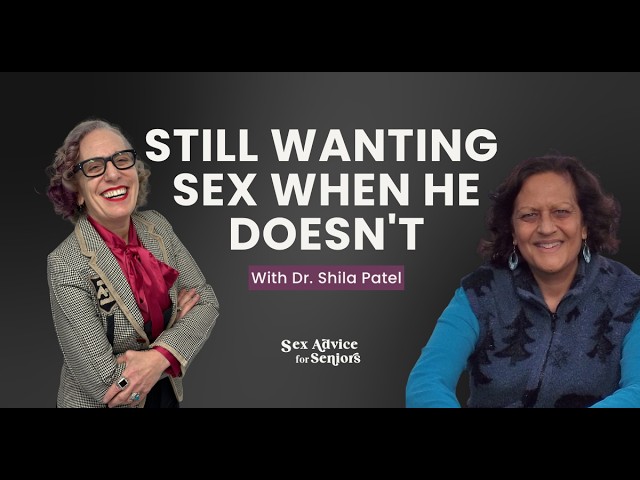
In this episode of the "Sex Advice for Seniors" podcast, host Suzanne Noble interviews retired psychiatrist Dr. Sheila Patel about how cultural upbringing, aging, and medical interventions shape sexual desire and satisfaction in older women. Dr. Patel recounts her multinational upbringing—Kenya, Zambia, England, and the United States—and how each culture’s silence around sex left her and her peers without proper sex education. She shares a striking research finding that women’s sexual satisfaction often peaks around age 64, contrasting with men’s decline after 50. The conversation moves to practical health strategies: the role of vaginal estrogen (estradiol cream) in restoring lubrication, reducing pain, and boosting libido after menopause or hysterectomy, and the importance of regular use to prevent UTIs and vaginismus. They discuss relationship dynamics in later life, emphasizing honest communication about sexual needs, navigating monogamy versus seeking new partners, and coping with male erectile dysfunction. Dr. Patel also reflects on how the MeToo movement and the pandemic spurred her to write two books addressing gendered social issues and relationships. Throughout, both women highlight the universal lack of early sex education across cultures, the evolving attitudes toward pleasure, and the need for humor, patience, and adaptability as physical limitations arise with age. The episode ends with reflections on sexual experiences in the 70s and 80s, underscoring that desire and intimacy can remain vibrant well into advanced age.
Chapters
Hi, this is Suzanne Noble, and you're listening to Sex Advice for Seniors. God, I can't even, can't even remember the name of my own podcast, Sex Advice for Seniors, probably because I have now moved to Thailand and have been living in Chiang Mai for the last 5 days, and the time zones and everything is all over the place. I'm all over the place. This is much later than I usually record my podcasts. I haven't had anything to drink. In fact, I've had virtually nothing to drink since I got here because drinking isn't really like that big a thing in this country. I've noticed cannabis, on the other hand, is a big thing, but I'm not, I'm not partaking of that. But today I'm actually with somebody who's Southeast Asian herself, although she's not based in Southeast Asia. Her name's Dr. Sheila Patel, and for over two decades, She was a psychiatrist, a doctor working in the mental health sector, working with lots of adults and children as well. But I thought because I'm in this country and I'm surrounded by women, lots and lots of Thai women, I thought we'd talk a little bit about how culture informs one's view of sex and how that upbringing can be a benefit or sometimes not a benefit. Especially as we get older, as we age, as older women. And Sheila, I suspect, is around roughly my age. Sheila, I won't ask your age, but you can, you can feel free to tell me. Anyway, welcome to Sex Advice for Seniors. It's so nice to have you on the show.
Thank you so much for inviting me on your show, Suzanne Noble.
That's okay. And so, yeah, tell me a little bit about, about your growing up. And what it was like.
Well, I grew up in— well, I was born in Kenya when it was a British colony. So I was always a British citizen. And I lived in Africa till I was 16. First 11 years in Kenya and the high school years in Zambia. And then my parents moved to England. And so I went to the University of St. Andrews for medical school. And I did my housemanship and clinical training in Manchester, housemanship in Preston. And then my parents, by that time, had moved to the States. And so I moved over here and I did my residency in child psychiatry, uh, general psychiatry in Georgia, which is just north of Florida. And I moved to Florida and, um, worked actually in Georgia for 25 years and retired at the age of 51. Basically because I had no children, I had no weddings, no colleges to fund. After 25 years of psychiatric work, it can be draining. And so I decided to hang up my shingle and just travel and retire. But during the pandemic and with the MeToo movement, I got really incensed with women jumping on the bandwagon and me too, me too. And I was like, no, I need to put a book out there with perspectives from both the men and the women. And it just catapulted into a lot of different areas of mental health because I had always treated patients one-on-one for 25 years. And I really wanted to kind of reach out and the mental health was really suffering during the pandemic. And since then. And so I really felt like I needed to reach out lots more people at one time instead of one-on-one treatment. And so I started writing a book and I couldn't stop. My book got so thick, I had to divide it up into two books, Us and the US, and dealing with all the social issues, but relationships. And obviously, your topic is main sex in and the elderly. And I think that talking about women and the different cultures just really helped me understand a lot about what people need to hear and understand moving forward as we age.
Yeah, it's— and you're, I mean, obviously coming from Kenya, Zambia, the States, England, In all of those places, did you ever feel like you had a home?
Had a home, uh, probably during my high school years in Zambia, because Kenya, I was a little bit younger. And then England, I still consider England as my home because that's where my most formative years were. Uh, that's where I went to medical school. That's where I, uh, I still love visiting. But coming to the States, of course, I've been here over 40 years now. And so yes, this is, this is home.
I had a conversation with a therapist a few episodes ago, and her view was that we formulate who we are sexually at 3, 3 key stages of our lives. And she was curious to know where I was during those 3 stages. I don't know if you agree with this with this concept, but her thought was that it's at age 7, at age 14, at age 21. And at each of those ages, similar to yourself, I was in a different location. And each of those locations informed in some way how I, my sexual identity, if you like, would— I'm curious to know where you were, Suzanne Noble Noble. 7 and 14 at 21, and whether you believe that.
7, like I said, I was in Kenya. Yeah. And I, you know, those formative years, which is about what I call, you're not a young toddler, but you're at a very moldable age. And you get exposed to some kind of sexual activity. Let's, let's admit that majority of girls and a fair number of boys have been exposed exposed to some kind of sexual molestation. Yeah, that's a given whether you want to admit it or not. But if you think back, and so in some ways you are exposed to some kind of sexual activity even though you're not a sexual being at that age. Yeah, teenagers, oh gosh, yes, our hormones are raging and of course you're going to be more involved, you're more attracted, whether you going to go the homosexual route or you're going to go the heterosexual route, but you are going to be more involved.
Um, were you in Zambia then? Were you in Zambia then at 14?
I was in Zambia at the age of 14.
14, okay.
And then, and then at the age of 21 when I was in medical school, of course you're under high stress situations. And if you have relationships, yes, you're going to be more sexually involved. But I, during my research when I was doing my book talking about relationships and sexual activity in the older population, I was very surprised that women tend to peak at their sexual satisfaction. Guess what? At the age of 64.
Really?
And that was a very interesting fact for me because men tend to switch off at 50. And unfortunately, women continue to have those sexual urges. And I think one of the things that we tend to forget is that we are sexual beings. And just because the age doesn't mean that our sexual activity falls off or our desire for sexual activity falls off. And I'm not ashamed. I'm almost 70. And when I talk to women in my condominium complex who are probably most of them are my age, we all laugh and joke about how the men have just kind of sidestepped this step of wanting to sexually love. And there are a lot of reasons for that. Like you said, you've explored it a lot on your podcast about erectile dysfunction, how it affects mental state of men, how they tend to withdraw, how they tend to switch off. And women have this need. So my thing was, how do you interact with patients? How do you— I had a lot of men, especially after the Drugs like Viagra came out, Cialis came out. They wouldn't have any problems asking me for those kind of medications, but you have to have that interest. You have to have— my whole thing was not just a sexual activity. It is what it does for the relationship and how the relationship can continue to benefit both of the couple. With sexual activity. And then, you know, there's always this stigma of being monogamous or going out of your relationship to satisfy your needs. Because let's face it, we all have needs and wants. And a lot of women our age just say, okay, you know, it's not happening in the marriage, so let's not do anything about it. Let's put a damn prawn in. Because that's what society teaches us. It doesn't matter what culture you're coming from. During all my studies, you know, that was the whole understanding. Americans are supposed to be very forward, but not like the Europeans when it comes to sexual activity. And it's not only the Asian cultures that don't talk to their kids about sex. I mean, it was really funny, um, while doing the research, I was listening to a preview of a Bollywood movie. And they were, they were, it was about an upcoming wedding. And the 4 friends were laughing and talking about sexual activity coming off the wedding night. And none of them could form the word for an orgasm. And the words that they came up with was intense pleasure. So that was—
Was that your experience as well as a young woman growing up that there was No conversation ever about pleasure, sexual activity? That was—
100%, because if, I mean, and that's what I'm saying, it's across the cultures. When I talk to the Americans who are my age, they will say that their parents very rarely showed affection. They should rarely show holding hands. They didn't believe in hugging. It's only in this later life. My mom is 91 now. And I was just telling somebody the other day that she still kind of cringes a little bit when you try and hug her, but she's so much more comfortable with my hugging her now, touching her. When I'm passing her, I'll kiss her on her forehead just to let her know that there is a deeper connection than just like, "Hi, Mom." And that's what it was growing up. I mean, and during my research, I was writing about how Parents are not talking to college kids about consent and sex and when the girls say no or in a situation of rape, the situation of getting intoxicated and taking advantage of your partner. And so this isn't just an Asian thing. I think it's a pretty much universal thing where parents don't talk to kids about sex and what's important and obviously what it can do for a relationship or not do. And now the culture is totally changing where they're using sex as a gratification overnight. And you have the half-night stands, you have Tinder, and you have Grindr where you're looking out just for sex but not for a lasting relationship. Yeah, it's interesting.
It's interesting that you should say that though, because I spoke to a woman of color a few weeks ago. Talking about her experience as a 50-plus-year-old woman and what messaging that she was given from her parents. And while I agree that there's not— that there's very rarely within our general age group. And if we talk about our age group being anywhere between 50 and 70 plus, I would say that, yes, I agree with you that everyone I've heard from is basically acknowledged that they received almost no sex education or no no, no conversations about pleasure or orgasms or anything as they were growing up. So I agree with that. But what I found more, what I found interesting about what she told me was that the messaging that she was clearly given was that the reason not to have sex and the reason to avoid sex was because her mother didn't want her to bring back a baby. That she was going to have to look after because the expectation within her culture was that if she was a young woman and she was still at school or just, you know, in her early 20s, that the expectation was that if she got pregnant, the person that would be looking after it would most likely be her mother. Her mother was a working woman and her mother said, I don't want any baby. I don't want you coming back here with a baby. And she said that culturally, that was something within her, you know, her Black community that was sex leads to babies. And if you're a young woman and you bring home a baby, the person that's going to end up looking after it is probably going to be me. And I don't want to look after your baby. So don't bring home a baby. So in other words, don't have sex. Don't bring home a baby. Right. My, my, my. My messaging was, as a younger woman, more in line with, if you think you might have sex, go and get yourself some contraception, go on the pill, because the pill came out when I was kind of, you know, when I was younger, everybody was on the pill. That's what they were, or using a diaphragm, which is what I used to use when I was a young woman. But I was taught clearly that if you want to go have sex, make sure that you're not going to get pregnant and you're not going to get pregnant if you go on the pill or if you take precautions or he uses a condom or whatever. So it wasn't necessarily a message about not having sex. It was a message about being safe. So that's quite a significantly different message that I got than this other person got. I'm curious, what was the message you got?
Just going back to talking about the African culture, even the African Americans that are here, majority of the children that were brought into my clinic were by grandmothers because the mothers had 3 to 5 children by 5, 3 to 5 different men. And the grandmothers were raising these kids. So you're exactly right that in that culture, that's the message.
Yeah.
As far as my message, like I told you, when I entered medical school and with the stress, yes, I had a boyfriend since I was 16. We had gone to medical school together. We were sexually active. You will not believe it, but I went to my GP and told him that I needed to get on the pill. And you know what he told me? Yeah. You are too young to be on the pill. You should abstain. The GP told me that. Unbelievable in England at the age of 21. And so I went to the university general practitioner and she was more than happy to put me on the pill. And that's what I was. As far as parents goes and Indian culture goes, you better not have sex. Not that anybody will spell it out to you because your mission in life is to finish school, get a degree. And my mom's mantra was that if you end up in a bad marriage, you better be able to stand on your own two feet and have a career so that you don't have to stay in a bad marriage. Nobody ever talks about sex. To this day, I'm 70, I and my sister even don't talk about sex or relationships or, you know, the importance of sex or whether she's ever had an orgasm. Let's put it that way. That is absolutely taboo subject. The only Indian person that I have ever talked to about sex and relationships is my cousin, who unfortunately became a widow at the age of before she was 60. And I always tease her about trying to find a companion, you know, having an outlet, you know, needing, needing somebody in her life. And how important, how important it was because she, she and I talked about how much she enjoyed having sex with my cousin. But no, Indians will not forget about the past generation. Even the present generation doesn't talk about it.
Yeah. And that's so— and for me, that's so interesting as well because Bollywood is quite— it is films about romance and all this wooing and all of this kind of stuff, right? But still, when it comes down to the actual thing, it's—
Right. But it's advancing. I don't think of myself as being conservative. But do you know what? That when I watch Bollywood movies, because I grew up with seeing the couple run around the tree holding hands and getting pregnant somehow, and everything was left to your imagination. And now when I see Bollywood movies and I see them kissing, I see them partially nude, I see them in bed, I'm like, I find myself thinking, Well, what is going on? I mean, you're so sexually advanced and talk about sex and talk about orgasms and talk about pleasure and giving pleasure and getting pleasure. And even at the age of 70, I still enjoy sex. And why are you thinking about these Bollywood actors going, oh my God, what are they doing? You know, they're supposed to be running around trees. So it's the mindset that you grow up with. It's the mindset that you are comfortable with. What is your comfort zone? What is your not comfort zone? And that is why I and my sister don't talk about it, because we are both very uncomfortable, since that's the atmosphere you grew up in, that you don't talk about it.
Yeah, it's interesting. But thank you for that, because I just wanted to clear that up, because you kind of skirted a little bit around that. And I thought, no, I'm not letting you get away with that. Great. So, so you mentioned, you mentioned I'm 64. So of course, and, and I'm totally— hi there. Sorry.
I think we got lost. Yeah.
Oh, it's still running though. That's good. Maybe hopefully it's not going to screw the whole thing up. I just, I just, I'm 64 years old. And like, you know, like we just discussed, one of the big issues that I find is that many women of my age group have just given up. They're just giving up on the whole idea of sex. Right. And you've said that this is one of the key moments in our lives, in women's lives of being sexual. And I find that, you know, just speaking personally, that my, my own sex drive is, you know, it's not what it was in my 20s for sure. And it's also my view on it is that I'm quite intentional about it. Otherwise I suspect it wouldn't really happen at all, if I'm really honest. So I'm curious about this research that you discovered. Like, it's the first time in 180 episodes that anyone has ever told me that 64 is the big age for women. I've never heard that before. Where the hell did you find that little piece of information?
Yeah, you know, I wrote my book so many years ago that I can't even remember what— where I read it, but it really interested me because I was probably, uh, around that age. I'm 70 now and I wrote my books back, so I was just past 64 at that time. And I was, I was like one of those women that had just given up on sex and everything. But the important thing is that I had a hysterectomy. And so one of the things is that the estrogen level just really drops. And when we were coming up, and this was 30 years ago, And at that time, the understanding was that if you get on hormone replacement, it increases the chance of breast cancer. Well, that theory is disputed now. And so when I came to Cape Canaveral to live, both my gynecologist and my family doctor told me that I should get on estradiol cream. That would help vaginal health. It helps the lubrication.. And I tell you what, my libido just increased tremendously. Yeah. And at that time, um, you know, it really helps women to know that there are things that they can help themselves and there are things that can help them get to where they can still get pleasure because sex becomes a really painful condition when the vaginal health is so poor.
Yes.
But it also increases your libido. As you get older. But the thing is, you have to have a partner who's also interested in having sex with you. And that was one of the reasons why my end of my chapter, I wrote about monogamous relationships, and that you can be in a healthy relationship with a partner, but if he is not interested in having sex with you, then you need to have a frank conversation with them saying, hey, I would still love to have sex. And if you are not interested in having sex with me, then if I find somebody, it's not that I want to leave you. We still can hold hands and cuddle and kiss and have a really— but if both people are happy, and if the person is willing to allow you to step out, but then you face what— whatever we have grown up with, the social stigma, what people are gonna think, are you a loose woman? Are you gonna have sex with anybody and everybody? You set your own limits. You set your limits to— because there are men who are interested in having sex, you know, in their older age, but you have to find the right partner. You have to be able to talk to your current partner. You can try and increase the interest between you and your current partner, but if it's not there, You know, the thing is we only go through this life one time. I believe in karma and I believe in reja, you know, reincarnation, whatever. But hey, for right now, this is the life I have. Now make the most of it. Are you going to get the most of what you enjoy? Let's face it, sex does have a lot of benefits. It does bring you joy. It does make you feel better about yourself. It makes you want to get up and get dressed, look pretty.
Yeah. And, and going back to what you said about estradiol cream, I use the, like, it's, it's more like a little, it's not a pessary. Well, I guess they call it a pessary. It's like a little tablet, but I was, I was listening to a doctor the other day, talk about the benefits of the cream version. And one of the things that I truly did not appreciate about the cream versus the pill, the little pill that you insert inside. Is that the cream can be used down there pretty much everywhere.
Right.
And they were saying, it's not just— it doesn't just necessarily have to be internal. You can rub it on your vulva, you can rub it on your clitoris, you can basically use it throughout your whole kind of genital area. And it's absorbed obviously microscopically into your bloodstream, but in that, in that way, you can increase the, you know, the, your arousal and also just lubrication and everything everywhere. And I was like, maybe I need to get some cream as well as the other thing.
What I do is, yeah, it's a compound. And so you have to find pharmacies that actually compound Vastodil cream. And then I, I mean, I just use it once a week and that's it. And that You know, but lubrication is very important. And both, you know, both for the males and the females that because we do have lack of the vaginal fluids. That's very important as well.
Yeah, for sure. And I mean, I use it twice a week and obviously, and it's just been a complete lifesaver. I mean, they should just give it to all women over a certain age just automatically because I just think there's, there's no harm in it at all.
Well, one of the things that my GP also told me was that your vagina gets really dry and it cracks and the vaginal fluids are acidic. So they tend to keep away the bacteria. So what happens is the women who don't use it, they end up— and that was one of the main reasons why they forced me to get on it is because they say that basically you end up getting more UTIs, you get more infections, you get thrush. And so you have to, if you want to stay healthy, this is what you need to do. No, I mean, I'm, I'm, I'm 100% believer in it. No, me too. For many reasons.
For like me too, honestly, I could just shout from the rooftops about the benefits of vaginal estrogen until every day until I'm dead, because I was introduced to it by a, by a friend of mine, not a doctor, not a GP, not a gynecologist, not a single healthcare professional told me about it. It was a friend of mine who, when I, when I complained about painful sex, burning sensations, dryness, all of that stuff, said, just get on this stuff. And I was like, why did nobody ever tell me this? Because no amount of wonderful lubrication, lubricants was going to do what one single little tablet did over, you know, over weeks. Amazing, amazing stuff.
But yeah, you know, when women talk about shutting down, that is a really definite thing that happens, the vaginismus, where you're not going to allow anything to go through your vagina. The muscles just close up. And that's when I had to end up going to my gynecologist and I was like horrified. I was like, my goodness, what's happened down there? It just closed up. And she said, don't worry about it. Just introduce this estradiol cream, use it, you know, a couple of times a week and Voilà, the walls open up and everything looks just like it's supposed to.
So are you currently in a sexual relationship with your partner? If I can be so bold as to ask that, what's your, what's your sitch?
As long as it's not getting out anywhere. No, I am sexually active. Yes.
Okay, cool.
Not as often as I would like, but you know, we do, we do have sex regularly. Yes. Cool.
That's great. I mean, I feel really good about it. Yeah. And I mean, I spoke to a wonderful, um, uh, woman called Dr. Suzanne Noble Noble a few weeks ago who's in her 80s. And she was saying, people talk about sex in their 60s. They talk about sex in their 70s, but they hardly ever talk about sex in their 80s. And she said, One of the interesting things that she discovered was that sex between 80 and 84 was quite different than it was between 75 and 80. And I was like, who knew? Who knew?
You know, even at 70, I always say you have to remember you hurt in certain positions. You have to be careful about how you have sex. You're not going to, you know, hang off the chandeliers like we used to. But you do have to be careful because yeah, we all have, you know, difficult joints, we have painful positions. So yeah, you have to adjust and you have to laugh a lot. And you have to be very patient because men at that age, you know, continue to have issues with erectile dysfunction. So you have to be patient. You have to work with it. So yeah, I mean, sex even in the '70s is very different than, you know, in the '60s from my experience that you just have to be patient. You have to work, you have to laugh a lot. You have to enjoy what you're doing. And then the rest of the time you just hold hands and kiss. Yeah.
And I, and I think as well, the thing about laughing a lot is something that's for me always been one of the benefits of getting older is the ability to just say, Do you mind if we stop? I really have to use the toilet, you know, or, or do you mind if we switch positions? Cause my knees are absolutely aching, you know, and just, and just being super honest about, about exactly that. Right. We just, we're not operating at the same pace at the same level. Personally, I, I was, I went to, um, I went to a little kinky event yesterday in Chiang Mai that was a munch, which is just a social event. It's not actually a sexual event.
Oh, sorry.
But what I found was that the people there were being really honest about all of this stuff, about, you know, about everything.
Suzanne Noble Noble.
Yeah, it was really interesting. Anyway, our time is up and I've been given the warning. I've been given the warning by my next door neighbor as well that I'm talking too loud, but it's been wonderful to talk to you and I'm really grateful that you came on the show. I'm going to stop now, but please don't go because in this country, the speed of this thing is very slow. So I'm still going to be waiting for it to upload probably until I go to sleep. But it's been a pleasure to talk to you.
It's a pleasure talking to you too. Thanks for inviting me again. It was fun. Thanks.
More from Suzanne









Why Sex Changes After Menopause (And Why That's Not a Bad Thing) | ft. Dr. Kelly Barron

Why Facesitting Is Trending Among Women: Power, Pleasure & Later-Life Intimacy
