Oats: The Simple Superfood for Performance, Health, and Longevity Ep 149
Chris Newport and dietetic intern Emily Q break down oats: the different types (steel-cut, rolled, instant), how beta-glucan fiber works, and why timing matters for performance. They cover prep methods from stovetop to overnight oats, sweet and savory recipes, and why oat bran has more protein and fiber than rolled oats.
Chapters
Welcome to the Find Your Edge podcast. I'm your host, Chris Newport, founder, head coach, sports nutritionist, and exercise physiologist at The Endurance Edge. Our mission is to empower people to reach and sustain peak performance and health. So get ready to dive into all things training, nutrition, recovery, and more. We hope to give you detailed information and inspiring stories to help you be your best. Let's do it. Welcome back to the Find Your Edge podcast. I am here with again Emily Q, who is our amazing dietetic intern, and this is our last podcast with her. I'm so sad. Oh, we were just saying, how is this everything you dreamed of and more, doing a podcast on oats?
And hey, I think this is the best way to go out on, honestly, right? Yes.
Well said. So good. So you guys know how I have a soapbox about oat bran and oats, and we had a whole conversation about this in our Longevity Lab group the other day of which one's better. Is it rolled oats? Is it steel-cut oats? And then they brought up a new brand of oats that is this steel-cut oats, but it's supposed to cook faster. And so we were like, you know what, we're gonna get to the bottom of this. And, uh, you know, The Endurance Edge needs to be sponsored by, by, by oats. Um, so anyway, Emily, you put together this great presentation. So if you guys are watching on YouTube, let's freaking go. We're gonna talk all about oats because, you know, sometimes we just need some inspiration. We need some ideas and we need some reminders that the fancy things are not necessarily— the fancy and expensive things are not necessarily the things that move the needle. For your health, for your heart, for your exercise. So here we are.
So why don't we just dive right into the oats?
We totally need to dive in. And full disclosure, I just had a bowl of oat bran, so that's probably why I'm a little bit amped up. A little bit amped up. It's like I've had caffeine over here. So anyway, tell us the benefits of oats because, you know, again, I feel like we gotta give 'em their time to shine. So what do you got, Emily?
Yeah, absolutely. So you probably grew up hearing that oats are healthy and oatmeal is healthy. I don't know if everybody necessarily loved oatmeal as kids, but let's go over why they're so good for us. The primary thing is that they're really rich in this type of soluble fiber called beta-glucan fiber. It's been shown in studies to help lower cholesterol and serve as a great prebiotic for your gut bacteria. Oats just have a lot of complex carbs and like I said, more of that soluble fiber, which helps to slow your glucose release into the bloodstream. So if any of you have trouble like managing your blood sugar, oats, uh, are a really good, um, they don't give you that like spike and crash. They'll really help do that slow release, and that also promotes feelings of satiety, or fullness is just a simpler word for that. Um, so like when you— if you eat it for breakfast, if you eat oatmeal for breakfast paired with a lot of other good stuff, you'll be feeling full for quite a few hours. You won't be like craving something else like an hour later or something. There's also a ton of different micronutrients in oatmeal. Um, there's manganese, magnesium, phosphorus, zinc, iron, B1, and even more than I just listed there. It's— there's just a huge variety of small things that we need and they really add up throughout the day.
Mm-hmm.
And finally, oats have a lot of antioxidants. I'm gonna butcher the name of this one, but it has a really specific— Oh, give it a try.
This is amazing. I'm better you than me. Go for it.
There's a really specific type of antioxidants called avenanthramides that, that, that was better than I would've done.
So who knows?
And they're shown to reduce oxidative stress, inflammation, and even blood pressure because they are shown to increase some nitric oxide. So a lot of antioxidant properties. So yeah, lots of benefits to eating oats.
So good. I remember this being one of the first papers that I did in one of my nutrition classes was on beta glucans and postprandial glucose and how much it mitigated that rise in blood sugar after a meal. And it's pretty phenomenal. So I'm gonna be patient and we'll talk more about beta glucans and the amounts when we get further down. Look at me, Emily, I'm so proud of myself.
Yeah. Rest— restraining yourself.
Restraining myself.
Well, we'll get to it eventually. Don't worry.
Okay. All right.
All right. So one of the things that is often confusing is you walk into the store, you see the wall of oatmeal and oats, and you're just like, wow, there's a lot of different varieties and types, and they all have claims on the packages. Like, what type is best to buy? So let's go over—
or like, how many grams of whole grains? You're like, I don't know how many grams of whole grains am I supposed to buy? Oatmeal. I'm like, what? Yeah, it's just confusing.
Yeah, exactly. So we're going to go over what makes each different type of oat, I guess, on the market unique. So a little background about oats and the processing of oats. All the oats you see in the store, they start off as these things called raw groats, which is in the little picture up in the top right corner there. Yes, the top. The top right corner. They do look like seeds. They're not like the nice pressed ones you see in the bottom left or that you see in your packages. And so what happens is that there's different levels of— there's different types of processing they do to these raw groats. Because if you try to cook raw groats, I'm not saying that you can't eat them, but they take forever to cook and they're really chewy. Yes. So most people don't like that type of texture. No.
And I, I don't think that we are really built, because we're not cows or certain types of animals that would otherwise eat these, we're not really built to break that fiber down. So you probably will experience some significant amount of digestive distress. Yeah. If you're trying to eat the whole groat. Yeah.
So I'd say that The next step after raw groats is your steel-cut oats. Those are basically the raw groats, but just like sliced up into smaller pieces. So they take longer than regular oats to cook, but they're much more digestible than the raw groats. And they have like a— some people like that like slightly heartier, like slightly chewier texture to it. Yeah, chewier.
Yeah, that's a good way of describing it.
Yeah. And then the regular ones that I was talking about, your old-fashioned rolled oats are the ones you'll see most often. That's in the picture. And if you just kind of go anywhere, like any store, the cheapest ones will probably be the old-fashioned rolled oats just because they're so common.
And literally pressed like a wit in the machine, thus the whole rolling process.
Right. Yeah, so that's why they— like, when you open a container of rolled oats, they're like— each of the kernels is like flattened. The whole groat has been just like steamrolled, literally.
Yeah, yeah.
And then we've got another type called oat bran, and this is for sure Chris's soapbox. Yeah, oat bran is kind of the— you take the raw groat and then you kind of take the outer layer of that groat. And like, that's, that's kind of all it is. And then you just like collect a bunch of these like outer layers and put them together.
So that's what— So that's what the ringen of the oat is. Yeah.
Yes.
Mm-hmm.
Cool.
So very similar, right? But just tastes different anyway.
Yeah. Yeah. So like when you're eating, when you're eating rolled oats, you're still getting some of the oat bran, but like in, if you buy just oat bran, it's just all concentrated. Yeah. Yeah.
Cool. And then there's good old packaged instant versions.
Yes.
So tell us about those.
Yeah. So often there's a difference between, I'll say, quick oats and instant oats. If you see a container of quick oats in the store, that's basically just the old-fashioned rolled oats, like cut up into smaller pieces. As the name suggests, it's supposed to cook slightly faster than the rolled oats, but they should texture-wise be very similar. Instant oats, however, are ground up even further. And usually when you see a little Quaker packet of oats, of instant oats or whatever, it's usually flavored in some way, sweetened and flavored. Like, I don't know, you'll see the apple cinnamon flavor or whatever it is.
Brown sugar or whatever.
Yeah. Yeah. And those are designed to be like super fast. Yes. As the name suggests.
Again, as the name suggests. Yes.
Yeah.
Okay, cool. And then you have this slide. Look, look at all this beautiful— if you guys could see these pictures, it's so good.
Yeah. So if you're not watching on YouTube, what's on the slide right now is a picture comparison of a bunch of different types of oats and like what they look like.. So you can see the visual differences between the groats, the steel-cut oats, the old-fashioned oats, the oat bran, all the types I just listed, plus a couple more. If you see, there's one called Scottish oatmeal, which I had never heard of before researching for this podcast. But basically what it is, it's very similar to steel-cut oats, but they're just like ground a little bit instead of being just simply sliced.
Yeah, they look, it looks like not as, as, um, thick as the steel cut oats, but just, you know, like a little, but maybe not quite as dark as the oat bran, kind of like right in the middle.
And they're, they're not flattened like rolled oats are.
Hmm. Cool. I have not tried Scottish oatmeal.
I haven't either.
You'd probably be surprised. I had all the oats except oat groats. I have not eaten an oat groat, but also that I would probably still be in the bathroom if I were.
Yeah, nobody wants that. Nobody wants that.
Nobody wants that. I will have to say, just brief note, is that oats are oftentimes rotated in the same fields as wheat, which makes them generally not gluten-free. But you can get gluten-free oats. So oats inherently are gluten-free, but like I said, they're oftentimes rotated in similar— in like the same fields. So if you do have issues with gluten, you can still enjoy oats. You just have to make sure that on the package it very specifically says gluten-free. So I wanted to make sure that all of those folks who are gluten-free can enjoy oats too.
Yeah, there are certain brands that will like ensure that their facilities are wheat-free in order to roll their oats so there's no cross-contamination. So yeah, look out, look out for the package.
Cool. Okay. Ooh, one of my favorite slides.
Yes. So here we are at Oat Bran. Yeah.
Did you find, did you have to take this picture, Emily, of Oat Bran?
No, I found this. I found this picture online.
I'm very impressed. I'm very impressed.
Thank you. Thank you. I actually had never heard of oat bran before working with you, Chris.
So of course, of course, I'm changing the world one person at a time.
So this was so fun to dive into. So like I said earlier, the oat bran is the outer layer of the, the groat. And the good thing about it is that when you put a bunch of those Oat bran, like outer layers together. There's a higher concentration of fiber and protein than regular rolled oats, and which is as high as about 1.5 times the fiber and protein. It also has more of those amazing beta glucan fibers that we talked about. They even cook faster than rolled oats and have a softer and smoother texture than regular oatmeal.
Yes, love it. And a note about beta glucans, cuz I, when I got this, I was like, oh, we gotta find some numbers for folks. So 3 grams of beta glucans per day will help to lower not only your total cholesterol, but that most the total cholesterol lowers because most of that is coming from your LDL, which historically we know of as bad cholesterol. I don't like that term for it because not all LDL cholesterol is bad, but that is another podcast for another day. Mm-hmm. But it's super effective there. Oat bran, on the other hand, so a serving of, let me back up a little bit. A serving of oats should get you to that 3 grams. A serving of oat bran, however, gets per 50-gram serving is 2 to 3 times more beta-glucans. So when you're getting oat bran, you're getting way more beta-glucans. So in this case, I'm gonna say that more is better. So of course somebody's gonna take that too far. So eat a variety of things, people. Just make sure. And also, this is not medical advice. This is for educational purposes. Anyway, go on, Emily.
Yeah, no, no need for beta-glucan maxing or whatever, but right.
Oh yeah. We just need that warm up.
But yeah, it's oat bran is, is really great and really packs a punch. In the fiber and protein department. So, so have you tried it yet, Emily? I have not, but I really, cuz I haven't been able to find it in a store yet, but I really want to try it.
Yes, the, it is super good. I just had it this morning. We'll get into some preparations here. I'm gonna, again, I'm gonna be patient. I'm gonna be patient. So let's talk about preparation times. How long does it take? Cuz I think that's some, I've heard a very, I've heard a variety of reasons why people don't like oats. We had somebody at one of one of our training camps who was like, "Oh, my parents made this and it was just like slop and it was bland and I didn't like it." But they, of course, Chef Jay is freaking phenomenal and made them in the slow cooker and people were like gaga for them. And they were like, "Wow, what did you make this with?" He's like, "Um, water." What else can you do?
Yeah.
So, but there's something about when you cook it properly and get it to the right texture in the right proportions, then it is more delicious. So, and a little bit of salt goes a long way. I will have to say that. So walk us through this slide so everybody knows kind of what the sense of how long various things take to cook.
Yeah, so I didn't put, one thing I didn't put on here was like the ratio of water to oats for each different type. Mm-hmm. Yeah. But that matters a lot too because like you'll usually want to put more water with steel cut oats than like rolled oats just because they're a little tougher, heartier, chewier. But anyways, if you were to, if you were to cook a whole groat, the whole groats for reference, it would take about an hour. So yet another reason why we don't usually eat whole groats, because I don't know anybody who has the time to sit around for an hour for their oatmeal to cook.
Yeah, exactly.
But yeah, so steel-cut oats take about 20 to 30 minutes on the stove. Your regular rolled oats will take 5 to 10 minutes. Oat bran is supposed to take 2 to 3 minutes. And quick and—
I know, Emily's like, oh, she's going to say something.
Didn't know when you wanted to jump in with that.
Yes. So in, for me, oat bran takes a minute. So I know on the package it says 2 to 3 minutes, but I took the serving size, I put it in my little bowl, I fill it up with water to cover the oat bran and then cover it maybe just a little bit more than that. And when I mean a little bit, and I use a pretty small bowl, it's maybe 2 millimeters above the surface of the oat. So a little bit more than I would for rolled oats. And mind you, I'm terrible at cooking rolled oats. Like, they don't— I don't get the texture right, which is why I also like Oat Bran, because it's kind of foolproof. And I put it in the microwave, hit it for a minute, and then take it out. And then I did a half a scoop of collagen this morning, but I also have done a half a scoop of whey with like that little bit of extra water on top, stir it up. And then for me this morning, I did a tablespoon of peanut butter. I I did cinnamon and I did a tablespoon of chocolate chips. And that sounds like we're in, we're in. And clearly I am energized, you guys. And it took, and it took a minute. It took a minute. It doesn't, you know, so this quick instant stuff that you don't, you don't have, you don't have to do that. Don't waste your money.
I guess it doesn't save you that much time.
No, it doesn't. And, um, The texture is different. It's much hardier. Just go try it, you guys. It's, it's hiding in the grocery store because nobody pays for store shelf space for it. It's usually on the very bottom shelf or on the very top shelf. You can also find it online. I found it in most, in most stores, not all, but you know, like you got to hunt for it a little bit. So if it's a smaller grocery store, you're probably not going to find it. Yeah. So super easy to make. And now let's talk about cost because. Cost matters these days. Geez.
Yeah. In this economy, groceries, yeah, can be tough. So, well, so let's talk through what each of these costs.
Yeah.
Usually oats, I feel like, are considered kind of like a cheaper, more like budget-friendly food.
Oh, for sure.
It really depends on the type though. So I did, I was really surprised that you can buy whole groats. Like there is that, that is a thing. People, some people will eat them. Some people will take the, you know, maybe they've trained their stomachs or, and guts to handle it.
God bless them. Yeah.
Yeah. And yeah, you can find it online.
They probably have like a, a very well controlled A1C.
So I, yeah, I guess so. You can't really find them in stores from what I've seen cuz of how uncommon it is to eat them, but you can order them online. Found a brand. It's about $4.50 a pound, which compared to regular oats, that is like pretty expensive, but it's also like not super horrible. I pulled the rest of these other costs from Harris Teeter. Steel cut oats. I think it was like the, the brand was called like Organic Simply. It was about $2.66 a pound.
Okay.
The old fashioned oats. Yeah, the old-fashioned and quick oats in the Harris Teeter brand was about $1.60 a pound. Super cheap. It was like, yeah, $4 for the whole 40-ounce tub. Oat bran is going to be about $5.15 a pound. This was the Bob's Red Mill brand. And then the instant oats, surprisingly, if you compared it by weight, was the most expensive one. Yeah, because you—
About that.
Yeah, because they come in the little packets and it's not like a huge container of it and then it costs about the same. So yeah, by weight, instant oats are most expensive. Who would have guessed?
How about that? I am so glad that you broke this down for us because some people just flat out don't know how to grocery shop, you know, more like cost effectively. And so these are some nice little tips. You know, and then also what are you paying for in terms of the pack that it punched in terms of nutrient density, right?
Yeah. So you can see that the, the oat bran on this list is the most expensive technically, but like we talked about earlier, it does pack more of a nutritional punch. I guess if you're on a budget, your old-fashioned rolled oats would probably be the best because yeah, it's basically the same. Them and steel cut oats have basically the same nutritional profile. And I guess you would just get steel cut oats if you like the texture better. That's my thinking, at least.
Yes. Which, good segue to some specialty oats. So, and this is really what brought on this entire podcast, is somebody came onto our Longevity Lab accountability calls and was like, hey, I was introduced to this brand. We have no association with any of these brands. We're just here to tell you about the science and to get into the nitty-gritty of it. So, yeah. Yeah, tell us about it, Emily.
Yeah, so the brand that was brought up was called Coach's Oats, and they stole my name, by the way.
I'm a little disappointed.
I think, um, no, I think he found it at Costco. I don't know how much it costs at Costco. I wasn't able to find that out. But if you go to Coach's Oats website, they sell it for about $5 a pound. You can get it on Amazon for like 7 bucks a pound, which is like kind of expensive at that point. But apparently there are steel-cut oats that have like— they've patented a certain way of like cutting them so that they cook in 3 to 5 minutes as opposed to 20 to 30 minutes, as I talked about earlier. It doesn't really change the nutritional profile at all. Um, they're nutritionally identical to regular steel-cut oats. But if you like steel-cut oats and don't wanna wait around, that's an option for you.
Yeah. They're about the same as Oak Bran, I guess, pound for pound. Yeah. In terms of cost. So it's a matter of which one do you wanna go with? So, and then this other brand I found more recently, actually we used this brand, it's the Bob's Red Mill quote unquote protein oats, not to be confused with the protein oats that has actual protein powder. Added to it, because that is also a thing on the market. When you go to the oat aisle, you're going to see all of these instant oat packets that are now quote-unquote protein oats because they've added some variation of protein powder, which makes them even more expensive. But again, what are you going for? And we use this brand, we use this type at camp, and everybody loved it. So maybe that was the magic. But honestly, I— if you gave me a bowl side by side with regular rolled oats and these protein oats, I don't think I would know the difference. So tell us about the cost with this one.
These ones are— they're— I, I found them on Target's website for $4 a pound. Not that bad. A little bit more expensive maybe, but it's not like out of this world or whatever. And I still don't really know how they do it. They— the only ingredient listed on the package is whole grain oat flakes, but each serving is supposed to have about 1.6 times the protein. So I don't know. We tried to get Bob's Red Mill to come onto this podcast, but you know, I don't think they ever responded to you.
No, Bob, Bob's busy. You know, he's, but it is like per serving, per serving on the label. I can't necessarily speak to, cuz I'm not looking at the labels, uh, right now in terms of ounce for ounce, but per serving of the Bob's Red Mill protein oats is 10 grams of protein per serving. Oat bran is 7, and then steel cut oats is maybe 5, maybe, probably something like that.
Yeah, that sounds right.
Yeah. So, you know, we're trying to not help you overthink it. So if you wanna try it, try it. I think they're good, you know? Anyway, so now how do we make 'em? I told you already how my oat bran recipe, but, um, what do you got, Emily?
Yeah, so you're probably— everyone's probably familiar with traditional oatmeal. You just kind of, you put oats and water together and then heat it on the stove or the microwave until the consistency is what you like, and then add your toppings of choice. There's also overnight oats, which I feel like is super popular on social media and all that, which is like you make You mix your oats with milk and/or yogurt ahead of time. You stir in whatever other mix-ins you want and then refrigerate it overnight, which is where the name comes from. And then when you take it out in the morning, the oats have soaked in the milk for a while and are now soft, and you're able to just eat them with a spoon and put in whatever other toppings you want. Then baked. Ooh, look out.
Mm-hmm.
Baked oatmeal. So this, I actually, one of my friends gave me a recipe for baked oatmeal like years ago, and it's really interesting. You mix, you're, it's kind of like you're making a cake. You like mix oats with milk, a little bit of butter or oil, some eggs, and then some, your choice of sweetener, either like sugar or honey or whatever. You mix it all together, put it into a baking pan, and then like bake it in the oven for like, it's like 20 or 30 minutes. And then it comes out and you're able to like slice the oatmeal. It, and like it comes out as like a piece and then you just like, you can eat it with a fork or a spoon and add toppings or whatever. It's really good. Nice. I was really surprised by it. Yeah.
Yeah. Okay, cool. So do you have a preferred method? It sounds like the baked version is your, is your jam.
The baked version is good, but also because it's also good for like if you want to meal prep ahead of time and you can have like multiple slices to like save for later. But I honestly—
like, like a granola bar kind of texture deal? Is this what you're describing? Because I have not made it specifically.
It's not as thick as that. It's not as thick as a granola bar.
Okay, so like more I don't know, how would you describe the consistency?
It's soft. You can use a fork and cut through it, but it's also really soft and you can still taste the individual oats. It's not like a cake. Although if you blended the oats to make an oat flour and then did this, it would be more cake-like. I've never tried that before, but that was super popular on social media for a while. Yeah. Mm-hmm.
I would love to say my, the traditional oatmeal by the, um, stove, on the stovetop or in the slow cooker. You can also do them in an Instant Pot. That's a really great way to do steel cut oats. Yeah. Especially if you wanna go faster. So instead of buying like the Coach's Oats, again, nothing against Coach's Oats, but you could just buy the cheaper version of the steel cut oats, put 'em in the Instant Pot, and then you can cook a, cook a bigger batch and then portion them out and leave them in the fridge and then just reheat them in the microwave. If you wanted to go that route and then mix whatever you want in. I stink at making regular oats, regular rolled oats in the microwave. I have zero patience, and then my water bubbles over. I, and then I just, I'm like, I'm out. I'm like so-so on the overnight oats. I know a lot of people really dig on this because you can get super creative with it. Oats with like milk and yogurt and, or your choice of, you can just do your choice of milk. You can also add chia seeds again if you're going for the cholesterol lowering properties. That's like, we got not only have all of this soluble fiber, but then we also have all those beta glucans. So like magic. You can add protein powder to it if you want to. You can add, I like jelly for a sweetener. You can add all kinds of, you can do stevia or monk fruit if you don't want a caloric version. So you can go hog wild with some overnight oats just like you can with traditional oatmeal. Mm-hmm. Uh, but again, Oat Bran microwave, 1 minute. That's my jam because, um, I'm impatient. Apparently. I actually—
yeah, I actually think for me every morning, I'd actually say I think overnight is my favorite because I'm—
is it? Okay, so what's your— what's your favorite mixture? Like, you're—
I'm always rushing in the morning, so I need, I need something that's like grab and go. I like to do oats with either almond milk or chocolate milk, actually, to get some Flavor in, and then I usually add chia seeds in to like, because it helps thicken it up a little bit more. If you've ever had chia pudding, like it's that similar thing. And then I'll like, I'll do like peanut butter, berries, mini chocolate chips, whatever. It's really good.
Oh wow. Okay. Yes. Loving this idea. So good. Let's see some other, let's see some other ideas because at the bottom of this slide you have something maybe a lot of people don't necessarily think about when it comes to oatmeal. Yeah.
So let's— so yeah, let's, let's get, let's get into that. We— I feel like whenever people talk about oatmeal, you think of the brown sugar, you probably bananas or berries with it, like a sweet type of oatmeal. But there are people that do savory oatmeal, like they'll add a fried egg or avocado or cheese or just like some savory, like herbs and spices. I've never tried this. I've never, I had never heard of it, but if you're not a person that likes sweet breakfast but want to get in some of these oats, there's a way.
Yeah. So good. I mean, it's, it's basically a blank canvas, you know, whether you're doing steel cut oats or whether you're doing rolled oats or oat bran, it's very similar to if you did brown rice or white rice or jasmine rice, or you have all these different, like slightly different flavors of a grain, or if you did farro, or if you did quinoa, you could do quinoa sweet, you could do rice sweet, you could do rice savory. You know, same kind of idea with oats. I like to think of like a replacement for polenta. Nothing against sweet polenta, but you know, you know, oats and oat bran are a little bit more powerful in the beta-glucan department. Um, yeah, so easy to— I basically dress it up just like I would like a My favorite way is like, uh, what you would do with a rice bowl. So I'll do oats or oat bran. I'll do a fried egg. I'll do black beans, either avocado or cheese, whatever I have in the pantry.
Yeah.
And then I will do hot sauce because I freaking love hot sauce. And what else will I— sometimes I'll maybe a little bit of salsa and salsa sounds really good.
Yeah.
You got a whole bowl situation going on here and also you could do that for dinner. So. No, nobody says that you have to do this for breakfast.
True. True.
Like, and we haven't even talked about doing oats pre-workout. I mean, talk about a pre-workout powerhouse. I will oftentimes get the, if I'm in a pickle and don't have enough time to prepare things, I will get the, you know, the little instant oat kind of situations on that come in their own individual cups. I'm sure that per pound, like, you know, the cost is ridiculous, but I'll grab one of them.
Sometimes the convenience outweighs the cost.
Absolutely. Yep. Absolutely. So, uh, no judgment, but I'll oftentimes grab one of those because I know that I will get usually a hotel room with a microwave and will oftentimes get a hotel that has water. You know, weird how that works with, uh, with your sink and then just fill it up at the sink. Throw in the, in the microwave and then have that. It's not as tasty as my homemade version, but it does the trick and sticks around pre-race. My magic timeframe for me with oats is somewhere around hour beforehand, maybe 90 minutes. I usually don't like to go too much further out than that, then otherwise I start, I start getting a little hungry. So Yeah.
Um, but you also don't wanna do it too early before, cuz remember we talked about it has all that fiber and that's not, that can't be great for digestion if you're running like soon after or biking or whatever. So yeah, yeah. Make sure to experiment with the timing.
Experiment with your timing. Also know that race day you will likely be more nervous, which means that oftentimes your digestion goes a little faster. Or a little slower depending on your particular sympathetic or parasympathetic response. So I'll test all these things in training for sure. Also, as much as I love peanut butter, peanut butter and me do not get along if I'm going to be going high intensity. So that also makes me a little sad because it helps keep me full, which is why I have to time it to that 60 to 90 minutes if possible. So I might be eating in the car, which, you know, it's not the greatest habit. But you know, you gotta figure it out. You gotta play with it.
Yeah. So sometimes you just gotta do what you gotta do.
You gotta do what you gotta do. What other ideas do you have in terms of what to put in your oats? I'm loving some of these ideas. Yeah. Oh, good.
So you can usually choose a type of sweetener, like mentioned brown sugar earlier. Honey or maple syrup are great options too. There's, uh, you can, if for even more like fiber and micronutrients, add in some fruit. I talked about bananas and berries earlier, but chopped apples are really, really nice. Nice. And oh yeah, oatmeal. I love, I love putting apples and oats and then apple butters like we talked about that time of the year.
I love apple butter. Just a little goes a long way.
Apple butter would be so good. Yeah.
Mm-hmm.
Crushed nuts work too if you, if you want the crunch and don't, maybe don't like the stickiness of the nut butter in your oatmeal. Uh, if you're allergic to nuts, you could do SunButter or sunflower seeds. Something like that.
Yeah. Love that.
Uh, I mentioned chia seeds earlier, flax seeds too, extra fiber, extra omega-3 fatty acids. So yum. And then we have our fun toppings, cinnamon, coconut flakes, chocolate chips even for extra flavor.
Or, and cacao nibs. I'd forgotten about cacao nibs. They're so good. Uh, good.
Like, I like those a lot.
Yeah. You, I would do, that makes me think of a good, um, overnight oats recipe. You could do whatever your choice of milk is, oats, maybe a little bit of yogurt if you wanted to make it thicker, and then add cocoa powder and then add whatever sweetener you, you like. Like in your version it was chocolate milk. Just, you know, skip the cocoa powder. Just go straight to like sweetener's already built in.
Yeah.
And then my new favorite these days is date syrup. Have you had date syrup? It's so yummy.
I haven't.
Yeah. So, and then we get the bonuses of the potassium from the dates and, um, little lower glycemic index there. So, you know, just search it up as my kids like to say. Yeah. So date syrup is basically just ground dates. Now you can do that too. You can ground the dates. Another thing, if you don't like the texture of oats, you can grind them up, giving them like a little bit of a whir in the blender or in the food processor. Maybe not necessarily to the degree of oat flour, although that is a hack. Oat flour is expensive. If you grind it yourself, it's so much cheaper to make. And that's literally all oat flour is. It's just ground oats. So just if you wanna save some dollars and you're eating oats a lot, that's an easy one to do. Another thing that we use with oat flour is when we had our meal service, we would make, and it was all gluten-free, we would we would take gluten-free oat flour and we would mix it with ground chicken and then whatever spice with— they were mixing it. So we used oat flour as the binder for— and you could use that for like crab cakes, you could use that for burgers or meatballs. We had like this really delicious Greek meatball that we would do, like feta cheese and spinach, and then oat flour was our binder because, you know, spinach can get a little bit wet, so oats can go a long way. Oh, and another—
that's such a good idea. I've never heard of that before.
Yeah. So instead of doing, well, I mean, you could do flour too, but if you wanted to go with a quote unquote less processed version, you could do that or get your beta glucans. Oh, another thing you can do with oats is you can put 'em in your smoothie.
That's right. Blend them up.
People don't necessarily think of that. You know, so if you need the extra carbs, if you want the extra bit of glucans, especially like a post-workout or even a pre-workout to give you that extra fiber boost and carbs, whatever smoothie you're making, throw 'em in.
That sounds really good. Yeah, you probably won't even taste it.
No, you won't at all. It'll, it'll make it a little bit thicker, but people also put all kinds of stuff in there. You can just, you can shoot, the kitchen sink can go in the, in the smoothie and you probably—
I've also heard, I've also heard of people putting protein powder in their oatmeal because you can't really like taste it with all the other toppings or even liquid egg whites. Oh yeah. As they're cooking their oatmeal for an extra protein boost.
Yep. Okay. So note on that, if you use, because you can use egg whites from the carton. So if you buy them. In the carton at the regular grocery store, they are already pasteurized, so you could literally drink them like Rocky and it would not hurt you. But I will have to say, if you do that with your oats, if you use oat— if you use egg whites and in place of water or milk or however you like to prepare your oats, it will turn into an egg pancake.
Oh, okay.
So you'll want to cook it first with your water and milk, and then if you wanna add protein to it, you can add a little bit of the egg white from the carton and you don't necessarily have to heat it up because again, if you heat it up, it's gonna turn into like a cooked egg.
Yeah. Yeah.
So, um, and then you can just mix it in. I prefer unsweetened protein powders. Some of the protein powders out there, especially vanilla, like they are over stevia'd for me. They're over monk fruited. They are just like they— I can't even. It's not my jam. So I have nothing personally against stevia. It is a plant. Some people still are skeptical of it. That's fine, continue to be skeptical of it, like, you know, whatever. But we do see a better blood sugar response, stevia versus like a regular sugar. Anyhow, I just personally don't like the flavor of it, so I like unsweetened, and then I have control over what I add to my smoothies or what I add to my oatmeal or whatever. And I'll be having a link on the blog to a, my favorite brand that is Informed Choice, which is another version of NSF Certified for Sport approved so that we know that it's literally just protein powder. There's no other, no other anything in it. So anyway, did we miss anything? On our lovely friend oatmeal and all things beta-glucan, Oprah, and et cetera?
I don't think so. I think we've learned today that oatmeal is just, or any, any way you wanna prepare oats, it's like endlessly customizable.
Yes.
To your preferences and it packs a great nutrient punch. So go out and get some oats.
I know. Yes. So good, you guys. Awesome. Emily. Great work.
Thanks.
Anyway, thank you guys for listening to the Find Your Edge podcast. If there is anything else that you want us to dig into in terms of various foods or recipes or educational topics, shoot us a DM at Instagram, at theenduranceedge.com, wherever you reach us. And, uh, let's freaking go. I love this. Thanks, Emily. Thanks for listening to the Find Your Edge podcast. If you like what you heard, don't forget to subscribe on your favorite podcast platform so you never miss an episode. And if you're interested in learning more about our endurance coaching, sports and wellness nutrition, metabolic and sweat testing, triathlon training team, or our triathlon training library, be sure to check us out at theenduranceedge.com. And don't forget to follow us on social media at The Endurance Edge. Thanks again, and we'll catch you next time.
More from Chris

Afraid of Open Water Swimming? How to Go From Panic to Confident with Author Hilary Topper

Carb Loading for Female Endurance Athletes: What New Ironman Research Reveals Ep 163
What Are We Training For? Performance, Longevity & Finding Joy in the Process Ep 162

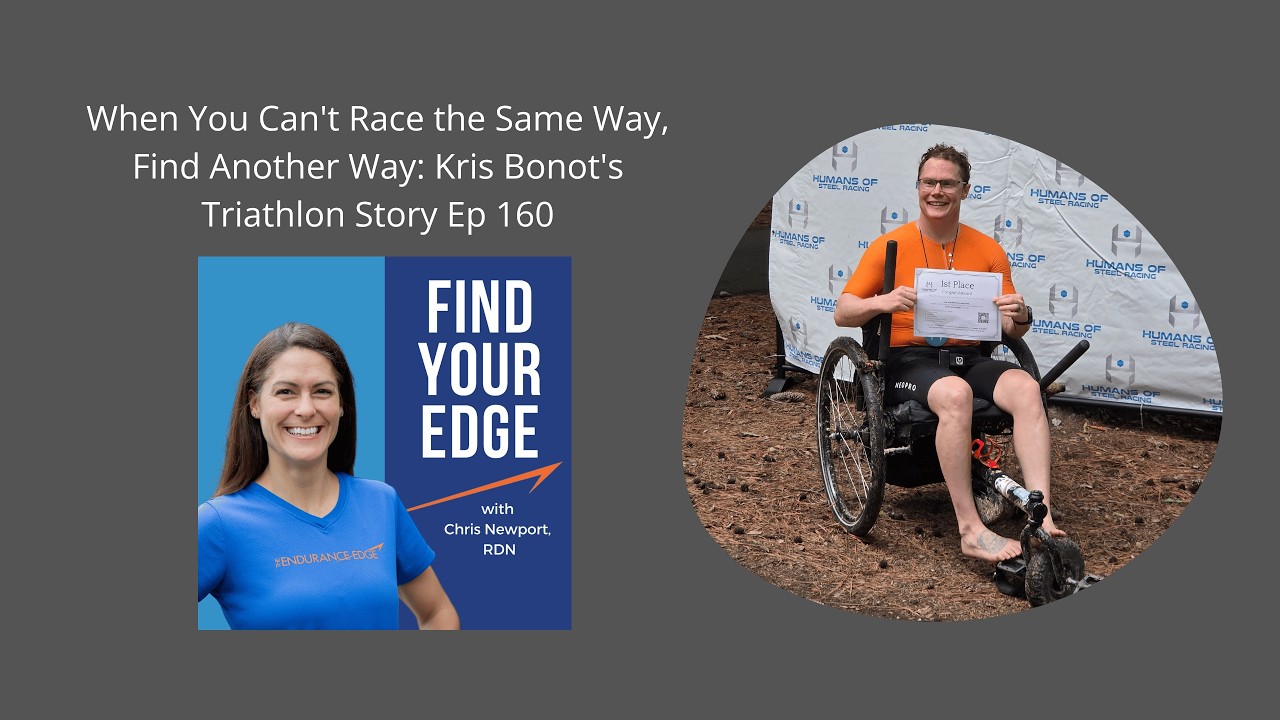
When You Can't Race the Same Way, Find Another Way: Kris Bonot's Triathlon Story Ep 160

Le Tour de Femme: Women, Cycling, Community & Supporting Women With Cancer Ep 158