The Science of Lasting Motivation in Endurance Sports Ep 155

This content was created by Chris Newport. This content was uploaded by Chris Newport. This is a YouTube podcast episode titled "The Science of Lasting Motivation in Endurance Sports Ep 155" (published 2026-08-06) featuring a conversational interview on the Find Your Edge podcast. Coach Chris Newport hosts Dr. Sarah Gordon, and they discuss her PhD journey, research on older triathletes, motivation (including self-determination theory: autonomy, competence, relatedness), successful aging, community, stress management, and practical lessons for sustaining long-term participation in endurance sport.
Chapters
Want to make a season's worth of progress in just one day? Our Ultimate Training Days are designed to help you stop guessing and train with confidence. In just one day, you'll receive personalized feedback from our experienced coaches through swim, bike, and run sessions, hands-on skills practice, and mental training. With our small coach-to-athlete ratio, you'll get the individual attention that's hard to find anywhere else. You'll leave with practical strategies you can apply immediately greater confidence in your training, and a community of athletes and coaches who are cheering you on long after the day is over. Whether you're training for your first race or chasing a new PR, these camps fill quickly because space is intentionally limited. Our upcoming camps are July 19th, August 9th, and September 20th. To learn more and reserve your spot, visit theenduranceedge.com/camps. Now let's get into today's episode. Hello and welcome back to the Find Your Edge podcast. I'm your host, Coach Chris Newport, and, uh, Technical difficulties. We're gonna make it this one today, you guys. I, I swear. Anyway, we've got a special guest today, Dr. Sarah Gordon, and, um, let's see, how did we originally meet? I think that you sent an email to fellow triathlon coaches. Does that sound like, ring a bell? Yes. You're like, I'm starting this triathlon related podcast and I would love to have some guests on and Yeah. Uh, so I was like, oh, all things triathlon related. Of course, let's do the things. And you have got such an interesting journey, thus the name of your podcast, right? So Sarah, tell us a little bit about your journey in endurance sports, how that took you to your PhD, and how that eventually led to your podcast? That was a big question, by the way.
So take it away. Okay, well, so to start, this is the first time I've been on the other side.
Isn't it cool? It's so fun.
Yes. Yeah, you can— I'm usually a little bit— yeah, I'm the interviewer, so this is good. So I appreciate the opportunity to be here, share my journey, and, um, and hopefully inspire people through my story. I know that the guests I have on my show— and Chris Newport Newport, you've been on my show, I'm so grateful for that. It's called The PhD Journey Unplugged. And I meet such incredible people on the show. They inspire me so much with their stories. And so I learned so much from that. So I'll try to share some of that wisdom with your guests. But so let's see my journey. Well, I remember the first time I ran. I was 15 years old. Wow. I can remember it clearly.
So yeah, what makes it stick out so much?
It was a beaut, because I love to run at night. It was a beautiful evening. It was the summer, probably summer. It was definitely warmer out. I don't know, just the elements. I've always been about the elements. My license plate for years was 4 elements. I have tattoo on my shoulder, it's the strength and endurance. I mean, it's always just been part of me to be physically active and enjoy being out in the elements, running, whatever, over the years that I've done. But I remember this first run and I just kind of fell in love with it. It was, maybe it was just what you feel, the runner's high too. It just all came together for me. And so that has always kind of been in my life, even as I approach 60. I still love it. So I had that all along for many years, fell off the tracks here and there, but found my way back. You know how it works. And then in my 20s, uh, I always loved to swim, never competitively, but just love to swim. And in my 20s, I tried my first triathlon. It was the Ruston Triathlon, and I had, I had an old Schwinn bike. Oh, that thing was heavy. It was like a It was like a steel tank. Yeah.
But those things are like unbreakable, you know? Yeah.
But for your first triathlon— no, I don't. But like for your first triathlon going up, you know, the hills and, uh, Ruston Triathlon, which is, which is still, they still hold that race. It's a great race.
Cool.
Um, it was, um, it was hard. I was, that bike and I had some words on that hill.
I bet. Yeah.
But that was in my 20s, and then I just kind of went on and worked different, you know, got my bachelor's, my master's, and raised my family and, um, worked. I worked in the government. I was a research analyst. I found my way into as a marketing director, which to a certain extent is market research. So I always kind of did research, and I was sitting in a job about 6 years ago. And I was like, you know, I think I really want to go for something I've always wanted to study, health and human performance, exercise science, exercise physiology, and just go for it. I mean, the kids were, you know, either graduating college or, you know, in college, and it just seemed like the right time. And so I did. I took a leap of faith at age 53 and went back to get my doctorate in health leadership and health and human performance. Best decision I ever made in my life. Totally shifted my life towards so much more alignment. I talk about it on my show all the time, how important it is to find things in your life that you enjoy, where you feel authentically yourself. And so that allowed me to move in that direction. And, and during that journey, um, I was doing triathlon. And I, I would see older, you know, I was doing, I did a couple half Ironmans and, you know, some sprints and I would just see older people at these races, you know, I didn't know their exact age, but I knew they had to be 70s or 80s or you could actually see on their leg, you know, sometimes.
Yeah.
Yeah. And I, I really seriously thought to myself, um, I wonder what motivates them. To be so highly physically active at later stages of life? How did they get there? How do they stay there? What does successful aging look like? And those were just the questions, you know, getting your PhD and, or doing research, it just starts with curiosity and a question or questions. And those were my questions. And so that's, that was the foundation of my dissertation research based on those questions. So, I built the whole project based on what, you know, the exercise motivations of older triathletes, 65 and older, and their perspectives on successful aging. So, in that process, I made a lot of connections. I, you know, I just learned a lot through the, you know, the dissertation project. And, when I completed my doctorate, uh, May 2025, um, I really wasn't sure what I wanted to do with it, quite, quite honestly. And I thought— a friend of mine had a few years earlier said, you, you should launch a podcast. Like, no, I could never do a podcast. And then I completed my doctorate and I said, you know what, I think I'm going to try a podcast. And, uh, now I'm in my second year approaching episode 77. Nice. I, like you mentioned, I reached out to people through email. Hey, you want to come on my show? The triathlon community was incredible. So responsive, so positive, so excited. And that's where I launched it, within the triathlon community. And just yesterday, I'm going to launch an episode later today, actually, episode 77. I just had a gentleman on my show who's a, uh, has been living with cystic fibrosis.
Wow.
Um, since, uh, it's a genetic, um, disease through birth. And his story is just one of like hope and resilience and motivation and passion and purpose. And so I'm still, I, I'm having just, I feel like whether you are On an Ironman journey, a triathlon journey, an athletic journey, it's very similar to other people's journeys and how they, you know, choose to live positive, productive lives. So I'm, you know, I'm spreading my wings a bit on the show, but the message is the same, you know, throughout all the episodes. So that's where I'm at. That's the journey and the PhD journey. The name, it was because I learned— and we'll talk about it. I learned so many lessons, so many lessons on that journey that are very similar to an athletic journey, an academic journey, a personal journey, a professional journey. They're all very similar lessons across all these different ways of living our lives.
Okay. Yeah. So tell us about some of those lessons. Give us some examples.
So I think, like, you know, you're a triathlete and you coach athletes. I think you get to points in your life where you wanna quit.
Mm-hmm.
You just wanna quit something. You're tired. There's lots of reasons, you know, when we get to that point, that breaking point, a lot of times it's fatigue. You're not getting good enough sleep. Your life is out of balance. You are, tipping the scale too much in one, maybe you're overtraining, you're not recovering, your nutrition, your hydration, all those things that make you, you know, influence optimal performance. It's the same in any endeavor in your life, whether you're working in medical school, in law school, getting your PhD, an emergency room physician. We call it the long game of human performance. Right? So, the lessons I learned is that you have to set boundaries in your life. You have to— if you're getting to these breaking points, which, you know, burnout, we can all experience burnout as an athlete, as professional, as a parent. When you're getting to these kind of breaking points, it means something's out of balance. So, that's a huge lesson I learned. I learned it. In lots of different ways. And I made a joke. I was fortunate enough to give the commencement address at graduation. And I did my lessons learned. And I made a joke like, when you feel like quitting to your audience, take a nap. I know it's a silly lesson, but it's like—
It solves everything. Right?
Just take a nap. It'll give you a fresh perspective on anything that you're— any goal that you're going after in your life. So that was a huge lesson I learned about setting. Um, a friend of mine in school, the first time he said it, I thought, wow, that sounds so super selfish. But he's like, you know, you need to set non-negotiable time. Non-negotiable time is time that you, you know, it's just not— it's, it's, it's about you. If it's 15 minutes or it's an hour, however it works in your life, everybody's Lives and journeys are different. But so when I started to learn how to set non-negotiable time, which for me was, you know, early morning running or meditation or prayer, I mean, things started to get more in balance. So that's my first major, major lesson.
Um, are we getting a taste of this commencement speech? Because this is awesome.
It was fun. I mean, the other thing I learned was be be open to learning. Yeah, right. I've noticed like a lot of times people dig themselves into a hole because they just think they just know how to do everything.
Yeah.
And if you keep yourself open to learning from other people, you, you will be surprised how much it can, you know, improve your experience and whatever you're doing. And then, uh, I don't know, just be grateful. Grateful Marilyn, who, uh, Marilyn Ward, Dr. Marilyn Ward, who started my podcast with me, we used to always laugh, like, be grateful for the hard because you learn a lot. You learn a lot in the hard. So, you know, lean into it sometimes. Yeah. You know, the obstacles teach us. There's a wonderful book, Ryan Holiday, uh, The Obstacle Is the Way. I highly recommend it. Um, because we all have obstacles. They come at, at, at us in different ways.
Mm-hmm.
Um, and so we, we learn a lot in that. So that's the thing. Getting your PhD is a 5-year goal, right? And a lot of life happens in, uh, 5 years. And so you're challenged, you know, I've, I've had guests on my show who've done like the Epic Deca, you know, or like JD Trambley or Carrie Mandel who ran the World Marathon Challenge, 7 Marathon, 7 continents, 7 days. I mean, I've had people that really challenge themselves and you're gonna have every emotion and every feeling and every, you know, so just, I guess the lesson there from the academic journey to the athletic journey is, um, have some fun.
Yeah.
Remember you're putting yourself in the hard. Enjoy it. Enjoy the journey.
Yeah, I know sometimes it can be hard to see the light at the end of the tunnel, if you will. You know, you just feel like the tunnel is so dark and it's like, well, I know the way back. I could just give up and, you know, but like what's on the other side is so much better than you perhaps could have imagined.
Yeah, I had a shift in my thinking and maybe this might help your listeners. Probably in my third or fourth class. You go into hard things, whether it's you're training for an Ironman or you're training for a doctorate, and you start to question, do I belong here? Am I good enough to be here? Do I look like everybody around me? They call it imposter syndrome. And the truth is, with all of that, you're always going to feel a little bit unsure of yourself when you're doing something for the first time or something new. And so when you shift your thinking to like, this is my journey, I'm here because I want to be here. I'm going to learn from my community and I'm going to be a part of it. But ultimately, I'm here because I want to be here. And it shifts your thinking. And then you enjoy the journey. You embrace the journey.
So it perhaps changes the trajectory a little bit just because you're It's almost like your energy shifts.
It does. You stop comparing yourself to other people. Listen, if you're at a starting line and you're looking around and you're like, oh, I'm not this, I'm not that. I mean, just stop. You're there because you want to be there. You're there because it's fun. You're there because you worked hard to get there. You're there because, you know, it's where you want to be. So when you shift it, yeah, your energy changes. And you can— I'm not saying these things aren't hard, right? Discipline, consistency, hard work. You need these things to achieve goals, especially when they're lofty goals. Yeah. But when you shift your mindset to, I'm here really because I want to be in this hard, it totally changes your perspective on life.
Yeah.
Yeah. It makes it so much more rewarding and fulfilling.
That's awesome. So mindset is one of them, and I know you talked a lot about motivation. So what in your PhD process did you learn about motivation? And feel free to throw some like fancy terms at us. Okay. No, like, uh, like FTP and VO2 max, and let's, let's hear like, you know, psychological terms.
Absolutely. You can throw it around. Well, I will tell you just Let me just, as far as physical activity, I mean, I've had the guests on my show and I'm learning myself about it. I'm not, you know, a performance coach like you are, but I know VO2 max is associated with all-cause mortality, which means that the less conditioned, the more deconditioned your body is, you know, the worse your ability to absorb oxygen in your system, the more likely you're going to have other issues. It's a strong motivator for exercising, the way we transfer oxygen efficiently through our physiological systems. So I do love the science base of it all, of everything I've learned in terms of neuromuscular system and the cardiovascular system. But my background's in psychology, and I find motivation fascinating. And motivation is highly complex. We're highly individualized. So what motivates you doesn't necessarily motivate me. It's very dynamic. So when you understand that, and when I say these things, just keep in mind that it's very individualized. But I study motivation within a theoretical framework called self-determination theory. OK? I just came home from a conference in Geneva, Switzerland. All on self-determination theory. There were practitioners and researchers from across the world who were there to talk about this theoretical framework, which can be applied to so many different aspects of life: sports, wellness, mental health, healthcare, K-12 education, the business world, philosophy, policy. Government, how governments, politics, how governments govern. It's, it's just a fascinating framework. And don't get me wrong, there's lots of theories out there and frameworks to study human behavior, but self-determination and, and I'll make the loop back to triathlon and what I found in my research. But self-determination theory says we have 3 basic psychological needs, the need for autonomy, the need for competence, and the need for relatedness. OK? Autonomy means that we take actions in our life to do the things that we want to do, that we feel freedom, that we feel empowerment to take those actions, to be a triathlete, to be a PhD student, to follow the things that bring joy and purpose and meaning into our lives. OK? And it's a process to get there, right? We're not always there. It's a continuum to get to being— living a fully autonomous life. Competence is that you acquire skill sets in your life that allow you to do these things, right? To, to ride your bike, to transition quickly, to be a triathlete, to problem solve, to do all this, to prepare, to understand pacing and nutrition and hydration. All those are skill sets. That's competency. And the more competent you feel in something, the more likely you have confidence in it, right? And enjoy it. And then the third is relatedness. It's community. It's sense of community. We all— we're not meant to be isolated. We are social human beings. We thrive in sense of community. Okay? So when you have autonomy, competence, and relatedness, you're more likely to be living your life more intrinsically motivated. Which means that you are taking at your— things like, I compete against myself, I challenge myself, I want to live a healthy lifestyle, I, I want to do this, that, or the other thing. So when you live more intrinsically lives, you're more likely to enjoy your life. And that's the ultimate goal, is human flourishing and human thriving. Okay, so my research I found a pattern with older triathletes using statements like, I do it because I enjoy it. I do it because it's fun. I love the camaraderie ship. I love to compete against myself, but I love to be in the community. Not things like, I'm doing it for the reward of winning. Now, winning feels good. Mm-hmm. We all know that, but that's not the driver, right? That's not getting people training to the finish line and carrying them past the finish line to the next race that they sign up for. It's enjoyment. It's something that comes from within. And so I found that in my research, a strong motivator, exercise motivator was enjoyment, health benefits, physical health benefits of exercising, which we know. We know that there's so many wonderful physiological benefits to exercising. And the third major theme in my research was community, triathlon community. You know, people excited to make new friends, excited to see existing friends, excited to travel, you know, through the USAT platform of Worlds and Nationals and seeing people, friends they hadn't seen in a while, training with older athletes, training with younger athletes, it just, this whole sense of community. And so within self-determination theory, which was really beautiful, I had an opportunity presented in Geneva, is it fits so my findings fit so beautifully with self-determination theory, you know, cuz autonomy is being a triathlete, competence is having the skillset to be able to do a triathlon.
Mm-hmm.
And relatedness is the triathlon community. And, um, so it was, it was, it was a beautiful thing to say.
Yeah.
Wow.
I love that. And, um, when I was on your podcast, we talked exactly about that, which was so cool that I was talking about like our club and our community and how we do our training camps to help people be more skilled, thus you know, fitting fabulously into your framework. We just, you know, we did that all intentionally, Sarah.
You built it. You built it to work. You built it to be successful. Yeah. And that's when you understand these things. Because ultimately, we want people to be successful. We want people to enjoy their lives and to have fulfilling lives. Like I always say on my podcast, like, so much of life is random. Mm-hmm. Right. We— there's so much we cannot control, but there's a lot we can. We can control our attitude toward things. We can control the actions that we take in our lives, the things we choose to eat, the activities we choose to do, the people we choose to connect with. So, you know, um, yeah.
So that's so cool. I love that. Wow. Um, has going through this process of doing your PhD made you shift your thinking in any way? I know you came in like super curious and with all these questions. Were there things that surprised you or made you think differently perhaps?
That's a great question. Hmm. I have to think about that one. Yeah, it's a good question.
Yes. Next podcast we will be discussing that. Cause you know, we, we come in, like you said, just curious, like, let me think more about this. And, uh, it's also making me think of, uh, you and I have talked pretty extensively about Natalie Grabow, which of whom I had on my podcast was the 80-year-old, uh, world record breaking, um, Ironman champion. And I went into that interview sort of having one notion about her and then left being like, wow, that was not at all what I was expecting, and it was similarly great. Hmm. You know, so yeah, I just got it in one way and then be like, oh, okay, all right. Like you had mentioned, like just being open and ready for just a different way of thinking. And I think it's so easy in this, certainly in this sport, and you know, so many people in this sport are just very hard driving in other areas of their life. And it's easy to put something in a box like, no, this is exactly how I address my FTP or how I address my ability to train for this event or that event or whatever. And if you give them other opportunities, it's almost like, no, no, no, that overwhelms me a little bit too much. So it's almost like if I just stay in my lane or stay in my sort of fixed way of thinking, it almost makes the decision-making easier. I see this in nutrition too. So yeah, yeah, it's almost like it makes it easier in a way for us to stay stuck, possibly, and to not be curious.
I feel like the answer to your question, the reason I was struggling with it a little bit, is something that Steve Jobs, um, fame famously said, sometimes you can't connect the dots. Well, you really can't connect the dots looking forward. You can only connect them looking back sometimes.
Yeah.
So for me, to answer your question, I think the thing that's most surprising— I love the journey of learning. And I loved— it was a joke amongst my peers. I fell in love with the neuromuscular junction. I know it's silly. It's a little area within the body, within our physiology where there's a communication between cells that are involved in like motor, you know, neuron communication. I mean, it's just very, it's like, I really did fall in love with that. But so I love the academic journey, but here's what my connecting dots looking back told me, and may this help your audience. I think it's the journey. It's why my podcast is called The PhD Journey. It's why I always say strength for the journey within. I, I think that we set our mind on, on goals and performance and metrics and data and outcome. But I, I'm here to remind you, it— don't forget what you're learning on that journey because yeah, I love have being Dr. Sarah Gordon. I'm happy I got the PhD. I made great friendships. I learned so much in 5 years. I mean, there were so many things that there's no way I— just being curious about a question, there's no way I could have understood the gravity, the depth of what that experience would've brought to my life. And so I think for me, it's, it was, it's now when I look back on it all, it, was it's just about the journey of life. Whatever you pursue, if you're going for an Ironman, yeah, when you finish that Ironman, it's gonna— I mean, I haven't done one. I can imagine it's like the best feeling in your life.
Yeah.
And then when you reflect on it, you, you think about, oh, everything that got you to that, to that moment in life, you know? Yeah. So that, that, that's my answer there.
I mean, that's awesome. And that, I mean, I know you mentioned Ironman, Um, but that was how I felt after I finished my first triathlon, which was a sprint. And I know so many people are like, oh, I'm just doing the sprint. I'm like, people, please stop saying that.
Like, all right, go fast. You gotta go fast.
Yeah. It's just, it's not just a sprint or just a 5K. Like, you know, own whatever event you're doing. But that's how I felt when I finished my first race of like, Holy smokes, I did that. And the process that got me there and the way that all the different puzzle pieces had to fit together. And, um, and that started the, that basically was the impetus to the company that I've grown today is that everyone deserves to feel that. Like, holy smokes, I just did that. And to reflect back and be like, Dang, that was hard. But also, whoa, look at me now.
You know, the American College of Sports Medicine says it so brilliant— brilliant. I can't say that word brilliantly. Brilliantly. Yes. I struggle with some of my words. They say that they are the governing body. You know, they put out position statements on recommendations for exercise. For healthy individuals, for, you know, people managing chronic illnesses and whatnot. And they say that the way they word it is any movement is better than no movement. And so the philosophy is like wherever you are, whether you're doing a sprint, Olympic, a half Ironman, an Ironman, like wherever you are on that journey, on that continuum of fitness, wherever you want to be at that point in time. Maybe you, you maybe you've tried it and you just, you would rather stay in a shorter distance. It's more fun, or you know, whatever, whatever it motivates you to, to be where you're at. Doing something is always better than doing nothing. Absolutely. And so I think that with that philosophy is just give yourself some grace that like, you know, you're out there to have fun and to enjoy it, and that's The research is very clear on that. Long-term adherence to physical activity is enjoyment, or long-term adherence to— and I'm going to broaden it, I'd have to research it, but I'm going to just say based on my own research, long-term adherence to anything in life is enjoyment. And so if you enjoy being at a shorter distance, then that's where you should be. Yeah, right. And so, yeah, I think that that's, it's true. You know, just we're all very hard on ourselves.
We are all so hard on ourselves. And as you're saying this, it's making me think of the journey of aging through sport, through, and in, through the lens of endurance sports. You know, I started as a runner and then got into triathlon, But you know, we just had our race this past weekend and our youngest competitor was 12 and our oldest was 75. Like, that's, that's amazing. So freaking cool.
That's amazing.
Um, but those journeys are different. And the 75-year-old, when he came to registration, yeah, we have swim caps for, um, swimmers who feel like they might need a little bit more attention in the water. So he was asking for a red swim cap. I was like, oh, you know, like, Do you know why you're asking for that? Rather than just being like, oh, red is pretty and I don't want the other one. Just like clarifying with him. He's like, well, I'm like 100 years old, so I figure somebody better keep an eye on me. I was like, seriously, how old are you? So that I think in our heads, like, okay, well, when I was 12 or when I was 20 or when I was 30 or whatever, I did 15 Ironmans, or I ran 5-minute miles, or, and then I had a hip resurfacing, or I had a knee replacement, or I had, you know, death in the family or something like that. And to your point, giving themselves grace to let activity and the sport or a sport look different and be different. Because it is all part of the journey. It doesn't have to be— when you're 75, the sport is going to look different than when you're 30. Absolutely right. And that's a beautiful thing.
It's adaptability. You have to— to be successful, I believe, in life, you have to be flexible and adaptable, right? You have to give yourself some grace to say, at 60, I'm not the same runner I was at 15, but I still love running and I still can push myself to be the best version of myself at this age.
Yeah.
So when you come, when you make peace with yourself and you stop comparing yourself to past versions of yourself, you're going to find so much more enjoyment in what you're doing. Right? That's ultimately the goal is to enjoy the activities that you have in your life. So I think when we compare ourselves to past versions of ourselves or to past performance, look, you can use it in terms of like wanting to be the— I am all about wanting to be the best version of myself I can be. But you have to recognize that my— your body is— it's called sarcopenia. As we get older, our body changes. We're not going to live forever. We can't control that. We can't control the actual biology and physiology and all the things that happen in terms of longevity. Now, there's a lot of really interesting research going on in terms of longevity, and we are living longer for sure. I don't know, I have to double-check that. At one point I, I read we were. I'm not sure.
We fell off a little bit in COVID, and now we're sort of rebounding. Going back.
Yeah.
Yeah.
But, but we want to live those added years with good health. I always say lifespan doesn't necessarily equal healthspan. So we want to live those added years in good health. So, yeah, so give yourself some grace. Recognize that aging is a process.
Yeah.
And that physical activity, your mental health, your physical health, your relationships in your lives are all really important in terms of aging successfully and quality of life too.
And then it seems like it ties into your dissertation about these aging triathletes and maybe their motivation? Like how, what did you see in that process? I mean, I know the big thing was enjoyment, but—
Well, I love my, I love my dissertation research so much. I, so here's a lesson for your audience. Sometimes you just have to pivot. It's beyond your control. You can hem and haw all you want, but you gotta pivot. I was in my program for 3 years thinking I was going to do aquatic-based exercise with Alzheimer's patients because I think that the water and exercising in the water has tremendous properties for aging with good health and just awakening our brains and our bodies. So I just, I love to swim. I love to be in the water. And I witnessed some of the stuff with my father who had Alzheimer's and I would take him to the pool and he would wake up and I was like, wow, there's something to this. Yeah. And 3 years into the program, I was told, no, you can't do it. For dissertation research study, it would have to have been a case study, which they don't necessarily like to do case studies for a dissertation research project. They like us, they like to challenge us with larger sample sizes and Alzheimer's, there's something called the Institutional Review Board, which your study has to get approved through. It's considered a high-risk population. It's doable, but not a little lofty for a PhD student.
Okay.
So I literally had to go back and look within and to say, okay, well, what do I enjoy? What would be interesting? I'm seeing these triathletes at these races. And then the questions started and I went back to the literature review. I found that there was a significant gap in the research. With older triathletes that wasn't performance-based or talking about decline as we get older. There's research on sports participation as we age, but not specifically older triathletes and definitely not the way I studied it. So mine was the first study of its kind. And so what did I find with successful aging? You know, it's all kind of interconnected. I don't think you can say it's, anything siloed. I think we know through research that physical activity is very important in aging. Okay. It has so many benefits. We all know that. There's the level, the recommendations, you know, that's a whole nother podcast to dive into all of that and what the ACSM says and what research is saying about all that kind of stuff. Can you exercise too much? Can you do anything too much? Perhaps, right? Injury, injury is a good signal, burnout, all those kinds of things. And then like I said earlier, beyond physical activity, and I, in my research, I call it healthy living. There's a lot to it, cognitive health, physical health. There's a lot that feeds into healthy living. Is this sense of community. I think as you get older, sadly, I do think there are older people later in life who are isolated. And I have a friend who ran a study a little bit different than mine. He looked at older adults who had mild depression. And so, you know, there is a a dynamic that older people who are, who are isolated and they, they suffer more things like depression and loneliness and things like that. I think social connection, relationships, however they look in your life, um, you know, going to sports or craft, being creative, or, you know, like a community center. Yeah, I think it's important. I think it, it helps keep things such as depression and loneliness at bay. Yes.
So, and as you're saying this, I'm thinking about, again, Natalie Grabeau, who part of her ability to race is because her husband was in a health condition who was not able to help her. She had to lean on her kids and onto some of her other friends slash neighbors and other, you know, fellow athletes to help her with transporting her bike and making sure that she got to all the, you know, helping her put her things together. And, you know, obviously she built that degree of competence to do some of it herself, but, um, you know, she needed a little bit of help and yeah, I think that It seems to me that as we age, we want to reach out less. And that seems like what you're saying is, no, you need to ask for help because whether you're going to go to your crafting class and a bus is going to pick you up or your kid's going to pick you up or your neighbor's going to pick you up, like somebody's got to get you there. And the more isolated we are, and we see this very clearly in the literature, whether you're a former endurance athlete or a current endurance athlete or whatever you like to do, the more isolated you are, the shorter the health span.
Yeah.
That you have. And so whatever it is that you choose to be passionate about and stay in, it sounds like you've gotta keep your community and ask, and ask for support so that you can keep doing it and keep that Um, and, and keep that fulfillment because we all—
I agree. I agree 100%. Um, I do say this often on my own show, you know, it's okay to ask for help. Yeah, it's okay. You know, there's strength in asking for help. Mm-hmm. I know people see it as a weakness, but it's not. It's okay to ask for help. Um, and there's so many wonderful people out there who wanna help you. Yeah, you know, they— people thrive on helping other people. So it's like, it's a beautiful thing. Yeah, that was the first thing I want to say. The second thing, I want to make this one point. Well, actually, I have two quick points. I wanted to mention when you asked about lessons learned, as you were just talking, I was just thinking some of these things we go through in life can create stress. And stress is really stress. If you do everything right, you eat right, you exercise, you hydrate, you do you're doing— you think you're doing everything right, but your stress levels, you know, chronic elevation of cortisol in your body, like, it wears on your body. And so stress, like, managing stress, that was a big lesson I learned in my PhD program. There was a lot of stress. I was a full-time caregiver while I was getting my PhD. And so a lot of my work was, you know, at night, late hours. It just— it was very out of balance. So it was a lot of the lessons there were to learn to manage stress. Back to aging. There's something in our cultures and society, and it, you know, there's a lot of diversity in our conversation depending on where you live in the world. Okay. So highly individualized, a lot of cultural diversity in how we handle things. There's a lot of diversity in our opportunities for living. Self-determined lives depending on where you live in the world. So all these kind of factors, but there is something that kind of penetrates. It's called ageism. Okay. Ageism are these false assumptions that as we age, we, we aren't supposed to live highly physically active lifestyles in sports.
Yeah.
That, that wasn't the narrative for a long time. It was that as you retire and you age, you, you slow down, you do less, you hit the recliner. And there's a whole new group of, uh, there's a whole shift now towards aging with, with being active, highly physically active. And that's why I loved my research so much, cuz the triathlon community, triathletes, older triathletes demonstrate this much more vivacious way of living life. And it's really a beautiful thing to watch and to see and to see it flourish.
Wow. That, and you start winning way more awards. I mean, just saying, because that's fun too, like you had mentioned, right?
It is fun. It is fun. I mean, it doesn't necessarily keep people in it, but it is rewarding. We all feel good when we when we, when we, uh, succeed. Um, I have a really good friend, I'm going to give him a shout out. His name is Mark Michelson, and, um, he's doing amazing work. He's been the— like, he was in corporate wellness years ago when it was just being founded, you know, with the big companies like IBM and all those companies are starting to put in corporate wellness programs. He has a platform which I love, and that's why I'm sharing it. It's called Ageless Rebel.
Oh yeah, I love that.
Ageless Rebel. And it's all about looking at these older years in our life in a totally different— from a totally different perspective.
Yeah, so cool. Um, and great segue to your podcast. And Sarah, how can people get a hold of you and listen to more?
Sure. Well, number one, if you're interested in being a guest on my show, I would love to talk to you and hear your story. I love to interview people and talk to people and, and hear your stories of things that you've overcome in your life, um, and the resilience. I call my guests resilience warriors, you know, we just never give up and we find avenues and opportunities to live our best lives. So I would love to hear from you. Um, the podcast is on every major platform, and, um, there's something out there called RSS feeds, which are podcast feeds. They're free. It's a free podcast, so it's on everything like iHeartRadio, YouTube, Spotify, Apple Podcasts. There's so many now— Listen Notes, CastBox, Refonix, Podbay. I mean, all you need to do is search Dr. Sarah Gordon, The PhD Journey Unplugged Podcast.
Cool.
And, um, and you can email me. You can email me. Um, my email is a little tricky, so maybe you can just—
I'll, I'll put it in the notes, but You'll find me.
You can find me through Chris too. And yeah, I thank you for this opportunity to share and connect on your podcast. Yes.
Love it. All right, so before we head out, what are maybe 1 to 3 things that you want listeners to really walk away with?
Well, I've been asking all my guests lately this one question, and you're welcome to use it —Yes, yes, please. I ask them at the end of every episode now, what are you training for? What are we training for? And you can answer it literally, figuratively, metaphorically, however you want to answer it. Right. You know, what are we training for? And I would say, to answer your question, I don't know if I could come up with 3 that quickly, but— That one is good. You know, I think I'm just— I personally am training and want to empower people to live your best life. You know, it's a short journey. Um, we have so much that we cannot control, and so why not put things in our lives that nourish our soul, ourselves? That where we can thrive and we can shine. And I tend to think I'm biased. I think physical activity is absolutely essential to manage stress, to do so many positive things in your life for your overall health and well-being, your mental health, and forming relationship. I mean, the whole— look, the whole reason we're connecting is through triathlon and, you know, relationship building. And so, um, that's my take. That's my, my final, I guess, um, thought is, um, find those things. Like, if you're, you know, we're assuming people are listening and they're right where they want to be. But if you're listening to this, if you find this episode somewhere and you're, you're just not, you feel like your life is just not aligned, you're not happy where you're at, you know, start taking small steps to move your life forward. You, you have the power within you. You have the strength for the journey within to move your life, to, to, to get it to where ultimately you find fulfillment and satisfaction and peace.
I love that. What a great way to finish. Dr. Sarah Gordon, it was so lovely to have you. Thank you so much for being on the Find Your Edge podcast and for the depth and, um, insights into both your life and your dissertation and your beautiful podcast platform. So thank you. Thank you.
Thank you for the opportunity. And, um, thank you for, I don't know if your listeners know this, but you, you've been a mentor to me and I appreciate it. The first time we actually spoke, I was very intimidated cuz I knew you had been doing this for a long time. I didn't know half of the things you were telling me I should be doing or thinking about. And what a great example of just putting yourself into uncomfortable spaces sometimes to continue to learn and to grow. So I'm really grateful for that. Thank you. Awesome. You're welcome.
And even though it was such a short conversation, but I think your podcast has so many amazing lessons. I'm like, ooh, I need to reach out to all the people that she's talked to. But just go to her podcast and listen to all these amazing interviews that you've done. Because it's pretty phenomenal.
Yeah, there have been some pretty incredible voices out there. So everybody's doing a lot of really great stuff in the world. It's really inspiring. It is.
Awesome. All right. Well, thank you again.
All right. Bye, everybody. Thank you.
Thanks for listening to the Find Your Edge podcast. If you like what you heard, don't forget to subscribe on your favorite podcast platform so you never miss an episode. And if you're interested in learning more about our endurance coaching, sports and wellness nutrition, metabolic and sweat testing, triathlon training team, or our triathlon training library, be sure to check us out at theenduranceedge.com. And don't forget to follow us on social media at The Endurance Edge. Thanks again. And we'll catch you next time.
More from Chris

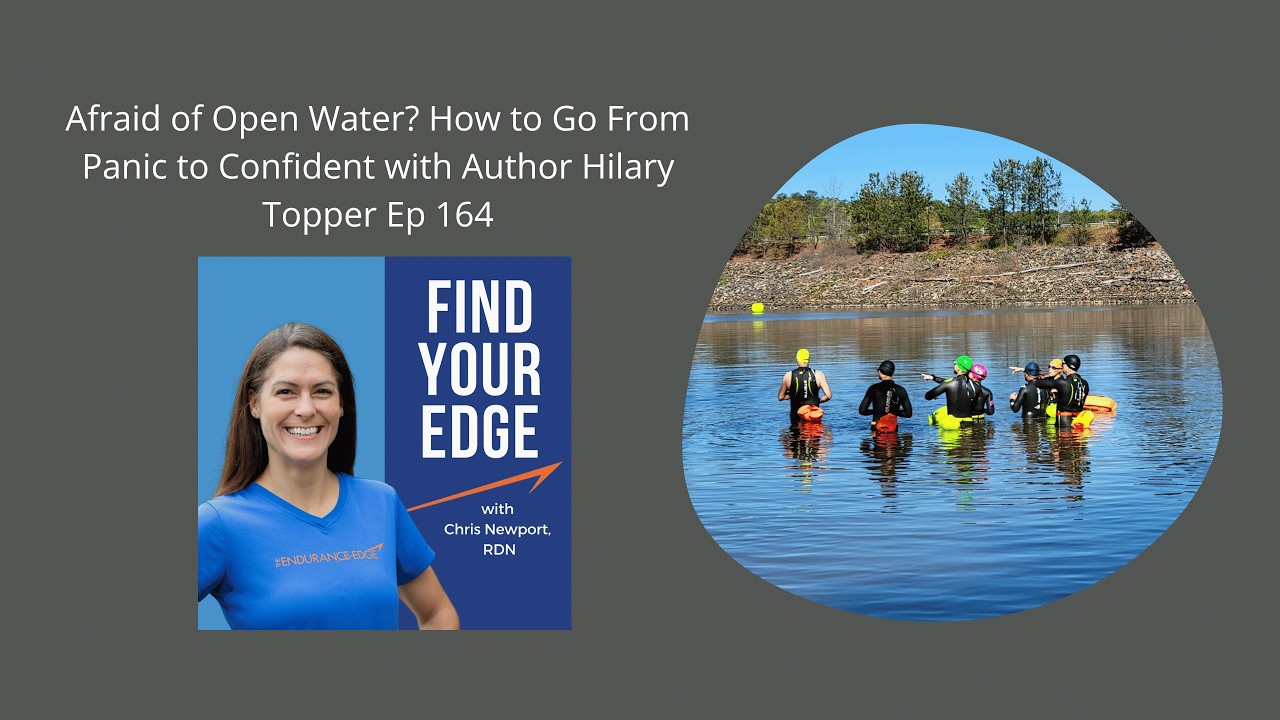
Afraid of Open Water Swimming? How to Go From Panic to Confident with Author Hilary Topper

Carb Loading for Female Endurance Athletes: What New Ironman Research Reveals Ep 163
What Are We Training For? Performance, Longevity & Finding Joy in the Process Ep 162

When You Can't Race the Same Way, Find Another Way: Kris Bonot's Triathlon Story Ep 160