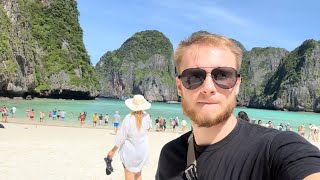
A first-person YouTube monologue by Timothy Schucker offering an "honest review" of the digital nomad lifestyle after roughly a year of travel. The speaker recounts a travel timeline (Medellin → Arizona → Thailand → hometown → Spain), praises the freedom to travel while earning, but emphasizes recurring downsides: lack of stability, intermittent poor Wi‑Fi/Airbnb issues, disrupted gym and routine, and reduced deep progress at work. He concludes that the nomad lifestyle is rewarding short-term but recommends building a business that can run without you and taking several fully-off vacations (e.g., four two-week trips per year) rather than blending work and travel long-term.
Chapters
All right, what's going on, ladies and gents? Wanted to give you guys a quick, honest review of the digital nomad lifestyle after doing it for the last year or so. I'm currently in Madrid, Spain, in the. It's called El Retaro Park. Judge my Spanish in the comments down below. But basically, I want to kind of just give you guys some things that are good about the digital nomad lifestyle, some things that are bad, and ultimately just like, my overall thoughts, right? So for context, I left my house, I guess you could say about. I think it was last June. I went to Medellin, Colombia, for two months. After that, I went back to Arizona, which is where I was staying for about two weeks. And then I went to Thailand for two and a half months. I came back to my hometown for about, like, six months because my mom was going through some medical things. And then for the last two months, I've been in Spain, so I've been, like, without a home, I guess you could say homeless for the last, like, a little over a year. And ultimately, the positives are this, right? So the. The nice thing about the digital nomad lifestyle is, you know, know, you see all these people on Instagram talking about it, and I remember being like, I think it was maybe 15 or 16, watching a YouTube video about some guy that was living in Chiang Mai, Thailand, right? And they were talking about, you know, how much. How cheap it is and this and that. And then I was able to actually go there and, like, see the exact same spots from the video that I'd watched, which was really cool. And so, like, everything that everyone says about it is true, right? It gives you the ability to live and travel and do these different cool things while still working and while still making money, which I think is awesome. And I've really thoroughly enjoyed that part.
But I think it has a. I think it has an expiration date, and I think it has a time limit, right? And also I think it depends on what your goals are and what type of person you are, right? So for me, personally, I'm the type of person who.
I enjoy traveling, but, like, while I'm traveling, I'm thinking about work, and while I'm working, I'm thinking about traveling, you know, which maybe that's some. Something that I need to address personally, but that's just the truth of it, right? And so for me, I get a lot of satisfaction and joy in my life from progressing in my career and progressing personally and going to the gym and getting more fit and stronger and, you know, Making more money in my business and growing my business. And, like, those are the things that really give me joy. And so the downside with the digital nomad lifestyle is you don't really have consistency and stability, which makes it harder for you to progress in those things. Right. One of the things that I do is I, like, track the productivity of every day. I track how many hours I work, and then I also time block everything on my schedule. And so when I look back at my calendar, the times where I have, like, the worst weeks in terms of work are where, like, I'm trying to figure out which Airbnb to go to, or the Airbnb that I go to has, like, terrible Wi Fi or, you know, I'm on a flight or whatever. And so, like, this constant movement, constant interruption, and, like, lack of stability really makes it difficult to make real progress in your work. Right. And I'm not saying that I haven't made progress because, you know, I've done, you know, multi six figures in revenue while traveling the world, which is really cool. But.
I've wanted to. I feel like it does hold you back to some extent. Right. It definitely does cap you in terms of what you can do and what you can accomplish. And then also, like, trying to find a consistent gym. When you get to a new place, you have to find new restaurants. Some places use Uber, some places don't. You got to download these different apps and figure all this stuff out, which, like, that's part of the excitement, which is amazing for like, six months. And then after that you're like, okay, damn, like, do I care more about this or do I care more about progressing in my life? Right. The other piece too is this is kind of like the way that I would describe the digital nomad lifestyle is it's like you're doing kind of on vacation and then you're kind of working, and so you end up just doing both, like, mediocre. Right. Like, when I was in Colombia, I was working like, 55, 60 hours a week, and I didn't really see Colombia, so it wasn't really like, like the. The extent of my tourism in Colombia. I did cool things on the weekend, but I spent most of my time inside of wework. Right? So, like, that was what I really saw. And I think that definitely has, like, it has its merit because you get to work from a different spot. It's a unique culture. It's different, but, like, constantly moving from place to place, really, I think will. I think it'll definitely take its toll over. Over an extended period of time, right? So what I've kind of come to the conclusion of for me personally is I want to make a ton of money and then just take like four two week vacations a year, right? So like eight weeks of vacation.
Going to a place and just really like experiencing that for two weeks, right? So for example, I'm in Spain right now. I was in the Canary Islands, Gran Canaria for the last two months. I'm in Madrid for like two days. And honestly in the two days that I've been in Madrid, not working at all because I'm just like taking the two days off. I've done more here than I did in the Canary Islands in two months, right. I'm like seeing all the sites, I'm doing all the things I'm trying all these foods. Whereas when you're working and you're on vacation, you're either not working.
Or you're not really on vacation. It's hard to do both and do that for an extended period of time. So what I think is actually a better way of doing things long term, I still like, if you're going to do the digital nomad thing, I still recommend doing it because it's a, it's a lot of fun and it's an experience I wouldn't trade for the world. But long term, what I think the best way is, is just make a shit ton of money and have a business that can run without you and then take four two week vacations a year. At the end of each quarter you go for two weeks, you shut off work and you just experience the culture of the place you're at. And it could be two weeks, it could be one week, whatever works for you. But I think ultimately that's a better lifestyle than like blending two things and kind of working kind of on vacation and just doing both. Mediocre. So, so that's my honest review of being a digital nomad for the last year.
I would definitely do it again, but I don't think I would do it long term. Which, yeah, that would be, that would be the biggest take that I would have, I think more vacations, like full vacation and then full work. But blending both is just, it's good for, it's good for a, for a season, but it's not good for, you know, for a long term thing. So you guys got value from this video. Let me know your thoughts in the comments down below. And.