How I'm Scaling My AI Marketing Agency To $1,000,000/mo
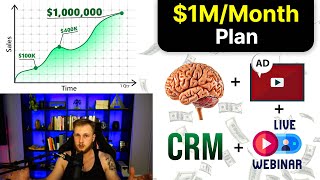
This single-speaker video (July 2025) lays out a step-by-step plan to scale an info/coaching marketing agency (serving insurance agencies) from ~$400k/month to $1,000,000/month. The speaker reviews recent growth (4x in four months after shifting from low-quality Final Expense clients to higher-value insurance clients), shares lessons (stop serving customers selling to low-income buyers; use multiple conversion mechanisms like webinars; spend more on ads and hire more closers; put people in right roles; add low-ticket/recurring products such as a white-labeled GoHighLevel CRM), and gives tactical targets (increase ad spend, grow CRM recurring revenue) to hit the $1M/month goal.
Questions this video answers
Approximately $1.3 million YTD (about $617k on one processor + $715k via Stripe).
Jan $114k; Feb $102k; Mar $187k; Apr $291k; May reported ~289–363 (finalized ~363); Jun $410k.
Recent margin ~34.4%; projected ad spend ~ $170,000 this month and $250,000 the following month.
About ~$20,000/month profit today; CRM priced at $97/month (seller expects potential to scale to ~2,000 customers → ~$200k/month).
A 2.5x increase from current ~$400k/month was mentioned as the exact multiplier to reach $1M/month; earlier growth cited as 4x over four months (from $100k to $400k).
Chapters
All right, what's going on, ladies and gents? So in this video, I'm going to be walking you through, step by step, our exact game plan of how we're going to hit $1 million a month by the end of the quarter. So what I'm going to do is kind of show you guys how we 4x over the last four months, we went from doing $100,000 a month to $400,000 a month. And then I'm going to show you how we're going to get from where we are right now to ultimately 2.5xing, I think is the exact number. Yeah, 2.5xing to get to a million dollars a month. So a little bit of context, I run like a info coaching slash marketing offer. I guess it's. You could kind of say it's like a business in a box for insurance agencies. Right. So that's pretty much what we do. And let me kind of show you where we're at. So this is our yearly revenue across two different payment processors. We also do a couple wires, so this doesn't account for everything. But as you can see right here, about $617,000 on fan basis. That all started in april and about 715k via stripe. Now that puts us at like 1.3 mil for the year so far. We're currently in July, but as you can see right here, you're going to see pretty much the ramp up. So 114k in January.
You can't tell. This is the first time I've ever used a Miraboard. My God, this is crazy. Everyone else makes it look so easy. All right, 114k in January, 102k in February, 187k in March. And then in April. 291. And then in May. 289. I think this actually after a couple extra payments and we had money held from stripe, ended up being like 363 was the exact number. And then in June, we just hit 410. So as you can see, we basically 4x star business in a matter of four months. So what I want to do for the first part of this video is walk you guys through the lessons that I learned and how I was basically able to do that, my business partner and I. So you can ultimately learn from those lessons, implement them yourself. Whether you're sub 400k a month or even more, these are all going to be valuable lessons. And then we're going to talk about the game plan of how we're going to get to a million dollars a month. So let's start off. I got three things. The first thing is one of the most painful lessons that I've had to learn in business, which is don't sell to broke people. Right. Specifically for me, it was don't sell to broke people who are selling to broke people. Right. This is by far one of the hardest. It seems super simple, but it took me way too long to learn. Right. So basically, to give context, what we essentially used to do is we would sell to insurance agents that were selling a product called Final Expense. And essentially what that product is, is it's for seniors who are typically on a fixed income, don't have any money saved. They basically just live off Social Security. And those people, when they pass away, they don't have enough money to pay for their burial or their funeral. And so they go and they buy these insurance policies to cover their funeral. Right? And as you can imagine, if somebody is living on 1,000, $2,000 a month from Social Security, the likelihood that they pay their bill is dramatically lowered. And so what would happen is you would write all these policies, but then if the person didn't pay their bill, it would claw back your commission. So we were doing marketing for people that were selling this product. In retrospect, sounds pretty fucking stupid, right? But that's what we were doing for quite some time. And looking back, I would say I wouldn't regret it because it made me progress in business in a way that I don't think I would have had to. Like, I had to get really good to serve that market. But anyway, not to go off on a tangent, that's essentially who we used to serve to. And so our payment collections on the back end was, you know, not the best, to say the least. We had people that would see success, but then they would get burned out of what they were doing because it was just a. It was a miserable business to be in overall. It, you know, you have to work 60, 70 hours a week. You're constantly just making phone calls and dials. People barely pick up. And then when you do sell something, it's like they end up canceling the policy and they lose the commission. And so they would end up just blaming us. Right. And not only that, not only the back end issues of once people got the system and started using it, it's like they would get the leads, and the leads were really good cost and they were quality for what it was, but they just. It's not an attractive product to sell. But also.
The dream outcome of selling this product. Like, anyone who had been in the industry for long enough and like understood the game, they wanted nothing to do with selling this product, right? And so basically we were like disqualifying all of the people in the market that we would actually want to work with and serve because they didn't want anything to do with this product. Right. And so the other thing too is, is what I call being down. You are essentially just downstream of your customers. So what does that mean? Well, basically I gave this example in a different video in the past, but essentially, let's say you are serving gym owners, right? Like you're doing the Alex Hormozi model. If you're serving gym owners, but the gym owners are selling to people that have no money, right? Let's just move this over here and we'll kind of do a little split off and I'll break this analogy down for you guys. So if you're selling to gym owners, but the gym owners are selling to people that are poor, right? Like it's, you know, they're selling the people that are coming in for free, free memberships, free trials of memberships. They don't really care about the training, right? Like they're selling to low income. Well, the gym owner is only going to make so much money because the customer they're serving is not a quality customer. Right? And so then if you are the marketing agency for those gym owners, you are downstream of the low income, low quality customers. That's what you need to realize. And that was our problem. We were downstream of who our clients were serving. So we were like only two steps away from people who like couldn't pay their electrical bill, which it's sad, but, you know, and they're not necessarily bad people, but it's not something you want to base a business off of by any means, by any stretch of the imagination, right? So this is essentially the first thing. Instead of serving these people, we were basically, over the course of a few months, slowly making the shift to serving people that sell insurance to higher quality, richer customers. And essentially when we cracked the code on how to serve those people and built a product around them, I mean, you saw in the numbers, we started doing that around April. So it went from 180 to 291 in a month, from immediately doing that and then to 363 and then to 410. So that is the first lesson. The second lesson is multiple conversion mechanisms, right? So this is something, when you're below a million dollars a year, everyone tells you don't do this. But the thing is, once you get past that level, having multiple conversion mechanism mechanisms is huge. So for me, I'm personally like, I feel like I'm good at presenting things, especially live. Like we'll do, you know, we'll go and speak at events with our company and then also doing these webinars. And it's something that I feel like I have a natural, like a natural inclination towards. And so that's essentially, you know, I started, I wrote out a webinar, I bought a course from Jason Fladlean, who's done $250 million in sales on a webinar. And I planned out a whole webinar, launched the webinar. We did over $30,000 from our first webinar of promoting it. We ran a little bit of ads to it and then also blasted our email list. And like, we knew immediately that we were going to start doing this on a weekly basis. So. So.
The other cool thing about whenever you go live, right.
The key is having multiple conversion mechanisms literally could mean anything. For us, it was webinars. So I'm just gonna talk about the benefits of webinars and why I like them and why I started doing them consistently. So the thing about webinars is what you need to realize is anybody that's inside of your funnel can go to the webinar to get pushed over the edge. So, for example, if you're just running like a basic call funnel, like ad to VSL to book a call, right? Terrible drawing, but you get the picture. Like, if that person doesn't buy, the sales rep can then tell them to go to the webinar. And then essentially, Jesus Christ, it says webinar.
They'll watch like a two and a half, three hour pitch of me as one of the founders talking about the product, just like breaking it down from every single angle using all these good analogies and stories and all this stuff, by the end of the webinar, they go back to the sales rep and then they buy, right? So, like, it's not just the conversion mechanism of the webinar itself of like, oh, people go to the webinar and the book will call afterwards. It's like when people are watching you live over and over and over, and you're doing it on mass week after week. Like, you're just basically pressure cooking a massive audience to ultimately become customers. So there would be people that would watch a whole webinar, not even book a call, and then they would see another ad and then Click on that ad and then go and then buy. Or someone would watch the webinar and. And then they would tell their friend or, you know, someone that they worked with how, like, amazing we were or something, and then all of a sudden, they would go and buy, right? So for me, lives and webinars was, like, a huge thing. So if you haven't done that before, I would. I mean, I would really recommend it. I personally enjoy doing them a lot. So that. That was a massive thing for us. Is. Is the webinars. The next thing I'm going to touch on, if I can figure out how to use Miro, is.
We'Re just going to move it out of the way. There we go. Spend more money, right? If you scale ads and you hire more people, why wouldn't you grow? Right? That's the question that you need to be asking. And for me, this has continuously been a limiting belief. Like, literally, I just went to a mastermind, a guy that I pay him, like, $60,000 a year to coach me. I'm like, cool. Our goal is we're gonna go from. We're at like, 400 now. We're gonna hit 500 next month, and then 650 the month after, and then 850 the next month. And he's like, why the hell don't you just go to a million a month immediately?
And then out comes a bunch of limiting beliefs that I have around. Oh, well, you know, if we scale too fast, fulfillment's gonna be a problem. If we do this, the cost might rise or whatever, right?
And for someone that's at a higher level, like, they hear those things and they just immediately just. They. They reject that belief because they've seen other people do it and not have issues. And then the other thing, too, is, like, I'll talk to people that are at lower levels than me. Like, I was talking to a guy who's doing, like, 60 grand a month, and he's worried about scaling because his fulfillment is gonna get out of whack. It's like, dude, the way that you fix fulfillment is you scale, you get more money, and then you hire people to have good fulfillment. Like, that's literally the whole game. And so for me, it's like, when you talk to someone that's at a lower level and you're giving them that advice, you just need to take that same advice at your level. And so that's essentially what I'm doing. But if you spend more money, you will make more as long as there's not an issue in your funnel, which if there is, then you just fix that and then you spend more money and hire more people. That's it, right? That's what scaling is. It's not like, it's not rocket science. It's not super complicated. It's like literally input.
Output until something breaks. And then here's the trick. Even when something breaks, you don't stop scaling unless it becomes unprofitable. You fix it while you're scaling. You fix it while you're scaling. You don't stop scaling. That's the key. Like, basically, you're just perpetually scaling and spending more, and that's how you increase your income and get to bigger numbers. So, yeah, spend more money. That's like, literally, if you're doing ads, just spend more on ads. If it's a positive roi, and hire more sales reps to take the calls.
Super simple. So, as you can imagine, how am I going to get to a million a month? We're at 400 now. Well, let's talk about it. The first thing I can do, if you didn't already guess, was more ad spend and more closers. Literally just more. Right. Right now our business is. Last month we were at like a 34.4percent margin, which is not like the best margin for an agency, but it's definitely not bad. It's not bad for a company that is scaling. So, like the extra margin we are dumping into more ad spend. So for me, I'd like to improve that margin, but it's also improving it as we're scaling. So we're going to spend more on ads. We're projecting to spend about 170 grand this month, and then the next month I want to shoot for 250. So spend more, more closers. That's it. Hire more sales reps. If you're a sales rep watching this and you want to work for a company that's growing fast and has a lot of opportunity. DM me on Instagram. I'll send you an application. But more ad spend more closers. Literally, that's it, right? We're going to spend double the amount on ads. If we do that, we should hypothetically double. And if we don't, then we just need to fix certain metrics in the funnel. That's it, ladies and gents. So that's the first one. Next up is putting the right people in the right seats. So this is something that I've had to get better at is like managing, leading and delegating people is like when you, when you Find somebody and you put them just in the right spot or even if they're not someone new, but it's just like you move somebody that's over here and then you put them here and it's just like it clicks. Such a good feeling. I'll give you an example. A guy who I've actually been friends with for, for like four or five years.
He came on as a sales rep initially. But this guy has like extensive knowledge and experience in marketing, working with different agencies, running his own e commerce businesses. And I was like, dude, why are you closing? You should just help me out on marketing. And the thing is, I under. You have to understand what your own weaknesses are and what people, what other people's strengths are on your team. So for example, for me, I'm very like, big picture. Like, I like to create the content, I like to film and write the ads. I like to make the big decisions. But for me, like when it gets super in the weeds, I kind of struggle to do that. Right. And I'm not a very organized person in certain ways. I don't want to speak that over myself, but I'm not, I'm not known to like create a system and then like stick to that system. I'm like, okay, I want to create this, put it in place, it's going to run and I'm going to go build some other shit. And that just doesn't work when you're trying to operate right. You can't have that. So I have to be more on the visionary side. So I understand that that is a weakness I have. So I go and I find somebody who can focus more on that. Like.
When you say, like when you say getting in the weeds, it almost sounds derogative and I don't mean it in that way at all. But you can get more in the weeds on like the nitty gritty in the day to day of the numbers on the marketing side and like make sure the reporting's up to date and then I can more so look at it and just make decisions which ultimately the best thing that I can do. So.
More. There's 100% more opportunities to like shift people around in my company and put them in the right spot and really empower them to do the things that they're good at. Right? So that's been a big thing is like whenever.
There'S a book called Traction, Eos Traction, I recommend that everyone reads it. I probably need to reread it, honestly, but it's one of those things where you should do continuous reviews of each of you, the people on your team, like is this for one, the right person to be at my company? And two, are they in the right seat in the company? And if no, you either need to move them or replace them. So putting more of the right people in the right seats would be one of the things that we're going to continue to do. The next thing is.
Low ticket to liquidate spend and juice recurring. So what do I mean by this? Well.
This will help with us boosting our profit margin. So one thing that we do is we have a go high level white labeled CRM, right? So we essentially resell go high level and I was looking at our numbers and our go high level rebuild white label profit thing or whatever is a pretty sizable portion of our, of our the amount of money we make, right? And it just kind of builds and builds and builds in the background and we don't even, we haven't even really pushed it. We've just sold this to our existing customers. So if you have a marketing agency and you're not reselling go high levels of white label, like what are you doing? We legitimately make an extra almost $20,000 a month in profit just from the CRM. So we looked at that and we said okay, well what if we just also sold this on the front end and then built up this recurring base because we charge people $97 a month which is the same price as GoHighLevel. The only difference is they get all of the automations already built with us. So it's a no brainer for our clients and it allows us to work on their account. And then even if they don't have us continuing to coach them and run their ads and stuff, they're still going to keep this because it's where all of their leads are. Right? And so what we're going to start doing is.
We'Re going to relaunch because we put a pause on the webinar for two weeks because we're starting to see diminishing returns. But what we're going to do is we're going to have add to webinar.
Add to webinar and then on the thank you page there's going to be an upsell for free trial of CRM.
Right? Like a seven day or 14 day trial. So they'll get the free trial and then this will start to juice our recurring. Right? So we'll get 97amonth times however many people come on. And so this essentially is going to help to liquidate the cost of ad spend. So then any sales we make on the webinar is just pure profit.
And on the back end we're building this recurring base. So for me, I don't see any reason why we couldn't get like 2000 people on the CRM, which is just an extra 200k a month.
In just recurring revenue stacked on top of what we're already going to do. And if we have that, we can just invest that back into ads, which then scales the business even more. So that's kind of the play that I see is like add to the web to the webinar and then liquidating it with the CRM. But overall, the whole concept that we're looking at is like, how can we get more low ticket purchases, right? Because like right now the cheapest thing that people can buy from us besides the CRM, which you have to look for to find, is like $8,000. So if someone sees us on an ad and they've never heard of us before, the first thing they're gonna buy is $8,000. It's like, that is a, it's a big leap to make, as you can imagine. And so it makes, it makes it so that the sales cycle is considerably longer than it could be or probably should be if we're being real, right? And so if I can have things that people can buy on the front end that kill multiple birds with one stone, it builds the trust with us as a company, then it also helps to liquidate the ad spend and that's a win win, right? So that's essentially kind of what we're looking at there. If you guys have questions about how that works, just drop a comment down below. Last thing, ladies and gents, we're going to touch on is back end cash monetization, right? So right now, our business, and hopefully you guys are like, as you're watching this, you're drawing parallels to your business. It's like 10 o' clock here. To be honest, I'm a little bit, a little bit sleepy. So I'm trying to articulate this the best way that I can and then also put it in a way where it's, it's relatable to you guys and I'm not just like yapping about my business. So.
Back in cash monetization.
Here'S the way that I look at business, right? It's all CAC to ltv, okay?
One of these numbers can go infinitely in the way that you want it. And another one of these numbers can only Go up to a certain point in the way that you want it. So what I mean by that is the lowest you could possibly get cac is zero, right? The lowest you could get to acquire a customer is zero.
Meaning you're not paying anything to acquire a customer. But ltv, this is literally infinite. Like, you could, realistically, you could make your LTV a million dollars a customer. I don't know how you would do it, but you could do it. There's nothing, there's nothing within physics that would stop you from making the LTV a million dollars a customer. So in terms of how do you make more money in your business and get to a million a month and do that with more profit, should you focus here or should you focus here? Well, I think you should focus on both, but I think you should put more focus here because it's a bigger lever to pull, right? And so what we're going to do is put together different things within our program so that people are roiing, like getting their investment back faster so that they can renew and continue to pay us.
The thing about the insurance business, particularly the side of it that we're in, is the commissions can take, you know, they can take 30 days plus for them to get paid on something they sell. So if they sell something today, July 14, it could be.
Mid August or even September before they get paid on it. And so it's like, how can we get them cash faster than so they can keep buying more things, take bigger risks with us and pay more money. And then also the cool thing about our industry, with insurance in particular, and this is something I would really look for in an industry, is like, how can you also monetize from like the upside, right? So the simple term for this is a rev share. So we're going to start looking at ways in which we can get a rev share. Because now, now that we're scaling, right, and our product is like so much better than it was before, some of my clients are making more money than me and like, I'm happy for them. I want a little piece of that pie. So rev shares as well to come in with the back end cash monetization. So, ladies and gents, that's my plan to get to a million dollars a month in the next, let's say three months. And hopefully you guys found this valuable. I'm going to start doing daily videos. So hit the subscribe button down below and let me know what you want to see next. See you tomorrow.










