How To Generate High Intent IUL Appointments In 2026
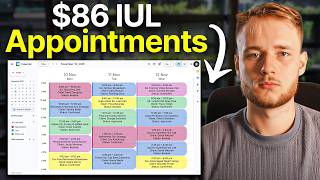
YouTube presentation (by Timothy Schucker) outlining a Facebook-based "personal brand funnel" to generate high-intent IUL appointments. The speaker shares specific campaign metrics ($4,000 ad spend → $40,000 in target premium; $16 cost per lead; $86 cost per booked call) and walks through each funnel stage: video ad creative (hook → insight → CTA), a value-first video training to build trust, a qualifying survey (filters: >$250/month, under 56, interested in IUL), calendar booking + thank-you page to improve show rates, and final sales via Zoom. The approach emphasizes educating prospects to overcome a "trust recession," leveraging ad copy to attract pre-interested audiences, and using the funnel data to train Facebook's AI.
Chapters
In this video, I'm going to be breaking down one of our clients who is running our IUL funnel and is getting $16 IUL leads, $86 cost per book deployments, and spent $4,000 on leads to generate $40,000 in target premium. So let me break this down. I'm going to show you guys what he's doing, what he's running, and how we're getting results like this. Alrighty. So again, to recap, these are the metrics. $4,000 spent, 40k in target premiums, $16 cost per lead and $86 cost per book deployment. And here you can see right here, these are screenshots from the Facebook ad campaign. Let me move my face here you can see $16 lead, $86 cost per booked call. So I'd speak with a lot of agents who are paying 80, 90, $100 per lead from lead vendors that are shared with other people. This individual is paying $86 cost per booked appointment. So if you're not Getting appointments for $86, listen up on a breakdown how we're doing this. Alrighty? So essentially the concept is we're using something that we call the personal brand funnel. Alright? And this is a system that we use and set up for clients that do anything from annuities, Iuls, infinite banking people that are financial advisors do retirement planning. This concept, this funnel can basically be used for any type of financial product that is high ticket. So if you sell something for a big commission and it's related to financial products, you can use this exact system. And essentially the way it works is it starts off by having a video ad. So what we found is in today's day and age, we are in what a lot of people are calling a trust recession. And essentially what that means is that people are less inclined to trust strangers on the Internet than ever before. Right? Especially when we're talking about with financial products, there's a lot of scams, there's things that are going on in the news. If you don't have trust built with a client, it is too 10 times harder to close a deal, especially if you're selling a financial product. So what we do first is we create a video ad and we put you in the video ad as the individual who is basically the expert or the one who is selling the product. So let's talk about how you actually do this. So there's a new update that just came out with Facebook. So we run all these ads on Facebook and it's called Andromeda. I'll make a whole separate video breaking down the new Facebook algorithm update and how that works and how it relates to lead generation. But essentially what you say in the ad determines who you get. So what used to happen is people would do targeting on Facebook so you could target like age, income, how much, what someone's credit score was, all these different things. You could target it directly on Facebook. And so the way that people would generate high quality leads and attract the right people is basically by going into the ads manager on Facebook, which is basically just like a dashboard where you can select everything and they would pick who they specifically wanted to talk to. Nowadays it's all based off of what you say in the ad. So when we create the ad, we want to have an attention grabbing hook that speaks to the right people, the right people that are ultimately going to be qualified for what we sell. So for example, if you're selling annuities, you would want to say something that is specifically going to reach people that have assets and are in retirement. So for example, if you have a million dollars saved, how long does that last you for retirement? Could be a hook or a concept of an ad. For example, for Infinite Banking, I could go and I could speak to someone who's saying, let's say I want to talk to a business owner who wants to save money on taxes. I could say, hey, if you're a business owner who's paying over X amount in taxes, listen up. Here's a tax advantage way that top business owners are using to also use more of their capital later on, right? With iul, we might even speak to people that are already interested in looking into an iul, which is what we did in this example. So in the ad we actually said what is the best IUL in 2025, right? So based off of what I'm saying in the ad, I'm going to attract people that are already looking into Iuls have already considered it and have already familiar with the concept. So it's going to be much easier for me to actually sell that product when I get them on the phone. Right? So you hook the right people and I'll give you some examples, right? What's the best IUL on the market? If you make too much money to qualify for a Roth IRA but still want tax free growth. Listen up, if you're looking for a way to retire tax free without relying on the stock market, watch this. And so when we give specific hooks like this, we're able to attract high intent prospects, right? If I say IUL in the ad, Facebook is going to know to show it to people that have already done research or are already familiar with the concept of an iul. Right? So here's essentially the structure of how we build out the video app. First, we have the hook. This is usually gonna be the first 0 to 3, 0 to 5 seconds. You're gonna call out your audience and their pain point. Right. Next, you're gonna share some interesting insight. So you wanna teach something simple that basically changes their perspective. So I might in the ad say, hey, what's the best IUL in 2025? And then I can go into the insight, and I could say, hey, so there's tons of people talking about Iuls on Facebook nowadays, but how do you actually know which one's right for you and you and which one's gonna be best for your specific situation? And then I'll go through and I'll lay out maybe three things to look out for. Here's three things to look out for. Number one, make sure you're working with an agent that can shop multiple different companies and multiple different carriers to find the right one for you. Number two, make sure that agent is gonna set it up with minimum death benefit, maximum cash value, so that your cash accumulates and grows over time. And number three, I could say make sure to pay attention to cap rates, and I could say make sure you pay attention to cap rates and floors within the iul. And then I could briefly explain what those are. So, hey, look, if I put together a free video that basically breaks down how these things work. If you want to see that more in depth, just click, Learn more down below. The video is completely free. You can check it out and that should give you some good insight and information to decide what's going to be the best IUL for you. So obviously that's just me freestyling, but that's kind of the structure of the ad. So I have the hook, brief insight that gives them value in my ads. I want to focus on educating, not just selling. And then I'm have a brief call to action at the end, right? Then you heard I talked about a video training. Kind of teasing that in the call to action, the video training is where the real magic happens. This is where you're able to transition from just being the guy on the ad to now you're this expert who they want to speak with and want to book a call with. Right? So here's essentially kind of how we lay it out and how we did it for this client. All right? So the purpose of the video training is we want to educate them and essentially build our authority. Right, so this is where again, I was talking about the trust recession before. This is a key part of establishing yourself as that expert. So what we want to do is we want to give them what I call an aha moment. So as you can imagine, just picture this, you're not in financial services, right? You're just a normal person. You hear about all these things, you know, Iuls, cap rates, tax free retirement, tax advantaged retirement. Oh, an IUL is bad and IUL is a scam. You should buy term. You should buy. No one really knows what's going on. They just see all this noise. So we want to be the person that cuts through the noise and clarifies and simplifies these concepts. One of the reasons that Alex Hormozi is so popular is, is because he simplifies the concept of business. So what we want to do is simplify the concepts that we help people with, right? So we basically, we use like pictures and graphs that aren't crazy complicated, they're simple. And we basically are taking these complicated concepts and distilling them down. Okay, so I'll talk more in just a second on what this looks like. So what do you basically teach? So you teach how your strategy works. And this is not a pitch of what you sell. So you're gonna basically reveal the mechanism, right? So in this case, this individual helps people with Iuls for tax free retirement. Whatever your opinion on that is, doesn't really matter in this concept. Cause we're talking about a marketing concept. You're revealing the mechanism and explaining how it works. So again, we talk about like, hey, the problem is rising taxes. You may have a 401k, you may have this, you may have that, the vehicle. We talk about how the IUL actually solves that problem and then the proof. So we weave in testimonials, results, we talk about the tax code. We're always kind of going through like, hey, here's the problem, here's how we solve it, and then here's proof to back that up. Right, so why does it work? Well, basically, again, we talked about the trust recession. They hear all of this noise, all these different things. We, they don't really know who to listen to and who to trust. So if you think about the way that you make decisions, the way that you find out who to trust, you're looking for who's going to give you value and teach you things and explain them without just constantly like asking you for Money, right? So when you run an ad and you send them to a training page, as opposed to just, hey, buy this, buy this, buy this, give me your info. We're giving value first, we're leading with value in education. And so then by the end of the video, they're thinking themselves, like, okay, perfect. Like this person took me from, I didn't know how this worked or I had some questions about it. They answered my questions, but I still want more, I want more info. And so the right people that are in that position, they're thinking that after watching your video, they'll go, okay, cool, I need to book a call, right? And so from there we then send them to a qualifying survey. So the goal is not just to get a ton of leads, it's to get the right leads and the right people. So essentially the goal of the survey is we screen out the low intent leads and we screen out the people that aren't qualified. And then what this also allows us to do is optimize our ads around the right people who are qualified. So for this individual, they specifically want people that can put more than $250 a month, are under the age of 56, and are interested in the IUL. So in the survey, we're going to ask questions that basically filter that out. So if someone says they can put less than $250 a month, we do not count that as a qualified lead. And so we will not send that data back to Facebook. So as more and more people come through, we're training Facebook's AI to optimize and attract the right customers, right? So, so from there, if they're qualified, we allow them to go to the next step, which is to book an appointment on your calendar, right? And then from there, after they book the appointment, we then send them to a thank you page. So what you're gonna do on the thank you page, the whole goal of this is essentially to increase the show up rate. So what we do is we'll put a short video basically confirming the appointment, right? We talk about what they need to what to expect on the call and what to bring from for the call, right? So imagine this, right? They watch the ad, they go through, they watch a training video where you're breaking down all these concepts, you're explaining it simply. They go through, they fill out the survey, then they book on your calendar. Now we need to really tie the appointment down. So if you imagine you're doing this manually, the thank you page is basically the tie down for the appointment. So you need to remind them of, hey, here's the value that you're gonna get, here's what you're gonna learn. Hey, you need to bring this statement, that statement, what, whatever. And it basically reinforces the reason that they booked, right, and just essentially bridges that, that gap. And the reason that this is so important is because it keeps the prospects warm, cuts down on no show, so it improves your share rate and it is also going to continue to build your credibility before the call. So Google did a survey, they call it the 7114 rule. So essentially people need to consume seven hours of content, have seven hours of FaceTime with you, have 11 touch points across four different platforms. So we've optimized and built the entire system around that. So seven hours of content, part of that's obviously meeting with you face to face, part of it is watching your videos, watching your ads, and then across four different platforms, they see you on Meta, you email them, you text them, you send them videos, they're going to your funnel and then also they're seeing you face to face. So it's technically 5 total different touch points that you're optimizing for to boost your conversions. So then you basically drive them to a call, they show up on Zoom, and you go through your normal sales process in terms of whatever the product is that you're selling. And that, ladies and gentlemen, is the entire structure and process that we used to get this client. $16 leads, $86 book calls, and a 10x ROI from what they spent to what they wrote in Target Premium, not annual premium. And if you want to see more in depth of how this system works, I put together a free mini course that I'm going to link down below in the description. So if you want to check that out, just click the link down below, you can access it for completely free. And if you want to work with us one to one and have us build out the system for you, then there's going to be a link down below as well to apply for one of our paid programs. So hopefully you got value from this and I will see you in the next one.










